
Dino Science Dash
172.7K playsPick your dinosaur and race to the finish! Every right science answer makes your dino dash ahead, three in a row lets out a big ROAR, and a wrong answer makes it trip. Learn about animals, your body, weather, plants, space, matter, Earth and energy to beat the pack.
Scientists start with a guess and then test it. So here is a guess for you to test: a dinosaur that knows its science runs faster. Does knowing that a spider has eight legs help a Triceratops sprint? Does knowing why the Moon changes shape push a Raptor past a T-Rex? In Dino Science Dash for kids, the answer is a big, dusty yes.
Dino Science Dash is a racing game on KidWorld. Four cartoon dinosaurs run down a track between two smoking volcanoes, and you choose which one is yours. Every right science answer sends your dino zooming ahead. Kids have run this race more than 170,000 times, and more than 2,200 players have rated it 4.9 out of 5. Let’s test that guess together, one race at a time.
🦕 One Track, Four Dinos, Lots of Science
The track is 1,000 metres long. Wooden signs like 100m and 200m pop up along the fence, so you can see how far you have run. Four dinos race in four lanes, and yours is always in the front lane with a dark YOU tag over its head.
You never steer. Your dino jogs along by itself the whole time. Under the track sits a question card with one science question and three or four answer buttons. A right answer gives your dino a burst of speed. A wrong answer makes it trip. The first dino past the checkered FINISH flag wins.
The questions come from ten science topics: 🐾 Animals, 👀 My Body, 🌦️ Weather, 🌱 Plants, 🪐 Space, 🧊 Matter, 🔬 Living Things, 🌋 Earth and ⚡ Energy, plus 🎲 Mixed, which shuffles your level’s topics together. Your age level decides which ones you get. A toddler might be asked which animal says “moo”. A tween might be asked which part of a cell holds its DNA.
The other three dinos never answer anything. They jog and put on a burst of speed now and then, so the race looks fair and close. It is really you and your science brain against the pack.
🦴 Meet the Real Dinosaurs Behind the Racers
Each racer is a cartoon version of a real dinosaur. Here is a little true science about each one, so you know who you are cheering for.
Rexy the T-Rex (green). Its full name, Tyrannosaurus rex, means “tyrant lizard king”. It was a huge meat eater with tiny arms, and some of its teeth were as long as a banana.
Trixie the Triceratops (orange). Triceratops means “three-horned face”. It ate plants with a beak like a parrot’s and had a big bony frill around its neck.
Spike the Stegosaurus (purple, with pink plates). Stegosaurus means “roof lizard”, because scientists once thought its plates lay flat like roof tiles. It swung its spiky tail to keep hungry hunters away.
Zippy the Raptor (blue). The most famous raptor, Velociraptor, means “swift thief”. In the game Zippy is as tall as the others, but a real Velociraptor was only about the size of a turkey, and it had feathers!
Here is a surprise: these four could never have raced in real life. Stegosaurus lived about 150 million years ago. T-Rex lived about 66 million years ago. That means T-Rex lived closer in time to you than to Stegosaurus! Velociraptor lived in Asia, far from T-Rex and Triceratops, who lived in North America. Only on KidWorld do all four meet on one track.
🧭 Your First Dino Science Dash Race, Step by Step
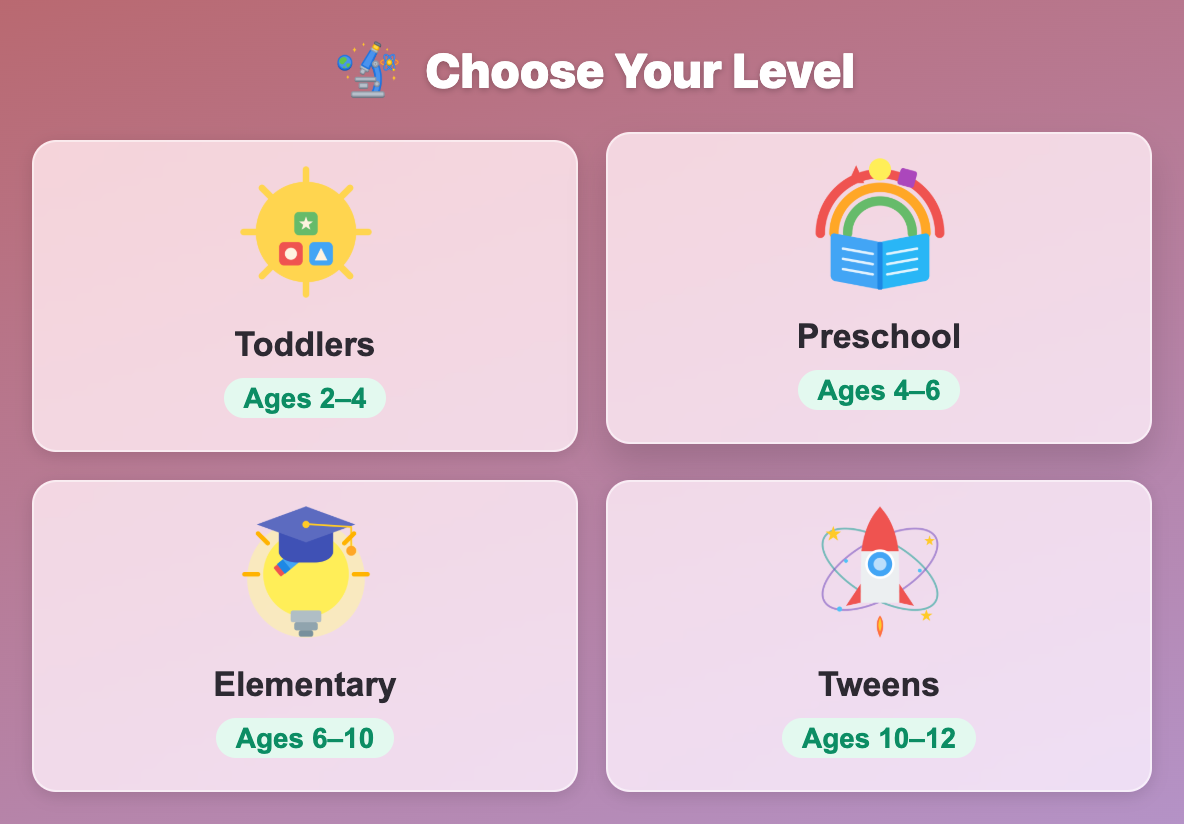
Choose your level. A new player starts on the Elementary level. Tap Change Level to see four cards: Toddlers (ages 2–4), Preschool (ages 4–6), Elementary (ages 6–10) and Tweens (ages 10–12). The game remembers the one you tap.
Pick your dino. Under 1. Pick your dino you will see Rexy, Trixie, Spike and Zippy. The one you tap gets a colored border and starts running on the spot. All four run at exactly the same speed, so just choose your favorite.
Pick your science. Under 2. Pick your science, tap 🎲 Mixed for a bit of everything, or tap one topic chip to practice just that. The game remembers your dino and topic for your next visit.
Tap Start Race! A big 3, 2, 1 counts down over the track. Then comes GO! and your first question.
Answer. Tap an answer button. Each one has a small number in its corner, so on a computer you can press 1, 2, 3 or 4 instead. Some questions also show a big picture clue above them, like 🦇 or 🌋.
Listen. The round 🔊 button next to the topic name reads the question out loud. For toddlers and preschoolers, it reads the answers too (“Cow, Dog, or Duck?”), and new questions are read by themselves when the site sound is on.
Check the top of the track. A long bar shows each dino as a colored dot moving toward the 🏁 flag. The badge on the left shows your place. It turns gold when you are 1st.
Take a break. Tap Pause, or press P or Esc. The race freezes and the question hides, so there is no peeking. Tap Go or the track to keep running. The game also pauses by itself if you switch to another browser tab. The Setup button takes you back to pick a new dino or topic.
Cross the line. Confetti flies, and then your finish card appears with your place, stars, score and a list of questions to practice. You can read more about it below.
Go again. Tap Race Again, Change Dino or Topic, or Change Level.
Around the game, the play page has three handy buttons: one turns the race music on or off, one makes the game fill your whole screen, and one reloads it for a fresh start.
⏱️ What Happens the Moment You Tap
Every tap changes your dino’s speed. Knowing exactly how will help you plan.
No answer yet: your dino keeps jogging. A dino that never got a single answer would still finish, but only after a bit more than two and a half minutes. That is always last place.
A right answer: a word like Zoom!, Dash!, Yes! or Go go! pops up, white speed lines stream behind your dino, and it gets a burst of speed. The burst is strongest at first and fades over about two seconds. The next question shows up almost at once.
Three right in a row: your dino opens its jaws for an orange ROAR! That burst is more than one and a half times as big as a normal one. A little 🔥 badge on the card counts your streak once you have two in a row.
A wrong answer: Oops! Your dino trips, spins dizzy stars around its head, and nearly stops for about a second. It also loses most of the speed it had saved up, and your streak goes back to zero. The card shows the right answer, and the game waits almost two seconds so you have time to read it.
When a rival runs off the edge of the screen, a colored name tag pops up on that side, like ◀ Rexy 36m. It tells you who it is and how many metres ahead or behind they are.
🏆 How to Win Dino Science Dash for Kids
Speed matters, but in this race the smartest dino wins, not the quickest finger. Here are the tricks good racers use, from easy to clever.
1. A careful right answer beats a fast wrong one
A wrong tap costs you twice. Your dino nearly stops while it trips, and it throws away most of the burst it was still riding. A right answer that takes a few extra seconds still pushes you forward. So read the whole question first, then every answer, and only then tap.
2. Turn every “Oops!” into a lesson
After a wrong answer, the card says Oops! The answer is: and shows it. Use those two seconds! Say the right answer in your head or out loud. Each topic has its own set of questions, and you will meet them again in later races. Next time, you will already know it.
3. Cross out the answers that can’t be true
Scientists rule things out. You can too. Every wrong answer in this game is wrong no matter how you read the question, so there are no “sort of right” traps. If you are asked what covers a bird’s body, Scales, Fur and Shells can all go, which leaves Feathers. Even if you only rule out one or two answers, your guess gets much better.
4. Let the picture point the way
Many questions show a big emoji above them. The picture never gives the answer away, but it tells you what to think about. A 🌋 means volcanoes and hot rock. A 🦘 means kangaroos, even if the question is about babies. Look at the picture first, and your brain is already halfway there.
5. Hunt for the little words that change everything
Words like only, both, not and most are tiny but mighty. “An animal that eats only plants” is a herbivore. “An animal that eats both plants and meat” is an omnivore. “A mushroom is not a plant” tells you to look for a different kind of living thing (a fungus). Slow down on these words.
6. Protect the third answer
When the 🔥 badge shows 2, your next right answer is a ROAR. That is the most valuable tap in the whole race, so give it a little extra care. After a ROAR the count keeps going, so 6 and 9 in a row are ROARs too. In our test race, a streak of 9 turned into three ROARs!
7. Keep a steady beat
Each burst fades over about two seconds. If you answer again before it is gone, the new burst lands on top of what is left. So a racer who answers right every few seconds builds up much more speed than one who answers in big, slow jumps. Find a calm rhythm: read, think, tap, read, think, tap.
8. Behind? Keep calm and keep answering
The pack stays close on purpose. A rival far ahead eases off a little, and a rival far behind pushes a little harder. So even after a couple of trips, a few right answers in a row can carry you back into the lead. Watch the name tags shrink as you catch up.
9. Practice one topic, then mix it up
If space questions keep tripping you, pick the 🪐 Space chip for a few races. Once those feel easy, switch back to 🎲 Mixed. And if you enjoy these questions, Science Horse Derby asks the same kind of science, but you ride a horse and answer a question before every fence.
🔬 Six Track Questions, Thought Through Like a Scientist
Here are real questions from the game, one level at a time, with the kind of thinking that gets them right.
Toddlers: “Which animal has a shell on its back?”
The buttons show pictures, like 🐢 Turtle, 🐶 Dog and 🐦 Bird. A grown-up can help by pointing at each one: “Does a dog have a shell? No, it has fur. Does a bird? No, it has feathers.” Only the turtle carries a hard home on its back. Tap 🐢 and off goes your dino!
Preschool: “How many legs does a spider have?”
A 🕷️ picture sits above the question, and the answers are numbers like 8, 6 and 4. Here is the trap: 6 is the number for insects, like ants and bees. Spiders are not insects. Think of a spider walking: four legs on each side. Four plus four is 8.
Elementary: “A bat is a kind of…”
You see a 🦇 and the answers Mammal, Bird, Insect and Reptile. A bat flies, so Bird looks tempting. But think like a scientist and check the clues. Birds have feathers and lay eggs. Bats have fur, and bat moms feed their babies milk. Fur plus milk means Mammal. Flying is not what makes something a bird.
Elementary: “Water drops forming on a cold glass is called…”
The 🥤 picture is a cold drink, and the answers are Condensation, Evaporation, Melting and Freezing. Nothing is melting or freezing here. Evaporation is water going into the air, like a puddle drying up. These drops are coming out of the air: invisible water vapor touches the cold glass and turns back into liquid. That is Condensation, the same thing that makes clouds. You can watch it happen high above a mountain and a lake in Water Cycle Explorer.
Tweens: “Which of these travels the fastest?”
The choices are Light, Sound, A jet plane and A cheetah. A cheetah is the fastest land animal, but a jet is quicker. Some jets can fly faster than sound. Then think about a thunderstorm: you see the lightning flash first and hear the thunder later. That means light beat sound. The answer is Light, the fastest thing there is.
Tweens: “Rock that forms when lava cools is…”
A 🌋 sits on top, and the answers are Igneous, Sedimentary, Metamorphic and Fossil. A fossil is not a kind of rock, so cross it out. Sedimentary rock is made of squashed layers of sand and mud. Metamorphic rock is rock changed by heat and squeezing deep underground. Rock made from cooled lava is Igneous. Memory trick: “igneous” comes from ignis, an old Latin word for fire.
🎒 A Science Race That Grows Up With You
The race looks the same at every level, but the science grows with you.
🐣 Dino Science Dash for toddlers (ages 2–4)
Toddlers get 🐾 Animals, 👀 My Body and 🌦️ Weather, with only three answers to choose from. Every answer is a big picture, like 🐄 Cow or ☂️ Umbrella, so a child who can’t read yet can still pick. With the sound on, each question and its answers are read out loud. Sitting together and cheering “Go, Trixie, go!” makes it extra fun.
🌼 Dino Science Dash for preschoolers (ages 4–6)
Preschoolers keep those three topics and add 🌱 Plants. The questions take a step up: baby animal names (a baby frog is a tadpole), the five senses, the seasons, and what a plant needs to grow. There are still three answers, most with pictures, and the voice still reads everything aloud.
🔭 Dino Science Dash for elementary kids (ages 6–10)
Now the topics are 🐾 Animals, 🌱 Plants, 🪐 Space and 🧊 Matter, with four word answers per question. Kids sort animals into mammals, reptiles and amphibians, learn words like photosynthesis and pollination, name the planets, and explain melting, freezing and evaporating. Questions are no longer read automatically, but the 🔊 button is always there.
🚀 Dino Science Dash for tweens (ages 10–12)
Tweens race through 🔬 Living Things, 🪐 Space, 🌋 Earth and ⚡ Energy. Expect cells and mitochondria, eclipses and light-years, rock types and tectonic plates, and circuits, friction and kinetic energy. The fastest rival is also a tiny bit quicker at the two older levels, so careful answers matter even more.
🎖️ What Your Finish Card Tells You
When your dino crosses the line, the finish card shows your dino with a medal and a title, from “You won the race!” to “You made it to the finish!”. Your score out of 100 is made of two parts:
Your place: 40 points for 1st, 30 for 2nd, 20 for 3rd and 10 for 4th.
Your right answers: 5 points each, up to 60. So 12 right answers fill this part all the way.
For example, finishing 2nd with 8 right answers gives 30 + 40 = 70. Winning with 12 or more right answers gives a perfect 100. Your score also turns into stars: 90 or more earns all ⭐⭐⭐⭐⭐, 70 earns four, 50 earns three, and 25 earns two.
The card also lists how many you got right and missed, your best streak, and your time. Below that, Practice these again shows up to six questions you missed, each with its right answer. A podium lists all four dinos with their finish times. Read the practice list before you tap Race Again. It is the fastest way to win more next time.
🌍 Little Scientists, Big Wins
Remember the guess at the start? That is how real science works: you guess, you test, and you check what happened. Dino Science Dash does that every few seconds. You choose an answer, the race tests it, and the card shows you if you were right. A wrong guess isn’t a failure. It is just new information, and the practice list makes sure you use it.
The race also teaches kids to read carefully. Rushing makes a dino trip, so children learn to slow down, look at every choice, and rule out the silly ones. Those are the same steps a scientist uses in a lab. And because every question comes inside a funny dinosaur race, kids happily answer dozens of science questions in one sitting. Many of them ask to race again to beat their own best streak.
Along the way, they collect real facts: how a caterpillar becomes a butterfly, why we have day and night, what plants breathe out, and which planet is the hottest. These are the same ideas they will meet at school.
For parents and teachers
Dino Science Dash is safe, cheerful and free of scary content. The dinosaurs are friendly cartoons, and a wrong answer only makes a dino trip and see stars. Children practice reading, listening, careful choosing, and core science vocabulary across life science, Earth and space science, and physical science. Toddler and preschool questions are picture-based and read aloud, so the youngest players can join in with a little help. Each race takes only a minute or two, which makes it a good fit for a short learning break.
Your dino is stretching at the starting line, and the volcanoes are puffing away. Pick Rexy, Trixie, Spike or Zippy, choose your science, and prove that knowing things makes you fast. Ready for a different kind of question? Dino Math Dash has the same four dinos racing on math answers. But first, let’s go: Dino Science Dash for kids is waiting, and the finish flag is calling your name! 🦖🏁
🖼️ See the Game in Action
The Choose Your Level screen in Dino Science Dash, with Toddlers, Preschool, Elementary and Tweens cards
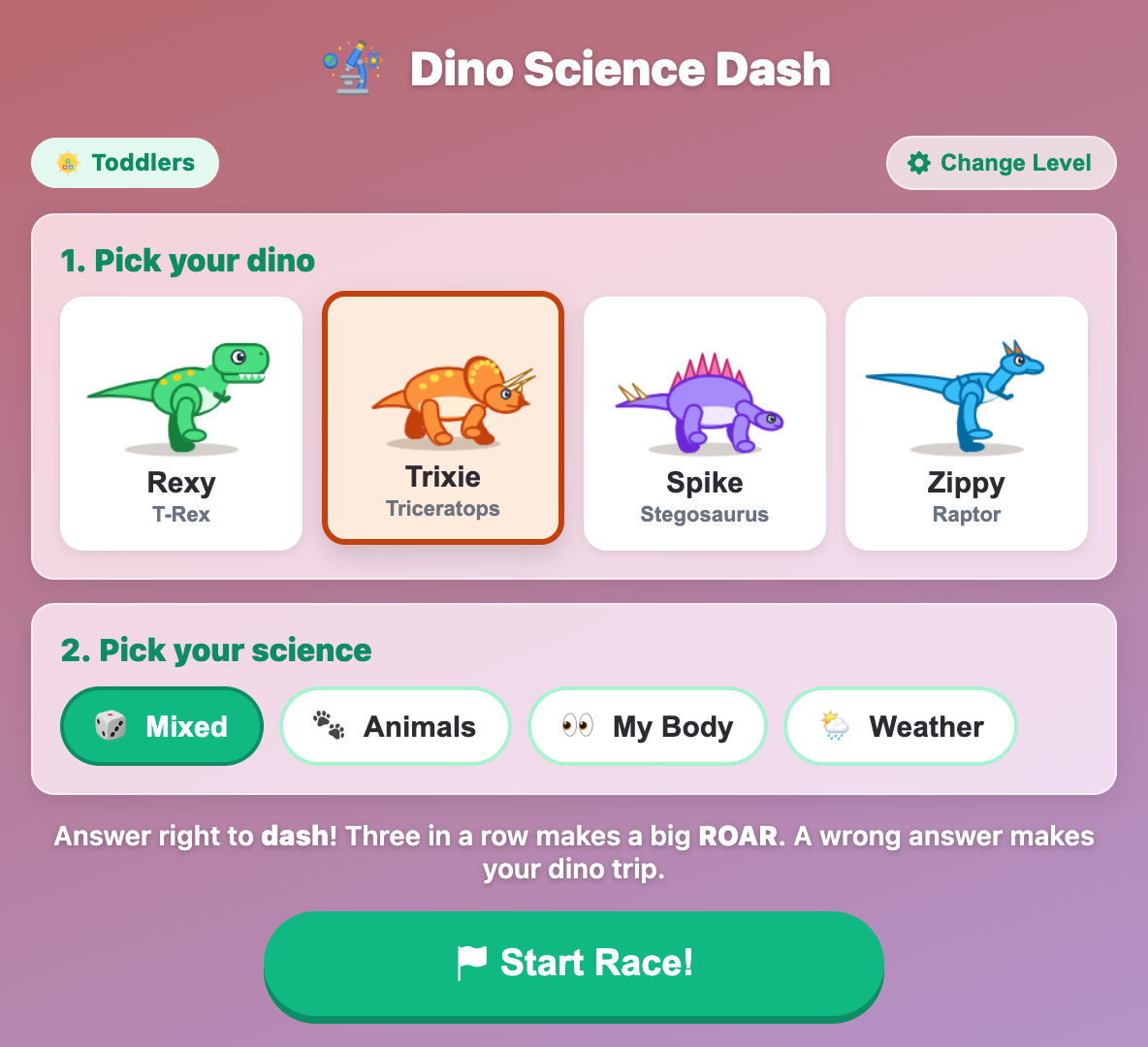
The Dino Science Dash setup screen at the Toddlers level, with Trixie the Triceratops picked and Animals, My Body and Weather chips
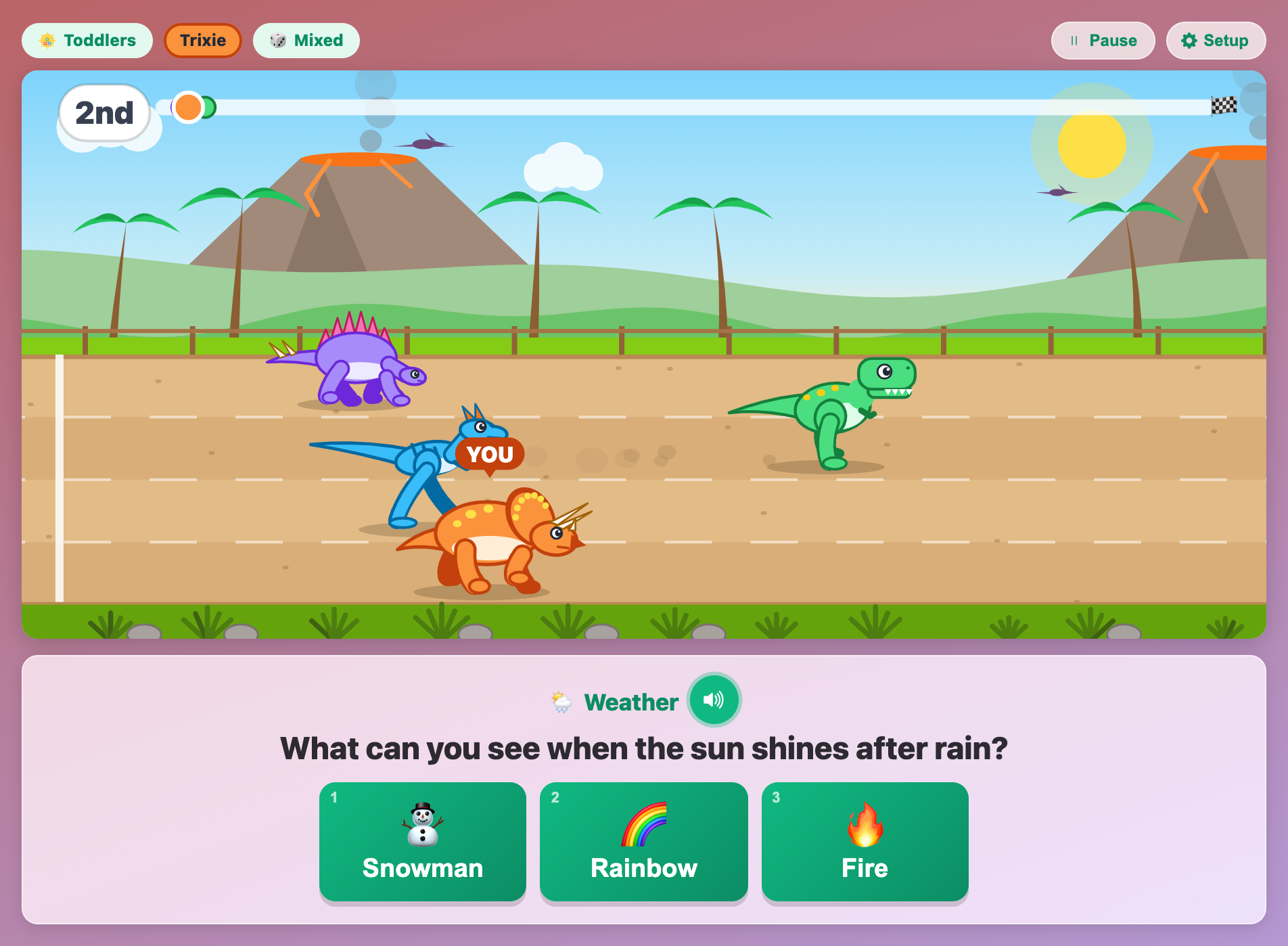
Dino Science Dash for toddlers, with Trixie racing in the front lane and a weather question with Snowman, Rainbow and Fire picture answers
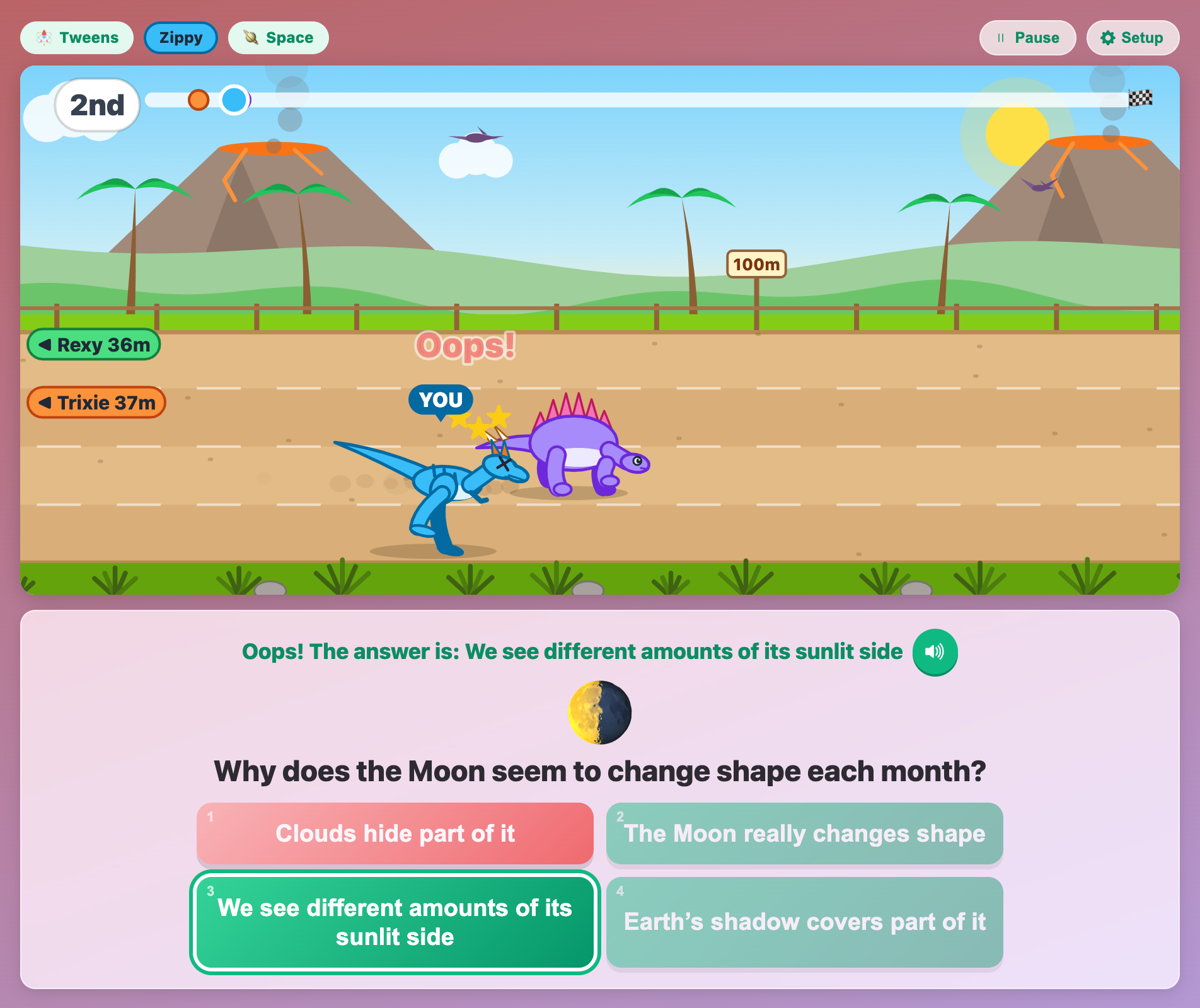
Zippy the Raptor tripping with dizzy stars after a wrong answer, while the card shows the right answer about the Moon
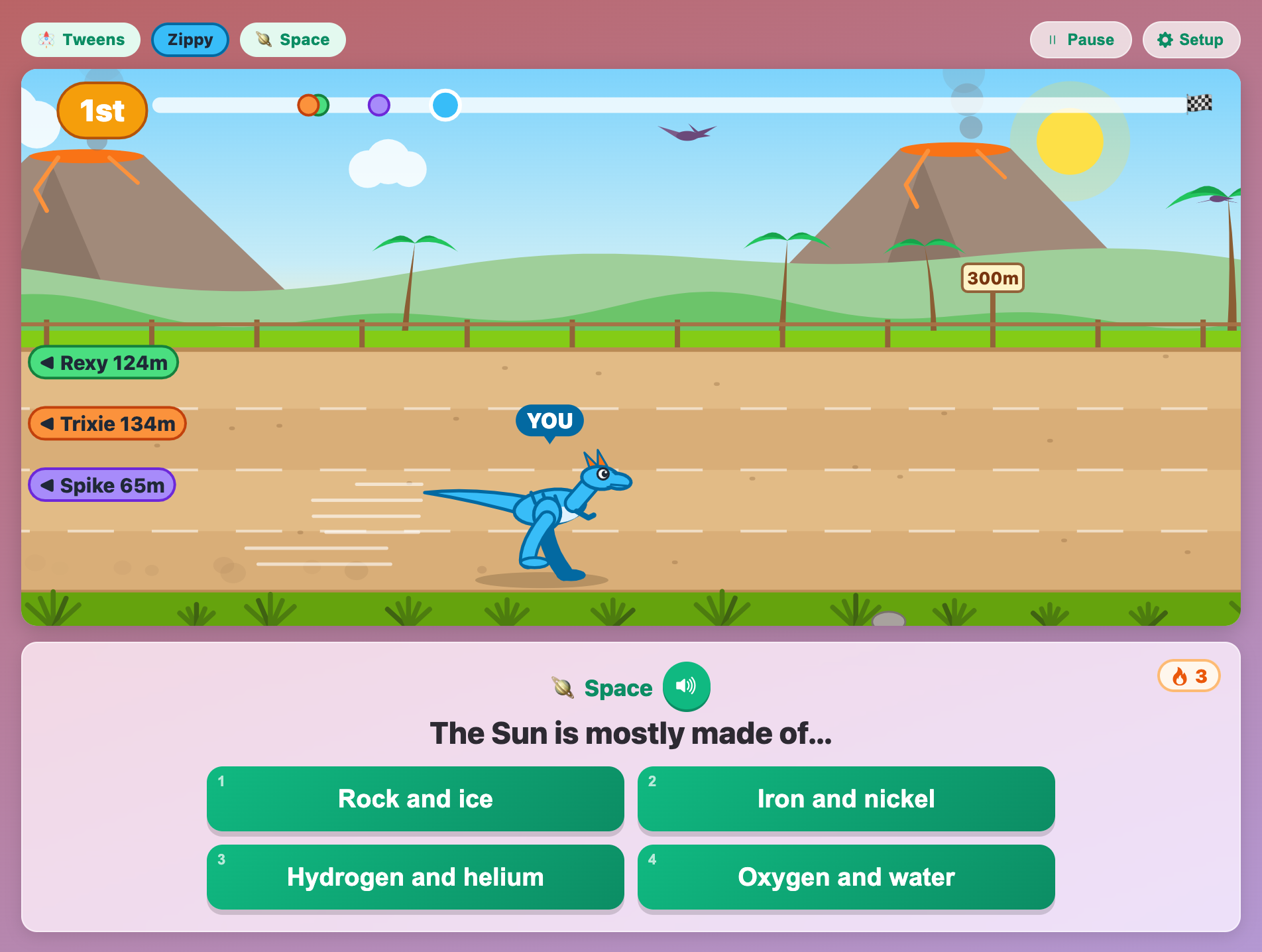
Zippy leading a tweens space race with a fire streak of 3, as name tags show how far behind Rexy, Trixie and Spike are
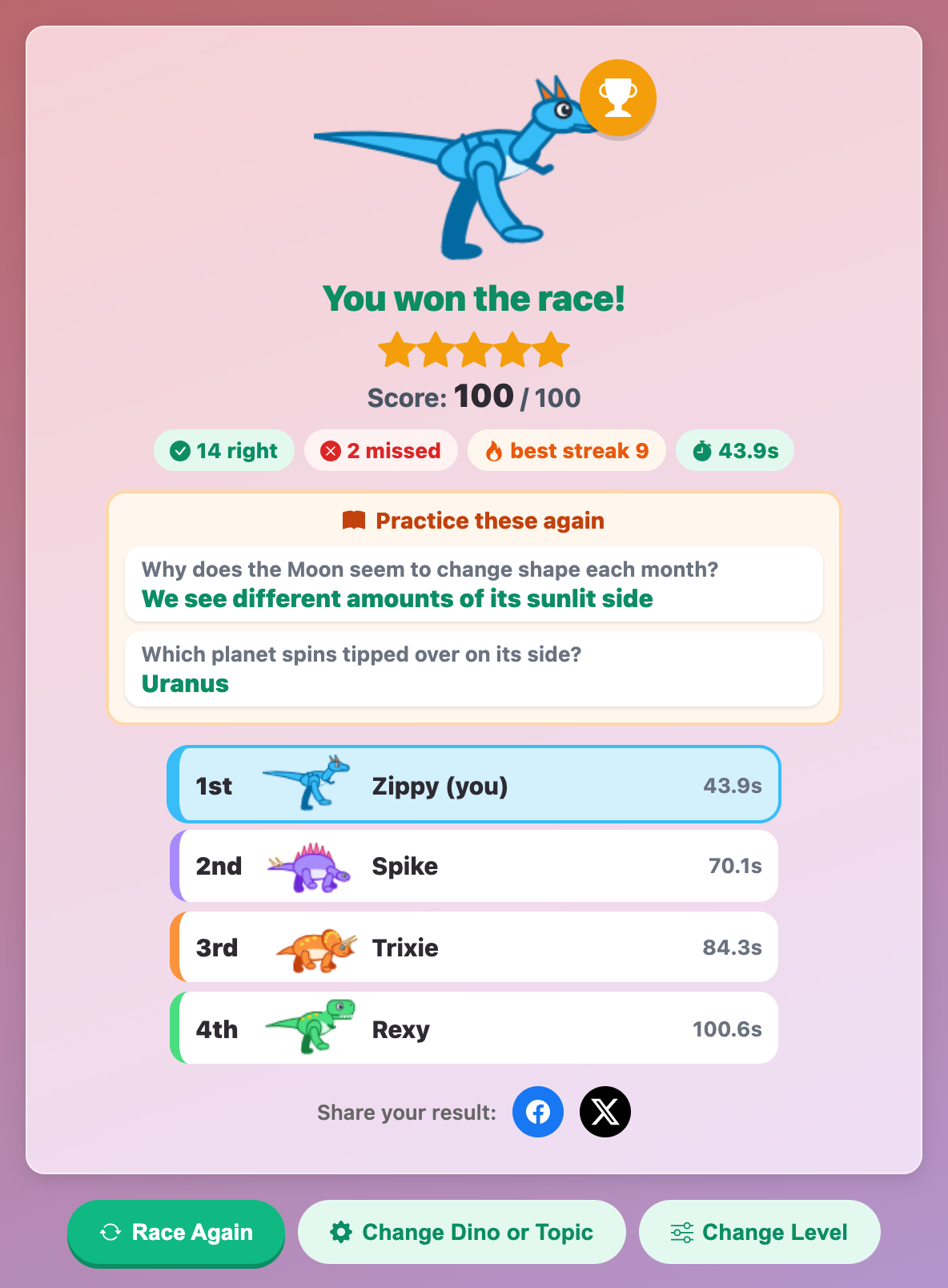
The Dino Science Dash result card with a trophy, five stars, a score of 100 and a Practice these again list
More Science Games
 59.4K plays
5.0
59.4K plays
5.0
Recycling Sort
Sort everyday items into the Recycle, Compost, or Trash bin before time runs out!
 85.7K plays
4.9
85.7K plays
4.9
Grow a Plant
Plant seeds in sunny and shady garden beds, then water, feed and protect them day by day. Watch the roots grow underground and harvest sunflowers, tomatoes, carrots and more!
 438.6K plays
5.0
438.6K plays
5.0
Magnet Experiment
Drag a magnet around the table and discover which objects it can pick up!
 386.8K plays
5.0
386.8K plays
5.0
Five Senses Match
Decide which of your five senses you would use for each everyday scene before time runs out.
Most Played Games
 1.8M plays
5.0
1.8M plays
5.0
Color & Draw
A free-drawing canvas with colors and brush sizes to unleash your creativity.
59.4K plays
5.0
Recycling Sort
Sort everyday items into the Recycle, Compost, or Trash bin before time runs out!
 365.5K plays
4.9
365.5K plays
4.9
Tic-Tac-Toe
Play a game of Tic-Tac-Toe against the computer and see if you can outsmart it.
 1.1M plays
4.9
1.1M plays
4.9
Chess
Play the classic game of chess against the computer or a friend, with FIDE time controls, hints, and undo.
Comments (24)