
Grow a Plant
85.7K playsPlant seeds in sunny and shady garden beds, then water, feed and protect them day by day. Watch the roots grow underground and harvest sunflowers, tomatoes, carrots and more!
Here is a garden secret: half of every plant is hiding. While the stem and leaves reach for the sun, the roots dig down into the dark soil where nobody can see them. Most garden pictures stop at the dirt. Grow a Plant for kids keeps going. The soil in this game is cut away like a slice of cake, so you can watch a seed wake up, roots spread out like tiny white fingers, and a carrot swell up orange under the ground.
You are the gardener. Every day you plant, water, feed and protect your plants. Then you tap 🌙 Next Day, the sky turns dark, and in the morning you find out how you did. Kids have played Grow a Plant on KidWorld more than 85,000 times, and families have given it 4.8 out of 5 stars in more than 1,300 ratings. Grab your watering can. Let's dig in!
🪱 A Garden With a Window Into the Soil
Grow a Plant is a science game that plays one day at a time. There is no clock ticking and nothing to race. You can take as long as you like on each day. The day only ends when you decide it ends.
Your garden has one, two or three raised beds, lined up in a row. A big leafy tree stands on the left. Its shadow covers the left bed, the middle bed gets some sun, and the bed on the right sits in full sun all day. A little signpost on each bed shows its light: 🌳 Shade, ⛅ Part sun or ☀️ Full sun.
The goal is to grow plants all the way from a tiny seed to a plant that is ready to pick, then harvest them into your basket 🧺. Each season lasts a set number of days. Before it ends, you try to harvest enough plants, and enough different kinds of plants, to fill your Garden Journal. That is the little row of six plant pictures at the top of the screen. Each picture turns from gray to full color the first time you harvest that kind of plant.
Every plant climbs the same ladder of seven life cycle steps. A life cycle is the set of changes a living thing goes through as it grows up: Seed, Sprout, Seedling, Young Plant, Bud, Flower and Ready to Pick. Some plants use their own names for the steps. A carrot goes from Young Carrot to Growing Root to Big Root to Ready to Pull. A tomato has Green Tomatoes before Ripe Tomatoes. And a fern doesn't even start from a seed!
🌰 Six Seed Packets, Six Different Needs
When the 🌱 Plant tool is picked, a row of six seed packets shows up under the garden. Each packet tells you what that plant needs. The number of 💧 drops shows how much water it likes, from one drop (a little) to three drops (a lot). From the Preschool level up, the number of 🍂 leaves shows how much plant food it likes, and a colored tag shows the light it wants.
🌻 Sunflower: ☀️ full sun, 💧💧 some water, 🍂🍂🍂 lots of food. A tall, hungry plant that ends with a big flower head full of seeds.
🍅 Tomato: ☀️ full sun, 💧💧💧 lots of water, 🍂🍂🍂 lots of food. The thirstiest and hungriest plant in the garden. It grows flowers, then green tomatoes, then red ones.
🥕 Carrot: ⛅ part sun, 💧💧 some water, 🍂 only a little food. The fun part happens underground, where you watch the orange root grow bigger.
🍓 Strawberry: ⛅ part sun, 💧💧💧 lots of water, 🍂🍂 some food. It makes white flowers, then green berries, then ripe red ones.
🌵 Cactus: ☀️ full sun, 💧 only a little water, 🍂 only a little food. The desert plant. Too much water hurts it!
🌿 Fern: 🌳 shade, 💧💧💧 lots of water, 🍂🍂 some food. The only plant that loves the shady bed under the tree. Ferns grow from spores, tiny dust-like specks, instead of seeds.
Tap any packet and a little message reminds you what that plant loves. Once you have harvested a kind of plant, its packet shows a 🧺 with how many you have picked.
🧑🌾 Your First Day as a KidWorld Gardener
Here is how a season of Grow a Plant works on KidWorld, from the first screen to the last.
Pick your level. The first screen shows four cards: Toddlers (ages 2–4), Preschool (ages 4–6), Elementary (ages 6–10) and Tweens (ages 10–12). The game remembers your choice. To switch later, tap the ⚙️ gear button in the top corner.
Read the lesson card. A card at the top gives you one small job at a time, like "Pick a seed packet, then tap a garden bed to plant it." The button you need even glows to help you find it. After the lessons, the card shows your Season Goal instead.
Check the day and the weather. Under the card you see Day 1 of 20 (or however long your season is), then today's weather and tomorrow's weather. That weather peek is very useful, as you will see below.
Pick a tool. The wooden toolbar holds your tools: 🌱 Plant, 💧 Water, 🍂 Compost, 🧤 Weeds, 🐞 Ladybug and 🧺 Harvest. Younger levels get fewer tools. On a keyboard, the number keys 1 to 6 pick them too.
Tap a bed to use it. You can tap the bed right in the garden picture, or tap its card under the picture. Each tap of the watering can pours one can of water. Each tap of the compost bag adds one scoop of food.
Read the bed cards. Every bed has a card with the plant's name, its life cycle step, six little dots for how far it has grown, and three ❤️ hearts. Below that are two bars: 💧 for water in the soil and 🍂 for food in the soil. Each bar has a light green "just right" zone. At the bottom, one word tells you how the plant feels, like Happy 😊, Thirsty or Weed!
Watch for thought bubbles. A plant that needs something shows a bubble above its head with an emoji, like 💧 for thirsty or 🐛 for bugs.
Tap 🌙 Next Day. This big blue button sits in the top-left corner of the garden. Night falls, the plants are checked, and happy plants sparkle as they grow. In the morning, a message tells you what happened. On the very last day, the button says End Season instead.
Oops? Use Undo. The ↩️ button in the top-right corner takes back your last action, like one can of water too many. It works for everything you did today, but not for anything before the last night.
Harvest with the basket. When a plant is ready to pick, choose 🧺 Harvest and tap it. It pops out with a +1. The first time you pick a new kind of plant, confetti rains down and your Garden Journal gets a new color.
Finish the season. The season ends by itself after the last day. You can also stop early with the 🏁 Finish button (tap it twice, so you don't finish by accident). Any plant that is ready gets picked for you.
See your results. The result card shows a picture of your garden, your score out of 100, how many plants you harvested, how many kinds, how many nights were happy, and 1 to 5 stars. It also shares a "Did you know?" fact about a plant you grew. Your points are added to your KidWorld ⭐ stars. Tap Grow a New Garden to play again, or Choose Another Level.
Use the page buttons. Around the game you will find buttons to go fullscreen, turn the music on or off, and reload. Your garden saves itself after every action, so if the browser closes you can come back later and keep going. The page's reload button is different: it starts a brand-new garden.
🌙 What Happens While the Garden Sleeps
Knowing what happens at night is the biggest secret to winning. Here is the order, every single night:
Every plant gets checked. The game looks at the soil exactly as you left it when you tapped Next Day.
Plants grow, or don't. A plant with no problems at all grows one whole step and gets back a heart. A plant with just one small problem grows only half a step. Two small problems, and it doesn't grow at all. Three small problems cost it a heart.
Big problems hurt. Bugs, a flooded bed, or soil that is dried out completely are big problems. So is the very wrong light at the Elementary and Tweens levels, like a sunflower stuck in deep shade. A plant with a big problem doesn't grow, and it loses a heart. At zero hearts it wilts 🥀.
The soil dries out. Plants drink water all night, and bigger plants drink more. The weather dries the soil too. A sunny day dries it a lot, a cloudy day less, and a hot day 🥵 dries it the most.
Plants eat. Once a plant has sprouted, it eats some food from the soil each night. Sunflowers and tomatoes eat the most.
Morning comes. The new day's weather arrives. Rain 🌧️ pours about a third of a bar of water into every bed. A storm ⛈️ pours almost half. Rain never floods a bed by itself, but it can make a bed too wet for some plants. Sometimes a weed pops up, or tiny green bugs called aphids start nibbling a plant.
See the big idea? The night checks your soil before it dries. So the most important moment of every day is right before you tap Next Day. Look at every bar. If they are all in the green zone, your plants will grow.
🥕 Growing Tips, From First Sprout to Full Basket
Beginner tips
Water seeds first. A seed only cares about water. It doesn't need food or the right light until it sprouts. So on planting day, fill the water bar up to the green zone and you are done.
Aim high in the green zone. Water drops a lot overnight, but that happens after the check. So ending the day near the top of the green zone keeps the soil from getting too low by the next evening, which means fewer cans in the morning.
Too much is a problem too. In this game, a plant can have too much water ("Too wet") or too much food ("Too much food"), just like too little. If the bar goes past the green zone, tap ↩️ Undo.
Look at the plants, not just the cards. A thirsty plant droops. A hungry plant's leaves turn yellow. A happy plant stands up straight and green.
Harvest and replant on the same morning. An empty bed grows nothing. As soon as a plant is ready, pick it and plant a new seed right away, the same day.
Match each plant to its bed
Light is the one thing you can't fix with a tool. It comes from where the bed is. So pick the right bed on planting day:
Shady bed (under the tree): only the 🌿 fern loves it.
Part sun bed (middle): 🥕 carrot and 🍓 strawberry.
Full sun bed (right): 🌻 sunflower, 🍅 tomato and 🌵 cactus.
If you plant in the wrong bed, the game gives you a gentle warning right away, like "Hmm, sunflowers like full sun ☀️, and this bed is shadier." Being one step off (a carrot in full sun) is a small problem, so the plant grows at half speed. Being two steps off (a fern in full sun, or a cactus in deep shade) is a big problem, and the plant slowly loses its hearts.
Weeds and bugs
A weed 🌿 is a plant that grows where you don't want it. It steals water and food from your plant every night, and it counts as a problem too. Pull it with the 🧤 tool the same day you see it.
Aphids 🐛 are tiny bugs that suck the juice out of plants. They show up on bigger plants, from the Seedling step on. They are a big problem, so send in the 🐞 ladybugs right away. Ladybugs love to eat aphids. That is a real trick gardeners use!
Smart tips for big gardens
Read tomorrow's weather. The weather chip shows today and tomorrow. If tomorrow says 🌧️ Rainy, the rain will fill the beds in the morning, so leave low-water plants near the bottom of their green zone tonight.
Plan more cans after a hot day. A 🥵 Hot day means the soil will be much drier the next morning. Your plants are still fine tonight, but tomorrow you will need an extra can or two.
Keep your hearts full. Every perfect night gives back a heart, up to three. A plant with three hearts can live through a bad night or two. A plant with one heart may not.
Plan your Garden Journal. Different kinds of plants count toward the Journal goal. Don't grow tomatoes three times in a row if you still need a cactus.
A ready plant is a waiting plant. A plant that is ready to pick stops growing and just waits. Every day it waits is a day that bed could be growing something new.
🔍 Five Garden Puzzles, Solved Step by Step
Here are five real moments from the game, and how a good gardener thinks them through. These use the Elementary level.
Puzzle 1: How much water for a fern seed?
Every bed starts with its water bar about one third full. A fern loves lots of water, so its green zone sits high up on the bar, starting a bit past halfway. One can of water fills about one fifth of the bar.
Plant the fern in the shady bed on the left.
Tap it with the watering can once. The bar is now about half full. Still not green!
Tap it once more. Now the bar is in the green zone, and a message says "💧 Just right for your Fern!"
Tap Next Day. The fern sprouts overnight.
Two cans on planting day, then about one can most mornings. That's the fern's rhythm.
Puzzle 2: The cactus that got too much love
A cactus likes very little water. Its green zone sits low on the bar, and the bed's starting water (about one third) is already inside it. So the right move on planting day is: plant it and do nothing else!
What if you water it anyway, out of habit? The bar jumps to about half full, and the card says Too wet. That small problem would make your cactus grow only half a step tonight. The fix is easy: tap ↩️ Undo before you tap Next Day. The water goes back to where it was.
Puzzle 3: The rainy-day trap
Your carrot's water bar sits at the very top of its green zone. Today is cloudy, so the soil won't dry much tonight. And the weather chip says Tomorrow 🌧️ Rainy. What happens next?
Tonight, the carrot is checked. It is in the green zone, so it grows. 👍
On a cloudy night, the soil dries only a little.
In the morning, the rain pours about a third of a bar into the bed. Now the carrot's bar is past the green zone, and it says Too wet.
You can't take water out of soil, so the carrot will only grow half a step that night.
The smart move: on the day before rain, don't water the carrot up to the top. Leave it low in its green zone. Then the rain tops it up for you, for free. Screenshot 4 below shows what the trap looks like on a rainy day, with a carrot and a sunflower both saying "Too wet."
Puzzle 4: Weed plus hungry
It's morning. A weed popped up next to your sunflower last night, and it stole food while it grew. Now the card says 🌿 Weed! · 🍂, and the food bar has slipped below the green zone. You are busy, so you think, "I'll just tap Next Day."
Here is what the night would do. The weed is one small problem. Being Hungry is a second small problem. And two small problems mean no growth at all. The leaves are already starting to turn yellow, too.
The fix takes just a few taps: 🧤 pull the weed, then 🍂 add compost until the food bar is back in the green zone. Now the plant has zero problems and grows a whole step tonight.
Puzzle 5: Planning a whole season
With perfect care, a plant goes from seed to ready in six happy nights. If you plant on Day 1, it is ready on the morning of Day 7. Pick it and replant that same morning, and the next one is ready on Day 13, then Day 19. So each bed can grow about three crops in an Elementary season of 20 days.
The Elementary goal is 5 harvests and 4 kinds. Here is one plan that works:
Shady bed: 🌿 fern, then another fern.
Part sun bed: 🥕 carrot, then 🍓 strawberry.
Full sun bed: 🌻 sunflower, then 🍅 tomato.
That gives you 6 harvests and 5 different kinds, with room for a few half-happy nights. Tweens need all 6 kinds, so they must fit a 🌵 cactus into the sunny bed too!
🧮 Adding Up Your Garden Score
Your score has three parts:
Harvests (50 points): how many plants you picked, compared to your level's goal.
Garden Journal (20 points): how many different kinds you picked, compared to the goal.
Happy nights (30 points): out of all the nights your plants spent growing, how many were perfect, with no problems at all.
For example, one Elementary garden picked 4 plants (goal 5), 3 kinds (goal 4), and had 69% happy nights. That is 40 + 15 + 21 = 76 points, which earned a "Lovely Garden!" card with four stars. Reach every goal and you become a Super Gardener! Get 90 points or more and you earn all five stars and a trophy 🏆.
🪴 Grow a Plant for Kids, From Tiny Hands to Big Planners
The garden changes a lot from level to level. Younger kids get a simpler garden, and older kids get more beds, more needs and trickier weather.
🐣 Toddlers (ages 2–4)
Grow a Plant for toddlers has just one sunny bed and three tools: Plant, Water and Harvest. There is no food bar and no light rule, so any seed grows well there. The green water zone is extra wide, weeds and bugs never show up, and the weather is only sunny, cloudy or rainy. The season lasts 14 days. The goal is to harvest 2 plants of 2 different kinds. A grown-up can read the lesson card out loud while the child taps.
🎨 Preschool (ages 4–6)
Grow a Plant for preschoolers adds a second bed, in part sun. Compost and plant food arrive, and so do weeds to pull. Light shows up as a hint on the seed packets and in the thought bubbles, but it doesn't hurt the plants yet. It's a gentle way to learn that plants like different places. The season lasts 16 days, with a goal of 3 harvests and 2 kinds.
📐 Elementary (ages 6–10)
Grow a Plant for elementary kids is the full garden: three beds (shade, part sun and full sun) and all six tools. Now light really counts. Aphids can show up from Day 4, and hot days dry the soil fast. The season lasts 20 days, with a goal of 5 harvests and 4 kinds. Guests who haven't picked a level start here.
🚀 Tweens (ages 10–12)
Grow a Plant for tweens is the master gardener challenge. The green zones get narrower, so you have to be more careful with every can. Weeds and bugs show up more often, and stormy days ⛈️ can soak the beds. The season is the longest, 24 days, and the goal is 7 harvests and all 6 kinds. That means planning a cactus, a tomato and a sunflower in the same sunny bed.
💚 What Grows in the Gardener, Too
Plants aren't the only thing that grows in this game. Here is what kids pick up along the way:
Real plant science. Plants need water, food and light, but not all the same amounts. A cactus and a fern want almost opposite things. That's the same thing real gardeners learn.
Seeing the hidden half. Because the soil is cut away, kids watch roots spread and a carrot root fill out underground. They see with their own eyes that the part we eat is the root.
"Just right" thinking. The green zone teaches that more isn't always better. Too much water drowns roots, and too much food makes plants sick.
Planning ahead. Checking tomorrow's weather before bed, and choosing which seed goes in which bed, are small steps toward thinking one move ahead.
Patience and care. A plant needs six good days in a row. Kids learn that a little care every day beats a lot of care once.
Nature's helpers. Ladybugs eating aphids is a real way gardeners protect plants without sprays.
For moms, dads and teachers
Grow a Plant is calm and safe. There is no timer, no scary content, and no way to "lose" in a harsh way. The worst thing that can happen is a plant that wilts, and the basket clears it away so you can try again. It practices reading simple bars and icons, cause and effect, early science words (life cycle, roots, spores, compost), and planning. The garden saves itself after every action, so it's easy to stop at bedtime and come back tomorrow. For a fun follow-up, plant a real bean seed in a clear cup, so your child can watch real roots grow just like in the game.
Your seed packets are waiting, and the soil is ready. Pick a bed, fill the water bar to the green zone, and tap 🌙 Next Day to see what grows. Play Grow a Plant for kids on KidWorld today, and see if you can fill your whole Garden Journal before the season ends! 🌻
🖼️ See the Game in Action
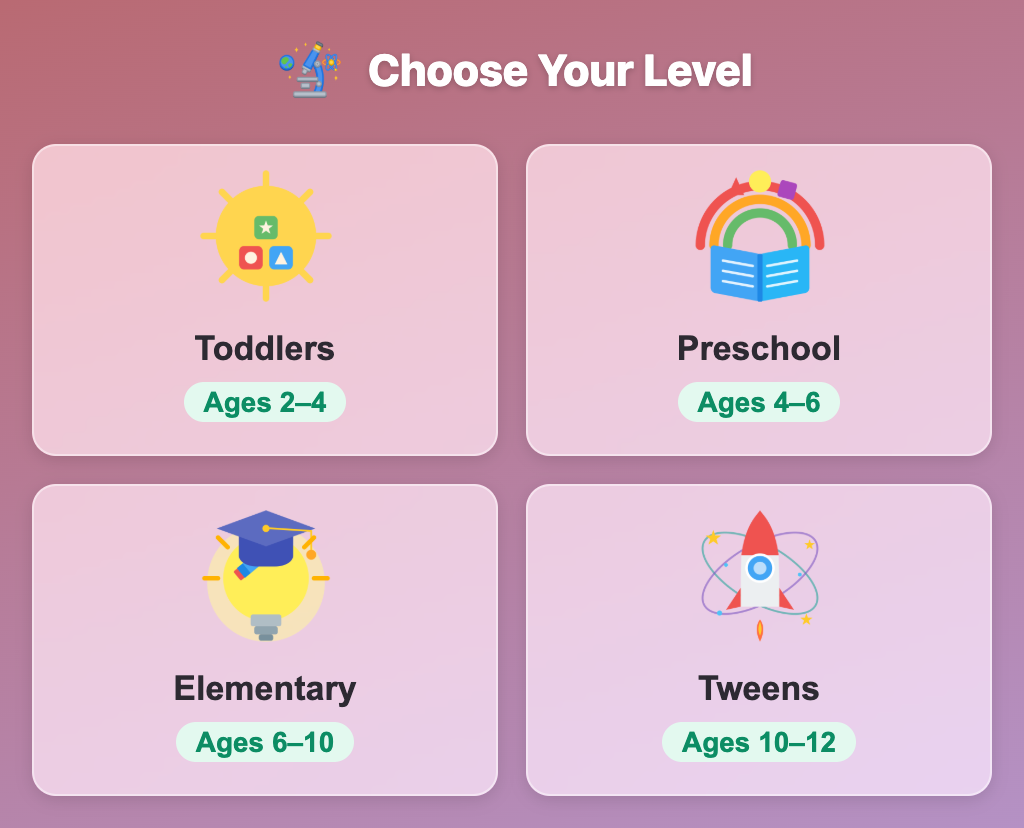
The Choose Your Level screen of Grow a Plant for kids, showing Toddlers, Preschool, Elementary and Tweens cards with their ages
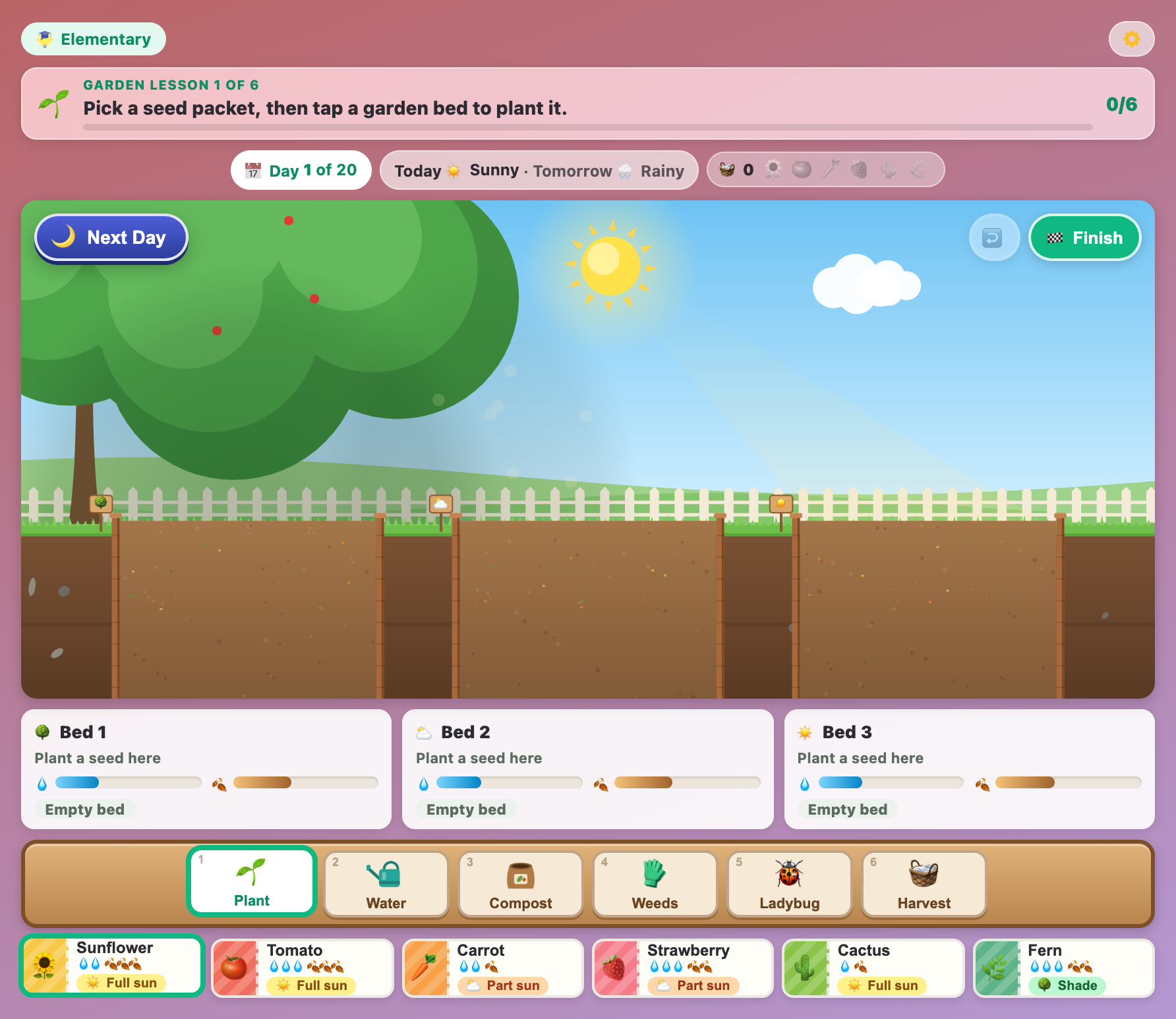
Three empty garden beds on day 1 of Grow a Plant, with a big shady tree on the left and six seed packets below
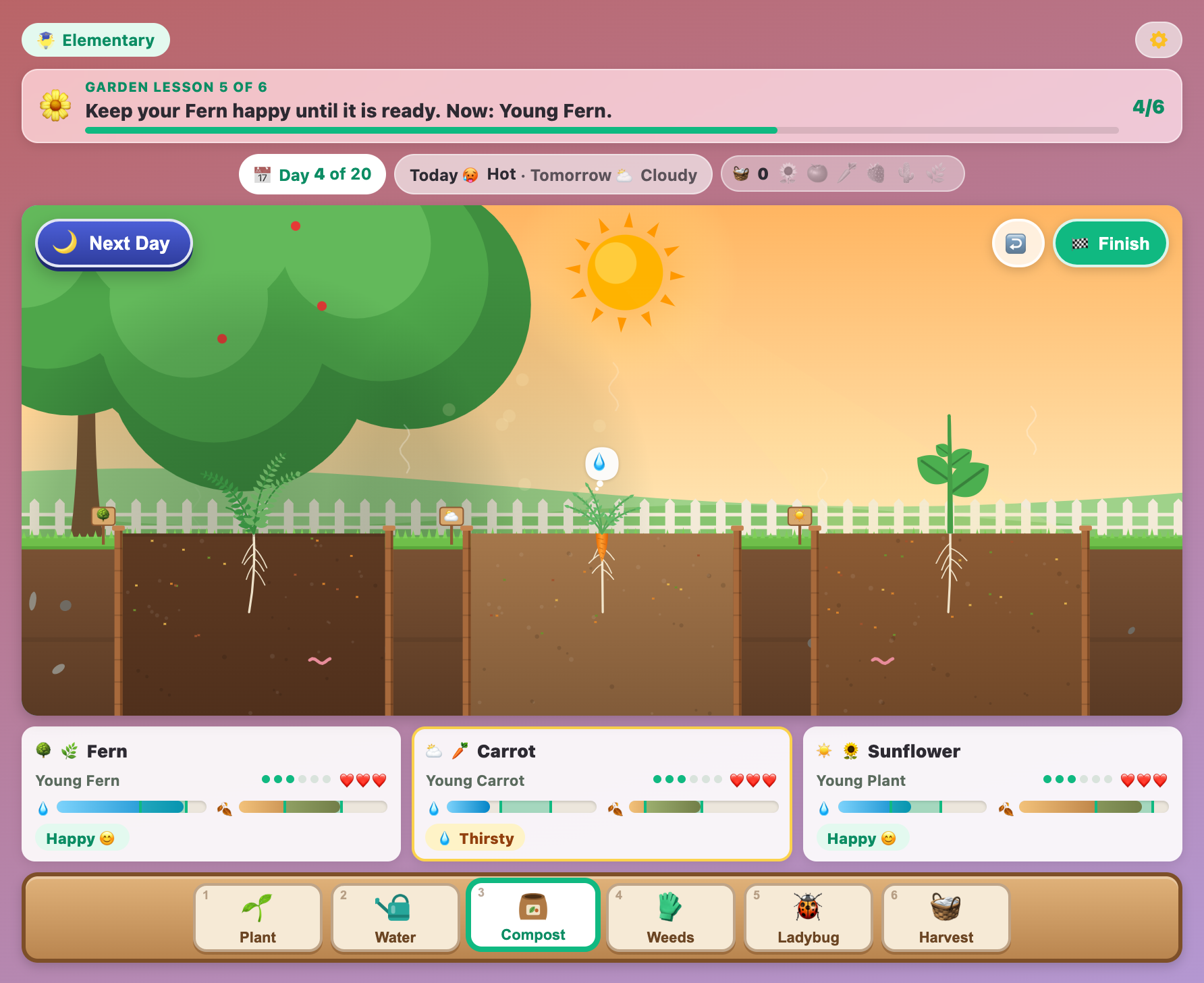
A fern, a carrot and a sunflower growing in Grow a Plant for elementary kids, with roots under the soil and a thirsty carrot
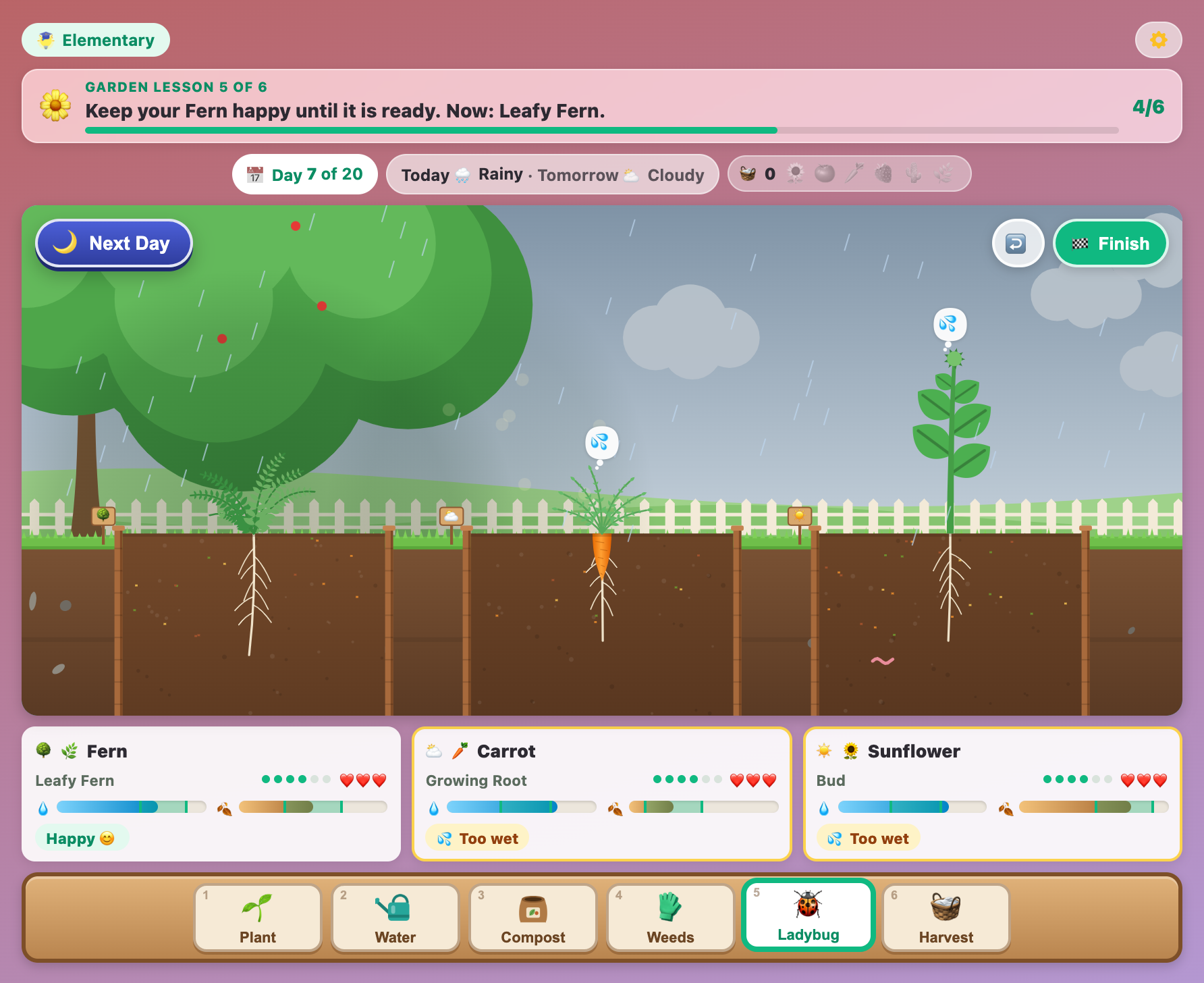
A rainy day in Grow a Plant with a tall sunflower bud and an orange carrot root, both showing Too wet bubbles
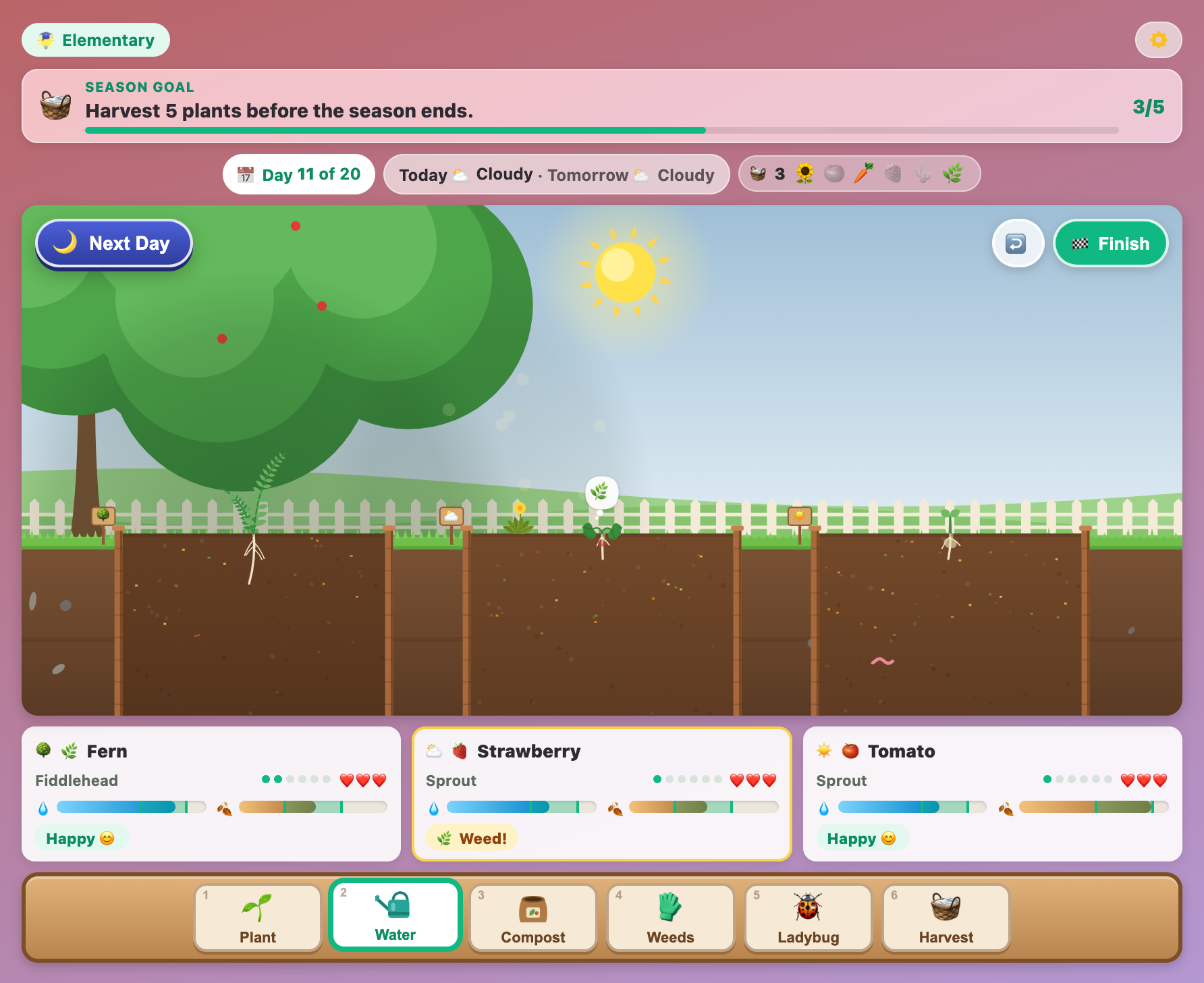
The Season Goal card in Grow a Plant asking for 5 harvests, with a fern fiddlehead and a weed next to a strawberry sprout
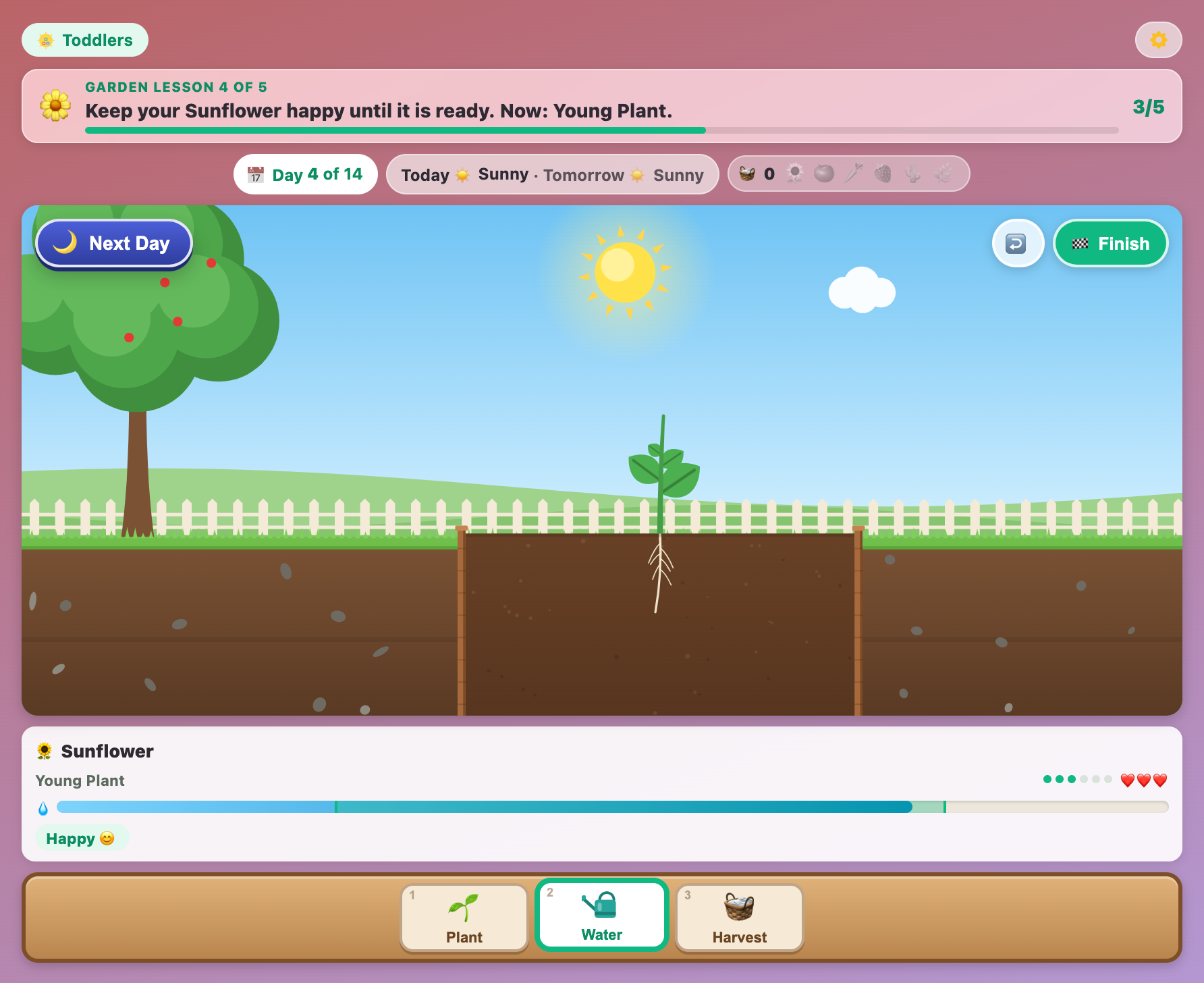
Grow a Plant for toddlers with one garden bed, a young sunflower, a single water bar and just three tools
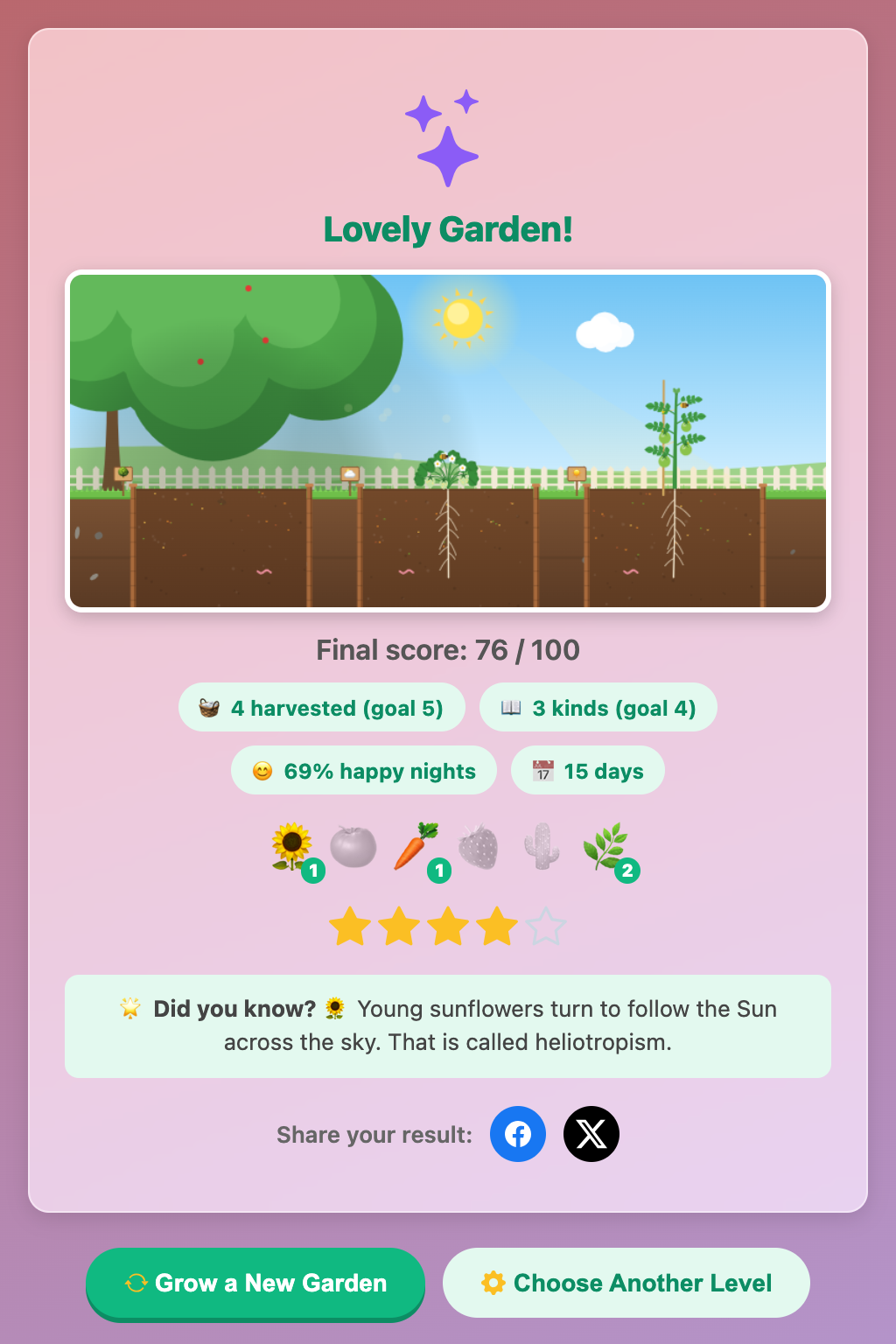
The Lovely Garden result card in Grow a Plant with a picture of the garden, a score of 76 out of 100 and four stars
More Science Games
 59.4K plays
5.0
59.4K plays
5.0
Recycling Sort
Sort everyday items into the Recycle, Compost, or Trash bin before time runs out!
 438.6K plays
5.0
438.6K plays
5.0
Magnet Experiment
Drag a magnet around the table and discover which objects it can pick up!
 386.8K plays
5.0
386.8K plays
5.0
Five Senses Match
Decide which of your five senses you would use for each everyday scene before time runs out.
 1.3M plays
4.9
1.3M plays
4.9
Robot Builder World
Build your own blocky robot, then program it with Forward, Turn and Repeat blocks to reach the red flag — learn loops, sensors and switches with no typing!
Most Played Games
 1.8M plays
5.0
1.8M plays
5.0
Color & Draw
A free-drawing canvas with colors and brush sizes to unleash your creativity.
59.4K plays
5.0
Recycling Sort
Sort everyday items into the Recycle, Compost, or Trash bin before time runs out!
 365.6K plays
4.9
365.6K plays
4.9
Tic-Tac-Toe
Play a game of Tic-Tac-Toe against the computer and see if you can outsmart it.
 1.1M plays
4.9
1.1M plays
4.9
Chess
Play the classic game of chess against the computer or a friend, with FIDE time controls, hints, and undo.
Comments (34)