Solar System Explorer
94.5K playsExplore a real 3D solar system, zoom into planets from the Sun to Pluto, and discover moons, space missions, and wild records!
About Solar System Explorer Game
Somewhere on your screen, a tiny sun is glowing and eight real planets are quietly swinging around it, never once stopping to wait for you. Drag it and the whole system spins in your hand. Zoom in and a planet grows from a distant speck into a real, textured world. Tap it, and the camera swoops in close and keeps flying right alongside it as it keeps right on orbiting — nothing here ever freezes in place just because you're looking at it. That's Solar System Explorer, the real 3D universe living on KidWorld, already visited by thousands of young astronauts and trusted with a full five-star rating by happy families along the way. Strap in, give the system a spin, and let's go find your first world!
🪐 What's Inside Solar System Explorer?
This isn't a poster of space — it's a real, spinnable model of our solar system that you steer yourself, dragging to rotate, pinching or scrolling to zoom, flying wherever your curiosity points you next. Ten worlds are waiting inside it: the blazing Sun at the center, the four small rocky Inner Planets huddled close by (Mercury, Venus, Earth, and Mars), the four enormous Outer Planets out past the middle of the system (Jupiter, Saturn, Uranus, and Neptune), and one tiny, icy Dwarf Planet, Pluto, trailing far behind everyone else. Tap any world and the camera flies right over to it, then keeps tracking it as it continues circling the Sun in the background — visit one planet's info card for as long as you like, and the rest of the solar system just keeps on turning without you. Hidden inside every single world are six kinds of facts to dig up, adding up to well over a hundred true space facts spread across the whole system.
🕹️ How to Play Solar System Explorer on KidWorld
Spin, zoom, and fly around. Click or touch and drag anywhere to rotate the whole system, scroll or pinch to zoom closer or farther away, or tap the ➕ / ➖ buttons on the side for a simple tap-to-zoom. Tap the compass button any time to sail back out to the full, zoomed-out view of the whole system.
Tap a world to visit it. Tap the Sun or any planet and the camera glides right over, staying locked onto it as it keeps orbiting — you're never chasing a planet that's wandered off while you weren't looking.
Open its info card. Landing on a world pops up a little panel with its name, a short description, and three quick stats — how wide it is, how far it sits from the Sun, and how many moons it has — followed by six round buttons, one per fact category, each showing how many of its hidden facts you've already uncovered.
Tap a category, then tap a card. Pick a category to see its facts, then tap one open to reveal a big emoji, a short description, and a "Did you know?" surprise — the very first time you open any card, a cheerful "+stars, new discovery!" banner pops up too.
Search for anything, anywhere. Tap the 🔍 Search button and start typing a planet's name, a group like "outer planets," or even a single fact you half-remember, and Solar System Explorer instantly lists every match — tap a result and the camera flies you straight there.
Browse by group. Tap the 🌐 Groups button to see the Sun, the Inner Planets, the Outer Planets, and the Dwarf Planets lined up with their own progress bars, so you always know exactly which corner of the system still has facts left to find.
Take a quick quiz. Tap the ❓ Quiz button for a fun multiple-choice question like "Which one is home to ___?" with four planet choices — answer right for a nice chunk of bonus stars, or answer wrong and simply watch the correct world glow so you learn something new either way.
Handy tools: tap the fullscreen button above the game to make the whole system bigger and easier to explore, and use the reload button any time you'd like to jump back to a calm, zoomed-out view with a fresh camera.
🌌 Meet the Worlds You Can Discover
Every one of these ten worlds is sitting inside the game right now, each with its own real look, real stats, and its own six categories of facts to dig up:
☀️ The Sun — the blazing star at the center of everything, so massive it holds nearly all of the solar system's weight and every planet in its gentle gravitational grip.
⚪ Mercury — the smallest, speediest planet, zipping all the way around the Sun in just 88 days while swinging between scorching days and freezing nights.
🟠 Venus — the hottest planet in the whole system, wrapped in thick clouds that trap in more heat than any other world, even Mercury.
🌍 Earth — our own home, and still the only planet anyone has ever found life on, covered mostly in deep blue ocean.
🔴 Mars — the rusty red desert world, home to both the tallest volcano and the deepest canyon anywhere in the solar system.
🟤 Jupiter — the biggest planet by a huge margin, famous for the Great Red Spot, a swirling storm that's been raging for centuries.
🪐 Saturn — instantly recognizable for its dazzling rings, and so light that it would actually float in a bathtub big enough to hold it.
🔵 Uranus — an icy blue-green giant that rolls around the Sun tipped almost completely on its side, unlike every other planet.
🟣 Neptune — the windiest and most distant planet, wrapped in a deep blue haze and found through math before anyone ever actually saw it.
❄️ Pluto — a small, icy dwarf planet way out past Neptune, marked with a giant heart-shaped glacier and five moons of its own.
🔎 The Six Kinds of Facts Hiding on Every World
No matter which of the ten worlds you visit, the very same six treasure categories are waiting for you there:
🔎 Overview — the standout features that make each world instantly recognizable, from giant storms to icy glaciers shaped like a heart.
🌙 Moons — the companions circling each planet, from Earth's own familiar Moon to Jupiter's volcanic Io and Saturn's cloudy Titan.
🚀 Exploration — the real spacecraft and missions that have actually flown past, orbited, or landed on each world.
🏆 Records — the biggest, hottest, windiest, and strangest superlatives each world can proudly claim.
🌬️ Weather — the storms, winds, and wild climate quirks that make every atmosphere (or lack of one!) totally unique.
🏛️ Mythology — the ancient gods and old stories each world was named after, long before anyone had ever seen it up close.
🌟 How to Rack Up the Most Stars
Solar System Explorer has no finish line to race toward — it's a whole system just waiting to be explored, and every fact you uncover earns real stars for your KidWorld profile. Here's how to make the most of it:
Harder facts pay off more. Every card is quietly labeled easy, medium, or hard behind the scenes, and trickier facts earn more stars than simple ones — you won't know which is which until you open the card, so the surprise is part of the fun.
Stars only come from brand-new discoveries. Once a card shows "Discovered!", opening it again won't earn more stars, so hunting down cards you haven't tried yet is always the smartest move.
Quiz questions score big, fast. A correct quiz answer earns a bigger stack of stars than most single facts, and there's zero penalty for guessing wrong beyond missing out on those stars — so once you've explored a bit, jump into Quiz mode and cash in what you've learned.
Keep an eye on your star badge. A running star counter sits right in the toolbar, climbing every time you open something new — with well over a hundred facts across ten worlds, there's plenty of room for that number to grow.
Let the Groups screen guide you. If the Outer Planets progress bar looks empty compared to the others, that's exactly where your next adventure should head.
Come back any time. Every fact you've uncovered is saved right on your own device, so you can explore a little today and a little more tomorrow without ever losing your progress.
🎯 Try These Space Trivia Questions
Think you already know a few Solar System Explorer secrets? Give these a try before you check the answers!
This planet's Great Red Spot is a storm that has been swirling for hundreds of years — which planet is it? (Answer: Jupiter!)
This ringed planet is so light that, if you had a bathtub big enough, it would actually float — which planet? (Answer: Saturn!)
Almost every planet spins mostly upright, but this one rolls around the Sun tipped nearly on its side — which planet? (Answer: Uranus!)
A NASA spacecraft called New Horizons gave us our very first close-up photos of this small, icy world back in 2015 — which one? (Answer: Pluto!)
One day on this thick-clouded planet actually lasts longer than its entire year — which planet is it? (Answer: Venus!)
🌟 Why Kids Love Exploring Space Here
Real astronomy, not just cartoon circles. Every fact is grounded in genuine space science, from real NASA missions to real orbital quirks, dressed up in kid-friendly language.
A gentle reading workout. Each discovery card is a short, friendly burst of reading — perfect for building vocabulary and confidence without ever feeling like homework.
A real sense of scale. Watching planets shrink and grow as the camera flies between them gives kids a feel for just how vast — and how different — each world really is.
Science hiding in plain sight. The Moons, Weather, and Records categories quietly introduce real ideas about orbits, atmospheres, and planetary science along the way.
No way to lose, ever. There's no countdown clock and no wrong way to explore — every tap either teaches something new or reminds you of something you already know.
Endless replayability. With ten worlds, six categories each, and a quiz that never asks the exact same round twice, there's always another corner of the system left to explore.
🚀 Solar System Explorer for Every Age
Nothing in Solar System Explorer is locked behind a difficulty setting — every planet and every fact is open to explore from the very first spin, so the same glowing system can be a cozy bonding activity for a toddler or a genuine challenge for a tween, depending on how deep you dig together:
For toddlers (around ages 2 to 4): let a grown-up handle the spinning and zooming, then let your toddler point at whatever catches their eye — the bright, colorful planets and their emoji-filled fact cards make a perfect first stop.
For preschool (around ages 4 to 6): search for Earth first and let your preschooler proudly spot our home planet, then hop over to its next-door neighbors, Venus and Mars, and compare what makes each one different.
For elementary (around ages 6 to 10): use the Groups screen like a checklist, aiming to fill up one group's progress bar completely before moving to the next, and try a few Quiz rounds to turn freshly learned facts into extra stars.
For tweens (around ages 10 to 12): go for full completion — with over a hundred facts waiting across every world in the system, chasing that star counter higher is a genuinely satisfying goal, and a head-to-head Quiz challenge with a friend is a great way to show off newly learned space knowledge.
A whole solar system, spinning and orbiting right on your screen, packed with real space facts and never once standing still — that's Solar System Explorer for kids of every age on KidWorld, and it's ready and waiting for its next astronaut. Give the system a spin, pick a world, and see what you discover first!
🖼️ See the Game in Action
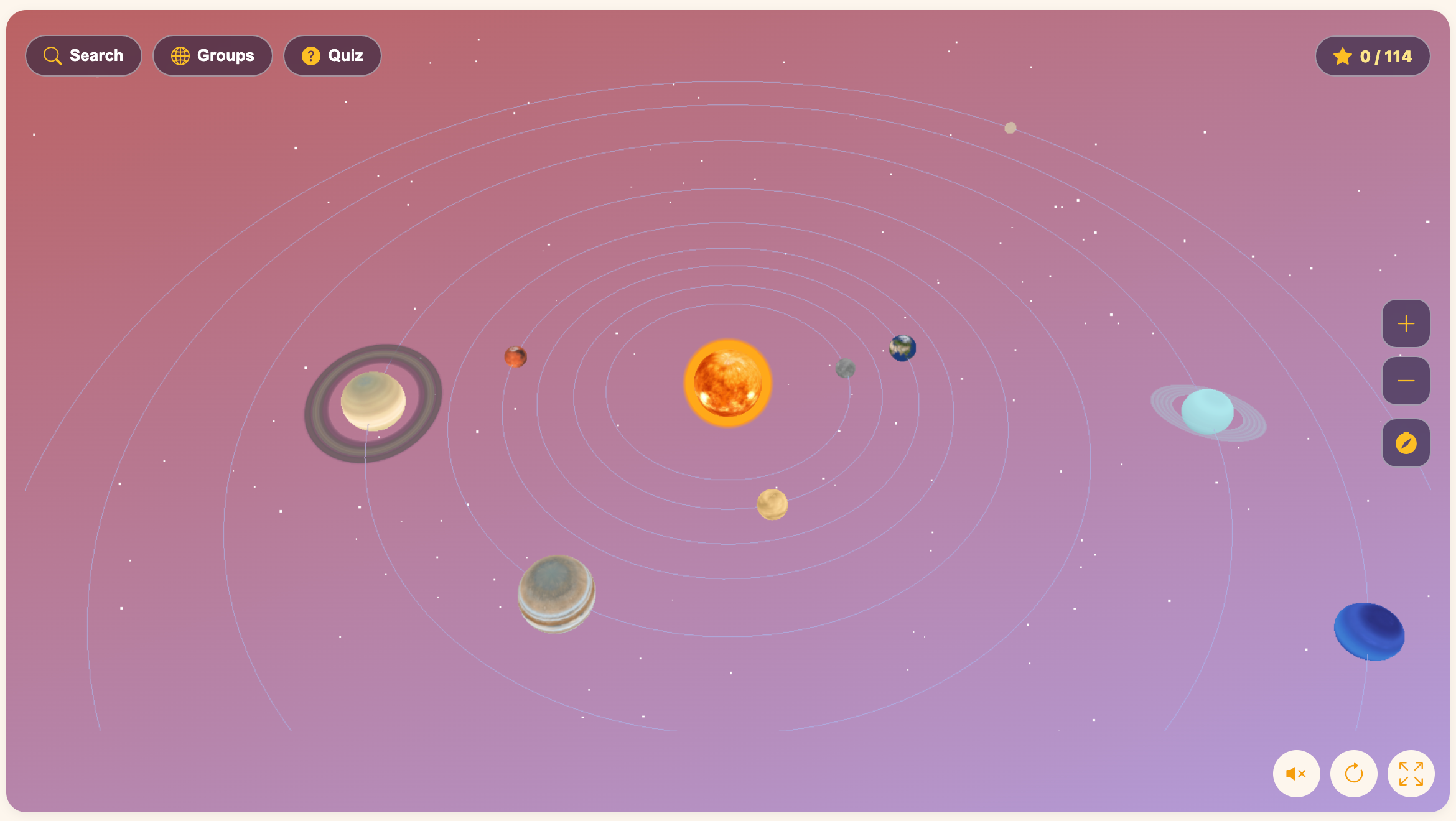
A screenshot showing all the planets in the Solar System Explorer game
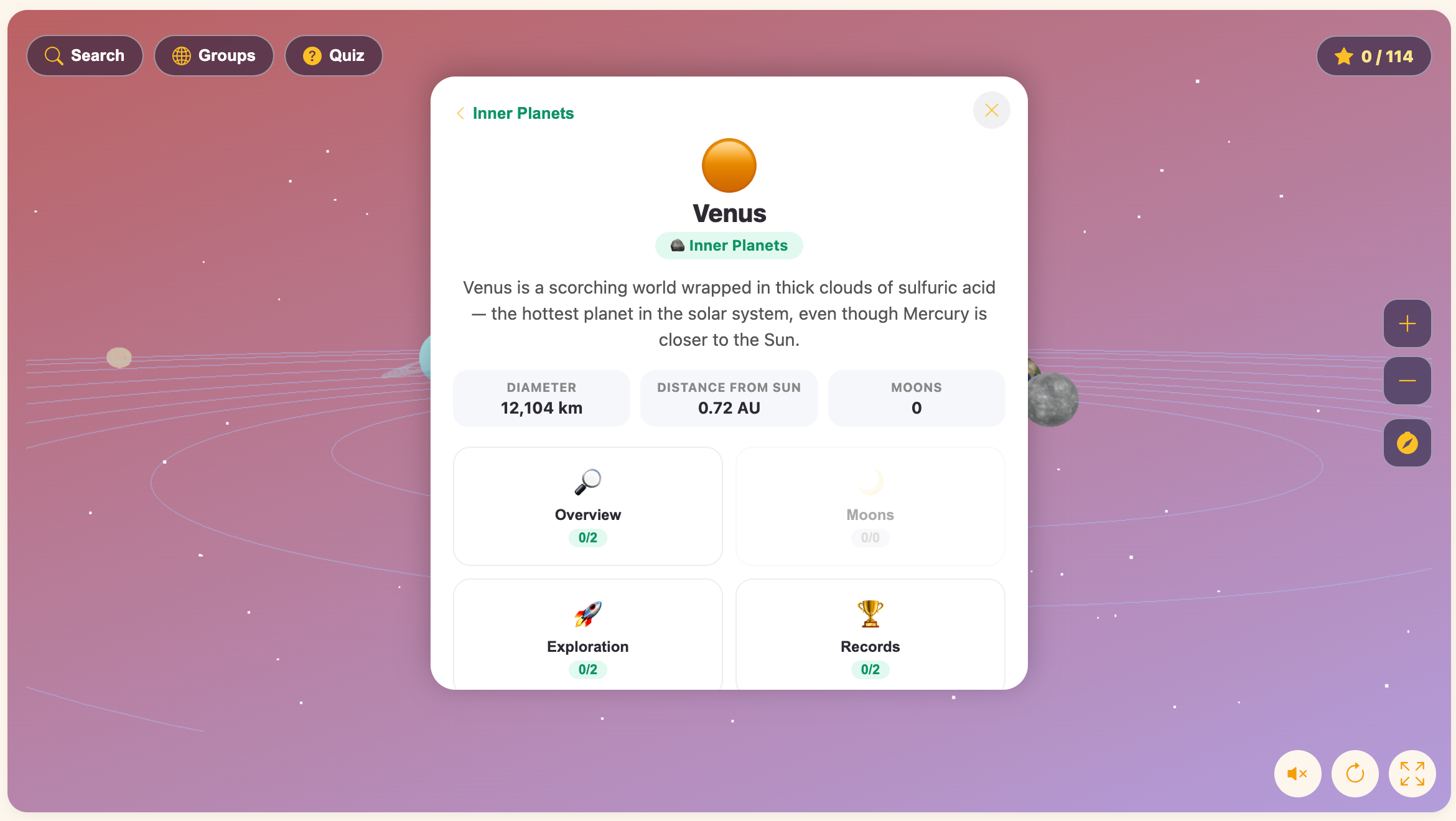
A screenshot showing overview, exploration, records, weather, mythology of the Venus in the Solar System Explorer game
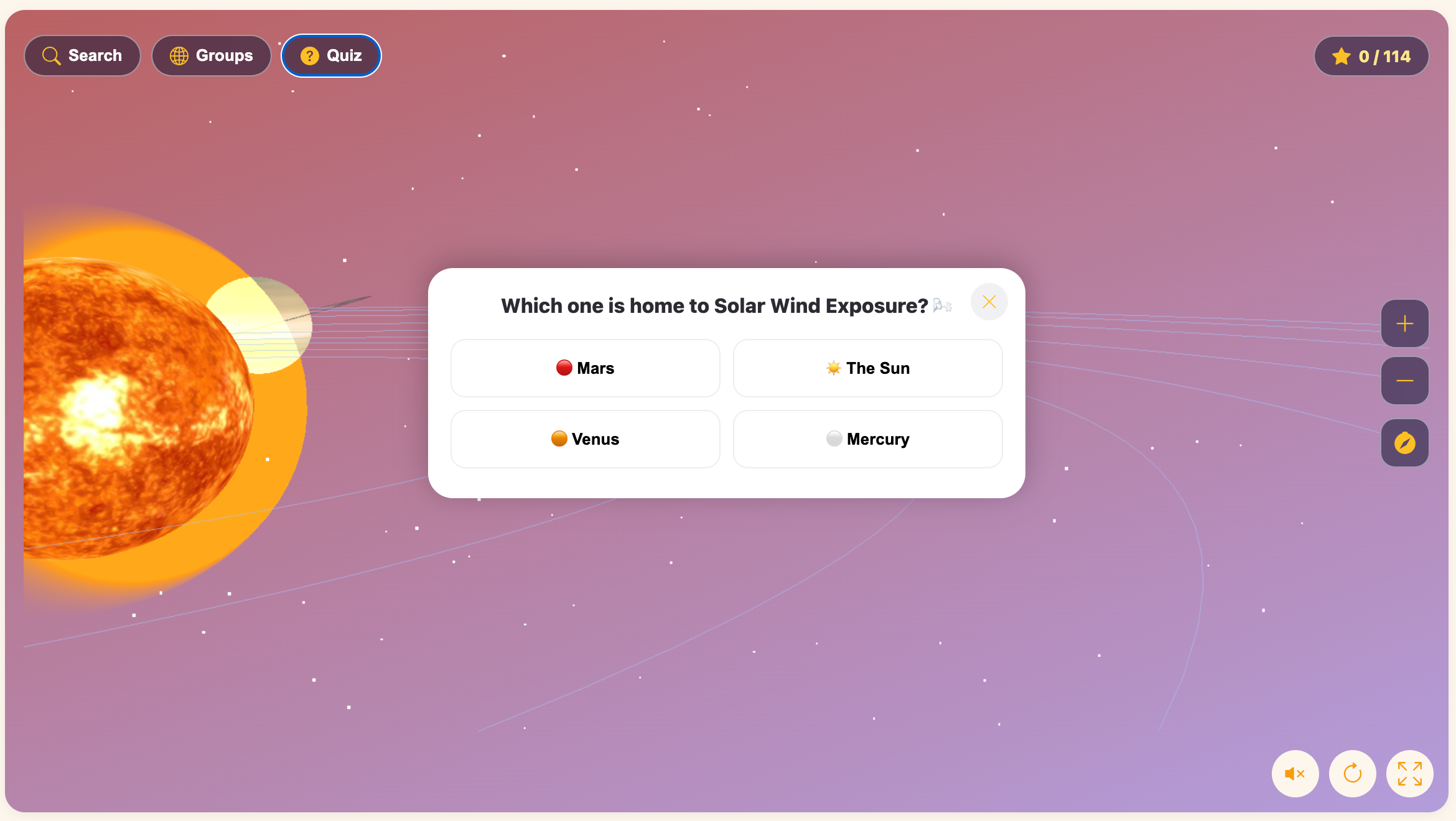
A screenshot of a quiz in the Solar System Explorer game
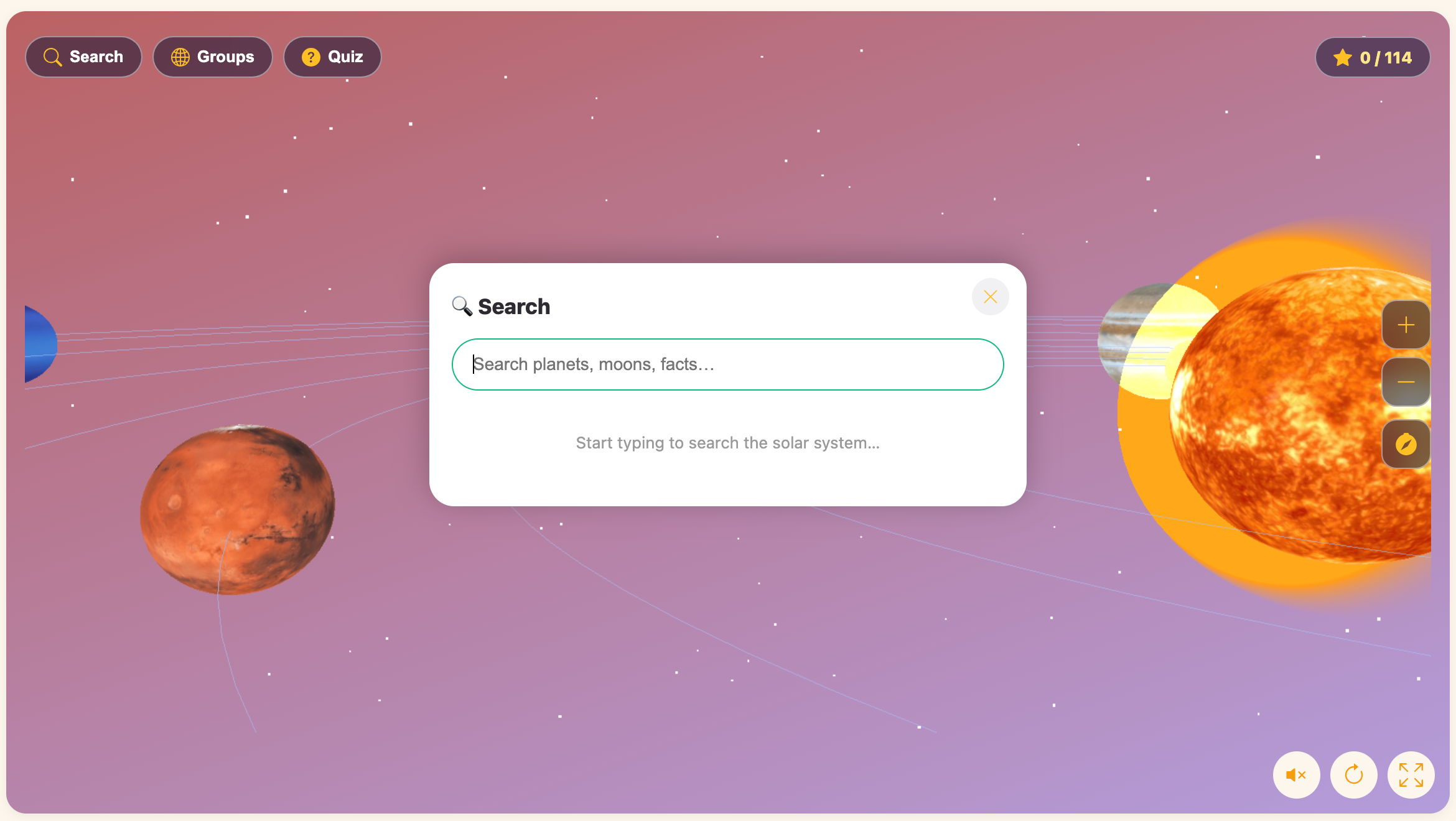
A screenshot of the search feature in the Solar System Explorer game
More Science Games
 59K plays
5.0
59K plays
5.0
Recycling Sort
Sort everyday items into the Recycle, Compost, or Trash bin before time runs out!
 438.5K plays
5.0
438.5K plays
5.0
Magnet Experiment
Drag a magnet around the table and discover which objects it can pick up!
 85.6K plays
4.9
85.6K plays
4.9
Grow a Plant
Pick a seed, then keep its Water, Heat, and Nutrients gauges in the right zone to grow it into a full bloom before the weeks run out!
 876.5K plays
4.9
876.5K plays
4.9
Science Quiz
Pick your age level and answer fun multiple-choice science questions!
Most Played Games
 1.8M plays
5.0
1.8M plays
5.0
Color & Draw
A free-drawing canvas with colors and brush sizes to unleash your creativity.
59K plays
5.0
Recycling Sort
Sort everyday items into the Recycle, Compost, or Trash bin before time runs out!
 365.4K plays
4.9
365.4K plays
4.9
Tic-Tac-Toe
Play a game of Tic-Tac-Toe against the computer and see if you can outsmart it.
 1.1M plays
4.9
1.1M plays
4.9
Chess
Play the classic game of chess against the computer or a friend, with FIDE time controls, hints, and undo.
Comments (88)