
Magnet Experiment
438.3K playsDrag a magnet around the table and discover which objects it can pick up!
Right there on your screen sits a shiny steel paperclip, minding its own business — and the instant a magnet swings close enough, it won't have a choice in the matter. It's going to slide, speed up, and snap on tight. But nudge that same magnet toward a wooden block, a glass jar, or even a coin, and… nothing happens at all. That's the delightfully sneaky science puzzle at the heart of Magnet Experiment, the hands-on discovery game live on KidWorld, already pulled, snapped, and played more than 400,000 times by curious kids everywhere and holding onto a dazzling 5.0-star rating from thousands of happy players along the way. Grab your magnet, steady your hand, and let's go find out what really sticks!
🧲 What Is Magnet Experiment?
Magnet Experiment isn't a quiz and it never asks you to pick an answer — it's a real little science table you get to explore with your own two hands. The moment a round begins, a scatter of everyday objects appears across the table, and a big red horseshoe magnet sits ready to go wherever you tell it to. Press down anywhere on the table and drag — the magnet follows your finger or mouse instantly, with a soft glowing ring drawn around it that shows exactly how far its pull can reach. Steer that ring over a steel or iron object and something wonderful happens: the object starts sliding toward the magnet all on its own, picking up speed the closer it gets, until it snaps on tight and joins a little chain of collected treasures dangling behind your magnet as you move. Steer that very same ring over a wooden block, a balloon, or a coin, though, and absolutely nothing happens — no matter how close you get, some things just won't answer a magnet's call, and figuring out which ones do is the whole exciting point of the game.
🔩 Meet What's Hiding on the Table
Every round scatters a fresh mix of household objects across your table, and each one falls into exactly one of two groups — learn to spot the difference and you'll start clearing rounds like a real scientist:
Answers the call (steel and iron things) — a paperclip, a key, a pair of scissors, a screwdriver, a gear, a hammer, a wrench, a chain, an anchor, and plenty of other steel and iron tools that come sliding straight to your magnet the moment they're close enough.
Stays put no matter what — a wood block, a glass bottle, a balloon, a teddy bear, a sock, a feather, an ice cube, and here's the sneaky one: a plain old coin. It looks like metal, it feels like metal, but most coins are actually made from materials a magnet can't grab at all — a genuinely surprising twist the very first time it happens to you.
🕹️ How to Play Magnet Experiment on KidWorld
Pick your level. Choose Toddlers, Preschool, Elementary, or Tweens right at the start — this quietly sets how many objects are scattered across the table, how long your round lasts, and just how far your magnet's pull can reach.

Press and drag anywhere on the table. You don't need to grab the tiny magnet itself — press down anywhere inside the table and the magnet glides straight to that spot, following your finger or mouse the whole time you keep holding.
Watch the glowing ring around your magnet. That soft, pulsing circle is your magnet's real reach — steer it so a steel or iron object falls inside the ring, and watch that object start sliding toward you all by itself.
Let each catch snap onto your chain. Get close enough and the object locks on for good, joining every other object you've already caught in a little dangling chain that follows your magnet around the table.
Notice the objects that never move. Drag your magnet right up next to a non-magnetic object and a quiet "not magnetic" label flashes by — a gentle nudge that this one simply isn't part of the club, no harm done and nothing lost.
Race to catch every magnetic object before time's up. A countdown ticks away at the top of the screen the whole round — clear the table of every last magnetic object early and you'll bank a speedy bonus on top of your score.
See what you missed if the clock beats you. Run out of time with objects still uncaught and the game reveals exactly which ones were magnetic (and what they're made of), so every round teaches you something new for next time.
Collect your final score. Once every round is done, a results screen tallies your total score and hands you a star rating — high enough, and you'll want to show it off.
Play again or switch it up. Tap Play Again for a brand-new scatter of objects at the same level, or tap Choose Another Level if you're ready for a tighter magnet and a faster clock.
Handy tools: the fullscreen button above the game gives you a bigger table with fewer distractions, and the reload button jumps you straight into a fresh round any time you like.
🧠 Secrets to Clearing Every Round
Magnet Experiment looks simple — just drag a magnet around! — but there's genuine strategy hiding underneath, and a little know-how goes a long way toward a perfect, full-chain round:
Trust the glowing ring, not your eyes alone. An object might look close on screen, but if it's sitting outside your magnet's ring, nothing happens yet — steer closer until the ring actually reaches it, and the pull takes over from there.
Plan one smooth sweep instead of darting back and forth. Objects already caught ride along in your chain wherever you go next, so a wide, thoughtful loop around the table that skims past several magnetic objects in one motion beats a dozen short, panicked trips.
Judge by material, not by looks. A shiny coin can trick your eyes into thinking "metal means magnetic" — but the true test is whether it's iron or steel underneath, and the game will always tell you the truth the moment you get close.
Never be afraid to explore. Dragging your magnet past a non-magnetic object costs you nothing at all — no points lost, no penalty, just a quiet label letting you know. That makes it completely safe to test anything you're unsure about.
Chase the full-clear bonus on purpose. Catching every magnetic object with time still on the clock turns your leftover seconds straight into bonus points — a calm, complete sweep almost always beats a rushed, half-finished one.
Expect a tighter challenge at higher levels. As the levels get harder, more magnetic objects share the table with more decoys, and your magnet's own reach shrinks a little — success there comes from precise, deliberate drags rather than big careless sweeps.
🌍 Real Magnet Science Hiding Inside the Game
Every drag across the table in Magnet Experiment is actually teaching real physics, dressed up as a game:
Only a few materials are truly magnetic. Iron, steel, nickel, and cobalt are the real magnetic materials in our world — most other metals, including aluminum, copper, and gold, aren't magnetic at all, even though they look just as shiny.
Most coins actually fail the magnet test. Because coins are usually made from copper or nickel-plated blends rather than iron or steel, an everyday magnet can't pick one up — try it with a real coin at home and see for yourself!
A magnet pulls harder the closer it gets. Move an object nearer to a magnet and the pull grows noticeably stronger — move it away and the pull fades fast — which is exactly why objects on the table speed up the closer they slide toward your magnet.
Magnets can turn other objects into mini-magnets. Touch a steel paperclip to a strong magnet for a moment and it can start acting like a tiny magnet itself, sometimes strong enough to hold onto a second paperclip — that's the real secret behind how a dangling chain forms.
Every magnet has two poles that behave differently. Scientists call them north and south — opposite poles always pull together, matching poles always push apart, and cutting a magnet in half just gives you two smaller magnets, each with its own north and south all over again.
Our whole planet behaves like a giant magnet. A huge magnetic field flows through the Earth deep beneath your feet, pointing roughly toward the North and South Poles — it's the entire reason a compass needle always swings around to point north.
🌟 Why Magnet Experiment Is Such a Wonderful Fit for Kids
Real science learned by doing, not memorizing. There's no fact to recite and no multiple-choice answer to guess — kids simply drag, watch, and discover which materials are magnetic through their own hands-on experimenting.
A completely safe place to be wrong. Testing a non-magnetic object costs nothing at all, which means kids are free to try everything, follow their own curiosity, and learn from every single guess without ever feeling penalized for it.
Instant, honest feedback on every try. A magnetic object visibly responds the second it's within reach, and a non-magnetic one visibly doesn't — the physics plays out right in front of a child's eyes instead of hiding behind a score they have to trust blindly.
Real practice at guess-test-and-learn thinking. Wondering whether something will stick, dragging over to test it, and watching what actually happens is the exact same loop real scientists use every day, just shrunk down into a friendly little table.
Gentle hand-eye coordination practice. Steering a magnet smoothly around a busy table, mouse or finger alike, is a fun, low-pressure way to build the same fine motor control that helps with drawing, writing, and plenty of other everyday skills.
Curiosity that doesn't stop at the screen. Plenty of kids finish a round of Magnet Experiment and go hunt down a real fridge magnet to test on spoons, coins, and toys around the house — a game that sends kids off to keep experimenting is doing something right.
🧲 Magnet Experiment for Every Age
Magnet Experiment quietly adjusts its own table size, timer, and magnet strength to match four different age groups, making it a genuinely great fit whether you're picking up your very first magnet or chasing a lightning-fast perfect round:
Magnet Experiment game for toddlers (around ages 2 to 4): a small, roomy table, a generous magnet reach, and a relaxed clock give a grown-up plenty of time to drag together, name each object out loud, and cheer at every single satisfying snap.
Magnet Experiment game for preschool (around ages 4 to 6): a slightly busier table with a bit less time to think is just enough of a step up for a preschooler to start dragging, guessing, and catching objects with growing confidence on their own.
Magnet Experiment game for elementary (around ages 6 to 10): a fuller table and a tighter clock make this the perfect proving ground for spotting sneaky look-alikes like that non-magnetic coin and chasing that first full-clear bonus.
Magnet Experiment game for tweens (around ages 10 to 12): the busiest table, the shortest clock, and the tightest magnet reach of all turn every round into a genuine speed challenge — sharp eyes and smooth, efficient drags are what separate a good round from a five-star one.
A shiny table full of everyday objects, one steerable magnet, and a ticking clock — that's Magnet Experiment game for kids of every age on KidWorld, ready and waiting the moment you press start. Pick your level, take hold of your magnet, and go find out what really sticks!
🖼️ See the Game in Action
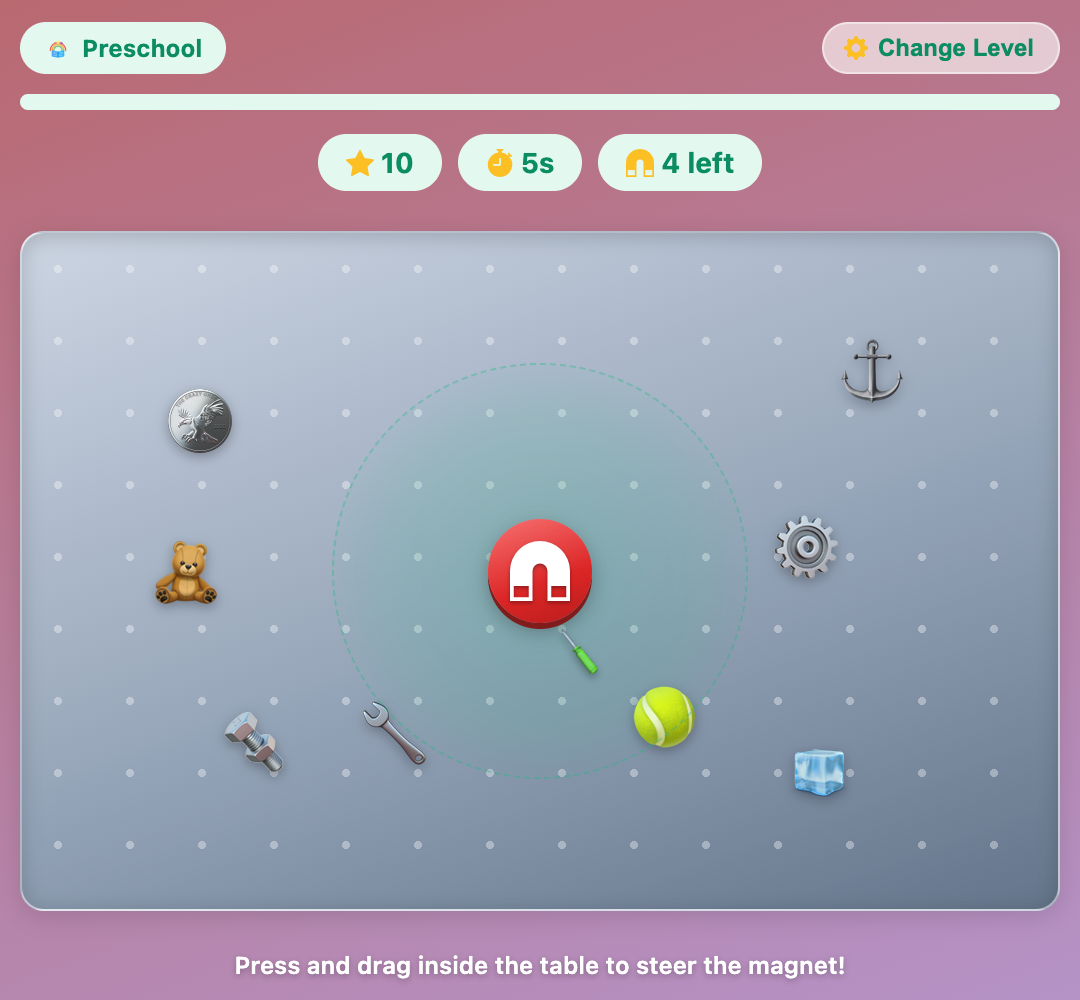
A screenshot when start a new Magnet Experiment game for Preschool
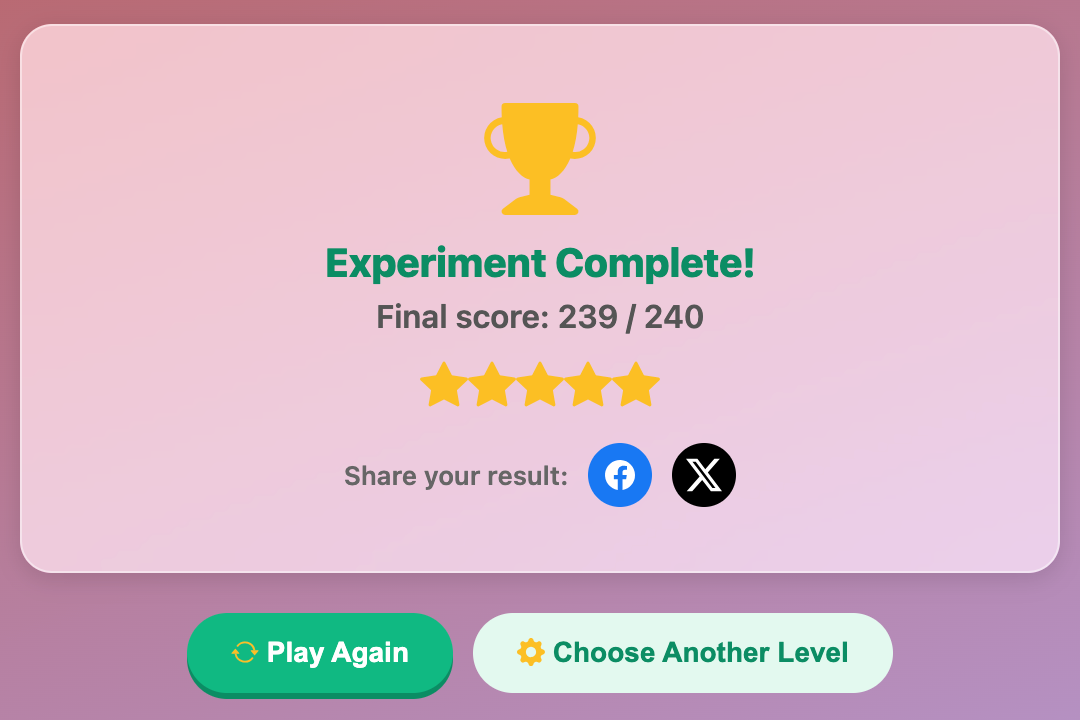
A screenshot when complete a Magnet Experiment game
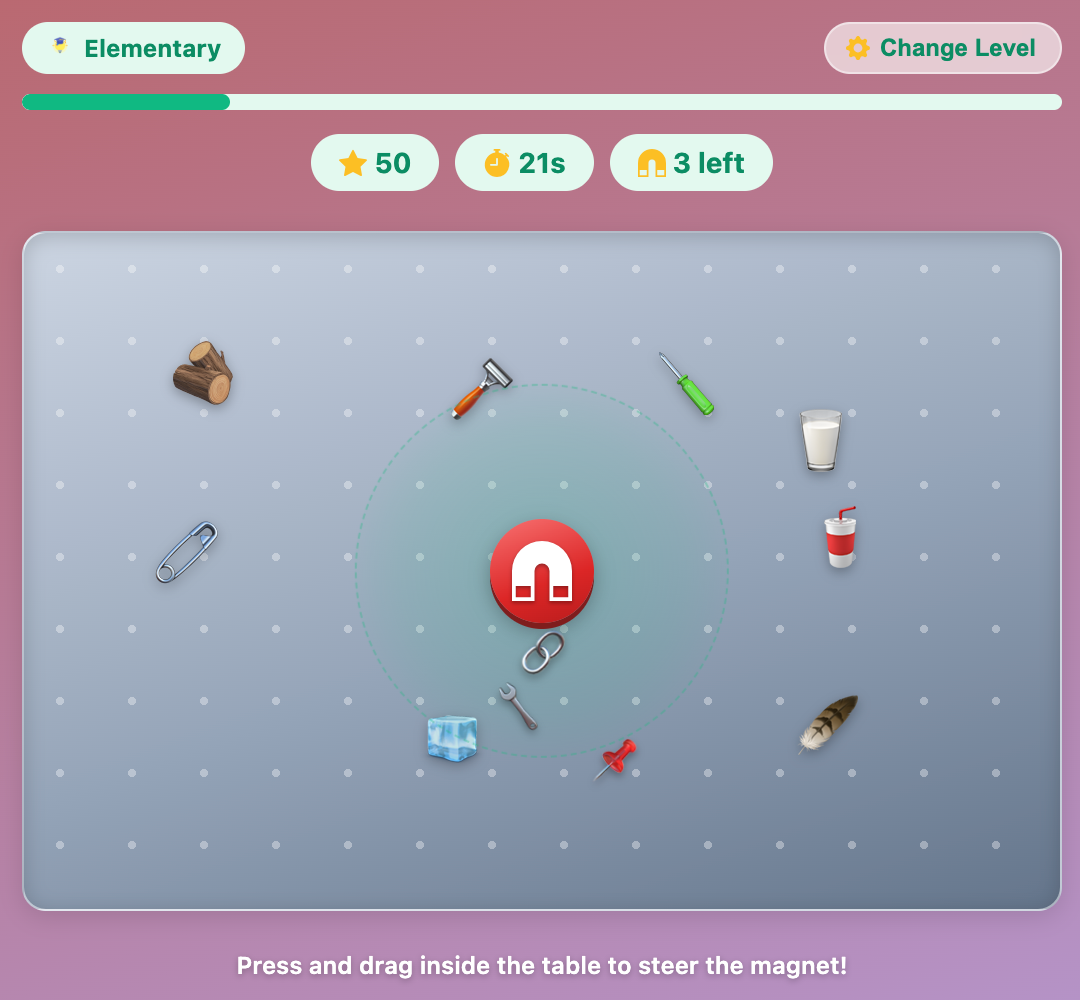
A screenshot when start a new Magnet Experiment for elementary
More Science Games
 85.5K plays
4.9
85.5K plays
4.9
Grow a Plant
Pick a seed, then keep its Water, Heat, and Nutrients gauges in the right zone to grow it into a full bloom before the weeks run out!
 58.5K plays
5.0
58.5K plays
5.0
Recycling Sort
Sort everyday items into the Recycle, Compost, or Trash bin before time runs out!
 876.5K plays
4.9
876.5K plays
4.9
Science Quiz
Pick your age level and answer fun multiple-choice science questions!
 193.4K plays
5.0
193.4K plays
5.0
Classify It!
Decide which science category each picture belongs to before time runs out.
Most Played Games
 1.8M plays
5.0
1.8M plays
5.0
Color & Draw
A free-drawing canvas with colors and brush sizes to unleash your creativity.
 365.3K plays
4.9
365.3K plays
4.9
Tic-Tac-Toe
Play a game of Tic-Tac-Toe against the computer and see if you can outsmart it.
 1.1M plays
4.9
1.1M plays
4.9
Chess
Play the classic game of chess against the computer or a friend, with FIDE time controls, hints, and undo.
 154.5K plays
4.9
154.5K plays
4.9
Mood Palette
Decide which color best fits a mood or theme before time runs out.
Comments (82)