
Water Cycle Explorer
76.6K playsExplore a living 3D water cycle in action — tap Ocean, Lake, River, Glacier, and Mountain to discover facts and take on the quiz!
Picture a whole tiny world sitting right on your screen: a blue ocean sparkling in the sun, a snow-capped mountain poking into the clouds, a quiet lake tucked in the hills, and a winding river carrying water all the way home to the sea. Now watch closely — because that water never stops moving. A puff of mist rises off the ocean, drifts up into the sky, puffs up into a big fluffy cloud, and then tips over and rains down somewhere brand new, over and over, forever, whether you're watching or not. That's Water Cycle Explorer, the living, breathing 3D landscape here on KidWorld, and more than 70,000 kid explorers have already wandered its hills and watched its clouds roll by, leaving behind a glowing 4.9-star rating from thousands of happy players. Grab the world, give it a spin, and watch nature's most amazing recycling trick happen right in front of your eyes!
💧 What Is Water Cycle Explorer?
Water Cycle Explorer isn't a flat drawing or a quiz with a timer — it's a real 3D island you can spin around and zoom into with your finger or your mouse, sitting out in space with its own little ocean lapping at the shore. On this one island you'll find five real water-cycle locations all in the same scene: a wide ocean, a sparkling lake, a winding river, an icy glacier, and a tall, snow-topped mountain — plus a whole forest of trees scattered across the hillsides. Nothing on this island ever sits still. Right now, this very second, invisible water vapor is drifting up from the ocean into the sky. It cools off, turns into a fluffy white cloud, and once that cloud gets nice and full, it floats over to join up with other clouds before letting go — sometimes as rain over the river, sometimes as sparkly snow over the icy mountain top. You don't have to press a single button to make any of this happen. The water cycle just keeps cycling, exactly like it does on the real Earth, whether you're watching or off exploring somewhere else on the island.
🕹️ How to Play Water Cycle Explorer on KidWorld
Spin and zoom the island. Click or touch and drag anywhere to turn the whole landscape around, and scroll or pinch to zoom in close enough to watch individual raindrops fall or pull back to see the whole island glowing under its little sun.
Look for the glowing rings. Five golden rings glow softly on the ground — one at the ocean, one at the lake, one along the river, one on the icy glacier, and one partway up the mountain. Each one marks a real spot where a piece of the water cycle is happening.
Tap a ring to open its info panel. Tapping a glowing ring opens a friendly panel explaining exactly what's happening at that spot right now — is it Evaporation, Condensation, Precipitation, Freezing, or Melting? — plus a couple of deeper "did you know?" facts to uncover.
Watch the clouds fill up and drift away. Keep an eye on the sky above each location — a small cloud slowly grows fluffier and whiter as tiny droplets rise up to join it. Once it's completely full, watch it drift off to meet other clouds before raining down somewhere new.
Browse by Groups. Tap the Groups button to see the island split into 💧 Water Bodies (the Ocean, Lake, and River, where liquid water flows) and ❄️ Frozen Water (the Glacier and Mountain, where things get icy and cold) — a quick way to compare how differently water behaves depending on the temperature.
Search for anything you remember. Tap the 🔍 Search button and type in a word like "snow" or "cloud," and Water Cycle Explorer instantly shows you which locations match — tap a result to fly right there.
Take a quick quiz. Tap the ❓ Quiz button for a friendly multiple-choice question about the water cycle. Answer correctly for a nice bundle of stars, or answer wrong and simply see the right answer light up so you learn something new either way — there's no penalty for a guess.
Handy tools: tap the fullscreen button above the game to make the island bigger and easier to explore, and use the reload button any time you'd like a fresh, zoomed-out view of the whole scene.
🗺️ The Five Real Places Where the Water Cycle Happens
Every single one of the five glowing spots on the island is teaching you about one real, true step of the water cycle scientists study all over the world:
🌊 Ocean — Evaporation. The Sun's heat turns liquid ocean water into invisible vapor that rises into the sky. This is where the whole water cycle really begins — and it's happening on the real ocean right now, even though you can't see it with your own eyes.
🏞️ Lake — Condensation. Rising water vapor cools off high in the sky and clumps together into billions of tiny droplets clinging to specks of dust — and that's exactly how a cloud is born.
🛶 River — Precipitation. Once a cloud's droplets get too heavy and crowded to stay floating, gravity pulls them back down to Earth as rain — and rivers carry that rain all the way back home to the ocean.
🧊 Glacier — Freezing. Way up at this cold, high spot, falling water doesn't stay a raindrop — it freezes solid into a snowflake instead, piling up into thick, ancient ice.
🏔️ Mountain — Melting. When the weather warms back up, that frozen mountain snow melts into liquid water again and trickles downhill, feeding rivers and lakes all over again.
🔬 Real Water Cycle Science: How to Really Understand This Game
Watching the clouds drift by is fun all on its own, but here's the real science hiding behind Water Cycle Explorer's five glowing spots — the kind of deep knowledge that turns a fun island into a genuine science lesson:
The Sun powers the whole thing. Nothing in the water cycle moves without the Sun's heat energy. It's the Sun that warms the ocean enough to lift water up into the sky as vapor — no Sun, no water cycle at all.
Salt gets left behind. When ocean water evaporates, only the water itself rises into the sky — the salt stays right where it was. That's the real reason rain never tastes salty, even though a huge amount of it started out as ocean water.
A cloud is heavier than it looks. Even though clouds float gently through the sky, an average fluffy cloud can weigh over a million pounds! It floats because its water droplets are spread out so thin that the whole puffy cloud is still lighter than the air holding it up.
Cold air makes snow instead of rain. The very same falling water droplet can land as rain or as snow — the only difference is how cold the air is on the way down. That's why the game's clouds snow over the icy Glacier and Mountain, but rain everywhere else.
Glaciers are Earth's biggest water piggy bank. Believe it or not, glaciers store almost 70% of all the fresh water on the whole planet, frozen solid — some of it for thousands and thousands of years.
Melted snow feeds millions of people. When mountain snow melts each year, it becomes a major source of fresh water for the rivers that millions of people, farms, and animals depend on to live.
Plants breathe out water too. It's not just oceans and lakes — plants release water vapor into the air straight through their leaves, in a process scientists call transpiration, adding even more moisture to the sky.
The water cycle never makes new water. Here's the biggest secret of all: not one single drop of water is ever created or destroyed by the water cycle. The very same water has been evaporating, raining down, and flowing back to the sea for billions of years — which means some of the water in a puddle today might once have fallen as rain on a dinosaur!
⭐ How to Earn the Most Stars on Water Cycle Explorer
Water Cycle Explorer doesn't have a finish line to race toward — it's a living island you can visit again and again, and every bit of learning you do earns real stars for your KidWorld profile.
Every new fact you uncover earns stars. Each discovery is quietly labeled easy, medium, or hard behind the scenes — trickier facts earn more stars than simple ones, so the harder-sounding secrets tend to pay off best.
Stars only come from brand-new discoveries. Once you've opened a fact, reading it again won't earn extra stars — so keep exploring locations you haven't fully checked yet to keep your star count climbing.
Quiz questions are a fast way to score big. Answering a quiz question correctly hands you a nice bundle of stars all at once, and answering wrong costs you nothing except the chance at those stars — so there's zero risk in taking a guess.
Your progress is always saved. Every fact you've discovered stays remembered right on your own device, so you can explore a little today and pick up exactly where you left off tomorrow.
🎯 Quick Water Cycle Quiz
Think you've already learned a few Water Cycle Explorer secrets? Try these bite-sized brain-teasers, just like the real ones waiting inside the Quiz button!
What is it called when the Sun heats water and turns it into invisible water vapor? (Answer: Evaporation!)
What do we call it when water vapor cools down and forms the tiny droplets that build a cloud? (Answer: Condensation!)
What's the name for water falling from clouds as rain, snow, sleet, or hail? (Answer: Precipitation!)
About how much of Earth's fresh water is stored frozen inside glaciers and ice caps? (Answer: About 70%!)
What do scientists call the water vapor that plants release into the air through their leaves? (Answer: Transpiration!)
True or false: the water cycle makes brand-new water every single time it happens. (Answer: False — it's the very same water, reused again and again!)
🌟 Why Water Cycle Explorer Is Such a Wonderful Fit for Kids
A drifting cloud and a snowy mountaintop might look like just a pretty scene, but Water Cycle Explorer is quietly one of the smartest science lessons on all of KidWorld:
A giant invisible process, finally made visible. The real water cycle happens all around us every day, but you can never actually watch a raindrop's whole journey with your own eyes — here, kids finally get to see the entire loop happen right in front of them.
Patient, calm observation instead of racing a clock. There's no timer counting down and no way to lose, so kids naturally slow down, watch closely, and notice small changes — a gentle, wonderful way to build real scientific curiosity.
Real earth science vocabulary, made unforgettable. Words like evaporation, condensation, and precipitation stop being flashcard homework and start being things a kid actually watched happen with their own eyes on a glowing 3D mountain.
A gentle reading workout, one fact at a time. Every discovery panel is a short, friendly burst of reading, perfect for building reading confidence and science vocabulary without ever feeling like a worksheet.
A deeper love for our one shared planet. Understanding that Earth's fresh water is precious, limited, and constantly recycled is a beautiful first step toward growing into a kid who cares about protecting rivers, lakes, and oceans.
No way to lose, ever. Every tap either teaches something brand new or gently reminds you of something you already know, so the only direction to go is forward.
🎮 Water Cycle Explorer for Every Age
Water Cycle Explorer doesn't lock any part of its island behind a difficulty setting or an age pick — every location and every fact is open to explore from the very first spin. That means the exact same drifting-cloud island can be a cozy bedtime wind-down for a toddler or a genuinely deep earth-science study session for a tween, just depending on how far you choose to dig together:
Water Cycle Explorer for toddlers (around ages 2 to 4): let a grown-up hold the spinning and zooming, then simply watch the clouds together and point out "look, it's raining!" whenever a merged cloud lets go. Naming the ocean, the mountain, and the snow out loud is plenty of learning for this age.
Water Cycle Explorer for preschool (around ages 4 to 6): tap each glowing ring together and read the short description out loud, then play a little game of "guess which one is next" — will the cloud rain, or will it snow?
Water Cycle Explorer for elementary (around ages 6 to 10): open every discovery fact at all five locations, try the Groups screen to compare Water Bodies against Frozen Water, and take a few Quiz rounds to turn freshly learned vocabulary into real stars.
Water Cycle Explorer for tweens (around ages 10 to 12): go for real mastery — learn every fact, ace every quiz question, and then try explaining the whole evaporation-to-condensation-to-precipitation loop from memory to a sibling or friend. Understanding how the very same water has been cycling for billions of years is the kind of big idea that sticks for life.
A whole living landscape where the Sun, the clouds, the rain, and the snow never stop moving — that's Water Cycle Explorer for kids of every age on KidWorld, and its island is ready and waiting for its next explorer. Give it a spin, tap a glowing ring, and see which secret of nature's greatest recycling trick you'll uncover first!
🖼️ See the Game in Action
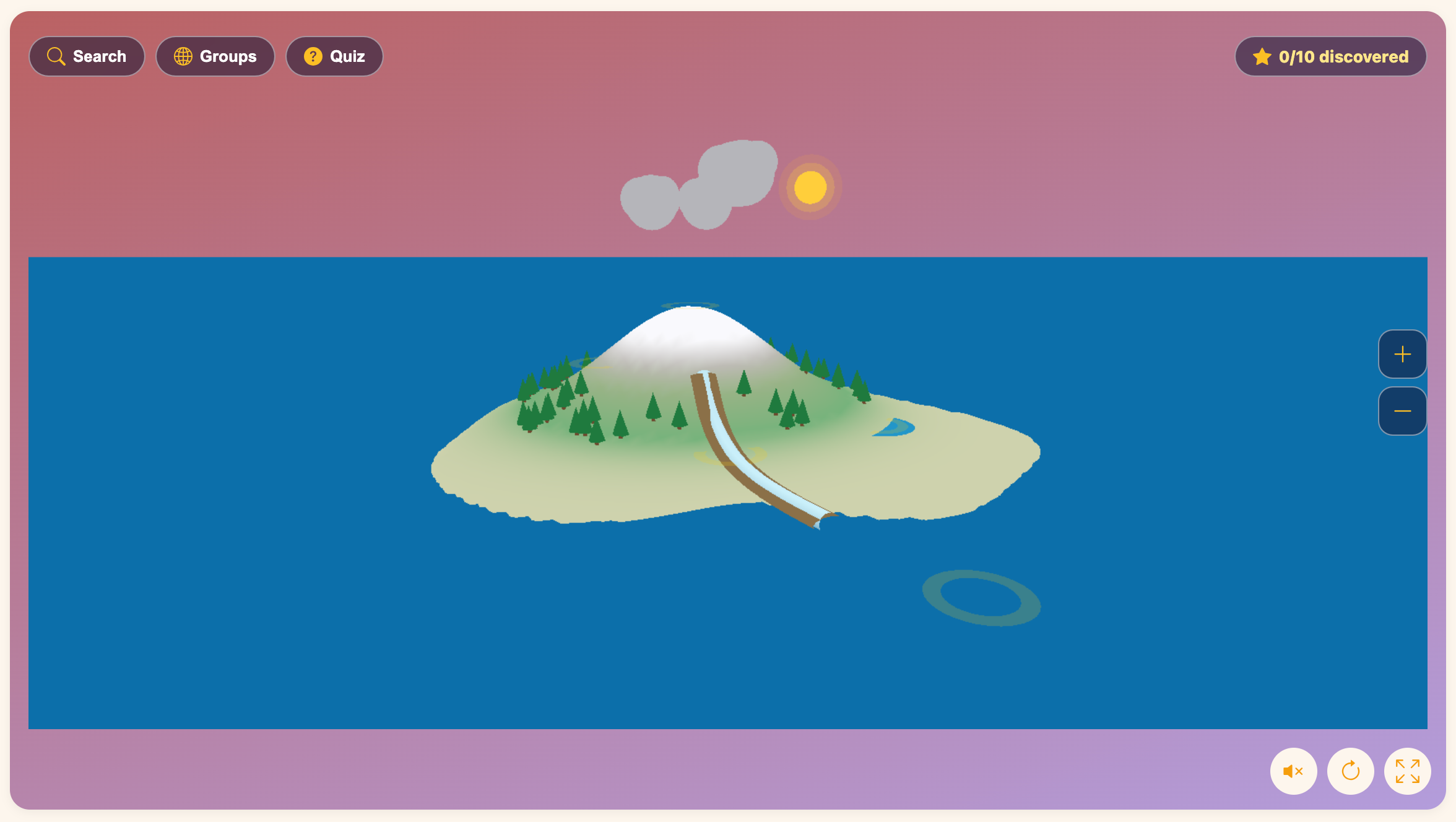
A screenshot about 3D of the Water Cycle Explorer game
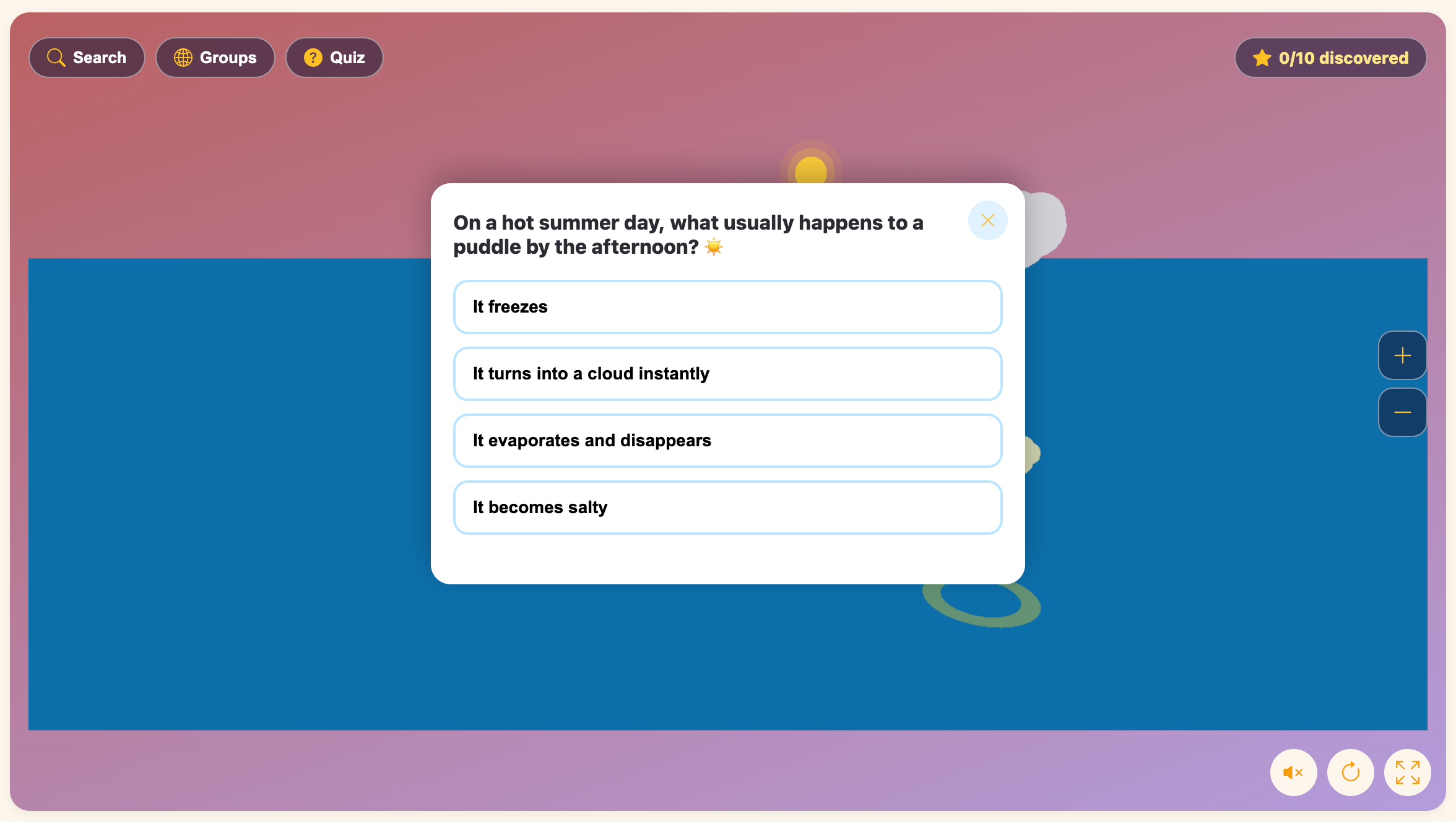
A screenshot about a quiz of the Water Cycle Explorer game
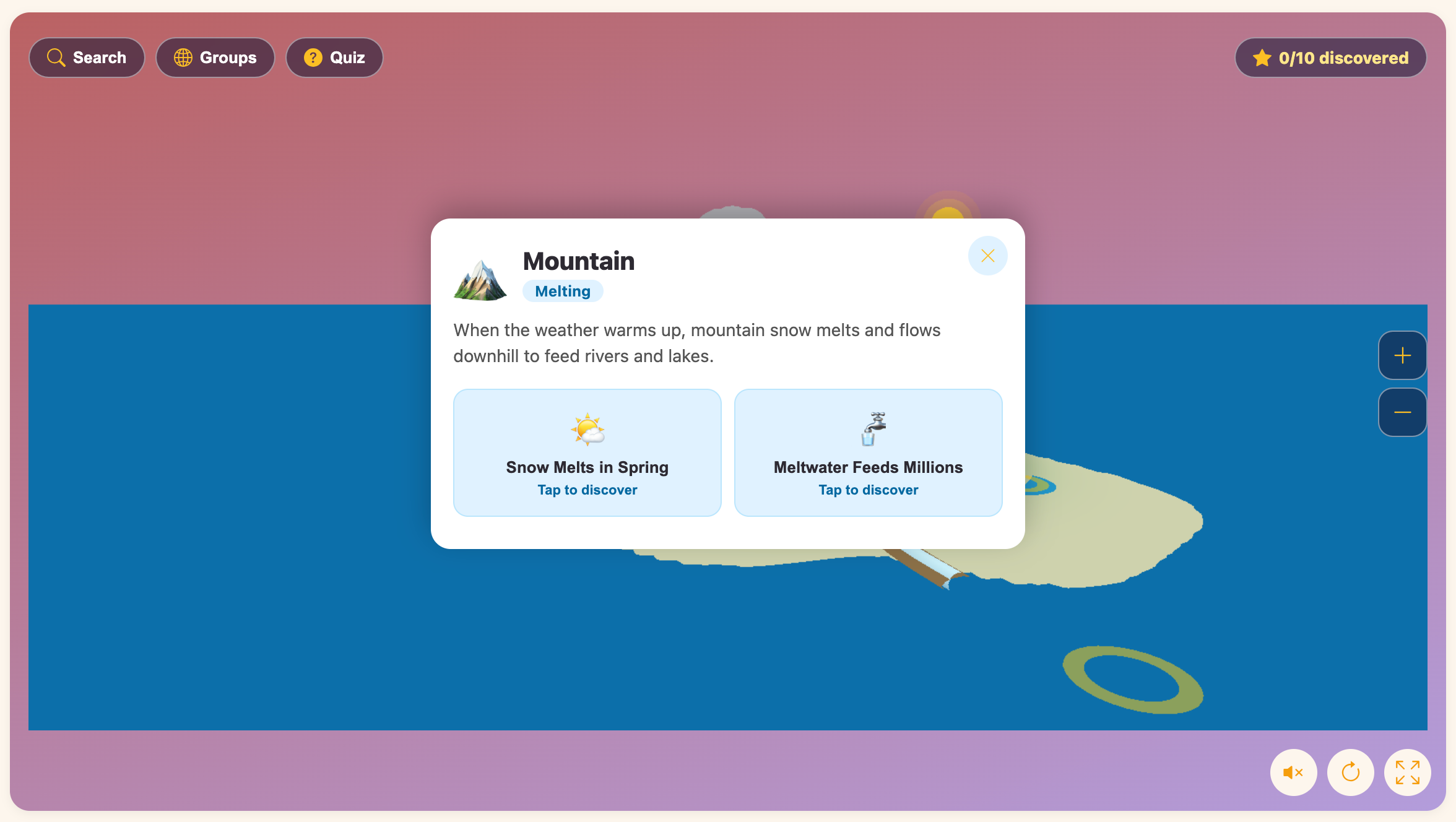
A screenshot showing information about the mountain scene in the Water Cycle Explorer game
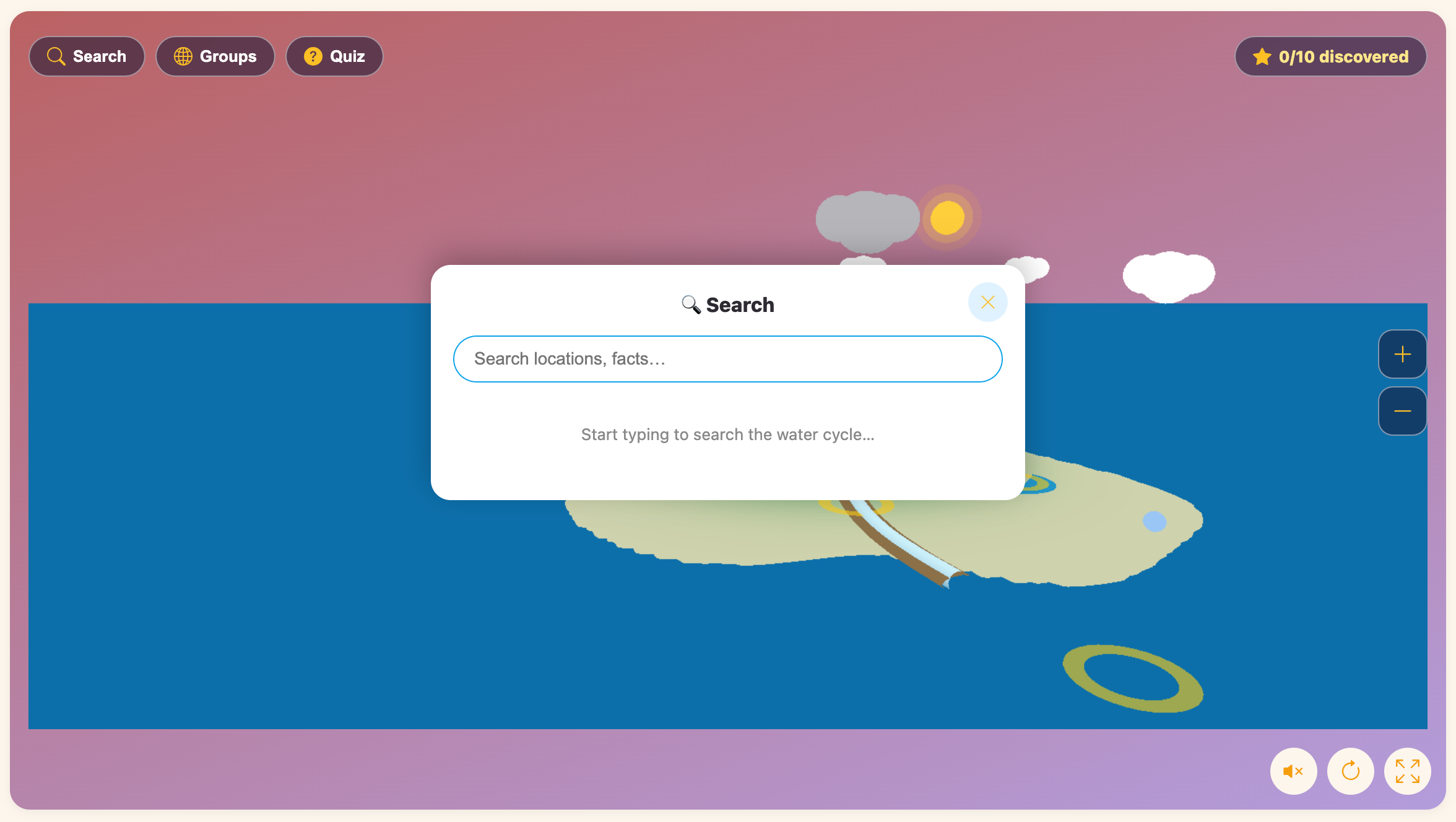
A screenshot about search feature of the Water Cycle Explorer game
More Science Games
 85.5K plays
4.9
85.5K plays
4.9
Grow a Plant
Pick a seed, then keep its Water, Heat, and Nutrients gauges in the right zone to grow it into a full bloom before the weeks run out!
 438.4K plays
5.0
438.4K plays
5.0
Magnet Experiment
Drag a magnet around the table and discover which objects it can pick up!
 58.5K plays
5.0
58.5K plays
5.0
Recycling Sort
Sort everyday items into the Recycle, Compost, or Trash bin before time runs out!
 876.5K plays
4.9
876.5K plays
4.9
Science Quiz
Pick your age level and answer fun multiple-choice science questions!
Most Played Games
 1.8M plays
5.0
1.8M plays
5.0
Color & Draw
A free-drawing canvas with colors and brush sizes to unleash your creativity.
 365.3K plays
4.9
365.3K plays
4.9
Tic-Tac-Toe
Play a game of Tic-Tac-Toe against the computer and see if you can outsmart it.
 1.1M plays
4.9
1.1M plays
4.9
Chess
Play the classic game of chess against the computer or a friend, with FIDE time controls, hints, and undo.
 154.5K plays
4.9
154.5K plays
4.9
Mood Palette
Decide which color best fits a mood or theme before time runs out.
Comments (44)