
Healthy Plate Chef
57.4K playsBe the chef and build balanced meals for hungry customers! Drag fruit, vegetables, grains, protein and dairy onto the right part of the plate and watch each customer cheer. Little chefs sort everyday foods and sometimes treats into baskets, while big kids find the food that gives energy for football or builds strong bones, match needs to nutrients like calcium, protein and fiber, and read food labels.
“I’m playing football this afternoon. I need lots of energy!” That’s the kind of order you get in Healthy Plate Chef for kids, a free science game about healthy eating. You are the chef. Drag fruit, vegetables, grains, protein and dairy onto the right part of a plate, and your customer cheers when the meal is balanced.
The plate follows MyPlate, the healthy-plate picture made by the U.S. Department of Agriculture: fruit and vegetables fill half of it, grains and protein share the other half, and dairy sits in a little dish beside it. Little chefs sort everyday foods and sometimes treats into two baskets. Bigger chefs find the food that meets a customer’s need, learn nutrients like calcium, protein and fiber, and compare simple food labels. The game plays in your browser on a computer, tablet or phone, with no download and no sign-up.
🍽️ A Plate With Five Places for Food
A food group is a set of foods that help your body in a similar way. The game shows each group with its own color and its own job, in the words the chef’s messages use:
Fruit (red): “Fruit is sweet and full of vitamins.” Think apples, bananas, grapes, strawberries, oranges, kiwis, pineapple, pears, watermelon and cherries.
Vegetables (green): “Vegetables help your body grow and stay healthy.” Carrots, broccoli, lettuce and green beans.
Grains (orange): “Grains give you energy to play.” Bread, rice, pasta, oatmeal and bagels.
Protein (purple): “Protein helps you grow and builds strong muscles.” Eggs, chicken, fish, beef and shrimp.
Dairy (blue dish): “Dairy has calcium for strong bones and teeth.” Milk, cheese and yogurt.
An empty part of the plate has a dashed edge in its own color, so you can see at a glance what’s still missing. The Vegetables and Grains parts are a little bigger than Fruit and Protein, just like on MyPlate.
Here’s a fun fact: you won’t find a tomato in this kitchen. Scientists call a tomato a fruit, but most cooks call it a vegetable! The game leaves out every food that could fairly go in two groups, like tomatoes, avocados, corn, peas and pizza, so no answer is ever unfair.
🧺 Everyday Foods or Sometimes Foods?
On the two youngest levels, some rounds have no plate. Instead there are two baskets: Everyday (green) and Sometimes (orange). Foods from the five groups go in Everyday. Treats go in Sometimes: cupcakes, donuts, cookies, lollipops, candy, chocolate, fries, soda, ice cream and cake.
The game never calls a treat bad. Each one gets a kind message instead, like “Ice cream is a sometimes food: a cool treat on a hot day!” or “Soda is a sometimes food: a fizzy treat now and then. Water and milk are the everyday drinks.” When all the foods are sorted, the chef says: “Everyday foods help you grow and play. Sometimes foods are treats: fun to enjoy now and then!”
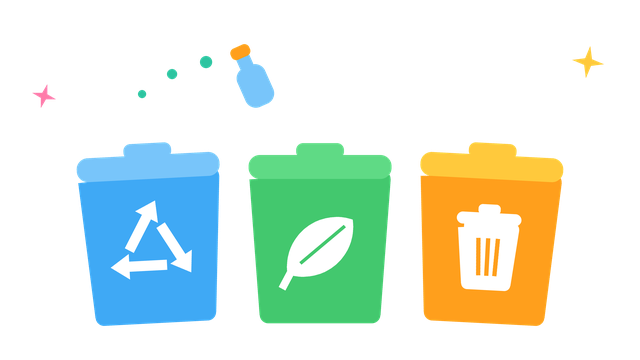
If dragging things into the right bin is your favorite part, Recycling Sort has you sort everyday items into Recycle, Compost and Trash bins.
👩🍳 Serving a Customer on KidWorld, Step by Step
Choose your level. The Choose Your Level screen has four cards: Toddlers (ages 2–4), Preschool (4–6), Elementary (6–10) and Tweens (10–12). On your first visit, the game starts you on Elementary. The Change Level button at the top brings the cards back at any time.
Meet your customer. The box at the top shows the customer’s face and name (like Mia, Leo or Priya), a small picture of what they need, and what they say in quotes. Press the 🔊 button to hear it.
Look at the tray. The food cards sit next to the plate. Some are spare foods and some are treats, so you won’t use every card. Leftovers are fine!
Put a food on the plate. Drag a card onto its part of the plate. Or, if dragging is tricky, tap the card and then tap the part. This works with a mouse or a finger. Pressed a card by mistake? Press Esc to put it back.
Read the message. Each food that goes in gets a short line, like “Milk! Dairy has calcium for strong bones and teeth.” If a food bounces back, the message tells you why and where it goes.
Finish the plate. When every part has a food, the customer’s face turns 😋 and they thank you, like “Yum! The carrot will help my tummy!” A panel shows your stars for this plate, such as “Perfect plate!”, and a short fact.
Press Next, or wait. The Next button fills up as it counts down from 5, then moves on by itself. You can also press it, or press Enter or the space bar. If the voice is reading, the countdown waits until it’s done.
Answer the question (Elementary and Tweens). After each plate comes a question with three answers. Click one, or press 1, 2 or 3. You get one try, and then the game shows the right answer and explains why.
See your Super Chef card. At the end you get your final score, up to five stars, and a gallery of every plate and basket you made, each with its own stars. “Look at these again” lists the questions you missed, with the answer and a 🔊 button. Press Play Again or Choose Another Level.
Use the page buttons. The KidWorld page around the game has buttons for fullscreen, reload and music.
⭐ How Stars and Points Add Up
Each plate or basket round earns up to 3 stars. No mistakes earns 3 stars, one or two mistakes earn 2, and more earn 1. Every star is worth 10 points.
Each right answer earns 10 points. That goes for the plate questions and the food label rounds.
What counts as a mistake: putting a food on the wrong empty part, putting a treat on the plate, or dropping a food in the wrong basket.
What doesn’t: dropping a food on a part that already has one (you just get a hint), or dropping it off the plate.
The best score is 90 on Toddlers and Preschool, 120 on Elementary and 140 on Tweens. The five stars on the Super Chef card come from your share of that best score: 90% or more earns five stars, 70% four, 50% three and 25% two.
For example, on Elementary say your three plates earn 3, 2 and 3 stars. That’s 80 points. Then you get two of the three questions right for 20 more. Your 100 out of 120 is about 83%, which earns four stars.
🥇 Healthy Plate Chef for Kids: How to Earn Three Stars on Every Plate
1. Spot the treats first, then leave them
Before you move anything, look at the tray for treats like 🧁, 🍩, 🍪, 🍟 or 🥤. A treat on the plate is always a mistake, and you never have to use it. Preschool and Elementary trays hide one treat, and Tweens trays hide two. Once you know where they are, you can’t drop one by accident.
2. Ask where the food comes from
A few quick questions sort almost any food. Is it the sweet part of a plant that holds its seeds, like a berry or an apple? Fruit. Is it a leaf, a root or a flower bud, like lettuce, a carrot or broccoli? Vegetable. Is it made from wheat, rice or oats? Grains. Is it meat, fish, shrimp or an egg? Protein. Is it made from milk? Dairy.
3. Follow the colors
Each part has its color: red Fruit, green Vegetables, orange Grains, purple Protein and the blue Dairy dish. The messages use the colors too, like “It goes in the green Vegetables part.” Little chefs who can’t read the labels yet can still match the colors.
4. Know what costs a star and what doesn’t
Spare foods in the tray come from other groups. Say the Fruit part already has cherries and you drop an orange there. That isn’t a mistake: the game just says “The Fruit part already has the cherries. Try a different food.” But if you drop the orange on the empty Protein part, that is a mistake. So when you aren’t sure where a food goes, don’t guess on an empty part. Think it through first.
5. Use the glow (Toddlers and Preschool)
On the two youngest levels, the part where a picked food belongs glows yellow on the plate. Pick up the food, look for the glow, and drop it there. There’s no glow in the basket rounds, because that would give the answer away.
6. Read the customer’s need before you build
On Elementary and Tweens, the question after each plate is about what the customer asked for. The food in the matching part is always a great source of the nutrient they need. Here’s how needs match parts of the plate:
Energy for football: the Grains food, full of carbohydrates.
Strong bones and teeth: the Dairy food, full of calcium.
Strong muscles for climbing the big rock wall: the Protein food.
A tummy that works well: the Vegetables food, full of fiber.
Fighting off germs: the Fruit food, full of vitamin C.
7. On label rounds, look only at the yellow row
Each label lists three nutrients, but only one is asked about, and that row is highlighted in yellow. Compare just those two numbers. Then read the question again: does it ask for more or less? Most ask which has more fiber, protein or calcium, but sugar questions ask which has less.
8. Learn from a bounce
When a food bounces back, the message tells you its group and where it goes: “An apple is a fruit. It goes in the red Fruit part.” Read it, move the right food, and you’ll remember that group next time.
9. Tap instead of drag on a small screen
On a phone, dragging a card across the screen can slip. Tap the card, then tap its part of the plate. It counts the same, and it’s easier for small fingers.
🔎 Five Orders, Worked Out
An energy order (Elementary)
Leo says, “I’m playing football this afternoon. I need lots of energy!” You fill his plate, and say the Grains part gets pasta, the Protein part gets chicken and the Vegetables part gets broccoli. Then the question comes: “Which food on Leo’s plate has the most carbohydrates for energy?” The answers are Pasta, Chicken and Broccoli. Carbohydrates are your body’s main fuel, and grain foods are full of them, so Pasta is right.
A tummy order (Elementary)
Priya says, “I want my tummy to work well!” After her plate, the question is “Which food on Priya’s plate has the most fiber?”, with Carrot, Milk and Chicken. Fiber helps food move through your tummy, and it comes from plants. Milk and chicken come from animals and have no fiber at all, so the carrot wins.
A muscle order (Tweens)
On Tweens, the question asks about the nutrient itself: “Sam wants strong muscles. Which nutrient does the body build muscles from?” The answers are Protein, Fiber and Vitamin C. Your body builds and repairs muscles with protein, so Protein is right. Fiber helps your tummy, and vitamin C helps your body’s germ fighters.
A yogurt label (Tweens)
Two labels show Yogurt A and Yogurt B, each per pot. The question is “Which yogurt has more calcium?”, and the calcium row is yellow. Yogurt A has 130 mg and Yogurt B has 280 mg. Don’t let the sugar and protein rows distract you: 280 is more than 130, so Yogurt B is right.
A cupcake in the tray (Preschool)
Your tray has a cupcake next to the everyday foods. If it lands on the plate, it bounces back with “A cupcake is a sometimes food: a treat for a birthday party! Today’s plate needs everyday foods.” That counts as a mistake. Just leave it in the tray, and fill the plate with one food from each group.
🎒 From Little Sorters to Label Readers
Healthy Plate Chef for toddlers (ages 2–4)
Toddlers play three short rounds. First they sort 2 everyday foods and 2 treats into the baskets. Then a hungry customer arrives with a plate that already has grains, protein and dairy, so toddlers only add one fruit and one vegetable, picked from a tray of two of each. Last comes one more basket round. The picked food’s part glows, and with the sound on, every message is read aloud. A grown-up can help with dragging while the child picks the food.
Healthy Plate Chef for preschoolers (ages 4–6)
Preschoolers sort 3 everyday foods and 3 treats, then fill two whole plates, with one food for each of the five parts. Each tray has one spare food and one treat to leave out. Some customers say what they want, like “I want strong bones and teeth!”, and thank you for it. The glow and the read-aloud messages are still there. Preschoolers who love sorting can also try Category Sort, which asks whether each picture is an animal, a food, a toy or a vehicle.
Healthy Plate Chef for elementary kids (ages 6–10)
Elementary kids serve three customers, each with a different need: energy, strong bones, strong muscles, a healthy tummy or fighting germs. Each tray has 8 cards: 5 for the plate, 2 spares and 1 treat. There’s no glow now, so kids have to know the groups. After each plate comes a food question, like which food has the most calcium.
Healthy Plate Chef for tweens (ages 10–12)
Tweens also serve three customers, but each tray has 10 cards, with 3 spares and 2 treats to leave out. The questions name the nutrients: carbohydrates, calcium, protein, fiber and vitamin C. Between the plates come two label rounds with cereal, yogurt or bread, where tweens read Nutrition Facts boxes and compare sugar, fiber, protein or calcium per serving.
🌱 What Cooking Up Plates Teaches
The half-plate rule. Every plate a child builds looks the same way: fruit and vegetables fill half of it. After a few customers, kids start to picture that half-and-half plate at their own table.
Why each food group matters. Each food that goes in comes with its job: grains for energy, protein for muscles, dairy for bones. Kids hear the reasons over and over, so they remember why to eat their broccoli, not just that they should.
Treats without guilt. The Sometimes basket teaches balance, not fear. A cupcake is “a treat for a birthday party”, not a bad food. That’s a kinder, healthier way to think about eating.
Reading real labels. The tween label rounds look like the Nutrition Facts boxes on real food packages. After a few rounds, comparing two cereals at the store feels like a game.
Where the food goes next. Once the plate is eaten, the food’s adventure is just starting. In Food Journey, kids ride a piece of fruit through the mouth, stomach and intestines to see what the body does with it.
👪 For parents and teachers
Healthy Plate Chef is gentle and safe. No food is ever called bad or unhealthy, and treats are always “sometimes foods”. The nutrition facts were checked, and only foods with one clear group are used. Vitamin C is said to help the body’s germ fighters, with no promise that it stops colds. The game practices food groups, nutrients, reading and simple comparing of numbers. With the read-aloud on, pre-readers can play too. Try asking your child at dinner which food group is missing from the table.
Your first customer is already waiting, and they’re hungry! Tie on your apron, choose a level and start cooking in Healthy Plate Chef for kids.
🖼️ See the Game in Action
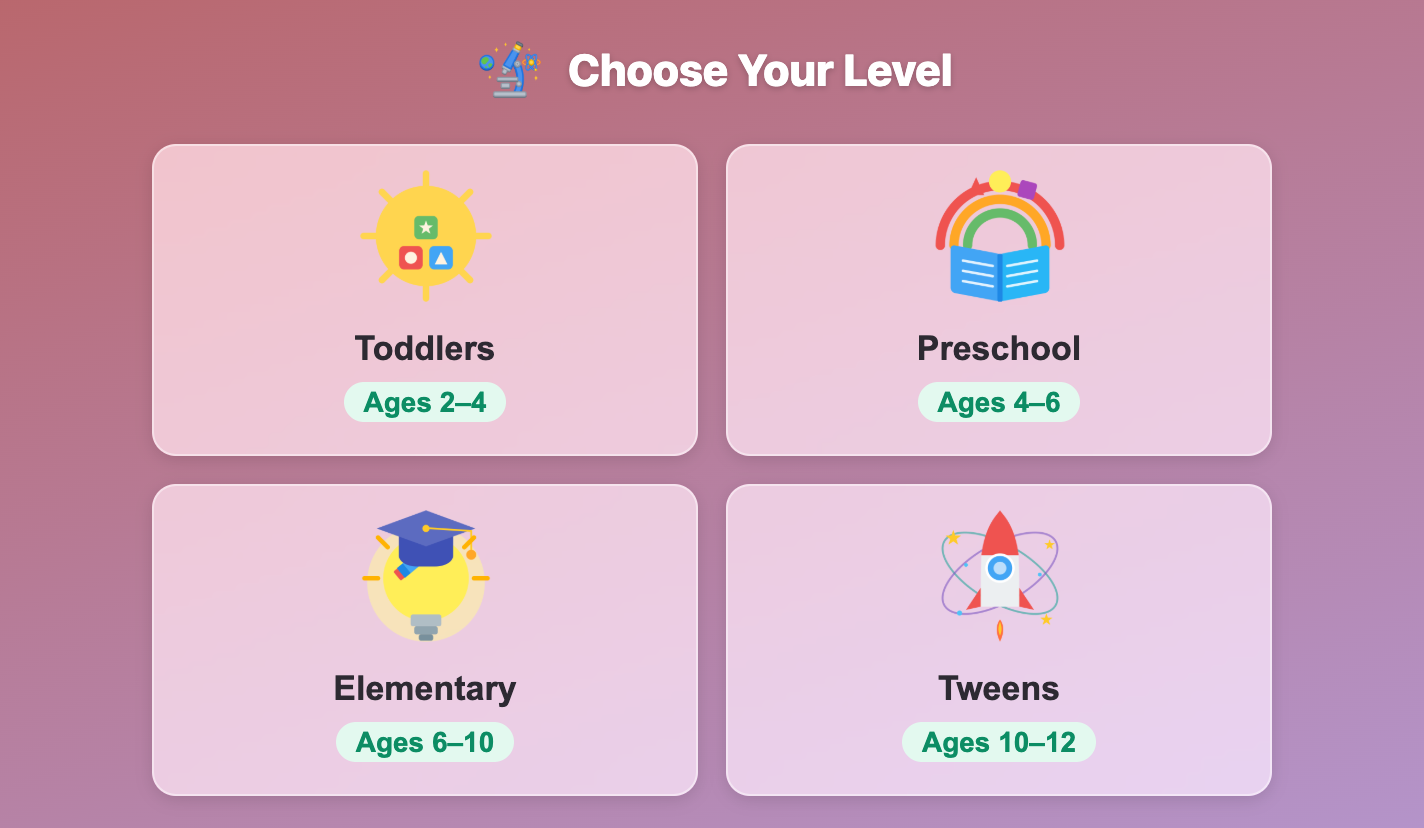
The Choose Your Level screen in Healthy Plate Chef with Toddlers, Preschool, Elementary and Tweens cards
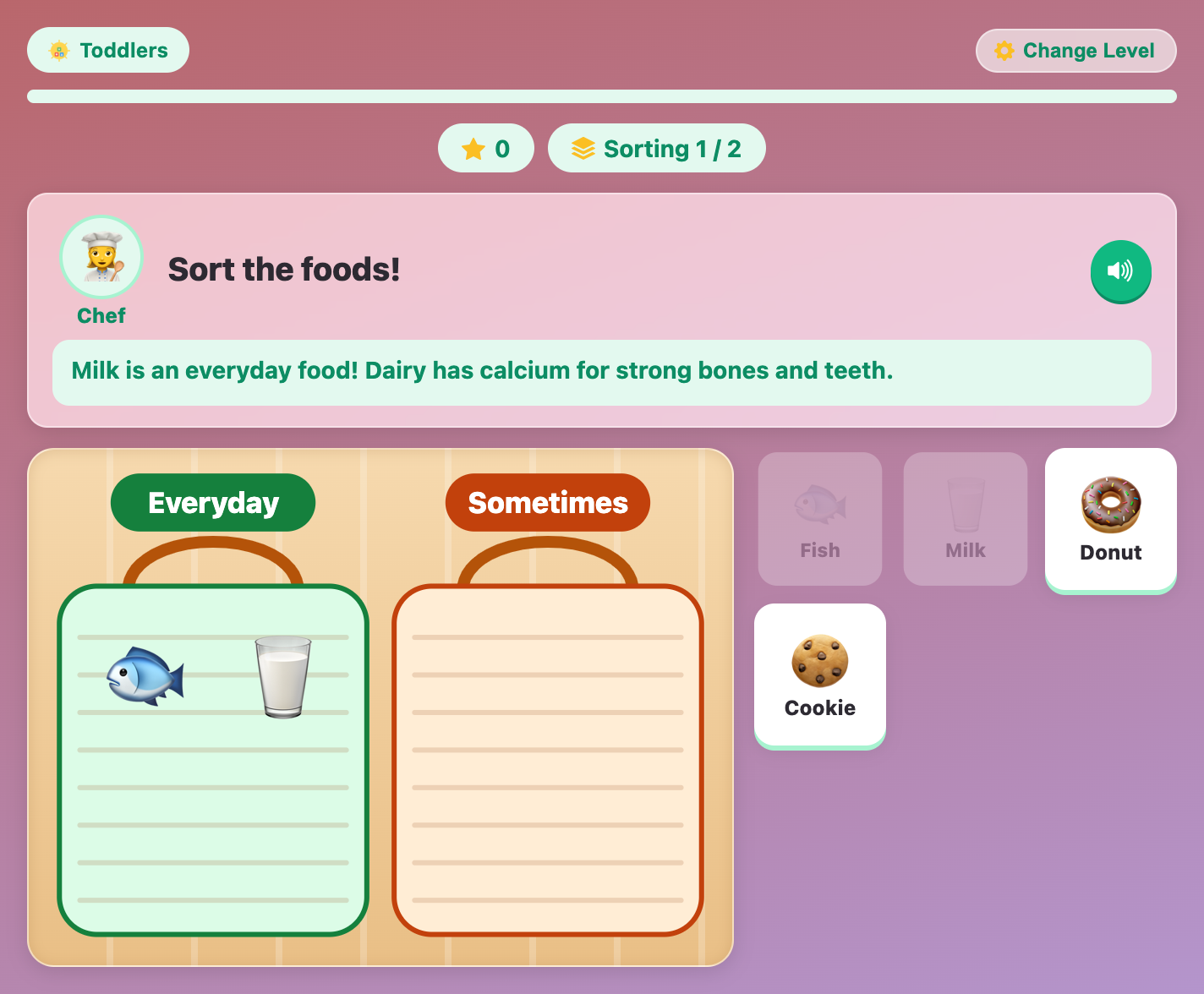
A fish and a glass of milk in the Everyday basket while a donut and a cookie wait in the tray
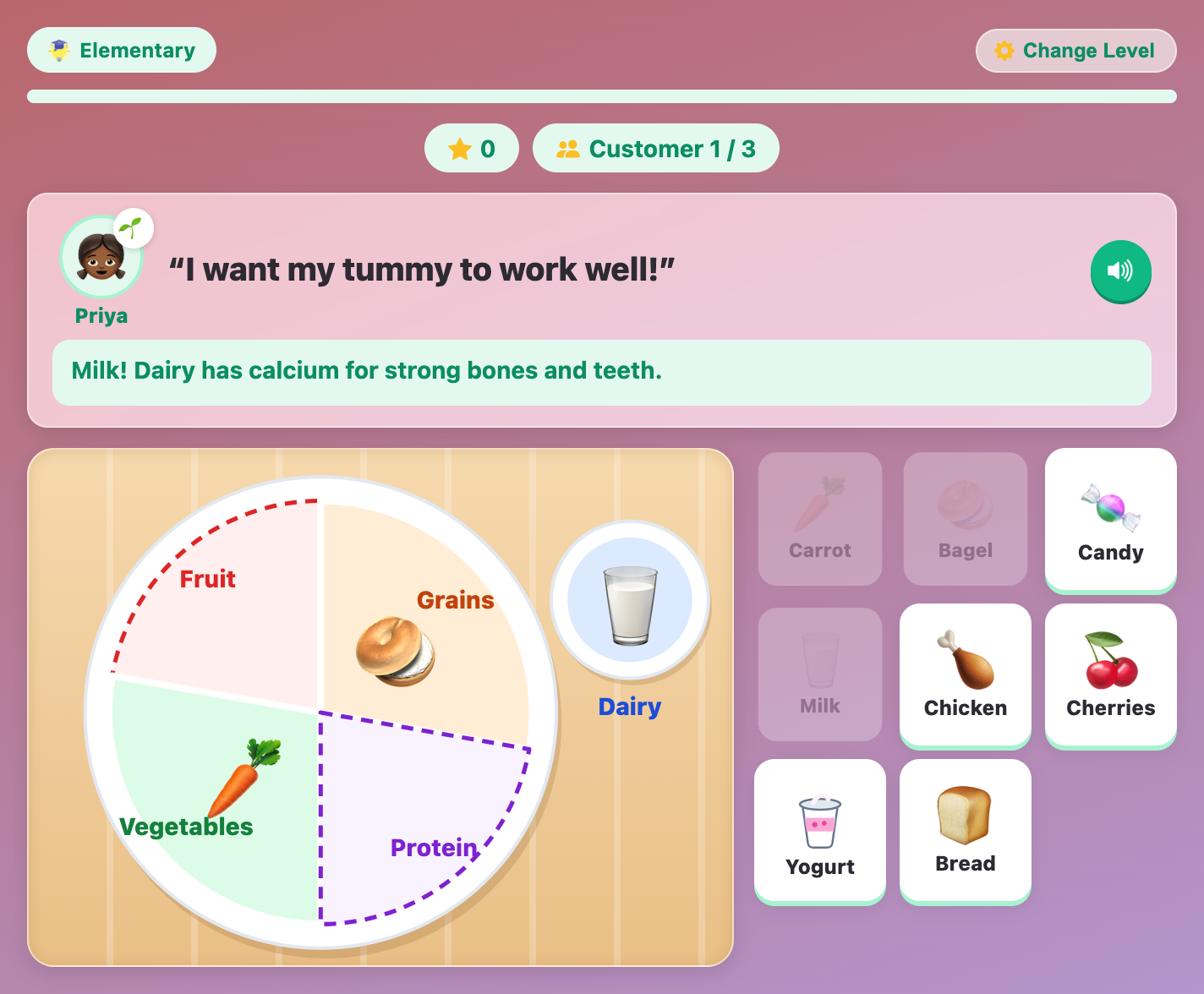
Priya wants her tummy to work well while a bagel, a carrot and milk sit on a half-built plate
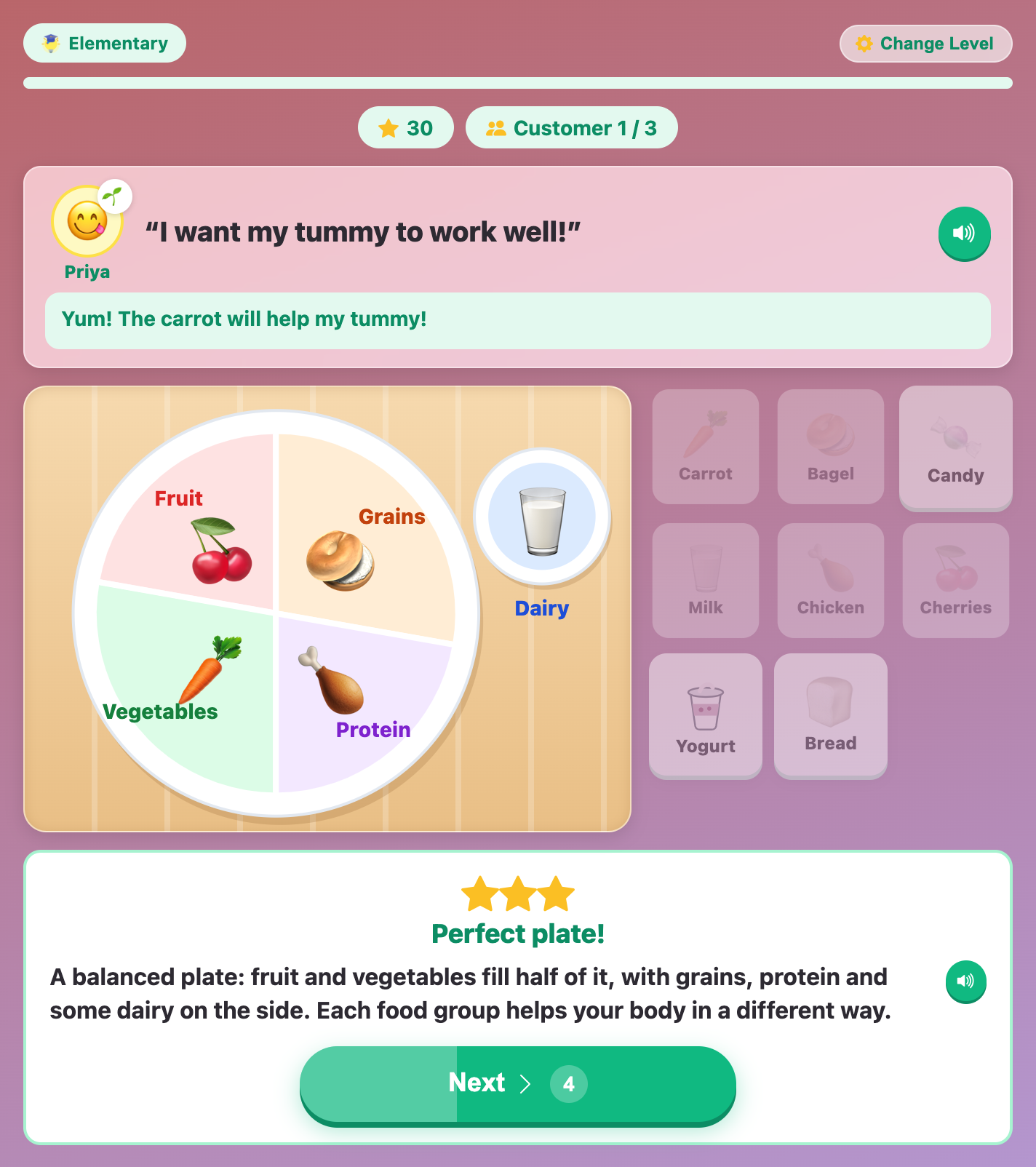
A full plate with cherries, a bagel, a carrot, chicken and milk earning three stars and Perfect plate!
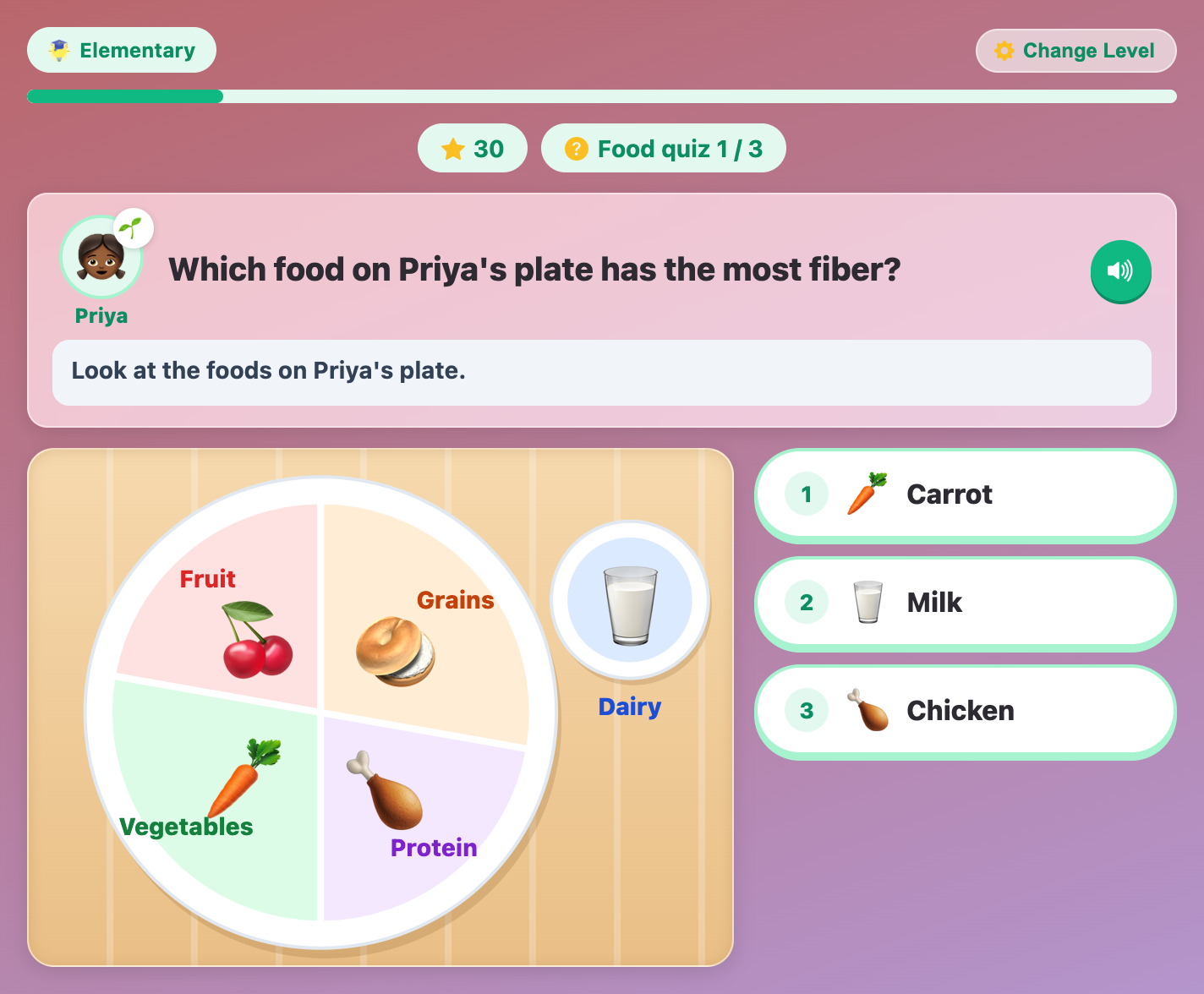
A food quiz in Healthy Plate Chef for kids asking which food on the plate has the most fiber
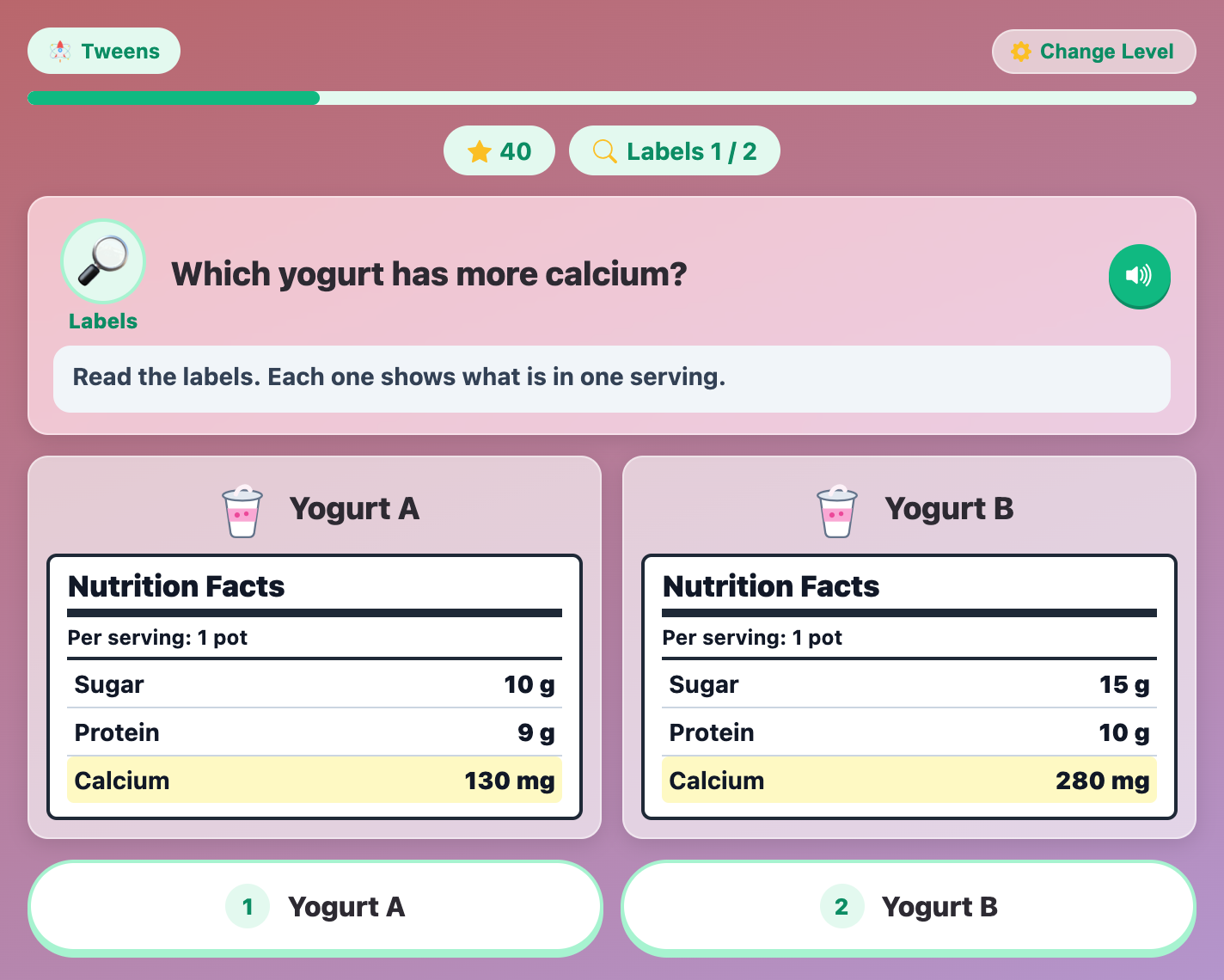
Two Nutrition Facts labels for Yogurt A and Yogurt B with the calcium row highlighted for tweens
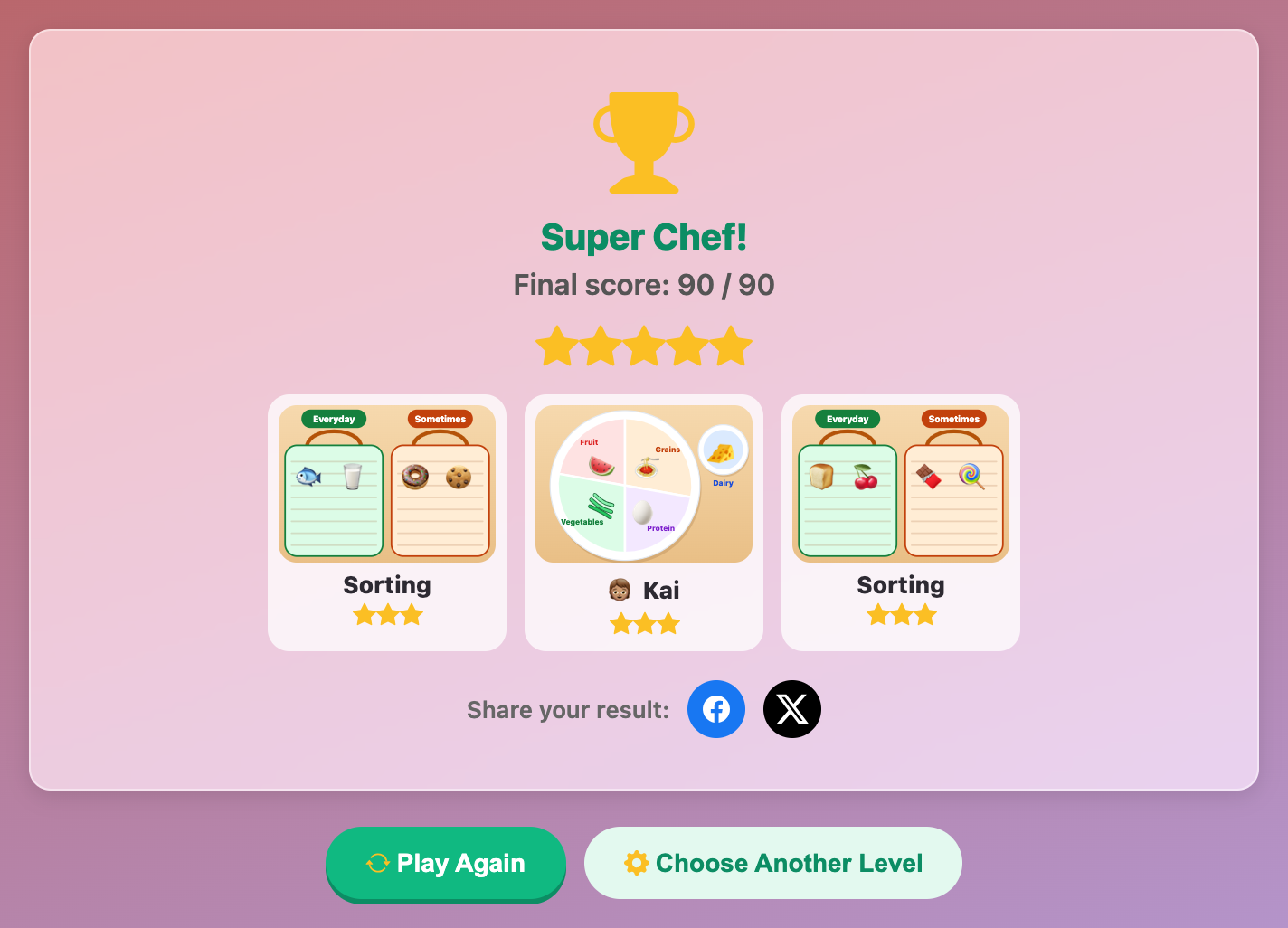
The Super Chef finish card with a trophy, five stars and a gallery of two sorted baskets and one plate
More Science Games
 59.5K plays
4.8
Recycling Sort
Sort everyday items into the Recycle, Compost, or Trash bin before time runs out!
 85.7K plays
4.9
Grow a Plant
Plant seeds in sunny and shady garden beds, then water, feed and protect them day by day. Watch the roots grow underground and harvest sunflowers, tomatoes, carrots and more!
 438.6K plays
4.9
Magnet Experiment
Guess which objects a magnet will pull, then drag the magnet to test every guess. Does gold stick? Does a battery?
 386.9K plays
4.9
Five Senses Match
Decide which of your five senses you would use for each everyday scene before time runs out.
Most Played Games
 1.8M plays
4.9
Color & Draw
A free-drawing canvas with colors and brush sizes to unleash your creativity.
59.5K plays
4.8
Recycling Sort
Sort everyday items into the Recycle, Compost, or Trash bin before time runs out!
 365.8K plays
5.0
Tic-Tac-Toe
Play a game of Tic-Tac-Toe against the computer and see if you can outsmart it.
 274.1K plays
5.0
Sentence Builder
Pick your age level, then tap the shuffled words in the right order to build the sentence.
Comments (20)