
Food Journey
127.4K playsRide a cute piece of fruit through your digestive system! Get chewed in the mouth, slide down the esophagus, dodge acid splashes in the stomach, grab nutrients in the small intestine and collect water drops in the large intestine. At every gate, hop under the right answer about what each part does. Little kids learn that food gives us energy, and big kids learn about enzymes, villi and absorption.
Where does an apple go after you swallow it? In Food Journey for kids, you get to ride along and find out! This free 3D science game puts you in charge of a smiling piece of fruit as it travels through the five parts of the digestive system: the mouth, the esophagus, the stomach, the small intestine and the large intestine. At every gate, three signs hang over the path, and you hop under the one with the right answer about what that part of the body does.
The tunnel changes as you go. Teeth line the walls of the mouth, muscles squeeze in the esophagus, acid bubbles in the stomach, and tiny finger-like bumps wave in the small intestine. Nothing chases you, so every ride reaches the end. Food Journey plays right in your browser on a computer, tablet or phone, with no download and no sign-up. It has four levels for kids from about 2 to 12.
🍎 What Happens to Food Inside You?
Your body can’t use an apple the way it is. First it has to break the apple into tiny pieces, so small that they can slip into your blood. That breaking-down job is called digestion. The body parts that do it are called the digestive system. You can think of it as one long, bendy tube that starts at your lips.
Each part of the tube has its own job. Teeth chew, the stomach mashes, the small intestine soaks up the good stuff, and the large intestine takes back water. In a real body, the whole trip usually takes about 1 to 3 days. In the game it takes about three to five minutes, which is much faster!
Food Journey turns that trip into a ride. The question at each gate is about the part you are riding through. So by the end, you have met all five parts in the right order and learned what each one does.
🗺️ Five Stops, Five Jobs: What Waits Inside the Tunnel
Between two parts stands a round door made of muscle. Scientists call a ring of muscle like this a sphincter (say “SFINK-ter”). Its petals stay shut until your snack gets close, and then they open. A board on top says “Next stop”, and a banner at the bottom of the screen shows the new part’s name and its job. Which obstacles you meet depends on your level, as you’ll see further down.
👄 Stop 1: The Mouth
Your ride starts in a pink tunnel lined with big white teeth. Jump over a row of bottom teeth. Slide under the top teeth as they chomp up and down. Step into another lane to get past a giant molar with a friendly face. (A molar is one of the big, flat teeth at the back of your mouth.)
⬇️ Stop 2: The Esophagus
The esophagus (say “ih-SOF-uh-gus”) is the tube that carries food from your throat down to your stomach. Its walls have stripes of muscle. Jump over the muscle ridges, and slide under the bands of muscle that squeeze in from above.
🥣 Stop 3: The Stomach
The tunnel turns orange, with soft folds and acid bubbles on the walls. Jump over lumps of mashed food and pools of acid. Slide under a hanging fold of the stomach’s lining. Change lanes when acid splashes up in front of you. If you land in the acid, a pop-up says “Sizzle!”
🌀 Stop 4: The Small Intestine
This is the twistiest part of the ride, with more corners than anywhere else, and a “Twisty!” sign warns you before each one. Slide under curtains of villi (the tiny finger-like bumps inside the small intestine), and dodge the giant ones. Grab the nutrients floating in lines: sugar cubes, chains of protein, drops of fat and green vitamin stars. The first time you grab each kind, a pop-up names it, like “+ Protein!”
💧 Stop 5: The Large Intestine
The last part is wide and brownish pink, with pouches and colorful gut bacteria on the walls. Collect the blue water drops, because taking back water is this part’s big job. You also meet a friendly gut bacterium sitting on the path. Say hi, but step into another lane so you don’t bump it! If you do, a pop-up says “Oops, sorry!”
At the very end, one last ring opens and bright light shines through it. Your snack made it!
🕹️ How to Ride Food Journey on KidWorld
Pick your level. The setup screen shows four cards: Toddlers (ages 2–4), Preschool (4–6), Elementary (6–10) and Tweens (10–12). The game remembers your pick for next time.
Pick your snack. Choose an Apple, a Green Apple, a Strawberry or a Banana slice. Below them, a row shows the trip your snack will take, from the Mouth to the Large Intestine. Then press Start the Journey!
Watch the chewing countdown. On 3, 2 and 1, your snack faces you and gets chewed a little smaller each time, with crumbs flying. The plate at the top says “Teeth chew food into small pieces” and “Chomp! Chomp!” On GO, your snack turns around and the ride begins.
Read the question. The question shows on a plate at the top of the screen, together with the name of the part you are in. Tap the plate to hear it. When the site’s sound is on, a voice also reads the question and its three answers once, as the gate starts rolling along.
Steer under the right sign. Each gate rolls ahead of you on golden rails for a few seconds, so you have time to read. The sign over the lane you are heading for gets a gold edge. On a keyboard, press ← and → (or A and D) to change lanes, or press 1, 2 or 3 to go straight to the left, middle or right lane.
Jump and slide. Press ↑, W or the space bar to jump, and ↓ or S to slide. On a phone or tablet, swipe left, right, up or down, or use the big arrow, Jump and Slide buttons under the scene. A quick tap on the left or right side of the scene changes lanes, and a tap in the middle jumps.
Let the corners turn you. A “Corner!” sign shows when the tunnel bends, and your snack turns by itself on every level.
Check the corners of the screen. The flag counts the gates you have passed, the ✨ counts what you have collected, and a little journey map of five pictures lights up the part you are in.
Pause when you need to. Press the Pause button, or P or Esc on a keyboard. The game also pauses itself when you switch to another tab. The Setup button takes you back to the setup screen.
Read your result card. At the end you see a message like “Your strawberry finished its food journey!”, up to five stars, your score out of 100 and your stats: gates right, nutrients, water drops, best streak, bumps and time. “Where your food went” sums up each part’s job, and “Practice these again” lists every question you missed, with its right answer. Then press Ride Again or Change Setup.
Use the page buttons. The KidWorld page around the game has buttons for fullscreen, reload and music, so you can make the tunnel bigger or turn the music off.
🧮 Where Your Points Come From
Your score is out of 100, and it has three parts:
Right answers: up to 60 points. This is the biggest part. Answer every gate right and you get all 60.
Collecting: up to 25 points. These are the nutrients in the small intestine and the water drops in the large intestine. You don’t need every one: grabbing about 6 out of every 10 already earns the full 25.
A smooth ride: up to 15 points. Each bump takes away 3 of them, so five bumps use them all up.
A bump never ends your ride. Your snack just wobbles and slows down for a moment. The stars on the result card come from your score: 90 or more earns five stars, 70 or more four, 50 or more three, and 25 or more two.
Here is an example. On Elementary there are 12 gates. Say you answer 10 of them right: that’s 50 points. You grab most of the goodies for the full 25, and you bump twice, which leaves 9 of the 15. That adds up to 84, which earns four stars.
🏅 Food Journey for Kids: Tips for a Smart, Smooth Ride
1. Look at the part name first
The plate always shows which part you are in, like “Stomach”, and the question is about that part. Say you’re in the stomach and the signs say Nose, Small intestine and Lungs. Think: food keeps moving down the tube, so after the stomach it goes on to the small intestine. The nose and the lungs are for air, not food.
2. Move as soon as you know
The gate rolls ahead of you for a few seconds before you reach it, so you have time. Use that time well. Get into the right lane early, and then your eyes are free for the obstacles coming up. On a keyboard, the number keys 1, 2 and 3 take you straight to a lane in one press.
3. Trust the gold edge
The sign over the lane you are heading for has a gold edge. Before the gate reaches you, check that the gold edge is on the answer you picked. If it’s on the wrong sign, you still have time to move.
4. Read the banner: it’s a hint
When you go through a door, the banner tells you what the new part does. The questions in that part are often about the same idea. On Elementary, the small intestine’s banner says “Most nutrients pass through the villi of the small intestine into the blood.” A few gates later you might see “Where do nutrients go from the small intestine?”, and the banner has already told you: into the blood.
5. Cross out the silly answers
Many wrong answers are funny on purpose. For “Your tummy squishes food into…”, the signs might say Mush, Bricks and Stars. Your tummy can’t make bricks or stars, so Mush is left. When you’re not sure, take away the answers that can’t be true and pick from what’s left.
6. Learn what each obstacle wants
There is a simple rule. Low things on the floor: jump. Things hanging from above: slide. Big things that fill a whole lane: change lanes. So in the mouth, jump the bottom teeth, slide under the chomping top teeth, and go around the big molar. In the stomach, jump the acid pools, but go around an acid splash. In the large intestine, go around the friendly bacterium. On the two older levels, a big obstacle can fill two lanes at once, so look for the one free lane.
7. Use the fast drop
If you press slide while your snack is in the air, it drops down fast and slides as soon as it lands. This helps when a ridge to jump comes right before a muscle band to slide under: jump, press slide, and you’re ready for both.
8. Right answers first, goodies second
Right answers are worth 60 points and goodies only 25, and you only need about six out of ten goodies for all 25. The nutrients and water drops float between the gates. So after each gate, go collect the line in front of you, then get back to the lane of the next answer in good time. Never swerve away from a right answer just to grab a vitamin star.
9. Build a streak for Super speed
Every right answer gives your snack a little speed boost. Get three right in a row and you see “Super speed!” and get a bigger boost. From two in a row, a 🔥 number on the plate shows your streak. A wrong answer starts the streak again, and a bump takes away the extra speed, so smart answers and clean jumps work together.
10. Ride again with your practice list
“Practice these again” on the result card shows every question you missed, with the right answer in green. Read it once before you press Ride Again. The questions come from a bigger set and are picked fresh each ride, so a question you missed may come back later, and then you’ll know it.
🔍 Six Gates, Thought Through
Toddlers: “Chew, chew, then…”
The signs might say 😋 Gulp!, 🤧 Achoo! and 🐶 Woof! After you chew, you swallow, and swallowing goes “gulp”. A sneeze and a bark have nothing to do with eating. A grown-up can act it out with a pretend bite, then a big gulp, to make it fun.
Preschool: “When you swallow, a little flap covers your…”
The signs might say Windpipe, Ears and Eyes. Your windpipe is the tube that carries air to your lungs. When you swallow, a little flap closes over it, so food goes down the right tube, to your stomach. Your ears and eyes stay open the whole time, so Windpipe is the answer.
Elementary: “Which food has fiber to help your tummy?”
The signs might say 🍎 Apple, 🥛 Milk and 🧀 Cheese. Fiber is found in plants, like fruit, vegetables and beans. Milk and cheese come from animals, so they have no fiber. The apple is the plant, so the apple wins.
Elementary: “The small intestine is…”
The signs might say Longer than you are tall, As short as your finger and As round as a ball. Here’s a trick: “small” in its name means thin, not short! The small intestine is a narrow tube that is folded up inside your tummy, and it is the longest part of the whole trip. So the answer is Longer than you are tall.
Tweens: “Which organ makes bile to help digest fats?”
The signs might say Liver, Heart and Lungs. If you read the small intestine’s banner on Tweens, it gave this one away: “bile from the liver”. The heart pumps blood and the lungs breathe, so Liver it is. A bonus fact: bile is stored in a little bag called the gallbladder, but it’s made in the liver.
Tweens: “Could food reach your stomach if you swallowed upside down?”
The signs might say Yes, muscles push it along; No, it would fall out; and Only water could. It sounds like a trick, but the esophagus doesn’t just let food fall. Waves of muscle squeeze it along, which is called peristalsis (say “pair-ih-STAL-sis”). That’s also how astronauts can swallow in space, with no up or down at all.
🎒 Food Journey for Every Age
The level changes how many gates there are, how fast your snack rolls, which obstacles appear, and the words in the questions and banners.
Food Journey for toddlers (ages 2–4)
The Toddlers ride is the shortest and gentlest: 8 gates at the slowest speed. Toddlers only meet things to jump and things to go around, with nothing to slide under. The questions are about everyday things: what we chew with, brushing teeth, where swallowed food lands, drinking water, and washing hands after the toilet. Most answers have a picture. With the sound on, the voice reads each question, the three answers and each part’s banner. A grown-up can press the arrow keys while the child points to the right sign.
Food Journey for preschoolers (ages 4–6)
Preschool has 10 gates, a little more speed, and things to slide under. The questions teach the basics in plain words: front teeth bite, back teeth grind, saliva (spit) makes food soft and wet, a flap covers the windpipe, stomach juices fight germs, nutrients go into the blood, villi look like little fingers, and good bacteria live in the large intestine. What is left of food is called 💩 poop, plainly, the way kids’ health books say it.
Food Journey for elementary kids (ages 6–10)
Elementary uses the same questions as Preschool, so the science stays friendly. The ride itself grows: 12 gates, more speed, acid pools to jump, and big obstacles that can fill two lanes at once. The banners use real science words, like chyme (the thick soup food becomes in the stomach) and villi. This level is great for reading practice, since kids read each question before the gate arrives.
Food Journey for tweens (ages 10–12)
Tweens get the longest, fastest ride: 14 gates and the most obstacles between them. The questions go deeper: incisors, canines and molars, mechanical digestion (chewing food into small pieces), the epiglottis, chyme, the mucus that keeps acid from hurting the stomach, the sphincter that lets food out of it, bile, carbohydrates, and how long the whole trip takes. The banners name amylase, peristalsis, pepsin, the pancreas and vitamin K. It makes a fun review for a human body unit at school.
🧠 What Kids Learn on the Way Through
The order sticks. Kids don’t just learn the five words. They ride them in order, again and again, while the little journey map lights up one part after another. Mouth, esophagus, stomach, small intestine, large intestine soon feels as easy as a song.
Each job matches what you see. You collect nutrients in the small intestine because that’s where the body soaks them up. You collect water drops in the large intestine because taking back water is its job. Seeing teeth, acid and villi in the right places helps kids remember what each part does.
Reading with a reason. The gate rolls ahead long enough to read, but not forever. Kids learn to read a question, think, and act on their answer. That’s good practice for reading in class, too.
Quick, careful moves. Jumping, sliding and changing lanes at the right moment trains eyes and fingers to work together. Because a bump only costs a few points, kids can keep trying without feeling bad.
Healthy habits, kindly. The questions talk about brushing teeth twice a day, sipping water, eating fruit and vegetables with fiber, and washing hands after the toilet. No food is ever called bad. To choose what goes into your tummy in the first place, try Healthy Plate Chef, where you build balanced meals for hungry customers.
Kids who get curious about the rest of the body can put a human skeleton back together, bone by bone, in Build a Skeleton.
👪 A note for parents and teachers
Food Journey is a safe, cheerful look inside the body. The tunnel is cute rather than gross, the teeth and bacteria smile, nothing chases the snack, and every ride ends at a ring of light. The facts were checked carefully, and every wrong answer is clearly wrong. It practices body science words, reading, quick thinking and keyboard or touch control. A good follow-up is to ask your child to explain one question from “Practice these again” in their own words.
Pick your snack, choose your level and roll into the mouth. Food Journey for kids is waiting, and your fruit is ready for the ride of its life! If hopping under answer signs becomes your favorite thing, Science Temple Escape has a baby bunny running the same kind of gates on a path above the clouds.
🖼️ See the Game in Action
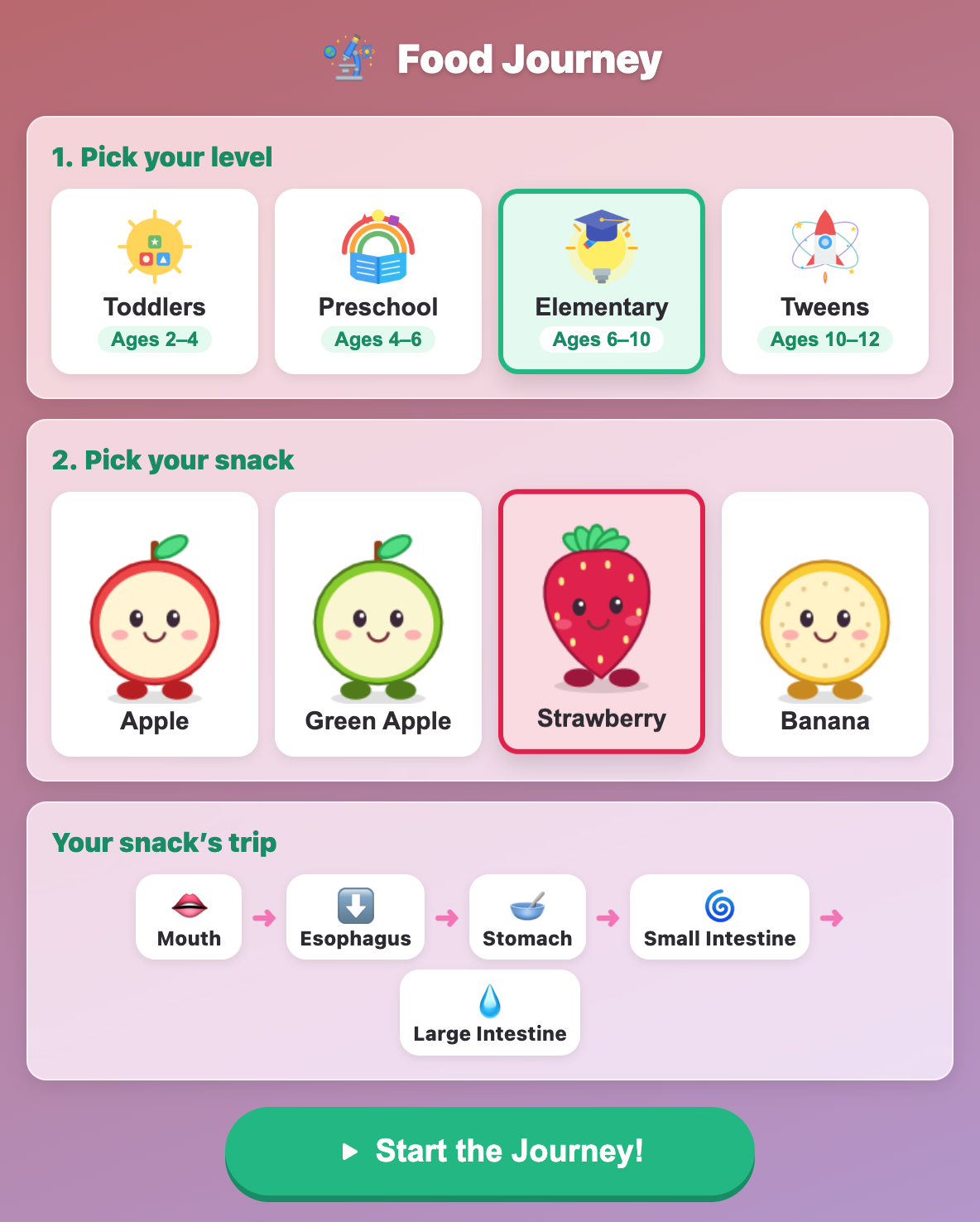
The Food Journey setup screen with four level cards, four smiling fruit snacks and the five stops of the trip
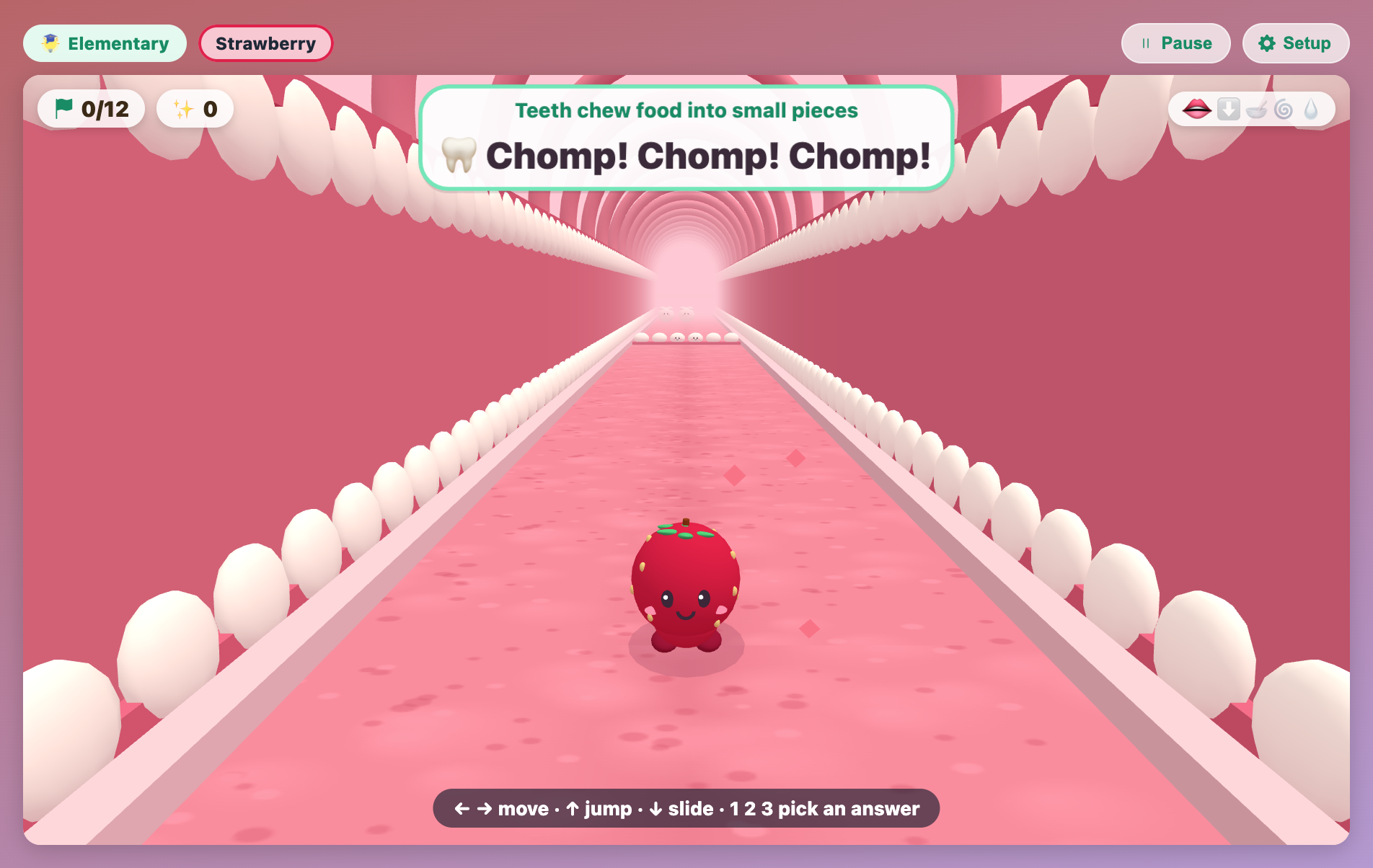
A strawberry snack standing in a mouth lined with teeth while the plate says Chomp! Chomp! Chomp!
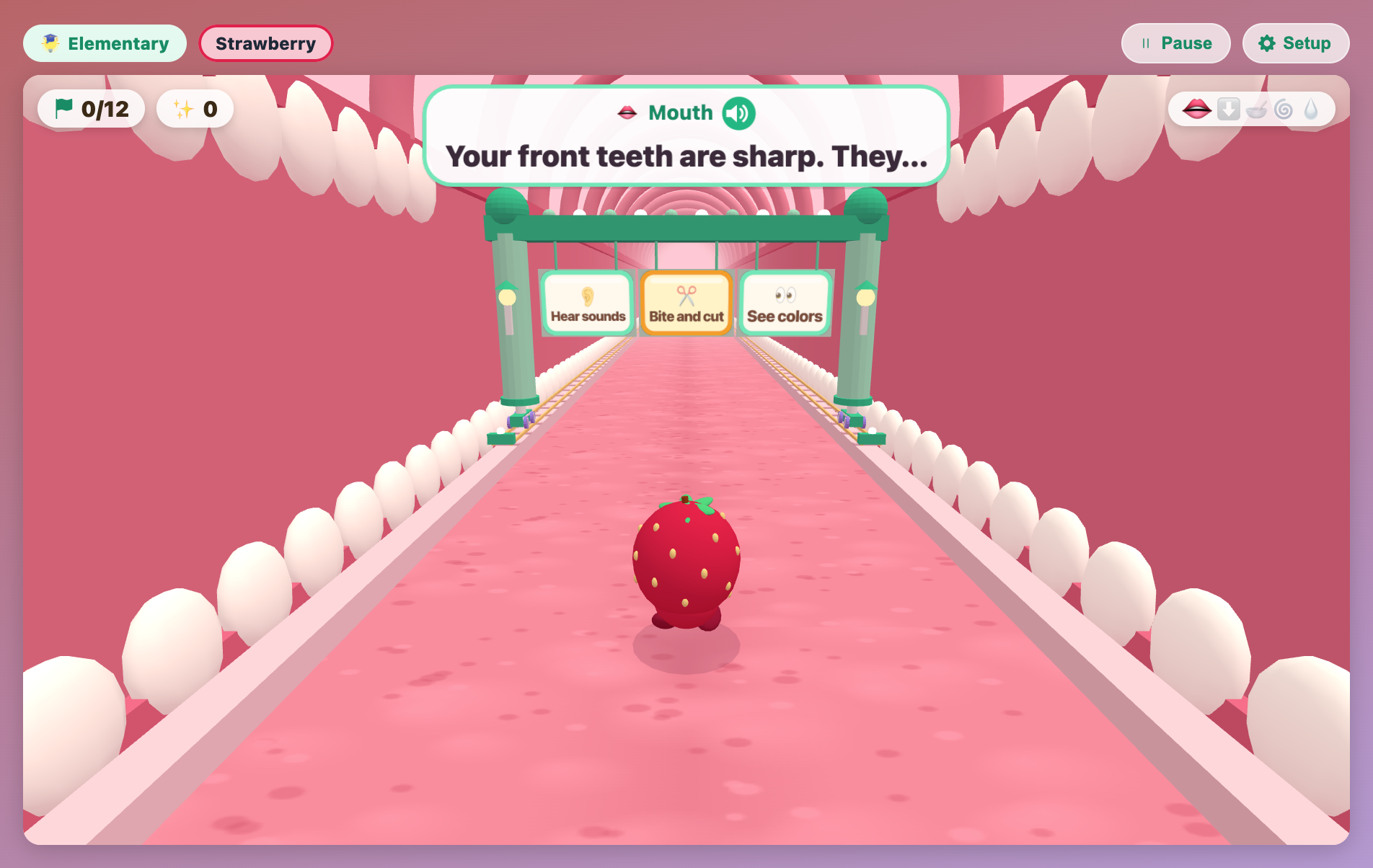
A gate with three answer signs in the mouth asking what sharp front teeth do in Food Journey for kids
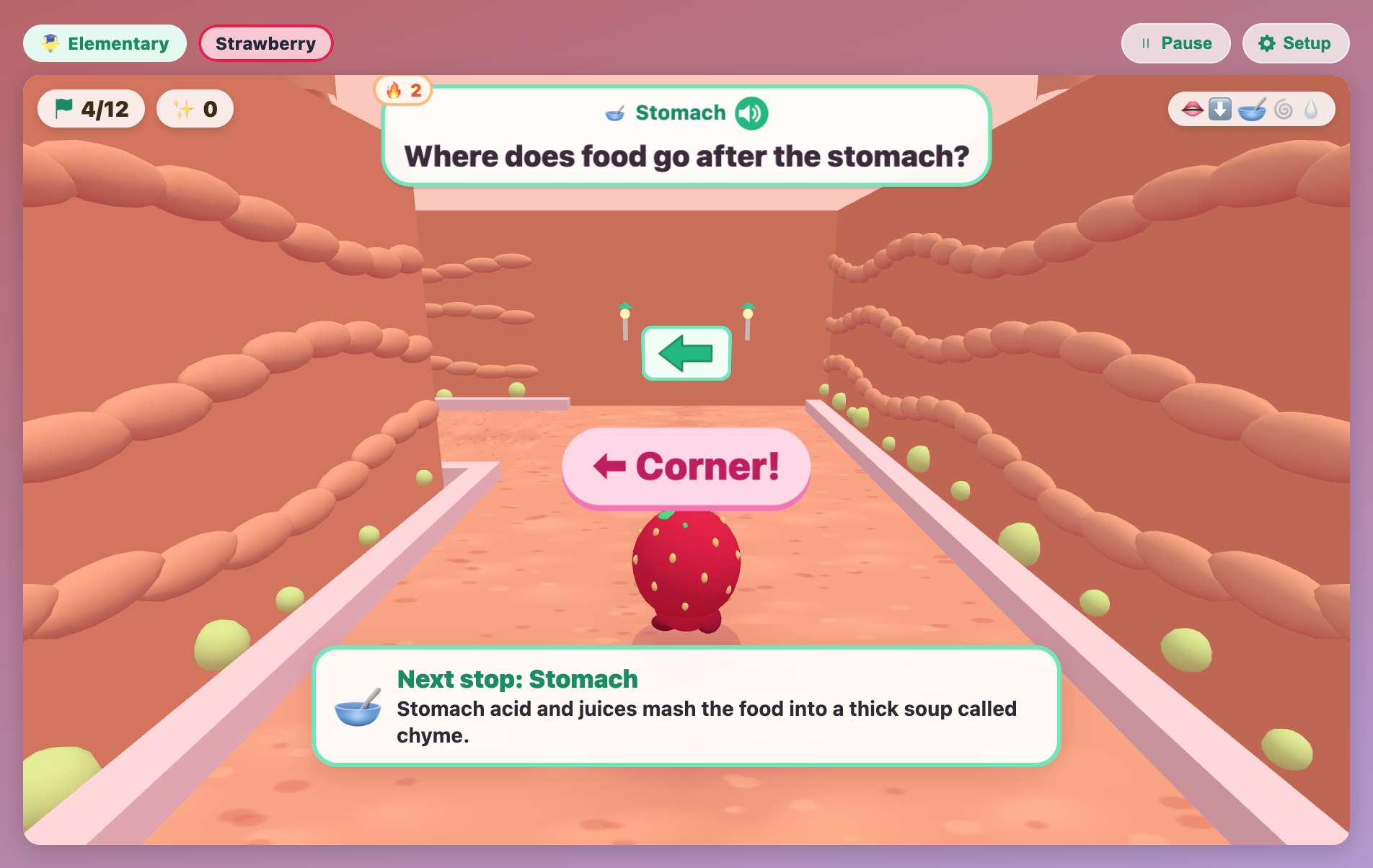
The orange stomach with folds and acid bubbles on the walls, a corner arrow and the Next stop: Stomach banner
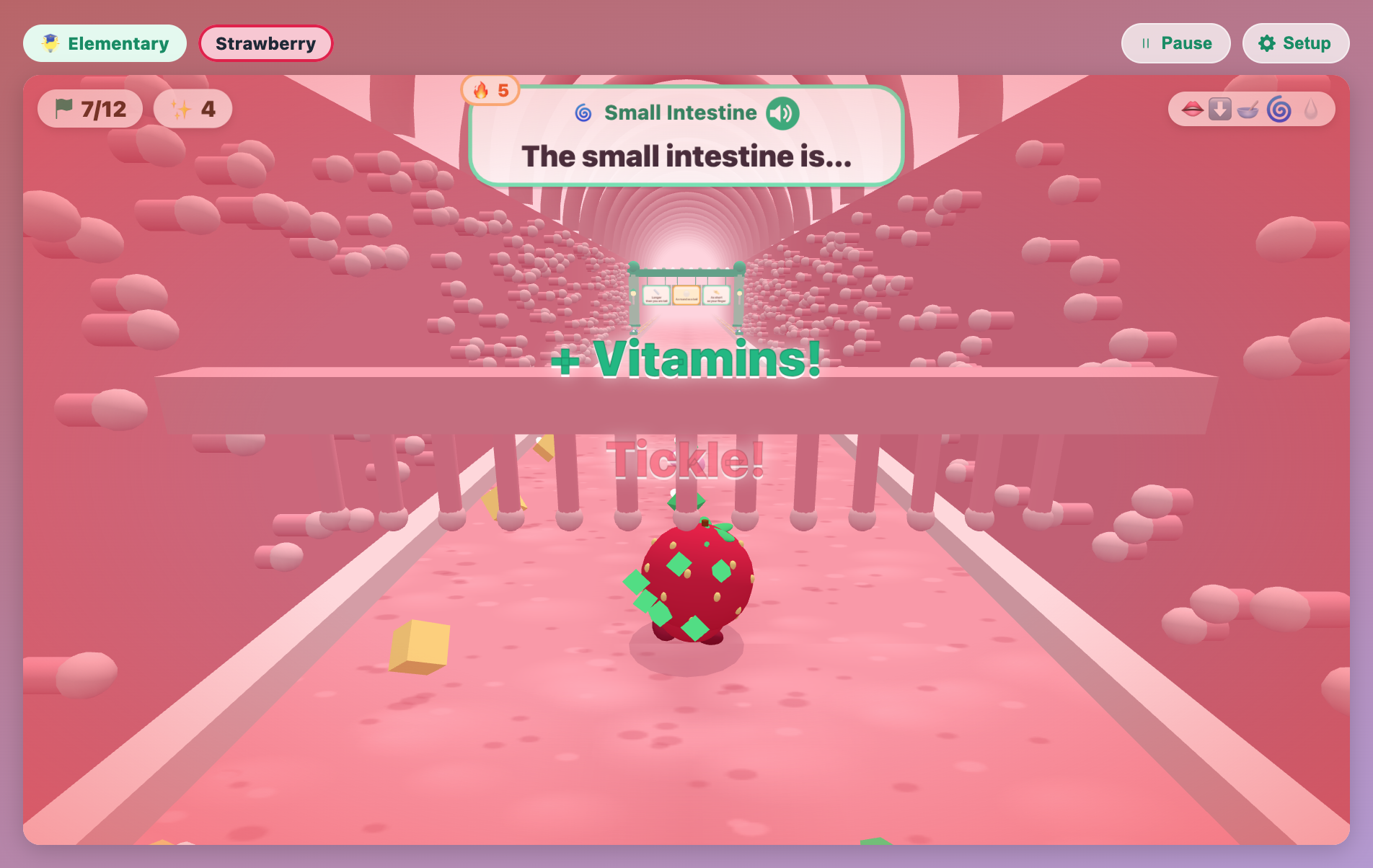
The strawberry sliding under a curtain of villi in the small intestine as a + Vitamins! pop-up shows
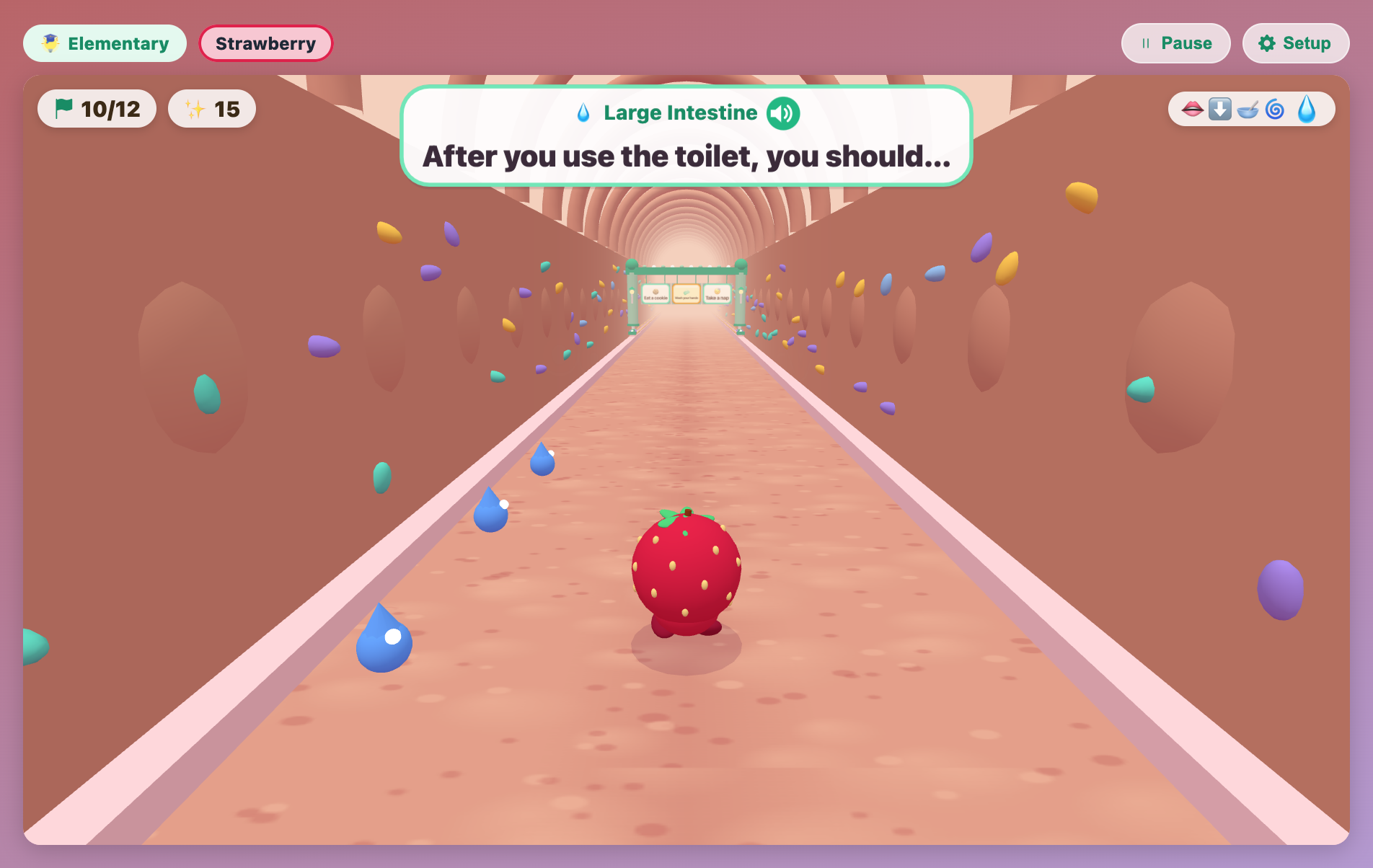
Blue water drops and friendly gut bacteria in the large intestine before a gate about washing hands
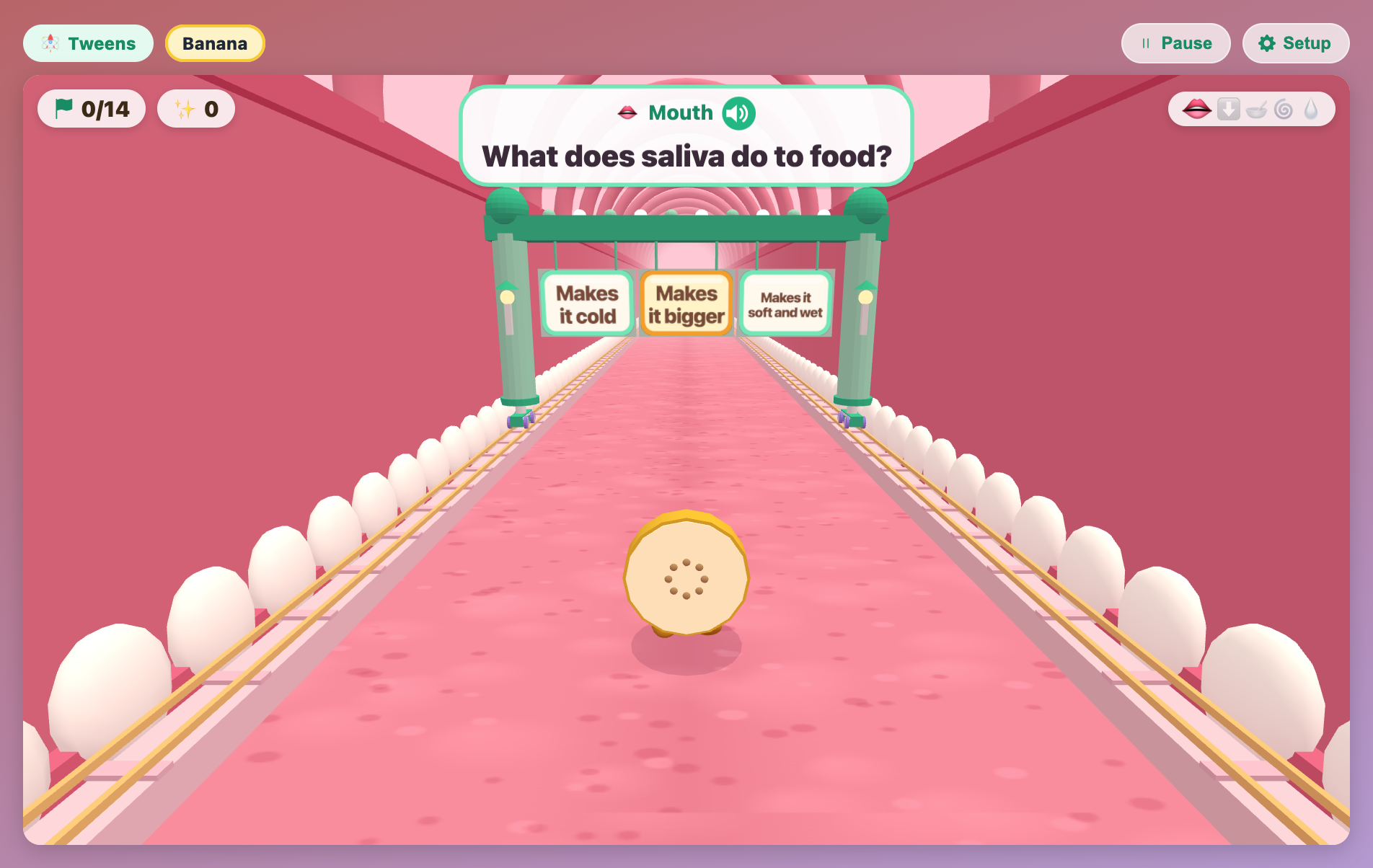
A banana slice heading for a gate asking what saliva does to food in Food Journey for tweens
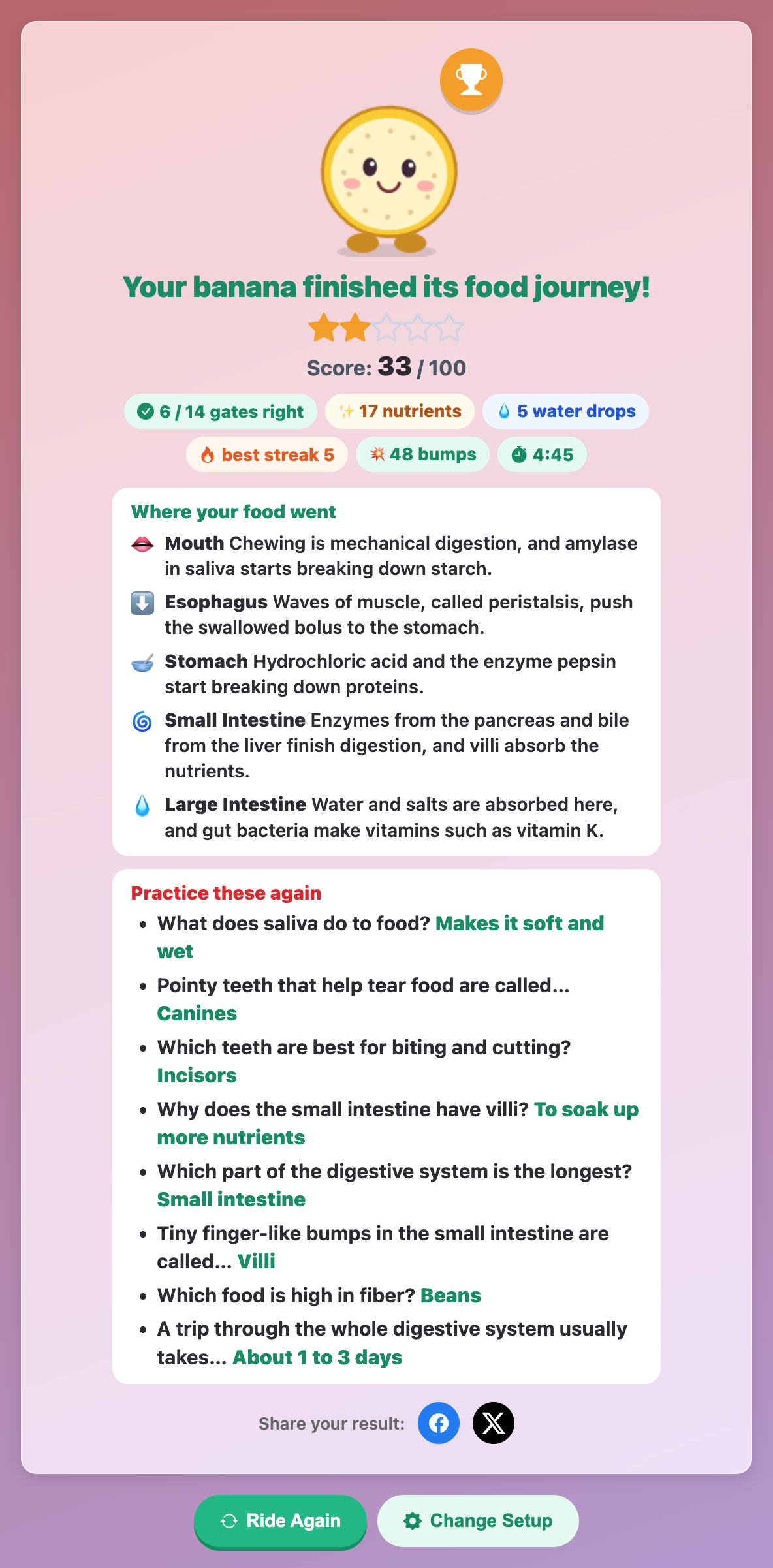
The Food Journey result card with stars, gates right, nutrients, a recap of each part and a practice list
More Science Games
 59.5K plays
4.8
Recycling Sort
Sort everyday items into the Recycle, Compost, or Trash bin before time runs out!
 85.7K plays
4.9
Grow a Plant
Plant seeds in sunny and shady garden beds, then water, feed and protect them day by day. Watch the roots grow underground and harvest sunflowers, tomatoes, carrots and more!
 438.6K plays
4.9
Magnet Experiment
Guess which objects a magnet will pull, then drag the magnet to test every guess. Does gold stick? Does a battery?
 386.9K plays
4.9
Five Senses Match
Decide which of your five senses you would use for each everyday scene before time runs out.
Most Played Games
 1.8M plays
4.9
Color & Draw
A free-drawing canvas with colors and brush sizes to unleash your creativity.
59.5K plays
4.8
Recycling Sort
Sort everyday items into the Recycle, Compost, or Trash bin before time runs out!
 365.8K plays
5.0
Tic-Tac-Toe
Play a game of Tic-Tac-Toe against the computer and see if you can outsmart it.
 274.1K plays
5.0
Sentence Builder
Pick your age level, then tap the shuffled words in the right order to build the sentence.
Comments (24)