
Build a Skeleton
483.8K playsPut a skeleton back together, bone by bone! Drag the skull, backbone, ribs and hips onto the X-ray outline, then the arm and leg bones, and watch your skeleton dance. Big kids find the humerus, femur, radius, ulna, tibia and fibula, name glowing bones and learn which joints are hinges, ball and socket joints or pivots. Then build a bonus fish, dog or bird skeleton and see which bones you share.
Oops! A skeleton has fallen to pieces. Its bones are lying in a tray, right next to an empty X-ray. Build a Skeleton for kids is a free science game where you put a human skeleton back together, bone by bone. You drag the skull, the backbone, the ribs, the hips, the arms and the legs onto their dashed outlines, and when the last bone clicks in, your skeleton starts to dance.
The game works for children from age 2 to 12. Little ones build with big, easy pieces like a whole arm or a whole leg. Older kids find the real bone names, like the humerus and the femur, answer bone quizzes and learn how their joints move. Then everyone builds a bonus animal skeleton: a fish, a dog or a bird. It plays right in your web browser on a computer, tablet or phone, with nothing to download and no sign-up.
🦴 A Puzzle Made of Bones
Your skeleton is the frame of hard bones inside your body. It does three big jobs. It holds you up, like the poles of a tent. It keeps soft parts safe, like a helmet for your brain and a cage for your heart and lungs. And it helps you move, because your muscles pull on your bones.
In this game, the skeleton is shown from the front on a dark blue X-ray screen. Every missing bone is drawn as a dashed outline, a line made of little dashes that shows the bone's shape. Your job is to find the card in the tray that matches each outline. It is a bit like a jigsaw puzzle, but every piece teaches you something. Each time a bone goes in, the game tells you what it does, for example: "The skull! It keeps your brain safe, like a helmet."
Watch out for trick cards. On most levels, the tray hides one bone that people don't have at all: a Tail, Antlers, a Beak or Fin rays. Try to put it on the body and it bounces back with a friendly reason, like "Antlers grow on deer, not on people!"
🩻 From Bone Tray to Dancing Skeleton: Playing on KidWorld
Pick your level. The Choose Your Level screen has four cards: Toddlers (ages 2–4), Preschool (4–6), Elementary (6–10) and Tweens (10–12). The first time you play, the game may start straight away at Elementary. To switch, press the Change Level button at the top of the game. The game remembers your choice for next time.
Read the goal box. It says "Build a skeleton!" and shows a message line under it. Press the green 🔊 button to hear the goal and the message read aloud.
Drag a bone onto its outline. Press on a card in the tray, slide it over the skeleton and let go on the dashed outline where it belongs. The outline under your finger lights up so you can see where it will land.
Or tap, then tap. If dragging is tricky, tap a card first. Then tap its outline on the skeleton. To put a picked card back down, tap it again (or press Escape on a keyboard).
Read the message after every bone. A right bone snaps in and the message tells you about it. A wrong bone shakes and jumps back to the tray, and the message tells you where that bone really goes. If you drop a bone on an empty spot, the game just says "Drop it on a dashed outline", and that doesn't count as a mistake.
Watch it come alive. When every bone is in, the message says "Your skeleton is ready! Watch it dance!" The skeleton steps back and dances, swinging its elbows and kicking its legs. A panel shows your stars and a bone fact.
Press Next, or wait. The Next button fills up and counts down from 5, then moves on by itself. It waits if something is being read aloud. On a keyboard, Enter or Space also works.
Answer the quiz rounds. Elementary kids name glowing bones and tweens answer joint questions. Tap one of the three answers, or press 1, 2 or 3.
Build a bonus animal. Next comes a fish, a dog or a bird skeleton, drawn from the side. When it's done, it swims, trots or hops, and the panel shows what it shares with you.
See your score. The last screen says Bone Expert! with your final score, one to five stars, and a little gallery of every skeleton you built with its own stars. Any question you missed is listed under Look at these again. Press Play Again for a new mix of bones and animals, or Choose Another Level.
Use the page buttons. Under the game you'll find buttons to go fullscreen, reload the game and turn the music on or off.
⭐ How the Stars and Points Add Up
Every build gives you stars. Each star is worth 10 points.
3 stars (30 points): no mistakes at all. The panel says "Perfect build!"
2 stars (20 points): one or two mistakes. The panel says "Great build!"
1 star (10 points): three mistakes or more. The panel says "You built it!" You always finish the skeleton, so nobody gets stuck.
Each right quiz answer is worth 10 more points. A wrong answer gives 0, and the right one lights up so you can learn it.
A mistake means putting a bone on the wrong outline, or trying to use a trick card. Dropping a bone on an empty space is not a mistake. The highest score is 60 at Toddlers and Preschool, 140 at Elementary and 160 at Tweens. On the final screen, a score of 90% or more earns a gold trophy and five stars.
🏅 Build a Skeleton for Kids: Secrets of a Three-Star Builder
Three stars means zero mistakes. That sounds hard, but a few smart habits make it easy. Here is how to do it.
1. Start at the top and work down
Begin with the skull, because it has only one possible place: the very top. Then add the backbone down the middle, then the ribs, then the hips. Each bone you place makes the next outline easier to find, since you can see what is above it. This is the same order the bones stack up in your own body.
2. Look at the shape on the card
Every card shows a small drawing of its bone. Compare it with the dashed outlines. The rib cage looks like a curved basket. The hips look like two big butterfly wings. The backbone is a long, thin stack of little blocks. Matching shapes is the fastest way to be sure before you drop.
3. Use your own body as a map
Not sure where a bone goes? Touch that spot on yourself! Pat your thigh: that's where the femur goes. Squeeze your upper arm, between your shoulder and your elbow: that's the humerus. Rub your shin, the front of your lower leg: that's the tibia and fibula. Your body is a perfect answer key.
4. Read the little word under the name
At Elementary and Tweens, each card shows the bone's science name and, under it, what it is in everyday words: Femur, thigh bone; Humerus, upper arm; Radius & ulna, forearm; Tibia & fibula, shin. If a long word feels new, the small word tells you where to look.
5. Spot the trick card first
Before you place anything, scan the tray for the bone that doesn't belong. Ask yourself: "Do I have one of these?" You don't have a tail, antlers, a beak or fin rays. Leave that card alone and it can never cost you a star.
6. Either arm fits either side
When the tray has two cards with the same name, like two Arm cards or two Femur cards, don't worry about left and right. Either card fits either outline. Just pick the free one.
7. Overlapping outlines are safe
The backbone runs behind the ribs, and the tops of the thigh bones tuck under the hips. If you drop a bone on its own outline, it goes in, even where another outline crosses it. So aim for the middle of the right shape and don't be afraid of the crowded parts.
8. Learn from a bounce
If a bone jumps back, read the message before you try again. It tells you exactly where that bone belongs, for example "The femur is the thigh bone. It goes from the hip down to the knee." One mistake is fine: you still get 2 stars if you make no more than two. If you liked snapping parts onto an outline, Build a Bug works the same way with the head, thorax, legs and wings of real insects.
🧠 Quiz Time: Glowing Bones and Bendy Joints
After the human skeleton is built, the older levels ask questions about it. You see the finished skeleton next to three answers.
Which bone is glowing? (Elementary)
There are three of these rounds. One bone on your skeleton glows, and you pick its name from three choices. The names come from six bones: Skull, Backbone, Rib cage, Pelvis, Humerus and Femur.
Example: a long bone glows in the top half of the leg, and the choices are Humerus, Femur and Rib cage. Think: Rib cage is in the chest, so that's out. Humerus is the upper arm bone. A leg bone above the knee is the Femur. After you answer, the game shares a fact: the femur is the longest and strongest bone in your body.
Tip: say "humerus, upper arm" and "femur, thigh" a few times out loud before you play. These two are easy to mix up, because both are long bones with a knob at the top.
Which kind of joint? (Tweens)
A joint is a place where two bones meet and move. Tweens get five joint rounds: the neck, the shoulder, the elbow, the hip and the knee, each one once. A yellow ring circles the joint on the skeleton, and you choose between Hinge joint, Ball and socket joint and Pivot joint. After you answer, a small moving picture shows how that kind of joint works.
Hinge joint: bends and straightens one way, like a door. Your elbow and your knee.
Ball and socket joint: a round ball sitting in a cup, so it can swing almost any way and even round in a circle. Your shoulder and your hip.
Pivot joint: one bone turns around another, like a doorknob. The top of your backbone, which lets your head turn.
The secret is to read the action word in the question. If it says bend, think hinge. If it says swing round in a big circle, think ball and socket. If it says turn from side to side, think pivot. Then test it on yourself:
"Which kind of joint lets your elbow bend?" Bend your elbow. It folds up and opens again, but it can't bend sideways. That's a hinge joint.
"Which kind of joint lets your arm swing round in a big circle?" Make big windmill circles with your arm. Only a ball in a cup can do that. Ball and socket joint.
"Which kind of joint lets your head turn from side to side?" Shake your head "no". Your head turns around a point at the top of your backbone. Pivot joint.
"Which kind of joint is in your hip?" Swing your leg forward, back and out to the side. Many directions means ball and socket. The hip's cup is deep, which makes it very strong.
"Which kind of joint lets your knee bend?" Your knee only bends one way, just like your elbow. Hinge joint.
🐟 Bonus Builds: Is a Fish Like You?
Every level ends with at least one bonus animal. Toddlers build a fish or a dog. Preschoolers get one of the fish, the dog or the bird. Elementary kids and tweens build two of the three, and each one is followed by a bonus quiz question. The animals are drawn from the side, so the outlines look different from the human ones. There are no trick cards here, but a bone on the wrong outline still counts as a mistake.
The fish 🐟
The fish has five cards: Skull, Backbone, Ribs, Fins and Tail fin. Start with the long backbone through the middle, then the skull at the front and the tail fin at the back. The ribs curve down around the belly. The Fins card is tricky because the fins are in three places: on top, underneath and on the side. When it's built, the fish swims and swishes its tail. The panel shows Like you: a skull, a backbone, ribs, and Different: fins instead of arms and legs, a tail fin, no neck.
Bonus quiz: "Which bones do you and a fish both have?" The choices are A backbone, Fin rays and Leg bones. A fish has no legs, and you have no fin rays, so the answer is A backbone. Animals with a backbone are called vertebrates, and that includes you!
The dog 🐕
The dog has seven cards: Skull, Backbone, Ribs, Hips, Front legs, Back legs and Tail. The far legs sit behind the body and look darker. Once it's built, the dog trots and wags its tail. One fun surprise: the bend in a dog's back leg that looks like a backwards knee is really its ankle!
Bonus quiz: "How does a dog stand?" Think about a dog's paws. Its heel is high up off the ground, so the answer is On its toes, not on flat feet like you.
The bird 🐦
The bird has six cards: Skull (with beak), Backbone, Rib cage (with its big breastbone), Wing, Legs and Tail bone. The backbone runs up a long, bendy neck. When it's done, the bird hops and flaps. The panel explains that a bird has a beak but no teeth, a big breastbone for its flying muscles, and many hollow bones that make it light. If you want to see how different beaks work as tools, try Bird Beak Buffet, where you test tools like a straw and a nutcracker to see which beak shape fits which food.
Bonus quiz: "A bird's wing has the same kinds of bones as your…" Look at the wing on the screen. It has one upper bone, two thinner bones, then small hand bones. That's just like your Arm.
🧪 Three Builds, Thought Through
Example 1: A toddler's first skeleton
Mia is 3. Her tray has eight big cards: Skull, Backbone, Ribs, Hips, two Arms and two Legs. She taps Ribs, and the ribs outline glows yellow on the chest, so she knows just where to tap next. She puts in the skull, the backbone and one arm, then the rest. No mistakes, so she gets 3 stars and 30 points. Then she builds a fish, and it swims away across the screen. A perfect run at Toddlers is 60 points.
Example 2: A preschooler meets the Antlers card
Leo is 5. His tray has the same eight pieces plus one more: Antlers. He drags the Antlers to the top of the skull. They bounce back, and the message says "Antlers grow on deer, not on people!" That's one mistake, so he can still get 2 stars. Next time he plays, he checks the tray for the odd card first.
Example 3: Adding up a tween's score
Ava is 11 and plays Tweens. Here is how her points add up:
Human skeleton with 2 mistakes: 2 stars, 20 points.
Joint rounds: 4 right out of 5, 40 points. (She called the knee a ball and socket joint.)
Bonus fish, no mistakes: 3 stars, 30 points. Fish quiz right: 10 points.
Bonus bird with 3 mistakes: 1 star, 10 points. Bird quiz wrong: 0 points.
That's 110 out of 160, a little under 70%, so the final card shows 3 stars. The knee and the bird question appear under Look at these again with the right answer. One more right answer would make 120, which is 75% and 4 stars. That's a great reason to press Play Again!
🎒 Which Level Fits? From Age 2 to 12
🐣 Build a Skeleton for toddlers (ages 2–4)
Toddlers get eight big, chunky pieces and no trick cards. When they pick a bone, its outline glows yellow, so they always know where to go. The messages are short and simple, like "A leg! It bends at the knee." When the sound is on, the game reads the goal and every message out loud, so a child who can't read yet can still play. They finish with one bonus animal, a fish or a dog. A parent can help by pointing to the same body part on the child: "Here's your arm! Where's the skeleton's arm?"
🌈 Build a Skeleton for preschoolers (ages 4–6)
Preschoolers build with the same big pieces and the same yellow glow, but one trick card joins the tray. Spotting it is a fun first step in thinking like a scientist: "Do people have a tail?" The game still reads everything aloud when the sound is on, and the bonus animal can be a fish, a dog or a bird.
📚 Build a Skeleton for elementary kids (ages 6–10)
At Elementary, the collarbones, hands, kneecaps, lower arms, shins and feet are already in place. Kids add the main named bones: the skull, backbone, rib cage, pelvis and both humerus and femur bones. There is no glow, so they must use the names and shapes. Then come three "Which bone is glowing?" rounds and two bonus animals, each with its own quiz question. The top score is 140.
🚀 Build a Skeleton for tweens (ages 10–12)
Tweens place the most bones: everything from Elementary plus both radius & ulna pairs (forearm) and both tibia & fibula pairs (shin). That's twelve bone cards and one trick card. After the build, they answer five joint questions and watch each joint move. Two bonus animals with quiz questions finish the round. The top score is 160.
💪 What Building Bones Teaches
It turns body words into a picture. Words like "femur" or "pelvis" are hard to remember from a list. When you drag the femur onto the thigh yourself, you know where it lives. Next time you hear the word, you can almost see it on the X-ray.
It connects science to your own body. The best tip in this game is to touch your own arm or bend your own knee. That makes kids notice how their body really works: elbows only bend one way, a shoulder can swing all the way round, a head turns on a pivot.
It shows we're part of a big animal family. Building a fish, a dog and a bird right after yourself makes a big idea easy: lots of animals have a skull, a backbone and ribs, just like us. The "Like you" and "Different" lists help kids compare, which is a real science skill. If digging up old bones sounds exciting, Fossil Dig lets you uncover a mystery dinosaur skeleton with a pickaxe, a chisel and a brush.
It makes mistakes useful. A wrong bone isn't a dead end. It bounces back with a hint about where it goes, and the build always finishes. Kids learn that a mistake is just a clue.
👪 For parents and teachers
Build a Skeleton is calm and friendly. The skeletons are cartoon-style, with round eyes and a happy dance, so there's nothing spooky or scary about them. There is no time limit and there are no lives to lose. The game practices the names and places of the main bones, the three kinds of joints, and what humans share with other vertebrates. The facts it teaches were carefully checked: a grown-up has 206 bones, a baby about 300, and bones are alive and can heal. Every message and fact can be read aloud with the 🔊 buttons, which helps early readers. It runs in the browser on computers, tablets and phones, with no download and no sign-up.
Ready to put some bones back where they belong? Pick your level, find the skull and start building. Can you earn three stars on every skeleton and become a true Bone Expert in Build a Skeleton for kids? Your dancing skeleton is waiting! 💀🕺
🖼️ See the Game in Action
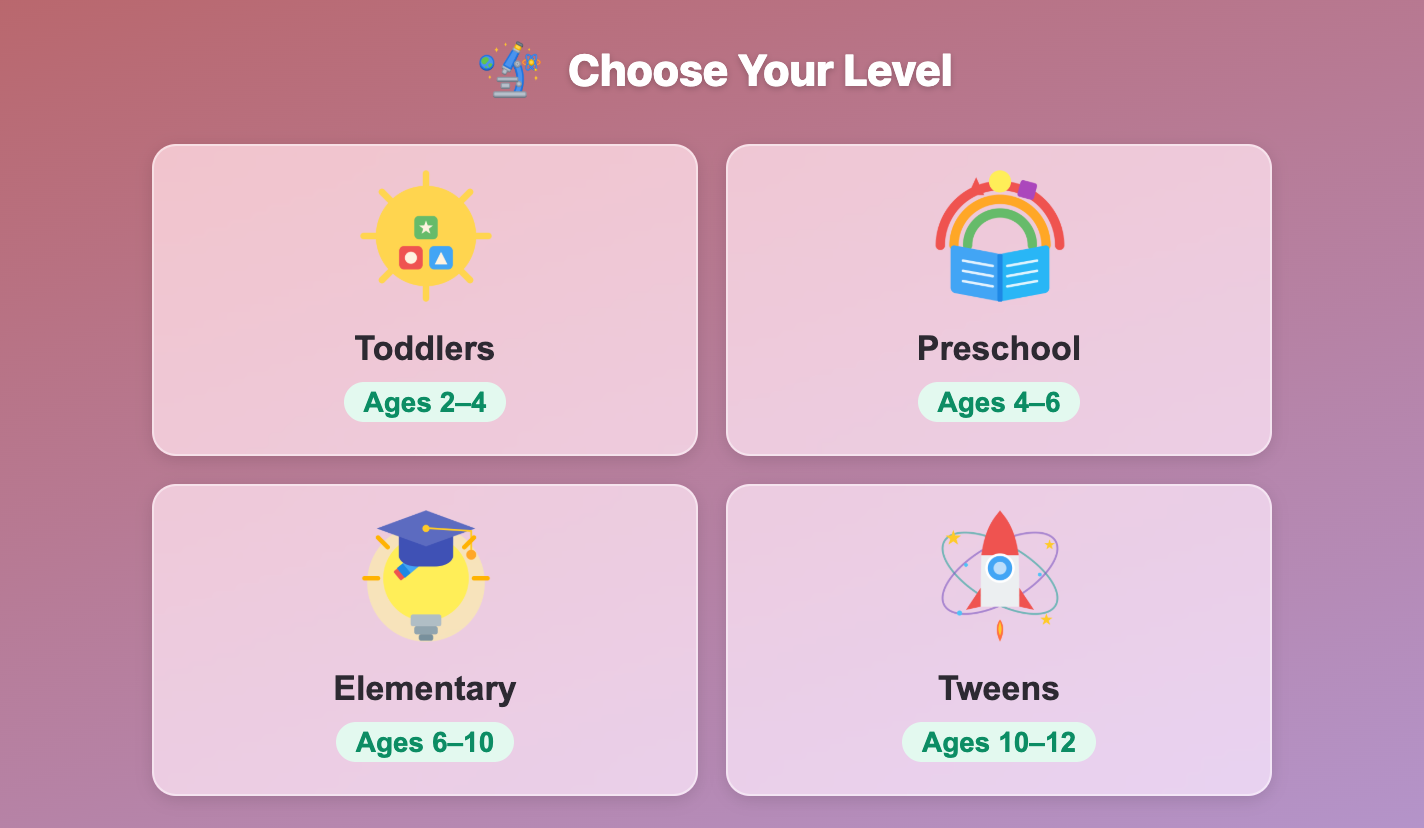
The Choose Your Level screen in Build a Skeleton for kids, with Toddlers, Preschool, Elementary and Tweens cards
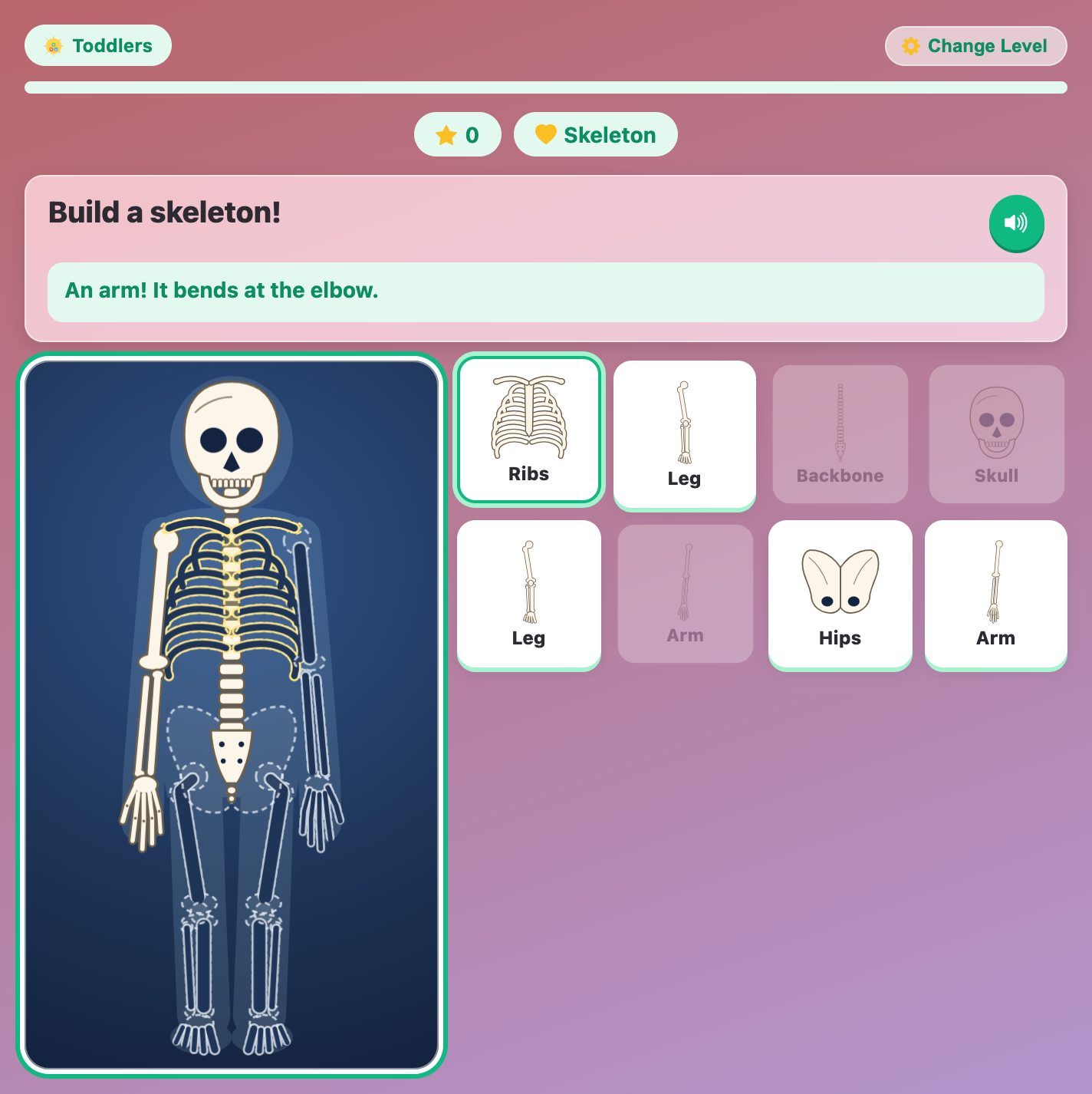
Build a Skeleton for toddlers with the skull, backbone and one arm in place and the ribs outline glowing yellow
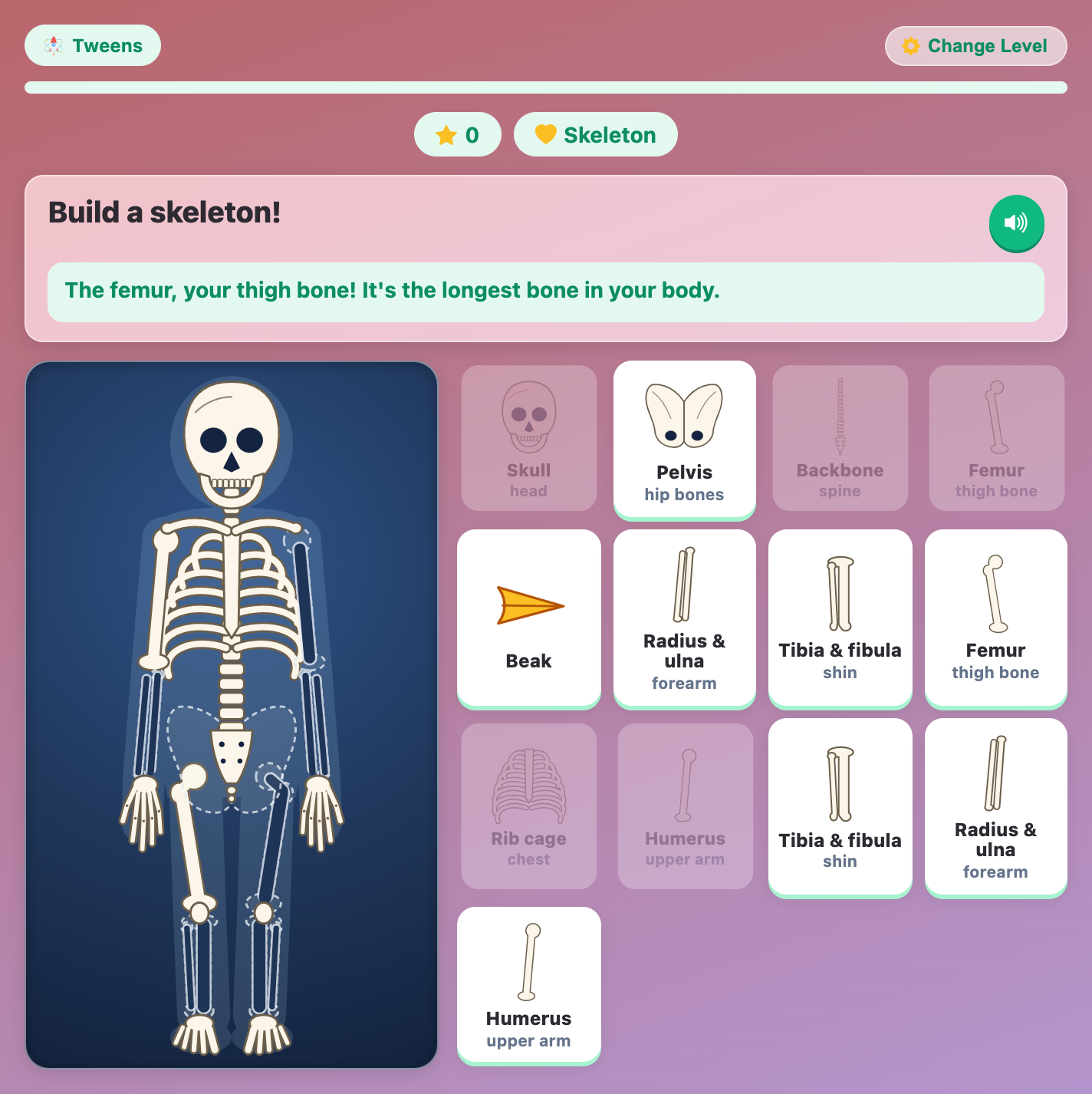
A half-built skeleton at the Tweens level, with Radius and ulna, Tibia and fibula and a trick Beak card in the tray
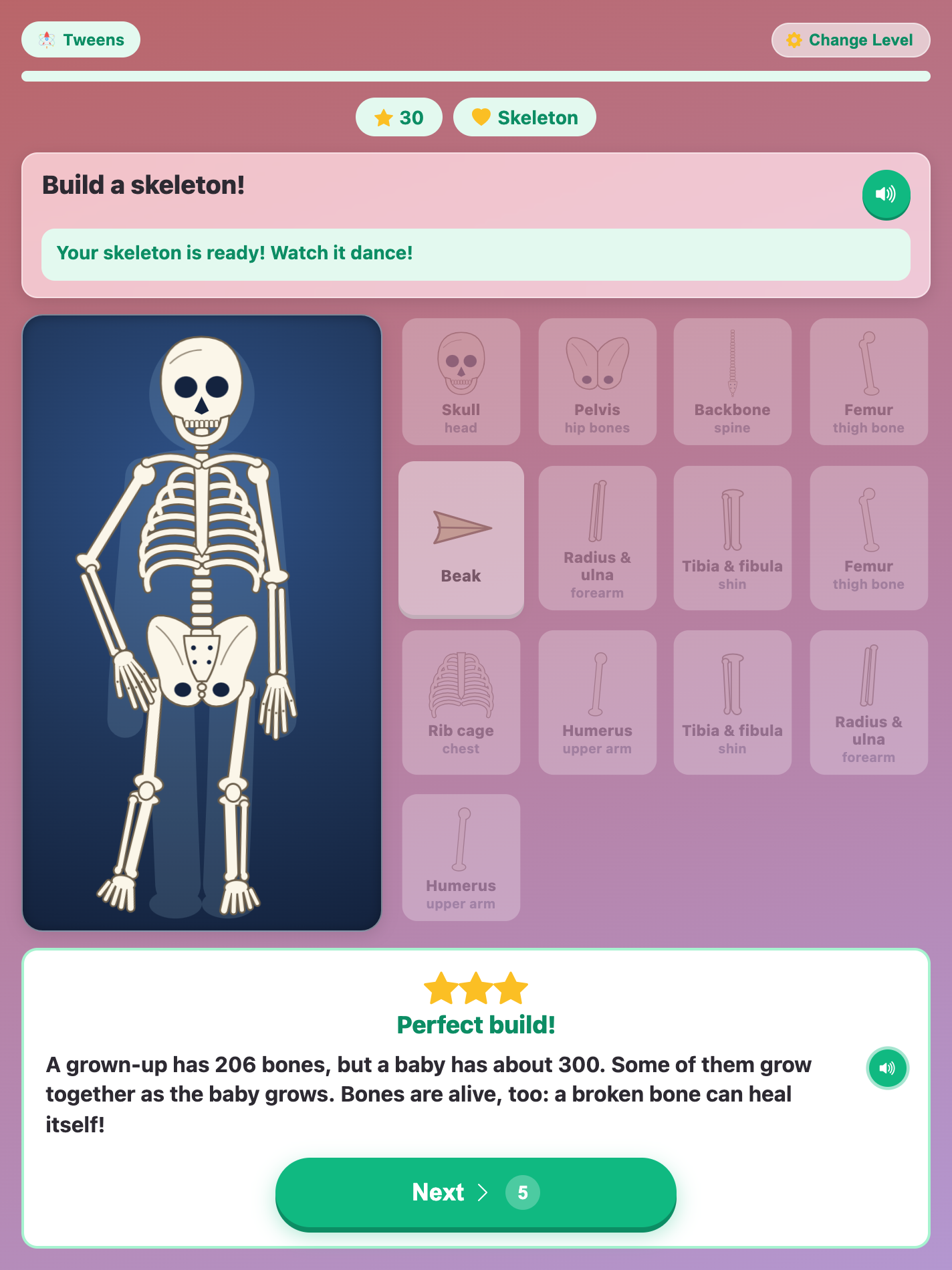
The finished skeleton dancing on the X-ray stage, with three stars, Perfect build and a fact about 206 bones
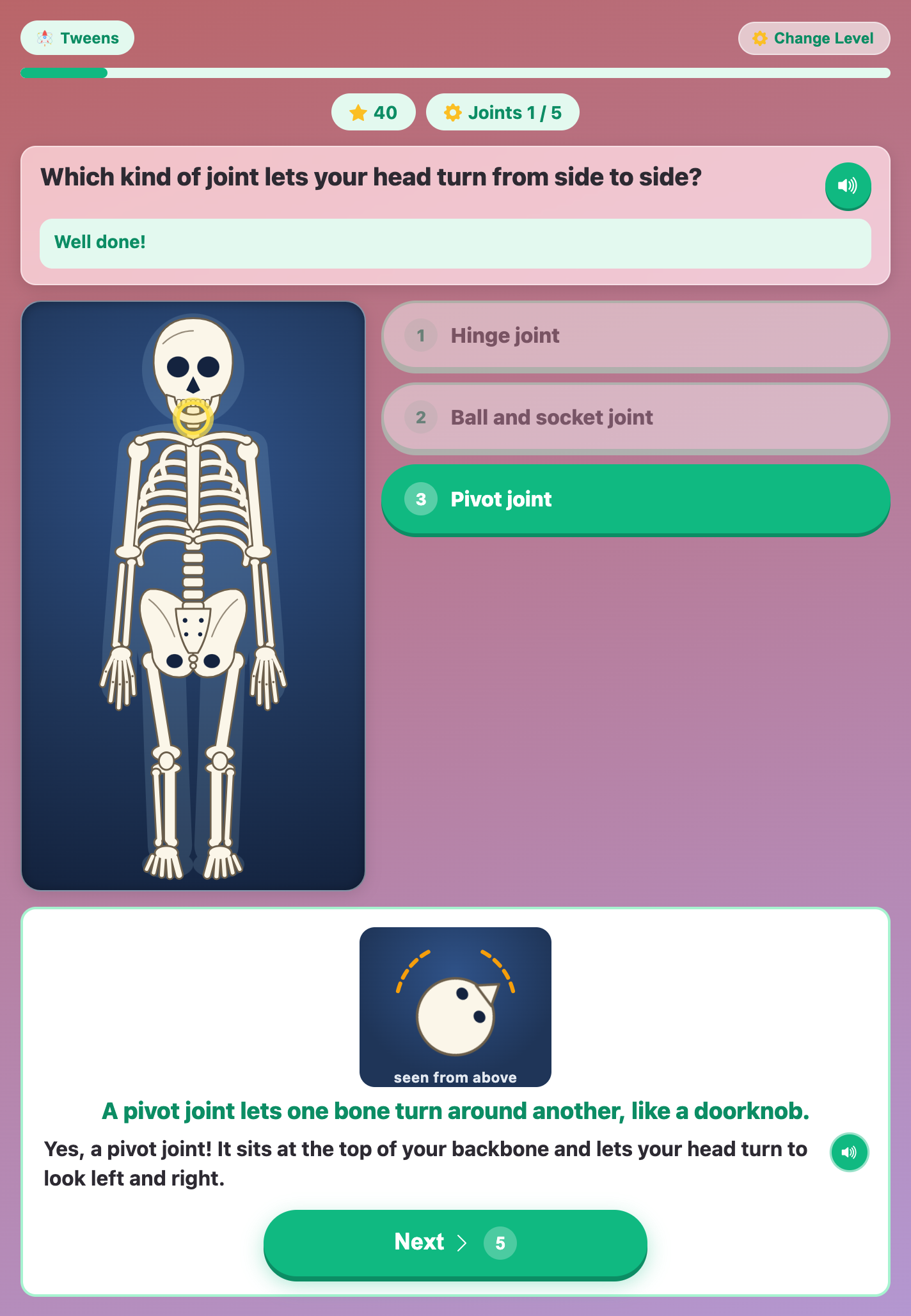
A joint question in Build a Skeleton for tweens, with a yellow ring on the neck and the pivot joint answer chosen
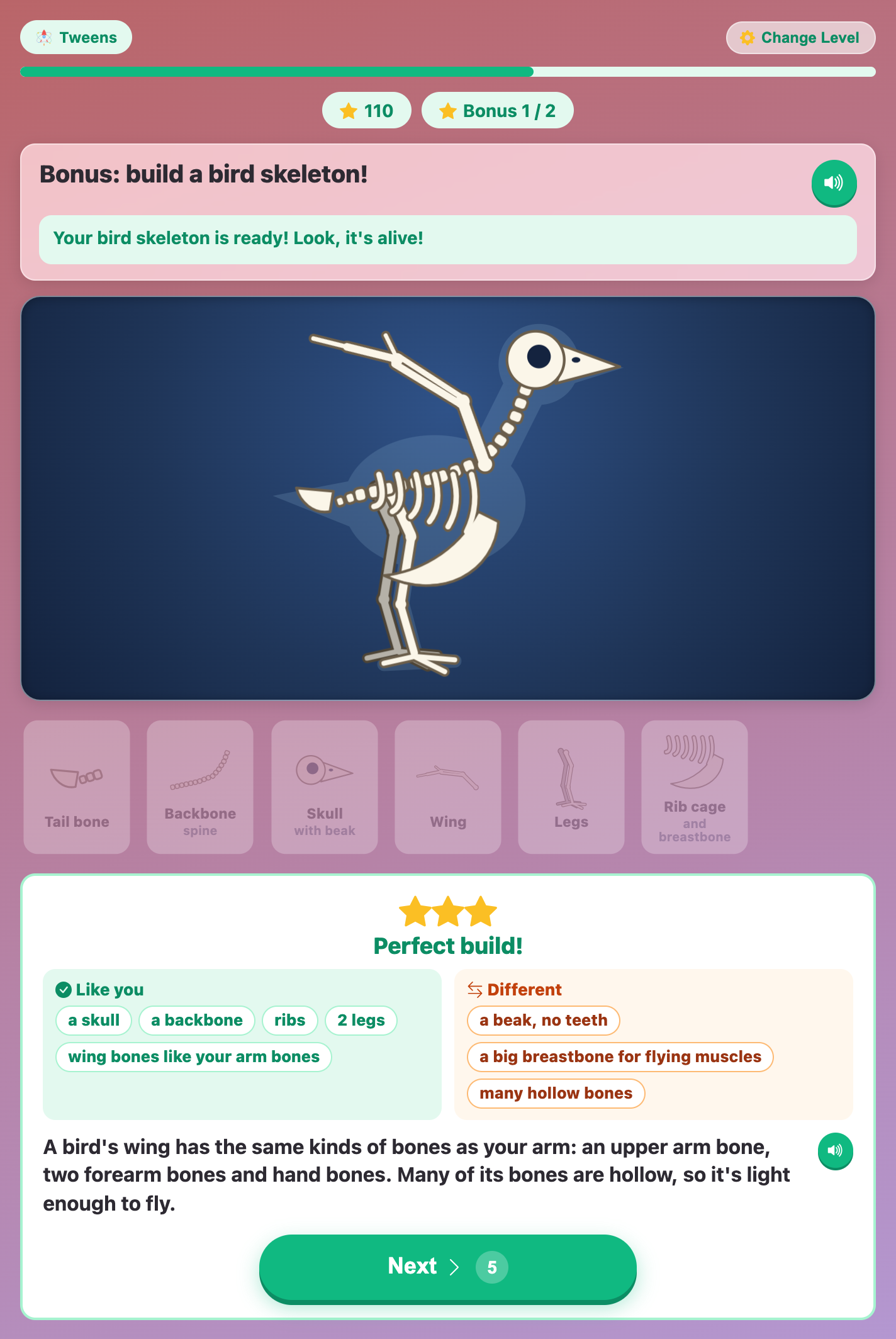
A bonus bird skeleton built in Build a Skeleton, with Like you and Different chips comparing it with a person
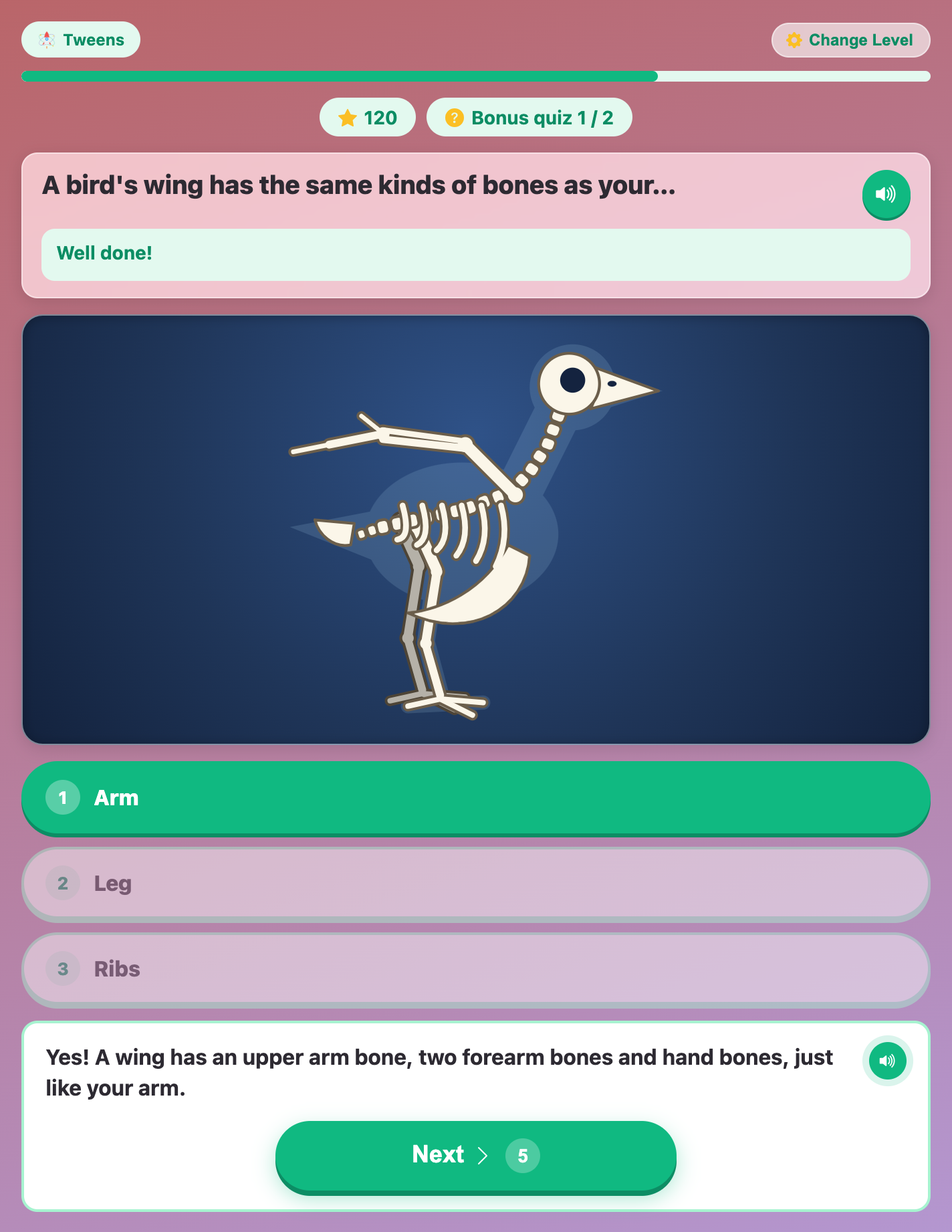
The bonus quiz asking which of your bones match a bird wing, with Arm picked as the right answer
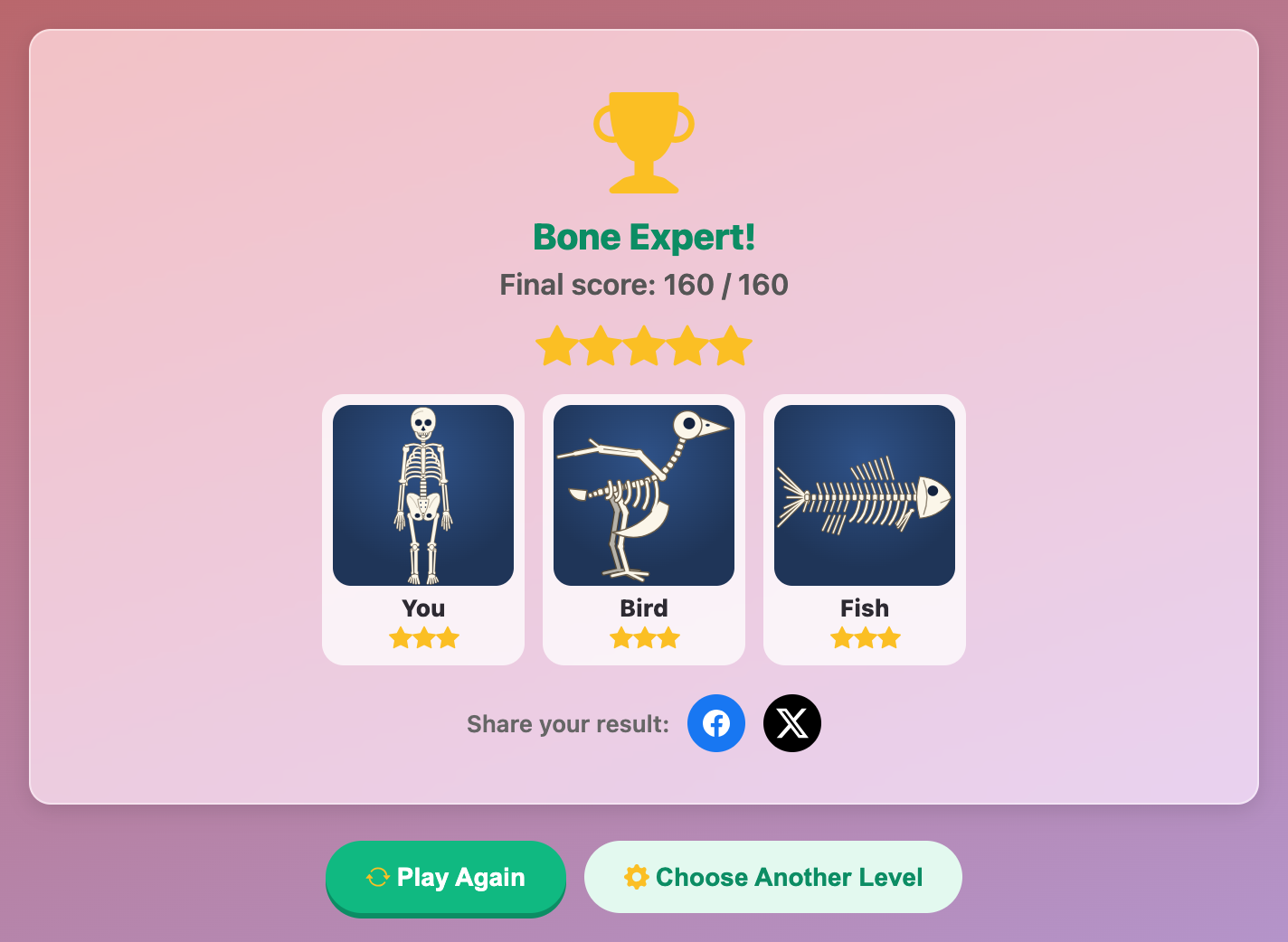
The Bone Expert result card in Build a Skeleton for kids, showing a full score and the person, fish and bird skeletons
More Science Games
 59.5K plays
4.8
Recycling Sort
Sort everyday items into the Recycle, Compost, or Trash bin before time runs out!
 85.7K plays
4.9
Grow a Plant
Plant seeds in sunny and shady garden beds, then water, feed and protect them day by day. Watch the roots grow underground and harvest sunflowers, tomatoes, carrots and more!
 438.6K plays
4.9
Magnet Experiment
Guess which objects a magnet will pull, then drag the magnet to test every guess. Does gold stick? Does a battery?
 386.9K plays
4.9
Five Senses Match
Decide which of your five senses you would use for each everyday scene before time runs out.
Most Played Games
 1.8M plays
4.9
Color & Draw
A free-drawing canvas with colors and brush sizes to unleash your creativity.
59.5K plays
4.8
Recycling Sort
Sort everyday items into the Recycle, Compost, or Trash bin before time runs out!
 365.8K plays
5.0
Tic-Tac-Toe
Play a game of Tic-Tac-Toe against the computer and see if you can outsmart it.
 274.1K plays
5.0
Sentence Builder
Pick your age level, then tap the shuffled words in the right order to build the sentence.
Comments (35)