Bird Beak Buffet
47.4K playsBirds don't have hands, so a beak is their tool! Test a straw, a nutcracker, a net, tweezers and chopsticks at the bird buffet and find out which food each one is best at: nectar, seeds, fish, insects or worms. Then meet the real birds with beaks just like them, from the hummingbird to the pelican. Big kids predict first and read a bar chart of their results.
Today's menu: sweet nectar, crunchy seeds, wiggly worms, tiny bugs and fresh fish. There's just one catch. You have no hands! Bird Beak Buffet for kids is a free science game where you test five tools that work like bird beaks (tweezers, a straw, a nutcracker, a net and chopsticks) to find out which food each one is best at. Then you meet the real bird whose beak works just like your tool.
It's a real classroom science experiment, turned into a fast and funny tapping game. You get a few seconds per tool, a live tally of everything you collect, and a little lesson every time a tool fails ("A straw can't pull a worm out of the mud."). It plays right in your web browser, with no download and no sign-up, and it has four levels for kids from about 2 to 12.
🍽️ A Buffet Where Your Beak Is the Fork
Birds can't hold a spoon. Whatever a bird eats, it has to grab with its beak. That's why beaks come in so many shapes. Some are long and thin, some are short and thick, and one even has a stretchy bag underneath.
In this game, each tool stands for one kind of beak. You try every tool on the same buffet and count what it collects. Here's the big secret the game wants you to discover on your own: every tool is great at exactly one food. It can be slow at another food or two, and it fails at the rest.
The buffet has five food stations:
Bugs in bark: little green beetles hiding in narrow cracks in a tree trunk.
Nectar flowers: pink trumpet flowers with sweet nectar deep inside. Nectar is the sugary juice that flowers make.
Hard seeds: striped seeds in a tray, each one inside a hard shell.
Fish pond: orange fish that swim round and round a blue pond.
Worms in mud: pink worms poking out of holes in thick, brown mud.
When a test ends, the game shows the real bird that matches your tool, drawn right next to it with an equals sign. By the end you'll have met five birds: a warbler, a hummingbird, a finch, a pelican and a kiwi.
🧪 How to Run the Experiment on KidWorld
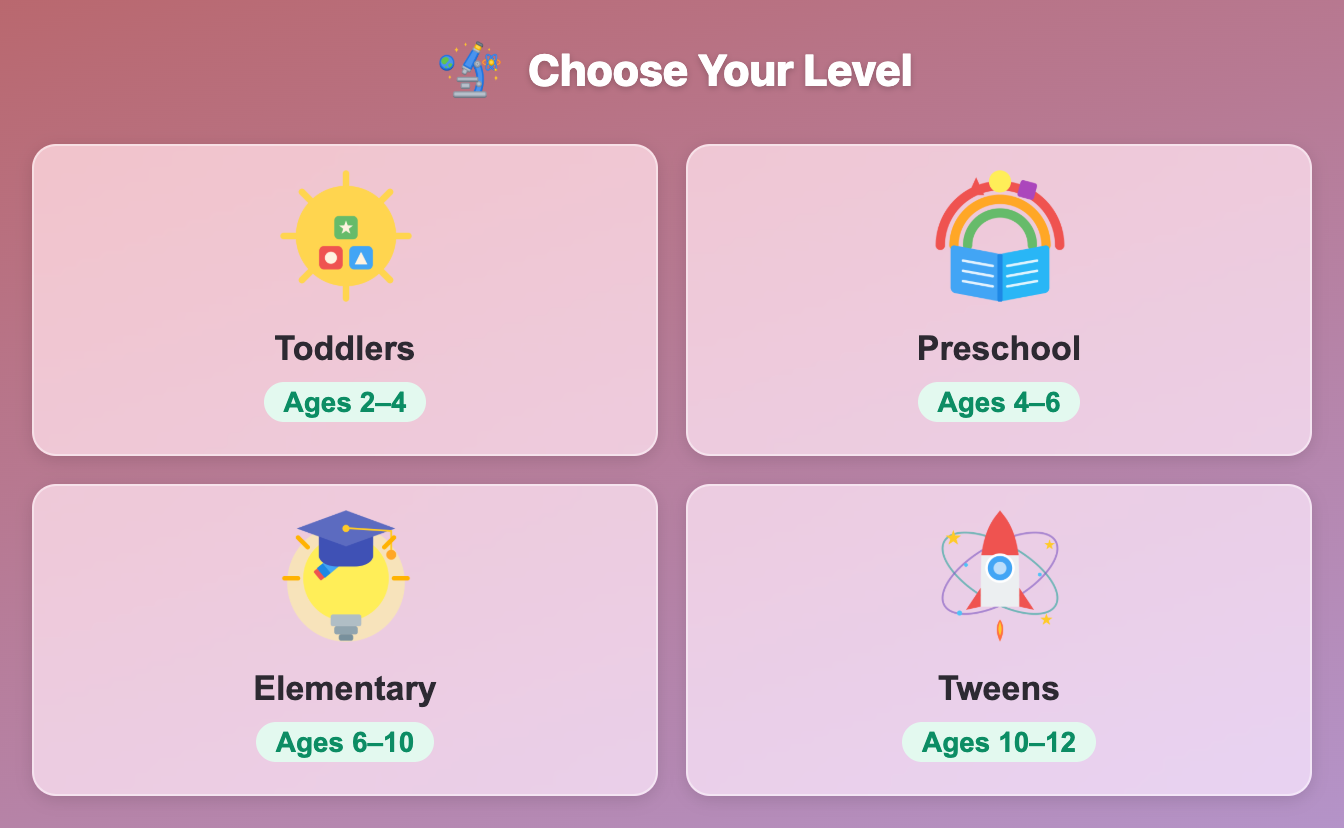
Pick your level. The game starts on Elementary. Press Change Level in the top corner to switch to Toddlers, Preschool or Tweens. The game remembers your choice next time.
Choose a tool from the rack. The tools show up in a different order every game. Under each one it says Not tested yet. After a test, it shows a check mark, the food that tool was best at, and its bird.
Press Start. A card tells you which tool you're testing and how many seconds you have: 20 seconds on most levels, 15 on Tweens.
Tap the food. On a computer, your tool follows your mouse around the buffet. On a phone or tablet, just tap. A good grab pops up a +1. A slow grab shows little progress dots, and a tool that can't get the food makes a red X.
Read the message strip. The white strip under the buffet explains what just happened. The first good grab says why the tool works ("Crack! The strong nutcracker breaks open the hard seed shell."). The first time you try a wrong food, it says why it fails.
Watch the tally. The row of food chips above the buffet counts everything this tool collected. The Food counter at the top adds up all your tests.
Time's up! When the clock runs out, you see the tally. On most levels you answer a question first, then the game shows the tool's best food and its real bird with a fun fact.
Move on. The Next Beak button slowly fills up and moves on by itself after 5 seconds, or you can press it sooner. After the last tool, you get the results (and a bar chart on the bigger levels), then your final score out of 100, up to five ⭐ stars, and a gallery of all the birds you met.
Play again. Choose Play Again for a fresh rack, or Choose Another Level. You can also use the page's buttons to go fullscreen, reload the game, or turn the music on and off.
Every card has a 🔊 button that reads the words out loud. The clock waits while the game is reading, so listening never costs you time.
🏆 Bird Beak Buffet for Kids: How to Collect the Most Food
Your score comes from three things: how much of each tool's best food you collect, how well you answer the questions, and (on Tweens) how good your predictions are. Food from the wrong station doesn't help your score at all. So the real trick is to find each tool's best food fast, then stay there.
1. Think about the tool's shape before you tap
Every tool's shape is a clue. Ask yourself three questions:
Is it long and thin? Then it can reach deep inside things, like into a flower or down into mud.
Is it short and strong? Then it can squeeze hard, like cracking a shell.
Is it wide, with holes? Then it can scoop things out of water, and the water drains away.
A straw is long, thin and hollow, so it's made for sipping a liquid. The nutcracker is short and strong. The net is wide with holes. Once you see the shape, you can often guess the best food before you even start.
2. Don't be fooled by a slow grab
Two tools can get a second food, but only slowly. It takes 4 taps instead of 1, and you'll see progress dots fill up. Slow is not the same as best!
Example: the tweezers test. Say you start by tapping the seed tray. The dots fill up, and the strip says "Tweezers can crack a hard seed shell, but only with lots of squeezes. Keep tapping!" That's 4 taps for one seed. Now try the bugs in the bark. Each beetle comes out in one tap: "Got one! Thin, pointed tweezers pinch tiny bugs out of narrow cracks." Bugs are the tweezers' best food, so spend the rest of your time on the bark.
The chopsticks have the same trap. They can catch a fish, but it's slippery, so it takes 4 taps. Worms come out of the mud in one tap. Go for the worms.
3. Keep moving between the items
A food you grab comes back after about one second. Each station has several items: 5 seeds, 4 bugs, 4 worms, 3 flowers and 3 fish. So don't wait for the same item to come back. Tap the next one, then the next, and by then the first one is back.
Tapping super fast doesn't help much. The tool can only peck about 6 times a second, so a steady tap, tap, tap works just as well as wild tapping. If you miss and tap empty space, the strip says "Tap right on the food!"
4. Catch fish where they're going
Fish are the only food that moves. They swim an oval lap around the pond. Tap a little in front of a fish, where it's heading, instead of where it was. The good news: the net has a wide hoop, so it gives you a bit of extra room, and moving fish are a little easier to hit than they look.
5. Use the number keys on a computer
With a keyboard, you can play without the mouse at all. Press a number key to peck the next ready item at that station. The stations are numbered from the top left, going across. On Elementary and Tweens, that's 1 for bugs, 2 for nectar, 3 for seeds, 4 for fish and 5 for worms.
The number keys also pick tools from the rack and answers from the cards, and Enter or Space presses Start and Next. That makes the keyboard a fast way to play, and it's handy for kids who find a mouse tricky.
6. Learn from every red X
Each wrong tap is a tiny science lesson, not a mistake to feel bad about. The first time you try a food that doesn't work, the strip tells you why. For example:
"The nectar drips straight through the holes in the net!"
"The nutcracker is too thick to fit into the narrow cracks in the bark."
"Tweezers are too short to reach the worms deep in the mud."
These lines are the answers to the big question at the end. Read them, and you'll know why each beak is shaped the way it is.
🔎 Five Tests, Solved One by One
Here is every tool, what it's best at, and the real bird it matches. Try to guess each one before you read it!
Straw → nectar → hummingbird. "Slurp!" A straw can reach deep into a trumpet flower. It can't do anything else: bugs, seeds, fish and worms are not liquids. A hummingbird's long, thin beak reaches into flowers, and its long tongue laps up the nectar.
Nutcracker → seeds → finch. "Crack!" Only the nutcracker breaks a seed shell in one squeeze. It's too thick for the bark cracks and too short for the mud. A finch has a short, thick, strong beak for cracking seeds.
Net → fish → pelican. "Scoop!" The net catches a fish and lets the water drain away. But seeds slip through its holes, and nectar drips right out. A pelican's long beak has a stretchy pouch that scoops up fish and water, then drains the water.
Tweezers → insects → warbler. Thin, pointed tips pinch bugs out of narrow cracks. Seeds work too, but only slowly. A warbler's thin, pointed beak picks tiny insects out of leaves and bark.
Chopsticks → worms → kiwi. Long chopsticks reach deep into the mud. Fish work too, but slowly. A kiwi pushes its long, thin beak deep into the ground to find worms.
🔮 Tweens Challenges: Predict It, Then Read the Chart
The Tweens level adds two real science skills: making a prediction and reading a graph.
Predict before you test
A prediction is your best guess about what will happen, made before you test it. Before every Tweens test, the game asks, "Predict! Which food will the net be best at?" A right guess earns 5 extra points.
Example: thinking through the net. Go through the foods one at a time. Nectar? It's a liquid, so it would drip through the holes. Seeds? They're small, so they would slip through too. Bugs? They hide in narrow cracks, and a net is too big to reach in. Worms? A net can't dig into mud. That leaves fish. Predict fish!
If your guess is wrong, the game doesn't scold you. It says what you predicted, what the test showed, and "Testing is how scientists check their ideas!"
Read the bar chart
After all five tests, Elementary and Tweens players see a bar chart. Each tool gets its own group of bars, and each food has its own color: green for insects, yellow-orange for nectar, gray for seeds, orange for fish and pink for worms.
On Tweens, the game then asks up to two questions, like "Read the chart: which beak collected the most fish?" The numbers are hidden until you answer, so you have to read the bars.
Example: the fish question. Find the orange bars. The net probably has a long one. But what if you spent a lot of time tapping fish with the chopsticks? Then the chopsticks have an orange bar too. Answer with the tool whose orange bar is longest. The chart shows your results, so trust the chart, not what you think the answer should be.
The game only asks about a food when one tool clearly collected the most of it, so there's always one right answer.
⭐ How Your Score Out of 100 Is Counted
Each test is worth up to 10 points for collecting your goal of that tool's best food: 5 items on Toddlers, 6 on Preschool, and 10 on Elementary and Tweens. If you collect half the goal, you get half the points. Anything past the goal is a bonus for your Food counter, but not for your score.
Questions give 10 points on your first try and 5 on your second. After two wrong tries, the game shows the answer. A right prediction gives 5 points, and each chart question gives 5 points (or 2 on a second try). Then everything is scaled to a score out of 100.
Example: a Tweens score. A perfect Tweens game is 5 tests × 25 points (10 for food, 10 for the question, 5 for the prediction), plus 10 for two chart questions and 10 for the last question. That's 145 points. Miss one prediction and you have 140 out of 145, which is a score of 97. A score of 90 or more earns all five stars and a gold trophy.
Example: a Toddlers score. Toddlers have no questions. Collect 5 of the best food in each of the 3 tests, and you get 100. Collect only 3 nectar with the straw, and that test gives 6 points instead of 10, so the score is 87.
🐣 Who Can Play? Bird Beak Buffet From Toddlers to Tweens
Bird Beak Buffet for toddlers (ages 2–4)
The youngest players get a small, friendly buffet. There are just three tools (the straw, the nutcracker and the net) and three stations. You have 20 seconds, and collecting 5 of the right food gets full points. There are no questions to answer. The game simply shows the answer and the bird. When the site's sound is on, it reads the cards and messages out loud, so a child who can't read yet can still follow along. A grown-up can help by pointing: "Look, the net is wet. What lives in water?"
Bird Beak Buffet for preschoolers (ages 4–6)
This level adds the tweezers and the bugs in the bark, so there are four tools and four stations. The goal is 6 items in 20 seconds. After each test, kids answer "Which food was the straw best at?" by tapping a picture, so no reading is needed. A wrong answer gets a gentle hint: which food could it grab in just one tap? With the site's sound on, the cards and the reveal are read aloud automatically, too.
Bird Beak Buffet for elementary kids (ages 6–10)
Here kids use all five tools on the full buffet, with 20 seconds and a goal of 10 per test. Each reveal adds an extra bird fact, like how a hummingbird can hover in one spot while it drinks. At the end, kids see the bar chart of all their results and answer the big question: "Why do birds have so many different kinds of beaks?" Here, words are read aloud only when a child presses 🔊.
Bird Beak Buffet for tweens (ages 10–12)
The oldest players get only 15 seconds per test, so finding the best food fast really matters. Tweens predict before every test, answer up to two chart questions with the numbers hidden, and get a longer explanation at the end. It uses the word adaptation: over many, many years, birds whose beaks fit their food got more to eat and raised more chicks. It also points out that real birds often eat more than one food, but their beak works best for their main one.
If your child loves the bug station, Build a Bug is a great next step. They put together a ladybug, a honeybee or a dragonfly piece by piece and find out what makes an insect an insect.
🌱 What Kids Learn at the Buffet
Shape fits the job. When the nectar drips through the net, kids see with their own eyes that a tool's shape decides what it can do. That's the same idea scientists use to explain beaks, teeth, claws and feet.
How a fair test works. Every tool gets the same buffet and the same amount of time. Only the tool changes. That's what makes the results fair, and it's how real experiments are built.
Guess, then check. On Tweens, kids make a prediction and then test it. When the test proves a guess wrong, that's not failing. It's learning, just like a scientist.
Reading results. The tally chips and the bar chart turn taps into numbers. Kids learn to compare counts and read a graph to answer a question.
Real birds, real facts. The kiwi is the only bird with nostrils at the tip of its beak, so it can sniff out worms underground. A brown pelican's pouch can hold up to 11 liters (about 3 gallons) of water. Facts like these stick when kids have just "been" that bird.
Food and feeding. Every beak in this game is about eating, and eating connects living things. Kids who want to know what happens next can try Food Chain Builder, where they put grass, rabbits and foxes in order to show who eats whom.
👪 A quick note for parents and teachers
Bird Beak Buffet is calm, cheerful and safe. There are no scary scenes and no chasing animals, and the only "hunting" is a beak picking up its lunch. It's free to play in the browser on a computer, tablet or phone, with no download and no account needed. It practices observing, comparing, predicting and reading a simple bar chart, all built around one clear science idea. It works well as a warm-up before a real beak experiment with tweezers and straws at home or in class.
🐦 Grab a Tool and Get Eating!
The buffet is ready, and five hungry birds are waiting to be discovered. Pick a tool, press Start, and find out which beak works best for which food. Then see if you can beat your score in Bird Beak Buffet for kids. If the fish pond was your favorite station, swish a net through the water in Pond Dip Detective and see which tiny pond creatures, like snails and tadpoles, you catch.
🖼️ See the Game in Action
The Choose Your Level screen in Bird Beak Buffet, with Toddlers, Preschool, Elementary and Tweens cards
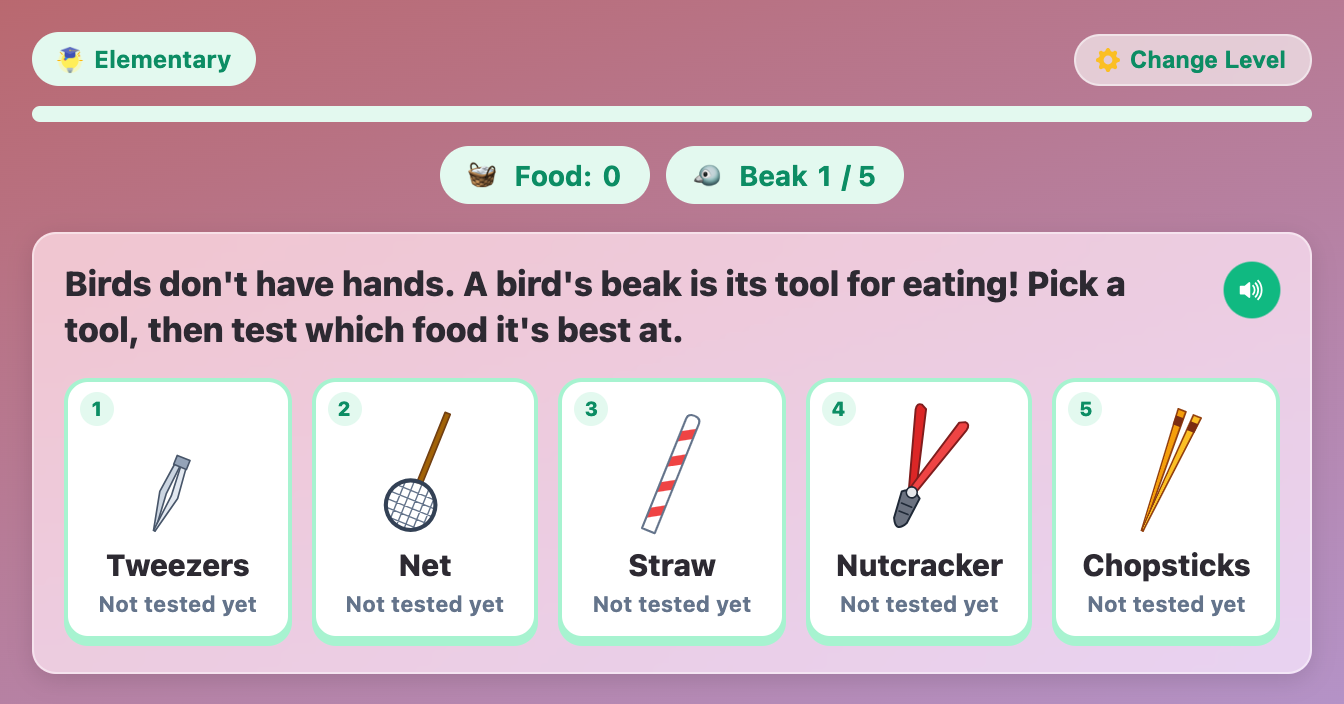
The tool rack in Bird Beak Buffet for kids, with tweezers, a net, a straw, a nutcracker and chopsticks to test
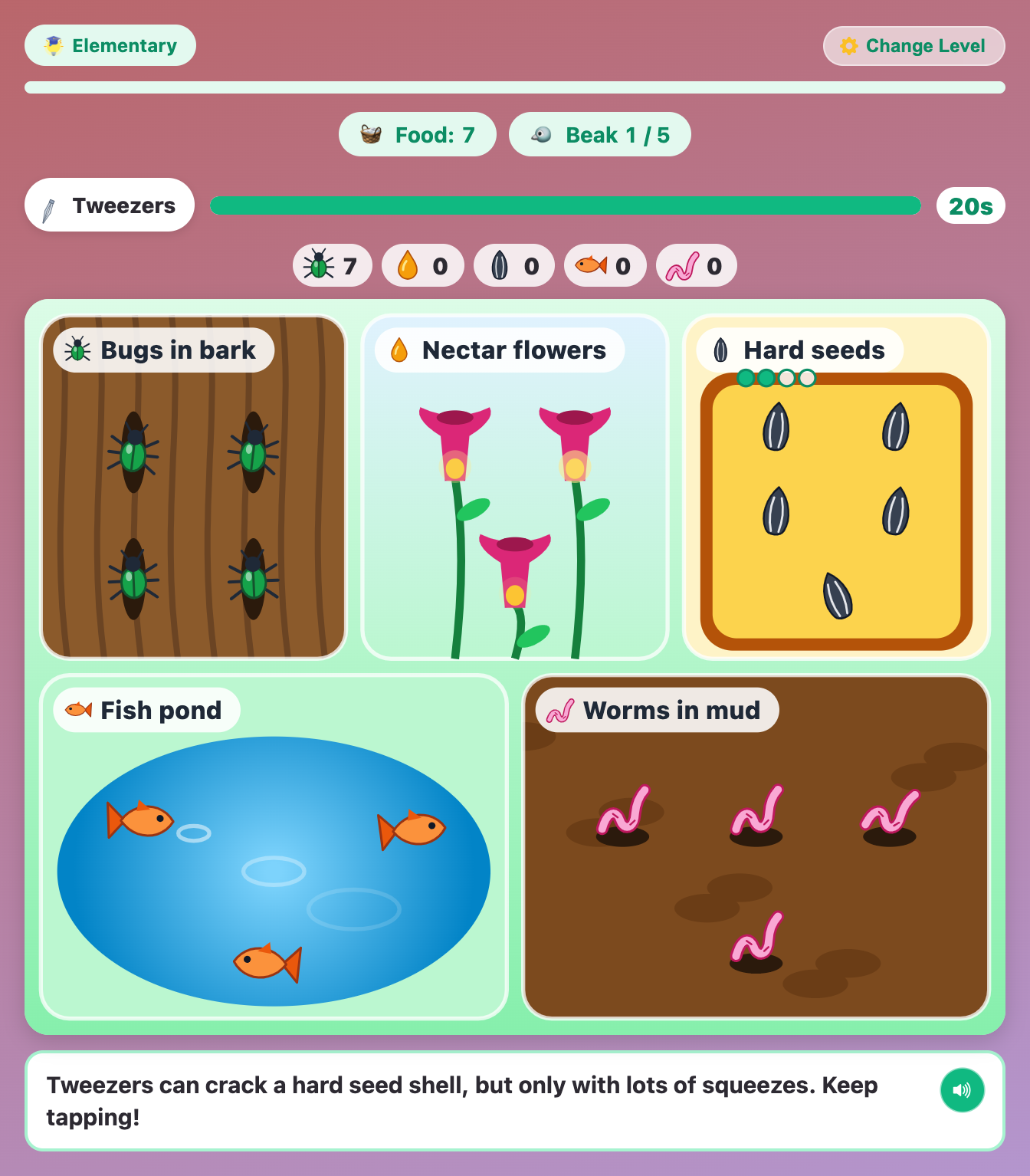
Tweezers at the Elementary bird buffet, with progress dots on a hard seed and a keep tapping message
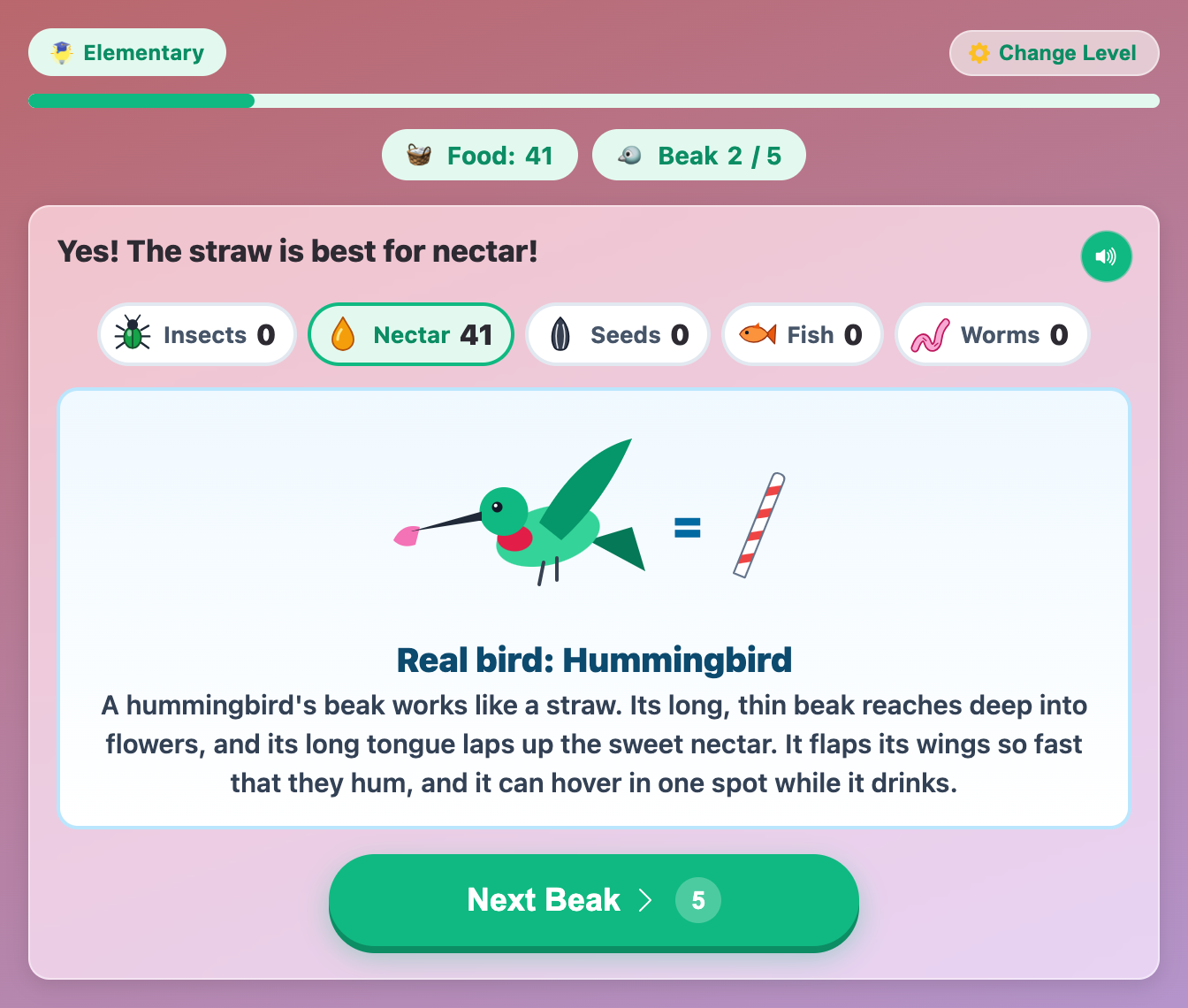
A hummingbird drawn next to a straw after the straw test, with the nectar tally highlighted and a bird fact
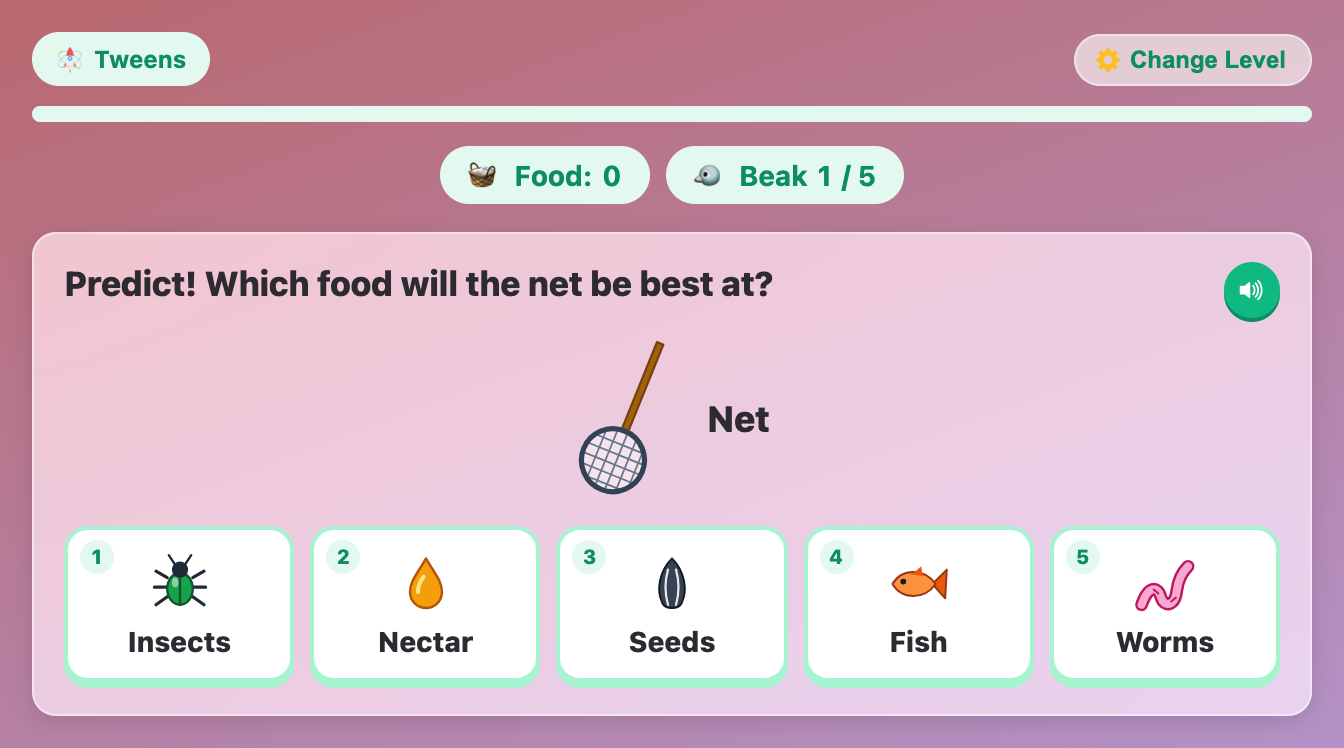
The prediction card asking which food the net will be best at, with five food buttons to choose from
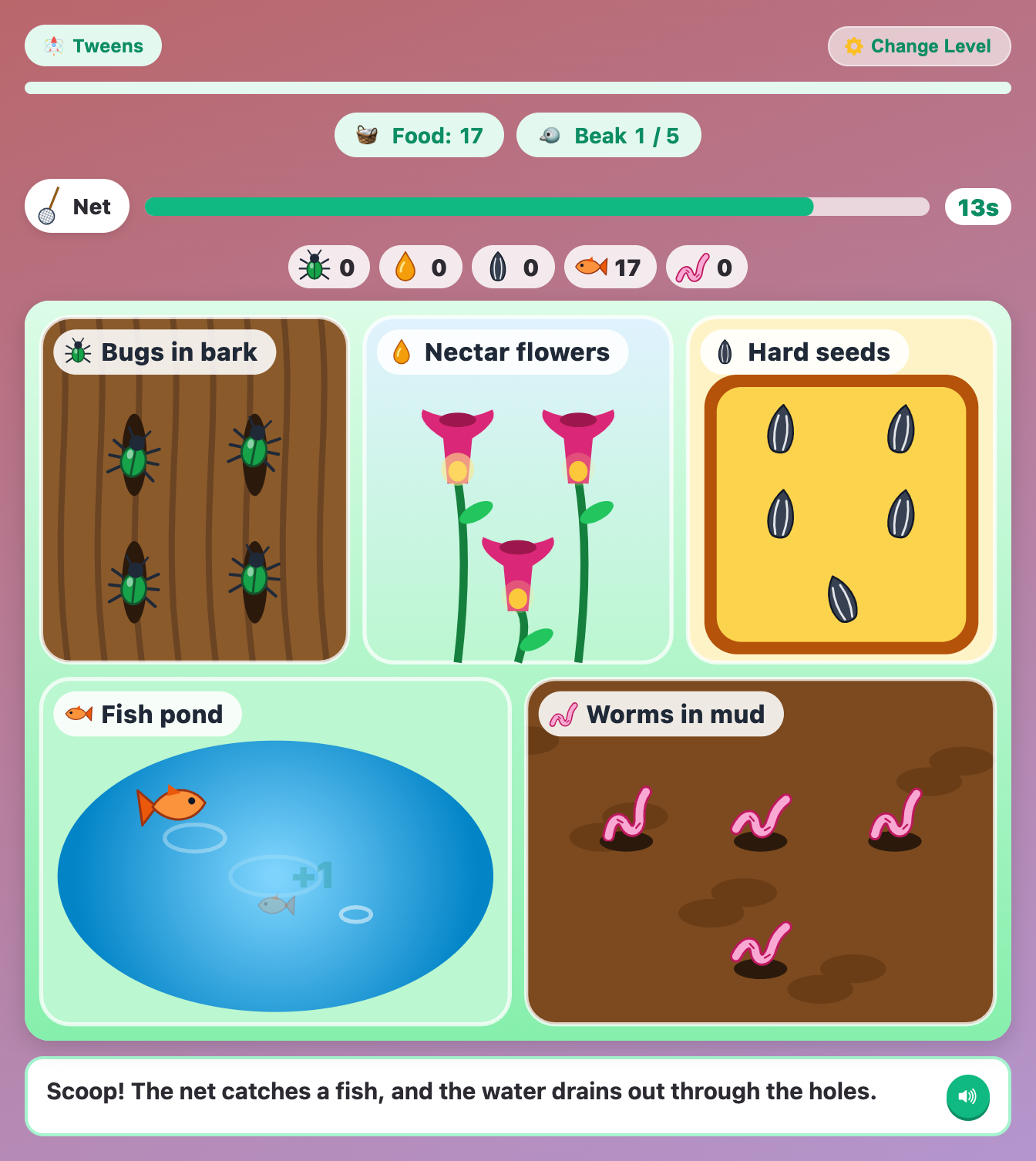
The net scooping a fish from the pond in Bird Beak Buffet for tweens, with 13 seconds left
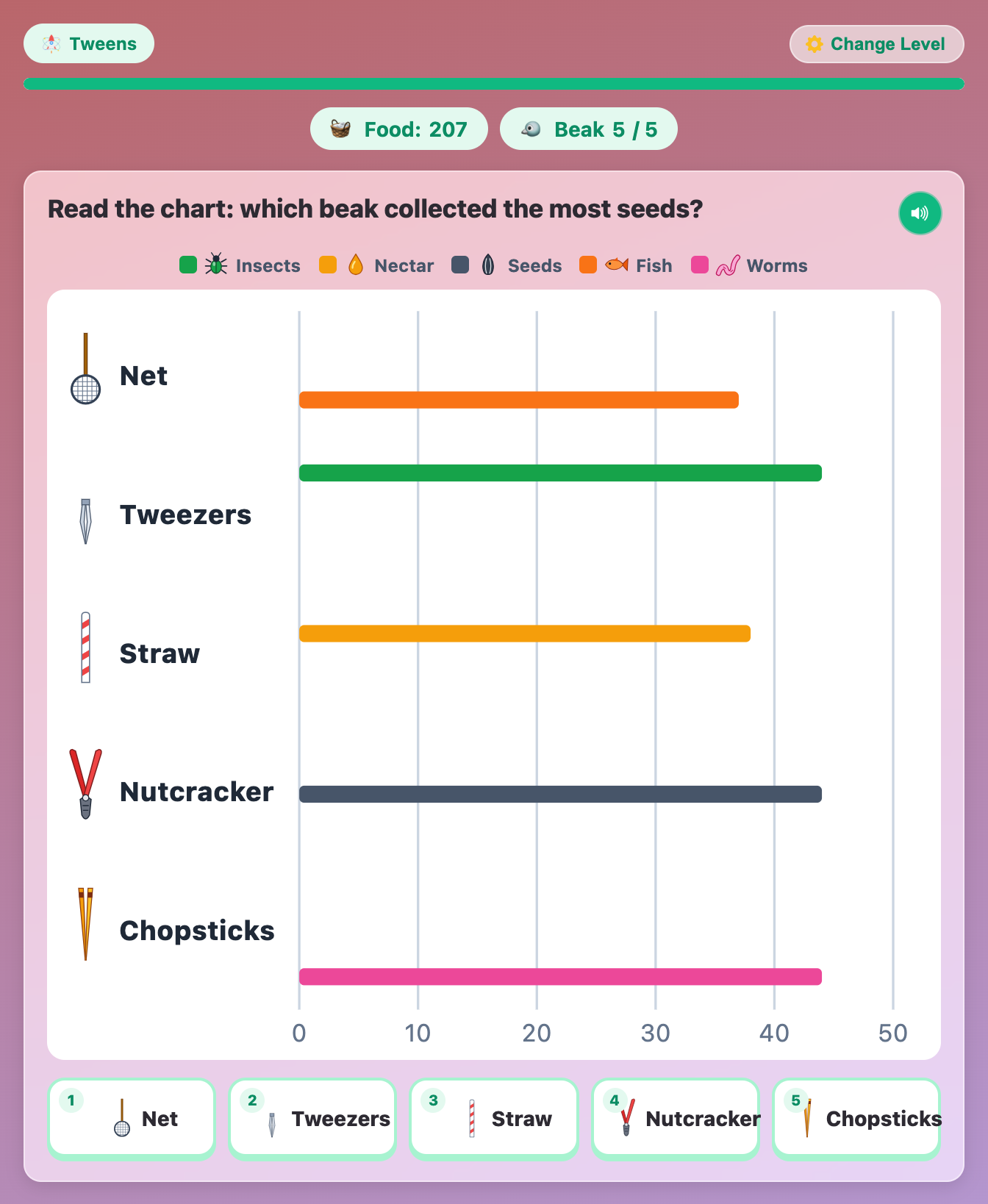
A bar chart of every beak's results with the question which beak collected the most seeds
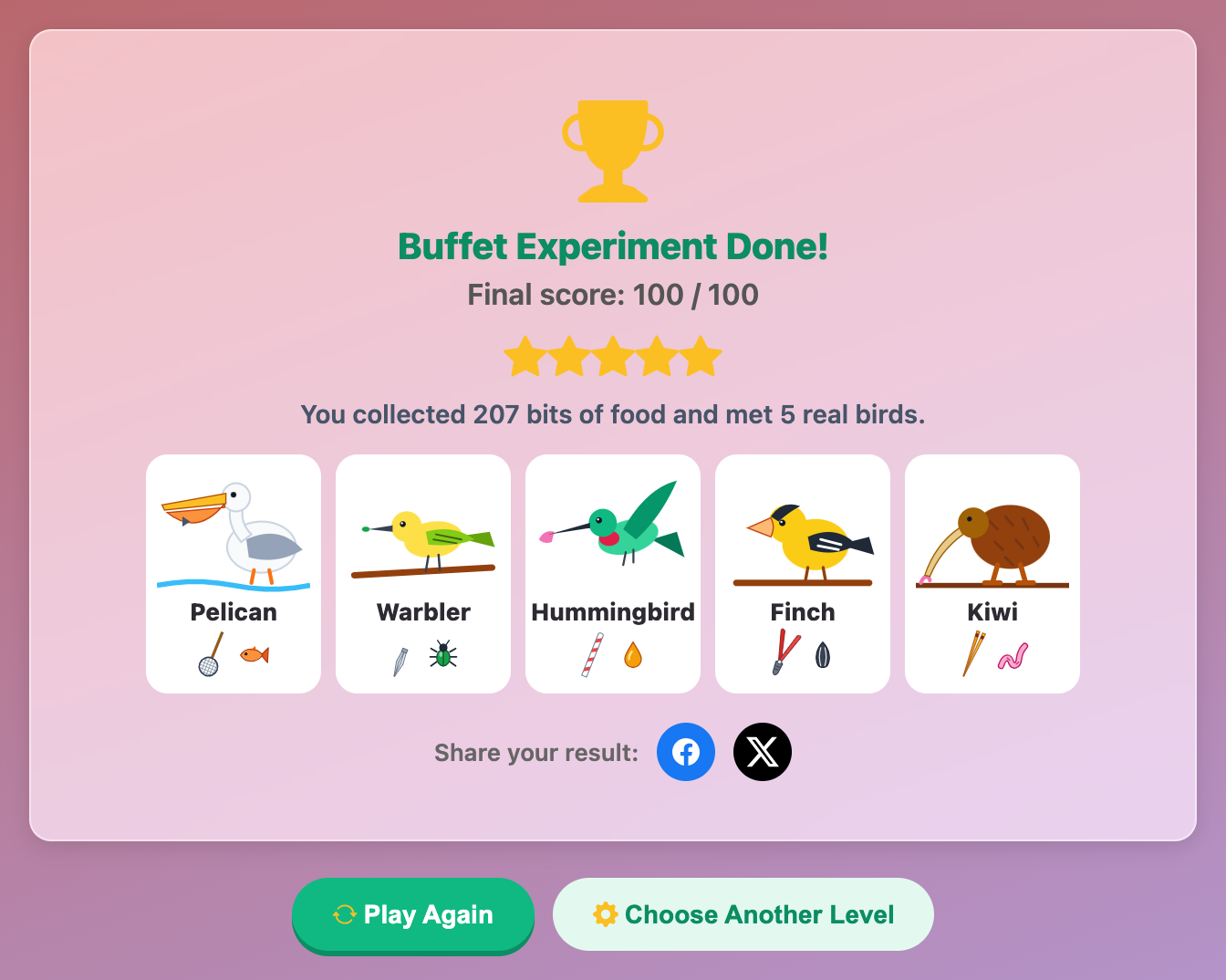
The Buffet Experiment Done card with a score of 100, five stars and the pelican, warbler, hummingbird, finch and kiwi
More Science Games
 59.5K plays
4.8
Recycling Sort
Sort everyday items into the Recycle, Compost, or Trash bin before time runs out!
 85.7K plays
4.9
Grow a Plant
Plant seeds in sunny and shady garden beds, then water, feed and protect them day by day. Watch the roots grow underground and harvest sunflowers, tomatoes, carrots and more!
 438.6K plays
4.9
Magnet Experiment
Guess which objects a magnet will pull, then drag the magnet to test every guess. Does gold stick? Does a battery?
 386.9K plays
4.9
Five Senses Match
Decide which of your five senses you would use for each everyday scene before time runs out.
Most Played Games
 1.8M plays
4.9
Color & Draw
A free-drawing canvas with colors and brush sizes to unleash your creativity.
59.5K plays
4.8
Recycling Sort
Sort everyday items into the Recycle, Compost, or Trash bin before time runs out!
 365.8K plays
5.0
Tic-Tac-Toe
Play a game of Tic-Tac-Toe against the computer and see if you can outsmart it.
 274.1K plays
5.0
Sentence Builder
Pick your age level, then tap the shuffled words in the right order to build the sentence.
Comments (53)