
Pond Dip Detective
27.5K playsSwish your net through the pond and see what you catch! Look closely in the tray and answer yes-or-no questions to name each creature, from tadpoles and water boatmen to dragonfly nymphs and caddisfly larvae hiding in their homemade cases. Fill your pond journal, and big kids use a real scientist's key and work out how clean the water is from the creatures they find.
Real scientists check how healthy a pond is with three simple tools: a net, a white tray and a list of yes-or-no questions. Pond Dip Detective for kids hands you all three. It's a free science game for ages 2 to 12 where you sweep a net through a pond, tip your catch into a tray, and answer questions about it until you know its name. Is it a tadpole, a water boatman, or a caddisfly larva hiding in a little house it built from sticks?
Every creature in the game is a real pond animal, drawn big enough in the tray to count its legs and tails. Each one you name goes into your own pond journal. On the Tweens level you go one step further: you look at what you found and decide if the pond's water is clean, fairly clean or polluted, just like a real water survey. It plays right in your web browser, with no download and no sign-up, on a computer, a tablet or a phone.
🪣 Pond Dip Detective for Kids: A Real Field Trip in Your Browser
Pond dipping is a real outdoor science activity. Classes go to a pond with nets, sweep them through the water, and pour what they catch into a shallow white tray. The white makes small animals easy to see. Then everyone looks closely and works out what each animal is. At the end, every creature goes gently back into the water.
To name an animal, pond dippers use a key. A key is a list of questions with two answers, yes or no. Each answer sends you to the next question, like a path that splits in two again and again. Scientists call it a dichotomous key, which just means "split in two". Follow the path all the way and it ends at one name.
Pond Dip Detective puts all of that on your screen. The pond is drawn from the side, so you can see every layer: the surface with lily pads, the open water, two clumps of weeds, the stony bottom and the soft mud. Each creature lives in its own part of the pond, just as it would in a real one. Your goal is to make 8 or 10 good catches (it depends on your level), name each one correctly with the key, and fill as much of your journal as you can.
🥅 Net, Tray, Key, Journal: How a Dip Works
Pick your level. The Choose Your Level screen shows four cards: Toddlers (ages 2–4), Preschool (4–6), Elementary (6–10) and Tweens (10–12). The game remembers your choice, and the Change Level button at the top takes you back here at any time.
Read the top bar. It shows your points, which dip you're on (for example "Dip 1 / 10"), and how many kinds of creature you've found out of the kinds on your level.
Catch something. Drag the net through the water with your mouse or finger. Or just tap a spot, and the net swishes across it for you. On a keyboard, the arrow keys steer the net and Space or Enter swishes it. With a mouse, moving without holding the button only moves the net; it catches nothing until you press.
Watch the catch come up. The net lifts out of the water and drops your creature into the white tray. A new creature swims into the pond to take its place.
Answer the key's questions. Next to the tray you see one question at a time, such as "Does it have a curly shell?" Tap Yes or No (or press Y or N). Each answer you give shows up as a little chip above the question, like "1. In a case? No", so you can see the path you've taken.
Look again if you slip. A wrong answer makes that button shake and turn grey, and the other button starts to pulse. A "Look again!" note tells you where to look, such as "Look at its back end and count the tails." It never just gives you the answer.
Meet your creature. When the key reaches the end, the game names it ("It's a damselfly nymph!") and tells you a true fact about it. The first time you find a kind, you see "New in your journal!"
Move on. The Next Dip button counts down 3 seconds and then moves on by itself. Tap it, or press Enter or Space, to go right away. If something is being read aloud, the countdown waits for it to finish.
Fill your journal. Under the pond, "My Pond Journal" shows every creature on your level. Ones you haven't found are grey shapes with "???". Ones you have found turn to full color with a count, like "×2".
See your score. After the last dip (or the water verdict on Tweens), the "Pond Dip Complete!" card shows your final score, up to 5 stars, how many creatures and kinds you caught, and a reminder that every creature was poured gently back into the pond. Then pick Play Again or Choose Another Level.
Use the extras. The 🔊 buttons read the task, each question and each fact out loud. The page's own buttons switch the music on or off, show the game full screen, and reload it for a fresh pond.
🧮 Where Your Points Come From
Every dip is worth 10 points. Those 10 points are shared between the questions that dip asks, and you only get a question's share if you answer it right the first time.
A pond snail on the Toddlers level needs just 1 question, so that one answer is worth all 10 points.
A tadpole on the Toddlers level needs 2 questions, so each one is worth 5.
A damselfly nymph on the Elementary level needs 6 questions. Get one wrong and you keep 5 of the 6 shares, which rounds to 8 points.
Toddlers make 8 dips, so the best score is 80. Preschool and Elementary make 10 dips, for a best score of 100. Tweens make 8 dips worth 80 points, then judge the water for 20 more: 20 if you get it right the first time, 10 on the second try. A wrong answer never stops the game. You can always fix it and keep going; it just costs that question's share.
🎣 Netting Know-How: How to Catch the Creature You Want
You can't name a creature you never catch. These tips help you fill more of your journal.
1. Know who lives where
Each animal stays in its own part of the pond. Water boatmen and great diving beetles zoom about near the surface and in the open water. Tadpoles and water mites like the middle and the weeds. Damselfly nymphs stay in the weeds. Caddisfly larvae and water lice crawl along the bottom. Bloodworms and rat-tailed maggots live down in the mud. So if your journal still has a gap, think about where that animal lives and sweep there.
2. Scrape the bottom on purpose
The bottom-dwellers are easy to miss, because a quick swish through the middle never touches them. Drag the net low, just above the mud, from one side of the pond to the other. This is how you find caddisfly larvae, and on Tweens it's the only way to catch a bloodworm or a rat-tailed maggot. The rat-tailed maggot hardly moves at all. Look for something standing head-down in the mud with a long thin tube poking up.
3. Cut across a fast swimmer's path
Water boatmen dart in quick bursts, and diving beetles are nearly as fast. Chasing them from behind rarely works. Instead, drag one long line across the water in front of where they're heading. The net catches whatever its path touches, so a long, steady sweep covers more water than lots of tiny jabs.
4. In a crowd, you get the closest one
If your net passes near two creatures, you catch the one nearest to the net's path. So if a snail sits right next to the dragonfly nymph you want, aim your sweep straight through the nymph, not between them.
5. Let new kinds come to you
After every catch, a new creature swims in about a second and a half later. Kinds you haven't caught yet are four times as likely to show up, and there are never more than 2 of one kind in the pond. So keep dipping: the pond keeps offering you new animals. And if you wait a while without catching anything, one creature starts to glow. It's usually one that isn't in your journal yet, so it's a free tip about where to sweep.
6. The keyboard is a steady net
On a computer, the arrow keys move the net smoothly, and it catches while it moves through the water. Steer it down to the bottom, then hold the left or right arrow to sweep along the mud. Press Space to swish wherever the net is.
🔬 Reading the Key Like a Real Scientist
Catching is half the game. The other half is looking. These habits help you answer right the first time, which is where the points are.
Look before you tap
The creature in the tray moves its legs, tails and gills, so give it a second. Read the whole question, then find that body part before you answer. Only first answers count, so a slow, sure tap beats a fast guess.
Count legs on one side, then double
"Does it have more than 6 legs?" is easier if you count only one side. Insects, like nymphs and beetles, have 3 legs on each side, which makes 6. A freshwater shrimp, a water louse or a water mite has more. If counting legs is your favorite part, Build a Bug lets you put 6 legs on a ladybug, a honeybee or a dragonfly and see why every insect has three body parts.
Check the back end for tails
Many questions are about the tail end. Mayfly and damselfly nymphs both have 3 tails. A damselfly nymph's tails are flat and wide, like little leaves (they're really gills it breathes with). A mayfly nymph's tails are thin like hairs. A dragonfly nymph has only short spikes at its end, and those don't count as tails.
Take each word at face value
The questions are careful with their words. "Curly shell" means a shell that twists round and round, like a snail's. A shrimp or a beetle has a hard outside, but not a curly shell. A caddisfly larva's case isn't a shell either: it's a tube the larva builds itself, and the key asks about it first.
Use your chips as a memory
The chips above the question remind you what you already said. If you said yes to legs and no to more than 6, you know you're looking at an insect with 6 legs. That makes the next questions easier to picture.
🧩 Seven Catches, Worked Out Together
Here are some real paths through the game's keys, so you can see how the questions split the animals apart.
Catch 1: a toddler's tadpole
"Does it have a curly shell?" No. (Yes would have meant a pond snail.)
"Does it have legs?" No. (Yes would have meant a water boatman.)
It's a tadpole! Two questions, 5 points each.
Catch 2: oars or no oars on Preschool
A water boatman and a dragonfly nymph both have legs, so the key needs one more question to split them: "Are its back legs long and flat, like oars for rowing?" Look at the last pair of legs. A water boatman's are long, flat and fringed with hairs, so the answer is yes. A dragonfly nymph's legs are thin, so it's no.
Catch 3: a damselfly nymph on Elementary
In a case? No. Curly shell? No.
Legs? Yes. More than 6 legs? No. So it's an insect.
3 tails at its back end? Yes. Now it's a damselfly or a mayfly nymph.
Are the 3 tails flat and wide, like little leaves? Yes. It's a damselfly nymph!
That's 6 questions. If the tails had been thin, the same path would have ended at the mayfly nymph instead.
Catch 4: the water boatman on Tweens
The Tweens key has 15 creatures, so the boatman takes 7 questions: case (no), curly shell (no), jointed legs (yes), more than 6 legs (no), 3 tails (no), wing cases (no), oar legs (yes). Why does the key ask about wing cases before oars? Because a great diving beetle has flat, hairy back legs too. Its back is covered by two hard, shiny wing cases that meet in a straight line down the middle, so that question sorts out the beetle first.
Catch 5: three wrigglers in the mud
On Tweens, a bloodworm, a rat-tailed maggot and a leech can all look like little worms. The key starts with "Does it have jointed legs (legs that bend in the middle)?" All three say no, because their little bumps don't bend. Then:
"Does it have a tail with a fin for swimming?" No. (That one's for the tadpole.)
"Does it have a long, thin breathing tube, like a snorkel?" Yes means the rat-tailed maggot. Its "tail" is really a tube it pokes up to breathe.
If not, "Does it have a round sucker at each end?" Yes means a leech. No means a bloodworm, the red baby of a tiny fly called a midge.
Catch 6: lots of legs on Tweens
If a creature has more than 6 legs, the key asks "Does it have 8 legs and a round body?" Yes means a water mite, a tiny cousin of spiders. If not, it asks if the body is wide and flat like a woodlouse. A water louse lies flat in the tray. A freshwater shrimp has a curved body that's thin from side to side, so it lies on its side.
Catch 7: a snail with a twist
Tweens meet two snails. After "curly shell? Yes", the key asks "Is its shell coiled flat, like a rolled-up rope?" A ramshorn snail's shell coils flat, like a ram's horn. A pond snail's shell twists up to a sharp point.
💧 The Tweens Challenge: Is This Pond Clean?
Some pond animals can only live in clean water with lots of oxygen. Others are tough and can live in dirty water too. Scientists use this to judge a pond, and the Tweens level lets you do the same. Each Tweens pond is clean, fairly clean or polluted. A polluted pond looks murkier, with scum on top and fewer weeds.
On Tweens, most creatures you name also show a water sign, and your journal shows it too. (The water mite, water louse and tadpole don't have one.)
🌟 Clean-water sign: mayfly nymphs and caddisfly larvae.
👍 Needs fairly clean water: dragonfly nymphs, damselfly nymphs and freshwater shrimp.
💪 Lives in dirty water too: leeches, bloodworms and rat-tailed maggots.
💨 Breathes air: pond snails, ramshorn snails, water boatmen and great diving beetles. They come up for air, so they don't tell you much about the water.
After your last dip, the game asks: "Going by the creatures in your journal, how clean is this pond's water?" You pick Clean, Fairly clean or Polluted (or press 1, 2 or 3). Here's the rule the game uses:
Any 🌟 in your journal? Then the water is clean.
No 🌟, but any 👍? Then it's fairly clean.
Neither? Then it's probably polluted.
For example, if your journal has a freshwater shrimp (👍) and one mayfly nymph (🌟), the answer is Clean, because the clean-water sign wins. If you found only shrimp and a dragonfly nymph, it's Fairly clean. If all you found were leeches, snails and water boatmen, it's Polluted.
A smart tip: the question is about your journal, so the right answer is whatever your journal shows. But a good scientist wants the journal to match the real pond. A clean pond always has clean-water signs swimming in it, and they live in the weeds and along the bottom. So in your last few dips, sweep low and through the weeds. If your net misses them, the game will tell you what the water was really like, so you learn from it either way.
👧 One Pond, Four Ages
The level changes the key, the pond and the net, so the game grows with your child.
🐣 Pond Dip Detective for toddlers (ages 2–4)
Toddlers meet just three animals: a pond snail, a water boatman and a tadpole. There are only two questions, about a curly shell and about legs. The net is big, the creatures swim slowly, and a creature glows after a short wait to show where to sweep. With the site's sound on, the task, the questions, the hints and the facts are read out loud. A grown-up can help by asking "Can you see legs?" and letting the child tap. A game is 8 dips.
🌈 Pond Dip Detective for preschoolers (ages 4–6)
Preschoolers add the leech and the dragonfly nymph, for five animals in all. New questions ask about a long, swishy tail and back legs like oars. Everything is still read aloud with sound on, and the facts are short and friendly. A game is 10 dips.
📚 Pond Dip Detective for elementary kids (ages 6–10)
Elementary kids work with nine animals, adding the caddisfly larva, the freshwater shrimp, and damselfly and mayfly nymphs. They count legs, count tails, and check for a case. A dip can take up to 6 questions. The facts get longer, the net gets smaller and the creatures move faster. Kids can also open "See the whole key" under the journal to read the full key as numbered questions, the way it looks on paper. A game is 10 dips.
🚀 Pond Dip Detective for tweens (ages 10–12)
Tweens get the full 15-creature key, with up to 7 questions a dip, words like "jointed legs", and tricky look-alikes such as the two snails and the three mud wrigglers. Every pond has its own water quality, every creature shows its water sign, and the game ends with the water verdict. A game is 8 dips plus the verdict. Nothing is read automatically on Elementary or Tweens, but the 🔊 buttons always work.
🌿 What a Muddy Net Teaches
Looking closely. Every question asks your child to check one body part: the back legs, the tail end, the middle of the back. That careful looking is the heart of science. The "Look again!" notes teach where to look instead of handing over the answer.
Sorting with yes and no. A key teaches a big idea: you can tell many things apart by asking one small question at a time. Kids see that "Legs? Yes" cuts the list in half, and that the order of questions matters, like asking about wing cases before oars.
Animals change as they grow. Many pond animals are babies of something else. A tadpole becomes a frog, a dragonfly nymph climbs out and becomes a dragonfly, and a bloodworm grows into a midge. If your child enjoys these changes, Magic Crossbow: Cycle Breaker is a fun way to practice putting life cycles in the right order.
Who eats whom. The facts are full of hungry animals. A great diving beetle catches tadpoles, many pond leeches eat snails and worms, and a dragonfly nymph grabs food with a hooked jaw. To build those links into chains, try Food Chain Builder.
Caring for nature. Tweens learn that tiny animals can tell us if water is healthy. And at every level, the game ends by reminding kids that every creature went gently back into the pond.
🧡 A note for parents and teachers
Pond Dip Detective for kids is gentle and calm. There's no timer, and a wrong answer never ends the game. No animal is hurt: the creatures are friendly drawings, and the older levels' leech fact even points out that many pond leeches don't drink blood at all. The game practices observation, counting, sorting with a key, real names of pond animals and, for tweens, how scientists judge water quality. It's a great warm-up before a real pond-dipping trip, or a way to keep the learning going afterwards. It's free, runs in the browser, and needs no download or sign-up.
So grab your net, dip it into the weeds and the mud, and see who's hiding down there. Every catch is a little mystery, and Pond Dip Detective for kids gives you the questions to solve it. How many squares of your pond journal can you fill today? 🐸
🖼️ See the Game in Action
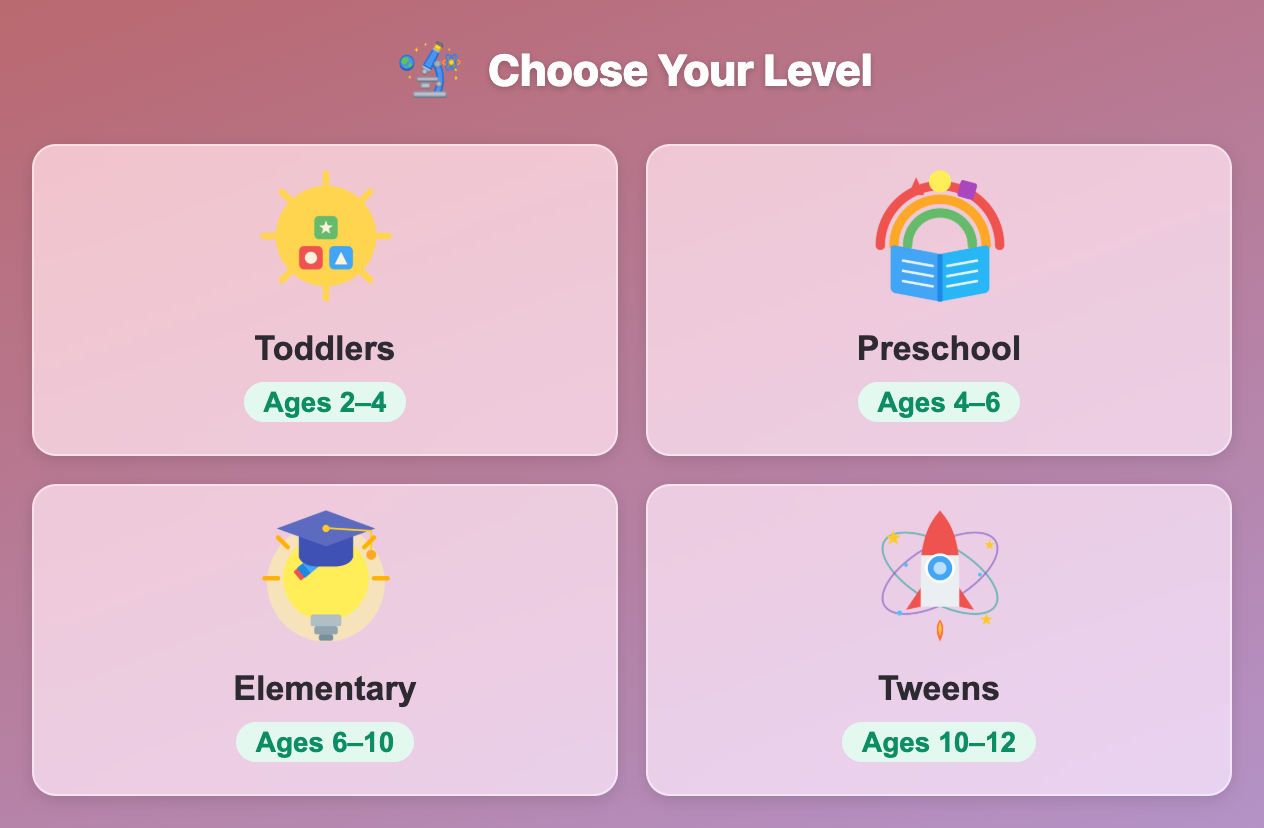
The Choose Your Level screen in Pond Dip Detective for kids, with Toddlers, Preschool, Elementary and Tweens cards
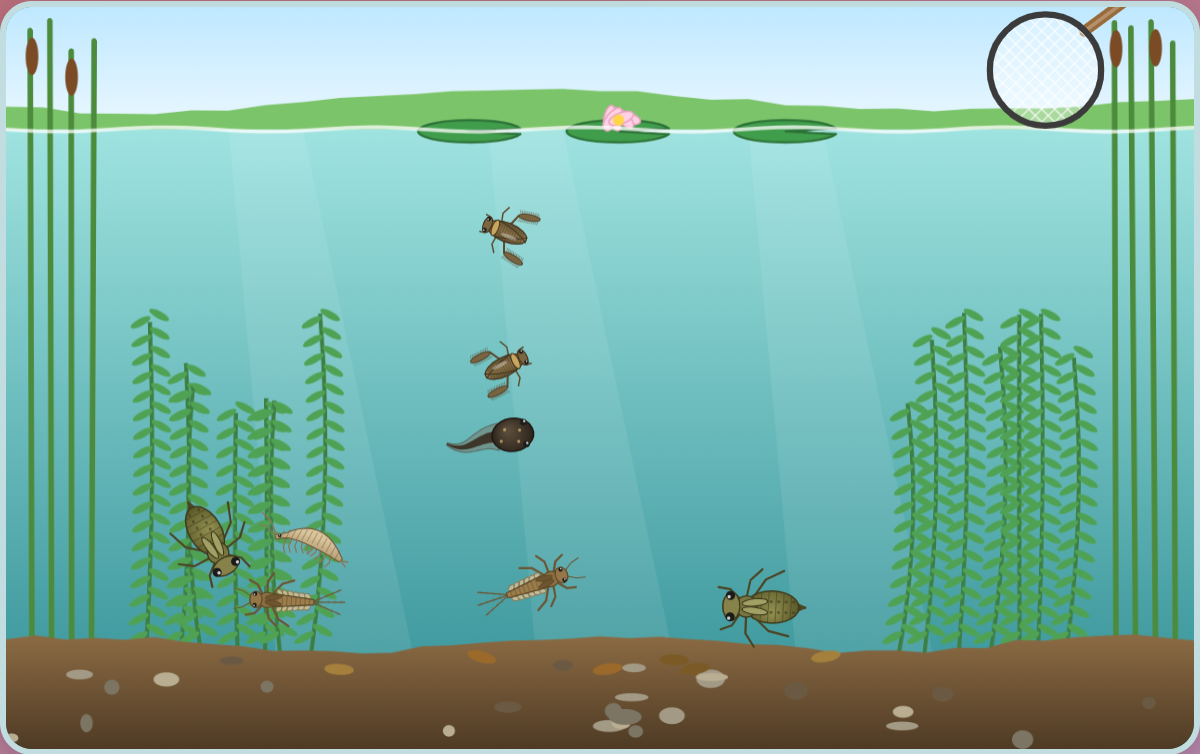
The pond at the Tweens level, with water boatmen, a tadpole, a shrimp and nymphs swimming above the muddy bottom
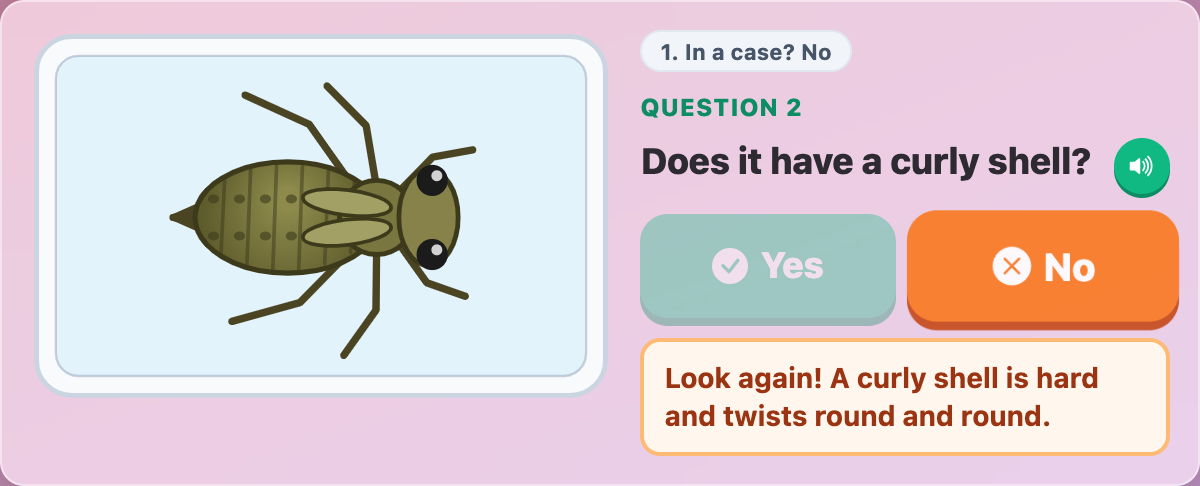
A dragonfly nymph in the white tray, with a Look again hint after a wrong answer to the curly shell question
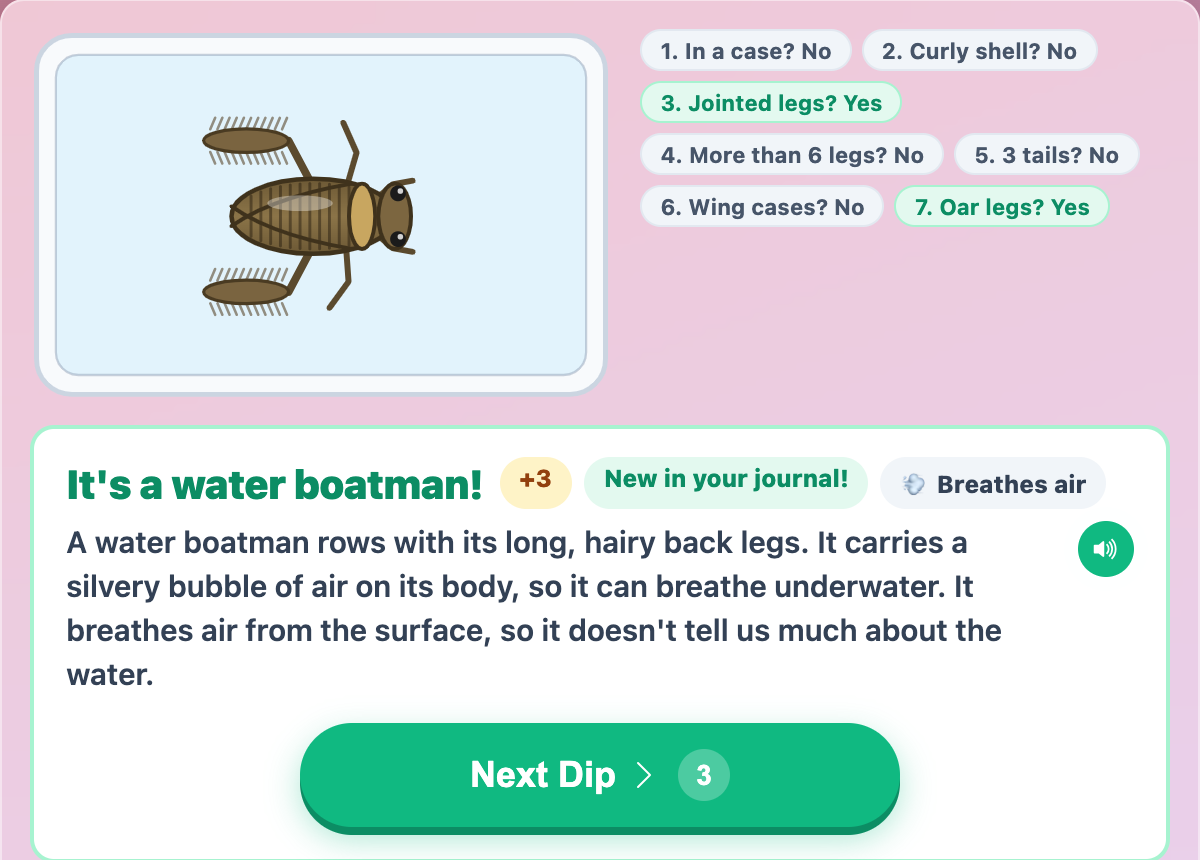
A water boatman named in Pond Dip Detective for tweens after seven key questions, with its Breathes air water sign
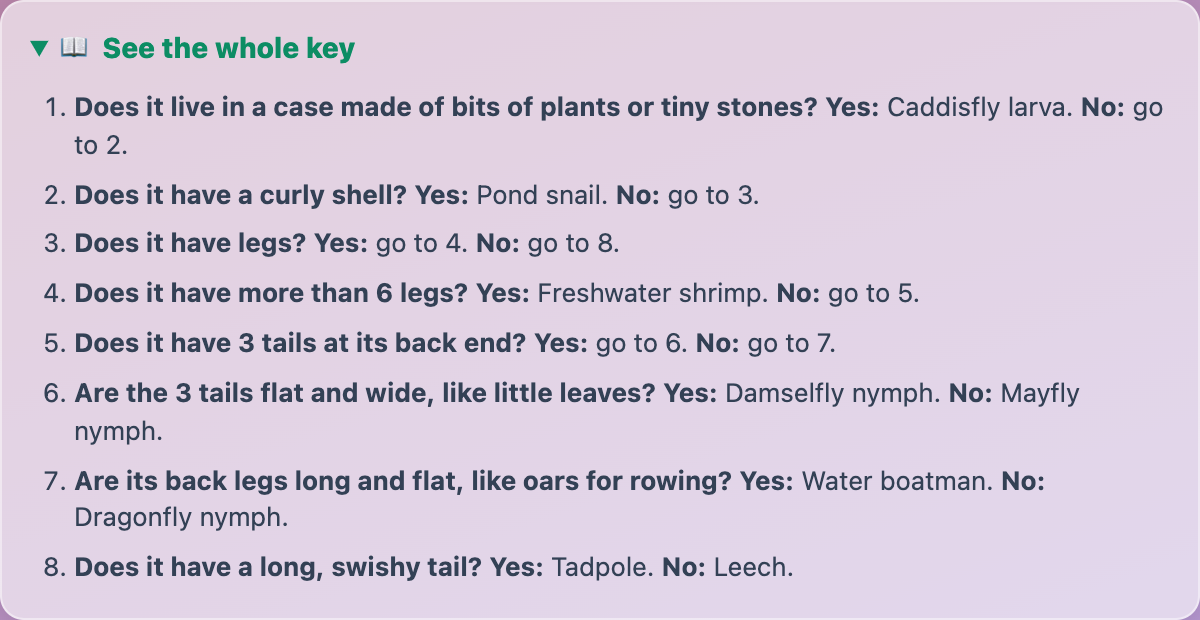
The whole Elementary key in Pond Dip Detective, written as eight numbered yes-or-no questions
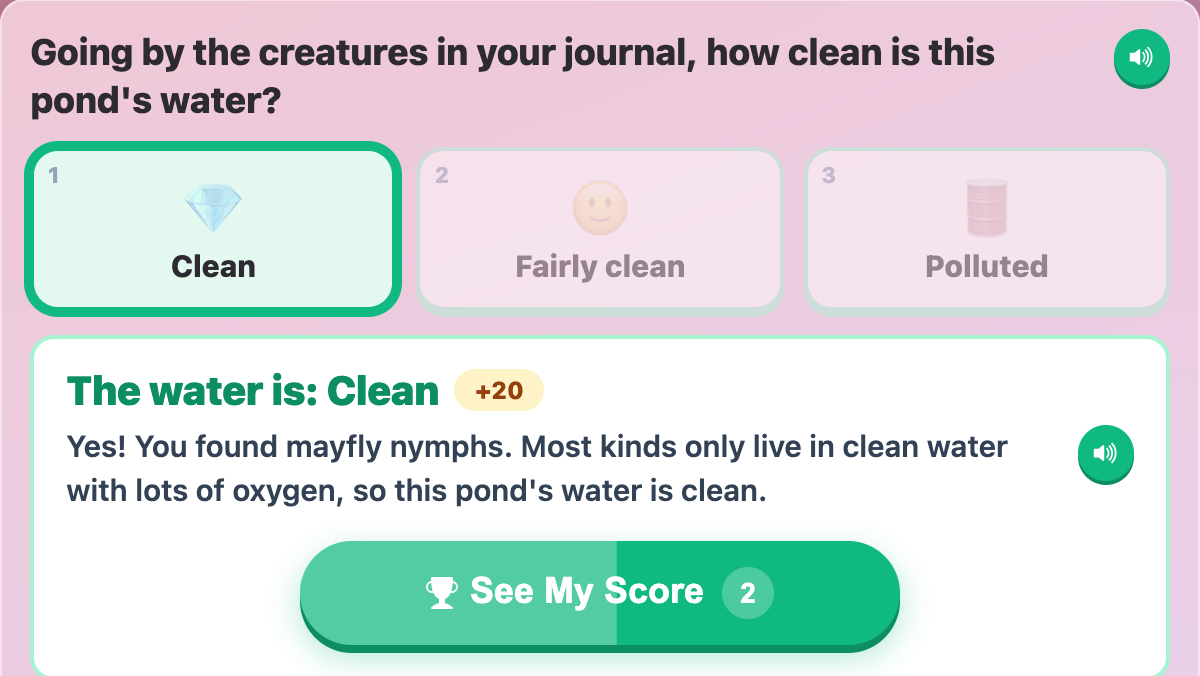
The Tweens water verdict, judging the pond Clean because the journal holds a mayfly nymph
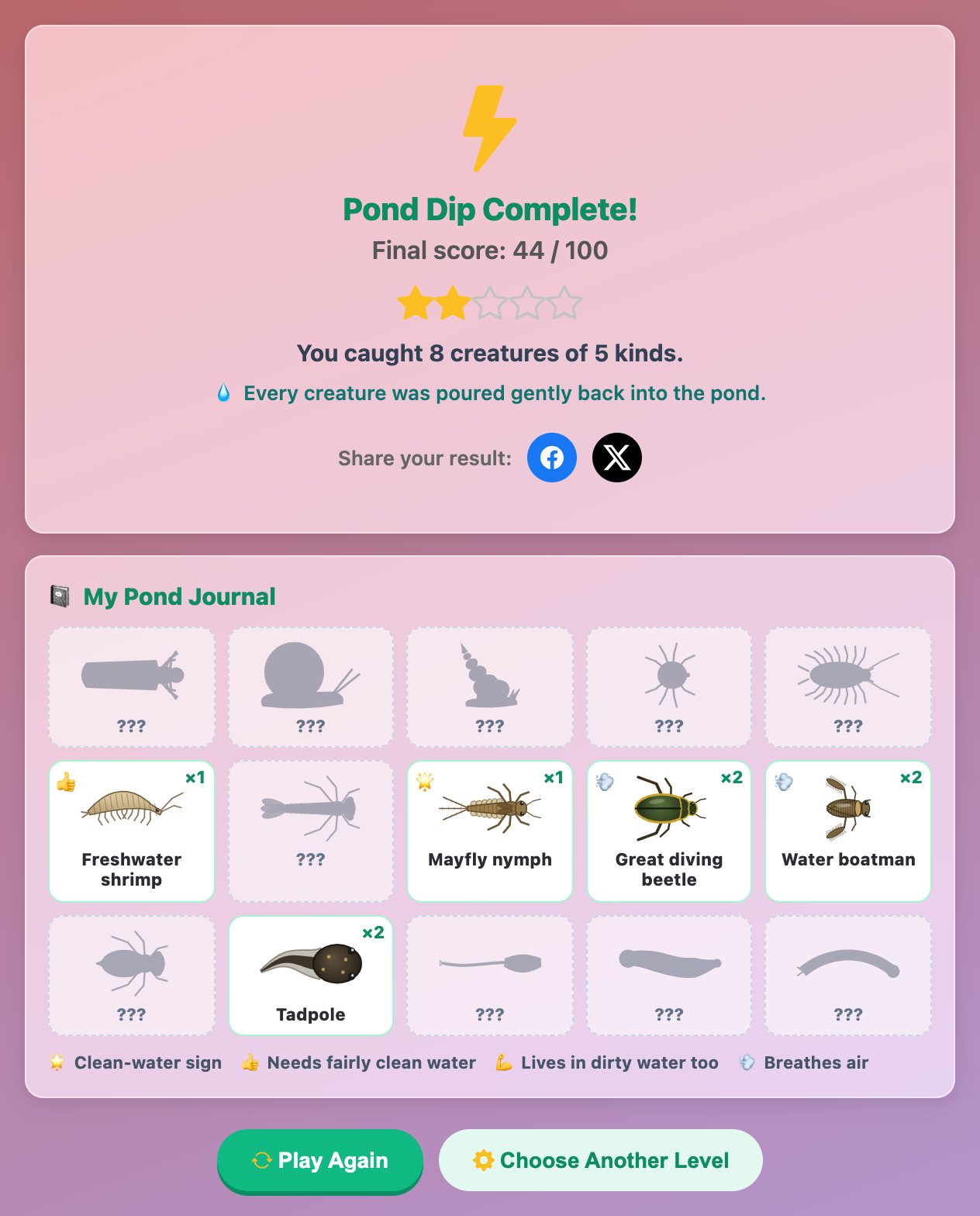
The Pond Dip Complete card with a score, stars and a pond journal showing five kinds of creatures found
More Science Games
 59.5K plays
4.8
Recycling Sort
Sort everyday items into the Recycle, Compost, or Trash bin before time runs out!
 85.7K plays
4.9
Grow a Plant
Plant seeds in sunny and shady garden beds, then water, feed and protect them day by day. Watch the roots grow underground and harvest sunflowers, tomatoes, carrots and more!
 438.6K plays
4.9
Magnet Experiment
Guess which objects a magnet will pull, then drag the magnet to test every guess. Does gold stick? Does a battery?
 386.9K plays
4.9
Five Senses Match
Decide which of your five senses you would use for each everyday scene before time runs out.
Most Played Games
 1.8M plays
4.9
Color & Draw
A free-drawing canvas with colors and brush sizes to unleash your creativity.
59.5K plays
4.8
Recycling Sort
Sort everyday items into the Recycle, Compost, or Trash bin before time runs out!
 365.8K plays
5.0
Tic-Tac-Toe
Play a game of Tic-Tac-Toe against the computer and see if you can outsmart it.
 274.1K plays
5.0
Sentence Builder
Pick your age level, then tap the shuffled words in the right order to build the sentence.
Comments (37)