
Magic Crossbow: Cycle Breaker
273.6K playsEgg, caterpillar, tadpole, butterfly... wait! A tadpole doesn't turn into a butterfly. Find the stage that breaks the order and shoot it with your magic crossbow. Fix life cycles, the seasons, the planets from the Sun, the Moon's shapes, food chains, the water cycle and the path food takes through your body, and find out why each stage goes where it does.
Every row in this game tells a little science story, and every story has a mistake hiding in it. Magic Crossbow: Cycle Breaker for kids is a free science game where you look at a row of pictures, like the steps of a butterfly's life, and find the one stage that breaks the order. Then you shoot it with a sparkly magic crossbow!
The rows cover life cycles, the seasons, the planets going out from the Sun, the Moon's shapes, food chains, the water cycle and even the path food takes through your body. Every hit tells you why that stage was wrong, and every fixed row ends with a short fact. It's made for kids from about 2 to 12, it plays right in your web browser, and there's nothing to download and no sign-up needed.
🔄 Orders, Cycles and the Arrows Between Them
In science, lots of things happen in a set order. A seed grows into a sprout before it becomes a tree. Ice melts into water before it boils into steam. Some orders go in a straight line and stop, like a baby growing into a child and then a grown-up.
Other orders are cycles. A cycle is an order that goes round and round, so it starts again at the end. A butterfly lays eggs, the eggs hatch into caterpillars, each caterpillar turns into a chrysalis, and out comes a new butterfly that lays more eggs. In the game, a cycle has a little 🔄 sign next to its name.
The tiles in each row are joined by small arrows. An arrow can mean "grows into", "comes next", "heat it up" or "is eaten by", depending on the row. Cycle Breaker is part of KidWorld's Magic Crossbow family. All the crossbow games share the same bow, sky and hills, but each one has its own puzzle, and this one is all about order.
🏹 Your First Round, Step by Step
Choose a level. Pick Toddlers (ages 2–4), Preschool (4–6), Elementary (6–10) or Tweens (10–12). If you haven't picked one yet, the game starts you on Elementary. The game remembers your choice, and the Change Level button at the top lets you switch any time.
Read the card. At the top sits a big picture and a green label with the order's name, like Butterfly life cycle 🔄. Under it is your job, such as "Shoot the one that doesn't belong!" or "Shoot the one that is out of place!" From Elementary up, a third line gives the rule, like "Each arrow means grows into. Then it starts again!"
Listen if you like. The green 🔊 button reads the order's name, the stages still standing and the question. On Toddlers and Preschool the game also reads each new row out loud by itself when the site's sound is on.
Aim and shoot. Tap or click a tile, and the crossbow turns and fires. On a computer you can also aim with the left and right arrow keys and shoot with Space or Enter, or press a number key to shoot that tile (1 is the first tile).
Watch what happens. A stage that doesn't belong bursts in a puff of magic and the row closes up. A wrong stage that took another stage's place bursts, and the right stage pops in where it was. A real stage in the wrong place flies to the spot where it belongs.
Learn from a bounce. If you shoot a stage that's fine, the arrow bounces off a magic shield. The message tells you why it stays, like "Keep that one! The eggs belong in a butterfly's life cycle."
Use the glowing hint. After one miss on Toddlers and Preschool, or two misses on Elementary and Tweens, the stage that breaks the order starts to glow and the game says "Look! The glowing one breaks the order." So every round always ends with the row fixed.
Enjoy the fixed row. The tiles turn green and hop, the message shows the whole order (like "eggs → caterpillar → chrysalis → butterfly → and again!"), and a fact about it takes the instruction's place on the card.
Finish 10 rounds. The counter in the top corner shows your round, and a 🔥 streak badge appears when you fix rounds in a row with no misses. After round 10 you get your result card, with Play Again and Change Level buttons.
The play page also has buttons to go fullscreen, reload the game and turn the music on or off. Everything works with a mouse, a keyboard or a finger on a tablet or phone.
⭐ How Points and Stars Add Up
Each round is worth 10 points. Every missed shot takes away 3 points from that round, but a round never goes below 0. So a perfect game is 100 points. Fix a round with one miss and you still get 7.
The result card shows your score out of 100 and up to 5 stars. You need 90 points or more for all 5 stars and the title "Bullseye! You are a cycle master!" The card also shows how many rounds you fixed on the first try, how many shots missed and your best streak.
If you missed in a round, that order goes on a Practice these again list, written out in the right order, like 🦋 eggs → caterpillar → chrysalis → butterfly. It's a perfect little list to read out loud before you play again.
🧠 Thinking Tricks for Fixing Every Row
1. Let the instruction tell you what kind of mistake it is
The card always tells you what you're looking for. "Doesn't belong" means a stage from a different story got into the row. "Out of place" means every picture belongs, but one is in the wrong spot. On Tweens it can say "Shoot 2: one doesn't belong, one is out of place!" Knowing the kind of mistake cuts your search in half.
2. Say each arrow out loud
Read the row two tiles at a time and say the arrow's meaning between them. "The caterpillar grows into a chick?" No way! The broken arrow is right next to the mistake. This works for every kind of row, from life cycles to food chains.
3. Ask "what kind of thing is it?"
A stage that doesn't belong is often a different kind of thing. A soccer ball is a toy, not a plant. A mushroom is a fungus, not a plant that grows from a seed. The Moon goes around Earth, so it isn't one of the planets. If one tile is a different kind of thing from all the others, shoot it.
4. Count the tiles
On Elementary and Tweens, it helps to know how many stages an order has. A frog's life on Tweens has 5 stages, the water cycle has 4, and the Moon goes from new to full in 5 shapes. If you see one more tile than the story needs, something extra has sneaked in.
5. Remember that a cycle has no wrong starting point
Since a cycle goes round and round, "caterpillar → chrysalis → butterfly → eggs" is still a correct butterfly life cycle. The game knows this. It will never mark you wrong for a row that is just a cycle starting somewhere else, so don't hunt for a mistake that isn't there.
6. When two stages swap, either one counts
Sometimes two neighbors have simply swapped places, like "water, ice, steam". You can shoot either one. Shoot the ice and it flies to the front. Shoot the water and it flies after the ice. Both fix the row, so pick whichever one you see first.
7. Read every message, even after a hit
Every hit comes with a reason, like "A tadpole is a baby frog. It isn't part of a butterfly's life cycle." These reasons are where the real learning is. On a two-mistake round, the message also says "One more to fix!", so you know to keep going.
8. Protect your streak
Since a miss costs 3 points, it pays to wait one more second and check. Hovering the mouse over a tile aims the crossbow without shooting, so you can look before you let go.
🔍 Five Broken Rows and How to Fix Them
Toddlers: seed, soccer ball, sprout, tree
The card says Seed to tree and "Shoot the one that doesn't belong!" There are no words on the tiles, just pictures. A seed grows into a sprout, and a sprout grows into a tree. A soccer ball doesn't grow at all! It's a toy. Shoot the ball, and the row closes up into seed → sprout → tree.
Preschool: seed, sprout, young plant, mushroom
This is the Sunflower life cycle, but the last tile is a mushroom. A mushroom is a different kind of living thing called a fungus. It grows from tiny spores, not seeds. When you hit it, the game says so, the mushroom bursts, and a sunflower pops into its place to finish the cycle.
Elementary: water, ice, steam
The card says Heat it up! and "Shoot the one that is out of place!" The rule says each arrow means "heat it up". Ice is the coldest, so it must come first. Shoot the ice, and the game explains, "Ice comes first: it is the coldest." Now the row reads ice → water → steam: heat melts ice into water, and more heat boils water into steam.
Elementary: Mercury, Venus, Mars, Earth
This row is Planets from the Sun, nearest first. Mercury is closest, then Venus, then our own Earth, then Mars. Mars and Earth have swapped! Shoot either one. If you shoot Mars, it flies to the end, and the game reminds you that Mars is farther from the Sun than Earth.
Tweens: Saturn, comet, Neptune, Jupiter
This is The giant planets, and the card says "Shoot 2: one doesn't belong, one is out of place!" First, the comet. A comet is a ball of ice and dust, not a planet. Shoot it, and Uranus pops into its place. Now the row reads Saturn, Uranus, Neptune, Jupiter. Jupiter is the closest of these giants to the Sun, so it's out of place at the end. Shoot it, and it flies to the front: Jupiter → Saturn → Uranus → Neptune.
🎒 Magic Crossbow: Cycle Breaker for Every Age
Magic Crossbow: Cycle Breaker for toddlers (ages 2–4)
Toddler rows are short: just 3 big pictures, with no words to read. The stories are ones little kids know, like egg → chick → hen, baby → child → grown-up and caterpillar → chrysalis → butterfly. The odd one is always something very different, like a car, a banana or a teddy bear. The row and the fixed order are read aloud when sound is on, and the hint glows after just one miss. Sit together and say the pictures out loud as your child taps.
Magic Crossbow: Cycle Breaker for preschoolers (ages 4–6)
Preschool rows have 4 stages with a name under each picture. Kids fix the life cycles of a chicken, a butterfly, a frog and a sunflower, plus growing up, the four seasons and the times of day. The mistakes are closer now: a tadpole sneaks into a chicken's life cycle, or "night" takes the place of a season. Sometimes a wrong stage takes a real stage's place, and the right one pops in when it's shot.
Magic Crossbow: Cycle Breaker for elementary kids (ages 6–10)
Elementary adds real classroom science: the rocky planets from the Sun, the Moon from new to full, ice to water to steam, a food chain from grass to snake, the water cycle, and an apple tree's life cycle. A new kind of mistake shows up too: a real stage in the wrong place. The card's rule line explains what the arrows mean, and the hint waits until two misses.
Magic Crossbow: Cycle Breaker for tweens (ages 10–12)
Tweens get the longest and hardest orders: a frog's 5 stages, the giant planets, an ocean food chain from tiny algae up to a shark, the water cycle's science words (evaporation, condensation, precipitation, collection), the path food takes from mouth to large intestine, the life of a star like the Sun, and how sedimentary rock forms. Most rounds hide two mistakes, often of different kinds.
🌱 Why Fixing Orders Builds Real Science Thinking
Scientists don't just learn facts. They learn how things change over time and what causes what. Putting stages in order is how kids start to think that way. When a child sees ice, water and steam and asks "which one is coldest?", they're reasoning about cause and effect, not just remembering.
The game also teaches kids to explain their thinking. Every shot gets a reason, so a child learns that a comet isn't a planet because it's a ball of ice and dust. That habit of asking "why?" helps in every science lesson.
If your child likes putting nature in order, Life Cycle Sequence lets them tap the stages of a life cycle back into the right order themselves. For a closer look at the planets in this game, the 3D Solar System Explorer lets kids spin and zoom around the Sun and every planet. And kids who love the crossbow can try Magic Crossbow: Pattern Breaker, where they shoot the picture that breaks a repeating pattern.
A note for grown-ups: the game is free, runs in the browser, and has no chat, no scary content and nothing to buy. The "crossbow" shoots sparkly magic arrows at picture tiles; nothing is ever hurt. It practices science vocabulary, sequencing, cause and effect, and careful reading. Misses only cost a few points, and a glowing hint makes sure every round ends in success.
Ready to aim? Load your magic crossbow and fix your first row in Magic Crossbow: Cycle Breaker for kids. Ten science stories are waiting for you! 🏹
🖼️ See the Game in Action
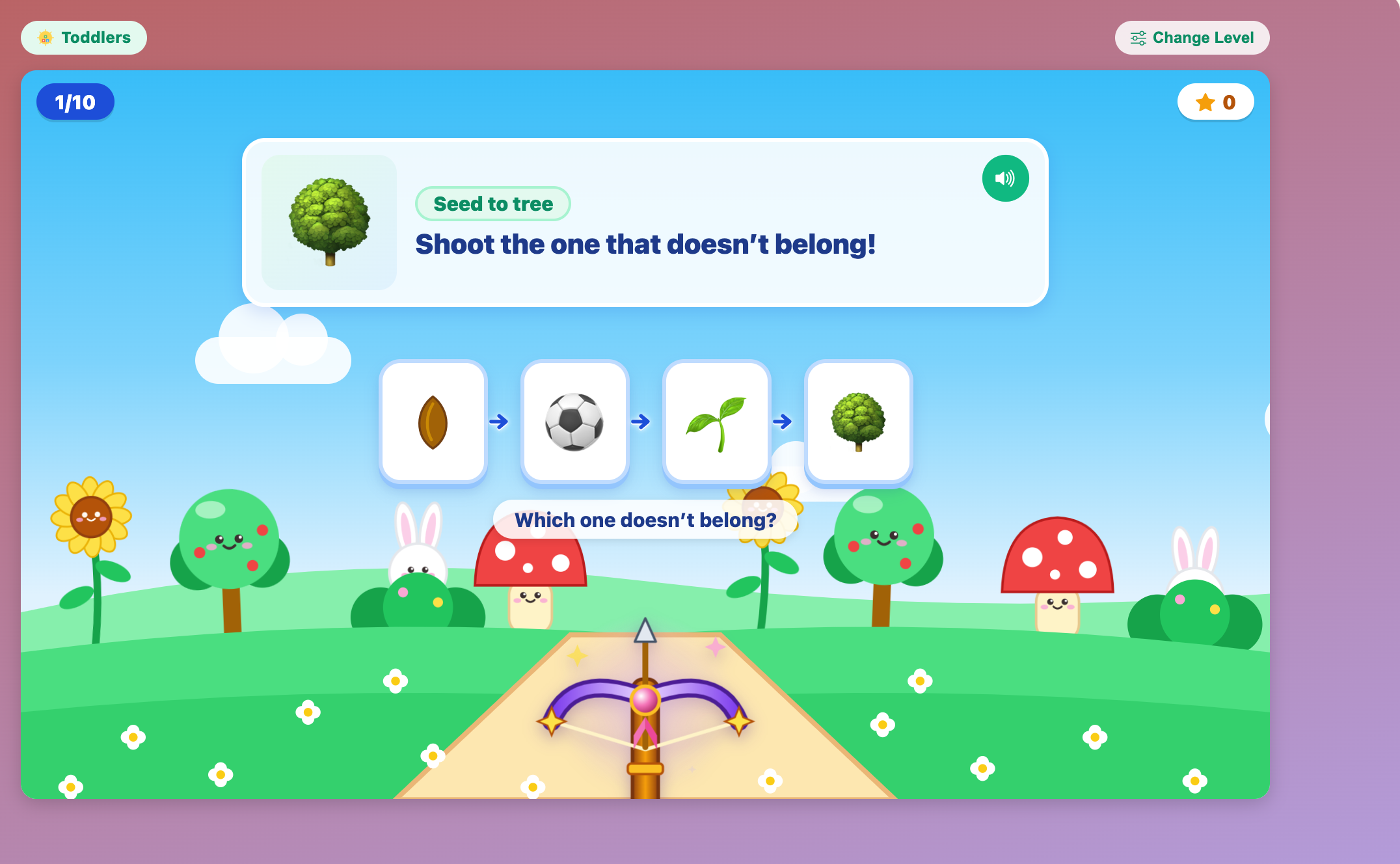
A Seed to tree row in Magic Crossbow: Cycle Breaker for toddlers, with a soccer ball between the seed and the sprout
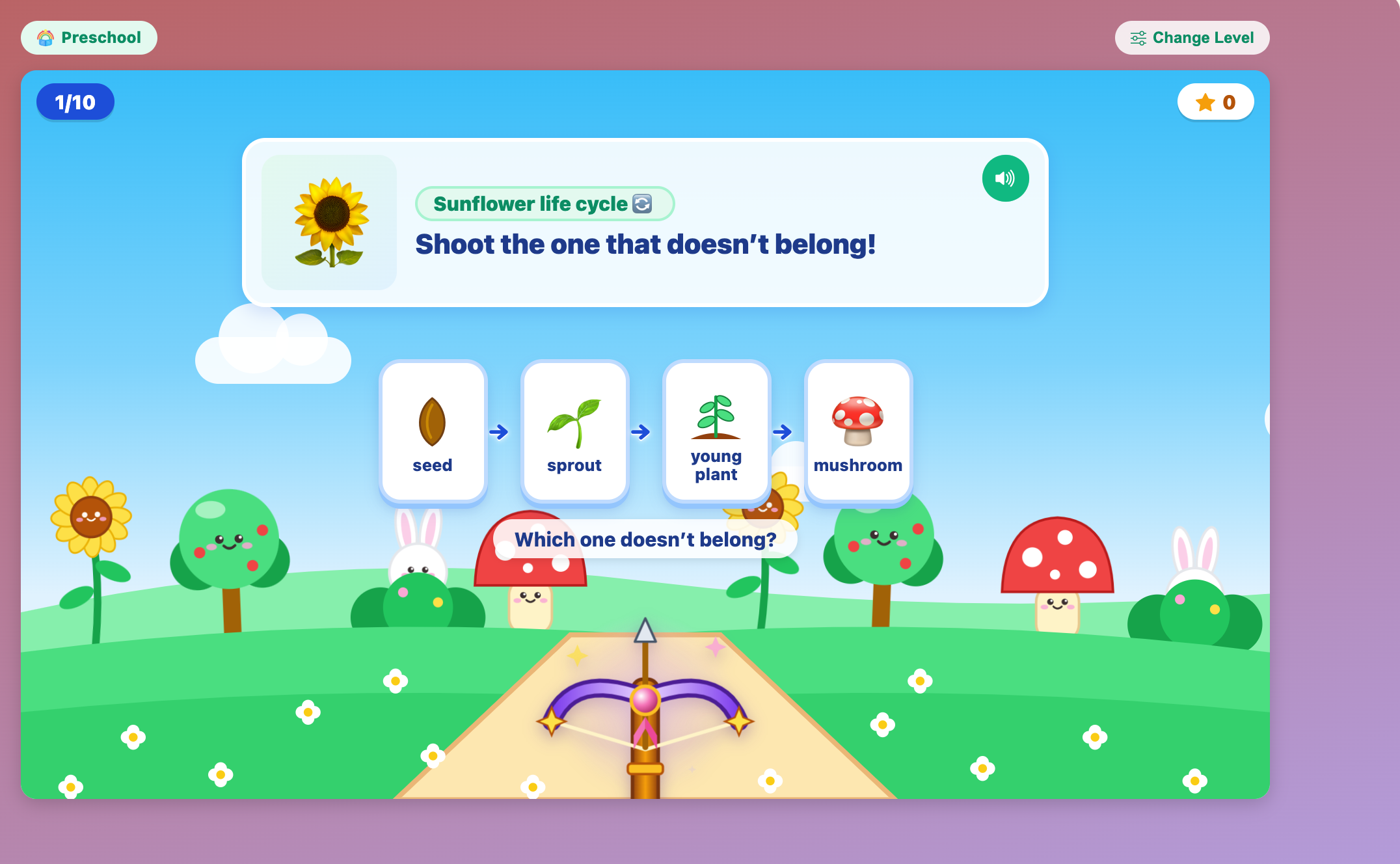
A sunflower life cycle round for preschoolers where a mushroom has taken the sunflower's place at the end of the row
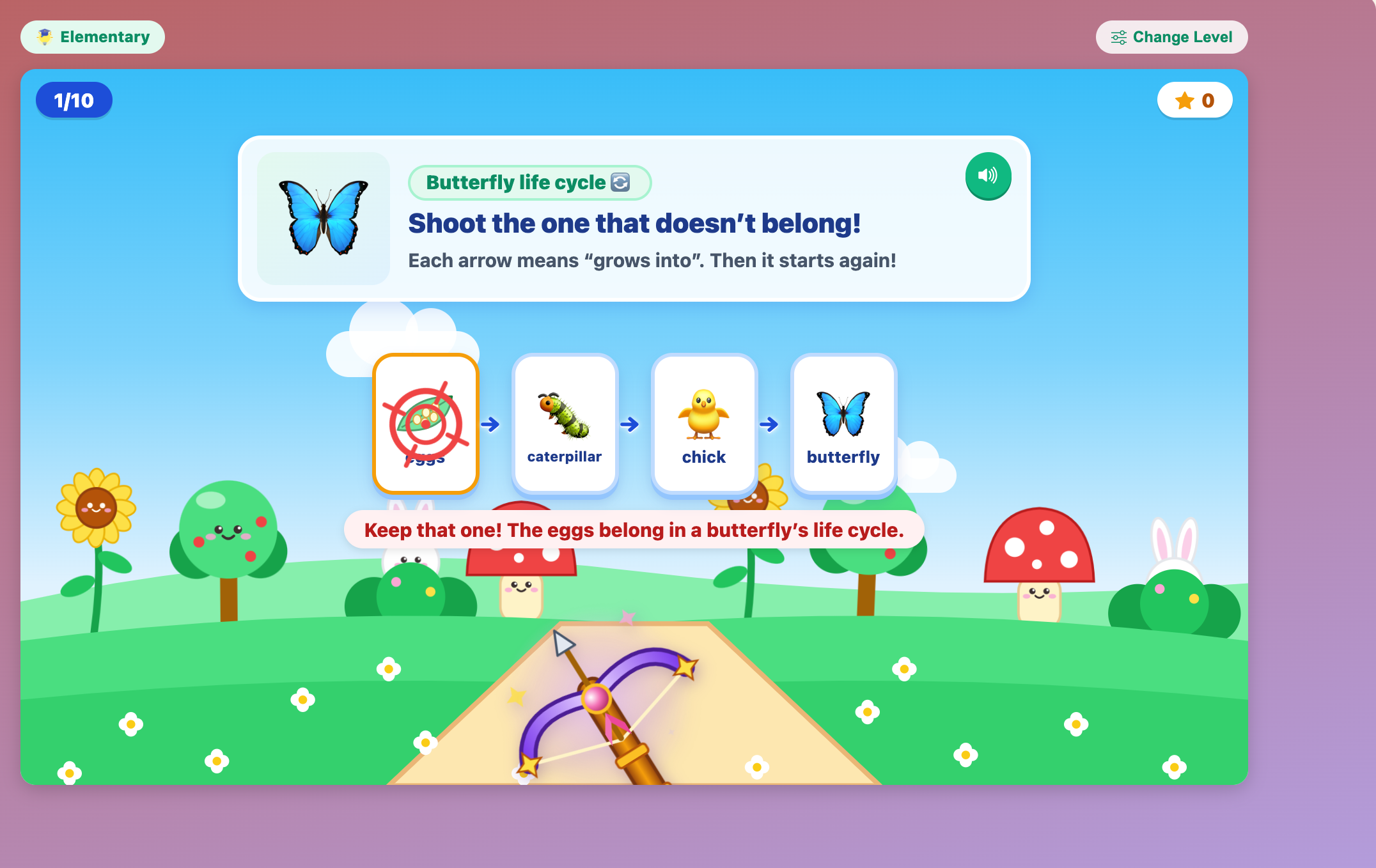
The arrow bouncing off the eggs in a butterfly life cycle row, with the message Keep that one!
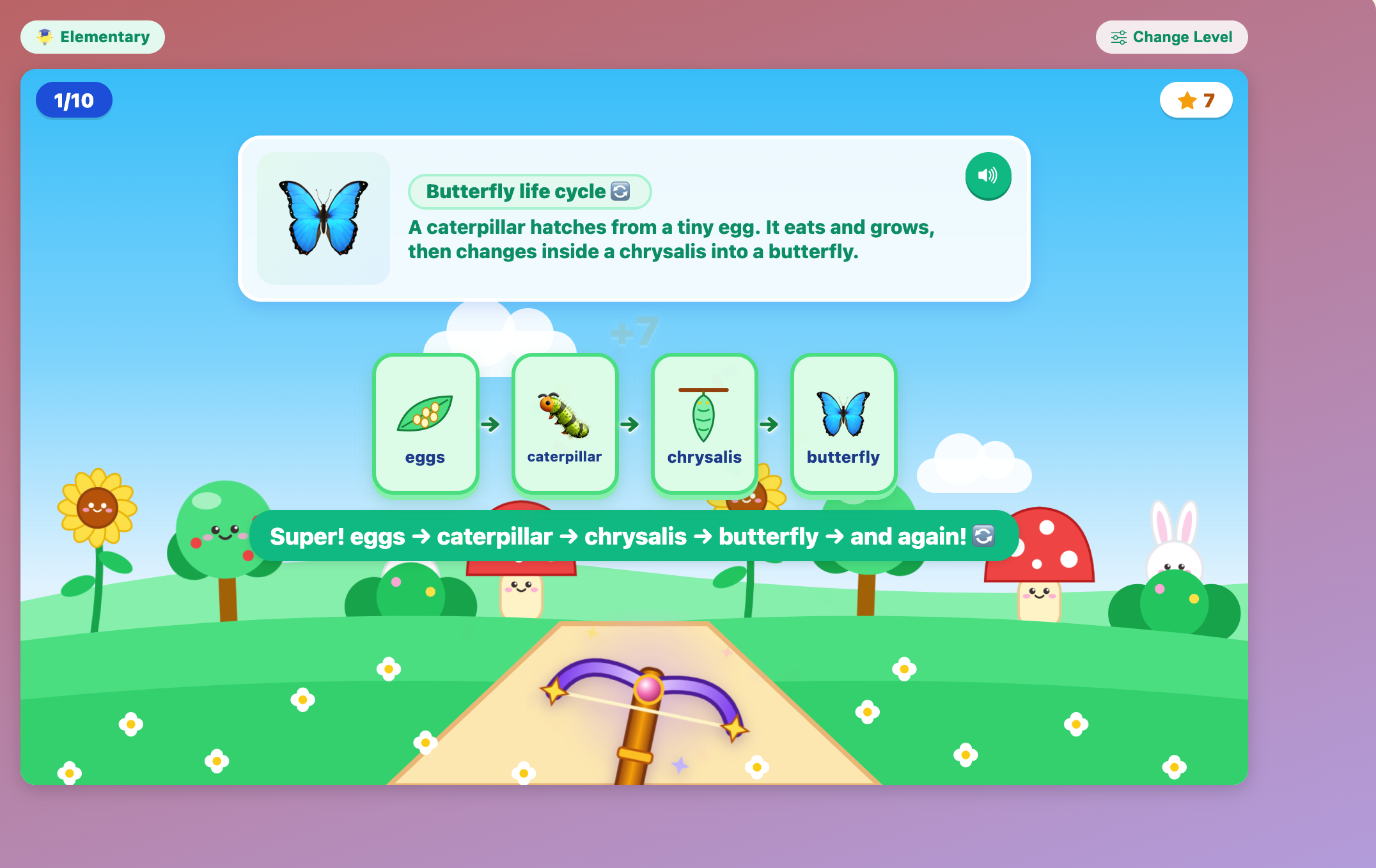
The fixed butterfly life cycle, eggs to caterpillar to chrysalis to butterfly, with a fact on the card
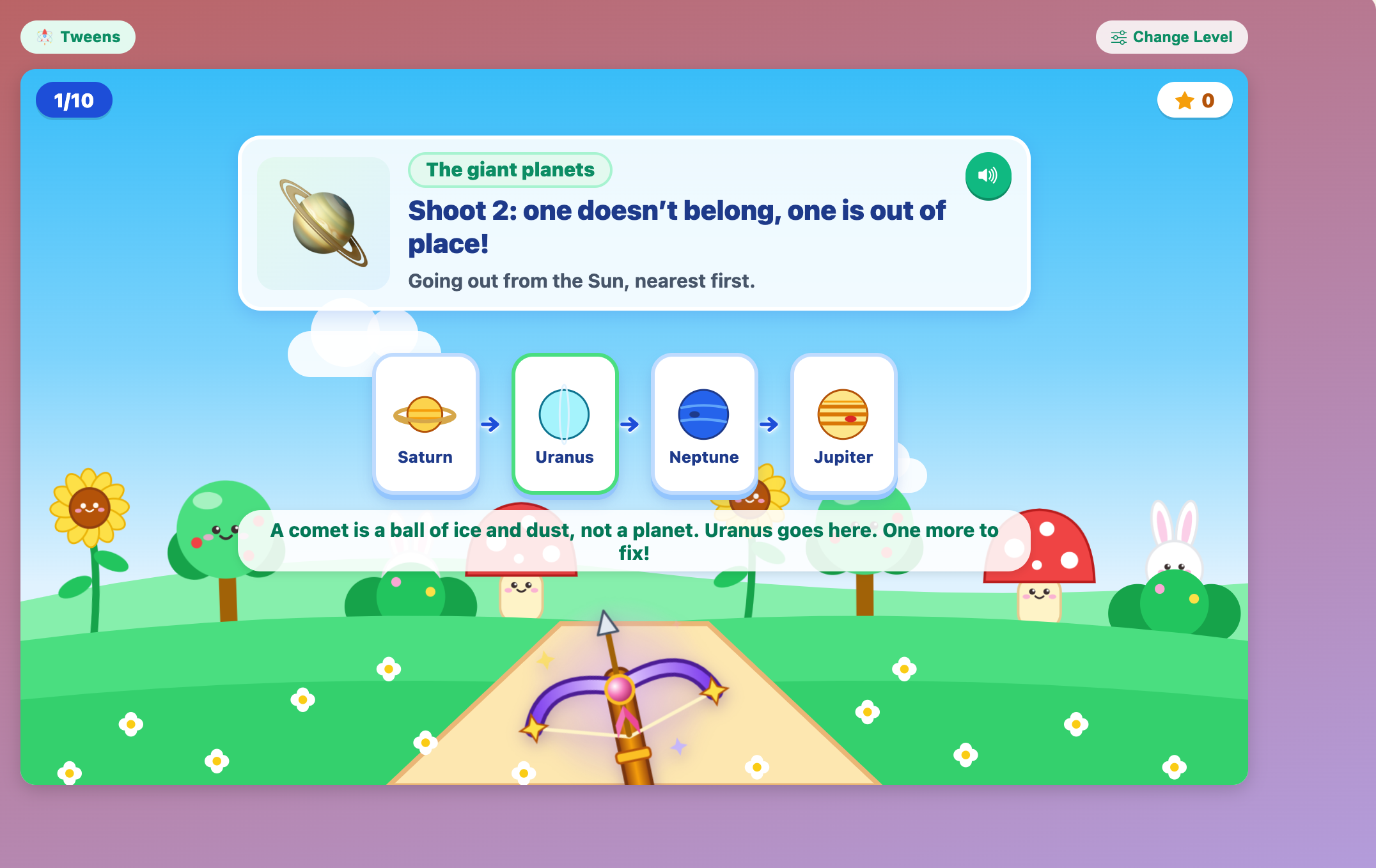
A giant planets round in Magic Crossbow: Cycle Breaker for tweens after the comet was shot and Uranus popped in
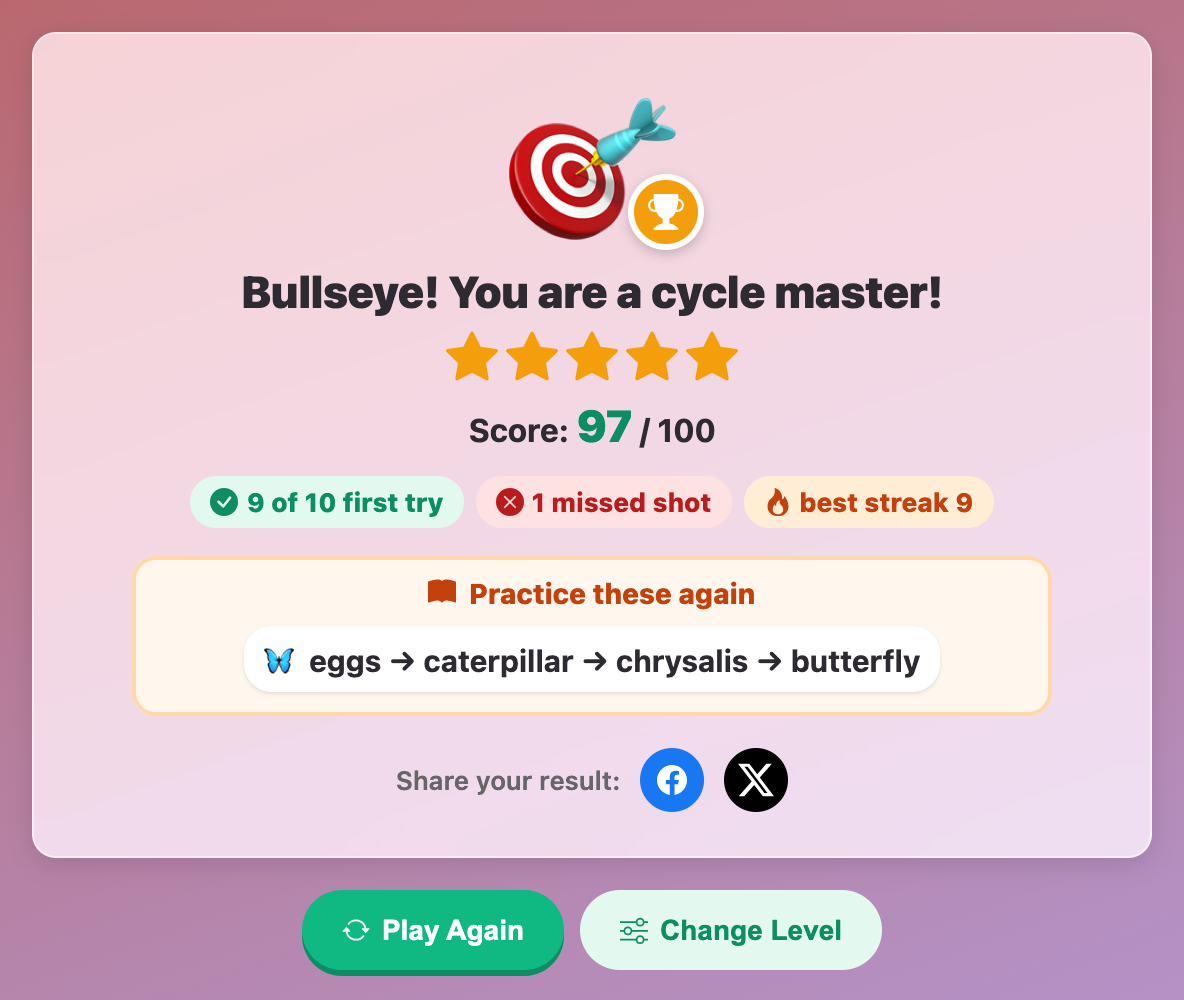
The results card with a score of 97 out of 100, 9 of 10 fixed on the first try and a practice list
More Science Games
 59.5K plays
4.8
Recycling Sort
Sort everyday items into the Recycle, Compost, or Trash bin before time runs out!
 85.7K plays
4.9
Grow a Plant
Plant seeds in sunny and shady garden beds, then water, feed and protect them day by day. Watch the roots grow underground and harvest sunflowers, tomatoes, carrots and more!
 438.6K plays
4.9
Magnet Experiment
Guess which objects a magnet will pull, then drag the magnet to test every guess. Does gold stick? Does a battery?
 386.9K plays
4.9
Five Senses Match
Decide which of your five senses you would use for each everyday scene before time runs out.
Most Played Games
 1.8M plays
4.9
Color & Draw
A free-drawing canvas with colors and brush sizes to unleash your creativity.
59.5K plays
4.8
Recycling Sort
Sort everyday items into the Recycle, Compost, or Trash bin before time runs out!
 365.8K plays
5.0
Tic-Tac-Toe
Play a game of Tic-Tac-Toe against the computer and see if you can outsmart it.
 274.1K plays
5.0
Sentence Builder
Pick your age level, then tap the shuffled words in the right order to build the sentence.
Comments (30)