
Magic Crossbow: Pattern Breaker
116.8K playsRed, blue, red, blue, blue... wait! Find the one that breaks the pattern and shoot it with your magic crossbow. Pop out the extra item or swap the wrong one, and the pattern is fixed. Simple two-color patterns for little ones, long tricky patterns with two breakers for big kids.
Patterns are all around you. A zebra's stripes go black, white, black, white. A clock goes tick, tock, tick, tock. Monday comes after Sunday every single week. Your brain loves patterns so much that it notices right away when one goes wrong, like a song that suddenly skips a beat.
Magic Crossbow: Pattern Breaker for kids is built on that feeling. Each round shows a row of pictures that repeat, like 🔴🔵🔴🔵🔴, with one picture that breaks the pattern (two on the Tweens level). You find it, aim your magic crossbow, and shoot. Then the row is fixed and every repeat lights up. This Mind game on KidWorld has been played more than 100,000 times, and it holds a perfect 5 out of 5 rating from more than 2,000 ratings. There's no timer and no lives, just 10 rows to fix in a sunny meadow full of smiling sunflowers and peeking bunnies.
🔁 What Makes a Pattern (and What Breaks One)
A pattern is a group of pictures that repeats in the same order again and again. The group that repeats is called the core. In 🍎🍌🍎🍌🍎🍌, the core is 🍎🍌. In 🐶🐶🐱🐶🐶🐱, the core is 🐶🐶🐱: two dogs, then a cat.
In this game, every row shows the core at least twice and starts it a third time, so there's always enough to spot the pattern. The pictures come from 11 themes, each with its own picture on the card: colored circles 🎨, colored squares 🧱, hearts 💝, fruit 🧺, pets 🐾, sky things 🌈, vehicles 🚦, sweets 🎂, bugs 🌿, sea animals 🌊 and sports balls 🏆. Each of the 10 rows in a game uses a different theme.
A breaker is the picture that spoils the pattern. It can sneak in two ways:
An extra picture squeezed in. 🔴🔵🔴🔵🔵🔴🔵 has one blue too many. When you shoot an extra picture, it pops and the row slides together.
A wrong picture in a spot. 🔴🔵🔴🟢🔴🔵 has a green where a blue should be. When you shoot a wrong picture, it pops and the right picture appears in its place with a little sparkle.
Breakers are placed carefully, too. They never hide in the first core (so you always see how the pattern starts), never stand at the very end of the row, and two breakers never sit side by side. The game also makes sure there's only one way to fix each row. If the breaker is a doubled picture, like 🔵🔵, either copy counts, because shooting either one fixes the row.
🏹 How to Play on KidWorld
Choose a level. The game may start right away on Elementary. Tap Change Level to see four cards: Toddlers (ages 2–4), Preschool (4–6), Elementary (6–10) and Tweens (10–12). The game remembers your choice.
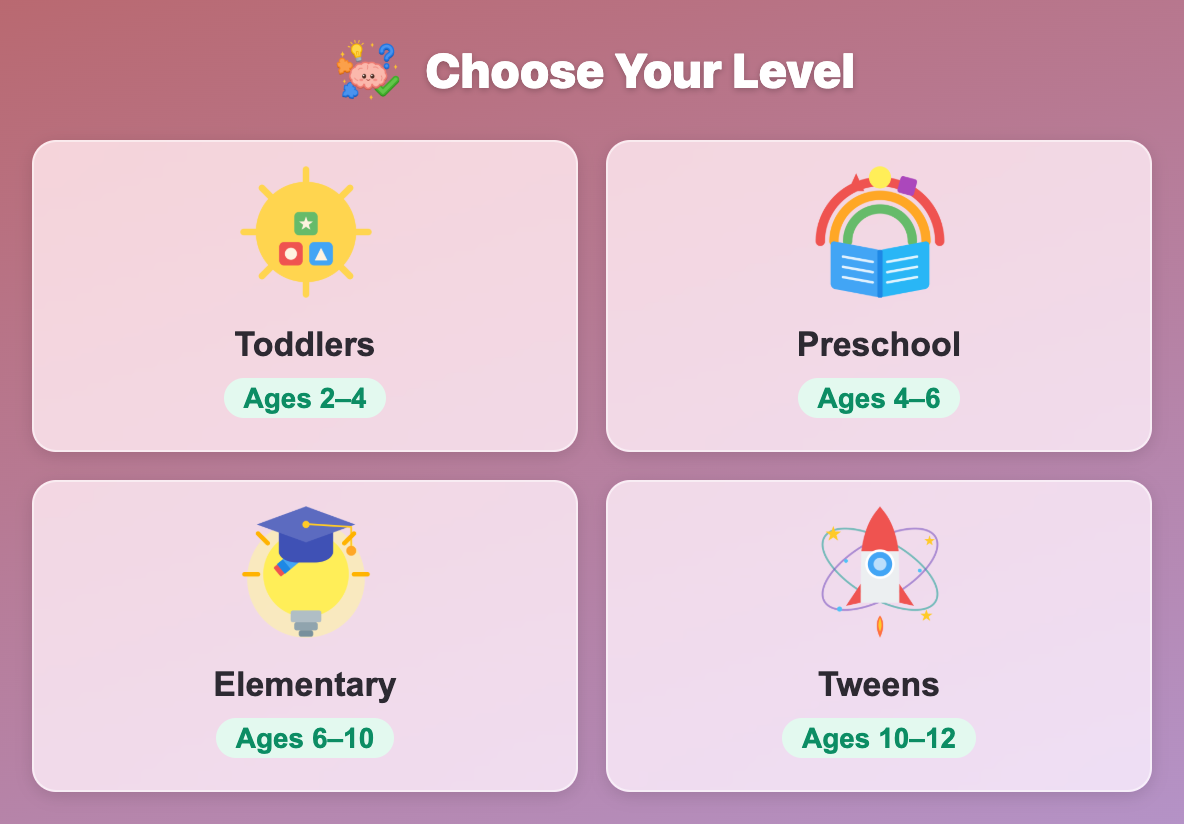
Look at the card. It says Shoot the one that breaks the pattern! (or Shoot the 2 that break the pattern! on Tweens). On Toddlers and Preschool, it also shows the core, like The pattern: ⛵🚗. On Elementary and Tweens, you have to figure out the core yourself.
Listen if you like. The green 🔊 button reads the row out loud by name: red, blue, red, blue, blue… Which one breaks the pattern? On Toddlers and Preschool, each new row is read by itself when the sound is on.
Aim and shoot. Move your mouse over a picture and the crossbow turns toward it, with a red target on the tile. Tap or click to shoot. With a keyboard, press ← and → to aim and Space or Enter to fire.
See what happens. A hit pops the breaker in a burst of sparkles. A miss bounces off a magic shield with a note like That one fits the pattern! On Tweens, your first hit says Great shot! One more breaks the pattern.
Enjoy the fixed row. The tiles turn green, every other repeat of the core is shaded so you can see each one, and a message cheers, like 🧡🧡💜 repeats! You did it! Then the next row arrives.
Finish all 10 rows. The badge at the top left shows which row you're on, and your points are at the top right. Two perfect rows in a row light up a 🔥 streak. After row 10, the result card shows your score, stars, first tries, missed shots and best streak. Tap Play Again or Change Level. The fullscreen, reload and music buttons above the game work any time.
⭐ Scoring, Stars and the Glowing Hint
Every row is worth up to 10 points. Each missed shot in that row takes away 3, and a row never drops below zero: 10 with no misses, 7 with one, 4 with two, 1 with three, then 0. A perfect game is 100.
Score 90 or more and you get five stars and the title Bullseye! You are a pattern master! From 70 you get Super shooting!, and from 50 Nice aiming! Any row you missed appears under Practice these again, showing the core twice, like 💜🧡💚💜🧡💚…
Stuck? The breaker begins to glow yellow after one miss on Toddlers and Preschool, or after two misses on Elementary and Tweens, with the note Look! The glowing one breaks the pattern. The glow costs nothing extra, and it means every row always ends fixed.
🔍 Pattern Detective: Tips to Hit It on the First Try
Only misses cost points, and there's no clock. So the smartest players take a moment to think before they shoot. Here's how.
1. Read the start of the row first
The breaker is never in the first core. That means the very first pictures always show the pattern correctly. Start on the left, find where the pictures begin to repeat, and you've found your core. On Toddlers and Preschool, the card shows the core for you, so you can skip this step.
2. Say it out loud
Patterns are easier to hear than to see. Say the row like a chant: car, boat, car, boat, car, rocket. The word that doesn't fit the beat jumps out. This works great with the 🔊 button too.
3. Chop the row into groups
Once you know how long the core is, split the row into groups of that size. For a core of 3, look at pictures 1–3, then 4–6, then 7–9. Each group should look exactly like the first one. The first group that looks different has the breaker inside it.
4. Ask: extra or wrong?
When you find the bad spot, think about which kind of breaker it is. If the row has one picture too many, it's an extra, so shoot the one that doesn't fit. If a picture is in the wrong spot, shoot it and watch the right picture appear. Either way you shoot the breaker. Knowing the kind just helps you be sure it's the right tile.
5. Watch out for pattern pictures in the wrong place
From Preschool up, a breaker can be a picture that's already in the pattern, just in the wrong spot, like a second 🔵 where 🔴 should be. These are trickier than a brand-new picture, because nothing looks strange at first glance. Grouping (tip 3) is the best way to catch them.
6. Doubles are easy points
If two of the same picture stand side by side where the core has only one, that's a double. Shoot either copy. Be careful, though: some cores have doubles on purpose, like 🐶🐶🐱. Only shoot a double when the core doesn't have one there.
7. On Tweens, fix one, then look again
Tween rows have two breakers, and they're never next to each other. After your first hit, the row changes: a tile disappears or a picture changes. Take a fresh look at the whole row before your second shot.
8. Learn the core shapes
Grown-ups describe patterns with letters. AB means two things taking turns (🔴🔵). AAB means two of one, then one of another (🍎🍎🍌). ABC means three different things. The older levels also use AABB, ABCD, ABAC, and on Tweens AABC, ABBC and ABCB. When you can name the shape, the breaker is much easier to find.
🧩 Five Rows, Fixed Together
Toddlers: ⛵ 🚗 ⛵ 🚗 ⛵ 🚀 ⛵
The card shows the pattern: ⛵🚗, boat then car. Say it: boat, car, boat, car, boat… The next one should be a car, but it's a 🚀 rocket! The rocket isn't in the pattern at all. Shoot it, and a car pops into its spot. The row reads boat, car, boat, car, boat, car, boat.
Toddlers: 🔴 🔵 🔴 🔵 🔵 🔴 🔵
Red, blue, red, blue, blue… Two blues in a row! An AB pattern always takes turns, so one blue is a double. Shoot either blue and the row closes up to red, blue, red, blue, red, blue.
Preschool: 🚌 ⛵ 🚗 ⛵ ⛵ 🚗 🚌
The card shows the core: 🚌⛵🚗, bus, boat, car. Chop the row into groups of 3:
Group 1: 🚌 ⛵ 🚗. Perfect.
Group 2 should be 🚌 ⛵ 🚗, but it's ⛵ ⛵ 🚗. The first spot has a boat where the bus belongs.
Shoot that boat. It pops, and a bus appears in its place.
Now the row reads 🚌⛵🚗 🚌⛵🚗 🚌. Fixed!
This one is sneaky, because the boat is part of the pattern. It's just in the wrong spot.
Elementary: 🧡 🧡 💜 🧡 🧡 💜 🧡 💜 🧡 💜
No core on the card now. Look at the start: orange, orange, purple, then orange, orange, purple again. So the core is 🧡🧡💜 (an AAB pattern). The third group should start orange, orange, but it goes 🧡💜. That purple heart is squeezed in. Shoot it, the row closes up, and you get 🧡🧡💜 🧡🧡💜 🧡🧡💜. The card then shows The pattern: 🧡🧡💜 and the middle repeat is shaded.
Tweens: 🏀 🎾 🎾 🎾 🎾 🎾 🏀 🏀 🎾 🎾 🏀
Eleven tiles and two breakers. Start at the left: basketball, tennis ball, tennis ball. Then the next group should begin with a basketball, but tile 4 is a tennis ball. Since the core is 🏀🎾🎾 (ABB):
Tile 4 is a tennis ball in a basketball's spot. Shoot it, and a basketball appears there.
Look again: 🏀🎾🎾 🏀🎾🎾 🏀🏀🎾🎾🏀. Now there are two basketballs side by side, but the core only has one.
Shoot either basketball. The row becomes 🏀🎾🎾 🏀🎾🎾 🏀🎾🎾 🏀.
🎒 Magic Crossbow: Pattern Breaker for Every Age
The level changes how long the core is, how sneaky the breakers are, and how much help you get.
🐣 Magic Crossbow: Pattern Breaker for toddlers (ages 2–4)
Toddlers get simple AB patterns that take turns, in rows of 6 or 7. The breaker is a picture that isn't in the pattern at all (taking a spot or squeezed in), or a doubled picture. Pictures come from each theme's four least alike items, so a red circle is never mixed up with an orange one. The core is shown on the card, each row is read aloud when sound is on, and the breaker glows after just one miss. A grown-up can say the pattern out loud while the child points.
🎨 Magic Crossbow: Pattern Breaker for preschoolers (ages 4–6)
Preschool adds AAB, ABB and ABC patterns, in rows of 7 or 8. Now the breaker can also be a picture from the pattern in the wrong spot. The core is still on the card, rows are read aloud, the hint comes after one miss, and pictures still come from the four least alike items in each theme.
📐 Magic Crossbow: Pattern Breaker for elementary kids (ages 6–10)
Elementary kids see longer cores, like AABB, ABCD and ABAC, in rows of 8 or 9, using all six pictures in a theme. The core is not shown until the row is fixed, so finding it is part of the puzzle. Breakers are often pattern pictures in the wrong spot or squeezed in. The hint waits for two misses.
🚀 Magic Crossbow: Pattern Breaker for tweens (ages 10–12)
Tweens get the longest rows (up to 11 tiles) and the trickiest cores, like AABC, ABBC and ABCB, with two breakers in every row. It takes real focus to hold a four-picture core in your head and check every group. Tweens who like this kind of hunt can try Magic Crossbow: Extra Number, where the same crossbow shoots the number that breaks a skip-counting pattern.
💡 Why Pattern Spotting Makes Brains Stronger
Patterns are the start of math. Counting by 2s, times tables, and later algebra are all about patterns. A child who learns to find the core in 🍎🍎🍌 is practicing the same thinking.
Looking closely. A wrong 🔵 in a row of 🔴🔵 isn't strange by itself. Kids have to compare each picture with where it should be. That careful looking helps with reading, spelling and checking work.
Holding things in your head. Remembering a core like 🐞🐝🐞🦋 while scanning the row exercises working memory, the brain's little notepad.
Fixing mistakes calmly. A miss just bounces off a shield, and every row ends fixed and sparkling. Kids learn that a mistake is something you find and fix, not something to be afraid of.
Thinking before acting. Since only misses cost points, slow and sure beats fast and wild. If your child enjoys working out what repeats, Pattern Sequence asks them to pick what comes next in a row of shapes.
A note for grown-ups
Magic Crossbow: Pattern Breaker for kids is calm and friendly. The arrows only pop picture tiles, the pictures are fruit, pets, hearts, vehicles and other everyday things, and there's no timer and no losing. It practices pattern recognition, careful looking, working memory and early algebra thinking. A fun follow-up is to make your own pattern with toys or snacks, break it on purpose, and let your child find the breaker.
Ready to restore some order? Read the row, find the core, and shoot whatever breaks it. Magic Crossbow: Pattern Breaker for kids has 11 themes and core shapes that grow from AB to ABCB, so there's always a new row to fix. When you want a science twist on the same idea, Magic Crossbow: Odd One Out asks you to shoot the picture that doesn't belong in a science group and tells you why.
🖼️ See the Game in Action
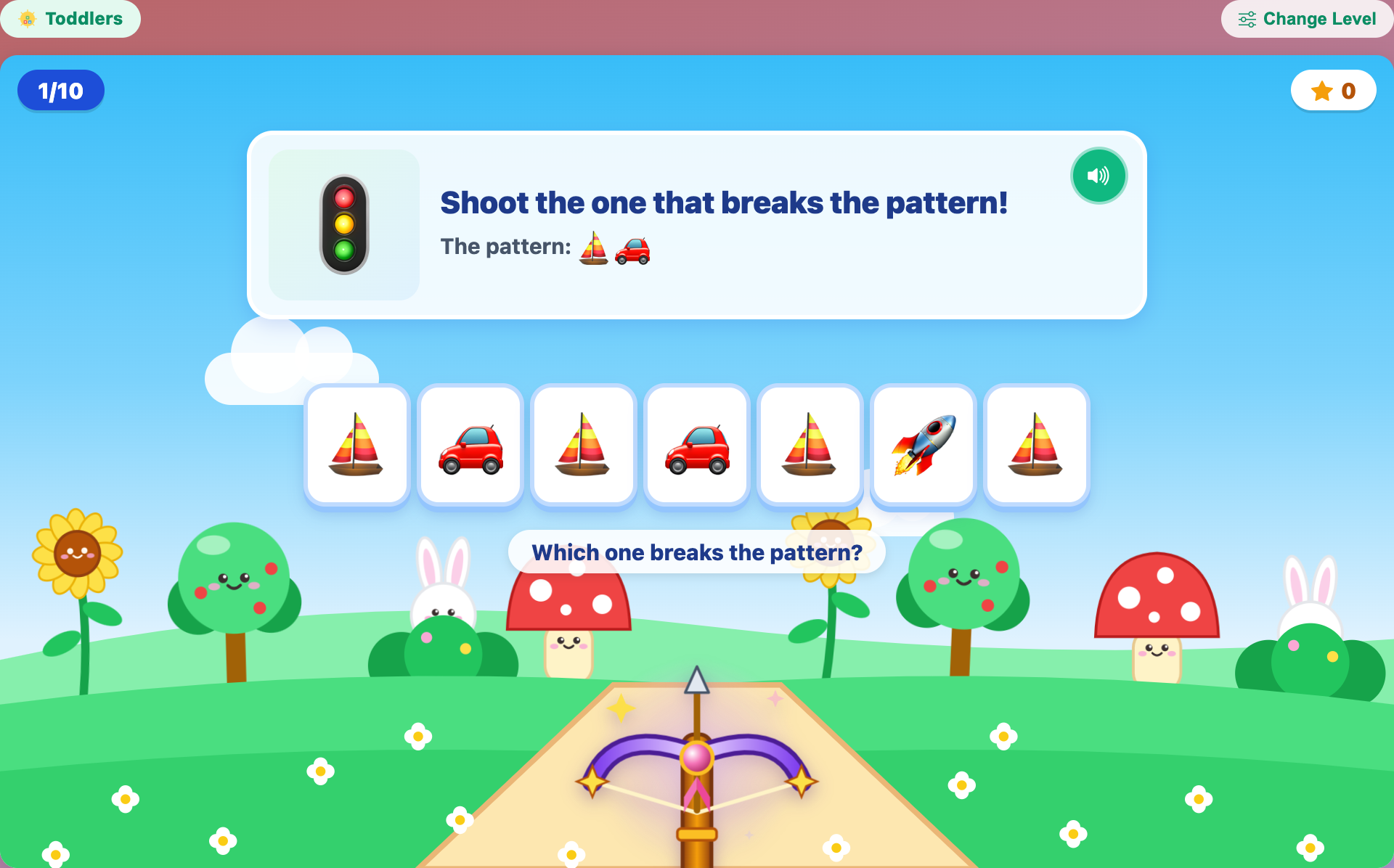
A toddler round with a boat and car pattern on the card and a rocket breaking the row of boats and cars
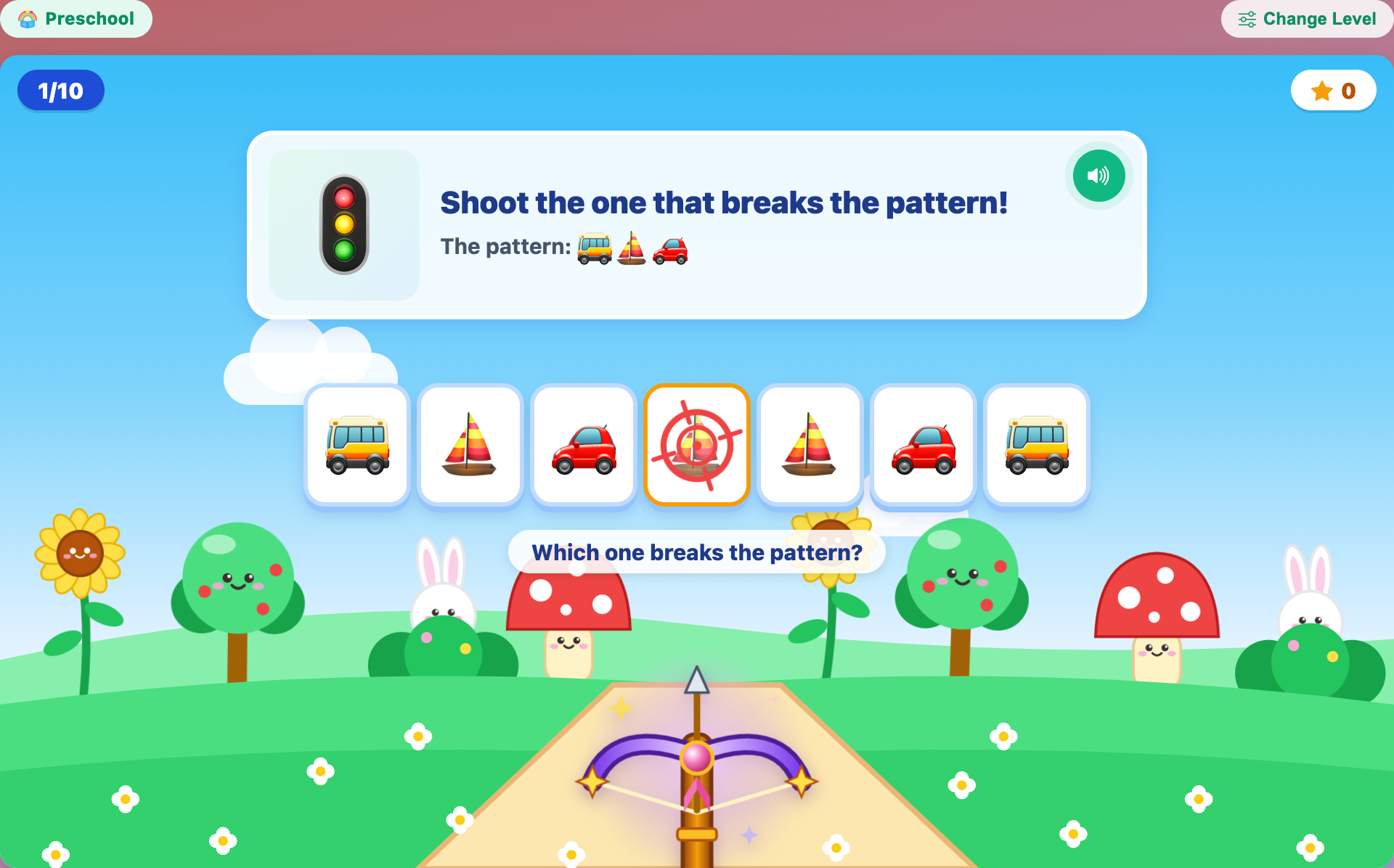
A bus, boat, car pattern for preschoolers where a second boat stands in the bus spot, with the crossbow aiming at it
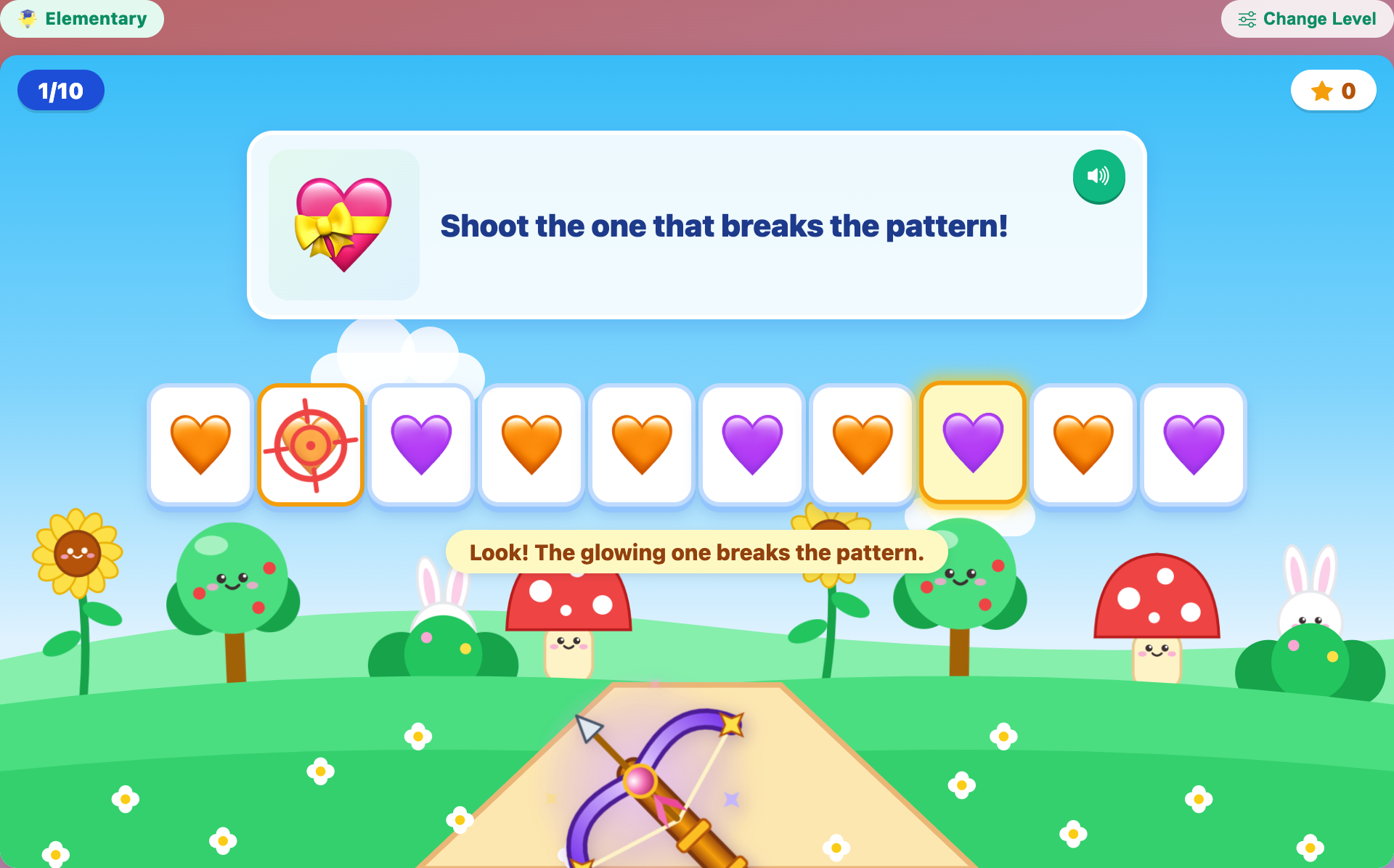
An extra purple heart glowing as a hint in a row of orange and purple hearts, in Pattern Breaker for elementary kids
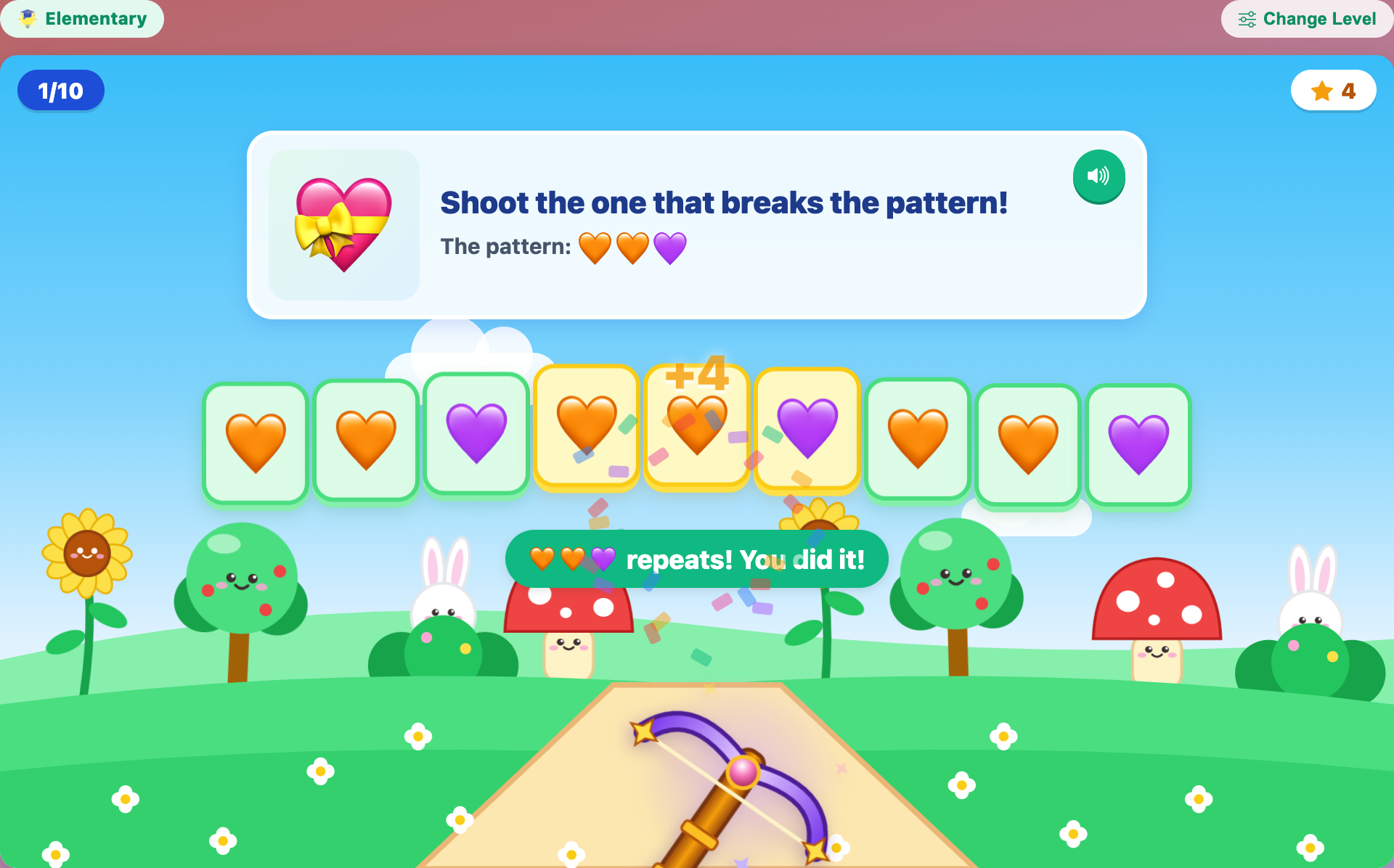
The fixed heart row with orange, orange, purple repeating, the middle repeat shaded, and a repeats! message
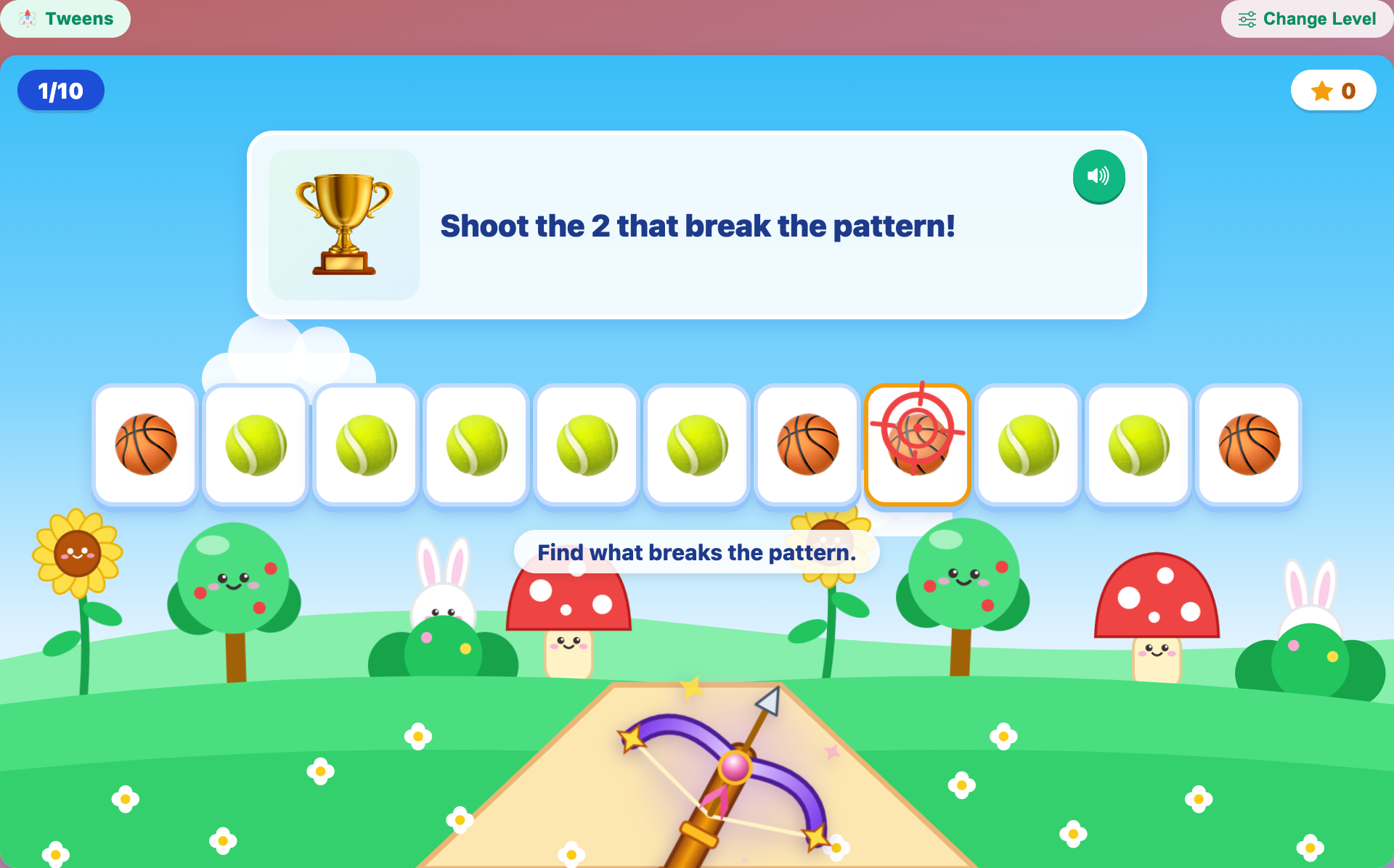
A tweens row of 11 basketballs and tennis balls with 2 breakers to find, and the crossbow aiming at a basketball
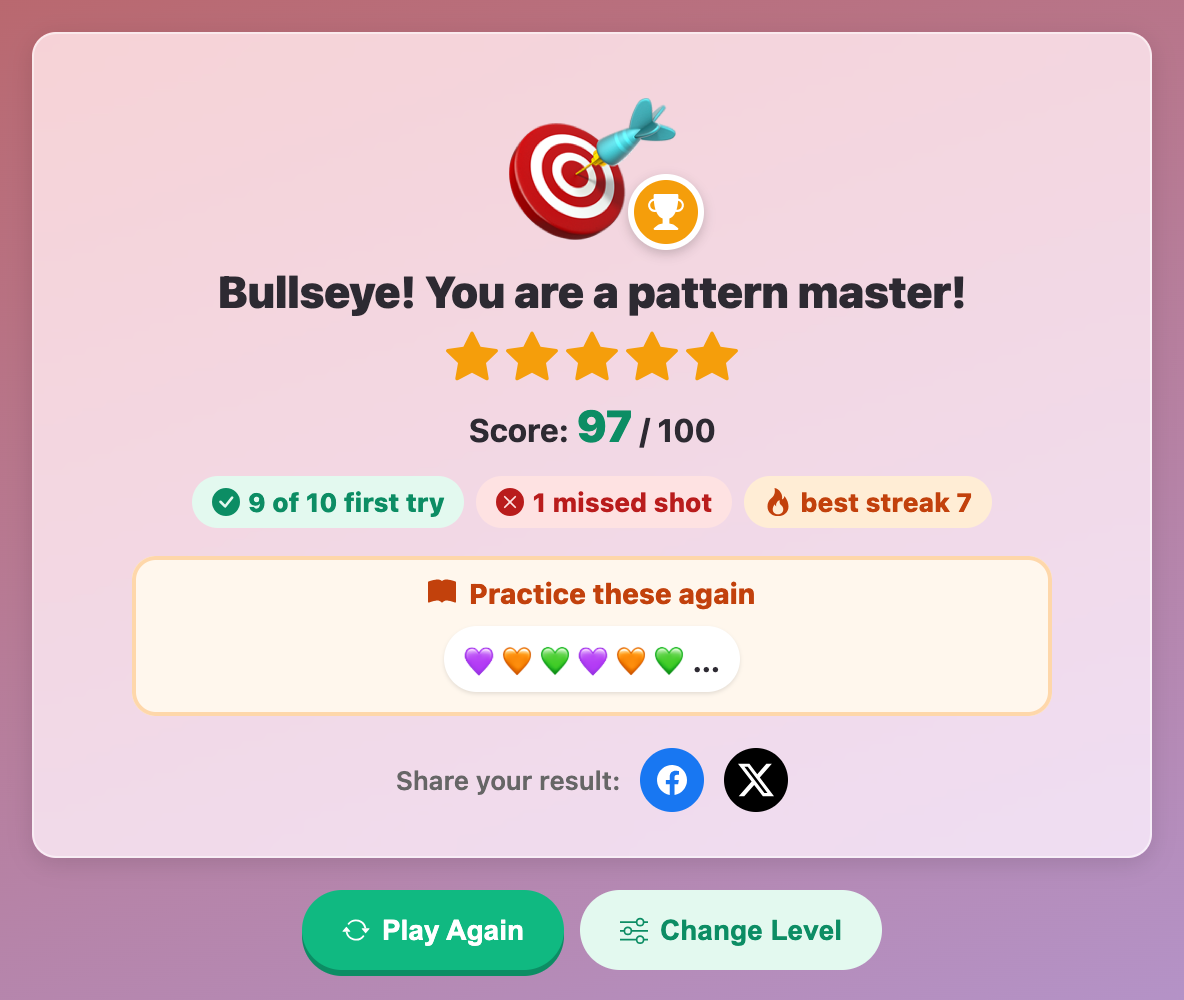
The result card in Magic Crossbow: Pattern Breaker with 97 out of 100, five stars and one heart pattern to practice
More Mind Games
 365.6K plays
4.9
365.6K plays
4.9
Tic-Tac-Toe
Play a game of Tic-Tac-Toe against the computer and see if you can outsmart it.
 1.1M plays
4.9
1.1M plays
4.9
Chess
Play the classic game of chess against the computer or a friend, with FIDE time controls, hints, and undo.
 568.6K plays
4.9
568.6K plays
4.9
Connect Four
Drop your pieces and be the first to connect four in a row against the computer or a friend.
 244.7K plays
5.0
244.7K plays
5.0
Tower of Hanoi
Move the stack of rings from one tower to another without ever placing a bigger ring on a smaller one.
Most Played Games
 1.8M plays
5.0
1.8M plays
5.0
Color & Draw
A free-drawing canvas with colors and brush sizes to unleash your creativity.
 59.4K plays
5.0
59.4K plays
5.0
Recycling Sort
Sort everyday items into the Recycle, Compost, or Trash bin before time runs out!
365.6K plays
4.9
Tic-Tac-Toe
Play a game of Tic-Tac-Toe against the computer and see if you can outsmart it.
1.1M plays
4.9
Chess
Play the classic game of chess against the computer or a friend, with FIDE time controls, hints, and undo.
Comments (22)