
Sliding Puzzle
973.3K playsSlide the numbered tiles — or a fun picture! — one at a time until they line up in order, from a cozy 5-tile board all the way up to the classic 15 puzzle.
Fifteen little numbered tiles, one empty square, and only one move you're ever allowed to make: slide a tile into the gap right next to it. That's the entire rulebook for Sliding Puzzle on KidWorld — and yet turning a jumbled mess of numbers back into perfect order, one careful slide at a time, has been quietly hooking kids (and more than a few grown-ups) for well over a hundred years. Families on KidWorld have already slid their way through more than 900,000 rounds, and the game holds a full, sparkling five-star rating from thousands of puzzle-lovers who've played it. Not bad for a game with just one rule!
🔢 What Is Sliding Puzzle?
Sliding Puzzle is the classic "one gap, one rule" number puzzle — you've probably seen a physical version of it rattling around in a toy drawer somewhere. KidWorld's version starts every round with the tiles scrambled by a computer that only ever performs real, legal slides to mix them up, so no matter how tangled the board looks, it is always, guaranteed, solvable. Your job is simply to slide tiles, one at a time, into the single empty cell, until every tile reads 1, 2, 3... in order from the top-left, with the empty cell left sitting in the bottom-right corner. No timer pressure, no wrong answers along the way — just you, the gap, and a bit of patient thinking.
🕹️ How to Play on KidWorld
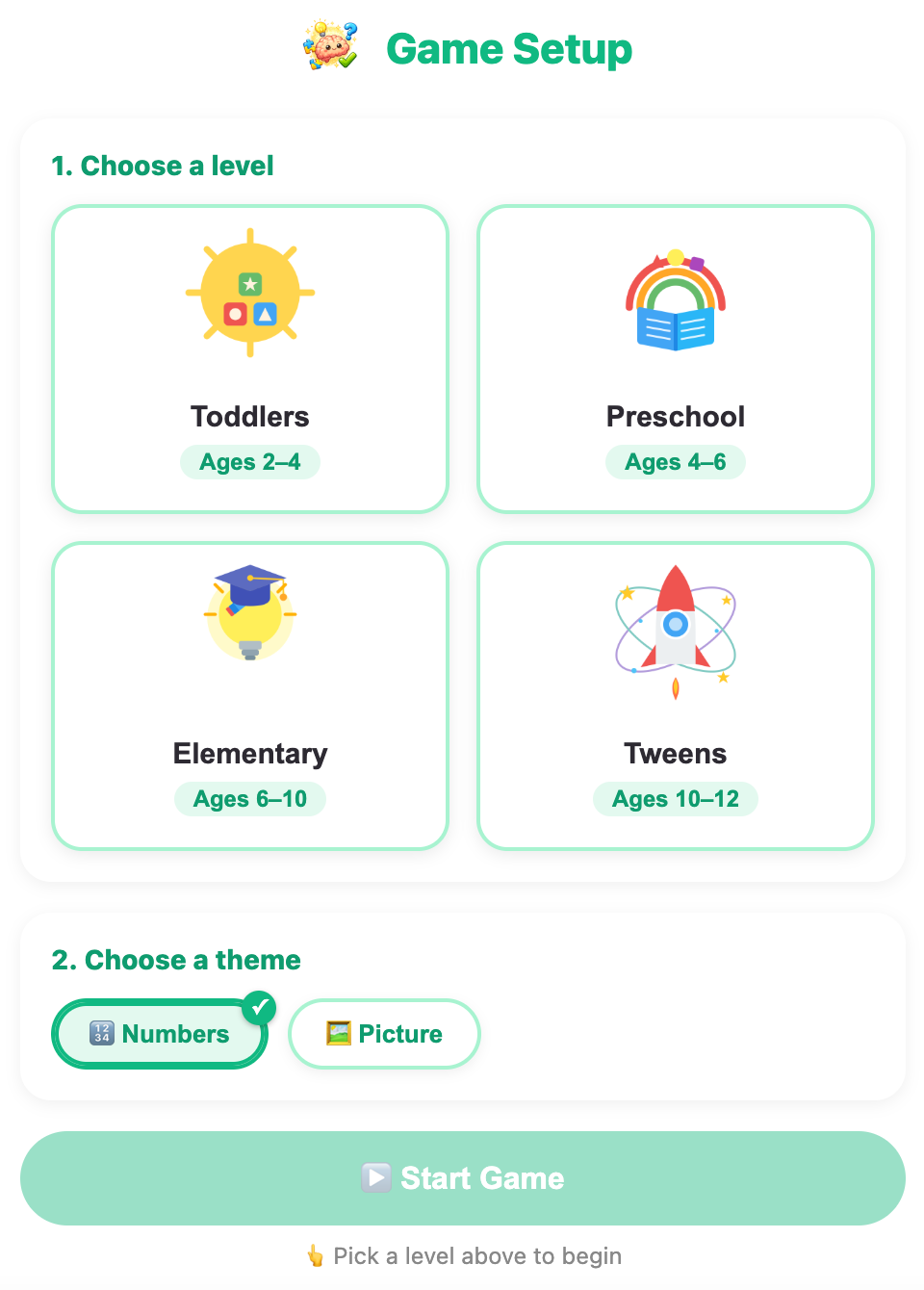
Set up your game: On the Game Setup screen, tap a level — Toddlers, Preschool, Elementary, or Tweens — then pick 🔢 Numbers or 🖼️ Picture as your theme, and tap ▶️ Start Game when you're ready. KidWorld remembers both choices for you, just like it does in other KidWorld games.
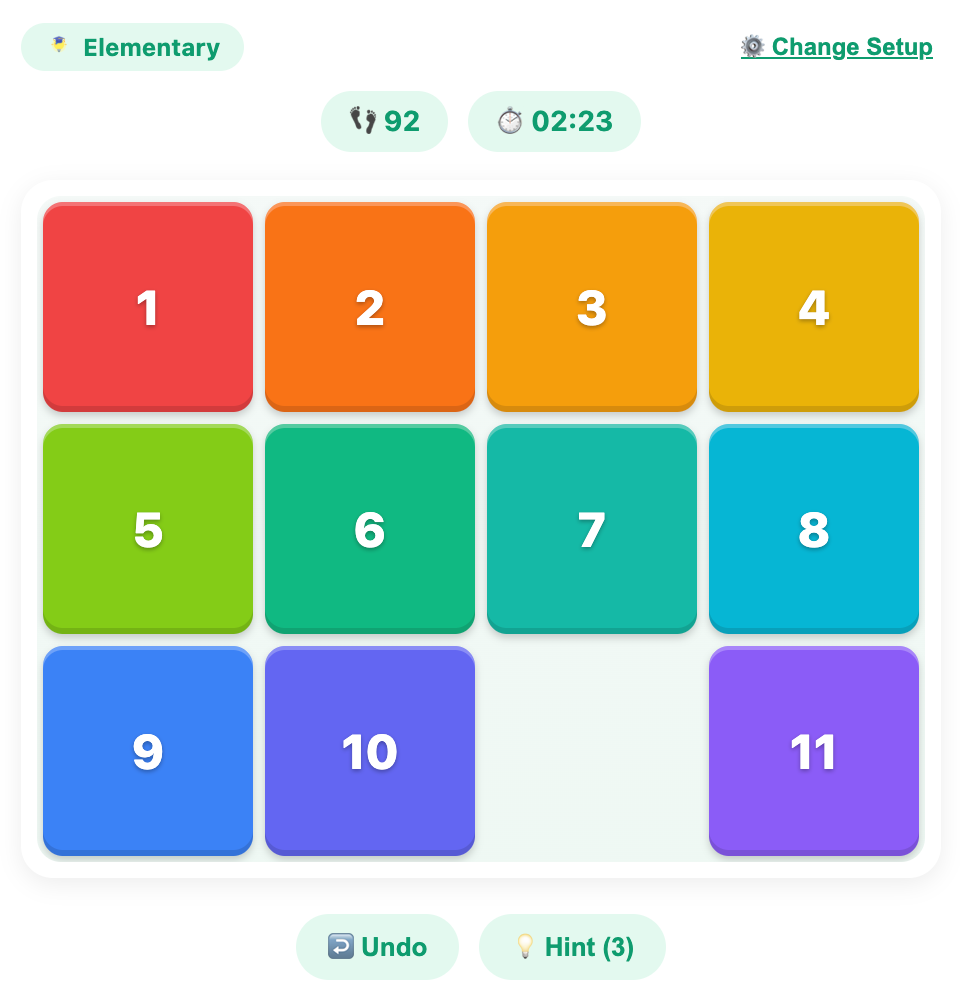
Find the empty cell. Every board has exactly one gap, and only the tiles directly above, below, or beside it can move.
Tap a tile next to the gap to slide it into the empty space — the tile glides right over, and the gap moves to where that tile used to be.
Keep sliding to walk tiles across the board, one careful step at a time, working them toward their correct numbered spot.
Stuck? Tap 💡 Hint and the next tile worth sliding will glow for a moment — slide that one and you're guaranteed to still be on a real path back to a solved board. Each level only allows a limited number of hints, shown right on the button, and using one trims a few points off your final score.
Changed your mind? Tap ↩️ Undo to step back through your own last slide, one tap at a time — it's free and unlimited, so feel free to experiment without worrying about wasting a move.
Finish the board by getting every tile into its correct spot, and your score turns into stars ⭐ for your KidWorld profile!
Handy tools: tap the fullscreen button above the game to make the board bigger and easier to tap, use the reload button any time you'd like a freshly scrambled board, and tap the speaker button to mute or unmute the background music whenever you like.
🖼️ Numbers or a Picture — Your Choice
Right on the Game Setup screen, alongside your level, KidWorld lets you choose how the tiles look: stick with the classic 🔢 Numbers tiles, or switch to 🖼️ Picture mode, where every round scrambles a colorful little scene instead — a curious cat, a happy dog, a fish, a rocket blasting off, or a leafy tree, picked at random each time you play. A small reference picture stays pinned above the board the whole round so you always know what you're rebuilding, and the exact same row-by-row strategy still works no matter which mode you're playing. Pick your level, pick your theme, then tap ▶️ Start Game — whichever theme you chose is remembered for next time, right on your own device.
🧠 Secrets to Solving Any Sliding Puzzle
Randomly sliding tiles around can work eventually, but real solvers use a steady plan instead of guesswork. Here's how to think like a true Sliding Puzzle champion on KidWorld:
Work in order, starting with tile 1. Get the very first tile into its home spot first, then leave it alone and move on to tile 2 — jumping around and trying to fix everything at once is what makes sliding puzzles feel impossible.
Finish a whole row before moving to the next. Once the tiles across the top row are correct, try not to disturb them again — treat that row as "locked" and do all your remaining sliding underneath it.
Think a few slides ahead. Before you tap a tile, picture where the gap will end up afterward — sliding puzzles are really a game of steering the empty space to exactly where you need it next.
Don't be afraid to slide a tile "the wrong way" for a moment. Sometimes getting one tile into place means walking the gap around in a little loop first — that's completely normal, and it's often the only way to bring the gap back to the right side of the tile you're trying to move.
Save your hints for real sticking points. A hint always shows a genuinely useful next slide, so it's worth holding onto them for the trickiest moments rather than using them all up early.
🔢 Quick Sliding Puzzle Riddles
Here are 5 fun riddles that use the same kind of thinking you'll use inside the real game. Can you figure them out before checking the answer?
In a Sliding Puzzle, how many empty cells are there on the board at any one time? (Answer: just one — that single gap is what makes every move possible.)
Can a tile ever hop over another tile to reach the gap? (Answer: no — only a tile directly next to the gap, with nothing in between, can slide into it.)
Which corner is the empty cell supposed to end up in once the board is fully solved? (Answer: the bottom-right corner, right after the very last numbered tile.)
Which is trickier to finish: a small 2x3 board with 5 tiles, or the classic 4x4 board with 15 tiles? (Answer: the 15-tile board — more tiles means the gap has much farther to travel to fix every last one.)
If you tap a tile that isn't touching the gap at all, what happens? (Answer: nothing — the board gives it a little shake to let you know that move isn't allowed yet.)
🎯 Sliding Puzzle for Every Age
What makes KidWorld's Sliding Puzzle so clever is that the very same "slide a tile into the gap" idea can feel like a gentle first puzzle for a toddler or a genuine brain-bender for a tween — the game simply changes how many tiles are in play:
Sliding Puzzle for toddlers (around ages 2 to 4): a cozy 2x3 board with just 5 tiles to sort, and the most generous hint allowance of any level — perfect for a first taste of "put it back in order."
Sliding Puzzle for preschool (around ages 4 to 6): the classic 3x3, 8-tile board — small enough to hold in your head, big enough to need a real plan.
Sliding Puzzle for elementary (around ages 6 to 10): a bigger 3x4 board with 11 tiles, where working row by row really starts to pay off.
Sliding Puzzle for tweens (around ages 10 to 12): the legendary 4x4, 15-tile board — the very same size and layout puzzle-lovers have been sliding for well over a hundred years, right here on KidWorld.
Because the one simple rule — slide a tile into the gap — never changes, one child can start on Toddlers today nudging 5 tiles into place, and grow all the way up to conquering the full 15-tile board, all in the very same game.
🌟 Why Sliding Puzzle Is Such a Wonderful Fit for Kids
A grid of numbered tiles might look simple, but Sliding Puzzle quietly gives a kid's brain a wonderful workout every single round:
Planning and sequencing. Solving tile by tile, row by row, teaches kids to break a big goal into small, ordered steps instead of feeling overwhelmed by the whole board at once.
Number sense. Reading tiles in order and recognizing which number belongs where builds quick, confident number recognition without ever feeling like a worksheet.
Working memory. Picturing where the gap needs to travel next, several slides ahead, is a genuine mental workout that strengthens with every round played.
Patience and persistence. A tile that isn't quite in place yet isn't a mistake — it just means a few more thoughtful slides, teaching kids to keep calmly working the problem instead of giving up.
Calm, can't-lose fun. There's no timer racing against you and no way to truly fail — the board simply waits, patient as ever, for the next slide, and hints are always there if things get tricky.
Simple enough for a toddler to enjoy nudging a few tiles into place, yet challenging enough to make a tween feel genuinely proud of cracking the full 15-tile board — that's exactly why this one-rule, endlessly replayable classic still feels so satisfying as a Sliding Puzzle game for kids on KidWorld today.
🖼️ See the Game in Action
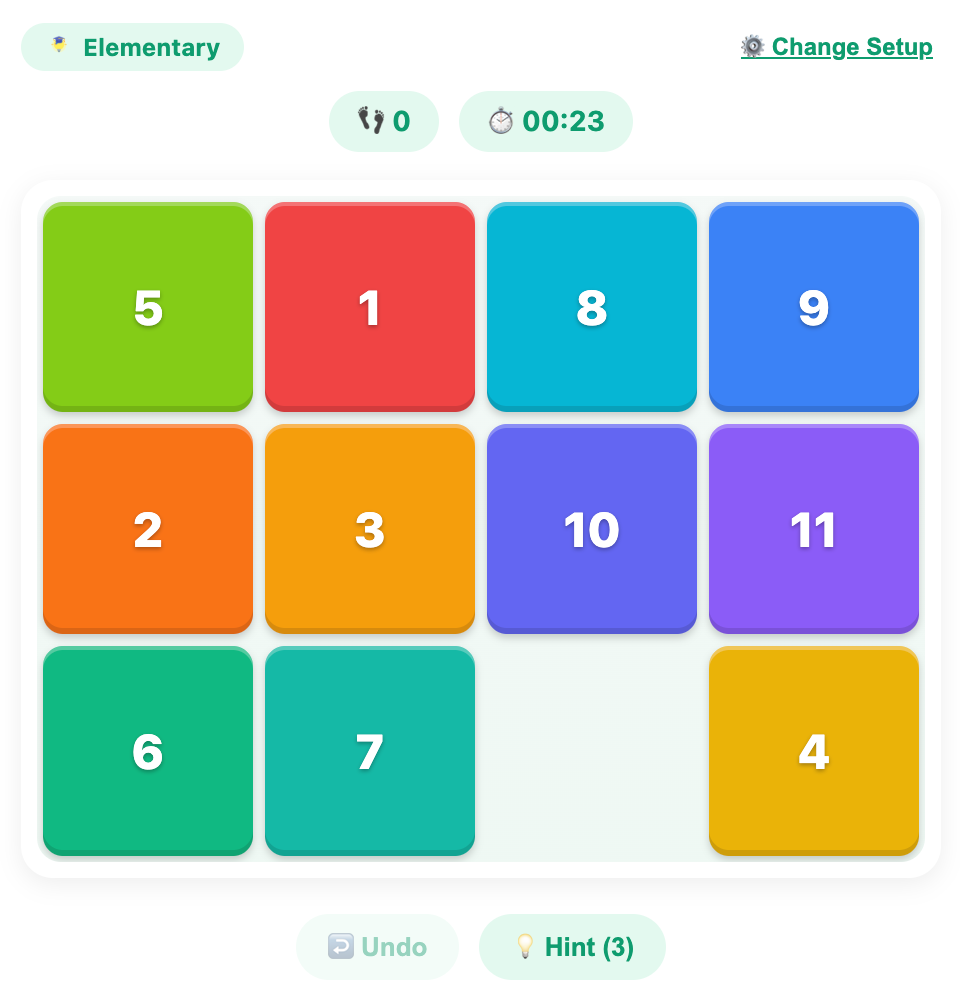
A screenshot when start a new Sliding Puzzle game for elementary
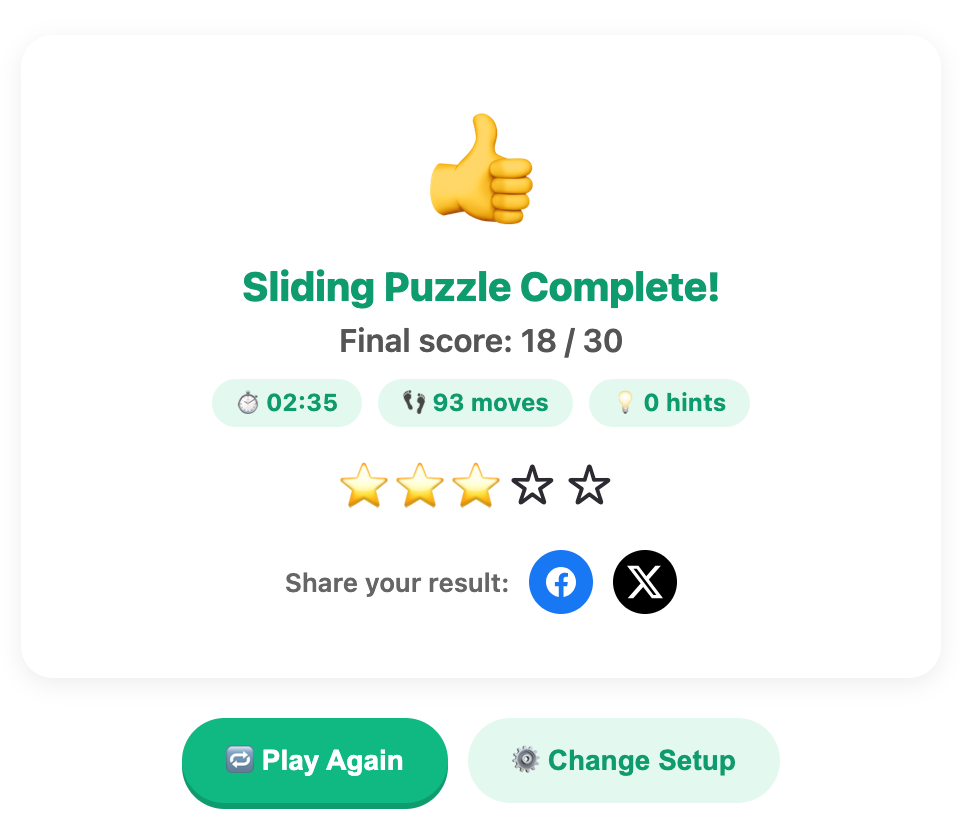
A screenshot when complete a Sliding Puzzle game
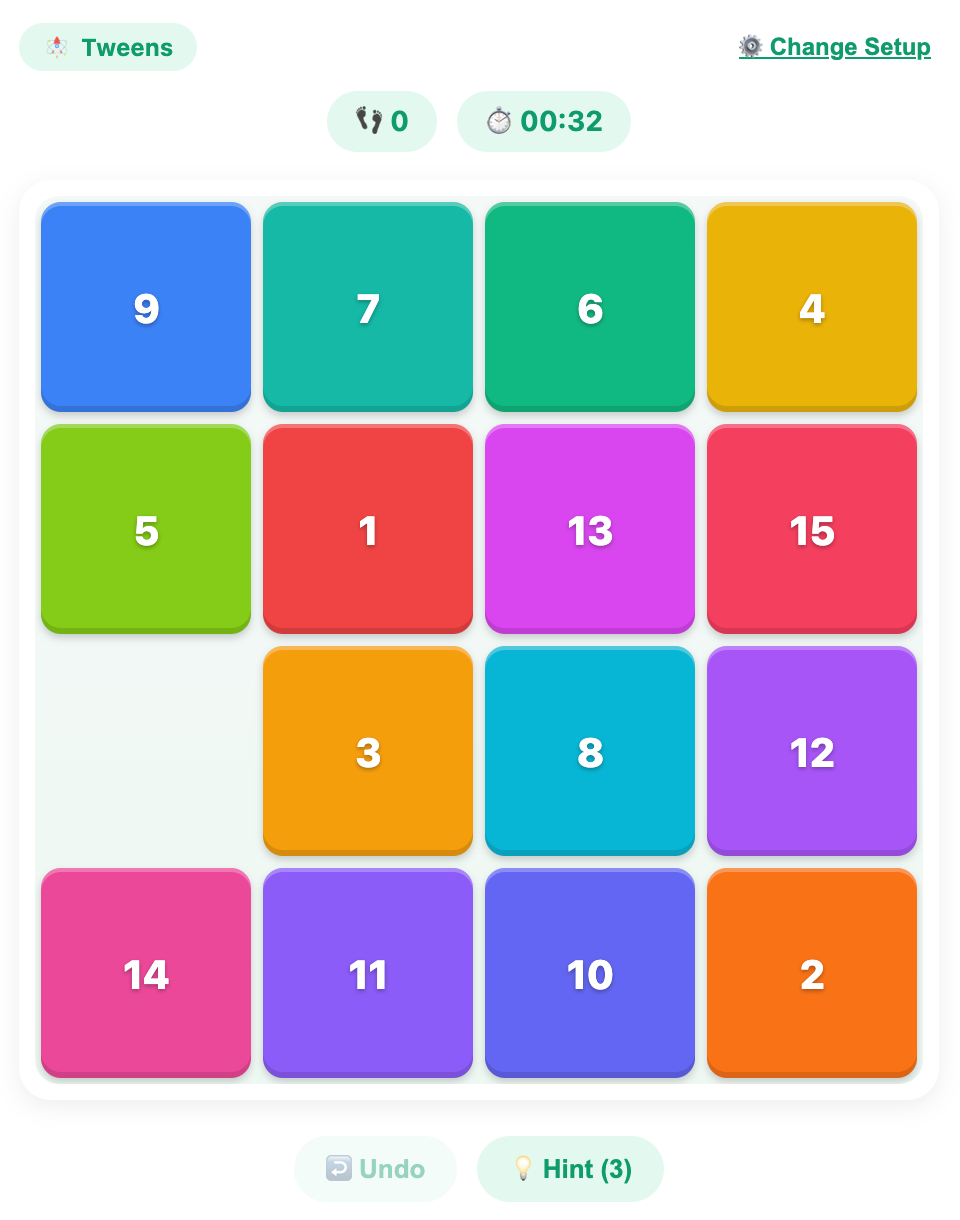
A screenshot when start a new Sliding Puzzle game for tweens
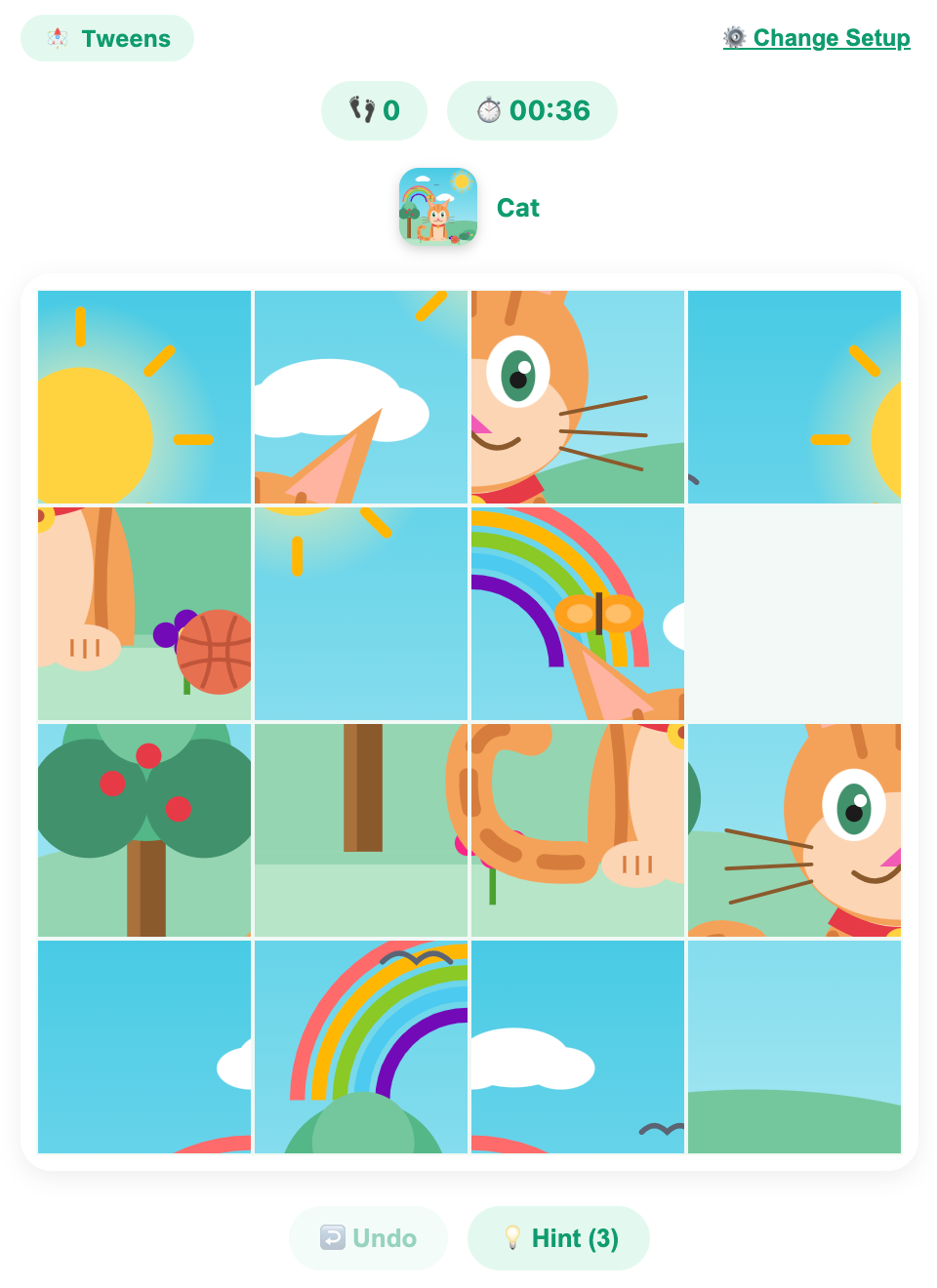
A screenshot when start a new Sliding Puzzle game with image theme option
More Mind Games
 365.5K plays
4.9
365.5K plays
4.9
Tic-Tac-Toe
Play a game of Tic-Tac-Toe against the computer and see if you can outsmart it.
 1.1M plays
4.9
1.1M plays
4.9
Chess
Play the classic game of chess against the computer or a friend, with FIDE time controls, hints, and undo.
 568.6K plays
4.9
568.6K plays
4.9
Connect Four
Drop your pieces and be the first to connect four in a row against the computer or a friend.
 244.7K plays
5.0
244.7K plays
5.0
Tower of Hanoi
Move the stack of rings from one tower to another without ever placing a bigger ring on a smaller one.
Most Played Games
 1.8M plays
5.0
1.8M plays
5.0
Color & Draw
A free-drawing canvas with colors and brush sizes to unleash your creativity.
 59.2K plays
5.0
59.2K plays
5.0
Recycling Sort
Sort everyday items into the Recycle, Compost, or Trash bin before time runs out!
365.5K plays
4.9
Tic-Tac-Toe
Play a game of Tic-Tac-Toe against the computer and see if you can outsmart it.
1.1M plays
4.9
Chess
Play the classic game of chess against the computer or a friend, with FIDE time controls, hints, and undo.
Comments (73)