
Maze Runner
514.4K playsGuide your explorer through a maze to find the treasure, using as few steps as you can.
Picture a curious little pup 🐶 standing at the corner of a twisty stone maze, ears perked up, nose sniffing the air, with a shiny golden trophy 🏆 waiting somewhere deep inside the winding paths. Every wall could hide a shortcut or a dead end, and only careful thinking (not luck!) gets the pup all the way to the prize. That's Maze Runner, one of the most-loved brain games on KidWorld, and no two mazes are ever the same — a brand-new one is drawn fresh every single time you play! Kids everywhere have already guided their pup through more than 500,000 mazes, and thousands of families have given it a full, sparkling five-star rating. That's a whole lot of happy little explorers!
🧭 What Is Maze Runner, Exactly?
Maze Runner is a classic kind of puzzle called a "labyrinth" — a grid of little rooms connected (or blocked off!) by walls, with just one true path winding from the start all the way to the goal. On KidWorld, the computer builds a brand-new maze for you every round using a clever shuffling trick, kind of like a robot with a paintbrush wandering around knocking down walls at random until every corner of the grid is reachable. That means the maze you get today has never existed before and will never appear in exactly that shape again — every single game is a genuinely one-of-a-kind adventure. Your job is simple to understand but fun to master: guide your pup 🐶 from the top-left corner, through the winding hallways, all the way to the trophy 🏆 waiting in the opposite corner.
🕹️ How to Play on KidWorld
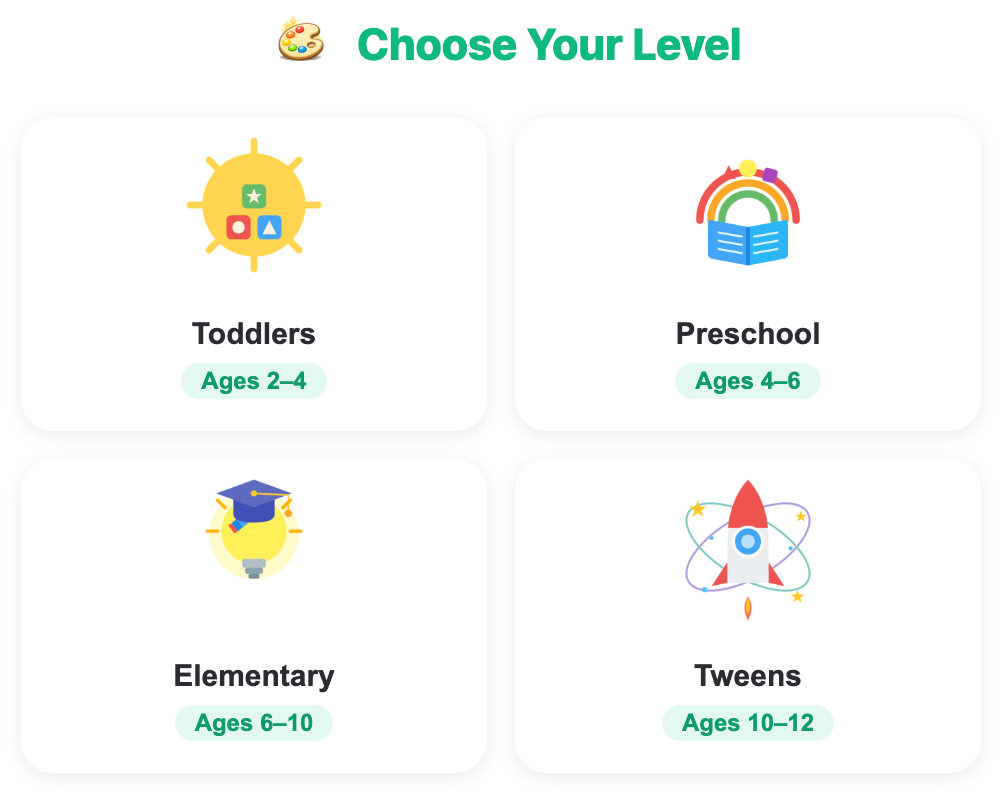
Pick your level: Choose Toddlers, Preschool, Elementary, or Tweens when the game opens. KidWorld remembers your favorite level, just like it does across other KidWorld games, so you can jump straight back in next time.
Look at the map. Your pup starts in one corner, the trophy sits in the other, and solid lines show you exactly where the walls are — no line means you're free to walk straight through.
Move your pup three ways: tap the arrow keys on your keyboard, tap the on-screen ▲ ◀ ▶ ▼ d-pad buttons, or simply click/tap any cell in your pup's own row or column that has a clear, wall-free path to it — your pup will zoom straight there in one go!
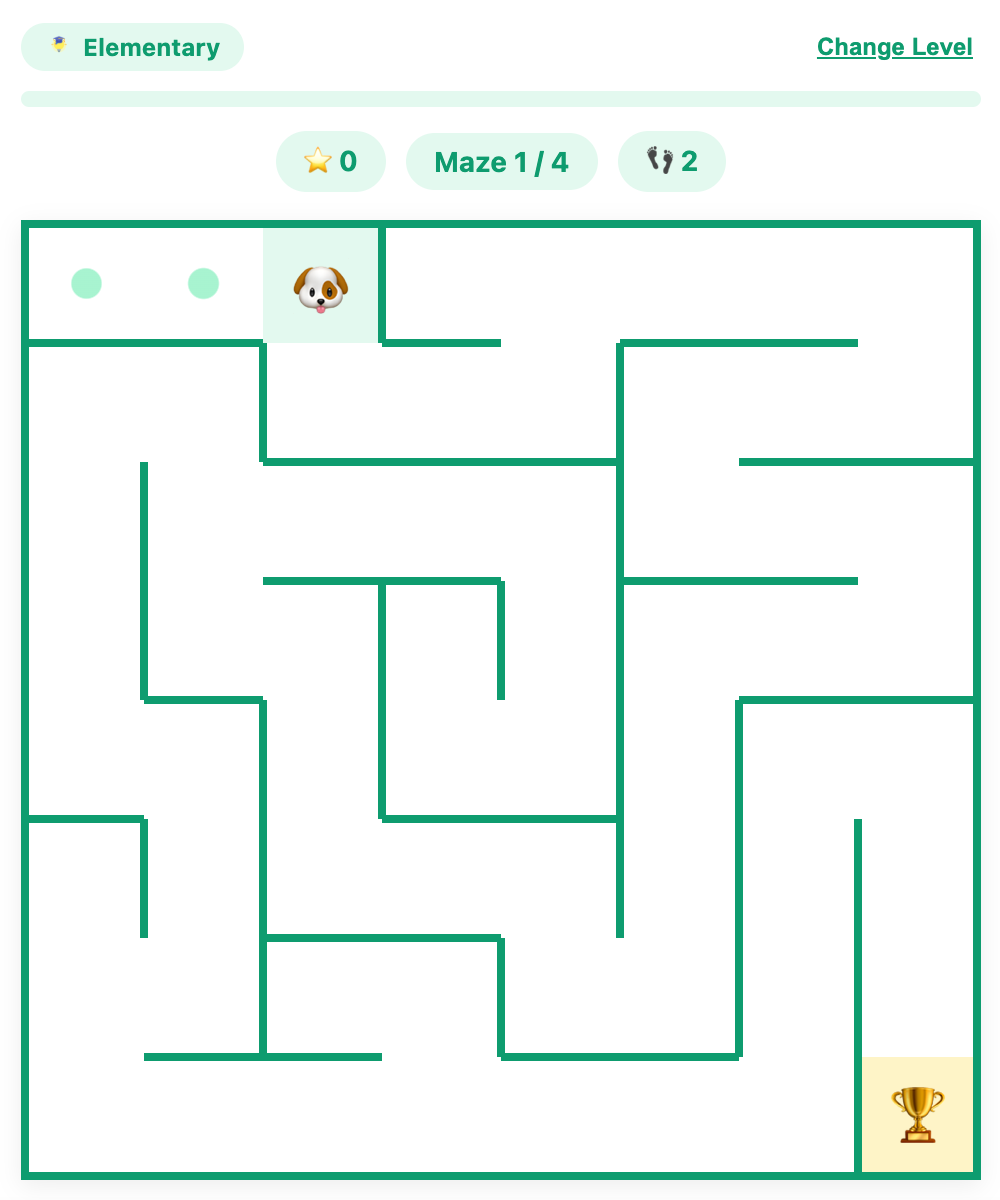
Bump into a wall? No harm done — the board gives a little shake to let you know that path is blocked, and you simply try a different direction.
Stuck and need a nudge? Tap 💡 Hint to light up the next few steps toward the trophy for a moment, or tap 👀 Show Path to reveal the entire rest of the route for a longer peek (this uses up all your remaining hints at once, so save it for when you really need it).
Reach the trophy and you instantly earn stars for that maze! Then a brand-new maze appears, and you do it all again — each level has a set number of mazes to complete in one full run.
Handy tools: tap the fullscreen button above the game to make the maze bigger and easier to see, use the reload button any time you'd like a whole new set of mazes, and tap the speaker button to mute or unmute the background music whenever you like.
🧠 Secrets to Solving Any Maze
Maze Runner isn't about wandering aimlessly and hoping for the best — real maze-solvers use clever tricks to find their way quickly. Here's how to think like a true Maze Runner champion:
Try the "one-hand-on-the-wall" trick. Pretend your paw is always touching the wall on your right side, and never lift it off as you walk. Believe it or not, this simple rule leads you out of almost any maze eventually, since it never lets you wander in circles forever.
Watch for dead ends. If a hallway only has one way in and no way out, that's a dead end — the moment you spot one, you know that path isn't the way to the trophy, so don't waste extra steps exploring it twice.
Look ahead before you leap. Since Maze Runner lets you click any straight, clear stretch of hallway to zoom there in one move, take a second to spot the longest open stretch toward your goal instead of tapping one square at a time.
Save your hints for real trouble. Each 💡 Hint only shows a few steps, so it's best saved for moments you're truly stuck rather than used the second you start — every hint you use trims a little off your final score, so a careful eye beats a quick tap.
Notice your own footprints. Cells you've already visited stay lightly marked on the board, which is a handy way to tell "I've been here before, try somewhere new" from "this path is still unexplored."
Aim for the shortest path, not just any path. Your score depends on how close your total steps are to the true shortest route, so a little extra thinking before you move pays off in extra stars at the end.
🧩 Quick Maze Riddles
Here are 5 fun maze riddles that use the same kind of thinking you'll use inside the real game. Can you figure them out before checking the answer?
If a hallway has walls on three sides and is only open on the side you walked in from, what do maze explorers call that kind of hallway? (Answer: a dead end — there's only one way in, and it's also the only way out.)
In Maze Runner, if you keep one paw touching the right-hand wall the entire time and never lift it, will you eventually reach the trophy in every possible maze? (Answer: yes! This classic trick, sometimes called the "wall follower" method, always finds the way out of a maze like the ones in this game.)
Your pup starts in the top-left corner and the trophy sits in the bottom-right corner. Which direction combination will your pup generally need to travel in overall? (Answer: down and to the right — though the exact winding path will curve left, right, up, and down many times along the way!)
If using a hint costs you a few points but saves you from taking ten extra wrong turns, is it ever worth using one? (Answer: yes — a small point cost from one hint is often much smaller than the points lost from wandering many extra steps down the wrong hallway.)
Two kids solve the exact same maze. One takes the shortest possible path, and the other wanders a little and takes five extra steps. Who ends that maze with more stars? (Answer: the kid who took the shortest path — since every step beyond the shortest route trims a little off the score for that maze.)
🎯 Maze Runner for Every Age
What makes KidWorld's Maze Runner so clever is that the very same walking-a-pup-to-a-trophy idea can feel like a gentle, cozy stroll for a toddler or a genuine head-scratcher for a tween — the game simply changes the size of the maze and how much help is on offer:
Maze Runner for toddlers (around ages 2 to 4): a small, cozy 5x5 grid with just 3 short mazes per session, plus the most generous helping of hints of any level — perfect for little ones just learning that clicking or pressing an arrow key moves their pup around the board.
Maze Runner for preschool (around ages 4 to 6): a slightly bigger 6x6 grid, still 3 mazes per session, with a healthy stock of hints still on hand — just enough extra twists and turns to make preschoolers pause and think before each move.
Maze Runner for elementary (around ages 6 to 10): the maze grows to a proper 8x8 grid across 4 mazes per session, with fewer hints and shorter hint peeks — real planning is needed now, since dead ends are easy to wander into without looking ahead.
Maze Runner for tweens (around ages 10 to 12): the full challenge — a big 10x10 grid across 4 mazes per session, with the fewest hints of any level. Finding the shortest path through a maze this size, mostly on your own, is a genuinely satisfying brain workout.
Because the pup, the trophy, and the controls stay exactly the same at every level, one child can start on Toddlers today taking a short, gentle stroll through a tiny 5x5 grid, and grow all the way up to plotting a careful route across a full 10x10 Tweens maze — all in the very same game.
🌟 Why Maze Runner Is Such a Wonderful Fit for Kids
A grid of walls and hallways might look simple, but Maze Runner quietly gives a kid's brain a wonderful workout every single round:
Spatial reasoning. Picturing which way a hallway curves before you even walk it builds the same mental map-reading skill used in geography, navigation, and even finding your way around a new building.
Planning ahead. Since extra steps cost points, kids naturally start pausing to look at the whole visible maze and plan a route, rather than just reacting one square at a time — an early taste of real strategic thinking.
Patience with dead ends. Hitting a dead end isn't a failure in Maze Runner, it's information — kids learn to calmly back up and try a different direction instead of getting frustrated, a wonderfully useful life skill in miniature.
Fine motor and coordination practice. Tapping precise arrow keys, d-pad buttons, or exact grid cells sharpens hand-eye coordination a little more with every maze.
Calm, can't-lose fun. There's no timer racing against you and no way to truly fail — a wrong turn just means backing up, and hints are always there if things get tricky. That makes Maze Runner a wonderfully calm kind of screen time, with a brand-new puzzle waiting every single time you press play.
Simple enough for a toddler to enjoy a short, cozy stroll to the trophy, yet challenging enough to make a tween feel genuinely proud of finding the shortest route through a big winding grid — that's exactly why this ever-changing, endlessly replayable labyrinth still feels so fresh as a Maze Runner game for kids on KidWorld today.
🖼️ See the Game in Action
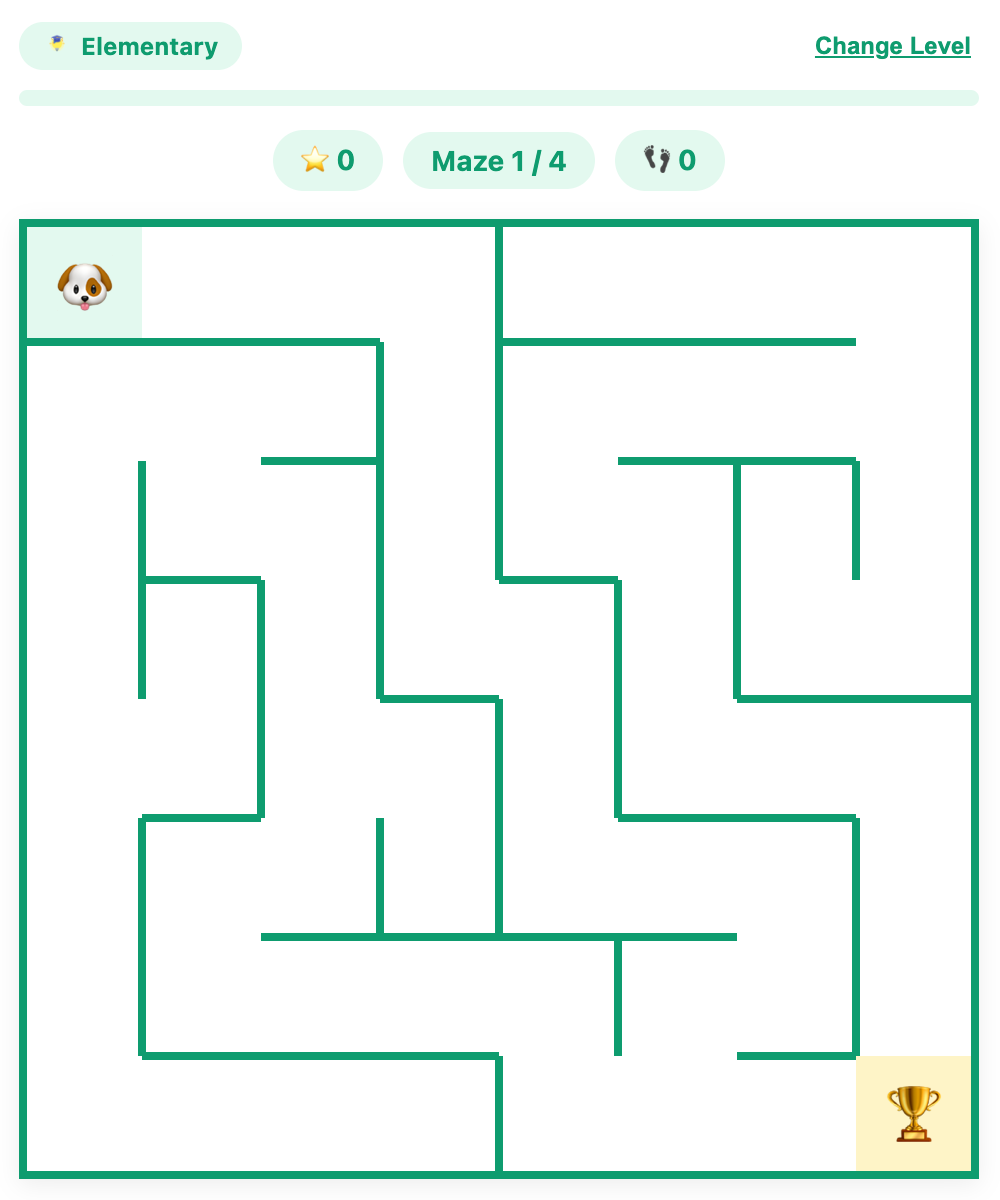
A screenshot when start a game for elementary
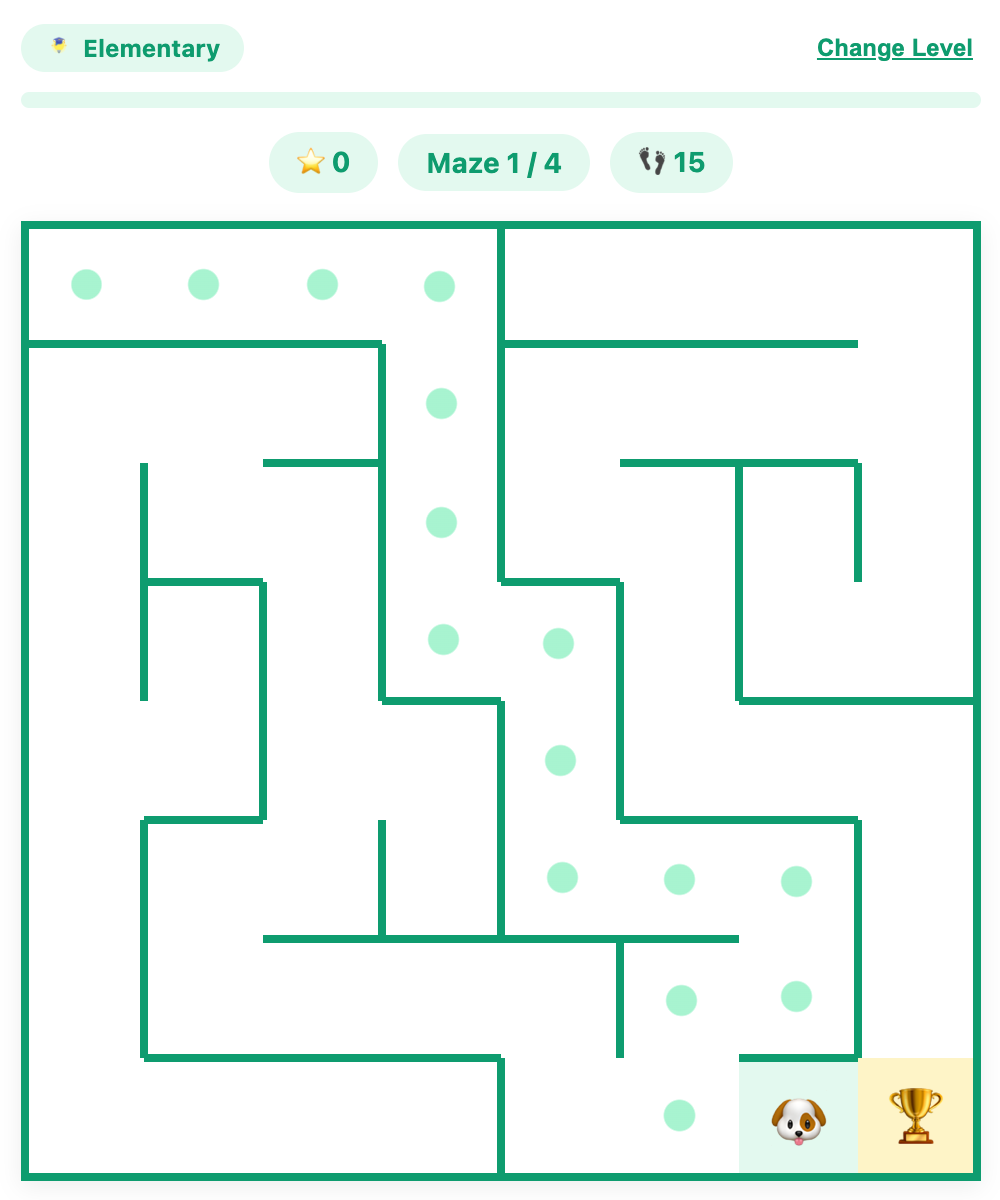
A screenshot showing the player almost reaching the finish line in a game.
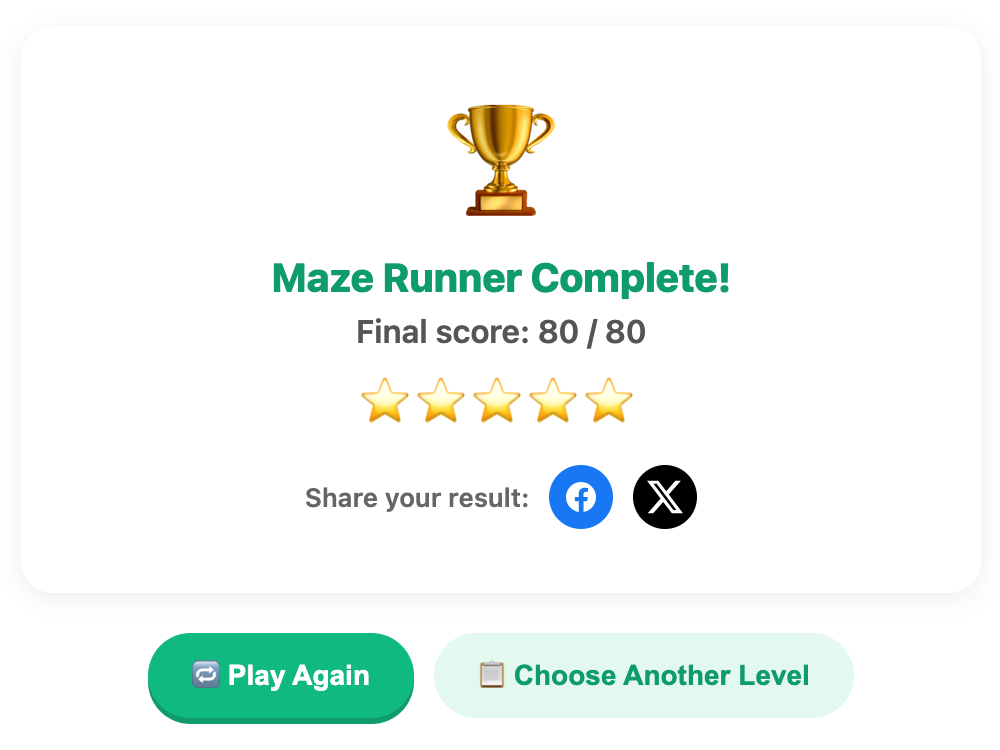
A screenshot when complete a game
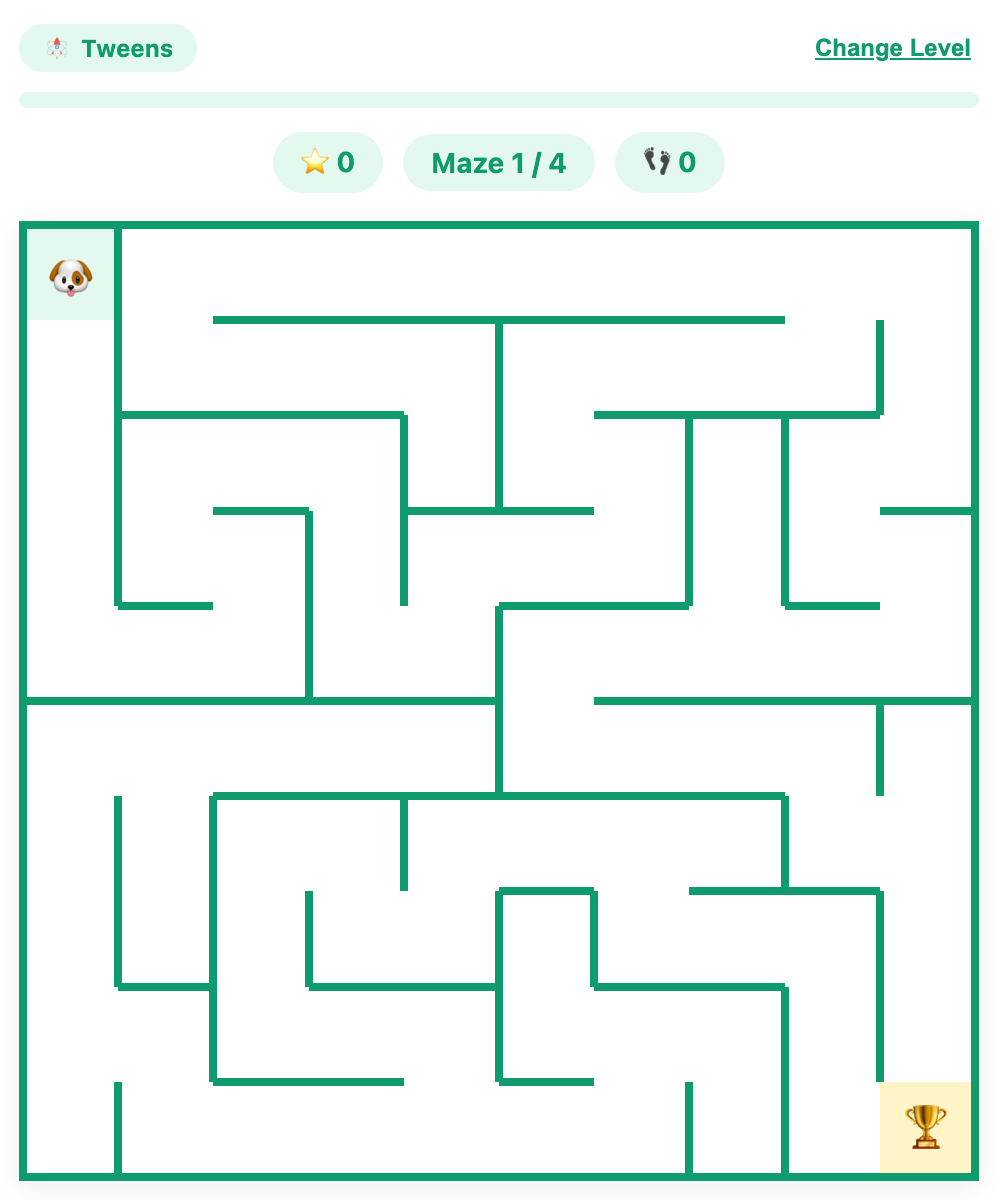
A screenshot when start a game for tweens
More Mind Games
 365.5K plays
4.9
365.5K plays
4.9
Tic-Tac-Toe
Play a game of Tic-Tac-Toe against the computer and see if you can outsmart it.
 1.1M plays
4.9
1.1M plays
4.9
Chess
Play the classic game of chess against the computer or a friend, with FIDE time controls, hints, and undo.
 568.6K plays
4.9
568.6K plays
4.9
Connect Four
Drop your pieces and be the first to connect four in a row against the computer or a friend.
 244.7K plays
5.0
244.7K plays
5.0
Tower of Hanoi
Move the stack of rings from one tower to another without ever placing a bigger ring on a smaller one.
Most Played Games
 1.8M plays
5.0
1.8M plays
5.0
Color & Draw
A free-drawing canvas with colors and brush sizes to unleash your creativity.
 59.2K plays
5.0
59.2K plays
5.0
Recycling Sort
Sort everyday items into the Recycle, Compost, or Trash bin before time runs out!
365.5K plays
4.9
Tic-Tac-Toe
Play a game of Tic-Tac-Toe against the computer and see if you can outsmart it.
1.1M plays
4.9
Chess
Play the classic game of chess against the computer or a friend, with FIDE time controls, hints, and undo.
Comments (81)