
Tower of Hanoi
244.7K playsMove the stack of rings from one tower to another without ever placing a bigger ring on a smaller one.
Three wooden towers, a stack of colorful rings, and one deceptively simple rule: never place a bigger ring on top of a smaller one. That's Tower of Hanoi, one of the oldest and most famous brain puzzles in the world, now glowing right on your screen at KidWorld! Tap a tower to lift its top ring, tap another tower to drop it there, and work your way toward moving the entire stack across to the goal tower — every single ring, in the exact same order it started in. It looks easy with just a couple of rings and turns into a real, satisfying challenge the moment more join the stack, which is exactly why KidWorld's Tower of Hanoi has already been played more than 200,000 times, earning thousands of 5-star ratings from players just like you!
🗼 What Is Tower of Hanoi?
Tower of Hanoi is a legendary puzzle that's been challenging thinkers for well over a hundred years. You start with a neat stack of rings — biggest on the bottom, smallest on top — all sitting on the leftmost of three towers. Your job is to move the whole stack, one ring at a time, all the way over to the tower marked with a little 🏁 flag. There are only two rules, but they matter every single move: you may only ever move the topmost ring of any tower, and you may never set a ring down on top of a ring that's smaller than it. Follow those two rules and the puzzle is always solvable — there's no way to get truly stuck, only ways to take a few extra moves getting there!
🕹️ How to Play on KidWorld
Pick your level: Choose Toddlers, Preschool, Elementary, or Tweens when the game opens. KidWorld remembers your favorite level for you, just like it does in other KidWorld games — and here, level controls how many rings are in your stack.

Move a ring two ways: tap a tower to pick up its top ring (it lifts up a little so you know it's selected), then tap a different tower to drop it there — or skip the two-tap dance entirely and just drag a ring straight from one tower to another with your mouse or finger, exactly like sliding a real ring off a real peg.
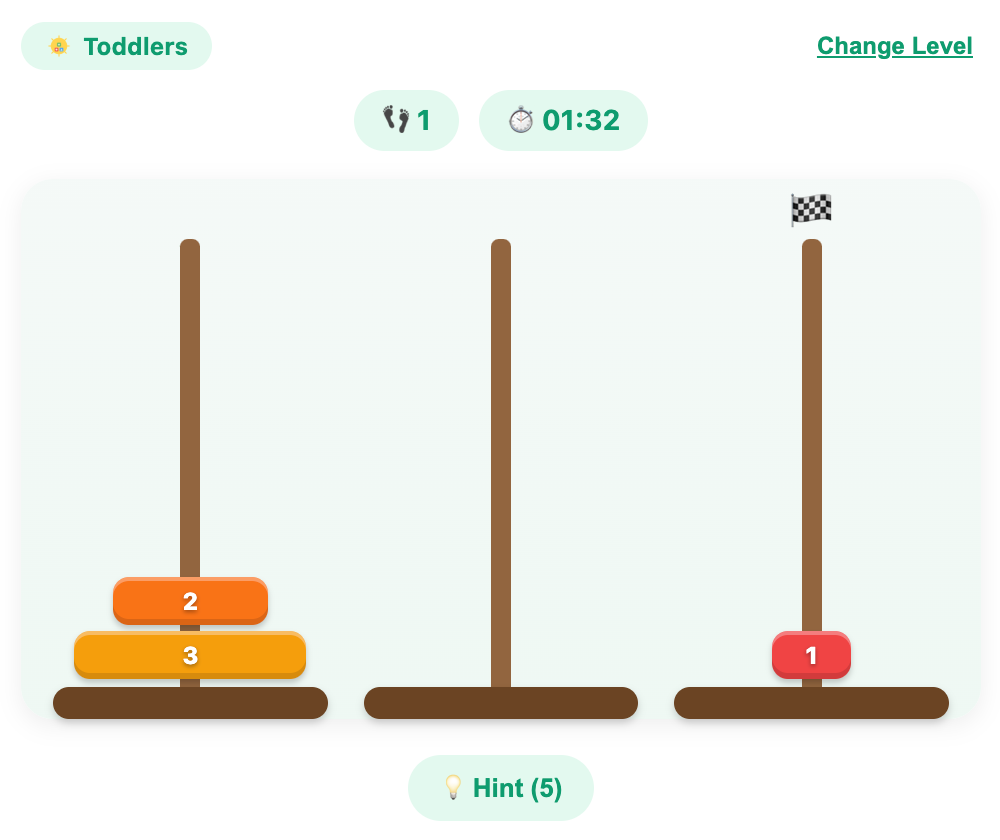
Watch for the glow while dragging: the tower under your ring lights up green the moment a drop there would be legal, or red if it wouldn't (like dropping onto a smaller ring) — so you always know before you let go. Changed your mind mid-drag? Just drop the ring back on its own tower, or let go anywhere off the towers, and it snaps right back with no move counted.
Watch the goal tower: the tower with the 🏁 flag is where every ring needs to end up, biggest on the bottom, smallest on top, just like it started on the first tower.
Stuck on your next move? Tap 💡 Hint and KidWorld will briefly glow the exact tower to lift from and the exact tower to drop onto — figured out fresh every time, so it's always the smartest possible move even if your stack looks nothing like where it started. Each level only allows a limited number of hints, shown right on the button, and using one trims a few points off your score.
Solve the whole stack to complete the round, and your score turns into stars ⭐ for your KidWorld profile! Move efficiently — as close to the fewest possible moves as you can — for the biggest score.
Handy tools: tap the fullscreen button above the game to make the towers bigger and easier to tap (or drag) on a tablet or phone, use the reload button any time you'd like a fresh stack to appear, and tap the speaker button to mute or unmute the background music whenever you like.
🧠 Secrets to Solving Tower of Hanoi
Tower of Hanoi looks simple, but real solvers lean on a couple of clever tricks to get every stack across in the fewest possible moves. Here's how to think like a true KidWorld Tower of Hanoi champion:
Think in "one ring at a time" chunks. To move a big stack, you first have to move every ring above the biggest one out of the way onto the spare tower, then move the biggest ring by itself, then move that smaller stack again on top of it. Puzzles inside puzzles — that's the whole secret!
Your very smallest ring moves every other turn. Once you notice this pattern, you can almost always tell yourself which tower the tiniest ring should hop to next, without even thinking hard about the rest of the stack.
The smallest ring always travels in one direction, in order. If your stack has an odd number of rings, the smallest ring cycles start-tower → goal-tower → middle-tower → start-tower and repeats; with an even number of rings, it cycles the opposite way. Lock that pattern in and half your moves become automatic.
Never undo a ring's direction without a reason. If you just moved a ring off of a tower, don't move a different ring right back onto that same spot next turn unless it's truly your only legal option — that usually means you've wandered off the shortest path.
Count your rings, then guess the minimum. The fewest possible moves to solve a stack of any size is always 2 multiplied by itself once for every ring, minus 1 — 3 rings need at least 7 moves, 4 rings need 15, 5 rings need 31, and 6 rings need a whopping 63! Knowing this ahead of time helps you notice right away if you're taking a wrong turn.
🎯 Quick Tower of Hanoi Practice
Here are a few mini puzzles that use the same kind of thinking you'll use in the real game. Picture the towers in your head and see if you can work each one out before checking the answer!
You have just 1 ring sitting on the start tower. What's the fewest moves to get it to the goal tower? (Answer: just 1 move — pick it up and drop it straight on the goal tower!)
You have 2 rings on the start tower. What's the fewest moves to move both to the goal tower? (Answer: 3 moves — small ring to the middle tower, big ring to the goal tower, then small ring on top of it.)
Your smallest ring just moved from the start tower to the goal tower. If you have an odd number of rings total, which tower should it move to next? (Answer: the middle tower — remember, an odd stack cycles start → goal → middle → start.)
You have a 4-ring stack solved and ready to go. Using the doubling rule, how many moves will it take at minimum? (Answer: 15 moves — 2×2×2×2 minus 1.)
🌟 Why Tower of Hanoi Is Such a Great Fit for Kids
A quiet stack of rings might look like simple fun, but it packs in a surprising amount of good-for-you brain practice:
Planning several steps ahead. Because a careless move can block your next few turns, kids naturally start picturing two or three moves into the future before tapping anything — an early, hands-on taste of real strategic thinking.
Breaking a big problem into small ones. Tower of Hanoi is the classic example of solving a huge task by solving smaller copies of the very same task first — a powerful thinking habit that shows up everywhere from tidying a room to writing a school report.
Pattern recognition. Spotting that the smallest ring always moves on a predictable schedule trains kids to look for the hidden rhythm inside a tricky problem instead of guessing at random.
A safe place to experiment. There's no way to truly lose or get stuck — any legal move keeps the puzzle solvable, so a young player can try a bold idea, see what happens, and simply keep going, building confidence instead of fear of "getting it wrong."
A gentle path to mastery. Because the ring count scales from a cozy 3-ring stack up to a genuinely tricky 6-ring stack, kids get to feel the satisfying climb from "I got there eventually" to "I solved it in barely any extra moves at all."
🎮 Tower of Hanoi for Every Age
What makes KidWorld's Tower of Hanoi such a great Tower of Hanoi game for kids is that the very same tap-or-drag towers can be gentle for a beginner or genuinely challenging for an older kid, all from one age-level picker:
Tower of Hanoi for toddlers (around ages 2 to 4): a cozy 3-ring stack (just 7 moves at minimum) with the most generous hint allowance of any level, so little ones can focus on simply learning what "smaller ring on top" means.
Tower of Hanoi for preschool (around ages 4 to 6): a 4-ring stack (15 moves at minimum) — still plenty of hints on hand, but just enough extra rings to make planning ahead genuinely useful.
Tower of Hanoi for elementary (around ages 6 to 10): a proper 5-ring stack (31 moves at minimum) with fewer hints, so kids have to really lean on the "smallest ring on a schedule" pattern to move efficiently.
Tower of Hanoi for tweens (around ages 10 to 12): the full 6-ring challenge (63 moves at minimum!) — a genuine test of planning and patience that even sharp grown-ups enjoy sitting down to solve.
Because the same tap-to-move and drag-and-drop controls work exactly the same way at every level, one child can start on Toddlers today moving a simple 3-ring stack, and grow all the way up to solving the full 6-ring Tweens challenge in as close to 63 moves as they can manage — all in the very same game.
Ancient in spirit, endlessly replayable in practice — that's exactly why Tower of Hanoi has fascinated puzzle-lovers for generations, and exactly why it feels right at home on KidWorld today. Lift a ring, find your tower, and see how close to perfect you can solve it!
🖼️ See the Game in Action
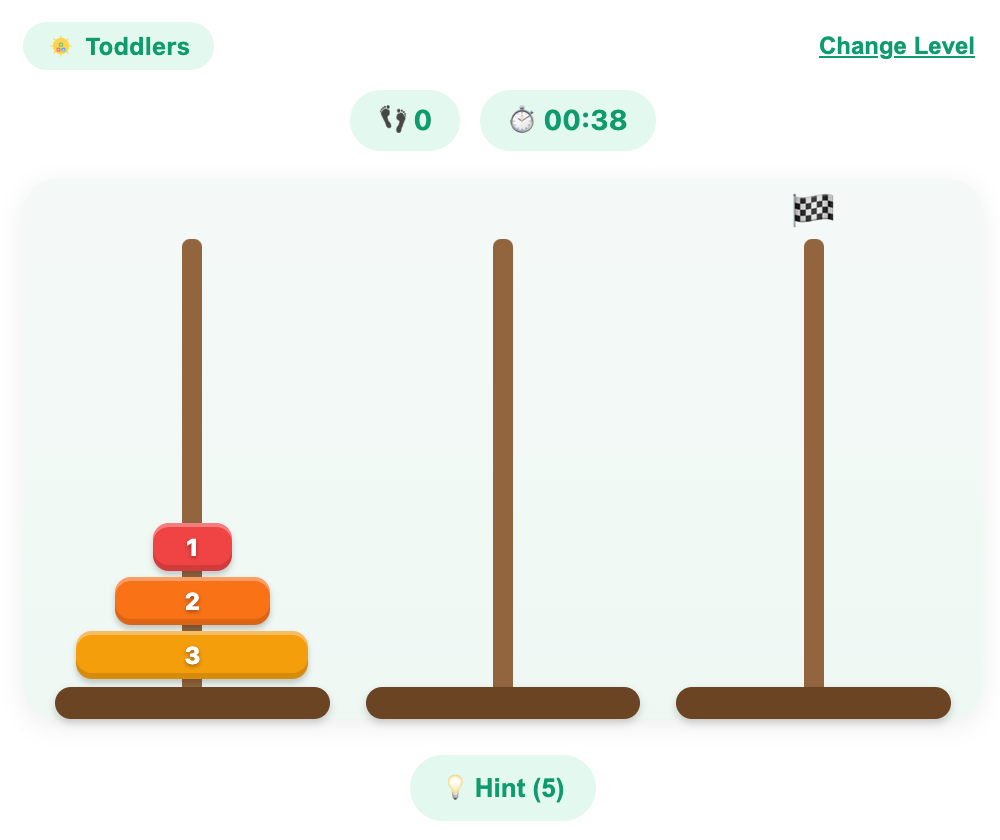
A screenshot when start a Tower of Hanoi game for toddlers

A screenshot when complete a Tower of Hanoi game
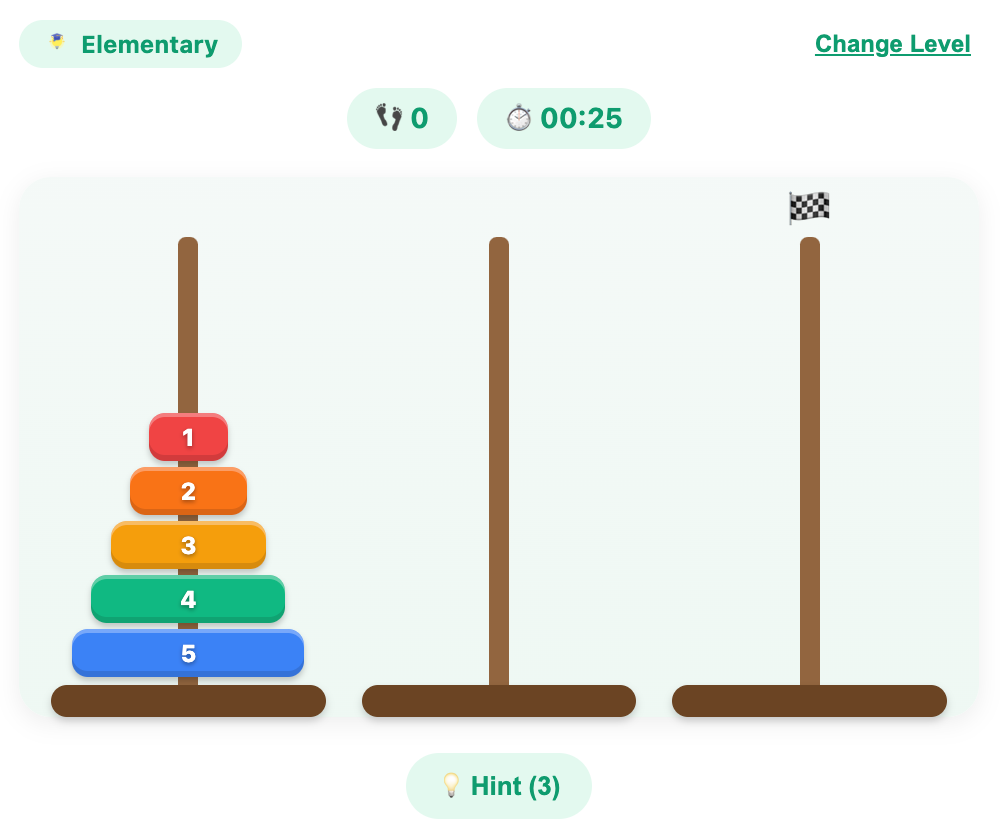
A screenshot when start a Tower of Hanoi game for elementary
More Mind Games
 365.5K plays
4.9
365.5K plays
4.9
Tic-Tac-Toe
Play a game of Tic-Tac-Toe against the computer and see if you can outsmart it.
 1.1M plays
4.9
1.1M plays
4.9
Chess
Play the classic game of chess against the computer or a friend, with FIDE time controls, hints, and undo.
 568.6K plays
4.9
568.6K plays
4.9
Connect Four
Drop your pieces and be the first to connect four in a row against the computer or a friend.
 973.3K plays
4.9
973.3K plays
4.9
Sliding Puzzle
Slide the numbered tiles — or a fun picture! — one at a time until they line up in order, from a cozy 5-tile board all the way up to the classic 15 puzzle.
Most Played Games
 1.8M plays
5.0
1.8M plays
5.0
Color & Draw
A free-drawing canvas with colors and brush sizes to unleash your creativity.
 59.2K plays
5.0
59.2K plays
5.0
Recycling Sort
Sort everyday items into the Recycle, Compost, or Trash bin before time runs out!
365.5K plays
4.9
Tic-Tac-Toe
Play a game of Tic-Tac-Toe against the computer and see if you can outsmart it.
1.1M plays
4.9
Chess
Play the classic game of chess against the computer or a friend, with FIDE time controls, hints, and undo.
Comments (87)