
Sudoku
644.3K playsFill in the missing numbers so every row, column, and box has each number exactly once.
About Sudoku Game
Have you ever seen a big square full of little boxes — some empty, some already holding a number — just waiting for a clever kid to solve it? That's Sudoku, one of the most famous number puzzles in the whole world, and now one of the most-loved games right here on KidWorld! Our Sudoku for kids has already been played more than 600,000 times, and thousands of players have left it five shiny stars, giving it a glowing 4.9 out of 5 rating. That's a lot of happy puzzle solvers!
🔢 What Is Sudoku, Really?
Sudoku is a number puzzle, but you do not need to be a math whiz to play it — you just need your eyes, your brain, and a little patience. The game hands you a big grid made of smaller boxes, and a few of those boxes already have a number sitting inside them. Your job is to fill in every empty box so that:
Every row (the boxes going sideways ➡️) has each number only once.
Every column (the boxes going up and down ⬇️) has each number only once.
Every small box inside the grid has each number only once.
No repeats allowed, anywhere! It sounds tricky at first, but once you get the hang of it, Sudoku feels like solving a fun little mystery every single time you play.
🕹️ How to Play
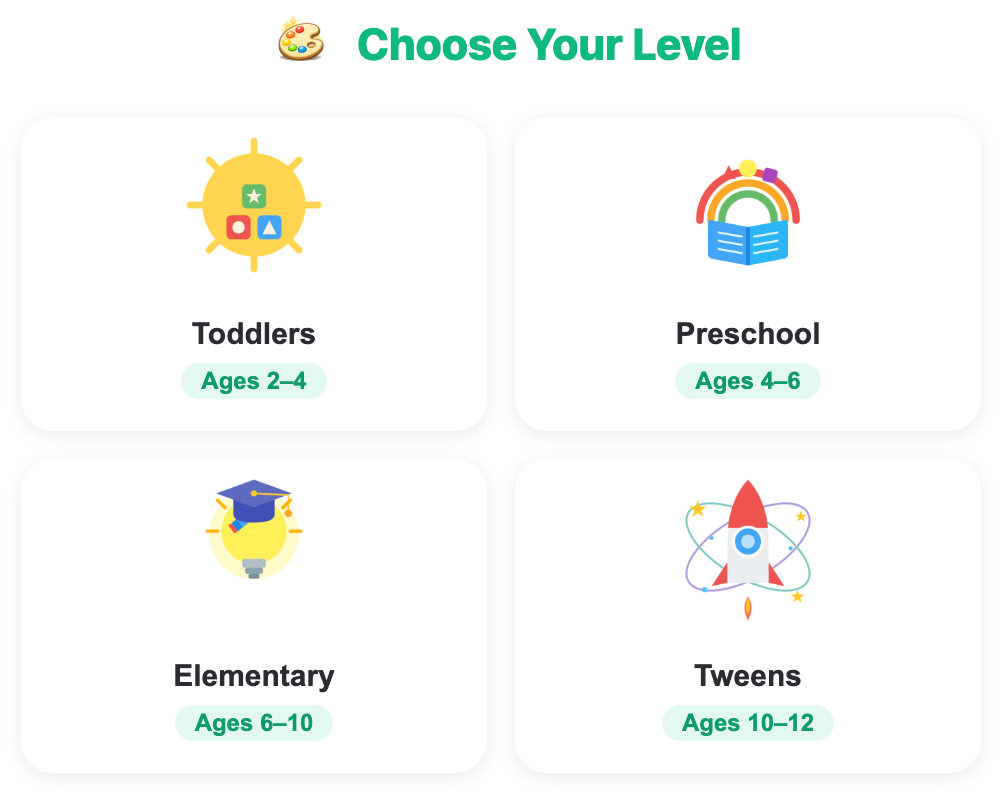
Pick your level: Choose Toddlers, Preschool, Elementary, or Tweens when the game opens. KidWorld remembers your favorite level, so you won't have to pick it again — it even remembers it for you in other KidWorld games too!
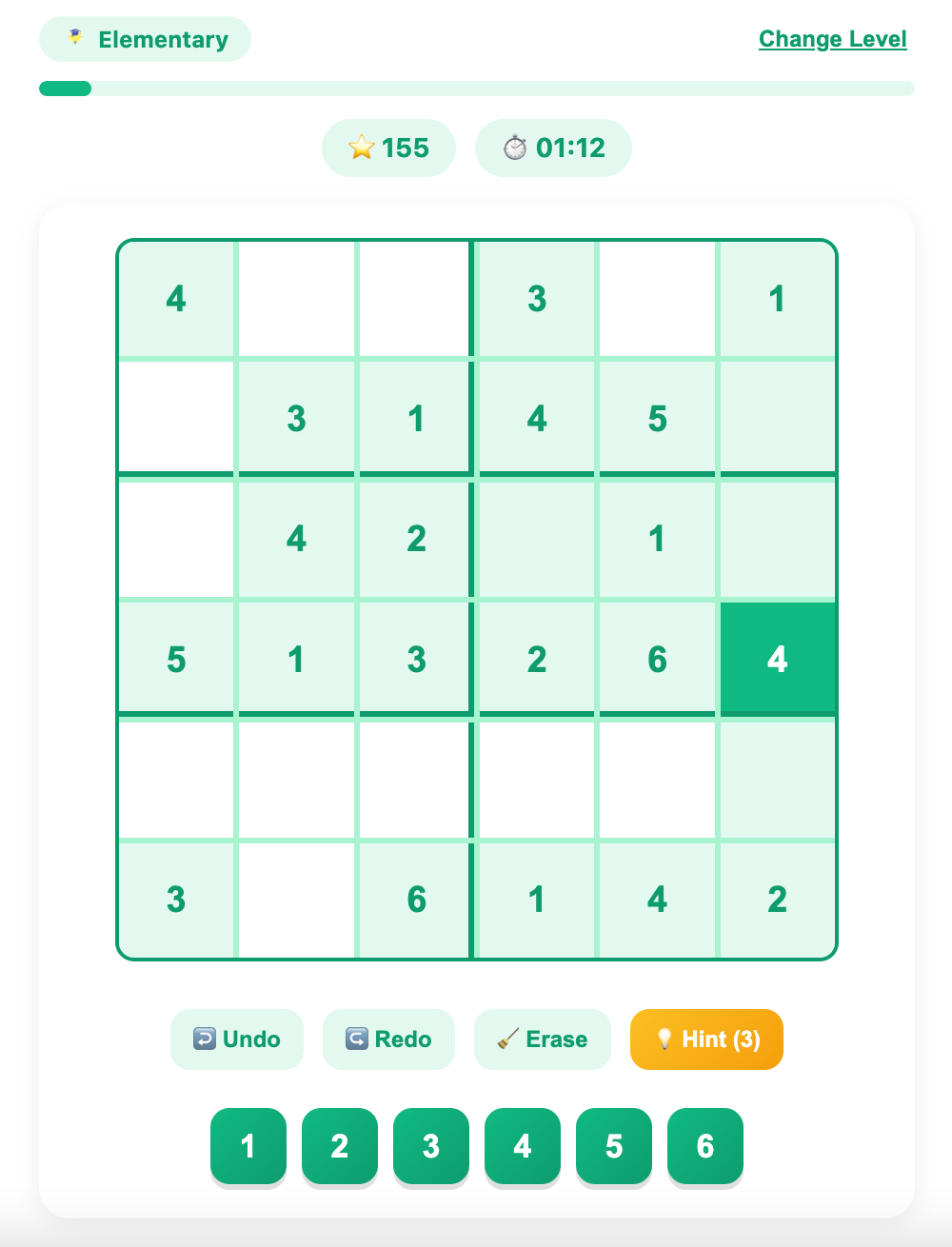
Tap an empty square: It lights up, and KidWorld also glows the whole row, column, and box around it, so you can easily see what numbers are already used nearby.
Tap a number: Pick a number from the number pad at the bottom to fill your square in.
Watch for red squares: If a number you picked matches another number in the same row, column, or box, those squares turn red. That's not "game over" — it's just Sudoku's friendly way of saying "try a different number here!" Tap the square again and pick something else.
Use your tools: Made a mistake? Tap Undo to take it back, or Redo to bring it forward again. Want to clear a square completely? Tap Erase. Totally stuck? Tap Hint 💡 and KidWorld fills in one correct number for you — you only get a few hints per puzzle, so save them for the trickiest spots!
Watch the clock: A little timer ⏱️ counts up while you play, just for fun. There's no rush, and mistakes never end your game.
Finish the grid: Once every square is filled in and no red squares are left, you solved it! Your score turns into stars ⭐ for your KidWorld profile, and a brand-new puzzle is ready the moment you want to play again.
Handy tools: tap the fullscreen button above the game to make your grid bigger and easier to tap on a tablet or phone, and use the reload button any time you want a completely fresh start from the level picker.
🧠 What Makes Sudoku Tricky — and How to Solve It Fast
Sudoku isn't about guessing — it's about noticing. Every number already on the board is a clue that quietly rules out where the missing numbers can't go. Puzzle champs don't stare at a blank square hoping for luck; they hunt for clues first. Here's how to think like one:
Find the lonely square. If a row, column, or box has only ONE empty square left, that square can only be one number. Figure out which number is missing, and you've got your answer!
Cross out numbers you already see. Before picking a number, look across the row, down the column, and around the box. If that number is already there, it can't go in your square.
Start with the fullest spots. Rows, columns, and boxes that already have lots of numbers filled in are the easiest to finish first, since there are fewer choices left to think about.
Use the glow to help you. Remember, KidWorld lights up the whole row, column, and box when you pick a square — use that glow to spot numbers that are already used nearby.
It's okay to try and fix. Since wrong numbers just turn red instead of ending your game, you can test an idea, see if it works, and erase it if it doesn't. That's exactly how real Sudoku solvers think!
📋 Try These 5 Number Riddles
Here are 5 quick riddles just like the logic you'll use inside the game. Can you figure out the answer before checking?
A row in a 4x4 puzzle already has 1, 2, and 4 filled in, with one empty square left. Which number goes there? (Answer: 3 — it's the only number missing from 1, 2, 3, 4!)
A column in that same 4x4 puzzle has 2, 3, and 4 filled in, with one blank left. Which number completes it? (Answer: 1 — the only one left over from 1, 2, 3, 4!)
A small box in a 6x6 puzzle has 1, 2, 4, 5, and 6 filled in, with just one empty square. Which number belongs there? (Answer: 3 — the only number from 1 through 6 that hasn't shown up yet!)
A column in that same 6x6 puzzle already has 1, 3, 5, and 6, with two empty squares left. Which two numbers are still missing? (Answer: 2 and 4 — the only numbers not used yet!)
In a 9x9 puzzle, a small box already has 2, 4, 6, 7, and 9, with four empty squares left. Which numbers could still go in those squares? (Answer: 1, 3, 5, and 8 — the numbers 1 through 9 that haven't shown up in that box yet!)
🧩 Sudoku for Kids at Every Age
One of the coolest things about KidWorld's Sudoku is that it grows right along with you! Instead of one grid for everybody, the puzzle changes size depending on your level — from a tiny warm-up grid for our youngest Toddler puzzlers, all the way up to a full-size grid for our oldest players.
Sudoku for Toddlers (around ages 2 to 4): the same friendly 4x4 grid as Preschool, but with even more numbers already filled in and just a small handful of blanks to spot. It's the gentlest possible first taste of Sudoku — matching and counting, nothing more.
Sudoku for Preschool (around ages 4 to 6): a cozy 4x4 grid using only the numbers 1 to 4, with most squares already filled in and just a few blanks to figure out. It's a wonderful way to practice counting, recognize numbers, and learn what "same" and "different" mean — all while feeling like a real puzzle superstar.
Sudoku for Elementary (around ages 6 to 10): a 6x6 grid with numbers 1 to 6 and more empty squares to think through, which helps build focus, patience, and step-by-step thinking — skills that help with schoolwork too!
Sudoku for Tweens (around ages 10 to 12): the real deal — a full classic 9x9 grid, just like the puzzles grown-ups solve in newspapers and puzzle books. This is where Undo, Redo, and Hint really come in handy, and finishing one feels like a huge win.
No matter which level you pick, the toolbox stays the same — Undo, Redo, Erase, Hints, and those friendly red squares — so every player, big or small, gets the same gentle, encouraging way to learn Sudoku for kids of any age.
🌟 Why This Game is Wonderfully Suited for Kids
Sudoku isn't just a fun way to pass the time — it's secretly a brain workout wrapped up in a game! Every time a kid plays, their brain is quietly practicing:
Thinking things through. Sudoku teaches kids to look at clues, ask "what fits here?", and figure it out step by step — the same kind of thinking used in math and science.
Patience and focus. A Sudoku grid can't be solved in one quick glance. Kids learn to slow down, look carefully, and stick with a problem until it's finished.
Number sense. Counting, comparing, and spotting missing numbers all get stronger the more a kid plays, which quietly helps with math at school too.
Confidence. Because mistakes just turn red instead of ending the game, kids feel safe to try, fail, fix, and try again — one of the best habits any kid (or grown-up!) can learn.
Calm, feel-good screen time. There's no racing clock pressure, no scary sounds, and no way to truly "lose." Sudoku is a quiet, calm kind of fun — perfect for winding down after a busy day.
Best of all, because the puzzle size changes by age, the very same game that helps a preschooler learn their numbers can turn into a real challenge for a tween who loves a good brain teaser. That's exactly why families come back to Sudoku for kids again and again — it's a game that truly grows with them.
🖼️ See the Game in Action
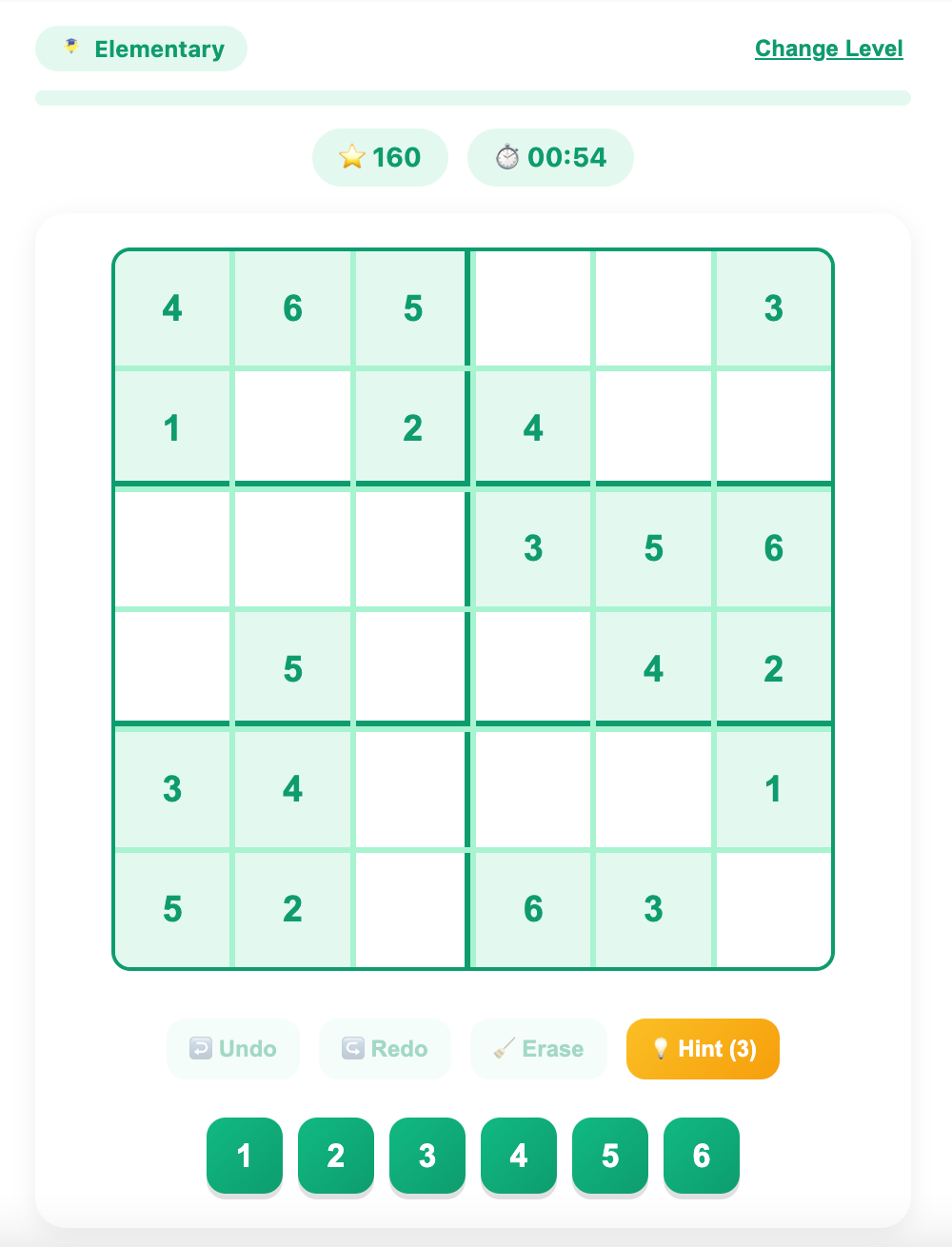
A screenshot when start a game for elementary
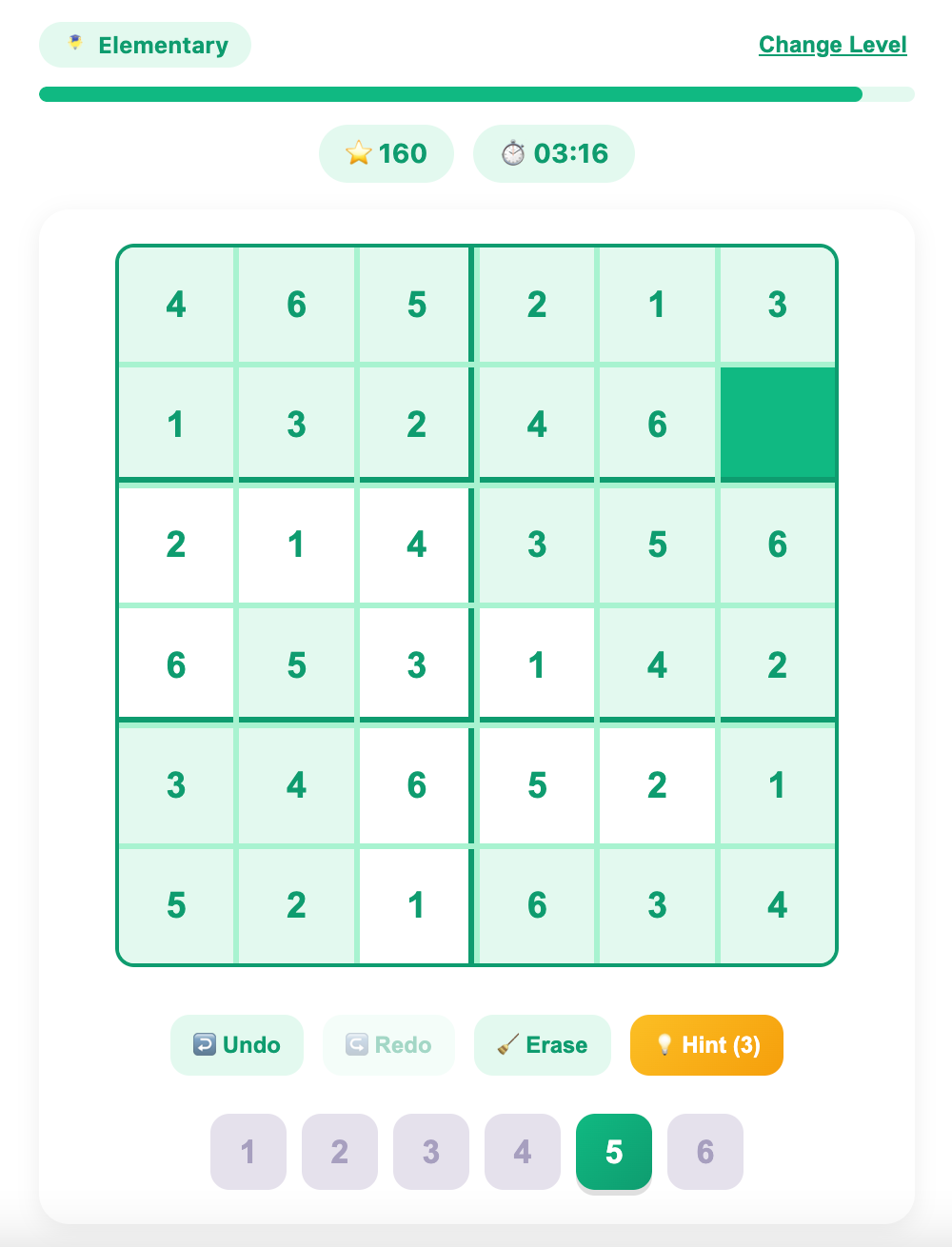
A screenshot when almost numbers are filled in a game
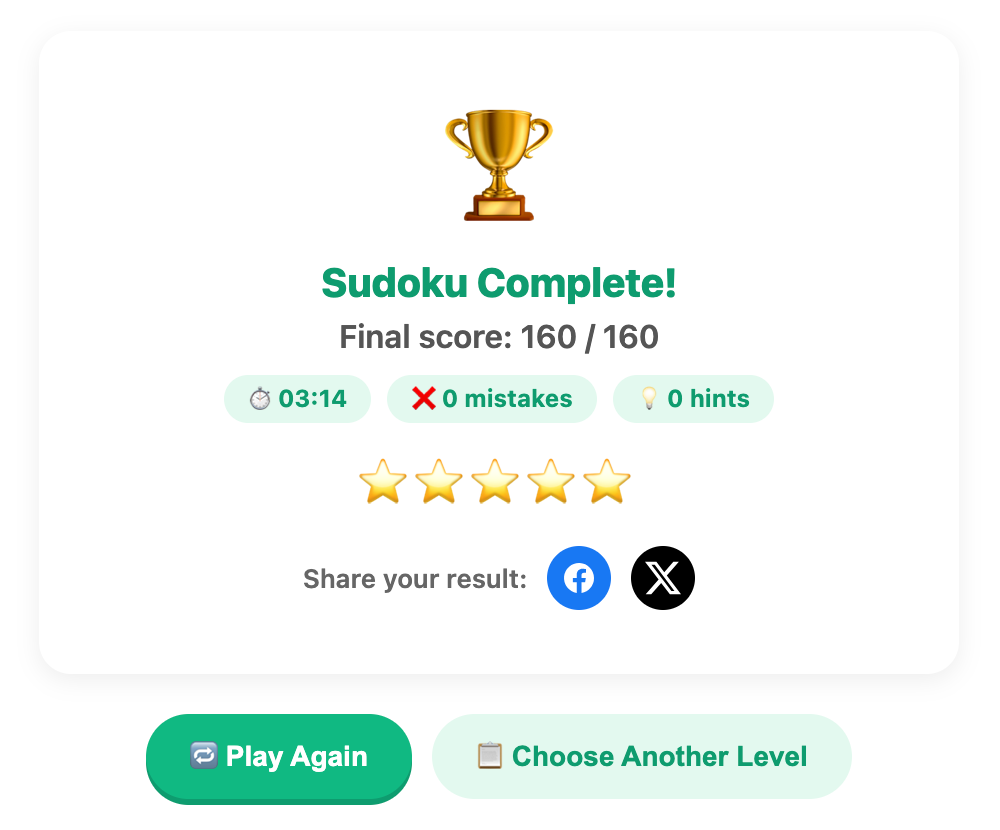
A screenshot when complete a game
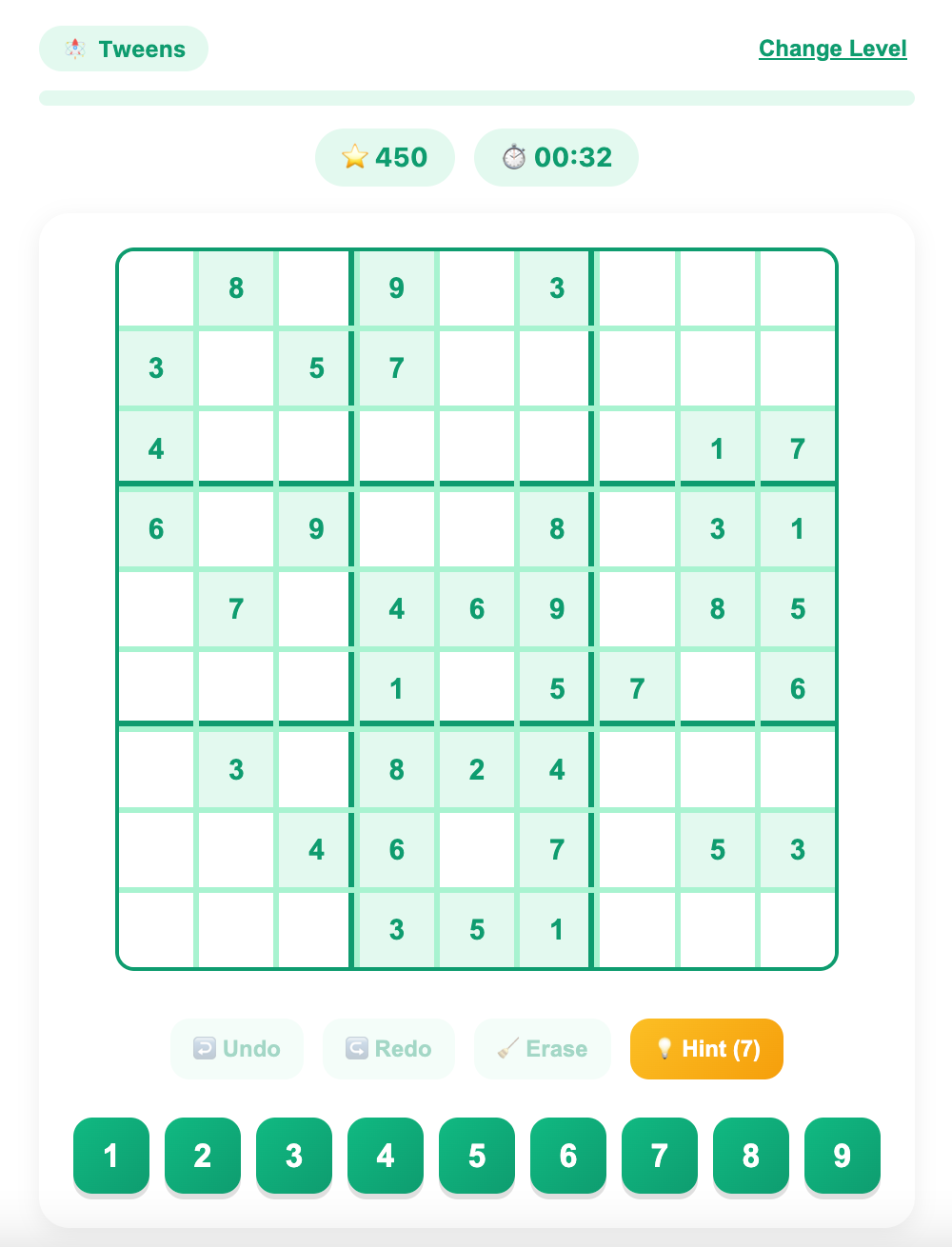
A screenshot about an example game for tweens
More Mind Games
 365.5K plays
4.9
365.5K plays
4.9
Tic-Tac-Toe
Play a game of Tic-Tac-Toe against the computer and see if you can outsmart it.
 1.1M plays
4.9
1.1M plays
4.9
Chess
Play the classic game of chess against the computer or a friend, with FIDE time controls, hints, and undo.
 568.6K plays
4.9
568.6K plays
4.9
Connect Four
Drop your pieces and be the first to connect four in a row against the computer or a friend.
 244.7K plays
5.0
244.7K plays
5.0
Tower of Hanoi
Move the stack of rings from one tower to another without ever placing a bigger ring on a smaller one.
Most Played Games
 1.8M plays
5.0
1.8M plays
5.0
Color & Draw
A free-drawing canvas with colors and brush sizes to unleash your creativity.
 59.2K plays
5.0
59.2K plays
5.0
Recycling Sort
Sort everyday items into the Recycle, Compost, or Trash bin before time runs out!
365.5K plays
4.9
Tic-Tac-Toe
Play a game of Tic-Tac-Toe against the computer and see if you can outsmart it.
1.1M plays
4.9
Chess
Play the classic game of chess against the computer or a friend, with FIDE time controls, hints, and undo.
Comments (50)