
Spot the Difference
328.9K playsCompare two nearly-identical pictures side by side and tap every little difference before time runs out.
Two pretty pictures. One sneaky secret. Look closely — because somewhere between that cozy backyard picnic on the left and the one sitting right beside it on the right, a few tiny little things have quietly changed, and only a sharp-eyed detective will catch every single one before the clock runs out! That's the whole magic of Spot the Difference on KidWorld, a game so simple to understand and so satisfying to play that families have already searched their way through more than 300,000 rounds together, handing it thousands of glowing five-star ratings along the way. Grab a seat, sharpen those eyes, and let's go hunting!
👀 What Is Spot the Difference?
Spot the Difference is one of the oldest, most beloved puzzle games in the world, and KidWorld's version keeps it wonderfully honest: every scene is a real pair of hand-illustrated pictures, drawn to look almost — but not quite — identical, sitting side by side right on your screen. A few tiny changes are tucked into the second picture somewhere: a missing button, a color that swapped, a little creature that vanished, a shape that shrank or slid over just a bit. Your job is simple to say and genuinely fun to do — study both pictures, and the moment you spot something that's different, tap that exact spot on either picture to mark it found. Tap the correct spot on the left drawing or the matching spot on the right one, and both pictures light up together with a cheerful checkmark, because a difference always lives in the very same place on both sides.
🕹️ How to Play Spot the Difference on KidWorld
Pick your level: Choose Toddlers, Preschool, Elementary, or Tweens when the game opens. KidWorld remembers your favorite level for you, just like it does in other KidWorld games.
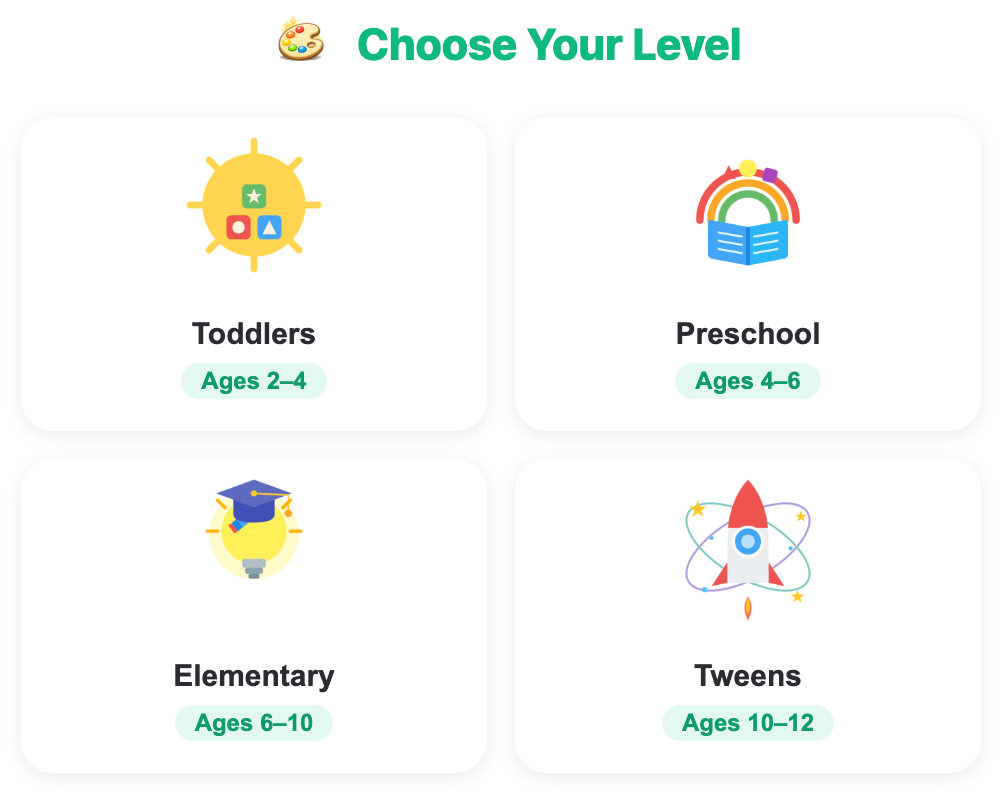
Read the scene title shown above the pictures — it's your first little clue about what kind of place you're about to explore, whether that's a sunny picnic, a friendly jungle, a sunken treasure scene, or a cozy reading nook.
Scan both pictures carefully, left one and right one, looking for anything that doesn't quite match — a color, a shape, a size, or something that simply isn't there anymore.
Tap the spot the moment you spot a difference — on whichever picture you noticed it in — and watch a checkmark bloom on both pictures at once to confirm you found a real one.
Watch out for wrong taps. Tapping a spot that isn't actually different pops up a little red mark and costs a few points, so it pays to really look before you tap rather than tapping all over the picture and hoping.
Racing the clock: Each round has its own friendly countdown timer — find every difference before time runs out, or the round ends and reveals whatever you missed.
Stuck on a tricky one? Tap 💡 Hint and one remaining difference will glow softly on both pictures for a moment. Each level only allows a limited number of hints, shown right on the button, and using one trims a few points off your score.
Clear every difference in a scene to finish that round early, then move on to the next one — finish all your rounds and your score turns into stars ⭐ for your KidWorld profile!
Handy tools: tap the fullscreen button above the game to make both pictures bigger and easier to compare, use the reload button any time you'd like a brand-new pair of scenes, and tap the speaker button to mute or unmute the background music whenever you like.
🧠 Secrets to Finding Every Difference, Every Time
Racing your eyes back and forth across two busy pictures can feel overwhelming at first — but real difference-spotters use a calm, steady method instead of frantic tapping. Here's how to think like a true Spot the Difference champion on KidWorld:
Sweep in one direction, not randomly. Pick a path — top-left to bottom-right works great — and slide your eyes across both pictures together along that same path, instead of jumping all over and losing your place.
Split the scene into invisible zones. Picture the scene divided into a top half and bottom half, or a left third, middle third, and right third, and fully clear each zone before moving to the next — it's the same "don't try to solve everything at once" trick puzzle experts use everywhere.
Compare color, then shape, then count. First check if anything changed color, then check if any shape looks bigger, smaller, tilted, or missing entirely, then double-check that nothing simply disappeared or popped up extra.
Look before you tap. Since a wrong tap costs points, it's always worth being truly sure a spot looks different before tapping it, rather than tapping everywhere and hoping one lands right.
Save your hints for the very last stubborn difference. A hint always reveals a real, remaining difference, so it's smartest to search hard on your own first and only spend a hint once you're genuinely stuck with time ticking away.
👀 Quick Spot the Difference Riddles
Here are 5 fun riddles that use the same kind of thinking you'll use inside the real game. Can you figure them out before checking the answer?
If you tap the correct spot on the left picture, does the right picture get marked too? (Answer: yes — a difference always sits in the exact same spot on both pictures, so tapping either one marks both together.)
What happens on the screen if you tap a spot that isn't actually different? (Answer: a little red mark pops up for a moment, and a few points get taken away — so it's smart to look closely before tapping!)
If a round's timer reaches zero before you find every difference, what happens to the ones you missed? (Answer: they get revealed on the pictures so you can see exactly what you didn't catch in time.)
Which is trickier: hunting through a scene with 5 differences, or one with 6? (Answer: 6 — one more hidden change means one more careful pass across the whole picture.)
Name a place you might explore while hunting for differences in a KidWorld scene. (Answer: any of a backyard picnic, a friendly jungle, a sunken treasure scene, or a cozy reading nook!)
🎯 Spot the Difference for Every Age
What makes KidWorld's Spot the Difference so clever is that the very same "look closely and tap" idea can feel like a gentle, unhurried activity for a little one or a genuine race against the clock for an older kid — the game simply changes how much time you get, how many hints you're allowed, and how close a tap needs to be to count:
Spot the Difference for toddlers (around ages 2 to 4): a relaxed 2 rounds with a generous 2-minute timer each, the biggest, most forgiving tap area of any level so a slightly-off tap still counts, and the most hints of any level to lean on.
Spot the Difference for preschool (around ages 4 to 6): still 2 rounds, but the timer trims down a little and the tap area shrinks slightly too — enough of a nudge to start rewarding careful looking over quick guessing.
Spot the Difference for elementary (around ages 6 to 10): a tighter 90-second timer per round, fewer hints in reserve, and a noticeably snugger tap zone that asks for a more precise, confident tap.
Spot the Difference for tweens (around ages 10 to 12): the full challenge — 3 rounds instead of 2, only 75 seconds on the clock each time, the fewest hints of any level, and pinpoint-precise tapping with none of the extra forgiveness younger levels get.
Because the same two side-by-side pictures and the same simple tap-to-mark idea never change, one child can start on Toddlers today calmly finding a handful of differences with plenty of time to spare, and grow all the way up to racing the clock through three sharp-eyed Tweens rounds — all in the very same game.
🌟 Why Spot the Difference Is Such a Wonderful Fit for Kids
Two pictures sitting side by side might look like simple fun, but Spot the Difference quietly gives a kid's brain a wonderful workout every single round:
Visual discrimination. Training your eyes to notice a tiny color shift or a shape that's just slightly off is a real skill — the very same close-looking ability kids later use for reading, spelling, and noticing small but important details everywhere in life.
Focus and concentration. Holding attention steady across a busy picture, without getting distracted, is exactly the kind of sustained focus that helps at school and beyond.
Working memory. Glancing at one picture, holding it in mind, then comparing it to the other picture right beside it is a genuine mental workout, strengthening the same memory muscles used in following multi-step instructions.
Patience under pressure. A gentle countdown timer teaches kids to stay calm and keep scanning steadily rather than panicking or tapping wildly, since a careful search almost always beats a rushed one.
Confidence from real wins. Every difference found pops up an instant, cheerful checkmark — a small, satisfying win that adds up round after round, making Spot the Difference a genuinely joyful kind of screen time for a kid of any age.
Simple enough for a toddler to enjoy a relaxed, generously-timed hunt through a cozy scene, yet sharp enough to make a tween feel truly proud of a fast, precise three-round sweep — that's exactly why this classic, endlessly rewarding lookout game still feels so exciting as a Spot the Difference game for kids on KidWorld today.
🖼️ See the Game in Action
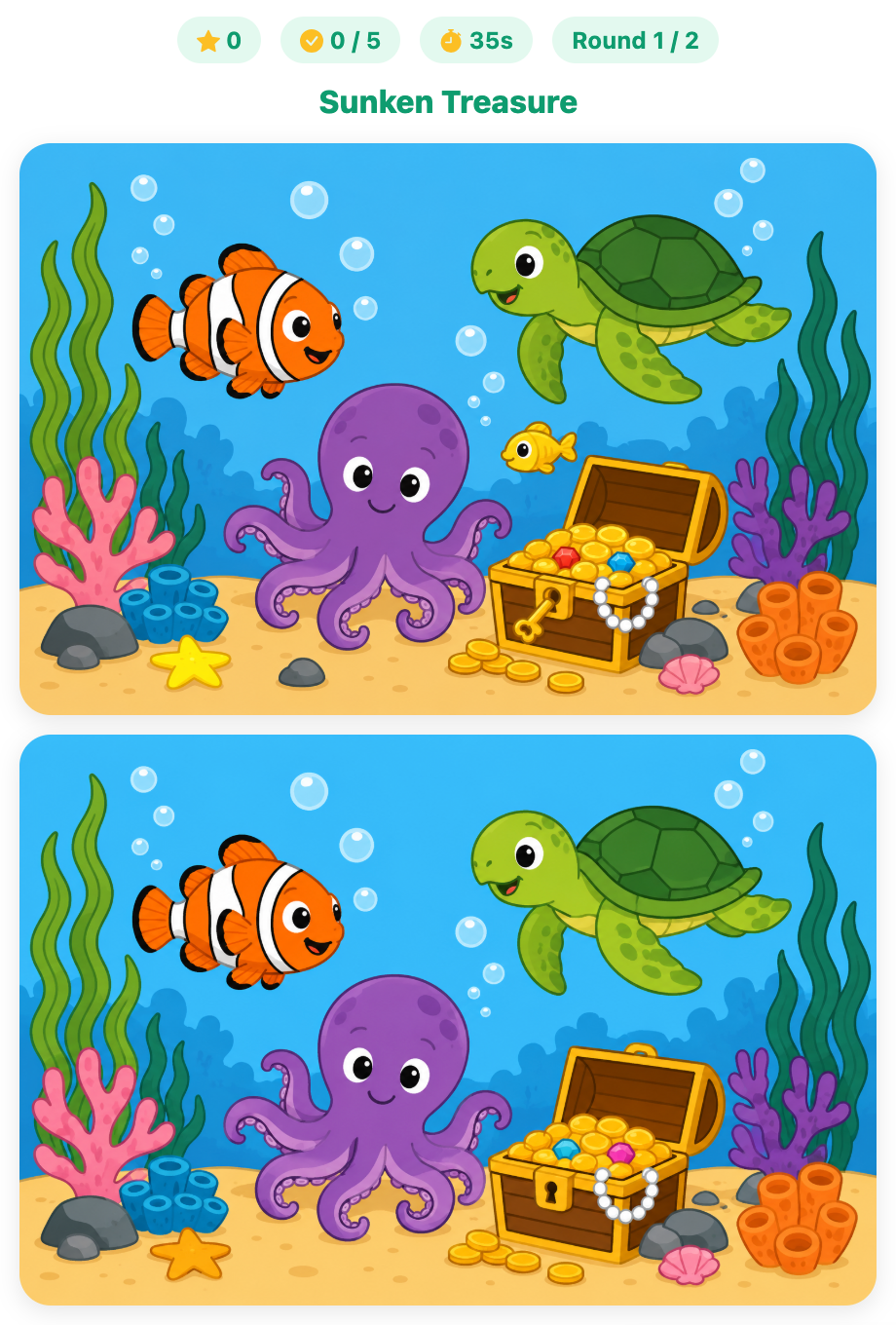
A screenshot about a round of the Spot The Difference game
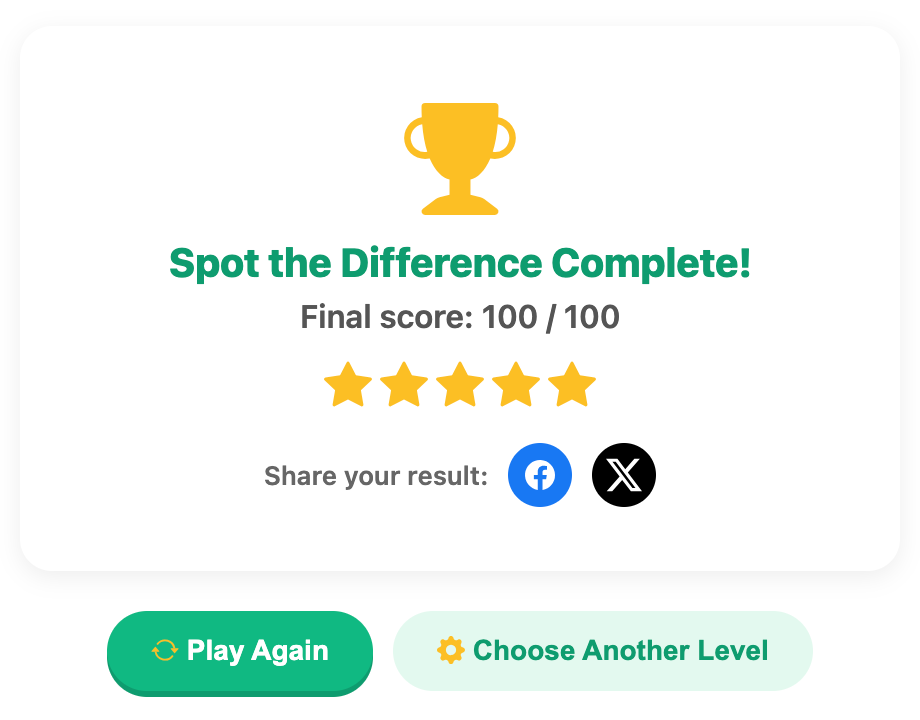
A screenshot when complete a Spot The Difference game
More Mind Games
 365.5K plays
4.9
365.5K plays
4.9
Tic-Tac-Toe
Play a game of Tic-Tac-Toe against the computer and see if you can outsmart it.
 1.1M plays
4.9
1.1M plays
4.9
Chess
Play the classic game of chess against the computer or a friend, with FIDE time controls, hints, and undo.
 568.6K plays
4.9
568.6K plays
4.9
Connect Four
Drop your pieces and be the first to connect four in a row against the computer or a friend.
 244.7K plays
5.0
244.7K plays
5.0
Tower of Hanoi
Move the stack of rings from one tower to another without ever placing a bigger ring on a smaller one.
Most Played Games
 1.8M plays
5.0
1.8M plays
5.0
Color & Draw
A free-drawing canvas with colors and brush sizes to unleash your creativity.
 59.2K plays
5.0
59.2K plays
5.0
Recycling Sort
Sort everyday items into the Recycle, Compost, or Trash bin before time runs out!
365.5K plays
4.9
Tic-Tac-Toe
Play a game of Tic-Tac-Toe against the computer and see if you can outsmart it.
1.1M plays
4.9
Chess
Play the classic game of chess against the computer or a friend, with FIDE time controls, hints, and undo.
Comments (59)