
Chinese Chess (Xiangqi)
56.3K playsPlay Xiangqi, the classic game of Chinese Chess, against the computer or a friend, with time controls, hints, and undo.
Long before video games existed, families in China were already gathering around a board covered in criss-crossing lines, moving little wooden discs across a make-believe river to defend their king. That game is called Xiangqi (say it "shyang-chee"), and most people around the world know it by its English nickname: Chinese Chess. It's one of the oldest strategy games still played today, and now you can play it right here on KidWorld! Kids everywhere have already clicked into this game more than 50,000 times, and it's collected thousands of glowing five-star reviews from players just like you. Grab your army, guard your General, and get ready to think like a real Xiangqi champion.
🏯 What Makes Chinese Chess (Xiangqi) So Different?
If you've ever played regular chess, get ready for something new — Chinese Chess (Xiangqi) doesn't look or feel the same at all! Instead of moving pieces inside little squares, every piece in Xiangqi stands on a dot, right where the lines on the board cross each other. Picture a spider web made of straight lines instead of a checkerboard, and that's much closer to a real Xiangqi board. Cutting the whole board in half is a river, and in the very back corner of each side sits a tiny fenced-off square called the palace, marked with a big X. The General has to stay locked inside that palace forever — step him outside, and he's in terrible danger. The biggest twist of all? In Chinese Chess (Xiangqi), if you're ever stuck with zero moves you're allowed to make, you lose instantly, even if nobody was directly attacking you. That single rule makes every turn in Xiangqi matter just a little bit more than you might expect.
🎮 A Kid's Guide to Playing Chinese Chess (Xiangqi) on KidWorld
Start on the setup screen. The very first thing you'll see is a friendly setup screen (you can always come back to it later by tapping ⚙️ Change Setup), where four choices are waiting for you:
Who's Playing? — battle the KidWorld computer (Player vs Computer), share the screen and take turns with a family member (Player vs Player), or just sit back and let two computers duel it out while you watch and learn (Computer vs Computer).
Difficulty — Easy 🌸 is friendly and forgiving for a first-timer, Medium 🛡️ makes you think harder, Hard 🔥 plans several moves ahead and is a serious opponent, and Expert 💎 searches so deeply into the future that it's an incredible challenge even for grown-ups.
Play As — pick Red to always take the very first turn, or pick Black and let the computer open the game instead.
Time Control — turn the clock completely off for a slow, thoughtful game, or race against Standard, Rapid, or Blitz timing, where each side has its own countdown that only ticks during its own turn.
Making a move is simple. Tap any piece that belongs to you, and every single dot it's allowed to travel to lights up instantly — a soft green glow means an empty landing spot, and a red ring means "capture this enemy piece!" Tap the glowing dot you want, and your piece slides right into place.
Changed your mind? The ↩️ Undo button is there whenever it's your turn, ready to take back your last move (and the computer's reply, too, if you're playing against it) so you can explore a different idea with zero risk.
Need a nudge? Tap 💡 Hint and KidWorld will light up its favorite move for you to consider. You only start with 3 hints each game, and each one you use trims 5 points off your final score, so save them for the moments you're really stuck.
Wrapping up. Whether the game ends with a captured General, a clock running out, or a fair draw, you'll land on a results screen worth up to 20 points, complete with stars ⭐ that get added straight to your KidWorld profile.
Tip: the fullscreen button above the board makes everything bigger and much easier to tap if you're playing on a tablet, and the reload button whisks you straight back to the setup screen whenever you want a totally fresh match.
⚔️ The Seven Warriors: Xiangqi's Army Explained
Something really cool about Xiangqi is that Red's army and Black's army don't even use the same written characters, even though every matching piece moves in exactly the same way — just like two real wooden Xiangqi sets from opposite ends of a chess club! Here's who's fighting for you:
帥/將 The General — your most important piece by far. He can only creep one dot at a time, and only straight up, down, left, or right, and he's trapped inside his own tiny palace for the whole game. Watch out for the wild "flying general" rule, too: if the path between the two Generals is ever completely empty, they're considered to be attacking each other directly!
仕/士 The Advisor — the General's personal bodyguard. An Advisor only ever shuffles one dot diagonally, and like the General, is never, ever allowed to leave the palace. There are only four spots an Advisor can even stand on, so think of this piece as glue holding your defense together.
相/象 The Elephant — a big, steady piece that hops exactly two dots on a diagonal. Elephants are homebodies: they can never cross the river into enemy land, and if there's any piece sitting right in the middle of their hop (called the "elephant's eye"), they can't jump at all.
傌/馬 The Horse — moves in a bouncy L-shape, just like a knight, but with a clever catch: if there's a piece standing directly next to the Horse in the direction it's stepping first, that "leg" trips it up and blocks the whole move. Learning to spot a tripped-up Horse is a real Xiangqi superpower.
俥/車 The Chariot — races in a straight line as far as it wants, up, down, left, or right, only stopping when it bumps into another piece. Most players agree the Chariot is the single strongest piece on the whole board.
炮/砲 The Cannon — the trickiest piece to learn, and the most fun once you get it! A Cannon glides around like a Chariot when it's just moving, but to actually capture something, it must first leap clean over exactly one other piece — friend or foe, it doesn't matter — and land right on an enemy waiting behind it. No piece to jump over means no capture at all.
兵/卒 The Soldier — small but full of surprises. A Soldier can only march straight ahead, never backward, right up until it crosses the river — then suddenly it can also creep sideways, left or right, turning your little foot soldier into a much sneakier attacker.
🧩 Deep Strategy: How to Actually Win at Chinese Chess (Xiangqi)
Ready to go beyond just knowing how the pieces move? Here's how players who actually win their games think:
Know what each piece is really worth. A rough scale most strong players carry in their heads looks like this: Chariots are the most valuable, Cannons and Horses come next and are roughly equal to each other, Advisors and Elephants are steady defenders worth less on their own, and Soldiers start out small but grow much more dangerous the moment they cross the river. Always ask yourself, "am I trading up, trading even, or trading down?" before you capture anything.
Wake your Horses and Cannons up early. A Horse tucked in the back row can't threaten anything, and a Cannon needs a "screen" piece in front of it before it can strike — so spend your very first few moves getting these two pieces active instead of leaving them asleep at home.
Send your Soldiers across the river on purpose. Since a Soldier only gains its sideways power after crossing, pushing your foot soldiers forward early (not carelessly, but with a plan) turns them from the weakest pieces on your team into surprisingly stubborn attackers deep in enemy territory.
Hunt for the flying-general trap. Every so often, clearing away just one piece is all it takes to line the two Generals up on an empty file — and the instant that happens, it's check! Strong players are always quietly checking whether that column is close to opening up.
Keep your Advisors and Elephants home on defense. Since neither piece is allowed to leave its own side of the board, don't waste turns wishing they could attack — instead use them to build a safe little fortress that protects your General from Chariots and Cannons sneaking in.
Double-check before every capture. Ask "what happens right after I take this piece — can they just take it back with something even better?" A capture that looks exciting for one second but loses material the very next move isn't a good capture at all.
Remember Xiangqi's golden rule: no moves means no game. Since there's no such thing as a safe stalemate draw here, always try to leave your own pieces at least one square of breathing room, and always be on the lookout for the moment your opponent might run out of options completely.
The 💡 Hint button can show you a strong move any time your brain gets stuck — but figuring these ideas out on your own first is what actually turns a Xiangqi beginner into a Xiangqi thinker.
🎯 Test Your Xiangqi Brain
Try picturing each situation in your head before you peek at the answer — that's exactly how real Xiangqi players train!
Your Cannon has a friendly Soldier sitting exactly two dots in front of it, and an enemy piece two dots past that. Can your Cannon grab it? (Yes! That Soldier is acting as the "screen" — your Cannon leaps right over it and captures the piece waiting on the other side.)
Your Horse wants to jump forward and to the side, but an enemy piece is parked directly beside it, blocking the very first step of that path. What just happened to your Horse? (It got "hobbled" — that neighboring piece is sitting on its leg, so the jump is completely blocked in that direction.)
One of your Soldiers just finished crossing the river for the very first time. What brand-new trick can it suddenly do? (It can now shuffle sideways, left or right, in addition to still marching forward — a power it never had before crossing.)
Every piece standing between the two Generals just got captured, leaving them staring straight down an empty file at each other, and it's your turn. What's really going on? (That's a flying-general situation — the Generals can never legally face off like that, so whoever's turn it is has to fix it immediately, and sometimes there's simply no way to!)
🌱 Why Chinese Chess (Xiangqi) Is Such a Great Fit for a Kid
A board covered in criss-crossing lines might look a little mysterious at first glance, but underneath it's secretly one of the best brain workouts a kid can get:
It builds real forward-thinking. Xiangqi gently trains a kid to stop and ask "okay, but what happens after that?" instead of just reacting to whatever's right in front of them — a skill that helps way beyond the game board.
It sharpens pattern-spotting. Noticing a hobbled Horse, a loaded Cannon, or a flying-general trap is really just visual pattern recognition in disguise — the exact same kind of skill that helps with reading, math homework, and even sports.
Mistakes are totally safe here. Thanks to the ↩️ Undo button, a kid can try a bold, risky idea, see exactly what happens, and rewind it instantly — building real courage to experiment instead of fear of getting something wrong.
It's a living piece of world history and culture. Chinese Chess (Xiangqi) has been enjoyed for well over a thousand years and is still cherished by millions of families today — learning it is a fun, hands-on way for a kid to connect with a tradition that stretches back centuries.
Every result still feels good. A win, a loss, and a draw all earn stars on KidWorld, so a kid gets plenty of relaxed, low-pressure practice at both celebrating a victory and shrugging off a tough loss.
The challenge grows right alongside them. Since the computer scales all the way from gentle to genuinely fierce, a kid gets to feel that amazing jump from "I think I got lucky" to "I actually understand why I won that game" — and that feeling is what keeps kids coming back for more.
👨👩👧 Chinese Chess (Xiangqi) for Every Age
One of the best things about Chinese Chess (Xiangqi) on KidWorld is how easily it stretches to fit a player's age — the exact same board can be a soft first introduction or a real mental workout, all from that one setup screen:
Chinese Chess (Xiangqi) for toddlers (roughly ages 2-4): a whole game is a lot to ask at this age, so start by watching Computer vs Computer together like a colorful little cartoon, calling out each piece's name as it hops or slides across the board.
Chinese Chess (Xiangqi) for preschool (roughly ages 4-6): switch the difficulty to Easy, choose Play As Red so your child always gets to open the game, and turn Time Control off completely so there's never any pressure to rush.
Chinese Chess (Xiangqi) for elementary players (roughly ages 6-10): Medium is the sweet spot for really learning the game — practice waking up Cannons and Horses early, save hints for genuinely tricky spots, and try a friendly Player vs Player match with a sibling or classmate.
Chinese Chess (Xiangqi) for tweens (roughly ages 10-12): flip on Hard or Expert for a true test of skill, try Rapid or Blitz timing to build fast, confident decisions, or simply study a Computer vs Computer game on Expert to watch deep strategy unfold move by move.
Because every single setting can be swapped instantly from that same setup screen, one kid can start out today just watching the pieces dance around the board — and be genuinely challenging the Expert computer a year from now, all without ever leaving the game.
Thousands of years of clever strategy, a river to defend, a General to protect, and a Cannon that jumps like nothing else in any other board game — that's Chinese Chess (Xiangqi), and it's ready and waiting for you right here on KidWorld. Pick your setup, make your very first move, and discover just how far your thinking can take you!
🖼️ See the Game in Action
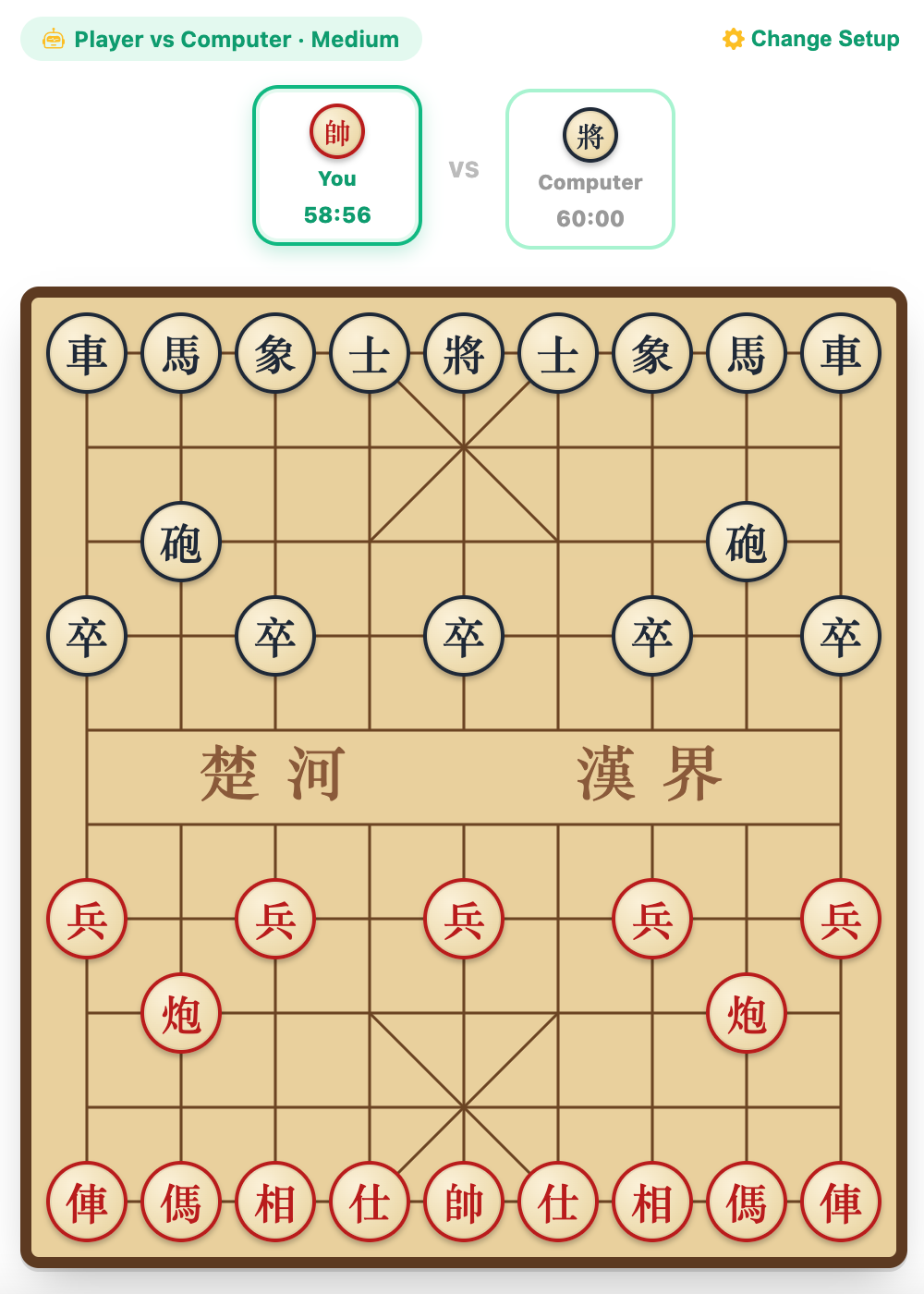
A Chinese Chess (Xiangqi) game at KidWorld
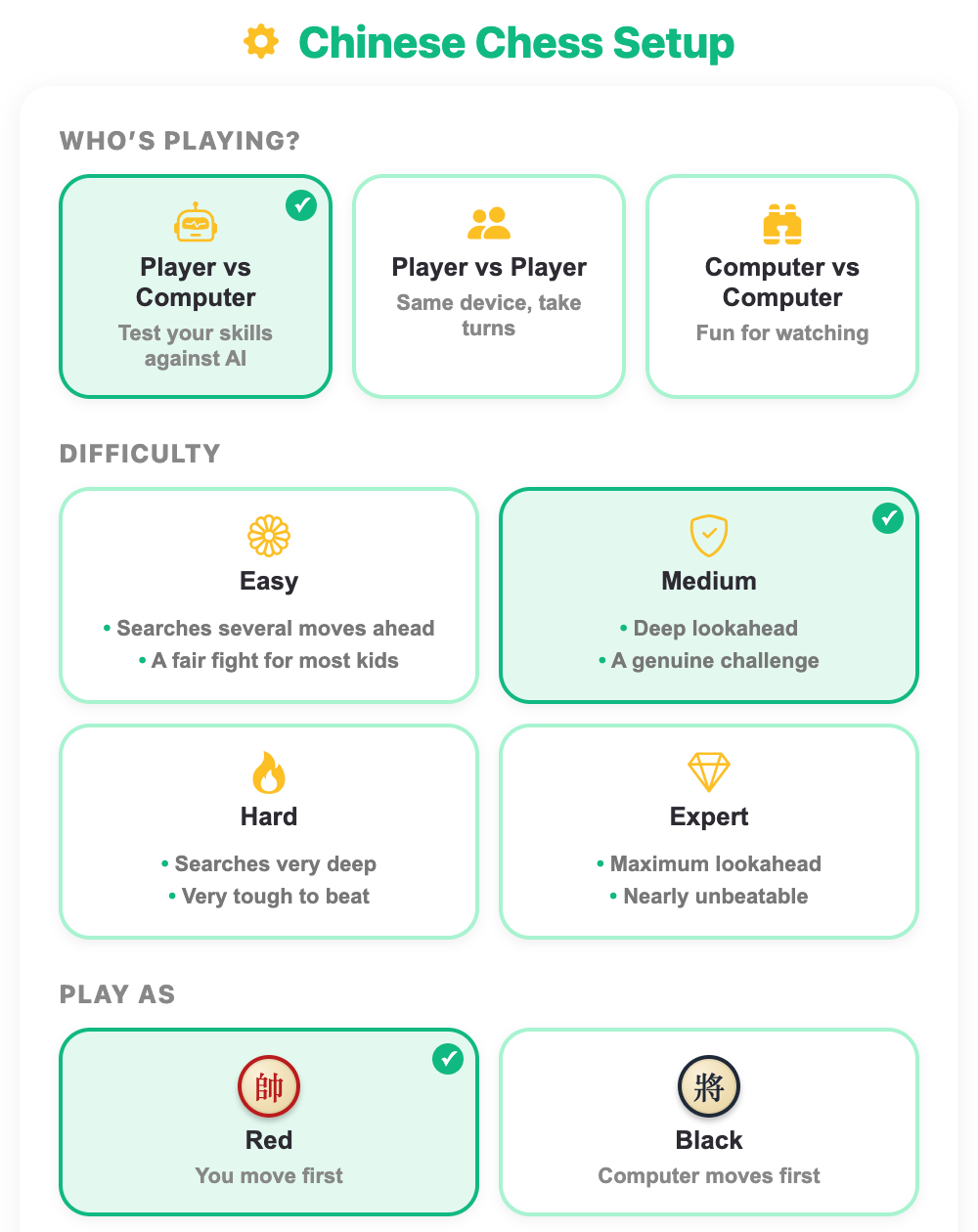
Setup screen in the Chinese Chess (Xiangqi) game at KidWorld
More Mind Games
 365.5K plays
4.9
365.5K plays
4.9
Tic-Tac-Toe
Play a game of Tic-Tac-Toe against the computer and see if you can outsmart it.
 1.1M plays
4.9
1.1M plays
4.9
Chess
Play the classic game of chess against the computer or a friend, with FIDE time controls, hints, and undo.
 568.6K plays
4.9
568.6K plays
4.9
Connect Four
Drop your pieces and be the first to connect four in a row against the computer or a friend.
 244.7K plays
5.0
244.7K plays
5.0
Tower of Hanoi
Move the stack of rings from one tower to another without ever placing a bigger ring on a smaller one.
Most Played Games
 1.8M plays
5.0
1.8M plays
5.0
Color & Draw
A free-drawing canvas with colors and brush sizes to unleash your creativity.
 59.4K plays
5.0
59.4K plays
5.0
Recycling Sort
Sort everyday items into the Recycle, Compost, or Trash bin before time runs out!
365.5K plays
4.9
Tic-Tac-Toe
Play a game of Tic-Tac-Toe against the computer and see if you can outsmart it.
1.1M plays
4.9
Chess
Play the classic game of chess against the computer or a friend, with FIDE time controls, hints, and undo.
Comments (42)