
Island Bridges
122.4K playsBuild bridges to join every island! Each island shows a number that tells how many bridges must touch it. Drag from one island to another to build a bridge, and drag again for a double bridge. Bridges go straight and can't cross, and all the islands must end up joined together. Finish the map and watch the little boats sail. A clever logic puzzle with a brand-new map every game.
Island Bridges for kids is a number puzzle where every island tells you exactly what it needs. Round islands sit on a bright blue sea, and each one shows a number, like 1, 3 or 4. You build wooden bridges from island to island until every number is matched and all the islands are joined together. It’s free to play right here in your web browser, with nothing to download and no sign-up, and it has levels for kids from about 2 to 12.
A stopwatch shows how long you take, but there’s no time limit and no lives to lose. Every game gives you three brand-new maps, so you never solve the same one twice. Each map also has exactly one right answer, and you can always find it by careful thinking instead of lucky guesses. When the last bridge clicks into place, the islands turn green and bounce, and little boats ⛵🚤 sail across the sea under your bridges.
🏝️ A Japanese Bridge Puzzle With Five Simple Rules
This kind of puzzle comes from Japan, where it’s called Hashiwokakero. That long word means “build bridges!” Many people just call it Hashi, which is the Japanese word for bridge. Japanese puzzle makers made it famous around 1990, and puzzle fans all over the world have been building bridges ever since.
The rules are short enough to fit on a sticky note. Here they are, just the way KidWorld checks them:
Match the number. An island’s number tells how many bridges must touch it. A 3 needs exactly 3 bridges. Not 2, and not 4.
Go straight. A bridge runs in a straight line, either across a row (side to side) or along a column (up and down). It always goes to the very next island that way. No bends and no slanted bridges.
One or two bridges per pair. Two islands can share one bridge or a double bridge, but never three. A double bridge counts as 2 for both islands.
No crossing. Bridges can’t cross over each other, just like two real bridges can’t run through each other.
Join everyone. At the end, you must be able to walk from any island to any other island using only bridges. All the islands make one big group.
That last rule surprises a lot of new players. You can match every single number and still not be finished! If the islands are split into two groups, the game tells you: “Every number is right, but the islands are in more than one group.” So keep rule 5 in mind from your very first bridge.
🕹️ Building Your First Bridge on KidWorld
Here’s how a game goes, from the first screen to the last boat:
Pick your level. On your first visit, the game starts on Elementary. Press ⚙️ Change Level to see all four cards: Toddlers (ages 2–4), Preschool (4–6), Elementary (6–10) and Tweens (10–12). Tap one to start three new maps.
Read the top bar. It shows your level, which map you’re on (🗺️ Map 1 / 3), how many islands are finished (🏝️ 3 / 6 means three of six islands are done) and the stopwatch.
Drag to build. Press on an island and slide toward the island you want to reach. A dashed white line shows where the bridge will go. Let go, and a wooden bridge appears. If the dashed line turns red, another bridge is in the way.
Drag again for a double bridge. Each drag between the same two islands changes the bridge: one bridge, then a double bridge, then no bridge at all. On the Toddlers level there are no double bridges, so a drag builds a bridge and the next drag takes it away.
Or just tap, tap. Tap an island and it gets a blue ring. The islands it can reach get a glowing dashed ring. Tap one of those to build. Tap the first island again to let it go. You can also tap a bridge you already built to change it. Dragging and tapping both work with a finger on phones and tablets, or with a mouse.
Watch the colors. A yellow island still needs more bridges. A green island has exactly the right number. A red island has too many, so one of its bridges has to go.
Read the message box. Under the sea, a message says what just happened, like “A double bridge! 3 islands still need bridges.” Press the 🔊 button next to it to hear it read aloud. On the younger levels, the goal is also read out when each map starts, if the site’s sound is on.
Fix mistakes. ↺ Undo takes back your last move. Start Over clears every bridge on the map, and if you change your mind, Undo brings them all back.
Ask for a hint when you’re stuck. The 💡 Hint button shows how many hints are left: 3 per map on Toddlers and Preschool, and 2 per map on Elementary and Tweens. A hint fixes one bridge for you and makes it glow, so you can see what changed. If you built a bridge that doesn’t belong, the hint takes that one away first, and you’ll see it fade out in red. Each hint costs 2 points.
Watch the boats. When a map is solved, the whole board turns green, the islands bounce, and two to four boats sail under your bridges. The big Next Map button fills up as it counts down from 5, then moves on by itself. You can press it sooner. After the third map it says See My Score.
Check your score. The “All Islands Joined!” card shows your final score out of 30, your time, the number of maps, islands and hints, and 1 to 5 stars. Press Play Again for three fresh maps, or Choose Another Level. The points you score are added to your ⭐ stars on KidWorld.
Use the buttons around the game. You can make the game fill the whole screen with the fullscreen button, start fresh with the reload button, and turn the background music on or off.
🌉 Island Bridges for Kids: Tricks for Finding Sure Bridges
The biggest secret is this: you never need to guess. Every map has just one answer, so somewhere on the sea there is always a bridge you can be completely sure about. Good bridge builders hunt for those sure bridges first. Each one makes the next one easier to find.
One word will help a lot. An island’s neighbors are the islands it could reach with a straight bridge, with nothing in between. An island can have at most four neighbors: one to the right, one to the left, one above and one below.
1. Start at the corners and edges
An island in a corner can have only two neighbors at most, and an island on the edge only three. Fewer neighbors means fewer choices, and fewer choices means you can be sure sooner. So before you look at the middle of the map, look all around the sides.
2. One neighbor? Every bridge goes there
If an island has only one neighbor, it has nowhere else to send its bridges. A 1 with one neighbor gets a single bridge to it. A 2 with one neighbor gets a double bridge to it. These are the easiest sure bridges in the whole game, so build them first.
3. The “full house” numbers
Two islands can share two bridges at most. So an island with two neighbors can have 4 bridges at most (2 + 2). With three neighbors, the most is 6. With four neighbors, the most is 8. When an island’s number is that biggest possible number, it’s a full house: every neighbor gets a double bridge. A 4 with two neighbors, a 6 with three neighbors, and an 8 in the middle of the sea are all full houses.
4. “One less than full” means a bridge to everyone
Now try a number that is one less than the full house: a 3 with two neighbors, a 5 with three, or a 7 with four. Such an island needs at least one bridge to every neighbor. Here’s why. Say a 3 has two neighbors and you skip one of them. Then all 3 bridges would have to go to the other neighbor, but a pair can only hold 2. That can’t work! So build one bridge to each neighbor right away. You can decide where the last bridge goes later.
5. Cross off the green islands
A green island is finished. It can’t take even one more bridge. So when you count the neighbors of the islands around it, leave the green one out. Suddenly an island that had three neighbors may only have one left, and trick 2 or 3 tells you exactly what to build. This is how big maps fall into place: each finished island makes the puzzle around it smaller.
6. Remember that bridges block bridges
A long bridge across the middle of the sea is like a wall. Islands above it can no longer reach islands below it in a straight line, because that bridge would have to cross. So a bridge you build also takes choices away from other islands. If you try to cross one anyway, the bridge in the way flashes red and the message says “Bridges can’t cross each other! Take that bridge away first.” Before you build a long bridge, ask yourself: “Who will this cut off?”
7. Never trap a little group
Rule 5 says all the islands must end up joined. So never finish a small group that can’t reach anyone else. The most common trap is two 1s side by side. A bridge between them uses up both numbers, and they’re stuck on their own forever. Two 2s joined by a double bridge are trapped the same way. If you see one of these pairs, each island must send its bridge somewhere else.
8. Let the 🏝️ counter help you
On a big map, it’s easy to miss one unfinished island. If the counter says 13 / 14, scan the sea for the one island that’s still yellow or red. And if you love squeezing every clue out of a number like this, Minesweeper uses number clues too, this time to find hidden mines.
🔎 Solve Along With Me: Five Little Maps
Let’s use those tricks on real maps. Read each one slowly, and try to spot the sure bridge before you read the answer.
Map 1: three islands on a Toddlers sea
There’s a 1 in the top right corner, a 2 in the bottom right corner, and a 1 in the bottom left corner. The top 1 has only one neighbor, the 2 straight below it. So it gets one bridge down to the 2 (trick 2). The bottom-left 1 also has only one neighbor, the 2 to its right. One more bridge. Now the 2 has two bridges, every island is green, and all three are joined. Solved! Notice that the two 1s don’t line up, so they couldn’t join each other anyway.
Map 2: six islands on an Elementary sea
This map has a 3 in the top left corner and a 2 in the top right corner, in the same row. In the bottom left corner sits another 3. Along the bottom row, to the right of that 3, there’s a 4. Straight above the 4, in the middle of the sea, is a 3, and to its right is a 1. Here’s the path to the answer:
The 2 in the top right has just one neighbor: the 3 to its left. Nothing is below it. So it gets a double bridge to that 3.
The top-left 3 now has 2 bridges and needs 1 more. Its only other neighbor is the 3 below it, so build one bridge down. The top-left 3 turns green.
The bottom-left 3 has 1 bridge and needs 2 more. Its only other neighbor is the 4, so it gets a double bridge to the 4.
The 4 has 2 bridges and needs 2 more. Its left neighbor is green, so only the 3 above it is left. Double bridge up.
The middle 3 has 2 bridges and needs 1. The 1 on its right is its last neighbor. One bridge, and the 1 is green too.
Six green islands, all in one group, and the boats start sailing. Every single step came from counting, not guessing.
Map 3: a 7 with a 1 above it
Picture a 7 in the middle of a bigger map, with four neighbors. The neighbor above it is a 1. That 1 can only take one bridge, so the 7 can get at most 1 bridge from up there. It still needs 6 more, and it has three other neighbors that can give at most 2 each. 2 + 2 + 2 = 6. So the 7 gets one bridge up to the 1 and double bridges to all three other neighbors. A small number next door turned a tricky 7 into a full house!
Map 4: two 1s that look like best friends
On a Preschool map, you might find a 1 with another 1 straight to its right, nothing in between. They look like perfect partners. But if you join them, both numbers are used up and the pair is cut off from everyone else (trick 7). So each 1 must reach for a different neighbor. If one of those 1s has only two neighbors, and one of them is the other 1, its bridge must go to the other neighbor. That’s a sure bridge!
Map 5: oops, too many bridges
Go back to Map 2. Suppose you guessed and built a double bridge between the two 3s on the left side, before the top-right 2 got its double bridge. Later, after the other double bridges are in, both 3s turn red, and the message says “Too many bridges! That island’s number is 3, so it needs 3 bridges.” You can drag between them once more to take that bridge away and build it again as a single one, or press Undo. Or press Hint: it turns that bridge back into a single one and says “The 3 and the 3 need just one bridge between them.” That hint costs 2 points, so the map is worth 8 instead of 10. The lesson? Build the sure bridges first, and the red islands rarely show up.
How the score works
Each map is worth 10 points. Every hint you use takes away 2, but a solved map never drops below 4 points. Three maps make a top score of 30. Solve all three with no hints at all for a perfect 30 out of 30. Even with one hint in the whole game you get 28, which still earns all five stars. Hints are there to help you learn, so don’t be afraid to use one when you’re truly stuck.
👪 Choosing the Right Sea for Your Child
The four levels change how many islands each map has, how big the numbers get, whether double bridges appear and how many hints there are. Every level has three maps that grow a little from the first to the last.
Island Bridges for toddlers (ages 2–4)
Toddler maps have 3, 4 and 4 islands on a small sea, numbers no bigger than 3, and no double bridges at all, so every pair of islands is either joined or not. There are 3 hints per map, and the goal is read aloud when the sound is on. Little ones will need a grown-up beside them. Count the bridges out loud together: “This island says 2. Let’s count: one, two!” The tap, tap way of building is easiest for small fingers.
Island Bridges for preschoolers (ages 4–6)
Preschool maps grow from 4 to 5 to 6 islands, and the numbers never go above 4. Double bridges show up now and then, and sometimes the bridges form a ring. There are still 3 hints per map. This is a lovely level for practicing counting and small adding, like “one plus two makes three.”
Island Bridges for elementary kids (ages 6–10)
Elementary maps have 6, 8 and 10 islands, numbers up to 8, and lots of double bridges. There are 2 hints per map. This is where the full-house trick and the one-less-than-full trick really start to shine, and kids begin to feel the fun of proving a bridge is right.
Island Bridges for tweens (ages 10–12)
Tween maps are big: 14, 19 and then 25 islands, on seas up to 10 squares wide. There are 2 hints per map, and the maps are full of double bridges and rings. Aiming for a perfect 30 with no hints is a real challenge. Tweens who want another puzzle of the same kind can try Lantern Castle, where lanterns shine along rows and columns and number clues on the walls say how many lanterns touch them.
💡 What Grows While the Bridges Go Up
Counting and adding, again and again. Every move is a tiny math problem. A 5 with a double bridge and a single bridge has 3, so it needs 2 more. Kids do dozens of these little sums in one game without ever seeing a worksheet.
Looking ahead. The red dashed line and the flashing bridge teach a big idea: what you build now changes what you can build later. Kids learn to ask “who will this cut off?” before they act.
Being sure instead of guessing. Because every map has one answer, kids learn the joy of finding a bridge they can prove. Explaining “this 2 has only one neighbor, so it must be a double” is real reasoning, in kid-sized steps.
Seeing the whole picture. The join-everyone rule makes kids think about the whole map, not just one island. It’s a gentle first taste of how roads, paths and networks connect places.
Bouncing back from mistakes. A red island isn’t a failure. It’s a friendly signal, and the message explains what’s wrong. With Undo, Start Over and hints that explain themselves, kids learn that fixing a mistake is part of solving. Kids who enjoy turning number clues into a finished result may also love Pixel Art Nonograms, where number clues paint a hidden pixel picture.
A note for parents and teachers: Island Bridges runs in the browser with no download and no sign-up needed. The game itself has no chat, no lives to lose, no time limit and nothing scary: just islands, wooden bridges, little boats and friendly messages. It practices counting, adding small numbers, logical thinking, planning ahead and seeing patterns in rows and columns. Because every map is new and has exactly one answer, it works well as a short daily brain warm-up.
Ready to grab your hard hat? Pick a level, look for an island with just one neighbor, and lay your first plank. Island Bridges for kids turns counting into a little adventure on the sea, and every solved map ends with boats sailing under bridges you built yourself. Happy bridge building! 🌉
🖼️ See the Game in Action
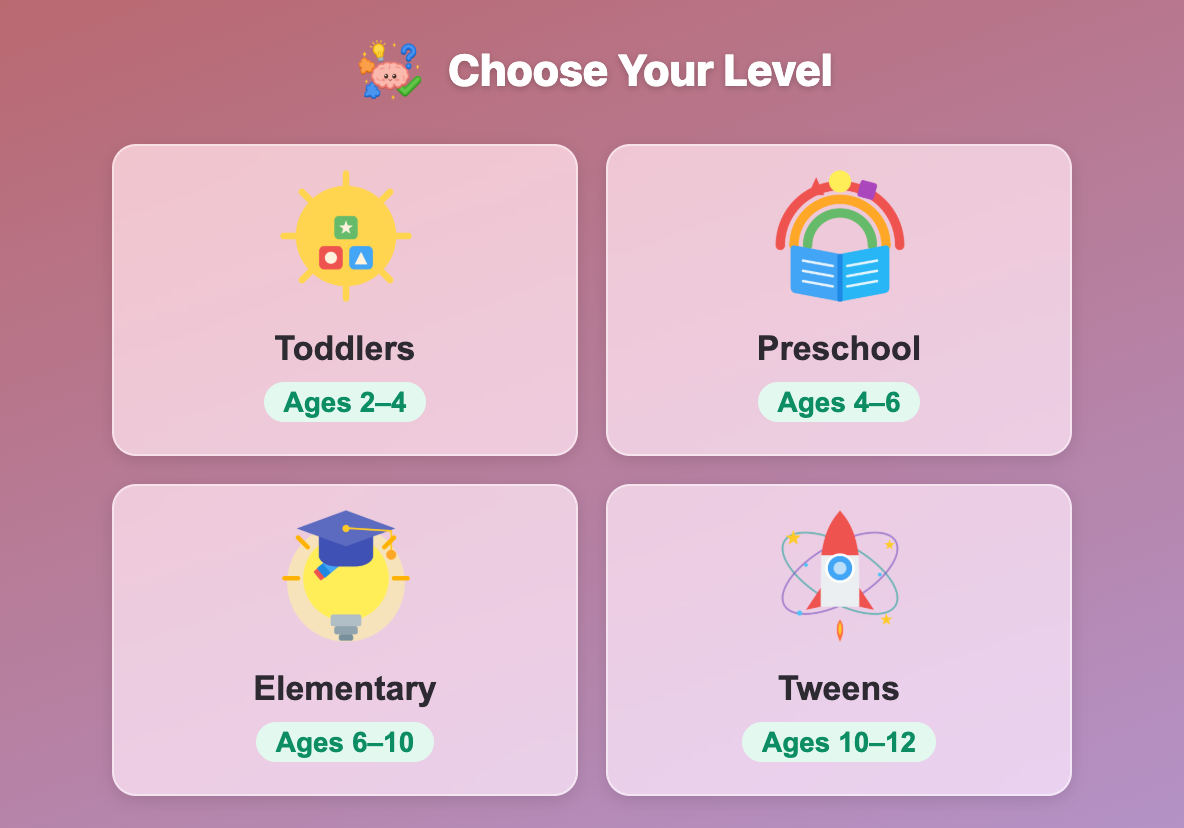
The level picker of Island Bridges with Toddlers, Preschool, Elementary and Tweens cards and their age ranges
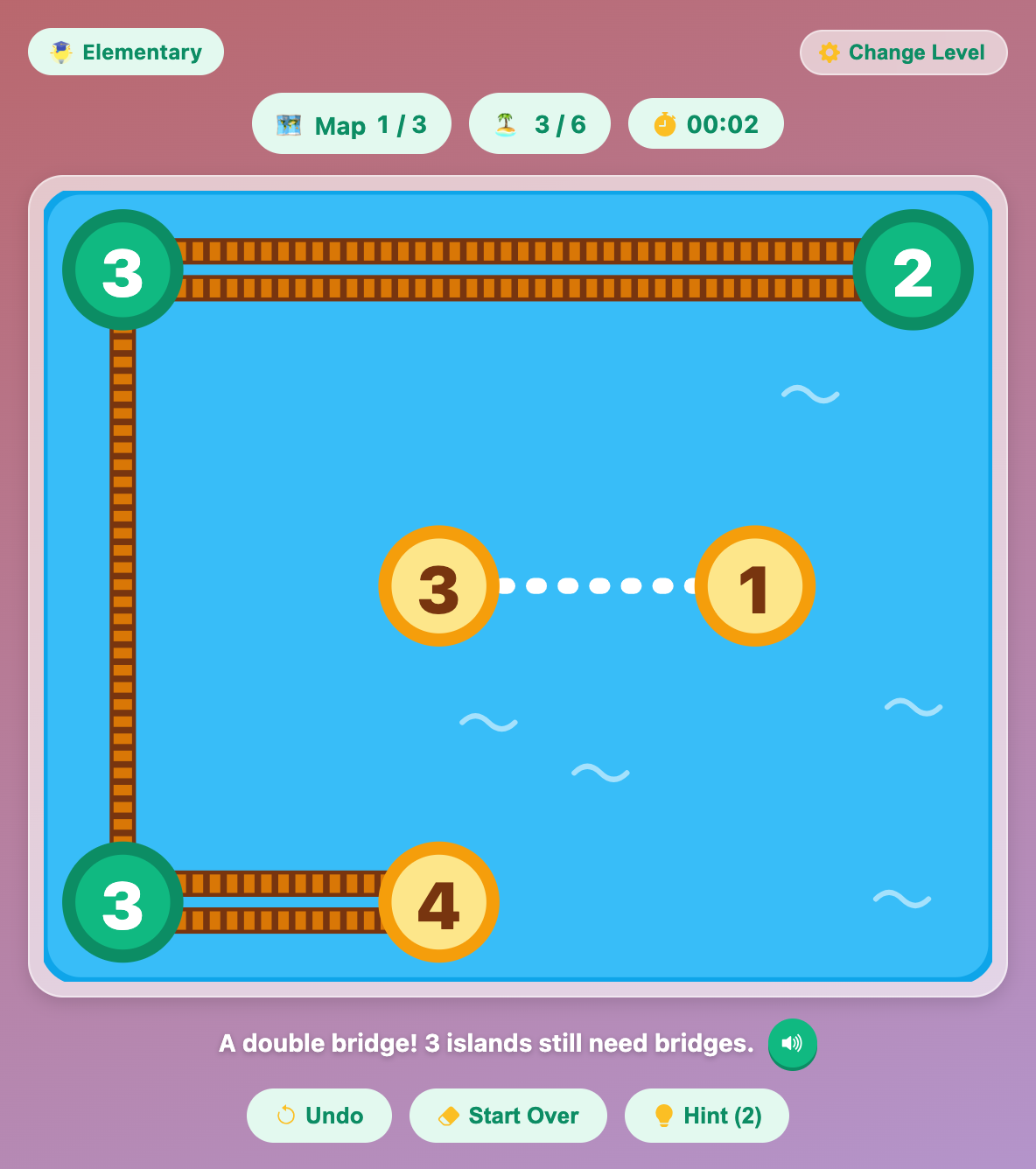
An Elementary map in Island Bridges for kids with green finished islands, double bridges and a dashed line for a new bridge
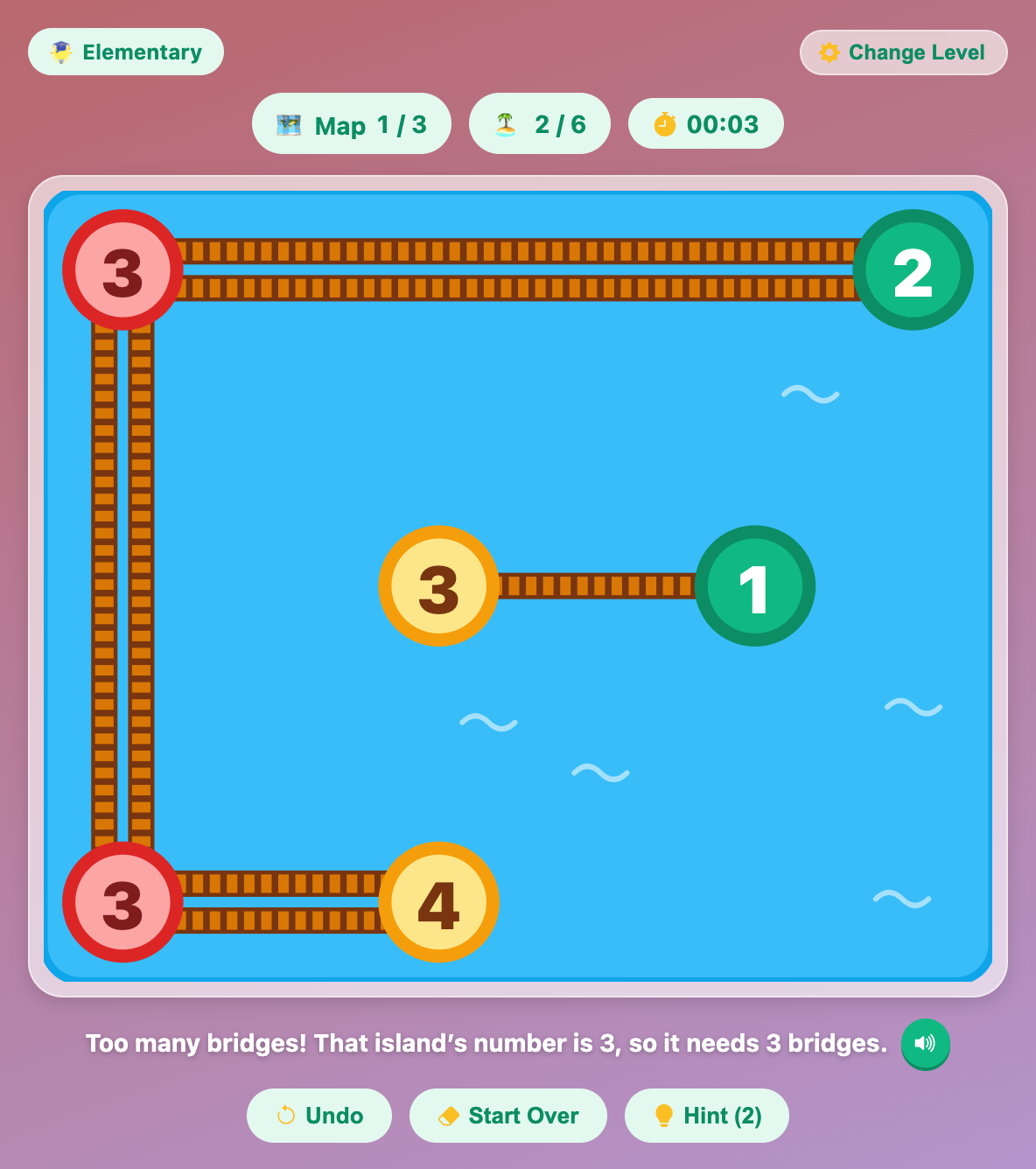
Two islands in Island Bridges glowing red because they have one bridge too many, with a Too many bridges message
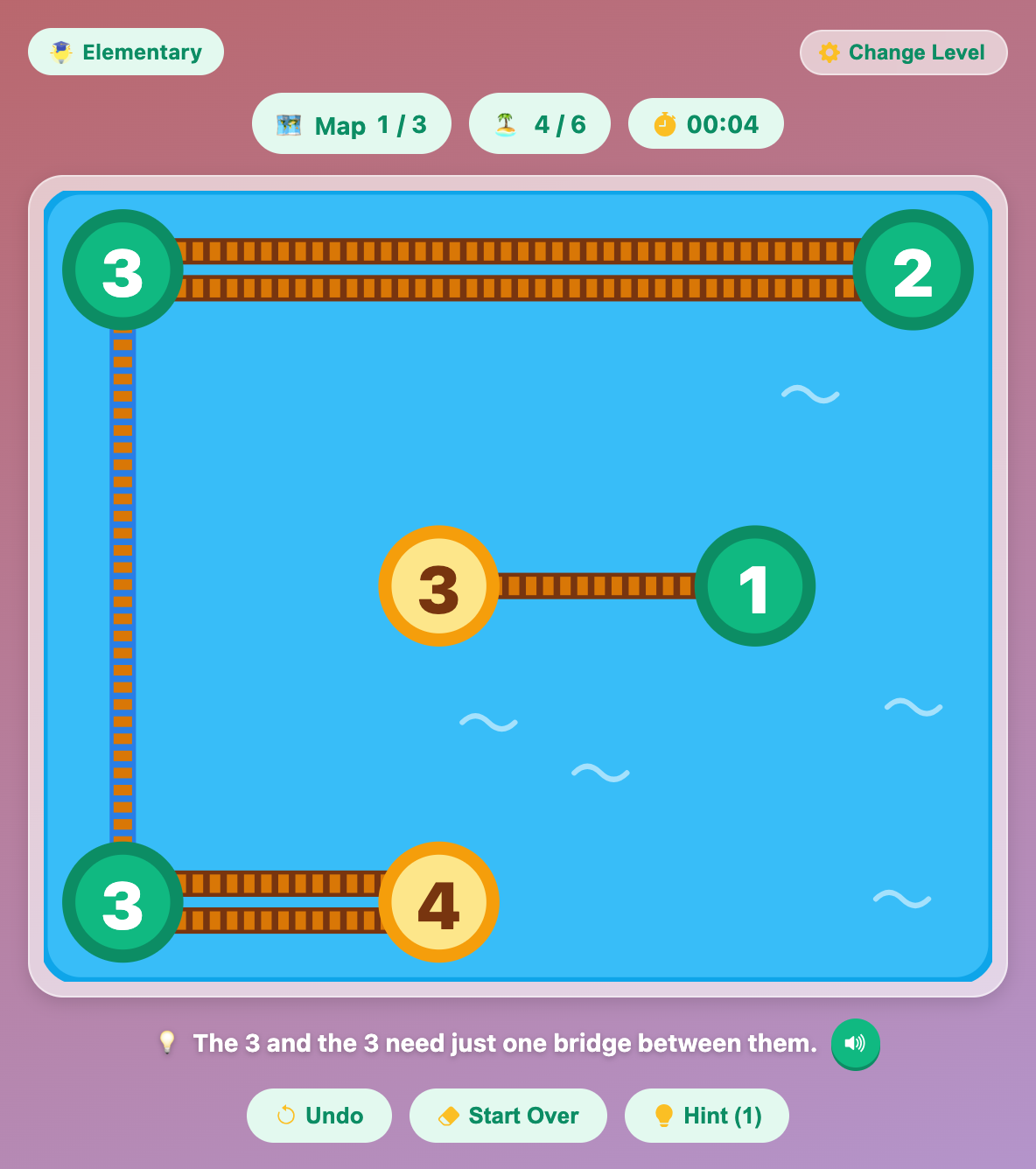
A hint in Island Bridges lighting up the bridge it fixed, with a message that the 3 and the 3 need just one bridge
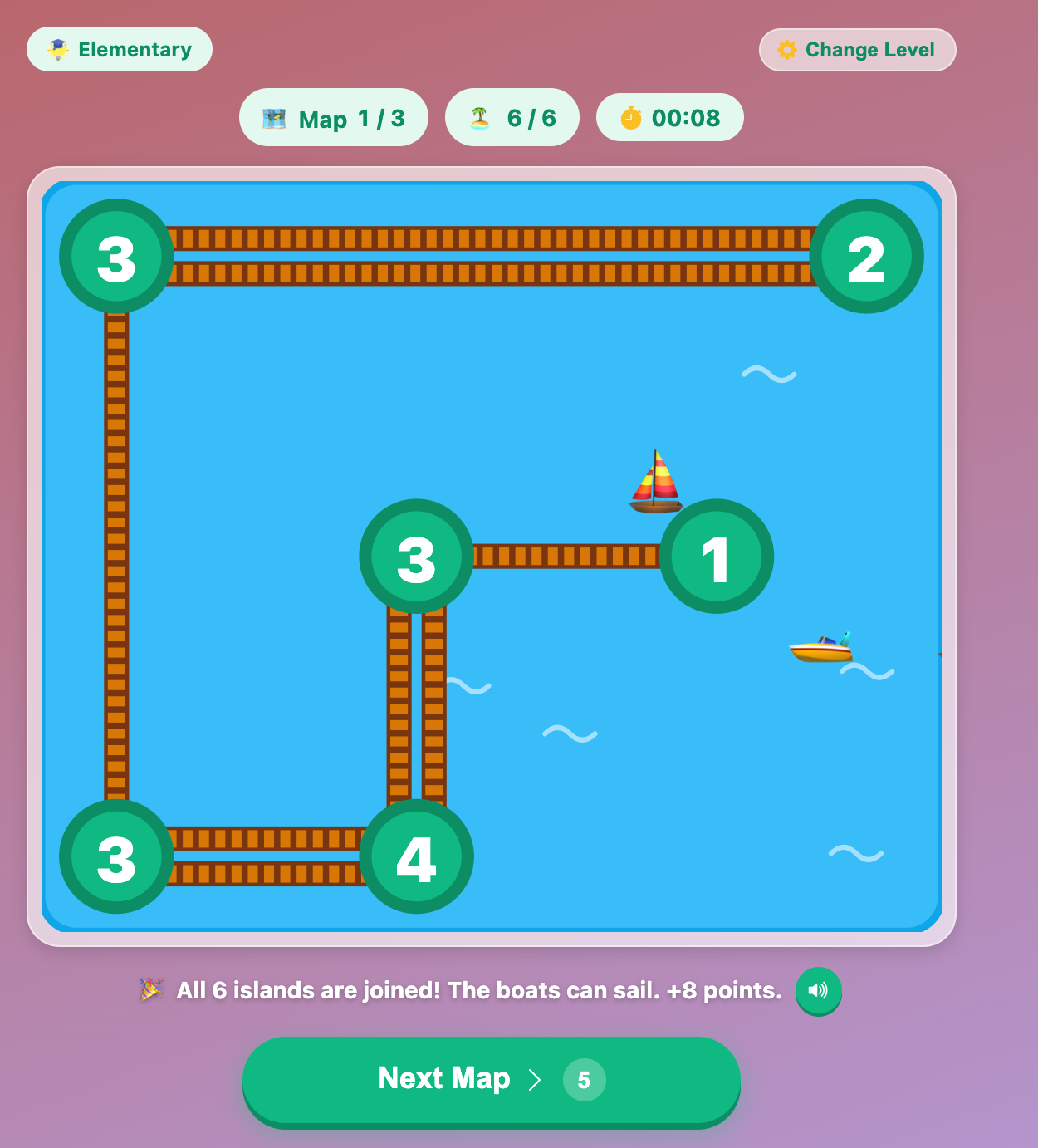
A solved Island Bridges map with every island green, a sailboat and a speedboat on the sea, and the Next Map button
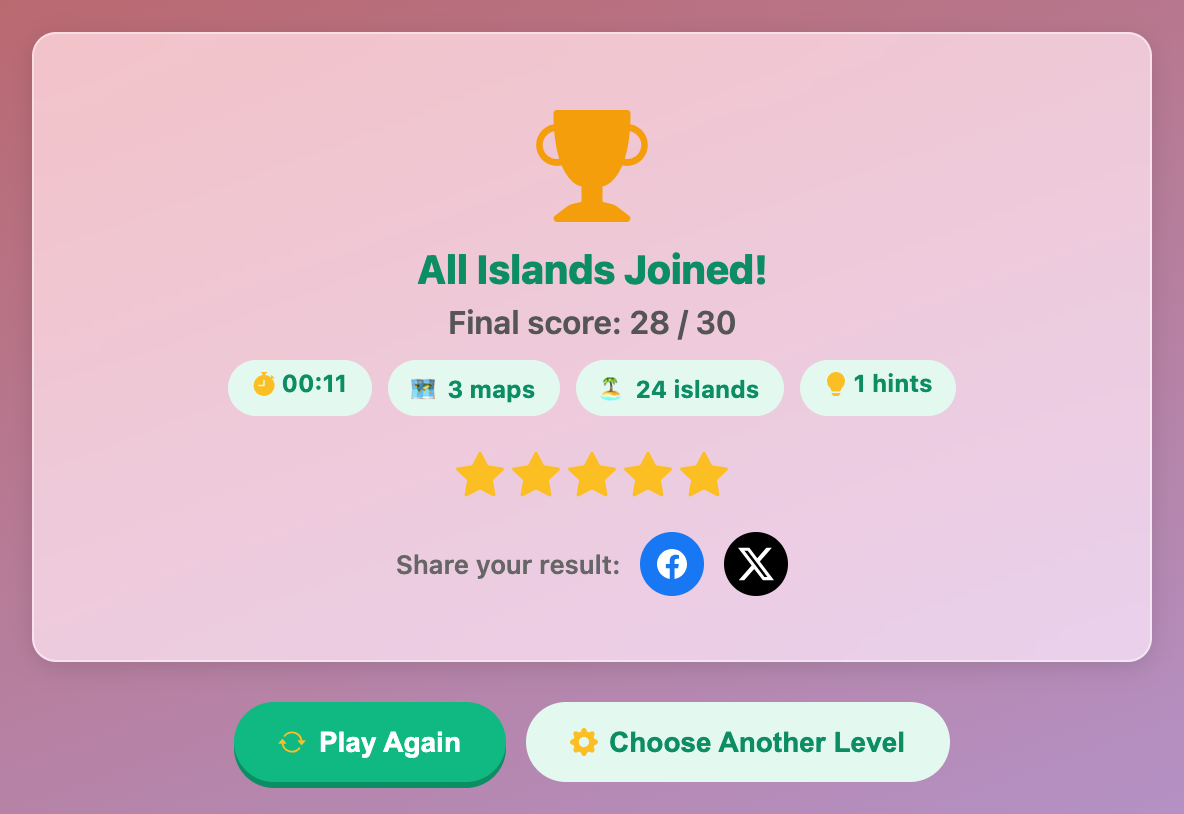
The All Islands Joined finish card with a trophy, a final score of 28 out of 30 and five gold stars
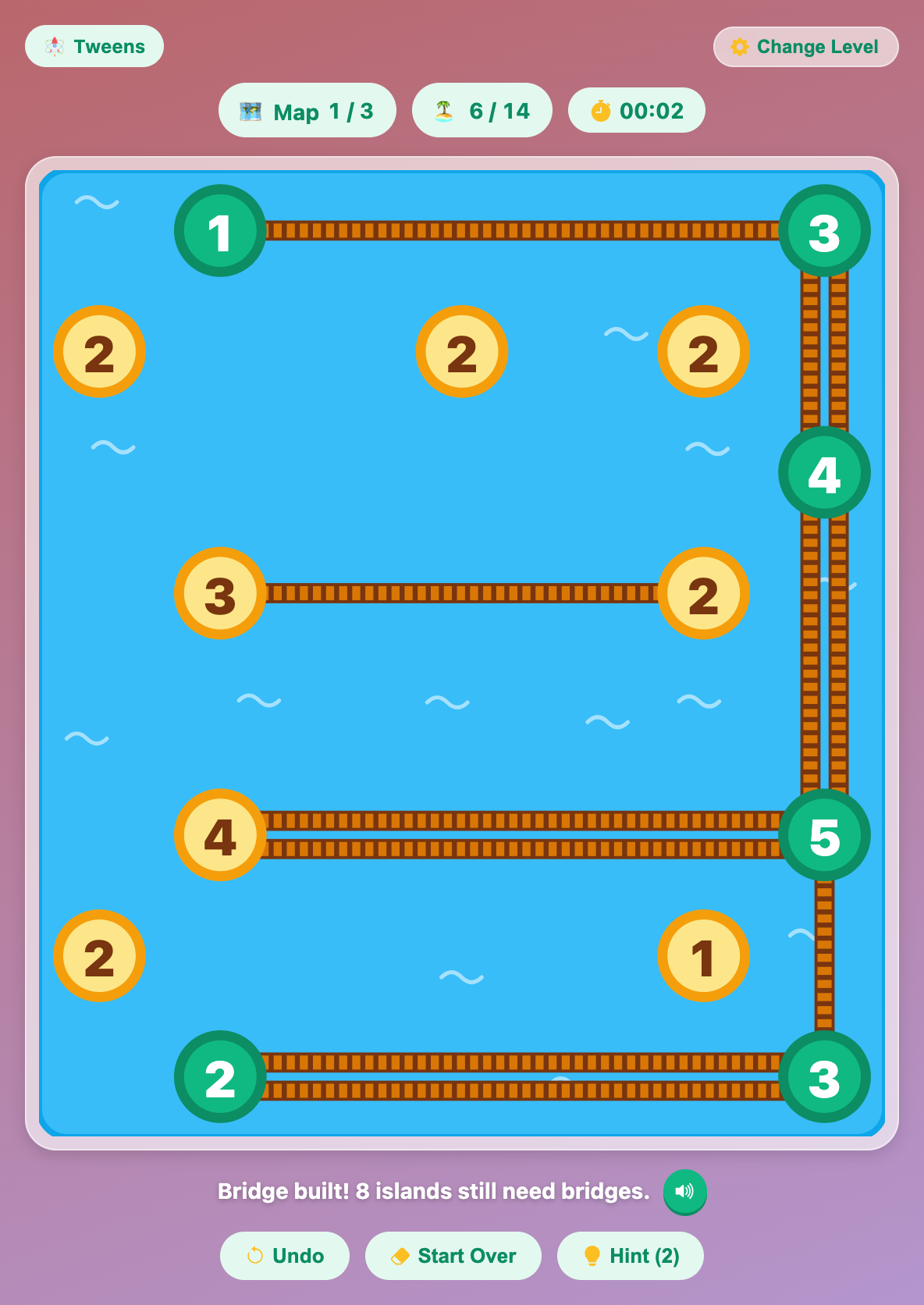
A 14-island map in Island Bridges for tweens, about half built with single and double bridges along the right side
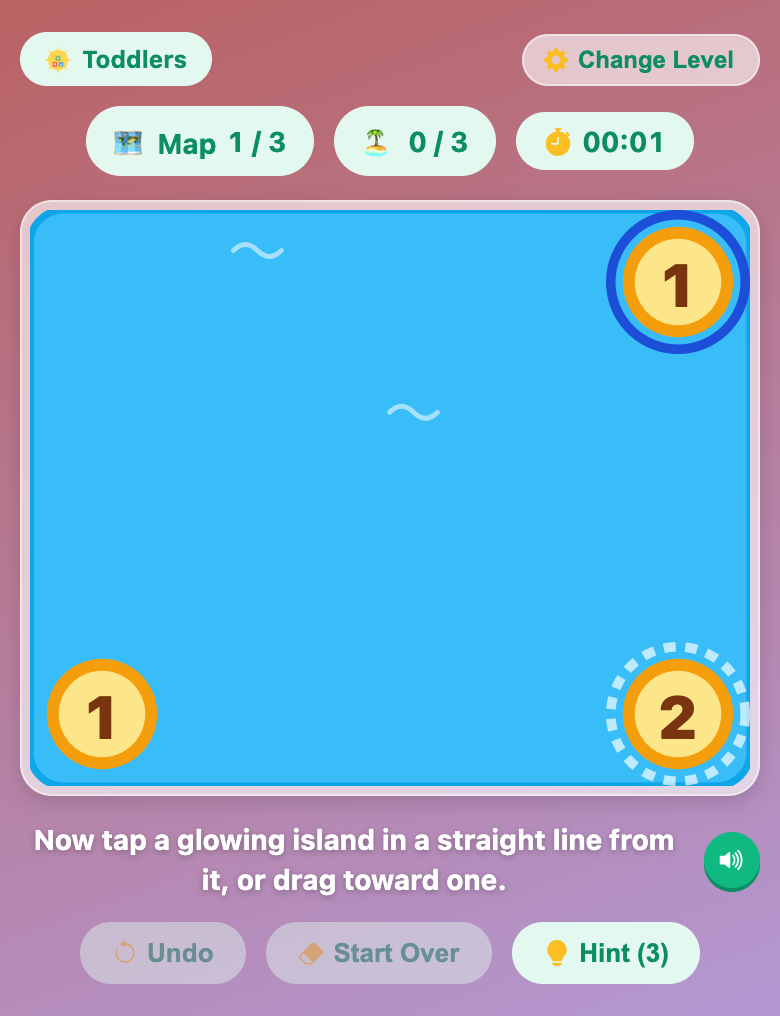
Island Bridges for toddlers on a phone, with one island picked by a blue ring and its neighbor glowing with a dashed ring
More Mind Games
 973.3K plays
4.9
Sliding Puzzle
Slide the numbered tiles — or a fun picture! — one at a time until they line up in order, from a cozy 5-tile board all the way up to the classic 15 puzzle.
 162.6K plays
4.9
Lantern Castle
The castle is dark! Hang lanterns to light every room. Each lantern shines along its whole row and column until a wall stops the light, but no lantern may shine on another lantern, and a number on a wall tells how many lanterns touch it. Watch the night sky turn to dawn as the castle lights up. A clever logic puzzle with a brand-new castle every game.
 1.1M plays
4.9
Chess
Play the classic game of chess against the computer or a friend, with FIDE time controls, hints, and undo.
 124.5K plays
4.8
Minesweeper
Use the number clues to find every safe square and flag the hidden mines — your first tap is always safe!
Most Played Games
 366.2K plays
5.0
Tic-Tac-Toe
Play a game of Tic-Tac-Toe against the computer and see if you can outsmart it.
 263.7K plays
4.9
Category Sort
Decide whether each picture is an animal, food, toy, or vehicle before time runs out.
 568.7K plays
4.9
Connect Four
Drop your pieces and be the first to connect four in a row against the computer or a friend.
 514.5K plays
5.0
Maze Runner
Guide your explorer through a maze to find the treasure, using as few steps as you can.
Comments (50)