
Lantern Castle
162.6K playsThe castle is dark! Hang lanterns to light every room. Each lantern shines along its whole row and column until a wall stops the light, but no lantern may shine on another lantern, and a number on a wall tells how many lanterns touch it. Watch the night sky turn to dawn as the castle lights up. A clever logic puzzle with a brand-new castle every game.
One lantern can light up half a castle, as long as you hang it in the right room. Lantern Castle for kids is a free logic puzzle where you tap dark rooms to hang lanterns until every room in the castle glows. It plays right in your browser, with no download and no sign-up, and it has four levels for ages 2 to 12.
Each lantern shines along its whole row and column until a stone wall stops the light. But two lanterns must never shine on each other, and the numbers on the walls tell you how many lanterns sit beside them. As more rooms light up, the night sky behind the castle slowly turns into a sunny morning. Best of all, every castle is brand new, built by the game the moment you start.
🏰 A Castle Puzzle Called Light Up
Lantern Castle is a kid-sized version of a Japanese puzzle called Light Up. In Japan it's known as Akari, which means “light.” It became famous through Nikoli, the Japanese puzzle company that also gave Sudoku its name.
The castle is a grid of squares. Some squares are rooms, painted dark blue for nighttime. Others are gray stone walls. You win when all three of these rules are true:
Every room is lit. A room is lit if it holds a lantern, or if a lantern in the same row or column can see it with no wall in between.
No lantern shines on another lantern. Two lanterns in the same row or column need a wall between them.
Every number is matched. A wall with a number has exactly that many lanterns right next to it: above, below, left or right. Rooms that only touch the wall at a corner don't count.
A wall with no number is just a wall. It blocks light, and it doesn't care how many lanterns touch it.
Here's something special about Lantern Castle for kids: every castle has exactly one answer, and you can always reach it by thinking, never by guessing. Before you see a castle, the game solves it by logic alone. Any castle that would need a lucky guess is thrown away and a new one is built.
🕹️ Hanging Your First Lantern, Step by Step
Pick a level. The first time you visit, the game starts on Elementary. Tap Change Level to see the four cards: Toddlers, Preschool, Elementary and Tweens. The game remembers the one you pick for next time.
Look around the castle. Above it are three counters: a sun that shows how many rooms are lit (like 0 / 28), a lantern that counts the lanterns you've hung, and a stopwatch. The stopwatch only starts with your first move, so take your time looking.
Tap a dark room to hang a lantern. The lantern's row and column turn warm gold right away, up to the nearest wall or the edge of the castle. Tap the lantern again to take it down.
Use Mark mode for rooms that must stay empty. Under the castle are two buttons, Lantern and Mark. In Mark mode, a tap puts a small dot in a room. The dot means “no lantern goes here.” It's a note just for you, and the game never checks it. On a computer you can also right-click a room to mark it. On a phone or tablet, press and hold a room.
Watch the wall numbers change color. A number badge stays white while it still needs lanterns. It turns green when it has exactly the right number beside it, and red when it has too many. A 0 wall starts out green, because it already has zero lanterns!
Fix things with Undo. The Undo button takes back your last change, one step at a time.
Ask for a hint when you're stuck. The Hint button shows how many hints are left, 3 per castle. If one of your lanterns doesn't belong, the hint takes it down. If all your lanterns are right, the hint hangs the next lantern you could have worked out yourself, puts a blue ring around it, and explains why in the tip line. When the reason comes from a wall or another room, that spot gets an orange dashed ring for a moment.
Light the last room. When every room glows and no rule is broken, the whole castle shines, the sun comes up, and a “Hooray!” appears. Then the Castle Lit Up! card shows your time, your lanterns, your slips, your hints, your score out of 100 and up to five stars.
Play again. Tap New Castle for a fresh castle at the same level, or Choose Another Level to switch.
Use the page buttons. The buttons around the game let you go fullscreen, reload the game, and turn the music on or off. The 🔊 buttons next to the tip line and the “How to play” box read the words out loud, which helps kids who are still learning to read.
🔦 Lantern Castle for Kids: Smart Moves That Light the Way
Lantern Castle looks like a tapping game, but it's really a thinking game. The big secret is simple: only hang a lantern when you're sure it belongs. Here are the moves that make you sure, from first-castle tips to tricks for the biggest Tweens castles.
Start Where the Walls Squeeze You
Don't begin in the middle of a big open hall. Begin where the walls are close together. Small spaces have fewer choices, and fewer choices mean sure moves.
Boxed-in rooms. Some rooms have a wall or the castle's edge right next to them on every side. No other lantern's light can ever reach them, so they must hold their own lantern. Hang those first.
0 walls. A 0 wall means none of the rooms beside it can have a lantern. Put a Mark dot in each of them right away.
Full walls. Count the rooms right next to a numbered wall. If the number is the same as the number of rooms, every one of those rooms gets a lantern. A 4 wall out in the open always gets four lanterns. A 3 wall pressed against the castle's edge only has three rooms beside it, so all three get lanterns. Don't worry, those lanterns never shine on each other: either the wall sits between them, or they're in different rows and columns.
Green badges. As soon as a wall's number turns green, mark every other room beside it. That wall is finished.
Gold rooms. A room that's already glowing gold can never hold a lantern, because a lantern there would shine right back at the lantern lighting it. The gold color works like a free Mark dot.
Four Little Castle Puzzles, Solved
Let's practice with some real castle moments. In these puzzles, rows are counted from the top and columns from the left.
Puzzle 1: A whole Toddlers castle. You can see this castle in the second picture at the end of this page. It's 4 squares wide. The top row is room, room, a 2 wall, room. The second row is three rooms and then a 1 wall. The third row is a 2 wall and then three rooms. The bottom row is room, a 1 wall, room, room. Here's how to light it:
The top-right room has the 2 wall on its left and the 1 wall below it. No other lantern can reach it, so it gets a lantern.
That lantern sits right beside the 1 wall, so the 1 wall is now full. Mark the other two rooms beside it: the one on its left and the one below it.
The top 2 wall touches three rooms: left, right and below. The right one already has a lantern, and the one below is marked. So the room on its left (row 1, column 2) gets the second lantern.
That new lantern lights the top-left corner, and shines down column 2 until the bottom 1 wall stops it.
The left 2 wall touches three rooms: above, below and to its right. The one on its right is now gold, so it can't hold a lantern. That means the rooms above and below the wall both get lanterns.
The bottom-left lantern sits beside the bottom 1 wall, so that wall is full too. Mark the room on its right.
Look at row 3, column 3. It's still dark, and every room that could light it is marked or gold. So it needs its own lantern. The bottom-right corner is just the same. Hang those two, and all 12 rooms glow with 6 lanterns!
Puzzle 2: The four corners of a 3. Imagine a 3 wall standing in the open, with a room on each of its four sides. Three of those four rooms will get lanterns. Now look at the room that touches the 3 only at its corner, say up and to the right. That corner room shares a row with the room above the 3, and a column with the room to the right of the 3. Only one of the four rooms around the 3 stays empty, so at least one of those two has a lantern. A lantern in the corner room would always shine on it! So you can mark the corner rooms around a 3 before you hang a single lantern there.
Puzzle 3: The room at the end of the hallway. Imagine a dark room at the end of a short hallway. There's a wall above it and a wall below it, the castle's edge is on its right, and on its left is one more room and then a wall. So only two spots can ever light it: itself, or the room next to it. Now say that neighbor room is already glowing gold, because a lantern lights it from above. A gold room can't hold a lantern, so the end room must light itself. Hang a lantern there. This is exactly the kind of reason a hint gives you: “No other lantern can reach this room, so it needs its own lantern.”
Puzzle 4: The “what if” trick (for Tweens). Sometimes no easy move is left. Then try a lantern in your head, not on the board. Imagine a dark corner room that's marked, so it can't hold a lantern. Walls close in around it, so only two rooms can ever light it: room B, right next to it on the right, and room C, right below it. Now look at room D, which sits right below B and right next to C. If you put a lantern in D, it would light both B and C. Then neither of them could hold a lantern, and the corner would stay dark forever. So D must stay empty: mark it. One “what if” can crack open a whole stuck castle.
If counting around a number is your favorite part, you'll feel at home in Minesweeper, where each number counts the hidden mines touching a square.
Tricks for the Big Castles
Sweep the whole castle first. Before any hard thinking, look everywhere for the easy moves: boxed-in rooms, 0 walls, full walls and green badges. One sure lantern often unlocks three more.
Hunt for dark rooms with few helpers. Pick a dark room and count the spots that could still light it: the room itself, plus the unmarked rooms in its row and column that aren't gold. If only one spot is left, that's where the lantern goes.
Don't rush a 1. A 1 wall with three open rooms beside it doesn't tell you which one yet. Hang a lantern there now and you're only guessing. Work somewhere else and come back. Often another wall or a gold room crosses out two of the choices for you.
Remember that plain walls give no clue. From Preschool up, some walls don't show a number. Those walls can touch any number of lanterns, so leave them out of your counting.
Save the “what if” trick for last. Easy moves are faster and safer. Use the trick from Puzzle 4 only when nothing else works.
How to Keep Your Score High
Every castle starts at 100 points. A slip costs 5 points. A slip means hanging a lantern that breaks a rule: it shines on another lantern, or it gives a wall too many lanterns. When that happens, the rooms shake, the clashing lanterns or the wall's number turn red, and the tip line says what went wrong, like “Oops! The 0 wall can't touch any lanterns.”
Each hint costs 8 points on Toddlers and Preschool, 10 on Elementary and 12 on Tweens. A finished castle never scores less than 10. Time doesn't change your score at all, so there's never a reason to hurry.
Here's a sneaky detail: Undo takes a lantern back, but it can't take back a slip or a hint that already counted. So when you're not sure, put down a Mark dot instead of a lantern. Marks are free, always. A score of 90 or more earns all five stars, so on Elementary you can still afford two slips or one hint.
🧸 Which Castle Fits Your Child?
The level changes the size of the castle, how many wall numbers are hidden, and what kind of thinking a castle needs. The rules stay the same at every level.
Toddlers (Ages 2–4)
Lantern Castle for toddlers uses a tiny 4x4 castle, and every wall shows its number. With about a dozen rooms, a whole castle needs only a handful of lanterns. Little ones will want a grown-up beside them. A great start is to tap and watch the light spread, then talk about it together: “Look, the light stops at the wall!” When the sound is on, the game reads the rules aloud at the start of each castle, and reads out every slip and hint.
Preschool (Ages 4–6)
Lantern Castle for preschoolers grows to a 5x5 castle, and some walls hide their number. That teaches an important idea: a plain wall only blocks light. Preschoolers can count the rooms around each number and check the badge color. White means “not yet,” green means “just right,” and red means “too many.” The rules, slips and hints are still read aloud when the sound is on.
Elementary (Ages 6–10)
Lantern Castle for elementary kids uses a 6x6 castle, and up to 4 out of every 10 numbers are hidden. This is the best level for learning the real tricks: boxed-in rooms, 0 walls, full walls and the corners of a 3. Most kids this age can read the tip line on their own, and the 🔊 button is always there to help.
Tweens (Ages 10–12)
Lantern Castle for tweens is the big challenge. Each castle is 8x8, 9x9 or 10x10, and up to three out of every four numbers are hidden. Most Tweens castles need at least one “what if” step, like Puzzle 4. Hints cost 12 points here, so even one hint drops the score to 88 and costs the fifth star. Tweens who love number grids can also try Island Bridges, where each island's number says how many bridges must touch it.
💛 What a Dark Castle Teaches a Bright Mind
Every lantern is a small “if… then…” sentence. If this room has a lantern, then its whole row is lit. If the row is lit, then no other lantern can go there. Kids learn to follow a chain of reasons, one step at a time. That same kind of thinking helps later with math, science and even coding.
The castle also teaches patience. The game rewards being sure, not being fast, and the timer never touches the score. When a lantern turns red, the tip explains exactly which rule broke, so a mistake turns into a lesson instead of a mystery.
There's plenty of counting and seeing, too. Kids count the rooms around each number, follow light across a row and down a column, and notice which rooms hide behind a wall. And as the sky slowly changes from moonlight to sunrise, they can actually see how far they've come.
A Note for Grown-Ups
Lantern Castle is calm and gentle. There are no monsters, no fighting and nothing spooky in the dark, just a quiet castle waiting for light. It's free to play in the browser, with nothing to download and no account needed. It works with a mouse on a computer and with taps on a phone or tablet. Along the way, it practices logic, counting, spatial thinking and reading short sentences, with read-aloud help for younger players.
❓ Quick Answers for Curious Players
Will I ever play the same castle twice? Almost never. The game builds a new castle every time you tap New Castle, so there's always another puzzle waiting.
Can a castle have two answers? No. Each castle is checked before you see it, so it has exactly one answer, and you can always find it with logic.
What if I use all 3 hints? The Hint button turns gray, but you can still finish the castle with Undo and Mark dots. A finished castle always earns at least 10 points.
Ready to chase away the night? Pick a level, hang your first lantern, and watch the sun rise over the castle walls. Lantern Castle for kids turns one simple idea, light travels until a wall stops it, into a puzzle you can solve again and again. When you've lit a few castles, try Crown Garden, a puzzle where you plant crowns in every row and column without letting any two touch.
🖼️ See the Game in Action
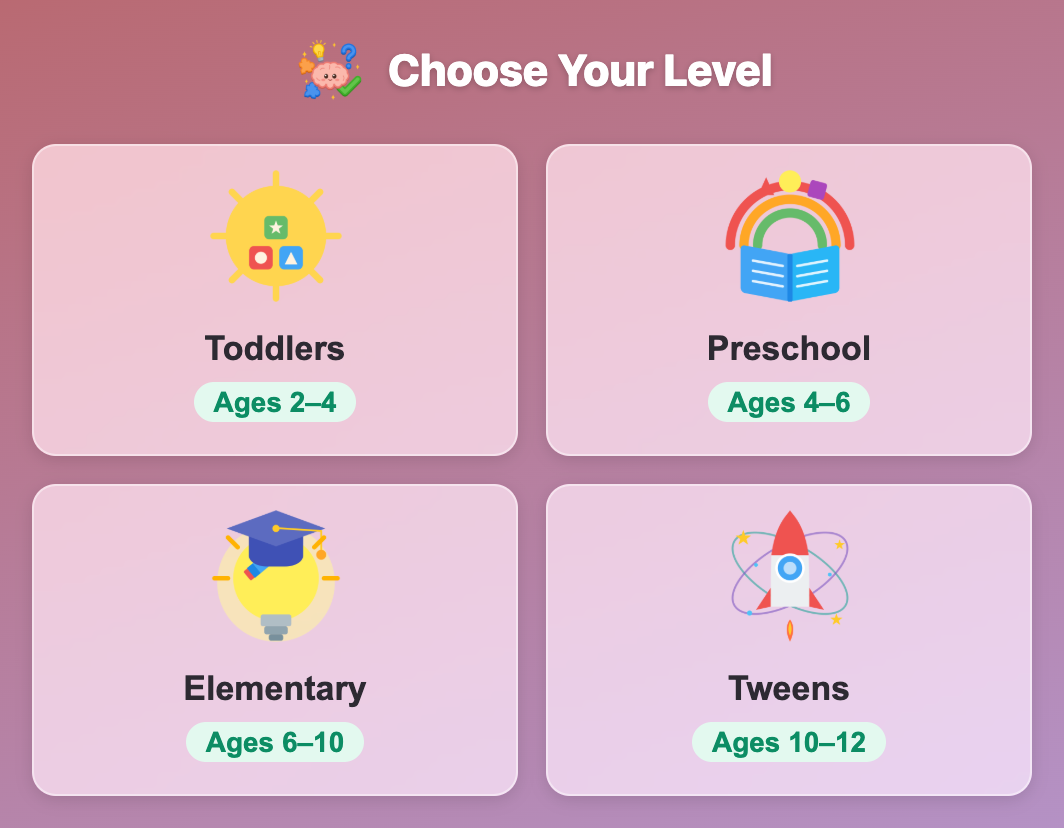
The Lantern Castle level picker with four cards: Toddlers ages 2–4, Preschool 4–6, Elementary 6–10 and Tweens 10–12
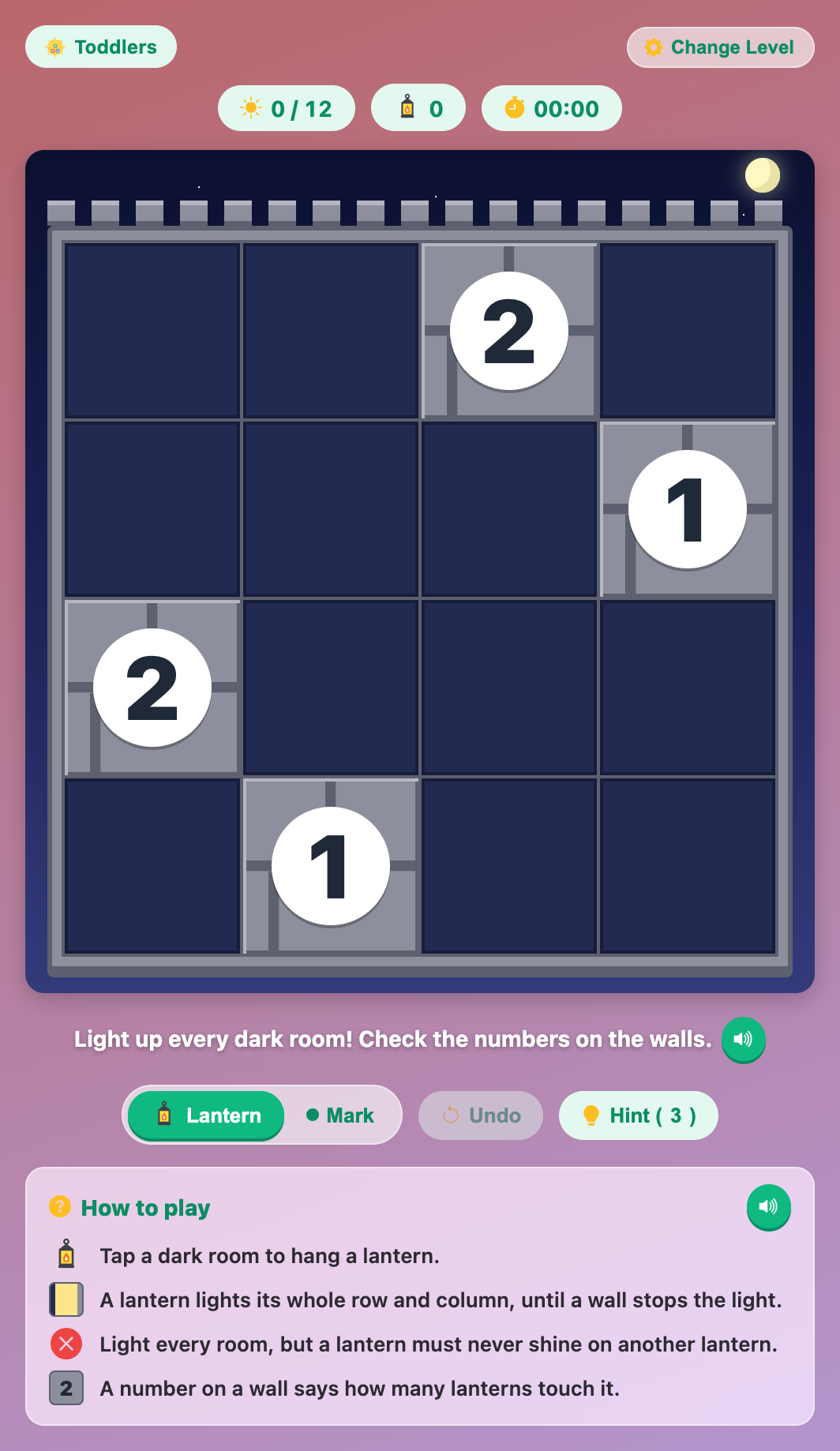
A dark 4x4 Lantern Castle for toddlers under a night sky and moon, with wall numbers 2, 1, 2 and 1
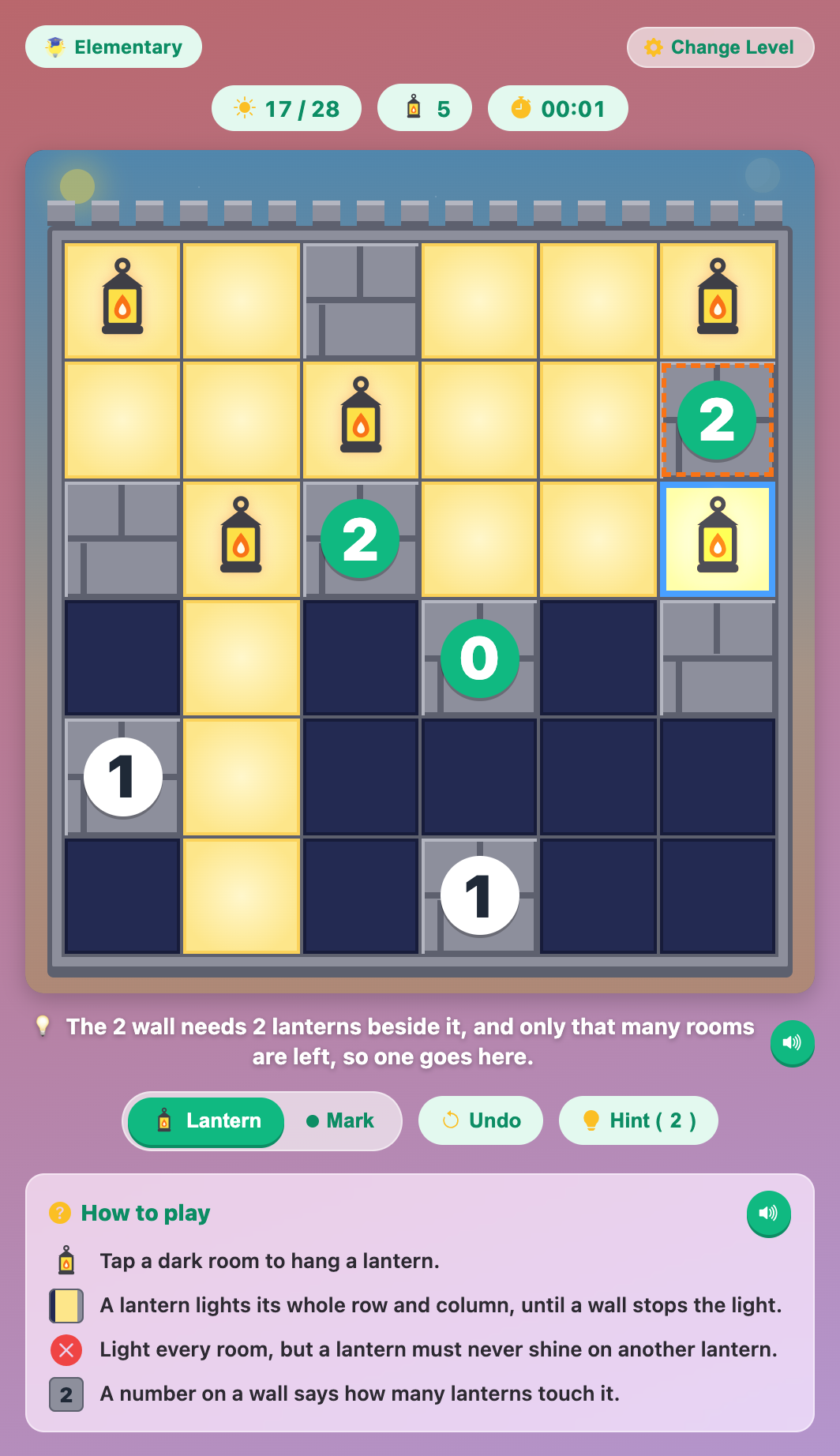
A half-lit Elementary castle where a hint lantern sits in a blue ring beside a 2 wall in an orange dashed ring
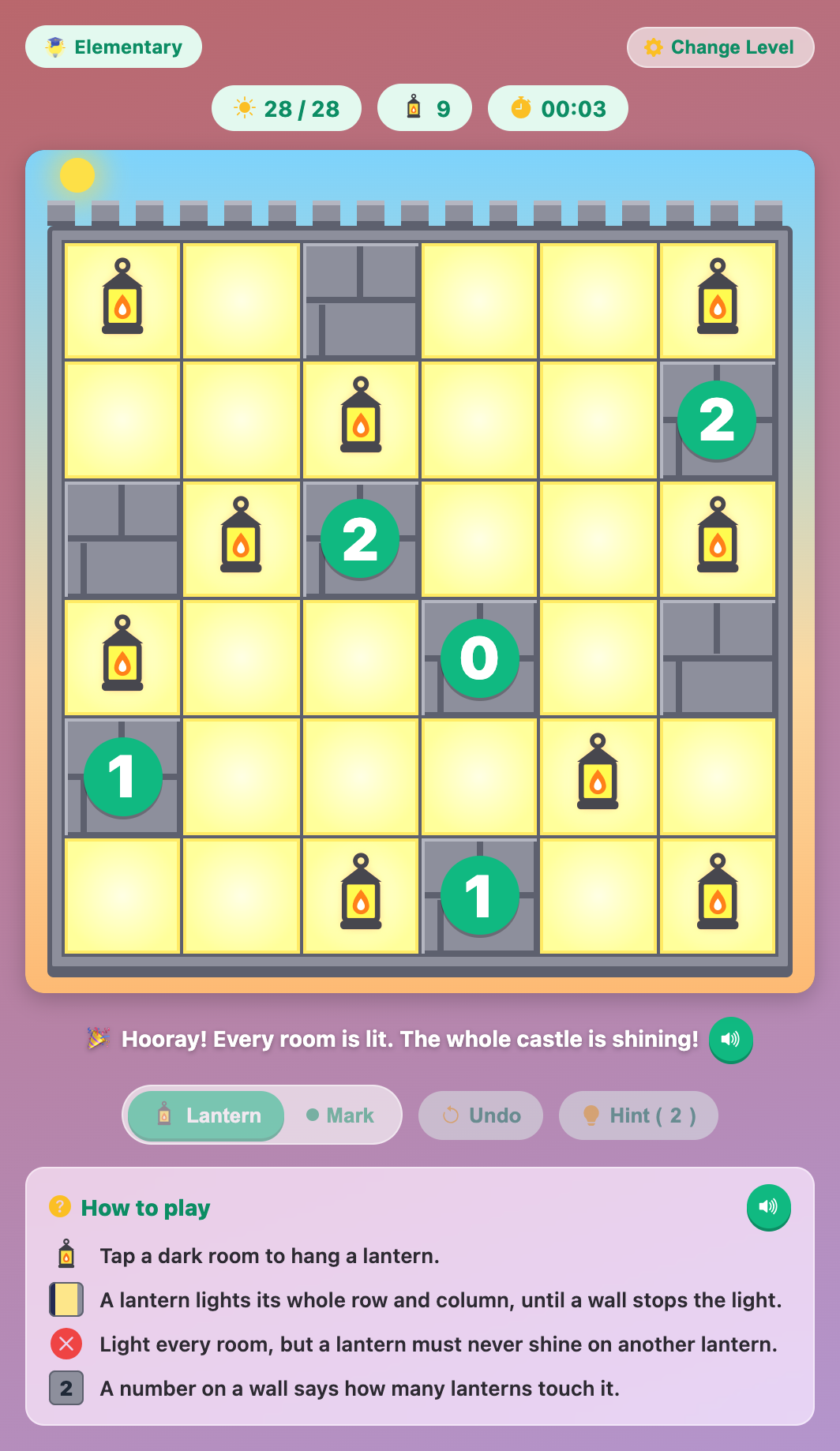
A solved 6x6 Lantern Castle with every room glowing yellow, every wall number green and the sun up
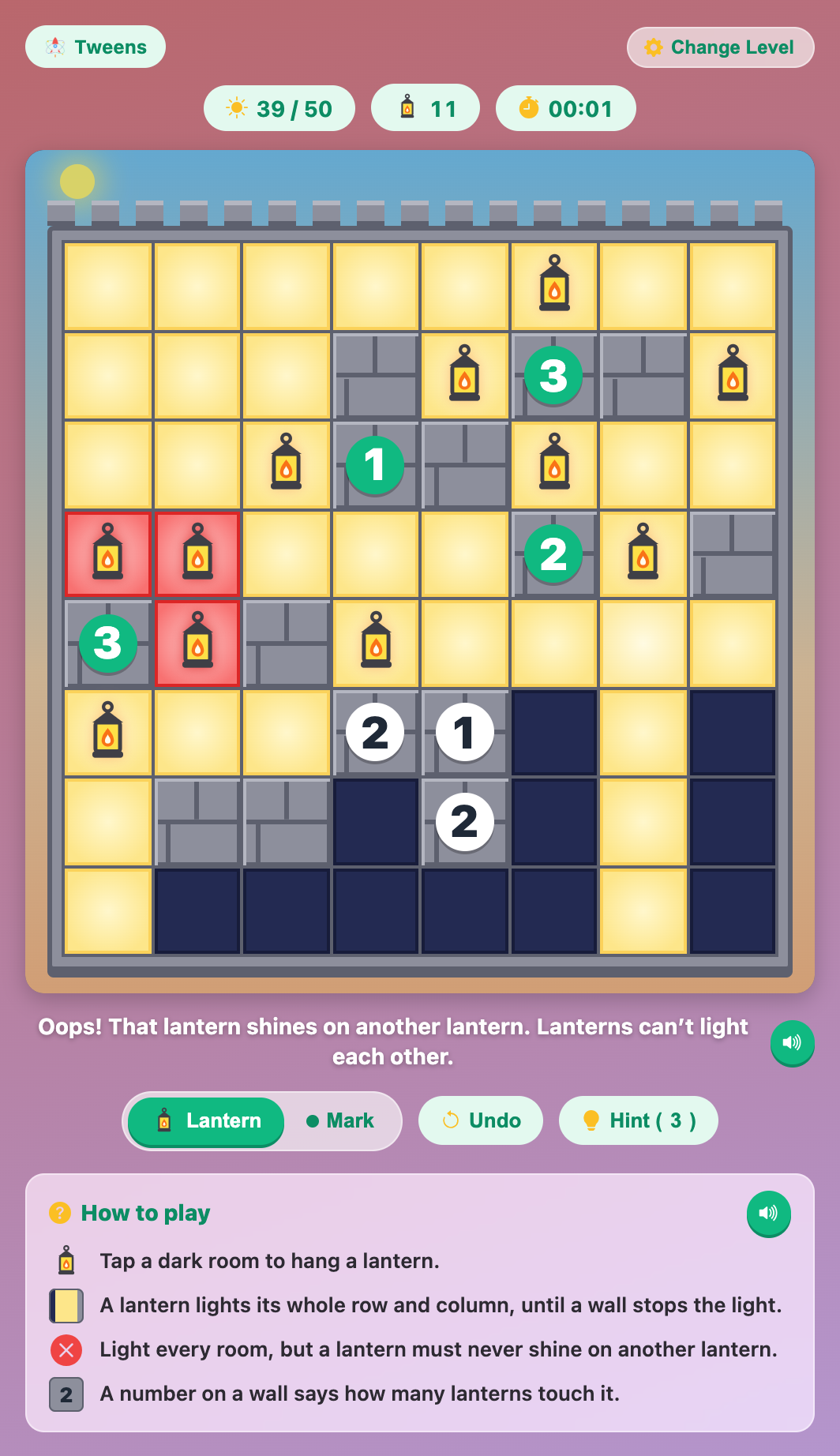
An 8x8 Lantern Castle for tweens where three lanterns glow red because they shine on each other
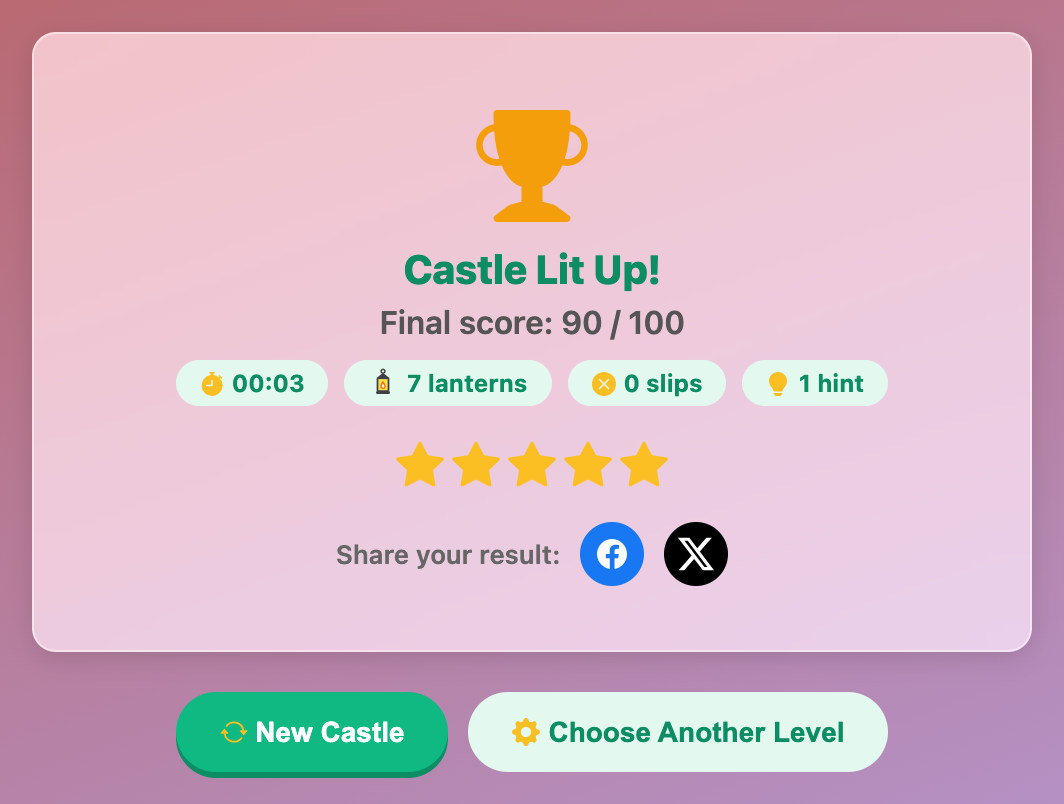
The Castle Lit Up finish card with a gold trophy, a final score of 90 out of 100 and five stars
More Mind Games
 328.4K plays
5.0
Sun & Moon
Fill the sky with suns and moons! Tap a square once for a sun and twice for a moon, but never put three of the same in a row. On bigger boards every row and column needs as many suns as moons, and no two rows can be the same. Broken rules glow red right away, and a hint always tells you why. A brand-new puzzle with exactly one answer every game.
 324.6K plays
5.0
Odd One Out
Spot the one picture that doesn't belong in the group before time runs out.
 863.6K plays
4.9
Jigsaw Puzzle
Drag interlocking pieces into place to assemble colorful pictures.
 96.6K plays
4.9
Riddle Rush
Read the fun riddle and pick the correct answer before time runs out.
Most Played Games
 366.2K plays
5.0
Tic-Tac-Toe
Play a game of Tic-Tac-Toe against the computer and see if you can outsmart it.
 1.1M plays
4.9
Chess
Play the classic game of chess against the computer or a friend, with FIDE time controls, hints, and undo.
 263.7K plays
4.9
Category Sort
Decide whether each picture is an animal, food, toy, or vehicle before time runs out.
 568.7K plays
4.9
Connect Four
Drop your pieces and be the first to connect four in a row against the computer or a friend.
Comments (43)