Sun & Moon
328.4K playsFill the sky with suns and moons! Tap a square once for a sun and twice for a moon, but never put three of the same in a row. On bigger boards every row and column needs as many suns as moons, and no two rows can be the same. Broken rules glow red right away, and a hint always tells you why. A brand-new puzzle with exactly one answer every game.
Sun, moon, sun, moon. The sky takes turns, and so does this puzzle! Sun & Moon for kids is a free logic puzzle where you fill a grid with smiling suns ☀️ and sleepy moons 🌙, but you may never put three of the same kind in a row. You play it right in your browser on a computer, tablet or phone, with nothing to download and no sign-up, and it has four levels for kids from 2 to 12.
The board sits in a sky that turns from bright blue day on one side to a starry night on the other. Some squares already have a sun or a moon. Your job is to fill every empty square, one tap at a time. Every puzzle is brand new, made by the game just for you, and it always has exactly one right answer. You can always find it by thinking, never by guessing.
🌗 A Puzzle Made of Two Pictures
Sun & Moon is the KidWorld version of a puzzle called Takuzu, also known as Binairo or the binary puzzle. "Binary" means "made of two things". Computers think with just two numbers, 0 and 1. In the grown-up puzzle, you fill the grid with 0s and 1s. On KidWorld, the 0s and 1s became suns and moons, so even a child who can't count yet can play.
The puzzle got popular in Belgium and the Netherlands around 2009, and now people solve it in newspapers and puzzle books all over the world. It uses only two kinds of pieces, but the rules make them fit together in just one way.
Here are all the rules. Not every level uses all of them:
Fill every square with a sun or a moon. (Every level.)
Never three in a row. Three suns or three moons side by side is not allowed, across or down. (Every level.)
Half and half. Every row and every column needs the same number of suns and moons. On a 6 by 6 board that's 3 suns and 3 moons. (Elementary and Tweens.)
No twins. No two rows can be exactly the same, and no two columns can be the same either. (Tweens only.)
A row is a line of squares going across, like words on a page. A column is a line going down, like a stack of blocks.
🕹️ Your First Sky, Tap by Tap
Pick your level. The game may start you on Elementary. Tap Change Level at the top to see all four cards: Toddlers (ages 2–4), Preschool (4–6), Elementary (6–10) and Tweens (10–12). The game remembers your choice next time.
Read the How to play box. Under the board, a box lists only the rules for your level. Tap its 🔊 button to hear them read out loud. When the site's sound is on, the game reads them to you as each puzzle starts.
Spot the starting squares. Some suns and moons are already there. They have a deeper color and a thicker edge, and they can't be changed. They are your first clues.
Tap to fill. Tap an empty square once for a sun. Tap it again for a moon. Tap once more to make it empty again. Sun squares turn yellow like daytime, and moon squares turn dark blue like the night.
Go backward if you like. On a computer, right-click a square to go the other way (empty, then moon, then sun). On a phone or tablet, press and hold the square instead. That's a quick way to put a moon on an empty square.
Watch the counters. Above the board you'll see how many squares are filled (like 22 / 36) and a stopwatch. The stopwatch starts with your first tap. There is no time limit, and your time doesn't change your score.
Check the little badges. On Elementary and Tweens, a small dot sits at the end of every row and under every column. It turns into a green check ✅ when that line is full and right. A red ! means too many suns or moons in that line, and a red = means that line matches another one.
Use Undo and Hint. Undo takes back your changes one at a time, as far back as you like. Hint helps with one square and tells you why. You get 3 hints for every puzzle.
Finish the sky! When every square is full and no rule is broken, the squares bounce in a wave and the suns and moons glow. Then the "Sun & Moon Solved!" card shows your time, the board size, your slips, your hints, your score out of 100 and up to 5 stars.
Play again. Tap New Puzzle for a fresh board at the same level, or Choose Another Level to switch. The buttons around the game let you go fullscreen, reload the game or turn the music on and off.
🔴 Red Squares, Slips and Hints
Sun & Moon tells you right away when something is wrong. If three suns or three moons line up, those squares turn red and pulse. A tip under the board says what happened, such as "Three moons in a row! Tap again to change it." On the bigger boards, the tip can also say "Too many moons in this row!" or "This row is the same as row 4!"
Here is the kind part: a red square doesn't cost you anything by itself. To get a moon, you have to tap through a sun first, and that sun might break a rule for a moment. The game knows that. It only counts a slip when you tap a different square while the one you just changed is still breaking a rule. Then a wrong-answer sound plays (when the sound is on), the red squares shake, and the tip says "Oops! A rule is still broken. Fix the red squares."
A slip also never happens when you tap Undo or Hint. So if you see red, you can fix it, undo it, or ask for help, and your score stays safe.
Hints are clever too. If one of your squares doesn't match the answer, a hint takes it away first, starting with any square that breaks a rule. If all your squares are right, the hint fills in a new one. The new square gets a blue ring, and the squares it was worked out from get orange dashed outlines for a moment. The tip explains the reason, like "Two moons side by side, so the next square must be a sun. Never three in a row!" Each hint is a tiny lesson.
☀️ How to Win at Sun & Moon for Kids: The Five Clues
Good players don't guess. They look for clues that leave only one choice for a square. The hints in this game use exactly five kinds of clues, from easiest to hardest. Learn them, and you'll barely need a hint at all.
Clue 1: The Pair Clue 👯
When you see two of the same kind side by side, the squares on both ends of that pair must be the other kind. Two suns next to each other? Then the square before them and the square after them must be moons. If they were suns too, you'd have three in a row.
This works across and down. It's the most common clue in the game, so always look for pairs first.
Clue 2: The Sandwich Clue 🥪
When two of the same kind have one empty square between them, that middle square must be the other kind. A moon, an empty square, then a moon? The middle one is a sun. Think of it like a sandwich: two slices of moon need a sunny filling! If you put a moon there, you'd make three moons in a row.
Clue 3: The Half-Full Clue 🍕
This one works on Elementary and Tweens, where every line needs half suns and half moons. Count the suns in a row. If the row already has half its squares as suns, every empty square left in that row must be a moon. It works the other way too.
On a 6 by 6 board, half is 3. On 8 by 8 it's 4, and on 10 by 10 it's 5. Counting like this is a great way to finish a line fast.
Clue 4: The No-Twins Clue 🚫
This one is for Tweens. Look for a full row, and then another row that has only two empty squares left. If filling those two squares one way would make it a copy of the full row, you must fill them the other way round. The same trick works for columns.
Clue 5: The "What If" Clue 🤔
This is the big-kid trick, and Tweens puzzles almost always need it somewhere. Pick a square and imagine a sun in it. Then follow the easy clues in your head. Does that lead to three moons in a row, or too many of one kind? If it does, the sun was wrong, so that square must be a moon.
When a Tweens hint uses this clue, the tip says something like "A sun here would make a rule break a few squares later, so it must be a moon." It's like checking a path in a maze with your finger before you walk it.
Smart habits that help every clue
Hunt pairs and sandwiches all over the board first. They're quick to spot, and every square you fill can create new pairs somewhere else.
Check down, not just across. Many players only look along rows and miss easy clues in the columns.
Count lines that are almost full. A line with only one or two empty squares is usually the next easy win.
Finish what you start. Before you tap a new square, make sure the last one isn't red. That keeps your slips at zero.
Use Undo when you're unsure. Undo never costs points, so step back instead of guessing.
Save your hints. Use one only when you've checked all five clues and still feel stuck. Then read the tip carefully, because it teaches you a clue to use on your own next time.
🧮 Let's Solve Some Lines Together
In these examples, ☀️ is a sun, 🌙 is a moon and ⬜ is an empty square. Read each line from left to right.
Example 1: A Toddlers row
The row is: ☀️ ☀️ ⬜ 🌙
The first two squares are a pair of suns.
A third sun would make three in a row, so the empty square is a moon.
The row becomes ☀️ ☀️ 🌙 🌙. Two moons side by side is fine. Only three is too many!
Example 2: A Preschool column
Reading from top to bottom, the column is: 🌙 ⬜ 🌙 ⬜
The second square is sandwiched between two moons, so it must be a sun.
Now the column is 🌙 ☀️ 🌙 ⬜. On the 4 by 4 boards there's no half-and-half rule, so either a sun or a moon could fit in the last square here.
Don't guess! Look at that square's row instead. A pair or a sandwich there will tell you the answer.
Example 3: An Elementary row, by counting
The row is: ☀️ 🌙 ☀️ ⬜ ☀️ ⬜
A 6-square row needs 3 suns and 3 moons.
Count the suns: there are already 3. That's half!
So both empty squares are moons: ☀️ 🌙 ☀️ 🌙 ☀️ 🌙.
Example 4: An Elementary row, with two clues working together
The row is: ⬜ 🌙 🌙 ⬜ ☀️ ⬜
The two moons are a pair, so the squares on both ends must be suns: ☀️ 🌙 🌙 ☀️ ☀️ ⬜.
Now squares 4 and 5 are a pair of suns, so the last square is a moon.
Check by counting: ☀️ 🌙 🌙 ☀️ ☀️ 🌙 has 3 suns and 3 moons. Perfect!
See how one clue opens the door for the next? That chain is what solving this puzzle feels like.
Example 5: A "what if" row
The row is: ☀️ ⬜ ⬜ ⬜ ⬜ ☀️ (it needs 3 suns and 3 moons).
No pair, no sandwich, and no half-full count. Time to ask "what if?"
What if the second square were a sun? Then squares 1 and 2 make a pair, so square 3 is a moon. Now the row has 3 suns already, so every empty square left is a moon too.
That gives ☀️ ☀️ 🌙 🌙 🌙 ☀️, which has three moons in a row. That breaks a rule!
So the second square must be a moon. The same thinking works for the fifth square, so the row starts to look like ☀️ 🌙 ⬜ ⬜ 🌙 ☀️.
Example 6: A Tweens no-twins row
A full 8-square row reads: ☀️ 🌙 ☀️ ☀️ 🌙 🌙 ☀️ 🌙. Another row reads: ☀️ 🌙 ⬜ ☀️ 🌙 ⬜ ☀️ 🌙.
The second row has 3 suns and 3 moons, so its two empty squares need one sun and one moon.
If square 3 were a sun and square 6 a moon, the row would be an exact copy of the full row. Twins aren't allowed!
So square 3 is a moon and square 6 is a sun: ☀️ 🌙 🌙 ☀️ 🌙 ☀️ ☀️ 🌙. No three in a row, and no twins.
🏅 How to Keep Your Score Near 100
Every solved puzzle starts at 100 points. Each slip takes away 5 points. Each hint takes away 8 points on Toddlers and Preschool, 10 on Elementary and 12 on Tweens. A finished puzzle always scores at least 10, so finishing is always worth it.
Your stars come from your score. 90 or more gets 5 stars and a trophy, 70 or more gets 4 stars, and 50 or more gets 3 stars. That means one hint on Elementary (90 points) still earns all 5 stars, but one hint on Tweens (88 points) drops you to 4. Two slips also leave you at 90. Time doesn't matter at all, so slow and careful is the winning plan.
🌱 A Puzzle That Grows Up With Your Child
Each level changes the board size, the rules and how many squares start empty. Here's what your child will see at each one.
Toddlers (ages 2–4)
Sun & Moon for toddlers uses a small 4 by 4 board with only one rule: never three in a row. Most of the board is already filled, and only about 6 of the 16 squares start empty. Big, friendly pictures and the read-aloud tips make it a gentle first puzzle. Sit with your little one, point at a pair of suns and ask, "What comes next?"
Preschool (ages 4–6)
Sun & Moon for preschoolers keeps the 4 by 4 board and the same single rule, but about half the squares start empty. Kids now need pairs and sandwiches together, and filling one square often unlocks the next. It's a fun way to practice spotting patterns.
Elementary (ages 6–10)
Sun & Moon for elementary kids moves up to a 6 by 6 board and adds the half-and-half rule: 3 suns and 3 moons in every row and column. About two thirds of the squares start empty, and the row and column badges help kids check their counting. If your child enjoys this level, Crown Garden is another puzzle where each row and column needs exactly the right thing, using the same tap-once, tap-twice controls.
Tweens (ages 10–12)
Sun & Moon for tweens is the real challenge. The board is 8 by 8 or 10 by 10, all four rules are on, and about four out of five squares start empty. Most puzzles need the "what if" clue at least once. Tweens who like counting along rows and columns can try Camping Trip, where numbers on the edge say how many tents go in each line and every tree needs its own tent.
🧠 What a Sky Full of Suns and Moons Teaches
Thinking in steps. When a pair of moons tells you where a sun goes, and that sun makes a new pair, your child is following a chain of reasons. That's the same kind of thinking used in math and in science.
Checking your own work. The red squares and the row badges show mistakes right away. Kids learn to look again and fix things themselves, without feeling bad, because a red square isn't a slip until they move on.
Counting with a purpose. On the bigger boards, counting to 3, 4 or 5 decides where every moon goes. Numbers stop being a worksheet and become a tool.
Patience and calm. There's no time limit and no lives to lose. Kids learn that slowing down wins more stars than rushing. Kids who love this kind of row-and-column thinking will also enjoy City Skyline, where every row and column gets one tower of each height.
A note for parents and teachers
Sun & Moon is calm and safe. There are no scary pictures, no chat and no timer pressure, just smiling suns, sleepy moons and soft music you can turn off. Every puzzle is made fresh with exactly one answer, so there's always something new to solve. It practices logical thinking, pattern spotting, counting and careful checking. Because the hints explain their reason out loud, it's also a nice puzzle to solve side by side, talking through each clue together.
Ready to fill the sky? Pick a level above, look for your first pair, and tap your way from day to night. Sun & Moon for kids has a brand-new puzzle waiting every time you play!
🖼️ See the Game in Action
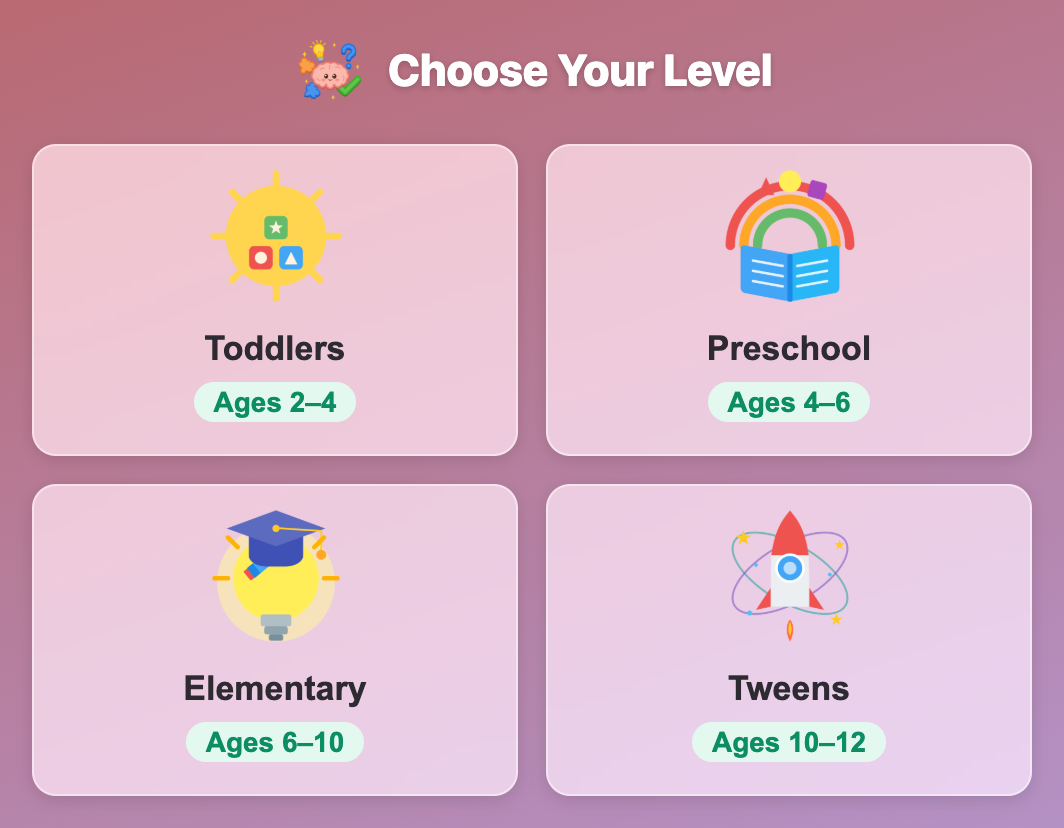
The Choose Your Level screen in Sun & Moon for kids, with Toddlers, Preschool, Elementary and Tweens cards
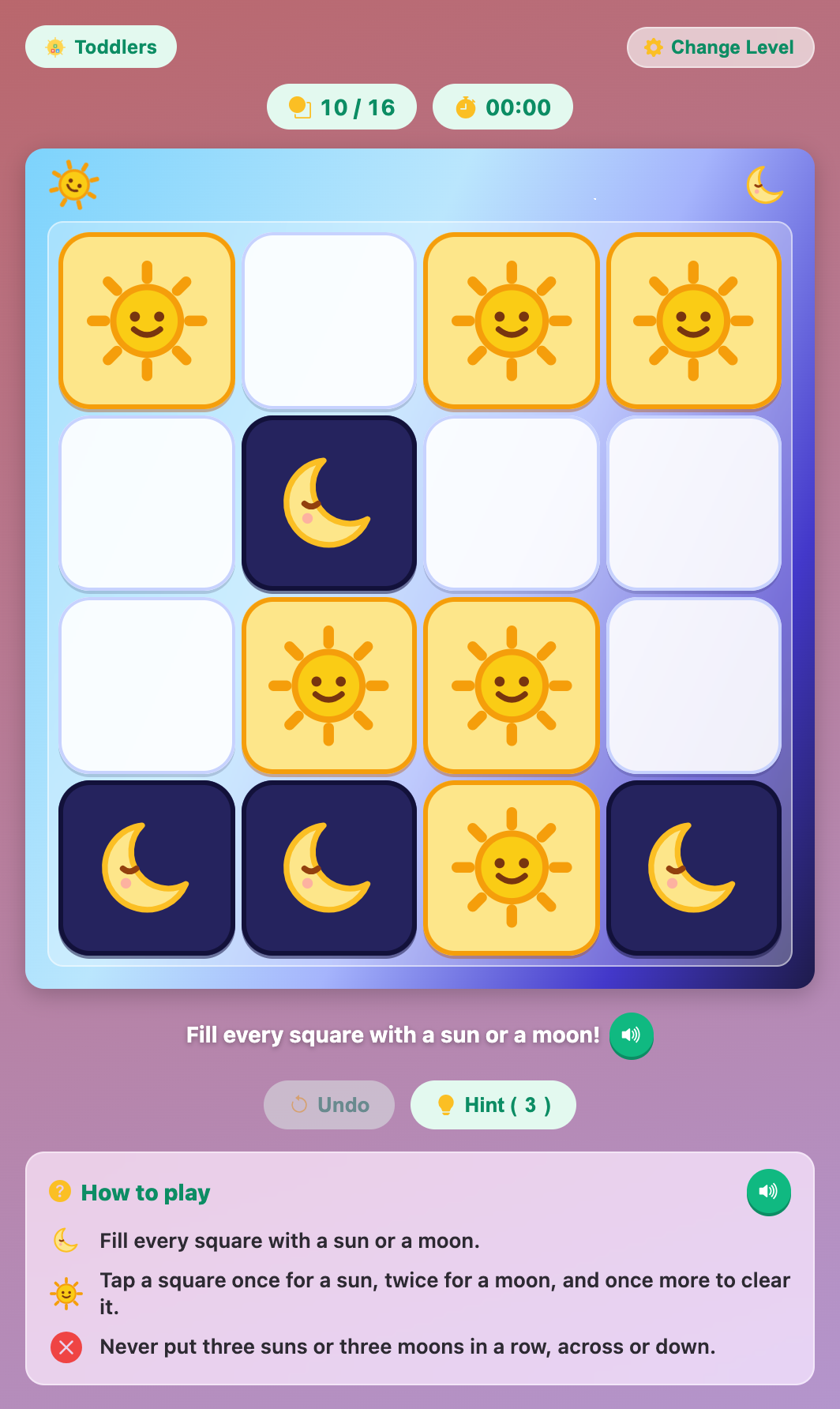
A 4x4 Sun & Moon for toddlers board with ten suns and moons already placed and six empty squares
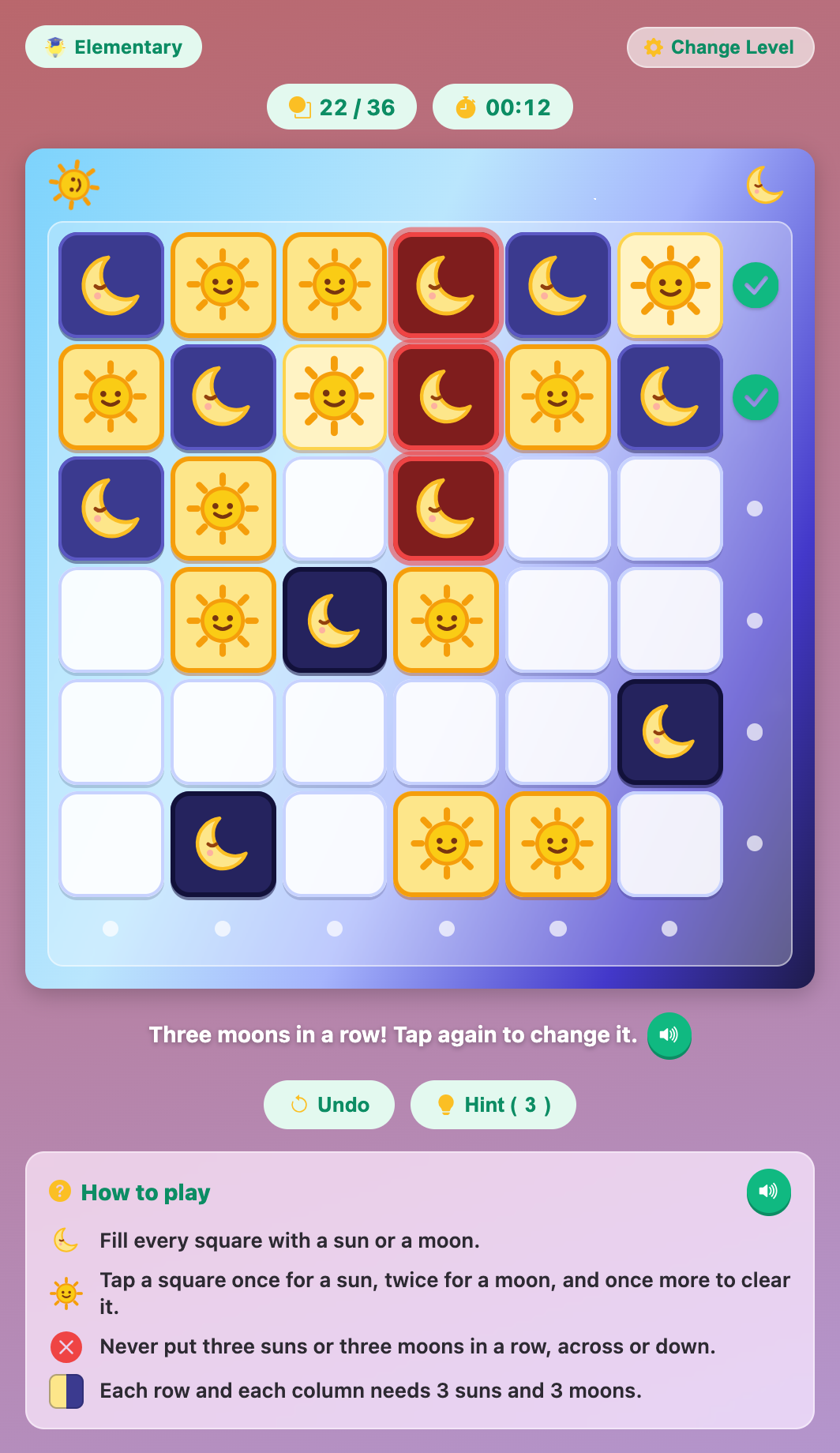
Three moons stacked down one column glowing red on a 6x6 board, with the tip Three moons in a row
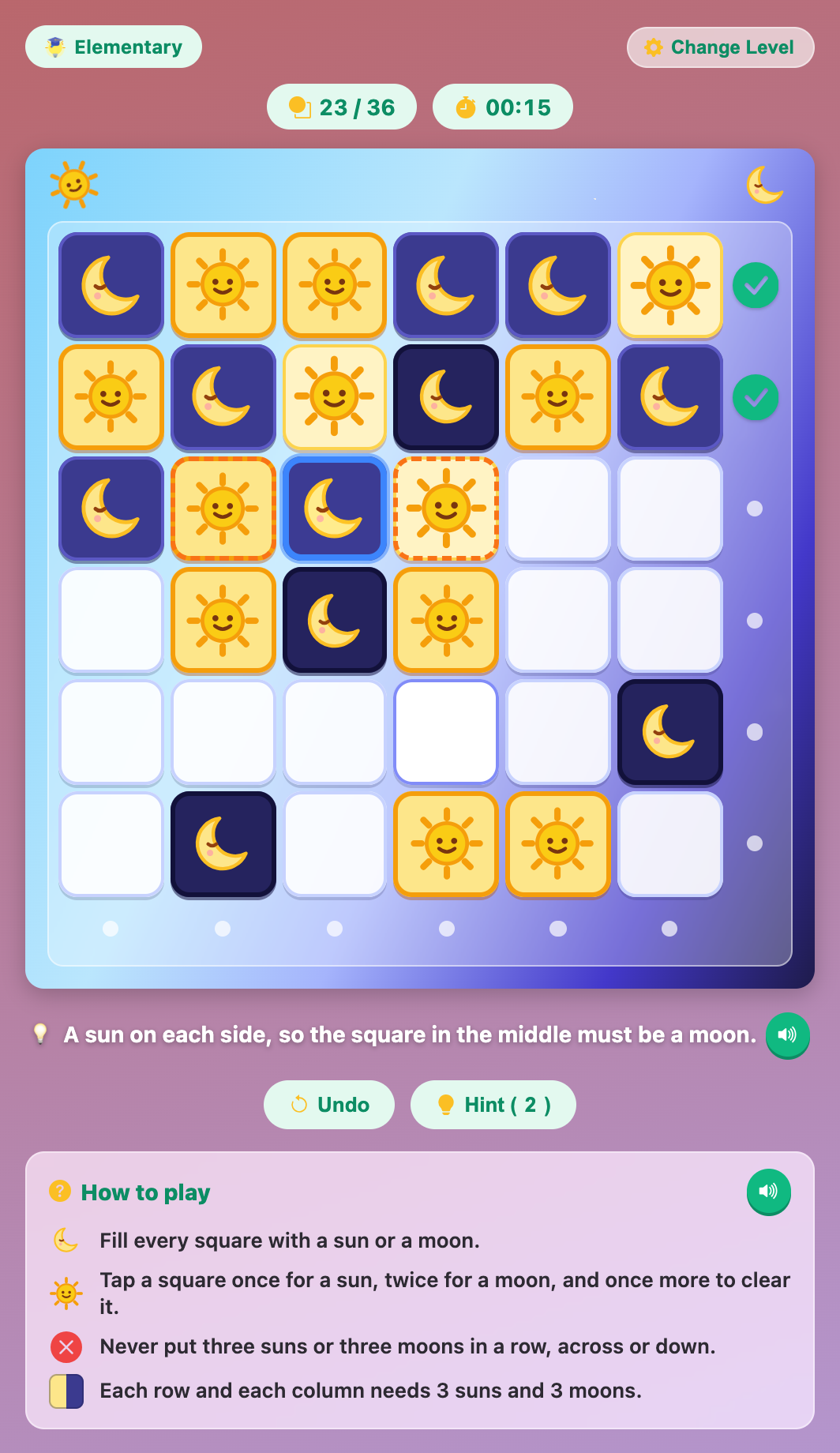
A hint ring around a new moon between two suns with orange dashed outlines on the 6x6 Elementary board
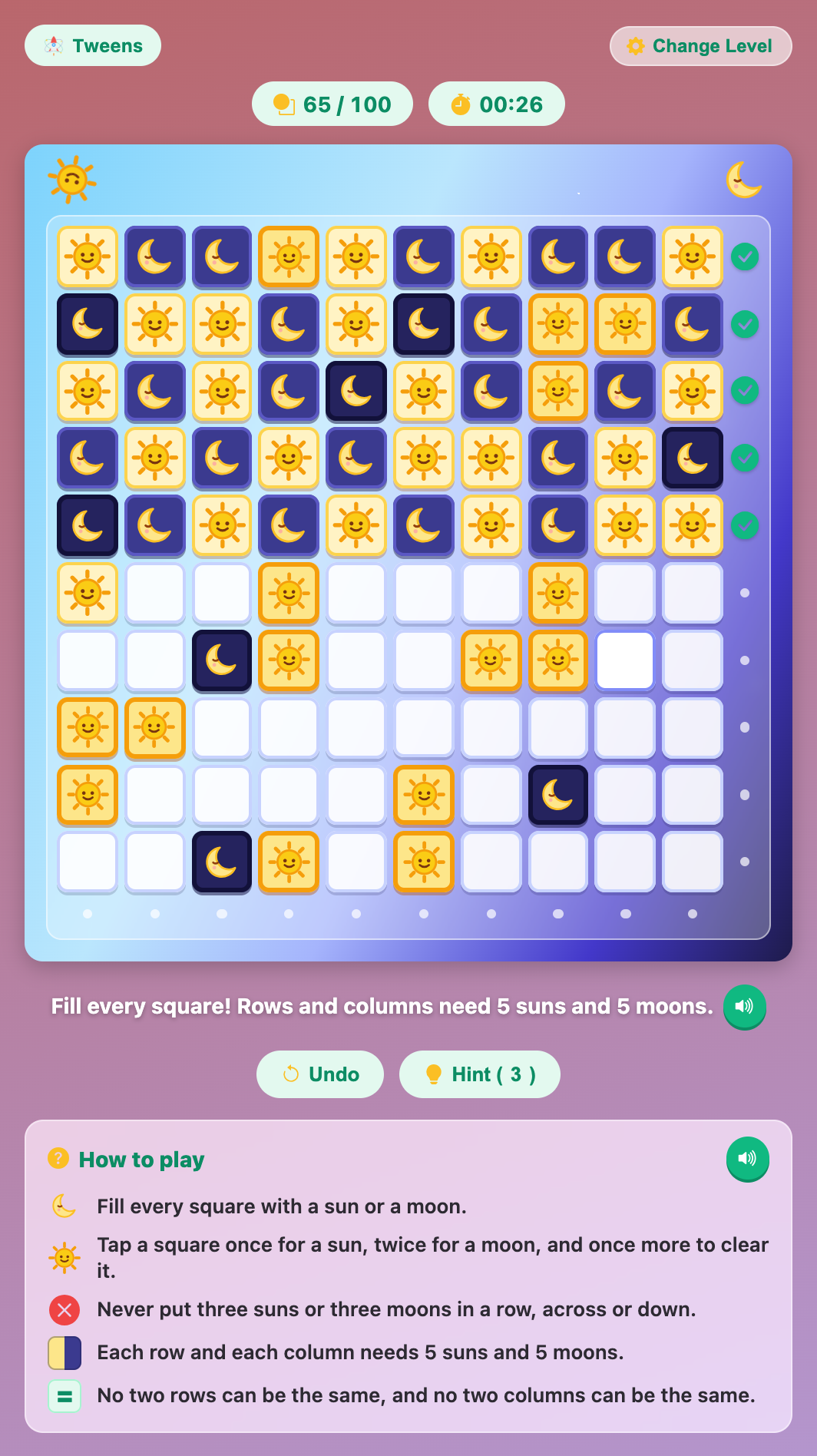
A 10x10 Sun & Moon for tweens board with the top five rows finished and green checks beside them
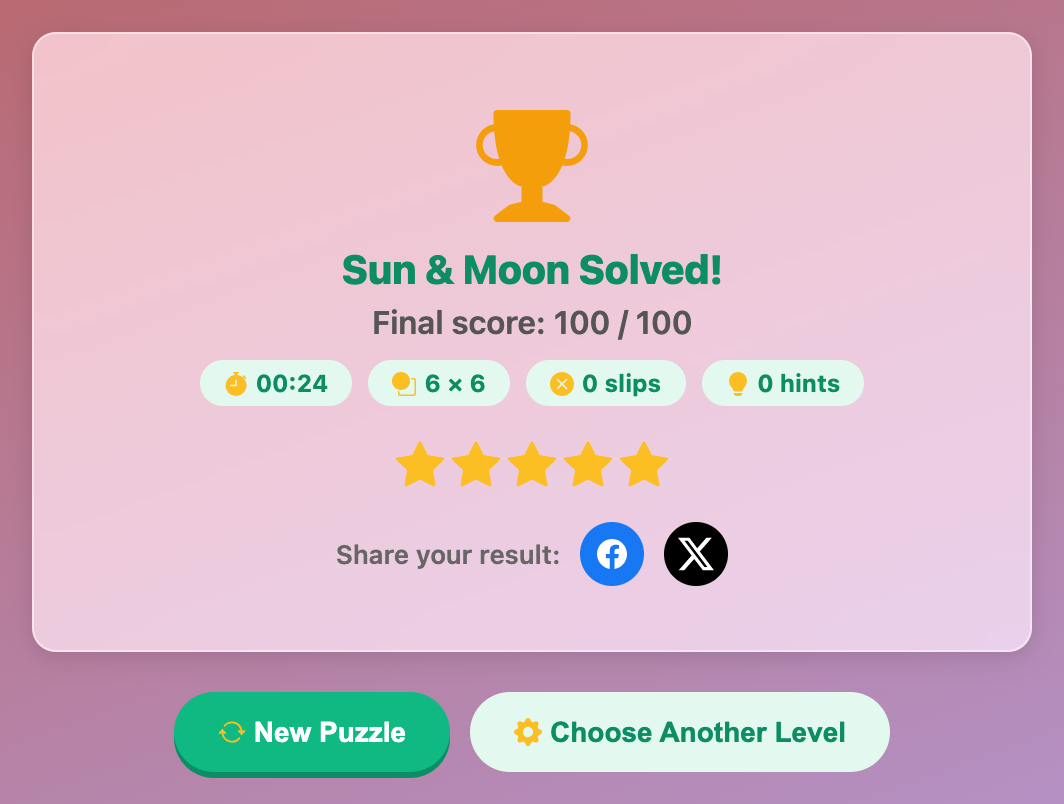
The Sun & Moon Solved finish card with a trophy, a score of 100 out of 100 and five stars
More Mind Games
 137.3K plays
5.0
Gomoku – Five in a Row
Place your stones on the board and be the first to get five in a row — across, down, or diagonal — against the computer or a friend.
 162.6K plays
4.9
Lantern Castle
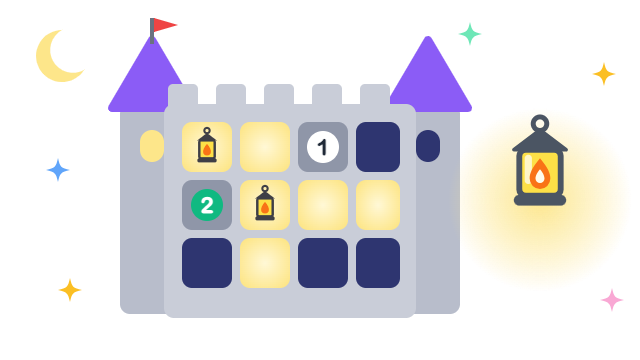
The castle is dark! Hang lanterns to light every room. Each lantern shines along its whole row and column until a wall stops the light, but no lantern may shine on another lantern, and a number on a wall tells how many lanterns touch it. Watch the night sky turn to dawn as the castle lights up. A clever logic puzzle with a brand-new castle every game.
 514.5K plays
5.0
Maze Runner
Guide your explorer through a maze to find the treasure, using as few steps as you can.
 38.5K plays
4.9
Crown Garden
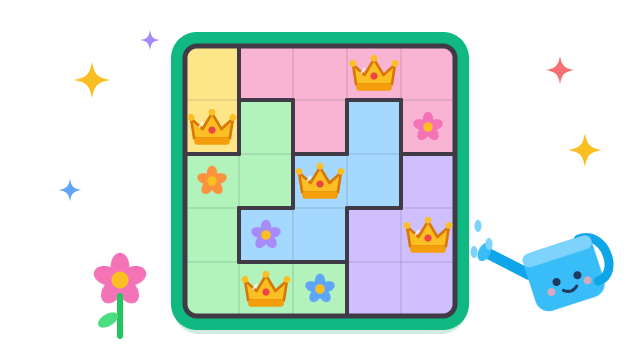
Plant one crown in every row, every column and every colored flower bed, but crowns can't touch, not even at the corners! Tap once for an X, twice for a crown, and watch rows, columns and beds turn green as you get them right. Every garden has exactly one answer you can find with logic alone, and a hint always tells you why.
Most Played Games
 366.2K plays
5.0
Tic-Tac-Toe
Play a game of Tic-Tac-Toe against the computer and see if you can outsmart it.
 1.1M plays
4.9
Chess
Play the classic game of chess against the computer or a friend, with FIDE time controls, hints, and undo.
 263.7K plays
4.9
Category Sort
Decide whether each picture is an animal, food, toy, or vehicle before time runs out.
 568.7K plays
4.9
Connect Four
Drop your pieces and be the first to connect four in a row against the computer or a friend.
Comments (32)