
Camping Trip
87.4K playsEvery tree needs its own tent right beside it! The numbers on the edge say how many tents go in each row and column, and tents can't touch, not even at the corners. Tap for a tent, tap again to mark grass, and watch the numbers turn green as you get them right. Every campsite has exactly one answer you can find with logic alone, and when it's done the campfires light up and the campers pop out.
Puzzle fans call it Tents and Trees, and on KidWorld it becomes a sunny campground. Camping Trip for kids asks you to put up one tent next to every tree, using the numbers on the edge of the board as your guide. It plays in your web browser on a computer, tablet or phone, with nothing to install and no account to make, and its four levels go from a tiny 4 by 4 field for ages 2 to 4 up to a big 10 by 10 campground for ages 10 to 12.
There is no guessing in this game. Every campsite has exactly one right answer, and you can always find it by thinking one step at a time. When the last tent goes up, the meadow turns bright green, little campfires 🔥 light up, and a happy camper pops out of every tent. That moment is the best part of the trip!
🏕️ Tents and Trees: The Puzzle Under the Pine Trees
Tents and Trees (sometimes just called Tents) is a pencil-and-paper puzzle that has filled puzzle books and magazines for many years. It is a logic puzzle. Logic means you use clues and careful thinking to work out the answer, instead of guessing.
Every Camping Trip board is a square field of grass with some trees 🌳🌲 on it. Your job is to put up tents ⛺ so that four camp rules are all true at the same time:
Every tree gets its own tent. The tent must be right beside its tree: up, down, left or right. A tent that only touches a tree's corner does not count.
Each tent belongs to just one tree. So there are always exactly as many tents as trees.
The numbers tell you how many tents go in each line. The numbers down the left side are for the rows (the lines that go across). The numbers along the top are for the columns (the lines that go up and down).
Tents can't touch each other, not even at the corners. Campers like a little space! A tent's eight neighbors, including the four squares at its corners, must all stay free of tents.
That's the whole game. Four short rules, and yet a big campground can keep even a grown-up thinking for a good while.
🎒 Packing for the Trip: How Camping Trip Works on KidWorld
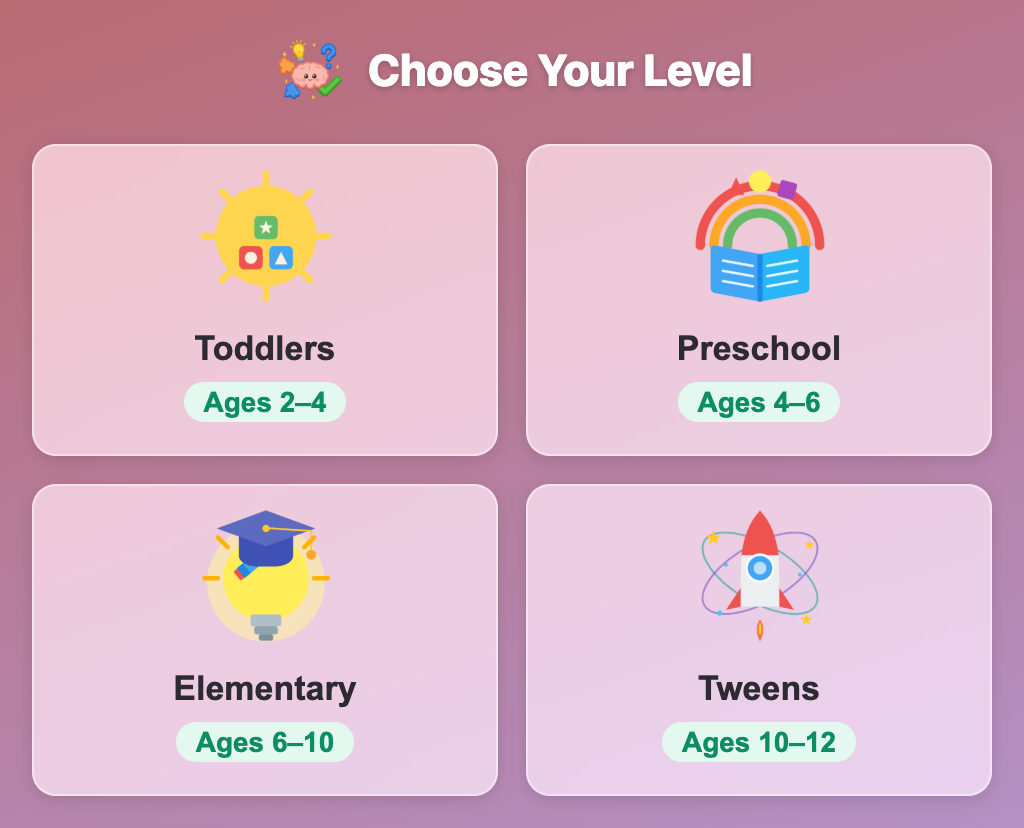
Pick your level. The game starts on Elementary. To switch, tap Change Level at the top and pick Toddlers, Preschool, Elementary or Tweens. The game remembers your choice for next time.
Read the camp note. The message box above the board tells you the goal. Tap the green 🔊 button beside it and the game reads the message out loud. That's handy for kids who are still learning to read.
Look at the stat row. It shows which campsite you are on (like Campsite 1 / 3), your points ⭐ so far, and a stopwatch. The stopwatch only counts up. There is no time limit, and being fast does not change your points.
Tap a square to put up a tent. Tap the same square again and it turns into grass 🌿. Grass is your own note that says "no tent can go here". Tap a third time to make the square empty again.
Drag to paint grass. Press on a square and slide across others to cover them all with grass in one go. If you start the drag on grass, the drag wipes grass away instead. Dragging never touches tents or trees.
Leave the trees alone. Trees can't be moved. If you tap one, the game reminds you: "Trees stay where they are. Put a tent right next to one!"
Use the tool buttons. Hint helps you with your next step. Undo takes back your last move, and you can keep pressing it to go further back. Clear empties the whole campsite so you can start over (and Undo can even bring it back).
Play with a keyboard if you like. The arrow keys move from square to square, and Enter or Space works like a tap.
Light the campfires. When every rule is true, the campsite is solved. A panel shows your stars for that campsite and a big Next Campsite button. The button fills up and counts down from 5, then moves on by itself, so tap it if you can't wait.
See your score. After the last campsite, the Happy Campers! card shows your final score, your total time, your hints and mistakes, and a tiny picture of every campground you solved. Tap Play Again for brand-new campsites, or Choose Another Level.
Use the page buttons. The buttons around the game let you go fullscreen, reload the game, and turn the music and sounds on or off.
🚦 What the Colors on the Board Are Telling You
Camping Trip talks to you with colors. Learning what they mean will make you a much faster camper.
Gray dots sit on squares where a tent can never go right now. A square gets a dot when no tree is beside it, when it touches a tent you already put up, or when its row or column already has all its tents. Trust the dots! They are free clues.
A green number means that row or column has exactly the right number of tents.
A red number means something is wrong in that line. Either it has too many tents, or there isn't enough room left for the tents it still needs.
A green ring around a tree means that tree has a tent of its very own.
Red stripes on a tent mean it breaks a rule: it touches another tent, it has no tree beside it, or it is trying to share a tree with a different tent. Red stripes on a tree mean it has no spot left for its tent.
An amber ring marks a tent that a hint just put up, and the squares the hint is talking about glow for a moment.
When you put a tent in a spot that breaks a rule, the message box tells you which one, like "Oops! Tents can't touch, not even at the corners." or "Oops! Row 3 only gets 1 tent." That counts as one mistake. If you only make a line run out of room, you get an "Uh-oh!" message instead, and that one is not counted as a mistake. It's just a friendly warning.
🔦 Camping Trip for Kids: Smart Ways to Find Every Tent
Good campers don't guess. They look for a square where they can be sure. Here are the tricks, starting with the easiest ones.
Trick 1: Clear out the zeros
A row or column with a 0 gets no tents at all. The game shows it green straight away, because it is already right! Every empty square in that line can be grass. Drag across the whole line to paint it in one swipe. This works because a 0 is the one number that never needs any thinking.
Trick 2: Find the lonely tree
Look at each tree and count its free sides. A side is not free if it's off the edge of the board, if another tree is there, or if it has a gray dot or grass. When a tree has just one free side, its tent must go there. Trees in corners and along the edges are often lonely, so check them first.
Trick 3: Count the room in a line
Since tents can't touch, they can't stand side by side in a row. So two open squares next to each other can only hold one tent. Three open squares in a line can hold two (the first and the third). Five open squares can hold three (the first, third and fifth).
Now compare that with the number. If a row needs exactly as many tents as it has room for, you know where they all go! And if a row needs as many tents as it has open squares, and none of those squares sit side by side, every one of them gets a tent.
Trick 4: Let each tent push its neighbors away
Every tent you put up makes the eight squares around it safe from tents. The game adds gray dots there for you. After each new tent, look at the trees nearby. One of them may have just lost a side and become a lonely tree from Trick 2. Good tents lead to more good tents, like a line of falling dominoes.
Trick 5: Finished lines and finished trees
When a row's number turns green, every other square in that row is grass. The same goes for columns. And when a tree has its own tent (a green ring), it doesn't need another one. So if a square is beside only trees that already have their tents, nothing can go there. It's grass.
Trick 6: Ask "what would go wrong?"
On the bigger campsites, the easy tricks sometimes run out. Then pick one open square and imagine a tent in it. Would that tent touch the only free spot of a tree? Would it give a row too many tents? If a tent there would break a rule right away, the square must be grass. You can also flip it around: if leaving a square empty would leave a tree with no spot at all, then a tent must go there. The 8 by 8 Elementary campsite and every Tweens campsite need this trick at least once.
Trick 7: Learn from the hints, but use them wisely
The Hint button never runs out, but every hint costs 5 points. A hint does one job at a time. First it takes down a tent that can't stay. Next it clears away any grass sitting on a spot that really needs a tent. After that, it puts up a new tent with an amber ring and tells you why, like "Row 3 needs 1 more tent and has just 1 empty spot, so a tent goes here!" Read that reason carefully. It's the same trick you can use by yourself next time.
One more thing to know: Undo takes a wrong tent back down, but the mistake still counts. So before you tap, take a breath and check the four rules. If you love puzzles where no two pieces may touch, Crown Garden uses that same corner rule with golden crowns in colorful flower beds.
🧭 Practice Round: Five Campsite Brain Teasers
You can't see a board here, so picture each one in your head, or play along on a real campsite.
Puzzle 1: The column with a zero
On a 6 by 6 Elementary campsite, column 4 shows a 0. A tree stands in row 4 of that column. Its tent can't go above or below it, because those squares are in column 4 too. So only two spots are left for that tree: one to its left and one to its right. Paint column 4 with grass, then look at the rows on each side to decide which one wins.
Puzzle 2: The corner tree
A tree sits in the top-left corner. A corner square has only two sides that touch the board: right and down. The square to its right holds another tree. That leaves just one free side, the square below it, so the tent goes there. Now its eight neighbors get gray dots, and a few more trees may suddenly become lonely too.
Puzzle 3: Five open squares and the number 3
A row needs 3 tents. After the gray dots, its only open squares are five in a line, side by side. Tents can't touch, so the most this row can hold is 3: in the first, third and fifth of those squares. The row needs exactly 3, so all three go there!
Be careful with a different case, though. Four open squares and a number 2 could be squares 1 and 3, squares 1 and 4, or squares 2 and 4. That's three ways, so that row needs another clue before you decide.
Puzzle 4: The column that's already full
Column 6 needs 1 tent, and you already put one at the top. Its number turns green, so every other square in column 6 is grass. Lower down, a tree in column 5 was counting on the square to its right, in column 6. That spot is gone now. If its top is gray and another tree stands to its left, only the square below it is left, and that's where its tent goes.
Puzzle 5: The square between two spots (a Tweens puzzle)
A tree in row 7, column 3 has just two free sides: the square above it (row 6, column 3) and the square to its right (row 7, column 4). Now look at the square in row 6, column 4. It sits beside both of those spots and touches the tree only at a corner. Another tree right beside it makes it look like a good place for a tent.
But try the "what would go wrong?" test. A tent in row 6, column 4 would touch both of the first tree's spots, and that tree would have nowhere left for its tent. So row 6, column 4 must be grass. A hint that uses this idea starts like this: "A tent in row 6, column 4 would leave the tree in row 7, column 3 with no spot for its tent, so that square is grass." Then it tells you where the next tent goes.
⭐ How Each Campsite Earns Its Points
Every campsite is worth 30 points. Each hint and each mistake takes away 5, but a solved campsite is always worth at least 10. So a campsite with 2 hints and 1 mistake still earns 15 points.
3 stars: all 30 points, with no hints and no mistakes.
2 stars: 20 or 25 points.
1 star: anything below 20. You still finished, and that's worth celebrating!
Toddlers solve 2 campsites, so the best score is 60. The other levels solve 3 campsites, so the best score is 90. Speed never costs you points, so slow and careful is the winning way to play.
🎯 A Campground for Every Age
The campsites grow bigger and the tricks get deeper as you go up. Here is what really changes at each level.
Camping Trip for toddlers (ages 2–4)
Little campers get two tiny 4 by 4 fields with 3 trees each, and one tent is already up to get them started (it has a gold ring and can't be changed). A tap puts a tent up and another tap takes it down, with no grass and no dragging to think about. Hints use short, simple words like "Try here! A tent fits in this spot." A grown-up sitting beside them can point at a tree and ask, "Where can its tent go?"
Camping Trip for preschoolers (ages 4–6)
This level has three 5 by 5 campsites with 4 or 5 trees. There's a special twist: only the rows have numbers, and the columns have none. That means kids lean more on the tree rule and the no-touching rule, which is a great way to really learn them. The 🔊 button can read every message out loud.
Camping Trip for elementary kids (ages 6–10)
Now the numbers sit on both sides, and the three campsites keep growing: 6 by 6 with 7 trees, 7 by 7 with 9 trees, and 8 by 8 with 12 trees. The first two often need only the easy tricks. The last one always needs at least one "what would go wrong?" step, so it's a gentle first taste of deeper thinking.
Camping Trip for tweens (ages 10–12)
The top level starts where Elementary ends: 8 by 8 with 12 trees, then 9 by 9 with 16 trees, then a big 10 by 10 field with 20 trees. Every one of these needs the "what would go wrong?" trick at least once. Tweens' hints can even look a few steps ahead, saying things like "Without a tent here, a few steps later column 4 wouldn't have room for its tents, so a tent goes here!" Older kids who like reading number clues on rows and columns can also try Nonograms, where the numbers reveal a hidden picture.
🌲 What Kids Learn While They Pitch Tents
Careful counting. Every number on the edge is a little counting problem. "This row needs 2, I have 1, so I need 1 more." Kids practice counting and comparing without even noticing.
Seeing spaces. The no-touching rule makes kids look at all eight squares around a tent, including the corners. That's real practice in noticing up, down, left, right and diagonal. Diagonal means the slanted direction, from one corner of a square to the opposite corner.
Thinking "if this, then that". One tent turns its neighbors gray, which leaves a tree with one spot, which places the next tent. Following that chain is the same kind of step-by-step thinking kids use in math and science.
Checking before acting. Mistakes cost points and Undo doesn't erase them. So kids learn to pause and check the four rules before they tap. That's a habit that helps everywhere.
Learning from help. A hint doesn't just place a tent. It explains its reason in plain words. Kids who read those reasons start using the same tricks on their own.
Camp counselor notes for parents and teachers
Camping Trip is calm and friendly. There are no monsters, no time limit and nothing scary: just trees, tents, grass, campfires and smiling campers. The game runs in the browser with no download and no sign-up, and it works with a mouse, a touch screen or a keyboard. Each campsite is made fresh by the game and always has exactly one answer that logic alone can find, so a child is never stuck with an unfair puzzle. It practices counting, spatial thinking, following rules and patient problem solving.
So grab your backpack, find the lonely trees and see how many campers you can make happy. Whether you're 3 or 12, Camping Trip for kids has a campground just the right size for you. And when you've lit the last campfire, Sun & Moon is another tap-a-square puzzle waiting for you, where you fill the sky with suns and moons. Happy camping! 🏕️
🖼️ See the Game in Action
The Choose Your Level screen in Camping Trip for kids, with Toddlers, Preschool, Elementary and Tweens cards
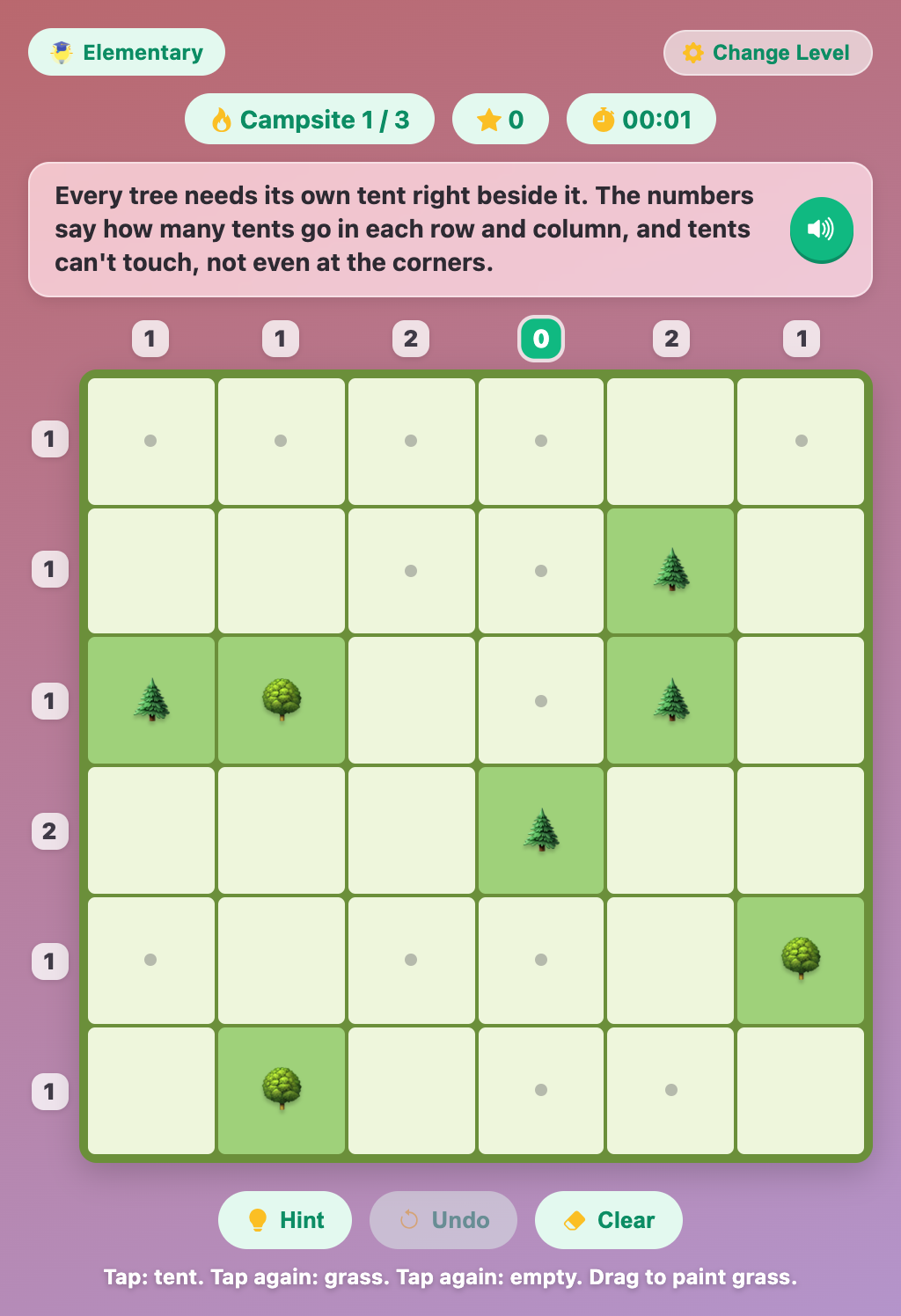
A fresh 6 by 6 Elementary campsite in Camping Trip with seven trees, gray dots and a green 0 above column 4
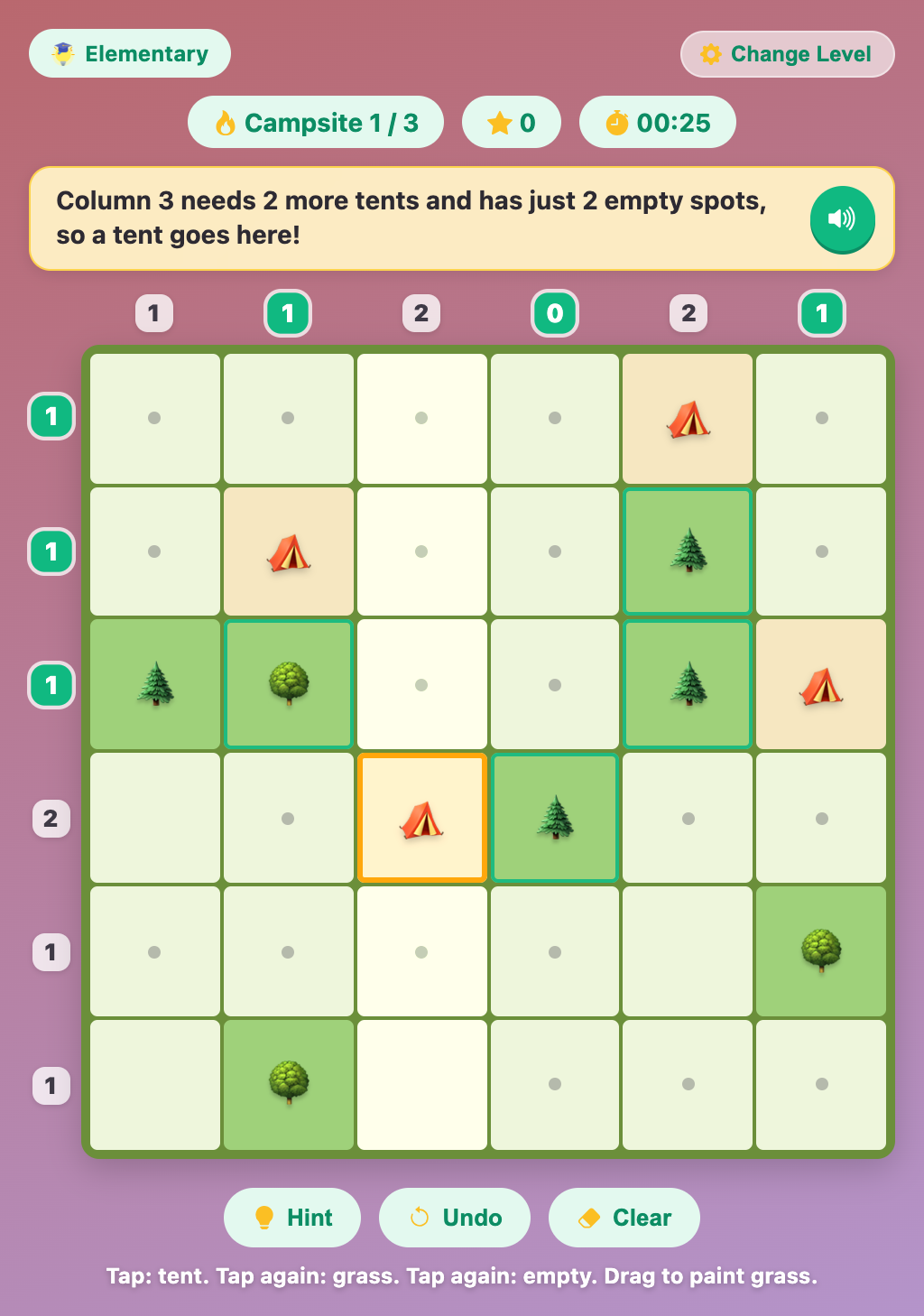
A hint in Camping Trip for kids putting up a tent with an amber ring because column 3 needs 2 more tents
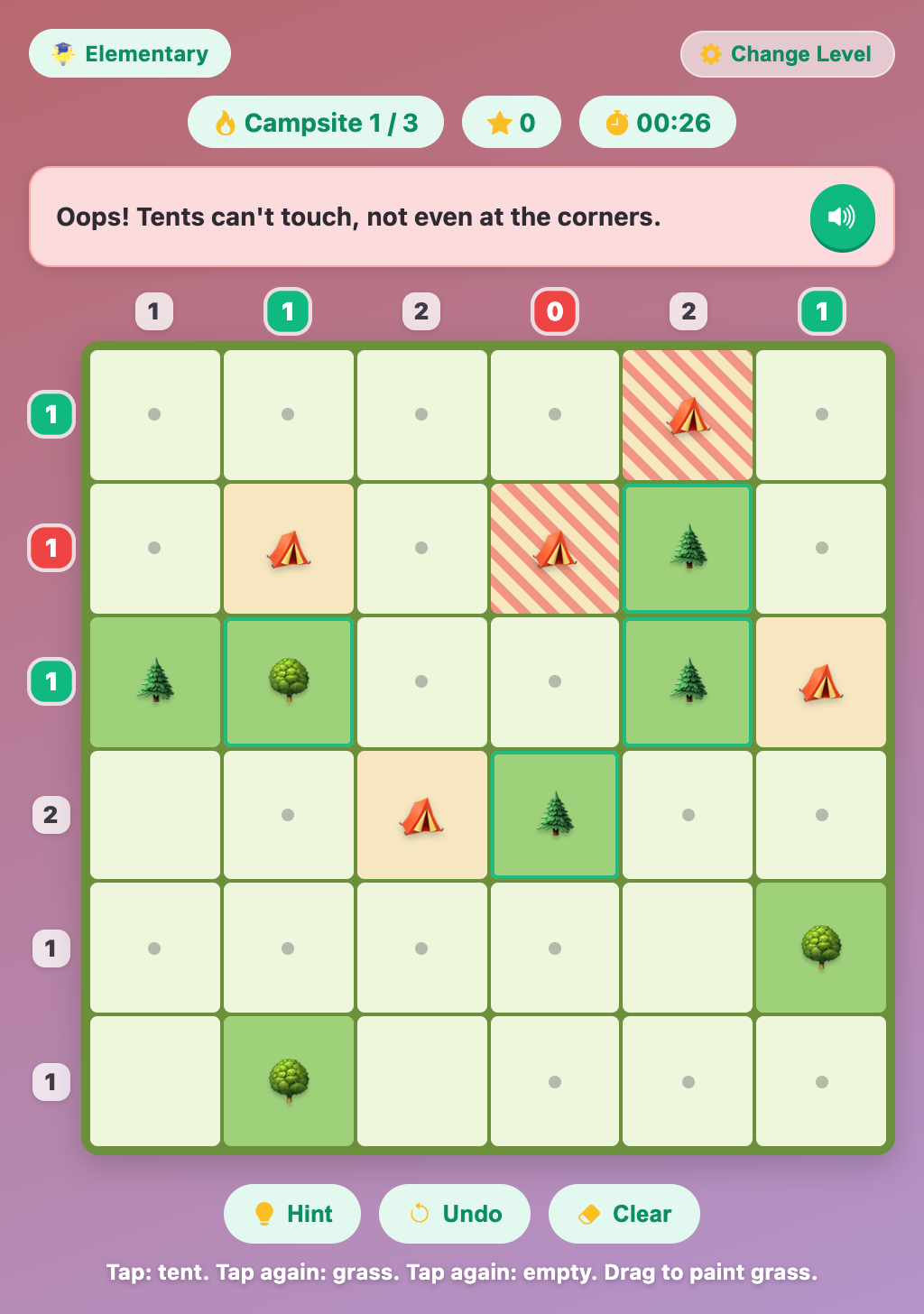
Two tents touching at a corner with red stripes and a red number in Camping Trip, after a rule was broken
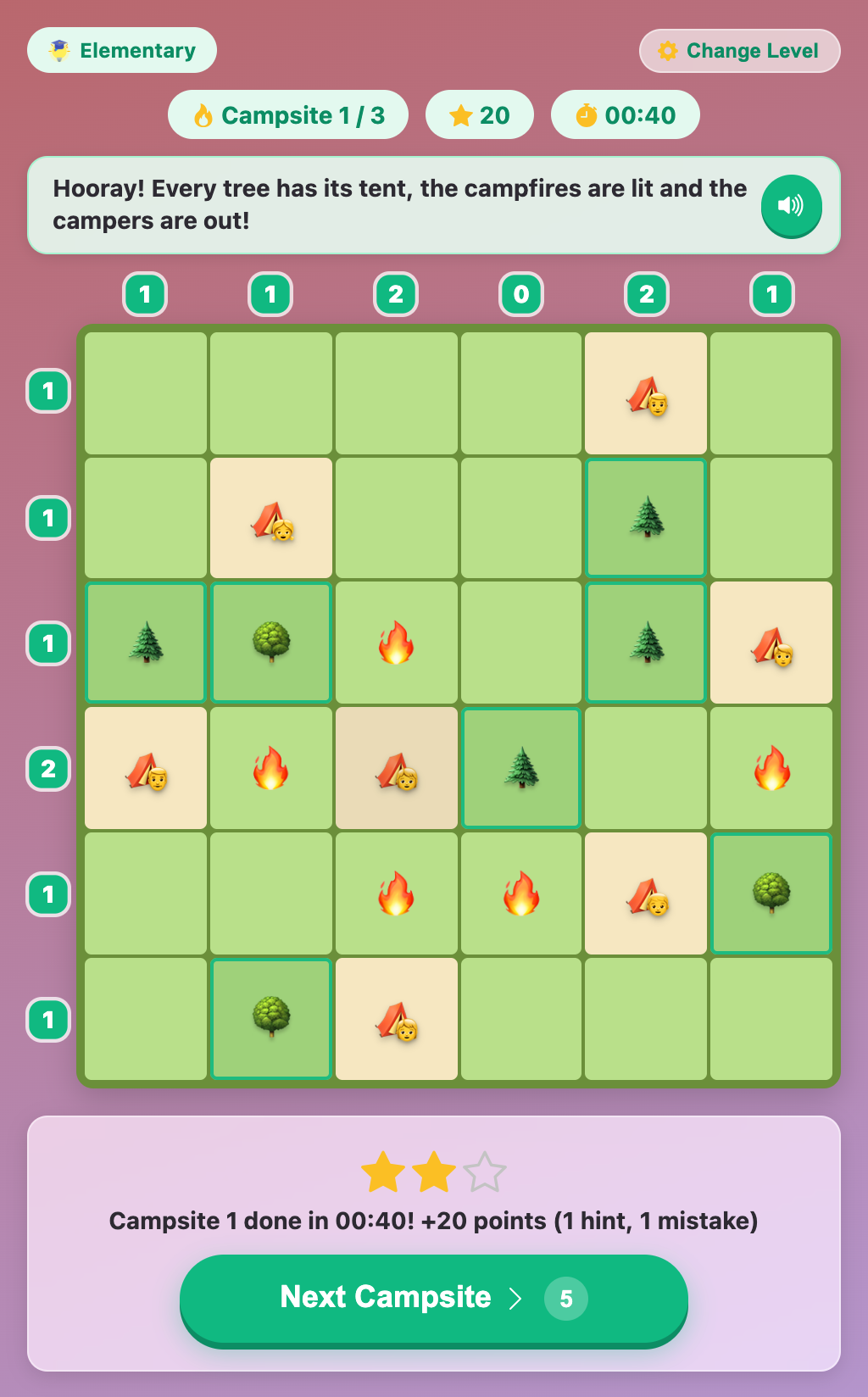
A solved Camping Trip campsite with a camper in every tent, campfires lit and a Next Campsite button counting down
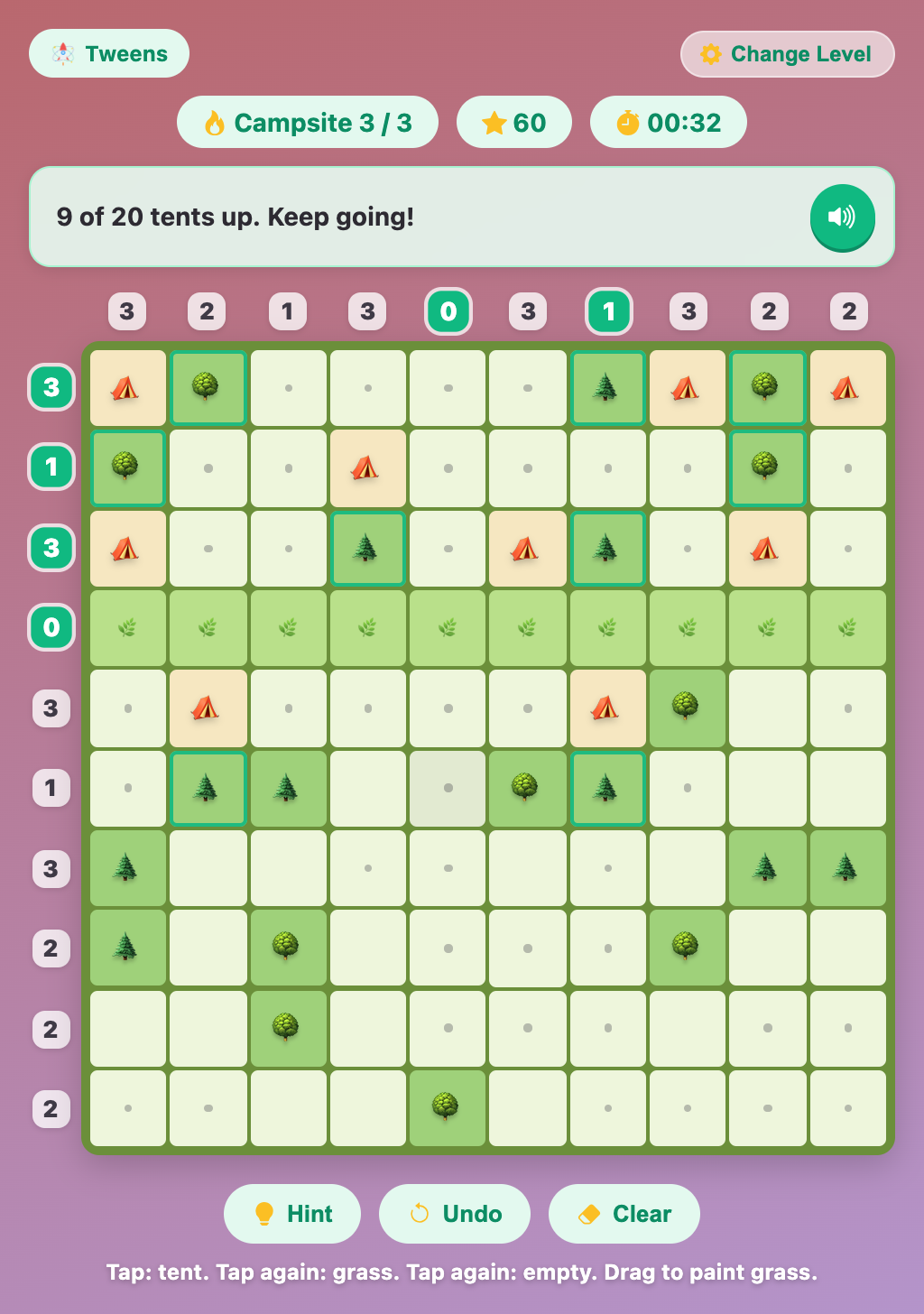
A 10 by 10 campsite in Camping Trip for tweens with 9 of 20 tents up and a 0 row painted with grass
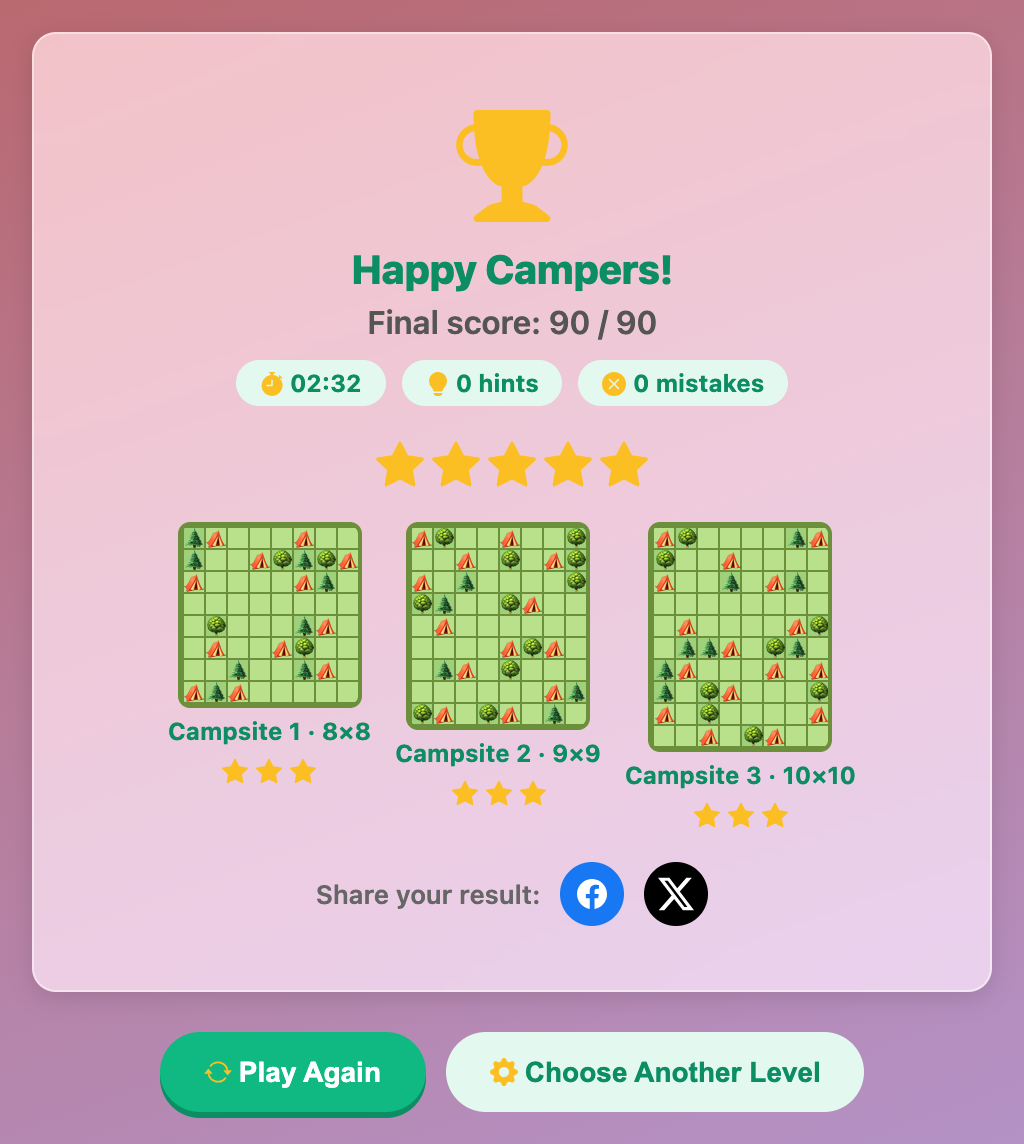
The Happy Campers finish card in Camping Trip with a score of 90 out of 90 and three tiny solved campsites
More Mind Games
 244.7K plays
5.0
Tower of Hanoi
Move the stack of rings from one tower to another without ever placing a bigger ring on a smaller one.
 514.5K plays
5.0
Maze Runner
Guide your explorer through a maze to find the treasure, using as few steps as you can.
 38.5K plays
4.9
Crown Garden
Plant one crown in every row, every column and every colored flower bed, but crowns can't touch, not even at the corners! Tap once for an X, twice for a crown, and watch rows, columns and beds turn green as you get them right. Every garden has exactly one answer you can find with logic alone, and a hint always tells you why.
 459.5K plays
5.0
Sequence Recall
Watch the glowing tiles light up in order, then tap them back the same way — how many rounds can you remember?
Most Played Games
 366.2K plays
5.0
Tic-Tac-Toe
Play a game of Tic-Tac-Toe against the computer and see if you can outsmart it.
 1.1M plays
4.9
Chess
Play the classic game of chess against the computer or a friend, with FIDE time controls, hints, and undo.
 263.7K plays
4.9
Category Sort
Decide whether each picture is an animal, food, toy, or vehicle before time runs out.
 568.7K plays
4.9
Connect Four
Drop your pieces and be the first to connect four in a row against the computer or a friend.
Comments (38)