
City Skyline
762.6K playsBuild a city of colorful towers! Every row and every column gets one tower of each height, and the clues around the edge tell you how many towers you can see from that side. Tall towers hide the short ones behind them, so tap a clue to look along its street. Every city has exactly one answer you can find with logic alone, and a hint always tells you why.
Count the rooftops! City Skyline for kids is a free logic puzzle where you build a little city of colorful towers, one tower in every square of the grid. The numbers around the edge tell you how many towers you can see from that spot, and a tall tower hides every shorter tower standing behind it. You play it right in your browser on a computer, tablet or phone, with no download and no sign-up, and there are four levels for kids from about 2 to 12.
The towers are drawn like tiny 3D buildings with windows, and each height has its own color: a short pink 1, an orange 2, a yellow 3, a green 4, a blue 5 and a tall purple 6. Every city is made fresh when you start, so you never get the same one twice. Each one has exactly one answer, and you can always find it by thinking, not by lucky guessing. When the last tower goes up, the sky turns to sunset, the windows light up and the whole skyline wiggles with joy.
🏙️ Towers, Streets and One Lookout Rule
Puzzle fans around the world know this game as Skyscrapers. You find it in puzzle books and even in big puzzle contests for grown-ups. It joins two simple ideas into one clever game.
Idea one: one of each. Think of every row and every column as a street. Each street gets one tower of each height, never two the same. On a 4 by 4 city, every street has a 1, a 2, a 3 and a 4.
Idea two: what you can see. Now stand at the end of a street, where a clue sits. Look along the street. A tall tower blocks your view of every shorter tower behind it, just like a big building hides a small house in a real city. The clue tells you how many towers you can see from there.
Your goal is to fill the whole city so that every street has one of each height and every clue is right. It feels a bit like Sudoku, but with a lookout tower on every corner of the map.
🧱 How City Skyline Works, Tap by Tap
Pick your level. The first time you play, the game starts you on Elementary. Tap Change Level at the top to see all four choices: Toddlers, Preschool, Elementary and Tweens. The game remembers the one you pick for next time.
Look around your city. The grid in the middle is the city. The round white numbers on the edges are the clues. Some towers may already be standing. They have a dark number badge, and you can't change them.
Tap a square. It gets a green outline. Its row and its column light up, and so do their clues, so you can see which numbers matter for that spot.
Tap a height. The number pad under the city has one button for each height, and each button shows its tower. Tap one and that tower is built in your square. A height button fades once all the towers of that height are built. Erase clears a square again.
Tap a clue to look along its street. The towers you can see from that clue glow, and the ones hidden behind taller towers fade. The tip under the city says how many towers you see, like From here you can see 2 towers, just like the clue says! If the street isn't finished yet, it says so far.
Watch the colors. If two towers of the same height share a street, both squares turn red. A clue turns green when its count is final and correct. It turns red if it's final and wrong, or if you can already see too many towers.
Jot notes on big cities. Tap Notes, then tap heights to write tiny pencil numbers in an empty square: the heights that might go there. Notes are never checked. Tap Build to go back to building. When you build a tower, its height is wiped from the notes in its row and column for you.
Use Undo and Hint. Undo steps back one change at a time, even a hint. Hint has 3 uses for each city. It takes away a tower that doesn't belong, or it builds one tower you could have worked out and tells you why.
Play with a keyboard if you like. Press a number key to build, Backspace, Delete or 0 to erase, the arrow keys to move, N to switch notes on and off, and Ctrl+Z (or Cmd+Z) to undo.
Listen. The 🔊 button next to the tip reads it out loud, and the 🔊 on the How to play box reads the four rules. Above the game, you'll find buttons for music, reload (a fresh start) and fullscreen.
Finish the skyline. The Skyline Complete! card shows your score out of 100, your time, the city size, your slips and hints, and up to five stars. Tap New City for another one, or Choose Another Level.
👀 How Many Towers Can You See? Reading a Clue
Everything in this game comes back to one skill: reading a clue. So let's practice it slowly.
Stand at the clue and walk along the street in your mind. The first tower always counts, because nothing is in front of it. After that, a tower only counts if it's taller than every tower before it. A shorter tower is hiding behind a bigger one, so you skip it.
Try this street from the left: 3, 2, 4, 1. You see the 3. The 2 is shorter than the 3, so it's hidden. The 4 is taller than the 3, so you see it. The 1 is hiding behind the 4. That's 2 towers, so the clue on the left would be a 2.
Now read the very same street from the right: 1, 4, 2, 3. You see the 1, then the 4. The 2 and the 3 both hide behind the 4. That's 2 again!
Here is a neat trick: the tallest tower is always seen from both ends, and nothing behind it ever counts. That's why a clue can turn green before its street is full. As soon as you reach the tallest tower, the count can't change.
🔎 How to Win at City Skyline for Kids: Clues That Give Towers Away
Good players don't guess. They look for spots where only one height can fit. These are the same tricks the game's own hints use, so you can learn from every 💡 too.
A 1 clue: the tallest tower stands at the front
If you can see just one tower, the first tower must hide all the others. Only the tallest tower can do that. So a 1 clue means the biggest height (a 4 on a 4 by 4 city, a 6 on a 6 by 6 city) goes right next to it. This is the best first move in almost every city.
The biggest clue: a staircase
If the clue is as big as the city (a 4 on a 4 by 4 city), you can see every single tower. That only works if each tower is taller than the one before. So the street goes 1, 2, 3, 4 in order, like a staircase walking away from the clue. One clue, and the whole street is done!
Big clues keep tall towers away from the edge
A big clue needs lots of towers in view, so a tall tower can't stand at the front and block them. On a 4 by 4 city, a 2 clue means the first square can't be a 4 (that would hide everything and make it a 1). A 3 clue means the first square can only be a 1 or a 2. Writing these as notes in the first square helps a lot.
One spot left for a height
This trick comes from the one-of-each rule. Pick a street and ask, "Where can the 3 go?" If the other squares are full, or the 3 is already used in their columns, there may be only one spot left. Then the 3 must go there. If you enjoy this kind of thinking, Sudoku is built on the very same rule, with numbers instead of towers.
Read both ends of a street together
Most streets have two clues, one at each end. Use them as a team. A 1 at one end and a 2 at the other is a lovely pair, and the first worked example below shows why.
Blank edge spots tell you nothing
On Elementary and Tweens, some clues are hidden and the edge spot is just empty. An empty spot doesn't mean zero. It simply means no clue, so lean on the other clues and the one-of-each rule there.
Look before you build
Tap a clue to make the towers you can see glow. This is a free check, and it never costs points. It's a great way to test a street before you add its last tower.
Try every way on a hard street
On bigger cities, sometimes no single trick works. Then pick one street and think of each way it could be filled. For example, a 4 by 4 street with a 2 clue at one end might be 3, 1, 4, 2 or 1, 4, 3, 2 or more. If one square has the same height in every way that fits the clues, build it! About two thirds of Elementary cities need this kind of thinking somewhere.
The "what if" test on Tweens
Some Tweens cities need one more step. Choose a square with two possible heights in your notes. Ask, "What if a 5 went here?" Follow the rules a few steps. If that 5 makes a clue impossible or puts two of the same height in a street, the 5 can't go there, so the other height must. Do this test in your head or in notes, not with real towers, so a wrong idea never becomes a slip.
🗺️ Little Streets to Solve in Your Head
Grab a pencil if you like. Each of these is a single street from a 4 by 4 city, unless it says otherwise.
A 1 on the left, a 2 on the right
The 1 on the left means the 4 stands in the first square: 4, ?, ?, ?.
From the right you must see 2 towers. One of them is the 4, because the tallest is always seen.
So you see the tower nearest the right clue, then nothing until the 4. That nearest tower must be taller than the two in the middle.
The heights left are 1, 2 and 3, so the last square is the 3. The 1 and 2 go in the middle, and their columns decide which way round.
The baby city: 3 by 3
On a Toddlers city, a row has a 3 clue on its left. That's the biggest clue, so the row is 1, 2, 3.
A column has a 1 clue on top. So the 3 stands at the top of that column.
Then use the one-of-each rule: when a street already has two towers, the missing height is easy to spot. Keep going until the city is full.
A 3 clue and a stubborn first square
A street has a 3 clue on its left. Could the first square be a 3? Then only the 4 could be seen after it. That's 2, not 3. No!
Could it be a 4? Then you'd see just 1 tower. No again!
So the first square is a 1 or a 2. Write both as notes.
If its column already has a 2, the first square must be the 1.
Checking a finished street
You built 2, 1, 4, 3 and the left clue is a 2.
Count: the 2 is seen, the 1 hides, the 4 is seen, the 3 hides behind the 4. That's 2 towers.
The clue matches, so it turns green. Tap it to watch the 2 and the 4 glow.
A Tweens street on a 6 by 6 city
A street has a 6 clue on the left and a 1 clue on the right. The 6 clue says you see every tower, so the street climbs 1, 2, 3, 4, 5, 6 from the left. The 1 clue agrees, because the 6 ends up right next to it.
Now a harder one: a 2 clue on the left, and the 6 is already built in the third square. You see the first tower and the 6. So the second square must be shorter than the first square, or you'd see 3.
If your notes say the first square is a 4 or a 5, the second square must be shorter than it. Use that to cross off notes.
⭐ Points, Slips and Stars
Every finished city starts at 100 points. A slip costs 5 points. A slip is a tower that puts the same height twice in a street, or one that makes a clue impossible. The tip says what went wrong, like Oops! This row already has a 4., and the squares give a little shake.
A clue only goes red when it is surely broken. So a fair move is never counted as a slip. A wrong tower that breaks nothing yet won't cost points right away. But it can trap you later, because the right tower next to it may then clash.
Each hint costs 8 points on Toddlers and Preschool, 10 on Elementary and 12 on Tweens. A finished city never scores below 10. So one hint on Elementary with no slips gives 90, and that's still five stars. The stars go like this: 90 or more is five stars, 70 or more is four, 50 or more is three, 25 or more is two, and anything lower is one.
The timer starts with your first move, so you can take your time looking at the clues before you begin. If you're logged in to KidWorld, your score is saved to your account.
🎈 From a 3 by 3 Block to a 6 by 6 City: Picking a Level
The rules never change. What changes is the size of the city, how many towers are built for you and how many clues are hidden.
Toddlers (ages 2–4): a tiny 3 by 3 block
City Skyline for toddlers has just 9 squares, every clue is shown, and at least three towers are already built. Most toddlers will play with a grown-up. A good way to start is to compare towers: "Which one is taller?" With the sound on, the game reads the rules out loud when the city starts, and it also reads slips, hints and the win.
Preschool (ages 4–6): a 4 by 4 city with helpers
City Skyline for preschoolers uses a 4 by 4 city with every clue shown and at least five towers built for you. That leaves fewer than a dozen squares to fill. The 1 clue and the staircase clue are enough for many of them. The tips are read aloud here too, which is a big help for kids who are still learning to read.
Elementary (ages 6–10): fewer helpers, some hidden clues
City Skyline for elementary kids keeps the 4 by 4 size but builds few or no towers for you, and up to a quarter of the clues are hidden. Many cities need the "try every way on a street" trick. Kids who love the edge-number idea can try Camping Trip next, where the numbers on the edge count tents in each row and column instead of towers you can see.
Tweens (ages 10–12): 5 by 5 and 6 by 6 cities
City Skyline for tweens builds a 5 by 5 or a 6 by 6 city, with up to 40% of the clues hidden and only a tower or two built for you, sometimes none. Some cities need the "what if" test. Notes become your best friend here. Nothing is read aloud by itself on Elementary or Tweens, but the 🔊 buttons still work.
🌇 Good Thinking Hidden in Every Rooftop
Seeing from someone else's spot. To read a clue, you imagine standing at the edge and looking down the street. That's a real skill: picturing the world from a different place.
Comparing sizes. Taller, shorter, tallest: young kids use these words on every tap, and the towers grow with their numbers, so the idea is easy to see. Little ones who like big-and-small puzzles can also try Tower of Hanoi, where a bigger ring may never sit on a smaller one.
Thinking step by step. Each tower you're sure of helps you find the next one. Kids learn that one small fact can open up a whole street.
Checking your own work. Tapping a clue to count the glowing towers is a habit of checking, and the green clues reward it right away.
Being okay with mistakes. A slip shakes the squares and explains itself in a kind way, and Undo puts things back. Kids learn that a mistake is just information.
👪 Grown-Up Corner: Is City Skyline a Good Pick?
City Skyline is calm and friendly. There's no scary content, no timer that runs out and no chatting with strangers inside the game. It's free in the browser, and kids can play without an account.
It practices logic, comparing numbers and sizes, and spatial thinking (picturing things from a viewpoint). Every city is checked by the game before you see it, so it always has one fair answer. The hints explain their reason, like This row still needs a 3, and this is the only square where a 3 can go, so they teach instead of just giving the answer.
For younger kids, sit together and say the clue out loud while you both count the glowing towers. For older kids, ask them to explain why a tower must go somewhere before they build it.
Ready to build? Pick a level, read the clues and raise your towers one street at a time. City Skyline for kids has a brand-new city waiting every time you tap New City, so there's always one more skyline to light up at sunset. 🌆
🖼️ See the Game in Action
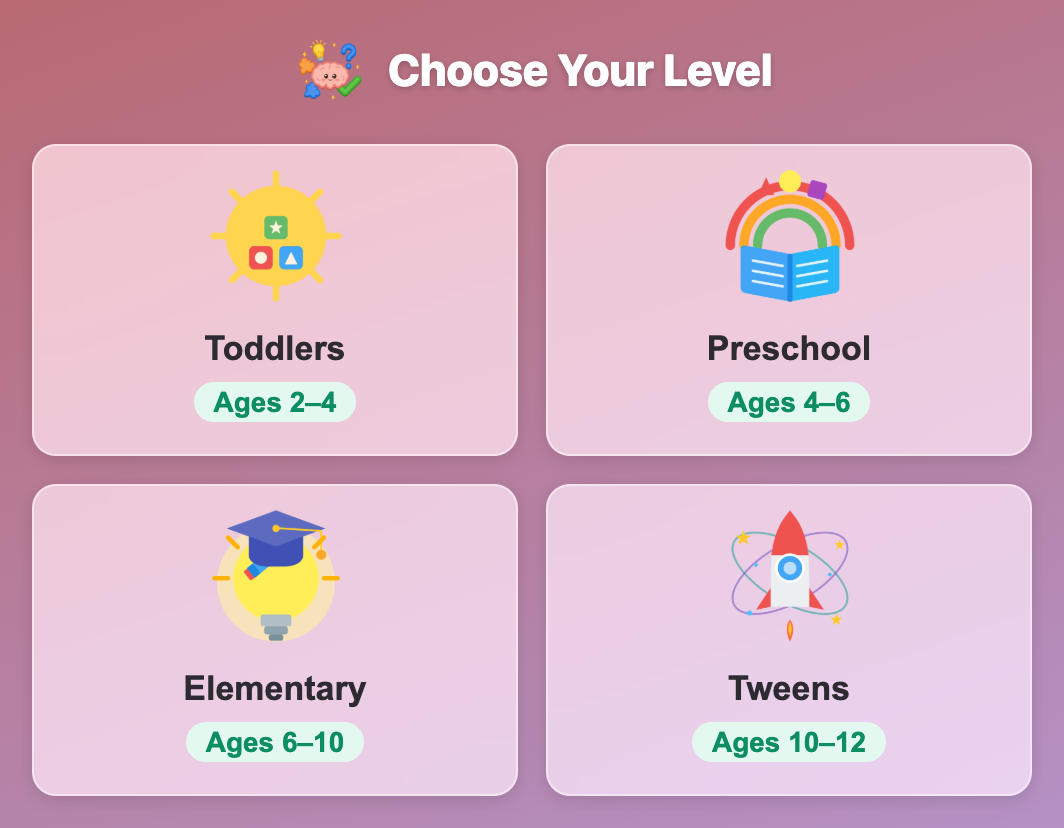
The Choose Your Level screen in City Skyline for kids, with Toddlers, Preschool, Elementary and Tweens cards
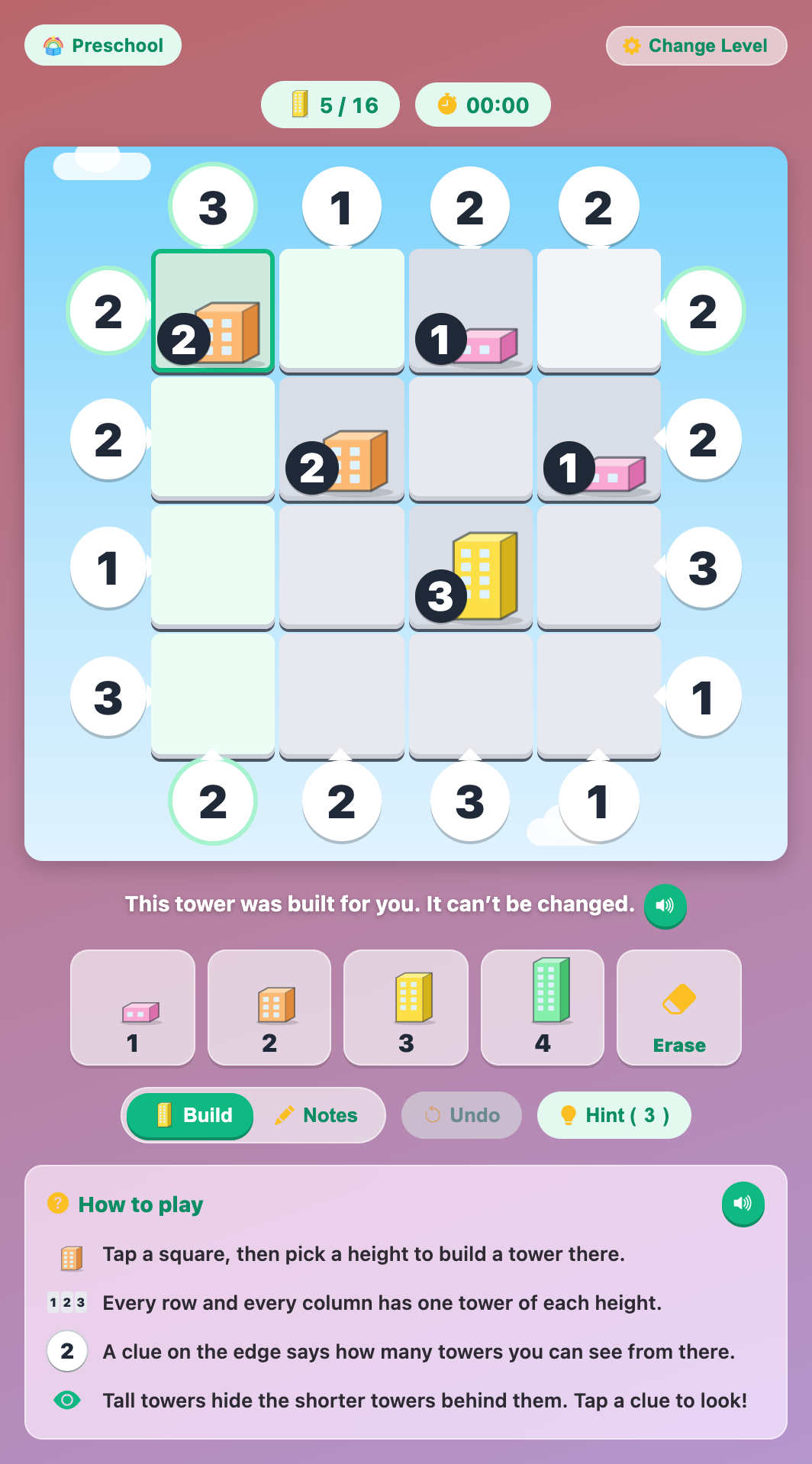
A 4 by 4 City Skyline for preschoolers with five towers already built and a number clue on every edge spot
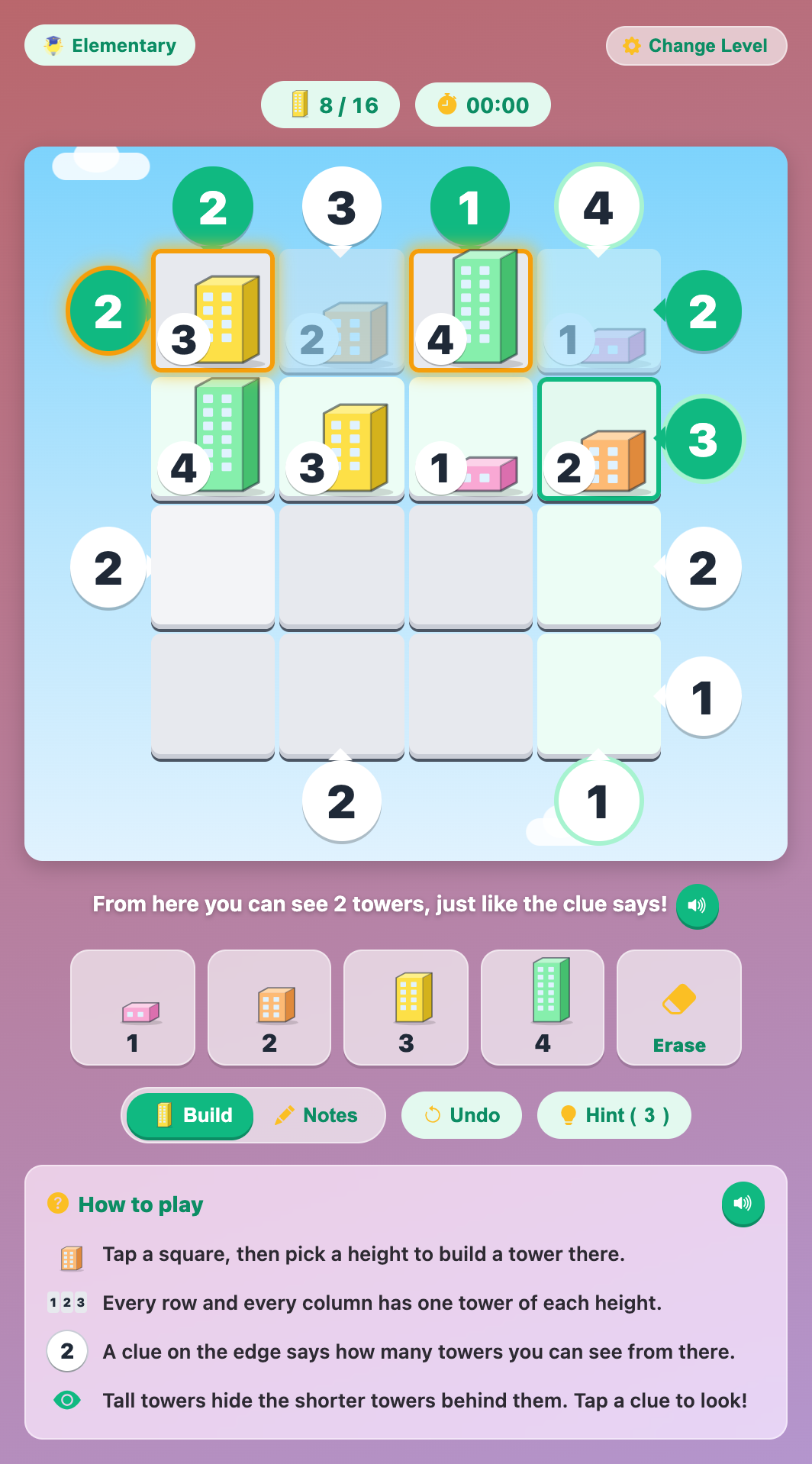
An Elementary city where tapping a 2 clue makes the 3 and 4 towers glow while the shorter towers fade
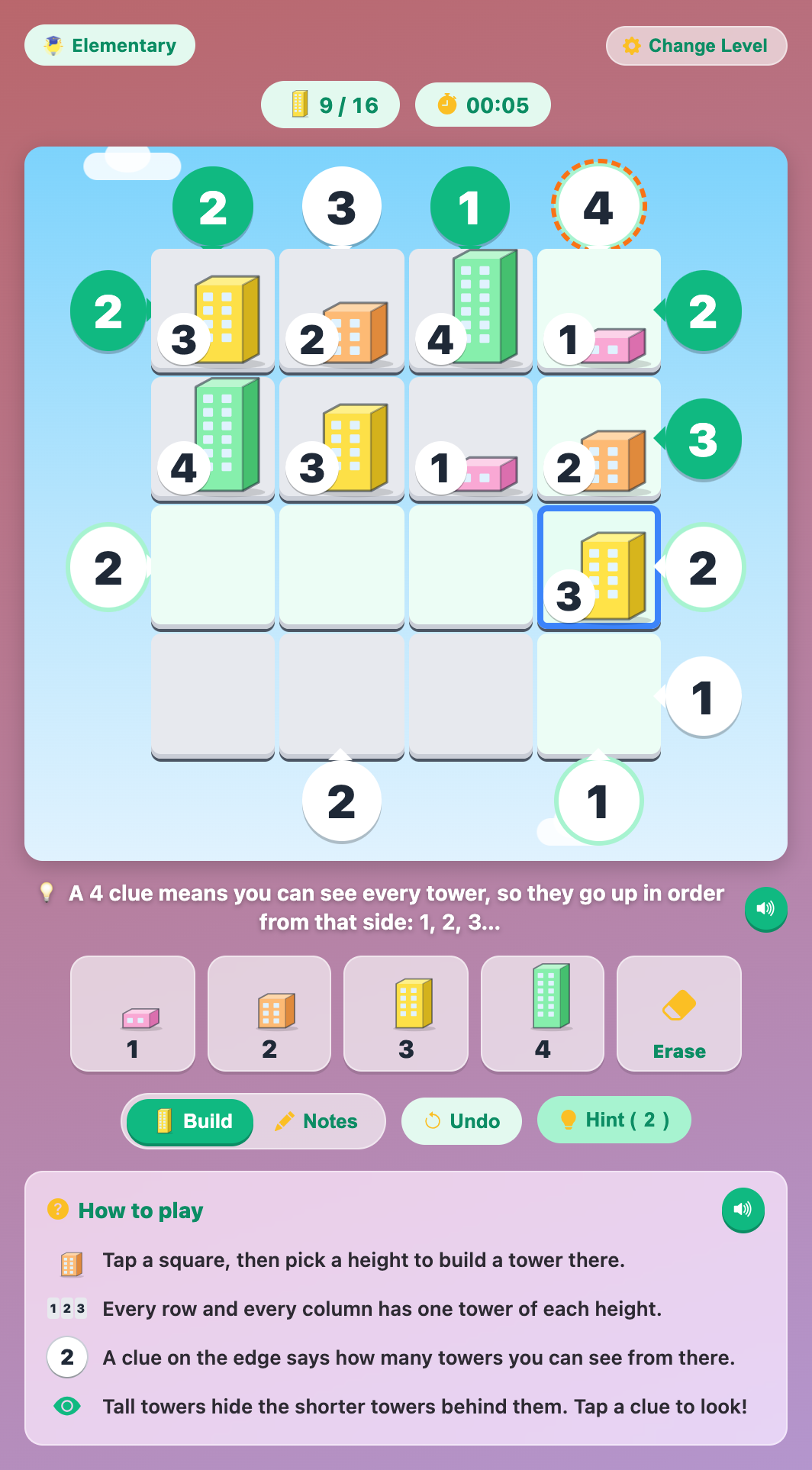
A hint in City Skyline for kids building a yellow 3 tower inside a blue ring, with the 4 clue circled in orange
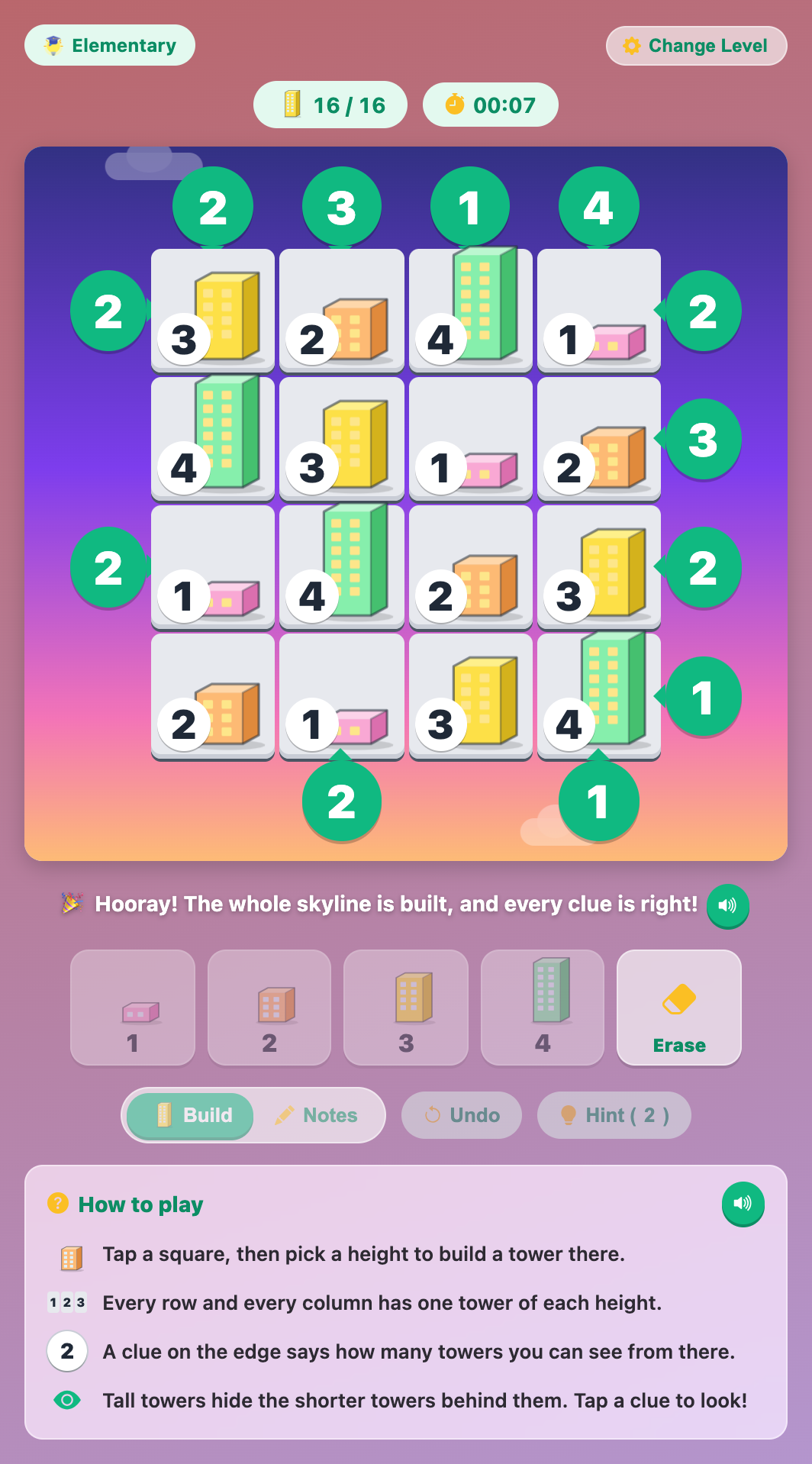
A finished City Skyline city under a purple and pink dusk sky, with every edge clue turned green
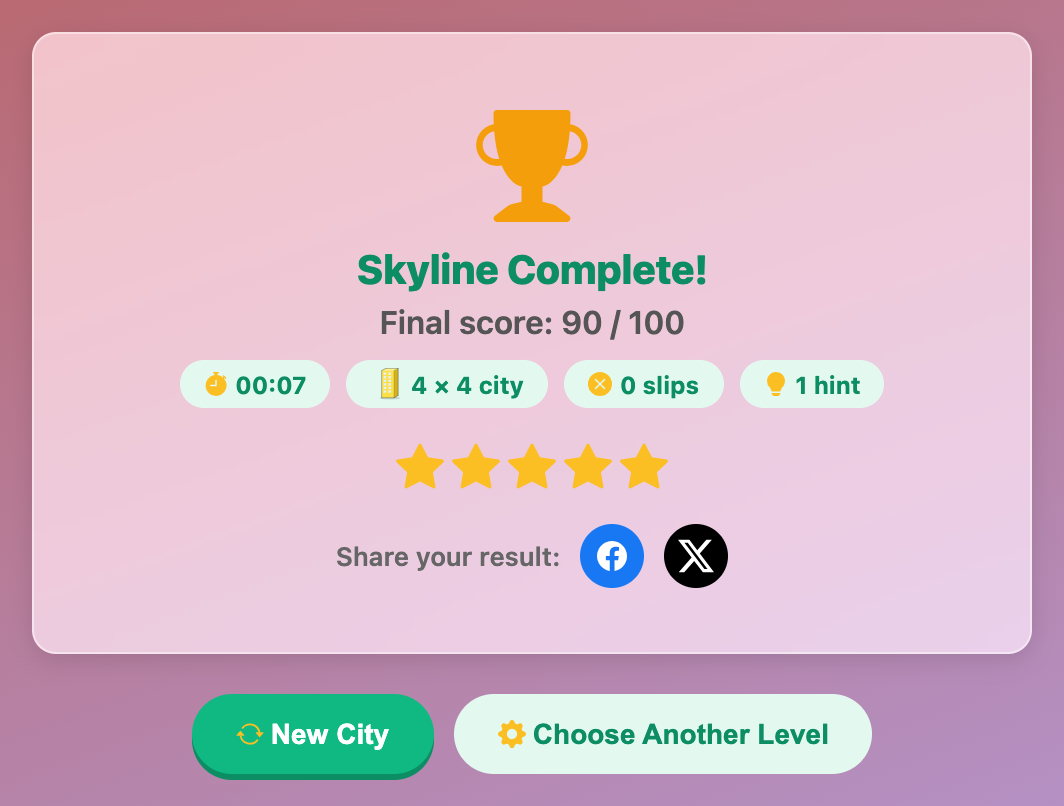
The Skyline Complete card with a trophy, a final score of 90 out of 100, one hint and five gold stars
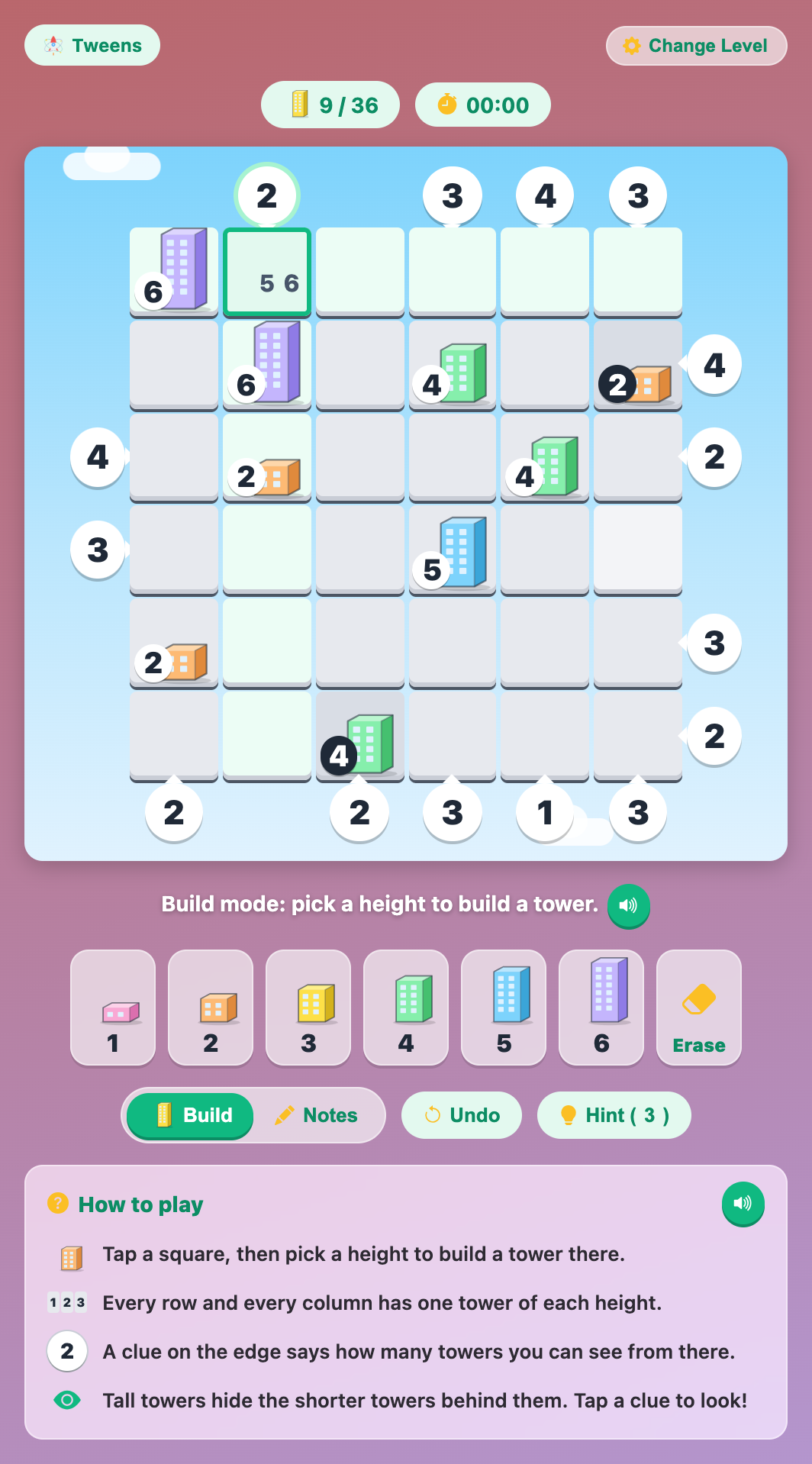
A 6 by 6 City Skyline for tweens with nine towers built, some blank edge spots and pencil notes in one square
More Mind Games
 1.1M plays
4.9
Chess
Play the classic game of chess against the computer or a friend, with FIDE time controls, hints, and undo.
 1.4M plays
4.9
Memory Match
Flip the cards and find all the matching pairs in as few moves as possible.
 328.4K plays
5.0
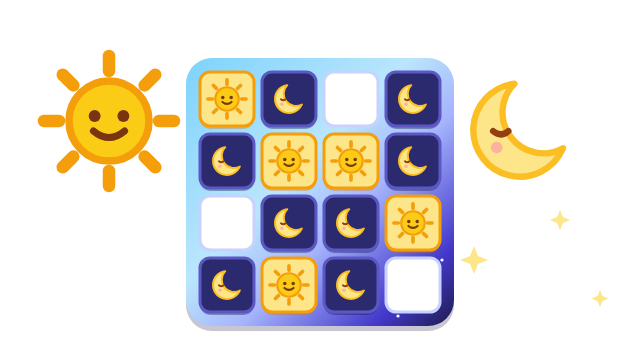
Sun & Moon
Fill the sky with suns and moons! Tap a square once for a sun and twice for a moon, but never put three of the same in a row. On bigger boards every row and column needs as many suns as moons, and no two rows can be the same. Broken rules glow red right away, and a hint always tells you why. A brand-new puzzle with exactly one answer every game.
 537.4K plays
5.0
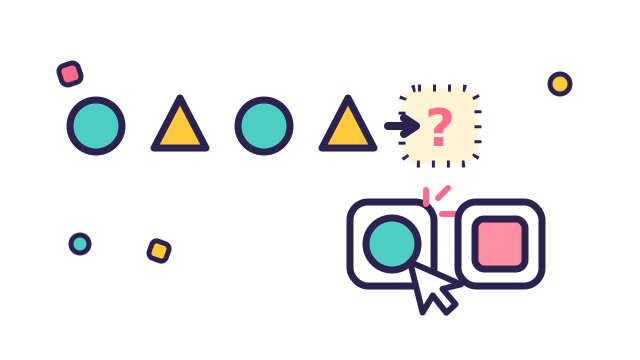
Pattern Sequence
Look at the pattern of shapes and pick what comes next in the sequence.
Most Played Games
 366.2K plays
5.0
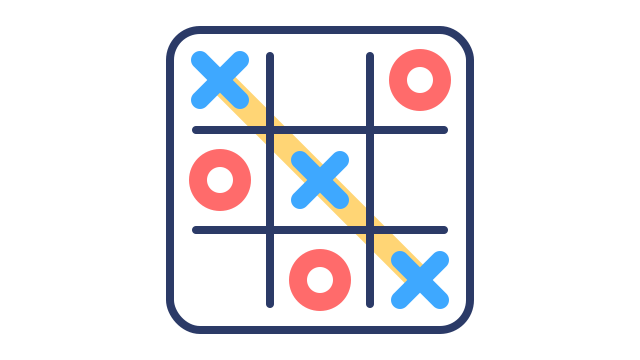
Tic-Tac-Toe
Play a game of Tic-Tac-Toe against the computer and see if you can outsmart it.
 263.7K plays
4.9
Category Sort
Decide whether each picture is an animal, food, toy, or vehicle before time runs out.
 568.7K plays
4.9
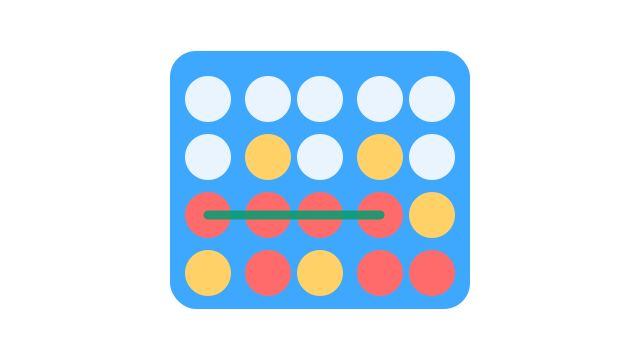
Connect Four
Drop your pieces and be the first to connect four in a row against the computer or a friend.
 514.5K plays
5.0
Maze Runner
Guide your explorer through a maze to find the treasure, using as few steps as you can.
Comments (47)