
Pixel Art Nonograms
16K playsPaint a hidden pixel picture using number clues! Each clue tells you how many squares to paint and in which color: pick a paint, tap the squares, and watch an apple, a rocket or a tropical fish appear. Same colors need a gap between them, but different colors can touch. Little artists start with 5x5 pictures in 2 colors, big kids take on 10x10 pictures in 4 colors, and every finished picture hangs in your own gallery.
Old video game heroes were drawn with tiny colored squares called pixels. One square was a red cap, two squares were a pair of eyes, and a row of brown squares was a pair of boots. Pixel Art Nonograms for kids asks you to draw a picture just like that, except nobody tells you what the picture is. You get only number clues, each one printed on a chip of paint.
A red 2 means "two red squares in a row". A blue 8 means "eight blue squares". Follow the clues, square by square, and a hidden picture slowly appears: an apple, a sailboat, a tropical fish, a robot. When the last square is painted, the grid lines fade away and your finished picture hangs in a gold frame in your own gallery.
🎨 Number Puzzles That Turn Into Pictures
A nonogram is a grid puzzle. The numbers at the start of each row, and on top of each column, tell you how many squares to fill in that line. People also call them "paint by numbers puzzles" or "picture logic puzzles". They were invented in Japan almost 40 years ago, and now people solve them all over the world.
In the classic puzzle, every square is either black or empty. This KidWorld game adds colors. Each clue number sits on a chip of its paint, so you know how many squares and which color. The numbers are always in order, from left to right in a row and from top to bottom in a column.
Colors bring one new rule, and the game shows it right above the grid with two tiny examples:
Same color: leave a gap. Two runs of the same paint always have at least one empty square between them. A red 2 and then a red 1 look like this: red, red, empty, red.
Different colors can touch. A red 2 and then a brown 1 can sit right next to each other: red, red, brown.
That one rule is what makes color nonograms so clever. A word for each idea: a run is a group of squares of one color in a row, with nothing else in between, and a line is one row or one column.
🕹️ How to Paint a Mystery Picture on KidWorld
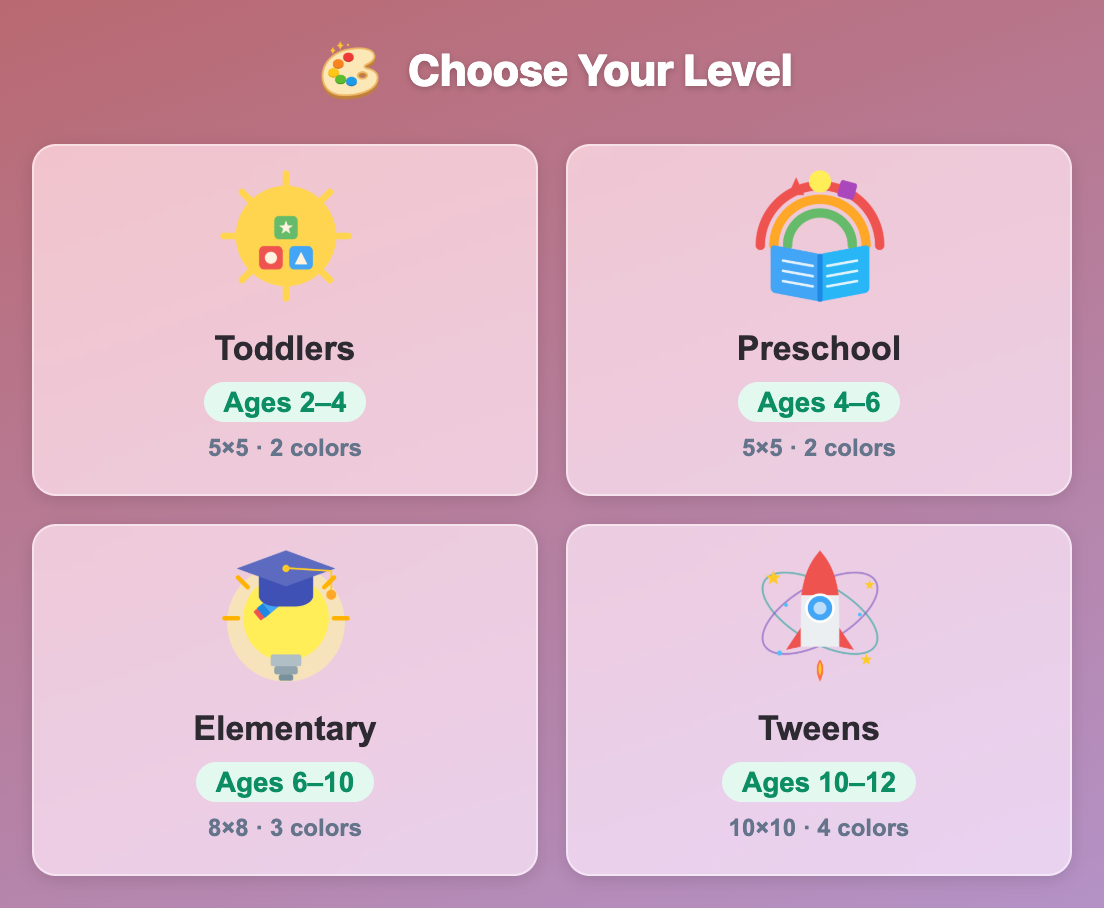
Pick your level. The Choose Your Level screen has four cards. Toddlers and Preschool play 5×5 pictures with 2 colors. Elementary plays 8×8 pictures with 3 colors. Tweens play 10×10 pictures with 4 colors. The game remembers your level, and Change Level at the top lets you switch.
Read the board. The title says "Mystery Picture". Column clues sit on top of the grid, row clues sit on the left. Two bubbles show your mistakes (✕) and a stopwatch. The stopwatch doesn't change your score, so take your time.
Pick a paint. Under the grid is a palette with one button for each color, numbered 1 to 4, plus an empty button with an ✕. On a keyboard, press 1, 2, 3 or 4 to pick a paint, and X (or 0) for the ✕ tool.
Tap or drag to paint. Tap a square to paint it. Press and drag across squares to paint a whole run at once. A drag only paints empty or ✕-marked squares, so it never paints over a different color by accident. Tap a square with the same paint again to clear it. If you press on the end of a run and keep dragging, you make the run longer instead.
Mark the empty squares. With the ✕ tool, tap squares you are sure stay empty. Marks are only notes for you. The game never checks them, so they can't hurt your score.
Watch the clues fade. When a row or column matches the picture, its clue numbers turn pale. That's your sign that the line is finished.
Use a hint if you're stuck. The Hint button fixes one square for you. If a square has the wrong paint, it fixes that first. If not, it paints a square that still needs paint. You get 6 hints on Toddlers, 4 on Preschool and 3 on Elementary and Tweens.
See your picture. When every line is right, the clues and grid lines fade and the title changes to "It's a Sailboat!" (or whatever it is). The finish screen shows the picture in a gold frame, your score out of 100, your time, mistakes, hints and up to 5 stars.
Visit My Gallery and keep going. The first time you finish a picture, a "New in My Gallery!" ribbon appears. Save Picture downloads it as an image file. Next Picture starts one you haven't painted yet. The music, reload and fullscreen buttons on the page work all the time.
🖼️ My Gallery: 36 Pictures to Collect
There are 36 hand-made pictures in all: 15 small 5×5 ones (like Apple, Ladybug, Bee and Cat), 10 medium 8×8 ones (like Owl, Rocket and Apple Tree) and 11 big 10×10 ones (like Tropical Fish, Robot, Cupcake and Pineapple). The My Gallery button shows them in three groups. Pictures you have painted show up with their best score. Pictures you haven't found yet at your level are mystery tiles that say "Play me!". Tap one to play it.
Tap a finished picture to see it big, play it again or save it. Your gallery is kept in your browser, and it's shared by all four levels.
⭐ How the Score Works
Every picture starts at 100 points. Points come off for two things:
A wrong paint: painting a square a color the picture doesn't have there. That's −5 on Toddlers, −6 on Preschool, −4 on Elementary and −3 on Tweens.
A hint: −5 on Toddlers, −8 on Preschool and −10 on Elementary and Tweens.
The score never goes below 0. 90 or more earns 5 stars, 70 or more earns 4, 50 or more earns 3, and 25 or more earns 2. Marks with the ✕ tool and clearing your own squares never cost anything.
On Toddlers and Preschool, a wrong paint doesn't stay on the board. The square gives a shake and the game says "Not this color here. Look at the clues!" It still counts as one mistake. On Elementary and Tweens, a wrong paint stays where you put it, just like on paper, and you have to find it and fix it yourself.
🧠 Clue-Reading Tricks for Pixel Artists
Never guess! Every picture in this game was checked so it can be solved one line at a time. There is always a square you can be sure about. These tricks help you find it.
Start with the big numbers
Look for a clue that fills a whole line, or almost. In a 5-wide row, a clue of 5 means all five squares are that color. Paint them first. Big numbers give you the most squares for free.
Add up the clue and the gaps
Add all the numbers in a line. Then add 1 for every gap that must be there, which is every place where two neighboring numbers have the same color. If the total equals the length of the line, there's only one way to paint it.
The game's own example shows this: a red 2 and a red 1 in a line of 4. That's 2 + 1 + 1 gap = 4. So the line must be red, red, empty, red.
Find the overlap
When a run is long but not quite long enough to fill a line, its middle is still certain. Slide the run as far left as it can go, then as far right. The squares it covers both times are definitely that color.
Mark what stays empty
When a line is done, use the ✕ tool on its empty squares. When a line's clue is "0", that whole row or column is empty: mark it all. Marks make the next lines much easier to read, because you can see exactly where a run can't go.
Switch between rows and columns
Each square you paint in a row also helps its column. Work on a row, then check every column you just touched, then go back to the rows. Ping-ponging like this is how the whole picture gets solved.
Different colors are a gift
When neighboring clues are different colors, there might be no gap between them. That can make a line fill up faster than you expect. Always check: same color or not?
🔍 Puzzles to Try in Your Head
Example 1: The middle square of a 5×5 row
A 5-wide row says red 3. The three reds could sit in squares 1 to 3, 2 to 4, or 3 to 5. Square 3, the middle one, is red every time. So paint it now, even before you know the rest!
Example 2: The Ice Cream column
In the 5×5 Ice Cream picture, the middle column's clue is pink 2, tan 3. That's 2 + 3 = 5 squares, and because pink and tan are different colors, they can touch with no gap. 5 squares in a 5-tall column means the whole column is filled: two pink scoops on top, three tan cone squares below.
Now imagine the clue were pink 2, pink 3. Same color, so there must be a gap: 2 + 1 + 3 = 6. That doesn't fit in 5 squares, so you'll never see that clue in a 5×5 puzzle. Same numbers, different colors, totally different answer!
Example 3: The Sailboat at Elementary
The 8×8 Sailboat has these row clues, from top to bottom: red 1, red 2, red 3, red 4, brown 1, brown 8, brown 6 and blue 8.
Brown 8 and blue 8 each fill a whole 8-wide row. Paint them right away.
Brown 6 in 8 squares: slide it left (squares 1 to 6) and right (3 to 8). Squares 3 to 6 are covered both times, so they're brown for sure.
Now look at the columns. Each one tells you whether its bottom squares are brown and blue, and that pins down the rest of the hull.
The red rows grow 1, 2, 3, 4 going down. Together with the column clues, they draw a triangle sail, sitting on a brown mast (the brown 1).
Example 4: The Car's headlights at Tweens
One row of a 10×10 picture says yellow 1, red 8, yellow 1. Add it up: 1 + 8 + 1 = 10. All three runs are next to a different color, so no gaps are needed. 10 squares in a 10-wide row means the whole row is set: a yellow square at each end and eight reds in between. Those yellow squares turn out to be the car's headlights!
Example 5: A hint or a mistake?
Say you're playing Elementary and you're stuck. A hint costs 10 points. A wrong paint costs only 4, so guessing might look cheaper. But a wrong square stays on the board, and every line it touches now looks wrong too, so you may paint more wrong squares trying to fix it. Before you guess, look for a line you haven't checked yet with the add-up or overlap trick. There is always one square the clues can prove. If you truly can't find it, a hint is the safer choice.
👧 Pixel Art Nonograms for Kids of Every Age
🐣 Pixel Art Nonograms for toddlers (ages 2–4)
The Toddlers level uses the small 5×5 pictures with just 2 colors, the gentlest penalties and 6 hints. Wrong paints are refused, so the picture can never get messy. Reading clues is still a big job at this age, so this works best with a grown-up: read a clue together ("this row needs 5 red"), then let the child tap or drag the squares. Pictures like the Apple, the Sun and the Ladybug are easy to recognize when they pop out.
🎨 Pixel Art Nonograms for preschoolers (ages 4–6)
The Preschool level uses the same 15 small pictures, with 4 hints. Counting to 5 and matching colors is just right for this age. Wrong paints are refused with a friendly message, which teaches "look at the clues first" without any mess to clean up.
📚 Pixel Art Nonograms for elementary kids (ages 6–10)
The Elementary level jumps to 8×8 pictures with 3 colors and 3 hints. Wrong paints now stay on the board, so kids learn to check their work. This is the level where the overlap trick and the "add up the gaps" trick really start to matter.
🚀 Pixel Art Nonograms for tweens (ages 10–12)
The Tweens level uses 10×10 pictures with 4 colors, like the Robot, the Pineapple and the Double Scoop. With 100 squares and up to 8 runs in one line, it takes careful logic from start to finish. Tweens who want an even more classic challenge can try black-and-white Nonograms, where every square is either filled or empty and every clue is plain black.
💛 Why Little Pixel Pictures Are Good for Growing Minds
It's real logic. Every square has to be proved by the clues. Kids learn to say "I know this square is red, because…" instead of guessing. That's the same kind of thinking used in math and science, and in number puzzles like Sudoku, where every number also has to be proved.
It's counting with a reason. Adding 2 + 1 + a gap is real math, and the answer instantly shows up as painted squares.
It teaches how pictures are built. Pixel art shows that a big picture is made of tiny parts. A few squares of yellow become headlights, a dark brown run becomes a boat. Kids who like this might enjoy Color by Number, where every numbered square already tells you its color.
It's kind to every eye. The paints in each picture were picked so they stay easy to tell apart, even for kids who see red and green differently.
A note for grown-ups
Pixel Art Nonograms is calm, quiet and safe: no chat, no lives, no countdown and no scary content, just cheerful pictures of fruit, animals, boats and toys. It practices counting, logical reasoning, attention to detail and patience. Progress and the gallery are saved in your browser, and every finished picture can be downloaded and printed to stick on the fridge.
Ready to find out what's hiding in the grid? Grab a paint, read your first clue, and let your mystery picture appear in Pixel Art Nonograms for kids!
🖼️ See the Game in Action
The Choose Your Level screen in Pixel Art Nonograms for kids, from 5x5 with 2 colors to 10x10 with 4 colors
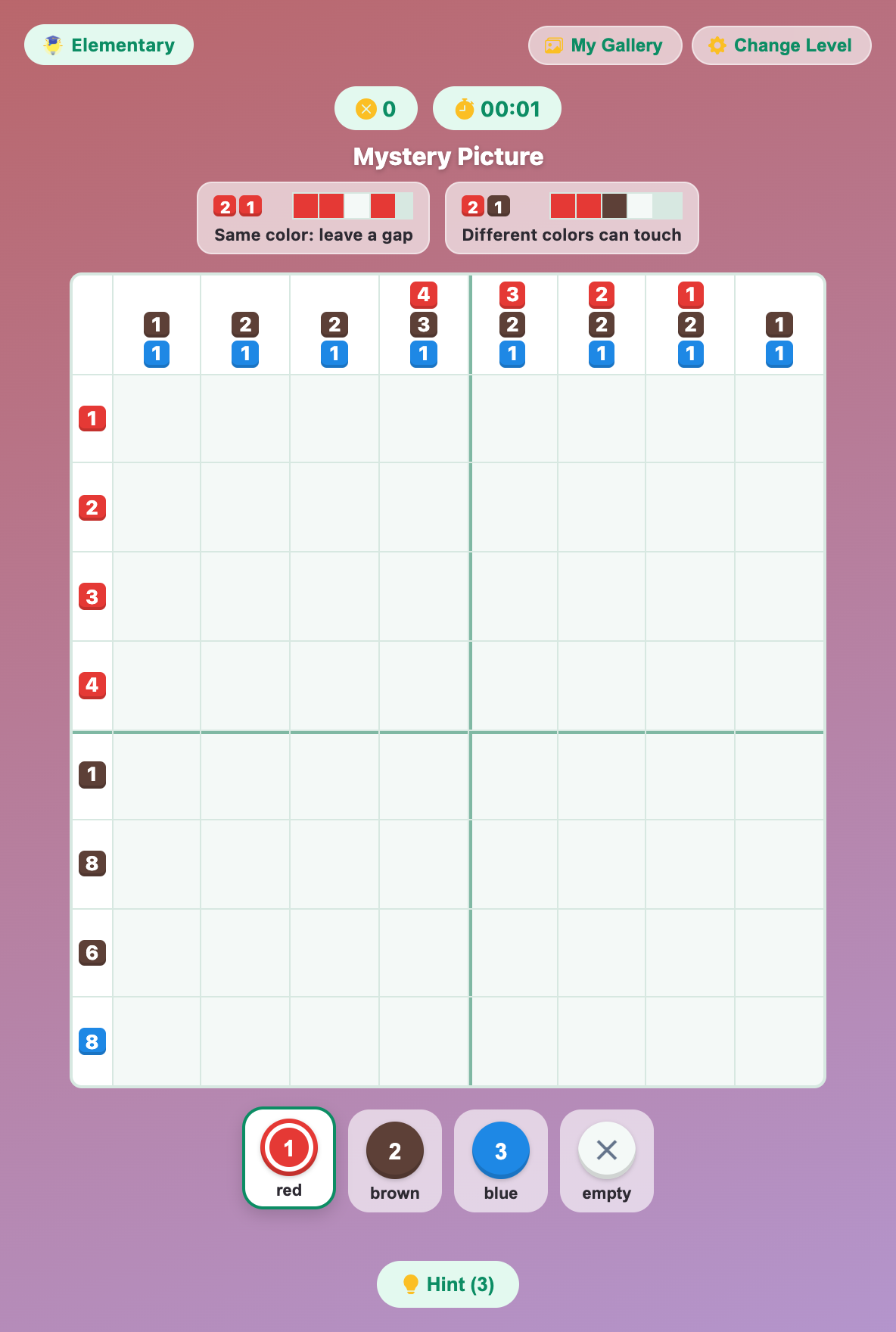
An empty 8x8 Mystery Picture at the Elementary level, with red, brown and blue number clues
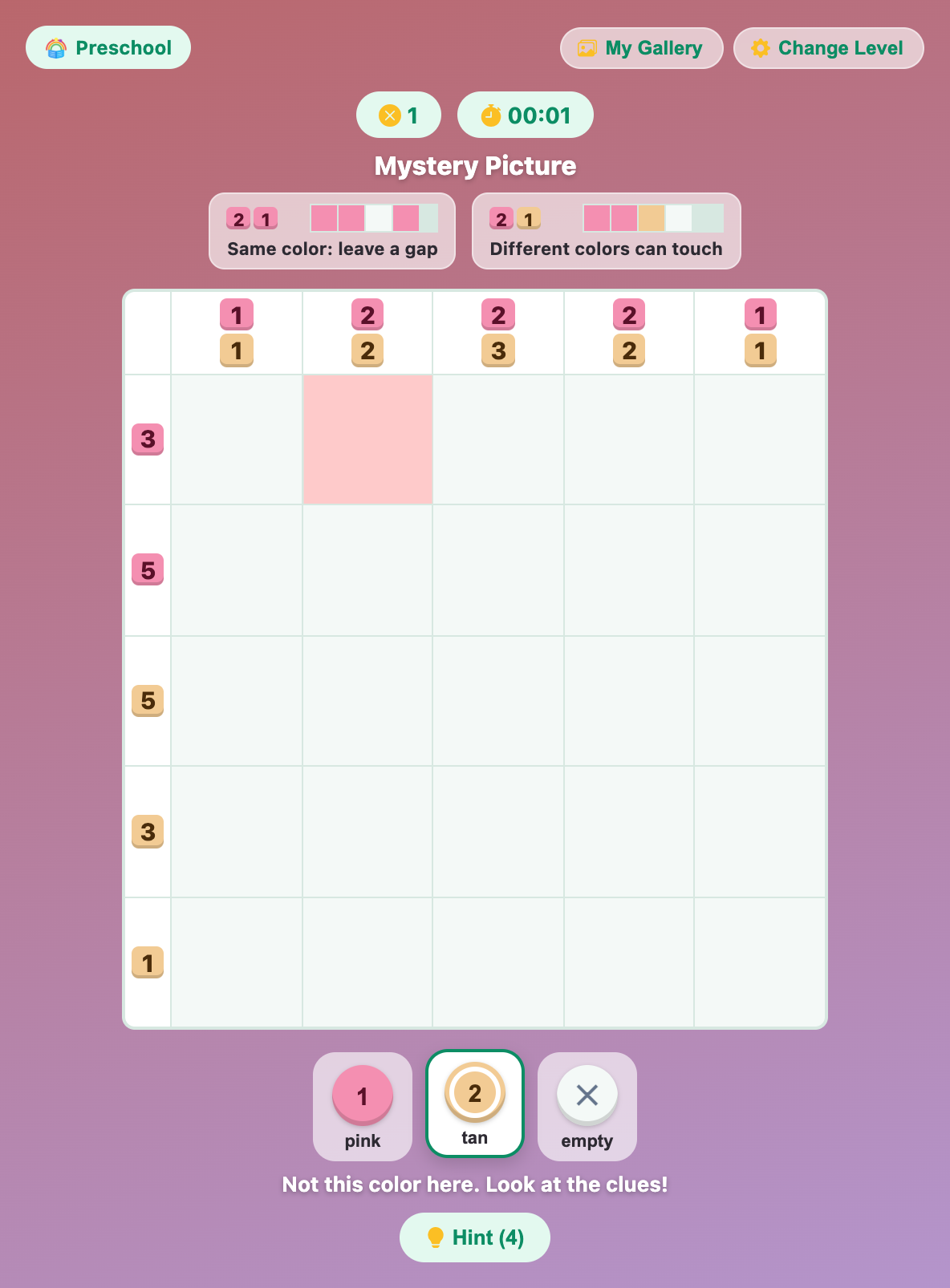
A 5x5 puzzle at the Preschool level where a wrong tan paint was refused with a Look at the clues message
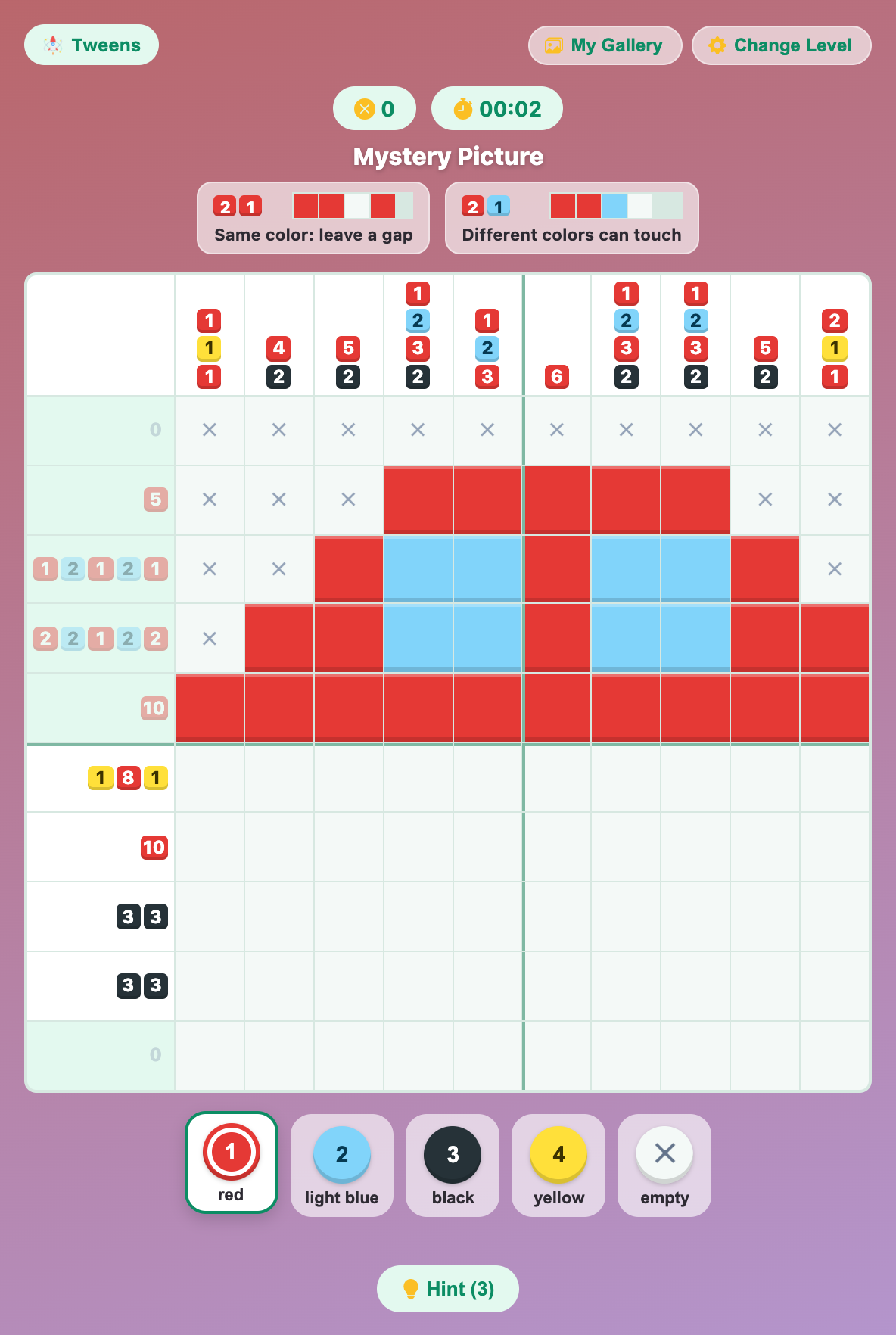
A 10x10 puzzle in Pixel Art Nonograms for tweens, with the top half painted red and light blue and X marks
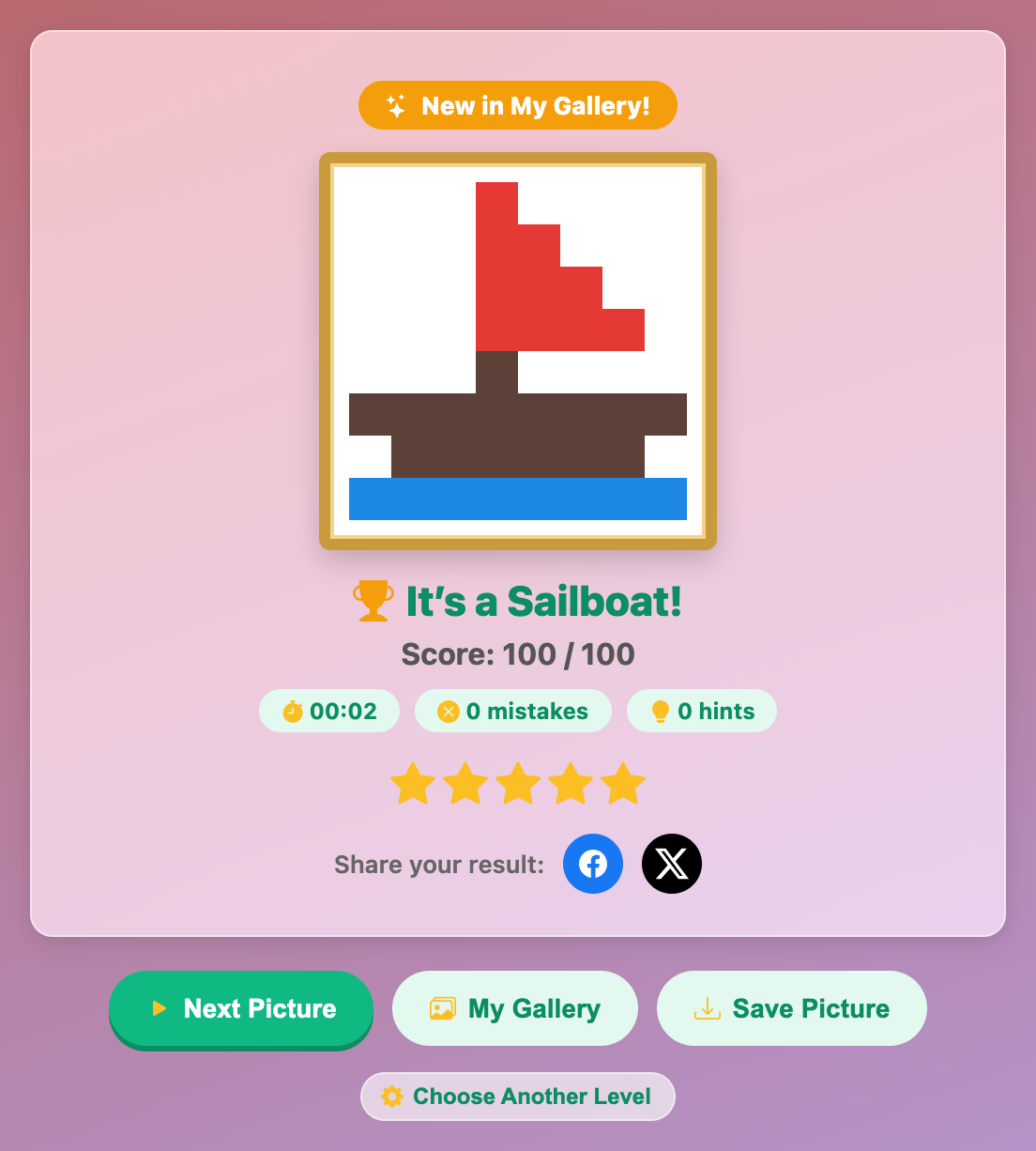
A finished pixel Sailboat in a gold frame with a New in My Gallery ribbon, a 100 out of 100 score and five stars
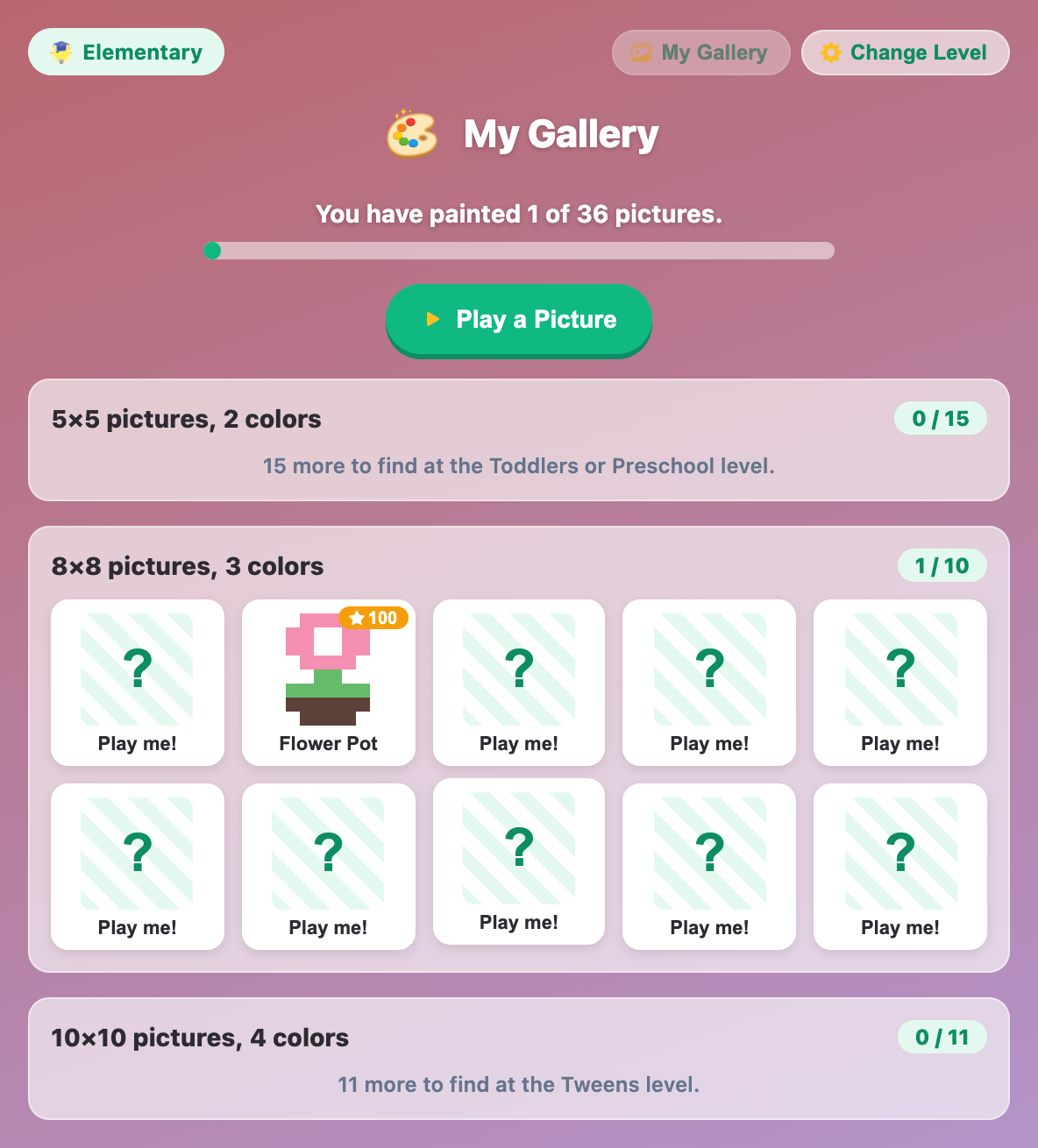
The My Gallery screen with a finished Flower Pot picture and mystery tiles waiting to be played
More Art Games
 1.8M plays
4.9
Color & Draw
A free-drawing canvas with colors and brush sizes to unleash your creativity.
 154.5K plays
5.0
Mood Palette
Decide which color best fits a mood or theme before time runs out.
 584.9K plays
5.0
Tiny World Builder
Start with a tiny empty island and build your own blocky village — plant grass and trees, lay roads, and unlock houses, farms, a school and more!
 174.6K plays
4.9
Color Mixing
Look at two paint colors and pick which color they mix together to make.
Most Played Games
1.8M plays
4.9
Color & Draw
A free-drawing canvas with colors and brush sizes to unleash your creativity.
 59.5K plays
4.8
Recycling Sort
Sort everyday items into the Recycle, Compost, or Trash bin before time runs out!
 365.8K plays
5.0
Tic-Tac-Toe
Play a game of Tic-Tac-Toe against the computer and see if you can outsmart it.
 274.1K plays
5.0
Sentence Builder
Pick your age level, then tap the shuffled words in the right order to build the sentence.
Comments (18)