
Magic Crossbow: Extra Number
393.7K playsFind the number that breaks the pattern and shoot it with your magic crossbow! In 2 4 6 7 8 10 we count by 2s, so pop the 7 and watch a little frog hop along the fixed pattern. Counting by 1s for little ones, skip-counting up and back by 2s, 5s and 10s, and tricky patterns with two extra numbers for big kids.
Two, four, six, eight… You probably know how that chant goes. Now imagine it written on a row of number tiles: 2 4 6 7 8 10. Something sounds wrong, doesn't it? The 7 snuck in where it doesn't belong. Aim your magic crossbow at it, let the arrow fly, and pop! The 7 bursts into sparkles, the tiles slide together, and a little animal hops along the fixed row, leaving a +2 over every jump.
That's Magic Crossbow: Extra Number for kids, a math game on KidWorld about number patterns. Each round is a skip-counting row with one number that breaks it (two on the Tweens level), and your job is to find it and shoot it. Kids have played it more than 390,000 times, and it's rated 4.9 out of 5 from more than 1,700 ratings. There's no clock and no lives, just 10 patterns, a purple crossbow and a sunny meadow full of smiling sunflowers and peeking bunnies.
🔢 Patterns With a Stowaway
Skip counting means counting by jumps instead of one at a time. Counting by 2s goes 2, 4, 6, 8. Counting by 5s goes 5, 10, 15, 20. The size of each jump is called the step. In this game, every pattern has one step that never changes. Patterns can count up or, on the older levels, count back, like 33, 30, 27.
Each round shows a card with a cute animal (a frog, a bunny, a kangaroo, a ladybug, a monkey and more) and the job: Shoot the extra number! Below it is a row of big number tiles. All of them follow the pattern except the extra one.
The game is fair in a clever way. It only builds a puzzle if there is exactly one way to fix it. Removing the extra number is the only way to leave a pattern with an even step, so a careful answer can't be marked wrong. And if the extra number is a double, like 3 3, it doesn't matter which copy you shoot. Either one fixes the pattern, so either one counts as a hit.
Once the pattern is fixed, the tiles turn green, and the round's animal hops from tile to tile with the step (like +2 or −3) popping up over each gap. It's a fun way to see the pattern work.
🎮 Playing on KidWorld, One Step at a Time
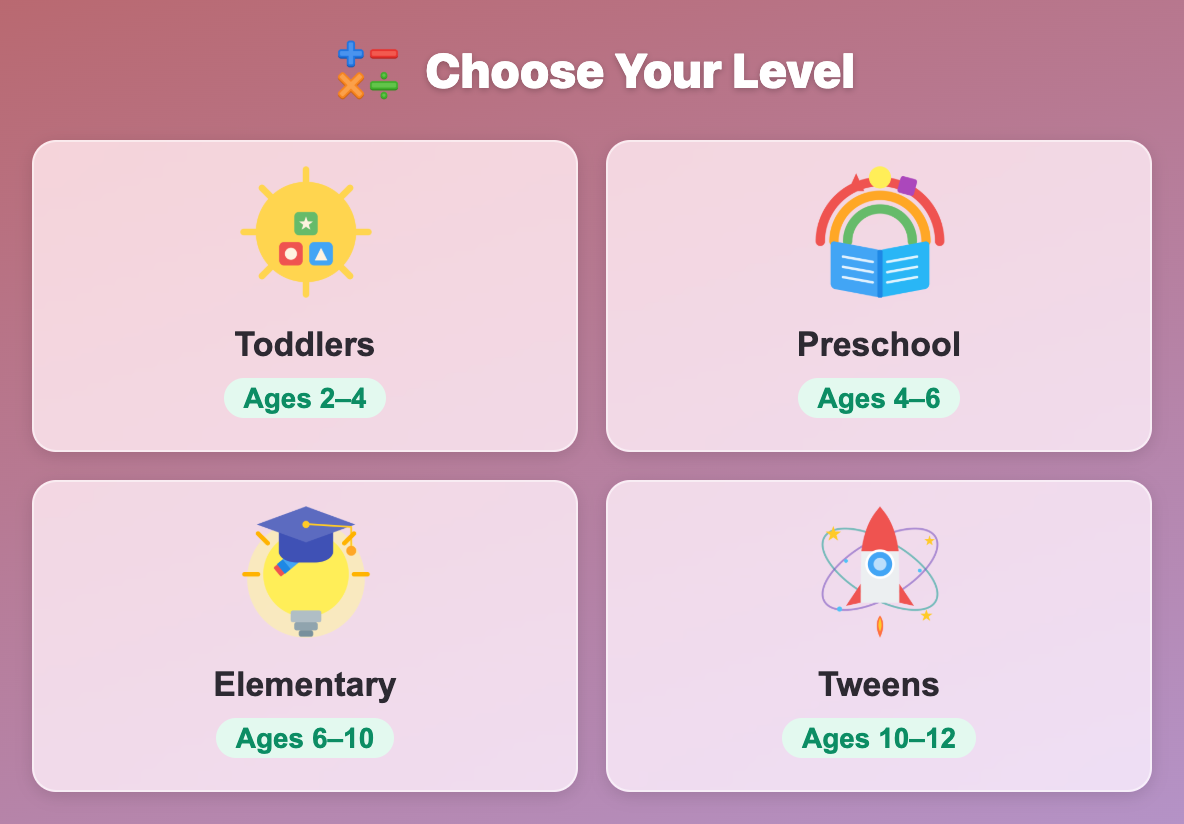
Pick your level. The game may start right away on Elementary. Tap Change Level to see the four cards: Toddlers (ages 2–4), Preschool (4–6), Elementary (6–10) and Tweens (10–12). The game remembers your pick.
Read the card. On Toddlers and Preschool, the card tells you the rule from the start, with a green badge like +5 on the animal and words like Count by 5s! On Elementary and Tweens, the rule stays hidden until you've fixed the pattern. Finding it is part of the puzzle.
Listen if you like. The green 🔊 button reads the numbers still standing and the question. On Toddlers and Preschool, the game reads each new pattern by itself when the sound is on.
Aim. Move your mouse over a tile and the crossbow turns to face it, with a red target on the tile. On a keyboard, use ← and →.
Shoot. Tap or click a tile, or press Space or Enter to shoot where you're aiming. You can also type the number. If you type a 2 while a 24 is on the board, the game waits a moment in case you're typing 24.
Hit or bounce. If you hit the extra number, it bursts and the tiles close up. If you hit a number the pattern needs, a magic shield bounces the arrow and a note says something like That number is part of the pattern! On Tweens, after your first hit, the message says Great shot! Now find one more.
Watch the hop. When the pattern is fixed, the card shows the rule with the first numbers, like Count back by 3s: 33, 30, 27 …, and the animal hops along the row.
Finish all 10. The top-left badge shows which pattern you're on, and the top-right shows your points. Two perfect rounds in a row light up a 🔥 streak badge. After pattern 10, the result card shows your score, your stars and a Practice these again list. Tap Play Again or Change Level. The play page also has buttons for fullscreen, reload and music.
⭐ Points, Stars and the Helpful Glow
Each pattern is worth up to 10 points. Every missed shot on it takes away 3, but a pattern never goes below zero. That's 10 for no misses, 7 for one, 4 for two, 1 for three, and 0 after that. Ten perfect patterns make 100.
Score 90 or more and the result card says Bullseye! You are a number wizard! with five stars. From 70 it's Super shooting!, and from 50 it's Nice aiming! The card also counts how many patterns you solved on the first try, your missed shots and your best streak.
If you're stuck, the extra number starts to glow yellow: after one miss on Toddlers and Preschool, or after two misses on Elementary and Tweens. A note says Look! The glowing number is extra. The glow is free, and it means every pattern ends fixed. Any pattern you missed shows up on the practice list with its step and numbers, like +8: 26, 34, 42, 50, 58, 66.
🧠 Number Detective Tricks: How to Spot the Extra Number
Speed doesn't matter in this game. Only misses cost points. So it pays to think like a detective and be sure before you shoot.
1. Say the pattern out loud
On the young levels the rule is on the card, so count along with it: five, ten, fifteen… When the number on the tile isn't the number you just said, you've found the extra one. Your ears often catch a wrong number faster than your eyes.
2. Find the gap that repeats
On Elementary and Tweens, nobody tells you the step. So work it out. Look at two tiles side by side and ask, How far apart are they? Do that for a few pairs. The gap that keeps coming back is the step. If one gap looks different from all the others, the extra number is probably right next to it.
3. Look for a number between two neighbors
The most common trick is a number squeezed in between two pattern numbers. In 25, 30, 31, 35, the jumps should all be 5, but 30 to 31 is only 1. A small jump in a row of big jumps is a big clue.
4. Watch for doubles
Sometimes a pattern number shows up twice, like 4, 4. A pattern with a step never repeats a number, so one copy has to go. Shoot either one.
5. Check both ends
On Elementary and Tweens, the extra number can stand at the very start or the very end of the row. Once you know the step, check the first and last tiles too. If the row is 12, 16, 20, 24, 28, 32, 35, the step is 4, so after 32 should come 36, not 35.
6. Notice which way it counts
A quarter of Elementary patterns, and more than a third on Tweens, count back: the numbers get smaller. Read from left to right and check whether each number is bigger or smaller than the one before. The jump is the same size either way.
7. Use what you know about times tables
Counting by 5s from 5, 10 or 15 always lands on numbers ending in 0 or 5. Counting by 10s from 10 always ends in 0. Counting by 2s from an even number stays even. On Preschool, the 2s, 5s and 10s patterns always start on their times table (like 10, 15, 20 for 5s), so a 31 in a 5s pattern stands out right away. On the older levels, patterns can start anywhere (like 3, 5, 7, 9), so check the jumps, not just the endings.
8. Count the tiles
Toddler and Preschool patterns have 5 numbers, so you'll see 6 tiles. Elementary patterns have 6 numbers plus 1 extra, which makes 7 tiles. Tweens have 6 numbers and 2 extras, which makes 8. On Tweens, the two extra numbers never sit side by side.
🔎 Five Rows Cracked Step by Step
Toddlers: 1 2 3 4 4 5
The card says Count up! with a +1 badge. Count along: one, two, three, four… four again? A counting row never says the same number twice. Shoot either 4 and the row reads 1, 2, 3, 4, 5. Then the chick hops along it.
Preschool: 2 4 6 7 8 10
The card says Count by 2s! Chant it: two, four, six, eight. The 7 doesn't fit, because 6 + 2 is 8. Shoot the 7. Bonus fact: counting by 2s from 2 only makes even numbers, and 7 is odd.
Preschool: 25 30 31 35 40 45
The card says Count by 5s! On Preschool, every number in a 5s pattern ends in 0 or 5. The 31 ends in 1, so it's the stowaway. Shoot it and the row reads 25, 30, 35, 40, 45.
Elementary: 33 30 27 24 21 21 18
No rule on the card this time. Let's find it:
33 to 30 is 3 smaller. 30 to 27 is 3 smaller. 27 to 24 is 3 smaller. So the step is 3, counting back.
After 24 should come 21. ✔️
Then 21 again. A pattern never repeats a number, so one 21 is extra.
After that comes 18, which is 21 − 3. ✔️
Shoot either 21. The card then shows Count back by 3s: 33, 30, 27 … and a ladybug hops along with a −3 over each jump.
Tweens: 46 51 58 65 72 79 83 86
There are 8 tiles, so two numbers are extra. Start in the middle, where the gaps match:
58 to 65 is 7. 65 to 72 is 7. 72 to 79 is 7. The step is 7.
Go left from 58: the number before should be 51. ✔️ Before that should be 44, but the tile says 46. So 46 is extra.
Go right from 79: the next number should be 86. The tile right after 79 says 83, which doesn't fit. So 83 is extra, and 86 comes next. ✔️
Shoot 46 and 83, and the row reads 51, 58, 65, 72, 79, 86: counting by 7s.
🎈 Magic Crossbow: Extra Number for Kids at Every Age
The level changes the step sizes, how big the numbers get, how sneaky the extra number is, and how much help you get.
🐣 Magic Crossbow: Extra Number for toddlers (ages 2–4)
Toddlers count up by 1s with numbers from 1 to 10. The extra number is either a stray number from somewhere else or a number said twice. The +1 badge and Count up! are on the card, each pattern is read aloud when sound is on, and the extra number glows after just one miss. It's a lovely way for a little one to practice saying the numbers in order with a grown-up. Like on Preschool, an extra 6 never joins a pattern that has a 9, or the other way round, since those two are easy to mix up.
🎨 Magic Crossbow: Extra Number for preschoolers (ages 4–6)
Preschoolers count by 1s and 2s up to 20, and by 5s and 10s up to 50. The step is shown on the card, patterns always count up, and the glow comes after one miss. The game also avoids a common mix-up at this age: it never drops an extra 9 into a pattern that has a 6, or an extra 6 into one with a 9.
📐 Magic Crossbow: Extra Number for elementary kids (ages 6–10)
Elementary kids count by 2s, 3s, 4s, 5s and 10s, from any starting number up to 99, and some patterns count back. The rule is hidden, so you have to find the step yourself. Extra numbers can sit between two neighbors, be a double, or stand at either end. Each step comes up about equally often in a game, so you practice all of them.
🚀 Magic Crossbow: Extra Number for tweens (ages 10–12)
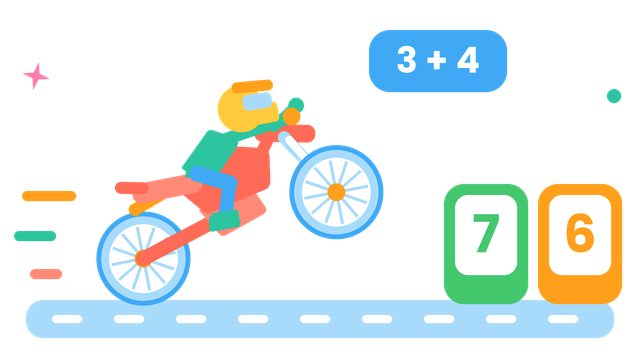
Tweens get bigger steps like 6s, 7s, 8s, 9s, 11s, 12s and 15s, more patterns that count back, and two extra numbers in every row of 8 tiles. Every number stays at 99 or below, so it's all about spotting the step, not doing huge sums. Skip counting by 6s, 7s and 8s is the same as saying those times tables, so it's great practice for Math Multiplication Moto Race, where you ride your motorbike through the lane with the right times-table answer.
🌟 What Kids Learn Between the Arrows
Seeing patterns. Noticing that 33, 30, 27 goes down by 3 each time is the start of algebra thinking. It teaches kids to look for a rule instead of seeing numbers as a random list.
Fast mental math. Checking each gap means lots of small adding and taking away: 58 + 7, 30 − 3. After a few games, these jumps start to feel easy.
Times-table power. Counting by 2s, 5s and 10s builds the first times tables. Counting by 7s, 8s and 12s builds the harder ones.
Checking your work. A miss costs points but time doesn't, so the game rewards kids who stop and check every number before they shoot.
Number order. For the youngest players, simply knowing that 5 comes after 4 is the whole lesson. If your child enjoys putting numbers in order, Number Bubbles asks them to tap a group of bubbles from smallest to biggest.
A note for grown-ups
Magic Crossbow: Extra Number for kids is gentle and calm. The arrows only hit number tiles, a wrong shot just bounces off a shield, and every round ends with the pattern fixed and a happy hop. There's no timer and no way to fail. It practices counting, skip counting up and back, spotting a rule, and early times tables. A nice habit after a game is to say each pattern on the Practice these again list out loud together, and then keep counting a few numbers past the end.
Ready to hunt for stowaways? Pick your level, find the step, and shoot every number that doesn't belong. Magic Crossbow: Extra Number for kids turns counting into target practice. If you like it, the same crossbow also hunts down the letter that doesn't belong in Magic Crossbow: Extra Letter, a spelling version of this game.
🖼️ See the Game in Action
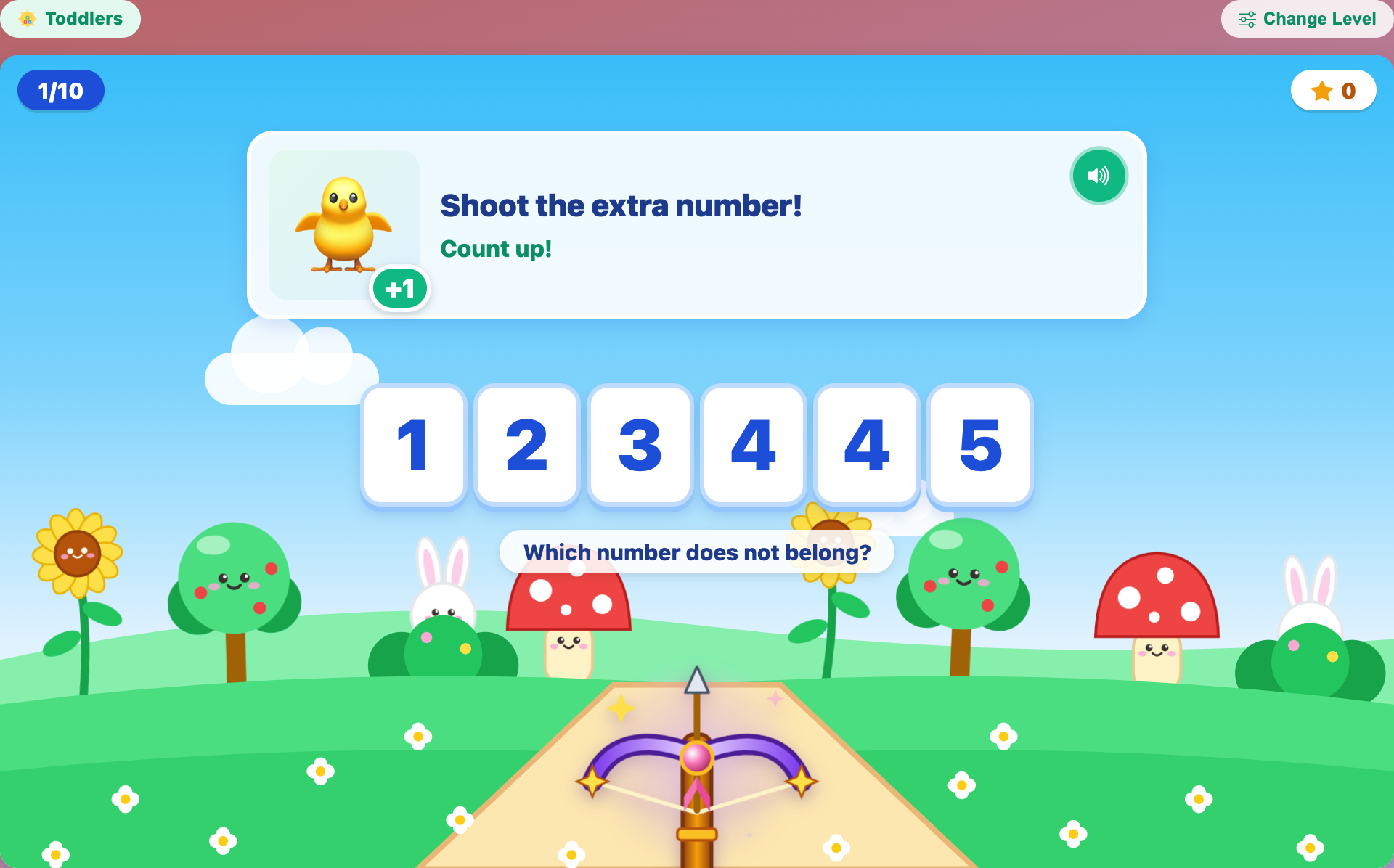
A toddler round with a chick, a +1 badge and the tiles 1 2 3 4 4 5, where one 4 is extra
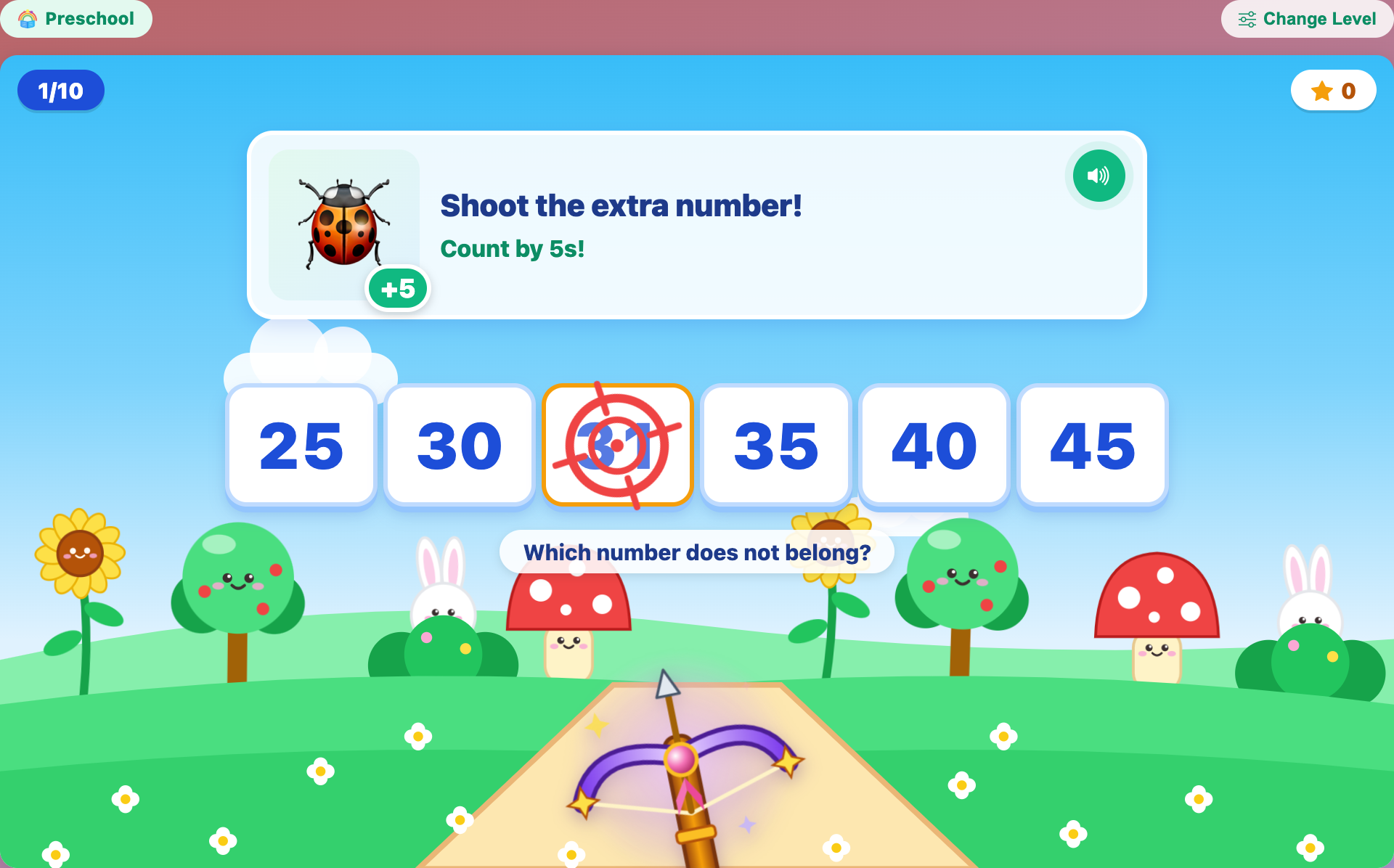
A Count by 5s round for preschoolers with the tiles 25 30 31 35 40 45 and the crossbow aiming at 31
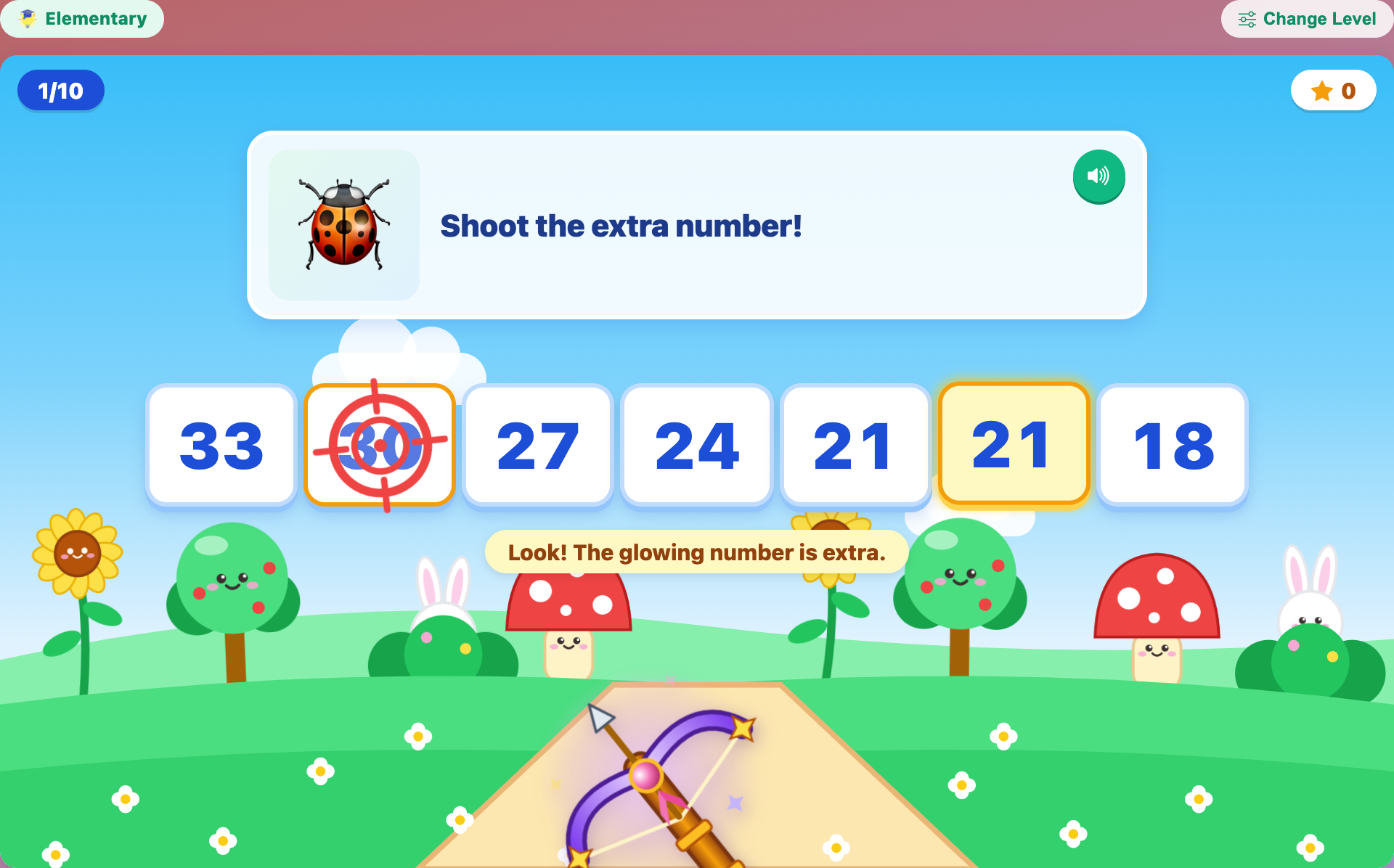
The second 21 glowing as a hint in 33 30 27 24 21 21 18, in Magic Crossbow: Extra Number for elementary kids
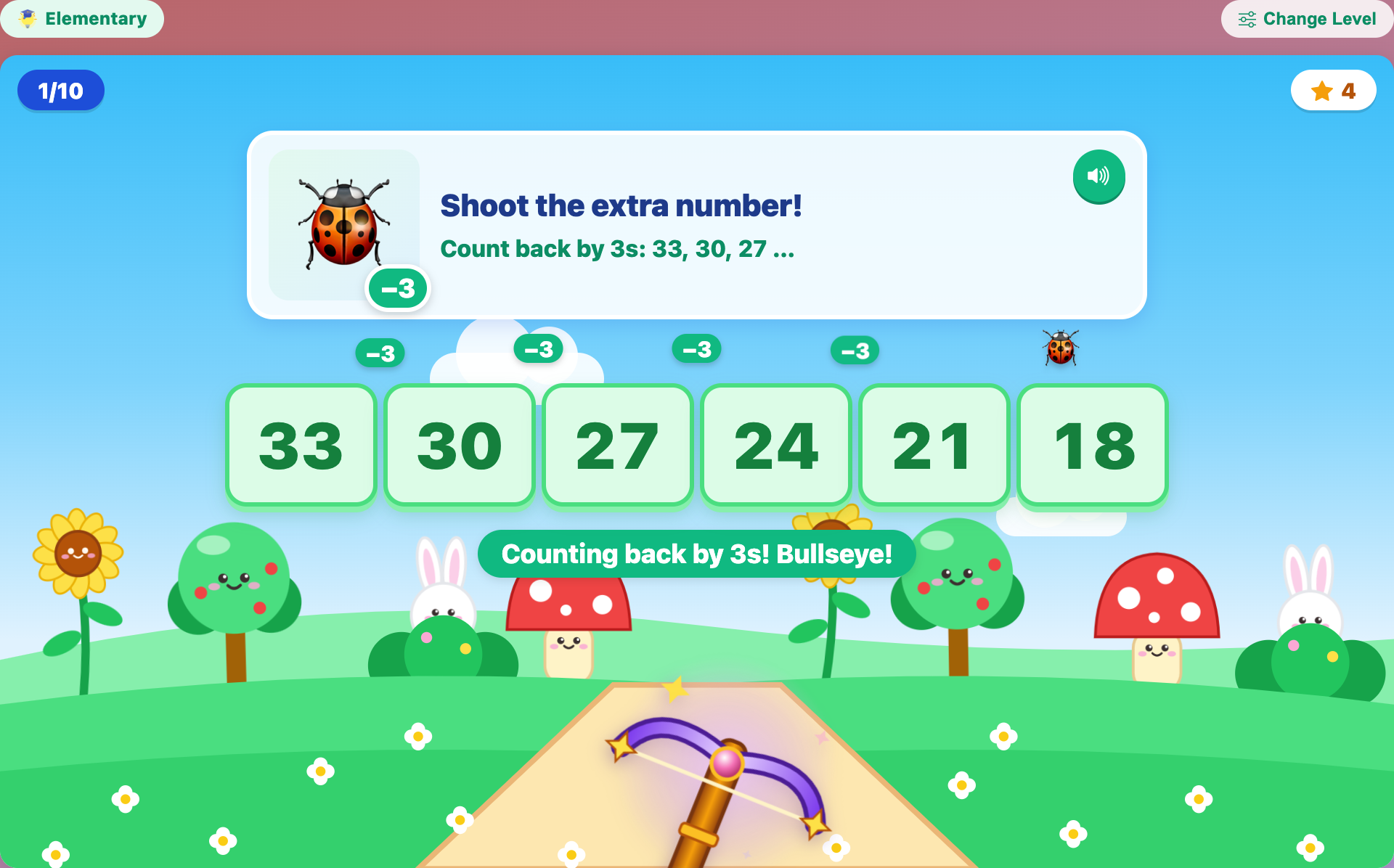
A ladybug hopping along 33 30 27 24 21 18 with a minus 3 tag over each gap and a Counting back by 3s message
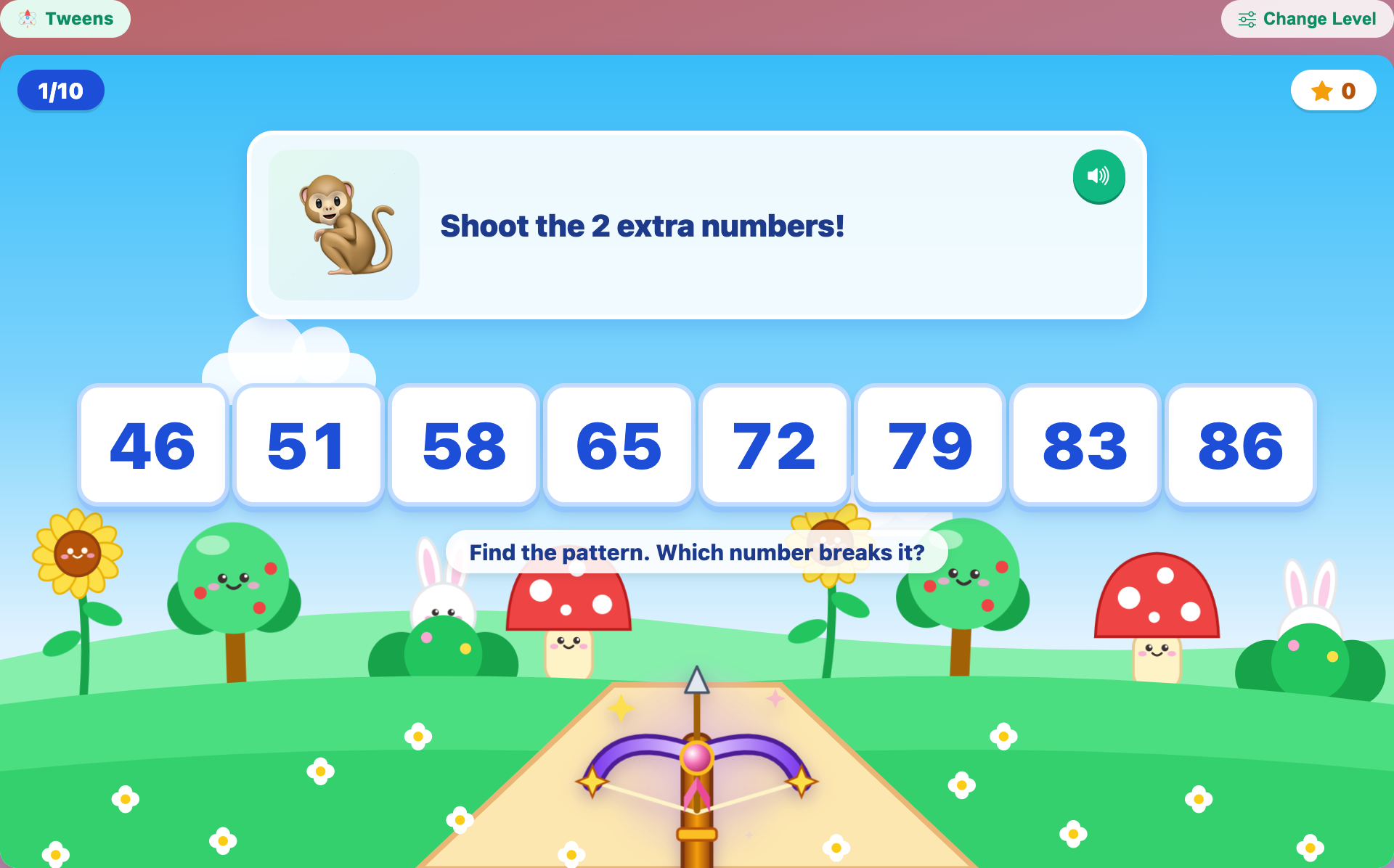
A tweens round with a monkey and the tiles 46 51 58 65 72 79 83 86, asking for 2 extra numbers
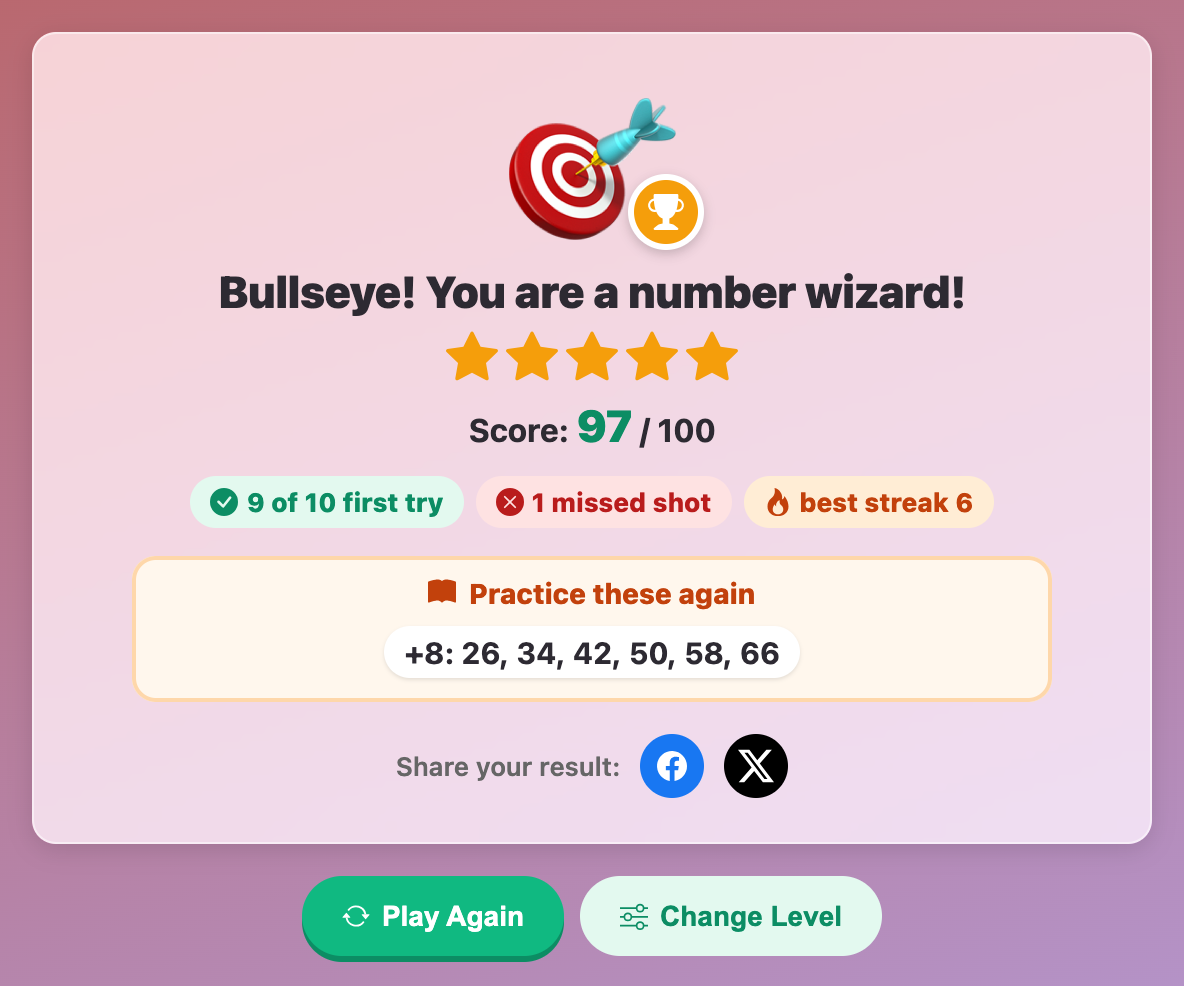
The result card in Magic Crossbow: Extra Number with 97 out of 100, five stars and one counting-by-8s pattern to practice
More Math Games
 1.1M plays
5.0
1.1M plays
5.0
Math Moto Race
Pick your age level, then ride your motorbike through the lane with the right answer — every correct gate makes you faster!
 518.4K plays
5.0
518.4K plays
5.0
Math Temple Escape
Help a baby bunny hop away with the Golden Carrot! Bounce along a pastel temple path in 3D, jump logs, slide under flower garlands and dodge smiling mushrooms while cheeky little monkeys chase you. At every gate, hop under the sign with the right answer to zoom ahead. Counting, adding, subtracting, times tables and division for every age.
 473.7K plays
4.9
473.7K plays
4.9
Math Addition Moto Race
Pick your age level, then ride your motorbike through the lane with the right addition answer — every correct gate makes you faster!
 857.5K plays
5.0
857.5K plays
5.0
Addition Quiz
Pick your age level and answer fun multiple-choice addition questions!
Most Played Games
 1.8M plays
5.0
1.8M plays
5.0
Color & Draw
A free-drawing canvas with colors and brush sizes to unleash your creativity.
 59.4K plays
5.0
59.4K plays
5.0
Recycling Sort
Sort everyday items into the Recycle, Compost, or Trash bin before time runs out!
 365.6K plays
4.9
365.6K plays
4.9
Tic-Tac-Toe
Play a game of Tic-Tac-Toe against the computer and see if you can outsmart it.
 1.1M plays
4.9
1.1M plays
4.9
Chess
Play the classic game of chess against the computer or a friend, with FIDE time controls, hints, and undo.
Comments (32)