
Math Car Race
847.4K playsPick your age level, then drive your race car through the lane with the right answer — every correct gate makes you faster!
About Math Car Race Game
Buckle up. 🚗 The traffic lights are counting down — 3… 2… 1… GO! — and four cars leap off the line together. Yours is in the middle of the screen, the road pours underneath you, a green hill rolls up ahead and the tarmac swings gently to the right. Then you see it far away: a big grey sign bridge standing right across the road, with four white signs hanging under it, one over every lane. As you rush closer the signs grow bigger, and you can read the numbers on them. At the top of the screen a white plate says 8 × 7 = ? — and the question mark is waiting for you. There is no A, B, C or D to tap. The lane you drive in is your answer. Pick the right one, drive under the bridge, and the sign flashes green, sparks fly off your bumper and your engine sounds happier. That is Math Car Race, the driving maths game on KidWorld — a game that has already been raced more than 800,000 times and earned thousands of five-star ratings for a shining 4.9 out of 5. Ten sign bridges. One chequered flag. Let's drive. 🏁
🚦 A Road Sign That Asks You a Sum
Have you ever sat in a car on a big road and looked up at the giant signs hanging over the lanes? They tell the driver which lane to take. Math Car Race takes that exact idea and makes it into a game. Ten times in every race, a sign bridge is built across the road in front of you. It always has four lanes and four signs, and each sign shows a different number. Only one of those numbers is the answer to your sum.
You do not tap a button. You do not type anything. You simply steer into the lane you believe in and keep driving. The moment your front bumper touches the white band painted across the tarmac under the bridge, your answer is locked in. That is a lovely thing about this Math Car Race game for kids: doing the maths and driving the car are the same action.
And this is a real road, not a picture of one. It bends left and right. It climbs over hills and dips into little valleys. White lane lines flick under your wheels, red-and-white stripes blink past the edges, and trees, bushes, rocks and big billboards whoosh by on the grass. Far away, everything turns soft and misty — just like real things do when they are a long way off. Behind it all, a sun sits in a blue sky with two rows of green hills and a dark treeline in front of them.
Here is the best secret of all: the sums are not stored anywhere. Your car invents every single one, right there on the road, using the age level you chose. Nobody can ever learn the answers by heart, because there is no list to learn. The only way to get better is to actually get better at maths. 🧠
🏁 How to Play Math Car Race, Step by Step
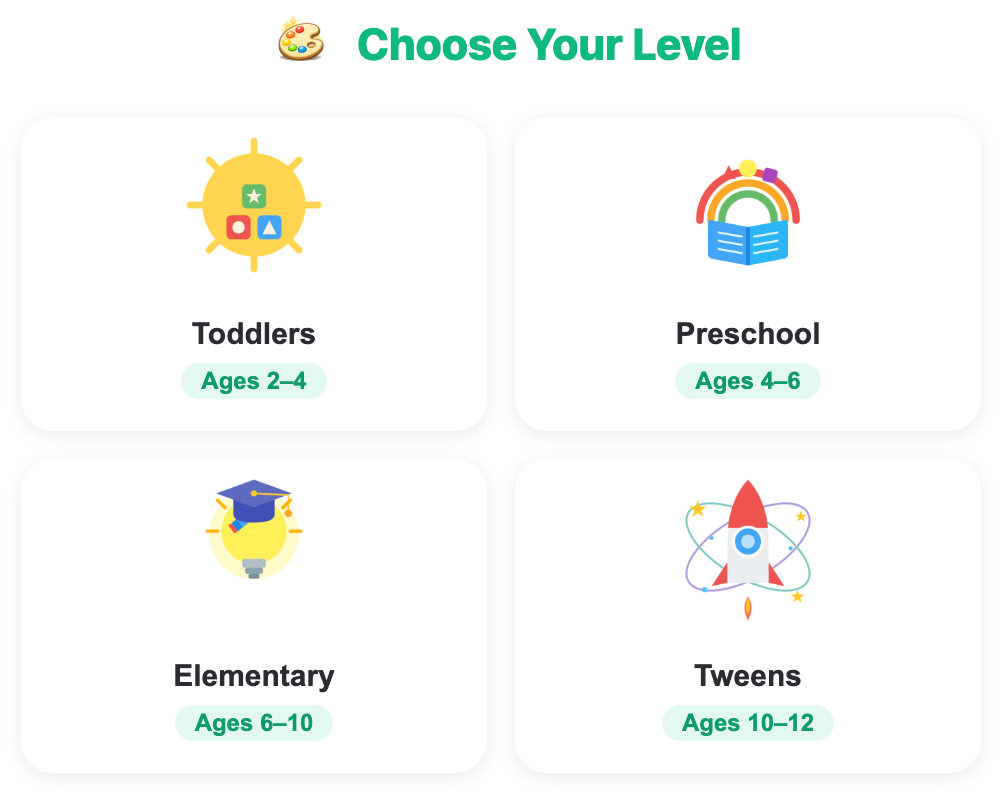
1. Choose your level. The game opens with four cards — Toddlers, Preschool, Elementary and Tweens — each showing the ages it is made for. Tap one and your race loads. KidWorld remembers your choice, so next time you can drive straight off. The ⚙️ Change Level button at the top swaps it whenever you like.
2. Line up on the grid. Four cars take their places: yours, plus a blue one, an orange one and a purple one. A big 3… 2… 1… appears on the screen, then a green GO! flashes, and everybody sets off from a standing start at exactly the same moment. Nobody gets a head start.
3. Read the white plate. Your sum is painted straight onto the picture, in a white plate at the very top of the screen, with a green edge around it. It says something like 11 − 4 = ?, and the question mark sits there patiently.
4. Look up at the four signs. The first sign bridge comes quite soon — it is set at only half the usual distance, so your race starts with a question instead of a long empty drive. After that they are evenly spaced out all the way to the end.
5. Steer into the lane you want. Hold an arrow key, hold an on-screen arrow button, press the number of the lane, or just press the road beside your car on the side you want to move to. More on all of these in a moment.
6. Drive over the white band. The answer is taken from whichever lane your car is in at that exact spot. The whole band flashes green if you were right or red if you were not. The correct sign turns green, and if you picked a different one, yours turns red so you can see both at once.
7. Always glance back at the plate. The instant a gate is judged, that orange question mark turns into the real answer. So even a wrong lane teaches you the sum before you have driven past the bridge. Nothing is ever kept secret from you.
8. Do that ten times… then keep driving! The tenth sum is not the finish. After the last bridge the road goes quiet and you drive on for about five more seconds to a black-and-white chequered flag painted flat across the tarmac. Crossing that is the real end of the race.
9. Collect your medal. A result card slides up with a big round medal showing your finishing place, how many gates you got right, your score out of 100, your stars, and buttons to Race Again, choose a different level, or share how you did.
🎛️ Your Dashboard: Every Control Explained
Math Car Race drives beautifully with a keyboard, with a mouse, or with one finger on a phone or tablet. Everything below works everywhere.
Steer left and right: hold ← or → (the keys A and D do the same job), or hold the two arrow buttons under the road. Hold longer, travel further. Your car rolls a little into the turn, the way a real car leans on its springs — but only a little, because a car is not a motorbike and should never look like it is tipping over.
Press the road beside your car: this is the special one, and it is the friendliest control in the game. Your car is always painted in the middle of the screen. Press the tarmac on its left and the car moves left; press on its right and it moves right — exactly as if you had held that arrow button. But it does something extra and clever: the lane your finger landed on becomes a wall, and the car stops neatly on that lane instead of sliding past it. Press right beside your car and you get the next lane over. Press further up the road, where the lanes look thin, and you can ask for a lane right across the tarmac. There is a small dead zone right on top of the car, so poking your own car by accident does nothing at all.
Slide your finger while you hold it: that re-aims at a new lane, even across to the other side of the car, which turns it around. A finger just resting on the glass will not re-aim — the game ignores tiny wobbles on purpose, so your car never creeps away from you.
Press 1, 2, 3 or 4: your car drives straight to that lane — counting from the left — and then holds it. This is the neatest trick in the whole game, because a bend is always trying to shove you sideways and a held lane fights that shove for you, all the way to the bridge. Touch a steering key or button and the car hands control straight back to you.
Boost: hold ↑ or W, or the ⚡ Boost button. Faster, louder, and white speed lines come flying at you out of the middle of the screen.
Brake: hold ↓ or S, or the 🛑 Brake button. A red glow lights up over the back of your car — real brake lights, just like the car in front of you on a real road.
Pause: press Space or P, or tap the Pause button. The whole world freezes — your car, the rivals, the music, everything — and a big PAUSED sign appears. Nothing moves a single centimetre while you are gone, so it is completely safe to pause in the middle of a tricky sum and come back later.
Just above the road there are three more buttons worth knowing. Fullscreen pushes the rest of the page out of the way so the road fills your whole screen — and that is not just for fun: bigger signs can be read from further away, and further away means more seconds to think. The reload button starts a brand-new race at the same level (finish the race you are in first — points only count once you cross the flag). The speaker button turns all the sound on or off together, and KidWorld remembers if you like to race in silence.
⚡ The Boost Tank: Right Answers Are Your Fuel
Boost is not a magic button you can lean on forever. Your car carries a small boost tank, and it behaves exactly like this:
A completely full tank holds about 3 seconds of boost. Hold the button down and you can feel it draining.
Filling up from empty takes about 7 seconds — and it fills up even while you are still holding the button. So if you run dry, you do not have to work out that you should let go. Just keep driving and it comes back.
Drain it all the way to zero and boost locks itself out until the tank has built back up to about a quarter full. That stops it flickering on and off, and it stops anyone from simply holding boost for an entire race.
Every correct answer pours fuel straight in — a big splash, worth well over a second of extra boost, added the instant the sign flashes green. This is the heart of the whole game: your maths is what makes your car fast.
Boost gives you about one and a half times your cruising speed. It refuses to work on the grass, it always loses to the brake if you somehow hold both, and it switches off completely for the run to the chequered flag — the Boost button politely greys itself out when that happens, so you can see it, not just feel it.
There is no fuel gauge on screen. You learn your tank by feel, the way you learn how long you can hold your breath. Watch the little speed readout in the bottom-right corner instead: in a Tweens race a boosting car climbs to nearly 200 km/h. 💨
🛑 The Brake Pedal Is a Thinking Machine
Most kids never touch the brake in a racing game. In Math Car Race the brake might be the cleverest button on the screen, and here is exactly why.
The sign bridges are not spaced out by time. There is no little clock ticking on each question — not one, anywhere in the game. They are spaced out by distance along the road. So the slower you drive, the longer that same stretch of tarmac takes you, and the longer you get to look up at those signs and work the sum out. Every second you spend braking is a free second of thinking time. 🧠
The brake is safe, too. It never brings you to a stop — it only pulls you down to a bit under half of your cruising speed, so you can hold it all the way to the bridge and still always arrive. And it always beats the boost if you press both at once, exactly like a real car.
So what does braking cost you? Ground. The other three cars keep going while you slow down, and you will watch them pull away up the road. That is the whole bargain of this game: speed, or thinking time — you choose. And if you are feeling nervous about that choice, skip down to the scoring section, because there is very good news waiting for you there.
🌿 Reading the Road: Grass, Bends and Crests
The tarmac is where all your speed lives. Wander off the edge onto the green and your car is dragged down to less than half of your cruising speed almost at once, and boost simply refuses to work until your wheels are back on the road. If you let go of everything while you are out there, your car will gently drift back onto the tarmac all by itself — you are never stuck and never stranded. A held key or a pressed lane always wins over that drift, so it never fights you.
One warning worth remembering: if a sign bridge arrives while you are out on the grass, the game still takes an answer from you. It uses the outside lane, the one nearest to where you are. That is almost never the lane you wanted. Get your wheels back on the road before the bridge arrives!
Bends matter too. A curve pushes your car toward the outside of the turn, so if you leave your lane change until the very last moment on a bend, the road itself can nudge you a lane sideways just as you cross the line. And when a hill gets in the way, the road ahead vanishes over the crest — but the top of the next sign bridge still peeks over the hill. Learn to spot that little grey beam poking above the horizon and you will see your next question coming before it "arrives". 👀
🧠 Maths Tricks That Pick the Lane for You
Now for the part that turns a good racer into a great one. The single most important thing to know about Math Car Race is this: the three wrong signs are always close neighbours of the right one. The game builds them on purpose to sit near the true answer — never more than about 3 away at Toddlers, 4 at Preschool, 5 at Elementary and 7 at Tweens. You will never, ever see 8 sitting next to 500.
That means you cannot win by spotting "the sensible-looking number". There is no sensible-looking number — they are all sensible. You have to actually know. These tricks help you know quickly.
Start from the bigger number and count on. For 2 + 9, do not begin at 2. Begin at 9 and go 10, 11. Two steps instead of nine. At 90 km/h that really matters.
Learn your doubles and then lean on them. If you know 7 + 7 = 14, then 7 + 8 has to be 15 and 7 + 6 has to be 13. Doubles are the very fastest facts in your head, and an enormous number of sums are sitting right next door to one.
Build a ten first. For 8 + 6, take 2 out of the 6 to turn the 8 into a 10, then add the 4 that is left over: 14. Tens are easy to carry around in your head while you are also steering.
Take-away means "how far apart". For 13 − 8, do not count backwards eight times. Ask "how far is it from 8 up to 13?" Jump 8 to 10 (that is 2), then 10 to 13 (that is 3), so the answer is 5. And good news: this game never gives you a subtraction that goes below zero, so your answer is always a friendly counting number.
Use odd and even to throw signs away. This trick is pure magic on a four-lane bridge. Even + even = even. Odd + odd = even. Odd + even = odd. Anything multiplied by 2, 4, 6, 8 or 10 is always even. So for 7 + 6 you already know the answer is odd before you have added anything — and just like that, some of the signs up there can be ignored completely.
Check the last digit. 9 + 4 must end in 3, because 9 and 4 always end in 3 no matter how big the rest gets. If only one sign ends in 3, that is your lane, and you never even finished the sum.
Know your times-table patterns. Every × 5 answer ends in 0 or 5. Every × 10 answer ends in 0. In the nine times table the two digits always add up to 9 (4 × 9 = 36, and 3 + 6 = 9). Patterns like these pick one sign out of four in under a second.
Build a hard times fact out of an easy one. Stuck on 8 × 7? You certainly know 8 × 5 = 40, and 8 × 2 = 16, so add them: 56. Stuck on 12 × 6? 10 × 6 = 60, plus 2 × 6 = 12, makes 72.
Turn a division back to front. 84 ÷ 7 is really just the question "7 times what gives me 84?" And here is a lovely promise hidden inside this game: every division it ever builds comes out exactly. No remainders. No halves. Ever. If your answer is not a whole number, you went wrong somewhere — go back and try again.
Guess the size before you read the signs. For 38 + 26, think "about 40 plus about 25, so somewhere near 65". Now look up at the bridge. Anything far from 65 is gone instantly, and you are choosing between two signs instead of four.
Expect the numbers to grow. After the fifth bridge, the adding and taking-away numbers quietly get a bit bigger for the rest of the race. That is not you getting worse — that is the race getting braver. 💪
Expect to get less time, too. Every correct answer raises your cruising speed a notch. The bridges stay exactly the same distance apart, so a faster car reaches them sooner. A brilliant run really does turn into a harder race — which is the game growing to match you.
🔢 Four Real Sign Bridges, One From Every Level
Here is what a real bridge looks like at each age level, with the four signs written out from left to right, plus the quickest way to pick your lane.
👶 Toddlers — the plate says 3 + 4 = ? The signs read 5 | 8 | 7 | 4.
Start at the bigger number, 4, and count on three: 5, 6, 7.
Notice how close together all four signs are — 4, 5, 7 and 8. No guessing your way out of this one!
The answer is 7, hanging over lane 3. Press 3, hold your line, drive through. ✨
🧒 Preschool — the plate says 11 − 4 = ? The signs read 7 | 9 | 5 | 10.
Ask "how far is it from 4 up to 11?" Jump 4 to 10 (that is 6), then 10 to 11 (that is 1). 6 + 1 = 7.
The answer is 7, in lane 1, over on the far left. Aim early — that is a long way across the road, and if a bend is pushing you the other way you will need every metre.
🧑 Elementary — the plate says 8 × 7 = ? The signs read 54 | 59 | 51 | 56.
Anything times 8 is even, so 59 and 51 are gone straight away. Two signs left, and you have barely started.
Now build it from something easy: 8 × 5 = 40, and 8 × 2 = 16. Add them: 56.
The answer is 56, in lane 4. 🛑 Squeeze the brake on the way in — those extra seconds cost you nothing but a little ground.
🧑🎓 Tweens — the plate says 84 ÷ 7 = ? The signs read 15 | 12 | 18 | 9.
Flip the question around: "7 times what makes 84?"
7 × 10 = 70, and you still need 14 more, which is another 7 × 2. So 10 + 2 = 12.
The answer is 12, in lane 2. Remember the promise — divisions here always come out exact, so a wobbly-looking answer is never the right one.
🎯 Now try one all by yourself. The plate says 6 + 7 = ? and the four signs read 12 | 15 | 13 | 11. Which lane? Two different tricks both get you there in a flash. Doubles: 6 + 6 = 12, so 6 + 7 must be one more, 13. Odd and even: even + odd is always odd, which throws out 12 straight away. Both point at the same sign. It is lane 3. Press 3 and go! 🚗💨
🏆 Points, Places and Stars — What Really Decides the Winner
There are two different scores in Math Car Race, and the same thing decides both of them: your maths.
Your points. Every bridge you drive correctly is worth 1 point on the counter at the top of the screen, and 10 points on your final score. Ten perfect gates make a perfect 100 out of 100. Nothing ever takes points away from you — the very worst a bridge can do is give you nothing.
Your stars. 90 points or more earns the full five stars 🏆, 70 or more earns four, 50 or more earns three, 25 or more earns two, and simply reaching the chequered flag always earns you one. Those stars go straight into your KidWorld account, where they feed your daily streak and unlock badges. Playing as a guest? Your device keeps them safely for you.
Your finishing place. This is the clever part, and it is worth reading twice. Your place depends on one thing only: how many bridges you got wrong. 0 wrong finishes 1st 🥇 · 1 wrong finishes 2nd 🥈 · 2 wrong finishes 3rd 🥉 · 3 or more finishes 4th 🏁
Please read that last one again, because it changes how you ought to drive. You cannot buy a place with the pedal. Hold boost from the lights to the flag and you will still finish exactly where your answers put you. Crawl the whole way round on the brake and you will still finish exactly where your answers put you. The three rival cars speed up and slow down all race long to make absolutely sure of it — and the quiet five-second run to the flag at the end is there to let that order settle properly.
So boost and brake are not there to win the race for you. They are there to make it exciting, and to let you buy your own thinking time. Which means the gentlest way to play is also the smartest way to play: slow down, get it right, win anyway. 🧠🥇
🔍 Little Things Racers Notice
Two small readouts sit in the bottom corners. Bottom-left is your live position — 2nd of 4 — and bottom-right is your speed in km/h. Both are drawn outside the shaking, so they stay perfectly steady and readable even while a wrong answer is rattling the whole world.
Your rivals have their own colours. Blue, orange and purple, each with its own racing stripe, and each one wandering between lanes on a mind of its own so the pack always looks alive.
Once you pass a rival, it stays passed. There are exactly three of them for the whole race and no new cars ever appear from nowhere. An overtake here really means something.
You cannot crash. There is no bumping, no damage and no collision of any kind. Drive straight through a rival if you want to. They never answer a single sum and they can never hurt you — they are your company, not your problem.
A correct answer throws sparks. Green sparks burst up off your car, the whole screen flashes green, and a happy sound plays. A wrong one shakes the road, flashes red, and scrubs some speed off. You could almost tell how you did with your eyes shut.
Your brake lights are real. Press the brake and a red glow lights up over the back of your car, fading in and out as you press and release.
The chequered flag is painted on the road, not floating in the air — so it bends with the bend, tilts over the crest of a hill and disappears behind it, exactly like everything else on the tarmac.
This game brings its own music. Three racing tracks instead of the usual KidWorld tunes, plus a boost sound that hums for precisely as long as you hold the boost, and a tyre scuff every time you stamp on the brake at speed.
The screen shape never distorts the road. On a wide monitor you simply see more of the countryside at the sides, rather than a stretched, squashed-looking road. Phone, tablet or laptop — the track always looks right.
🌱 Why Math Car Race Is So Good for Kids
Imagine a maths worksheet that drives at 100 km/h, cheers when you are right, shows you the answer when you are wrong, and never once tells you off. That is roughly what is happening here — and there is real thinking behind every piece of it.
It builds fast, confident number sense. Working out 8 × 7 slowly with a pencil is perfectly fine. Knowing it while a sign bridge rushes toward you is something different and better — it is fluency, and fluency is the thing that makes every maths lesson afterwards feel easy instead of heavy.
The close-together answers train real thinking. Because the wrong signs always sit right beside the right one, a child cannot win by guessing which number "looks about right". They have to estimate, check the last digit, use odd and even — exactly the strategies teachers spend years hoping for.
Mistakes teach instead of punish. The correct sign lights up green, the plate at the top spells out the real answer, and the car simply keeps driving. There are no lives. Nothing is ever taken away. A child who gets four gates wrong still reaches the flag, still scores, and still earns stars.
Good maths turns into speed you can actually see. Right answers refill your boost tank and raise your cruising speed. It is the clearest message a game can send a child: the thinking is what makes the car fast.
It is completely fair. Because your finishing place comes only from correct answers, a younger child with slower thumbs never loses to a faster button-masher. The only skill being measured is the maths.
It joins the hands and the head. Steering, choosing a lane and calculating all at the same time builds focus and split attention — the same muscle you use for reading music, playing a team sport, or thinking clearly while somebody is talking to you.
Almost no reading is required. The whole game speaks in numbers, arrows, colours and sounds. That makes it perfect for a child who is already brilliant at counting but not yet reading sentences — and for anyone learning English as a second language.
There is no question timer, and Pause always works. A child can freeze the entire world in the middle of a hard sum, take a breath, talk it through with a grown-up, and start again. Driving fast is always a choice here, never a demand.
Nothing ever repeats. The sums are invented fresh every time, the road twists and climbs, and the four signs land in a different order on every bridge, so the answer is never in the same lane twice by habit. There is no pattern to memorise — only maths to learn.
It is free, and it fits in a pocket. No download, no install, no cost. Open KidWorld.org on any phone, tablet or computer and the traffic lights are already counting down.
🚗 Math Car Race for Every Age
One road, four completely different races. The level you pick changes three things at once: which sums appear, how fast your car drives, and how many seconds you get between bridges.
Math Car Race game for toddlers (ages 2–4) — adding only, with small numbers up to about 5 (growing to 7 later in the race), and the wrong signs never more than 3 away from the right one. It is the gentlest drive on the whole track: you pull away at around 57 km/h and can only build up to about 97, and the bridges are roughly 21 seconds apart at starting speed — by far the longest thinking time in the game. Perfect for counting on fingers together, side by side, with nobody in any hurry at all. 👶
Math Car Race game for preschool (ages 4–6) — adding and taking away now, with numbers up to about 10 (growing to 12), wrong signs within 4, a start of about 66 km/h and roughly 19 seconds between bridges. This is the level where "how far apart are these two numbers?" suddenly clicks into place, and where most children first discover that the brake button is really a thinking tool in disguise. 🧒
Math Car Race game for elementary (ages 6–10) — times tables join the adding and taking away: sums up to about 20 (growing to 22) and tables all the way to 10 × 10. The wrong signs sit within 5, your car leaves the line at about 75 km/h, cruises up toward 123 and touches nearly 180 km/h on boost, with about 18 seconds between bridges at the start. This is where the odd-and-even trick and the last-digit trick begin winning races all on their own. 🧑
Math Car Race game for tweens (ages 10–12) — the complete set: +, −, × and ÷, adding up to about 50 (growing to 52), times tables to 12 × 12, and divisions as big as 144 ÷ 12 — always exact, never messy. The wrong signs spread right out to 7, your car starts at about 84 km/h, cruises to 136 and screams to nearly 200 km/h on boost, with about 16 seconds between bridges and every correct answer shrinking that further. The fastest, hardest and most exciting race on KidWorld. 🧑🎓
And remember: whichever level you are on, those gaps between bridges get shorter and shorter as you answer correctly, because your car keeps getting quicker while the bridges stay put. Winning is what makes it hard. 😄
🏍️ More Racing Maths Games on KidWorld
Loved the car? KidWorld has a whole garage of racers built on the very same road, in case you fancy two wheels instead of four — or want to practise one single operation until you own it:
Math Moto Race — the same ten sign bridges, but on a motorbike that really leans into the corners.
Math Addition Moto Race — every single bridge is an adding sum.
Math Subtraction Moto Race — every single bridge is a take-away sum.
Math Multiplication Moto Race — pure times tables, at speed.
Math Division Moto Race — dividing all the way to the flag, and always coming out exact.
Quick Math — no engine at all this time, just you and the numbers, for when you want to sharpen up before your next race.
So: mirrors checked, hands on the wheel, eyes up the road. 🚦 Ten sign bridges are waiting for you out there, three rival cars are already revving on either side, and the tarmac climbs, curves and rushes away toward a chequered flag you cannot see yet. Every sum you get right splashes fuel into your tank and pushes you one place up the podium. Every one you get wrong shows you the answer and waves you straight on through. Math Car Race on KidWorld.org is free, it works on any phone, tablet or computer, and it quietly turns your times tables into pure speed. The lights are changing. 3… 2… 1… GO! 🚗💨🏁
🖼️ See the Game in Action
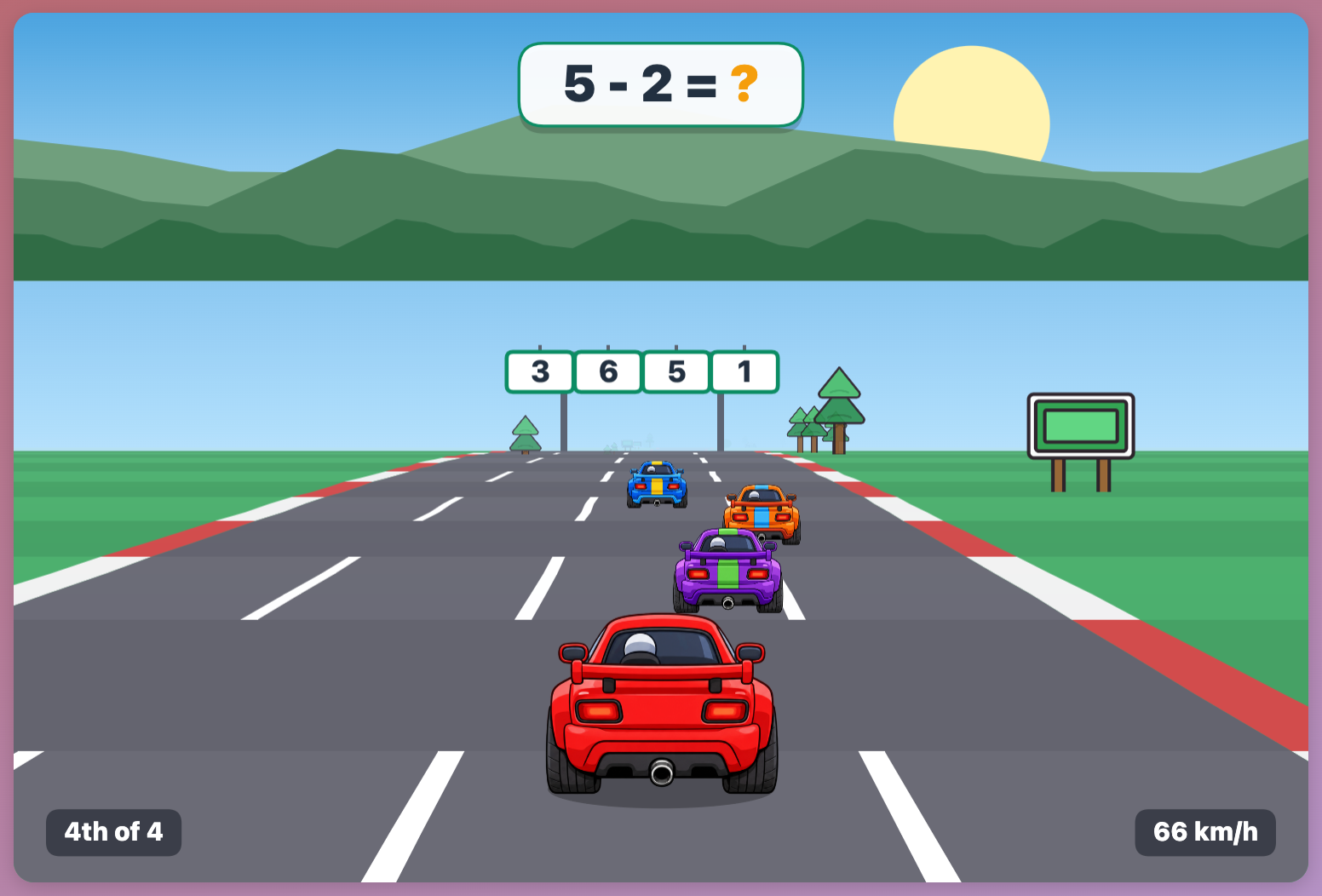
A screenshot when start a new Math Car Race game for preschool
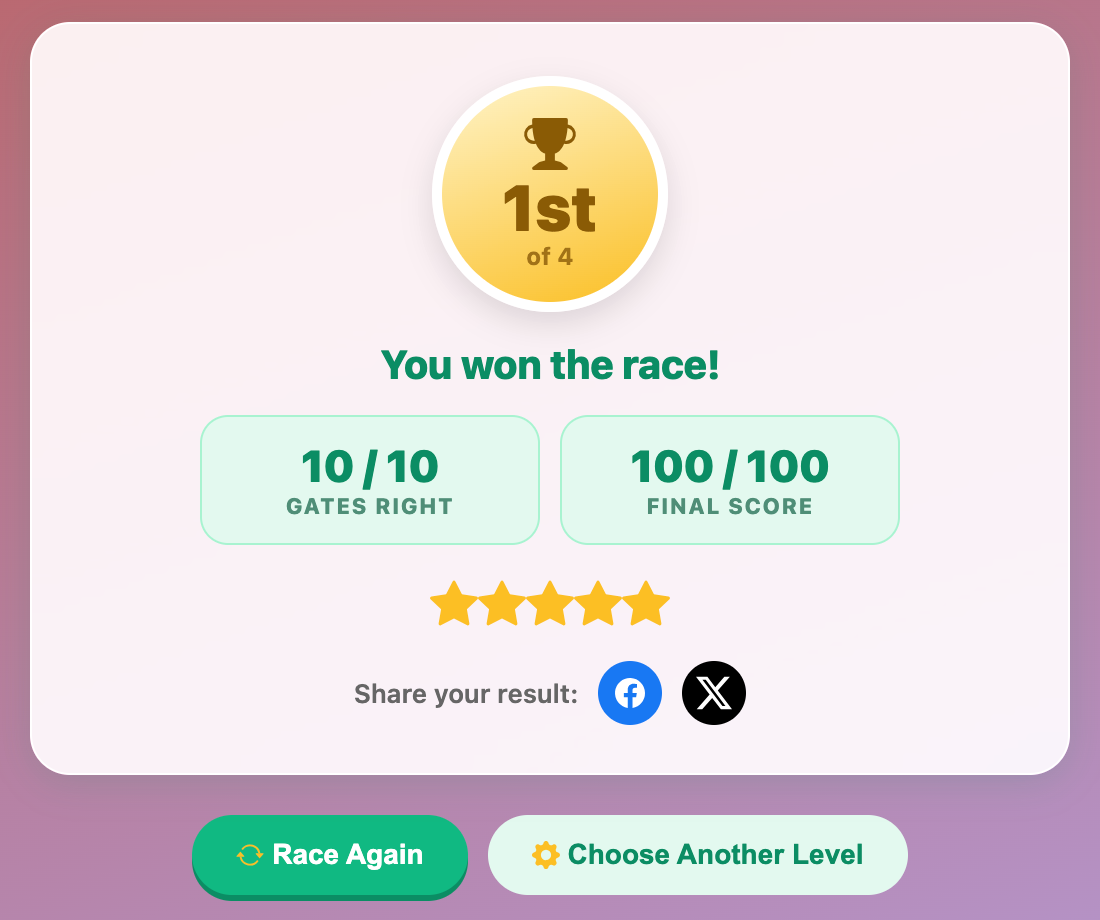
A screenshot when complete a Math Car Race game
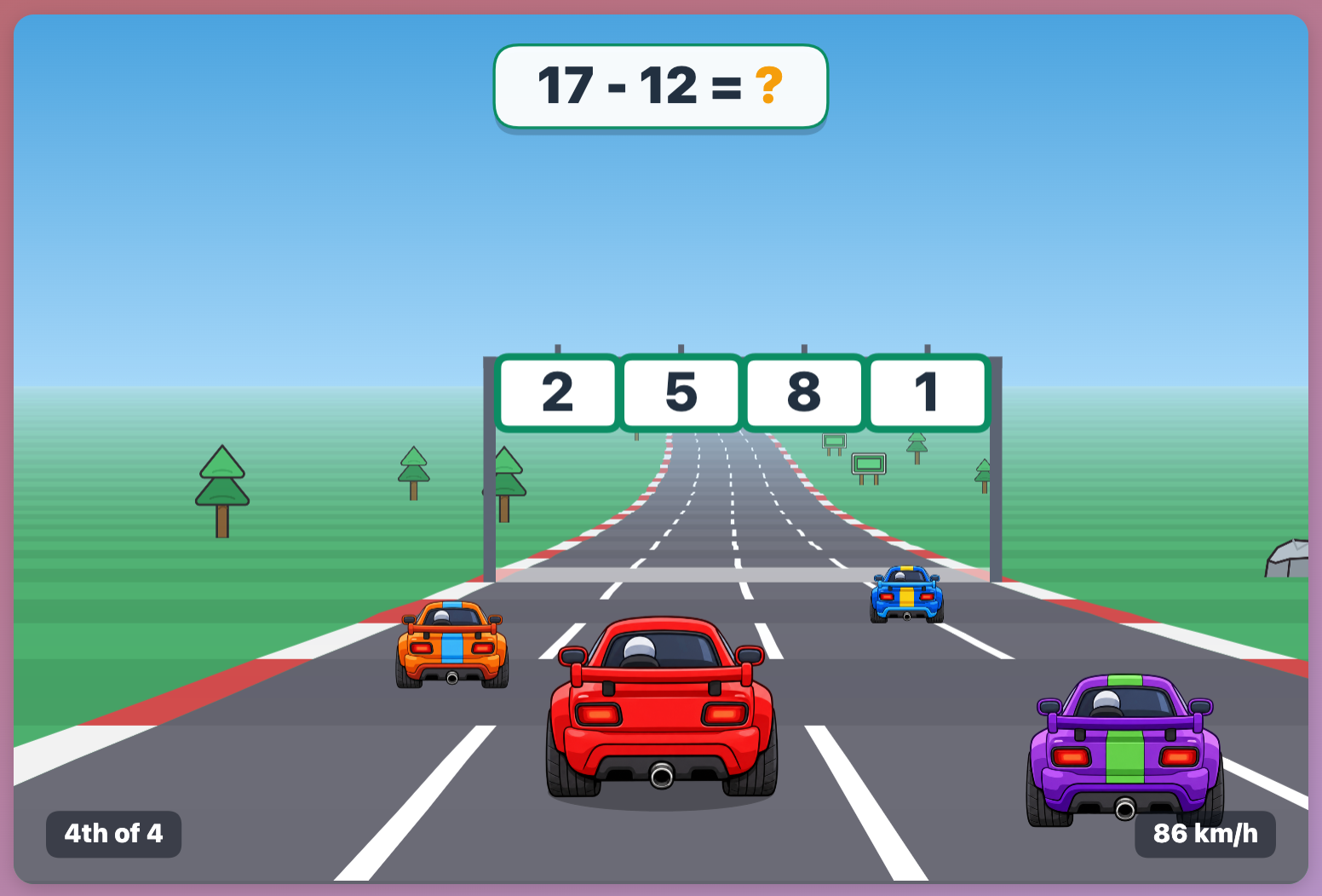
A screenshot when start a new Math Car Race for elementary
More Math Games
 1.1M plays
5.0
1.1M plays
5.0
Math Moto Race
Pick your age level, then ride your motorbike through the lane with the right answer — every correct gate makes you faster!
 473.7K plays
4.9
473.7K plays
4.9
Math Addition Moto Race
Pick your age level, then ride your motorbike through the lane with the right addition answer — every correct gate makes you faster!
 857.5K plays
5.0
857.5K plays
5.0
Addition Quiz
Pick your age level and answer fun multiple-choice addition questions!
 283.8K plays
5.0
283.8K plays
5.0
Math Subtraction Moto Race
Pick your age level, then ride your motorbike through the lane with the right subtraction answer — every correct gate makes you faster!
Most Played Games
 1.8M plays
5.0
1.8M plays
5.0
Color & Draw
A free-drawing canvas with colors and brush sizes to unleash your creativity.
 59K plays
5.0
59K plays
5.0
Recycling Sort
Sort everyday items into the Recycle, Compost, or Trash bin before time runs out!
 365.4K plays
4.9
365.4K plays
4.9
Tic-Tac-Toe
Play a game of Tic-Tac-Toe against the computer and see if you can outsmart it.
 1.1M plays
4.9
1.1M plays
4.9
Chess
Play the classic game of chess against the computer or a friend, with FIDE time controls, hints, and undo.
Comments (62)