
Math Moto Race
1.1M playsPick your age level, then ride your motorbike through the lane with the right answer — every correct gate makes you faster!
Helmet on! Your engine is humming, the road rolls up over a green hill and swings to the left, and far away — tiny at first, then bigger and bigger — a big metal sign bridge comes rushing toward you. Four signs hang from it, one above every lane, and every sign has a different number on it. Up at the top of the screen a white plate says 7 + 6 = ?. You have a few seconds. Choose the lane with the right number, ride under it, and you burst through in a shower of green sparks while three other bikes fall behind you. That is Math Moto Race, the racing math game on KidWorld where your answer is not a button you press — it is the lane you ride in. Racers have already taken the start line more than 1,000,000 times, and thousands of five-star ratings have pushed it up to a shining 5 out of 5. Ten sign bridges, one chequered flag, and a whole road full of hills. Ready? 3… 2… 1… GO!
🏍️ What Is Math Moto Race, Anyway?
Math Moto Race is a real motorbike race with math bridges built across the track. It is not a quiz with a picture of a bike stuck next to it. The road is drawn like a real road: it bends left and right, it climbs hills and dips into valleys, white lane lines rush under your wheels, red-and-white stripes flick past the edges, and trees, bushes, rocks and billboards fly by on the grass. Far away everything goes soft and misty, exactly the way things do when they are a long way off.
Ten times in every race, a sign bridge (racers call it a gate) is built right across the road ahead of you. There are always 4 lanes, so there are always 4 signs — and only one of them shows the answer to the sum on your screen. Nobody asks you to tap A, B, C or D. You simply steer your bike into the lane you believe in and ride under the bridge. Whichever lane you are in at that exact moment is your answer.
Here is something special about this math racing game for kids: the sums are never copied from a list. Your bike builds every single one fresh, right there on the road, using the age level you picked. That means no two races are ever quite the same, and you can never "learn the answers" — you can only get better at maths. 🧠
🕹️ How to Play Math Moto Race on KidWorld
Pick your level. The game opens with four cards: Toddlers, Preschool, Elementary and Tweens, each with its own ages. Tap one and your race begins. KidWorld remembers your choice for next time, and the ⚙️ Change Level button at the top swaps it whenever you like.

Take your place on the grid. Four bikes line up, one in each lane — you and three rival racers. Then a big 3… 2… 1… GO! counts you down and everybody launches from a standing start together. Nobody gets a head start on the throttle.
Read the plate at the top. The sum is painted right onto the picture, in a white plate above the road: something like 9 − 4 = ?. The question mark sits there in orange, waiting for you.
Look up at the four signs. As the bridge comes closer the signs get bigger and easier to read. One of them is your answer. The other three are close cousins of it.
Steer into that lane. Hold an arrow, press a button, drag the road, or just tap the lane you want and your bike will drive itself there and stay there.
Cross the white line. A white band is painted on the tarmac under the bridge. The moment your front wheel touches it, your answer is locked in. The band flashes green if you were right and red if you were not, and your chosen sign lights up too.
Always look at the plate afterwards. The second a gate is judged, the orange question mark turns into the real answer in green. So even a wrong turn teaches you the sum before you ride on. Nothing is ever hidden from you.
Do that ten times, then keep racing! The last sum is not the finish. After gate 10 the bridges stop and you ride on for about five more seconds to a black-and-white chequered flag painted flat across the road. Crossing that flag is the real end of the race.
Collect your medal. The result card shows a big round medal with your finishing place on it (gold, sky blue, orange or green), how many gates you got right, your final score out of 100, your stars, and buttons to race again, change level, or share how you did.
🎮 Every Control on Your Bike
You can play Math Moto Race with a keyboard, a mouse, or just your finger on a phone or tablet. Everything works everywhere.
Steer: hold ← or → (or A and D), hold the on-screen arrow buttons, or drag your finger sideways across the road. Your bike leans over when you steer, just like a real one.
Aim at a lane: tap the lane you want on the road, or press 1, 2, 3 or 4 for the lanes from left to right. This is the clever one. Your bike drives to that lane and then holds it, even through a bend that is trying to push you sideways. Touch a steering key or button and the bike hands control straight back to you.
Boost: hold ↑ or W or the ⚡ Boost button to go much faster.
Brake: hold ↓ or S or the 🛑 Brake button to slow down and give yourself more time to think.
Pause: press Space or P, or tap the Pause button. A big PAUSED sign appears and the whole world stops — the bikes, the music, everything. Tap the road or press Space again to go back. Nobody moves an inch while you are away, so it is completely safe to pause in the middle of a hard sum.
Three more buttons live in the little bar just above the race. The fullscreen button pushes the rest of the page away so the road fills your whole screen — a really good idea here, because bigger signs mean numbers you can read from further away, and further away means more thinking time. The reload button starts a brand-new race at the level you are on (careful: your points only count when you cross the flag, so finish the race you are in first). The speaker button turns the sound on and off — the racing music, the whoosh of your boost and the scuff of your brake all go quiet together, and KidWorld remembers if you like to race in silence.
⛽ The Boost Tank: Three Magic Seconds
Boost is not free, and it is not endless. Your bike carries a little tank, and here is exactly how it behaves:
A completely full tank holds about 3 seconds of boost. Hold the button and it drains away.
Refilling from empty takes about 7 seconds, and it refills even while you are still holding the button down — so if you run dry, you do not have to work out that you need to let go. Just keep riding.
If you drain it to zero, boost locks out until the tank has built back up a decent amount. That stops the boost from stuttering on and off, and it stops anybody from simply holding boost for the whole race.
Every correct answer pours fuel back in — about another second of boost, straight away. This is the heart of the game: good maths is what makes you fast.
Boost does not work on the grass, and it switches off completely for the run to the chequered flag (the Boost button politely greys itself out when that happens, so you can see it, not just feel it).
When you are boosting, white speed lines fly out of the middle of the screen at you, and the little speed readout in the bottom-right corner climbs fast. In a Tweens race a boosting bike can hit close to 200 km/h. 💨
🛑 The Brake Is the Real Secret Weapon
Most kids never touch the brake in a racing game. In Math Moto Race, the brake might be the smartest button on the screen — and here is the reason why.
The sign bridges are not spaced out by time. There is no little countdown clock ticking on each question. They are spaced out by distance along the road. So the slower you ride, the longer that same piece of road takes, and the longer you get to stare at the signs and work out the sum. Every second you spend braking is a second of free thinking time. 🧠
The brake will not stop you dead, either. It only slows you to a bit under half of your cruising speed, so you can hold it all the way to the bridge and still always get there. It also beats the boost — if you somehow hold both at once, the brake wins, just like on a real vehicle. Hold it and a red glow lights up behind your bike.
What does braking cost? Ground. The three rival bikes keep riding at their own pace while you slow down, so a long brake means watching them pull away up the road. That is the whole trade: speed or thinking time, you choose. And here is the good news for anybody who is nervous — see the scoring section below to find out why choosing "thinking time" is almost always the winning move.
🌿 Keep Off the Grass!
The tarmac is where the speed lives. Wander off the edge onto the green and your bike is dragged down to less than half of your cruising speed almost instantly, and boost refuses to work until you are back on the road. If you let go of everything while you are out there, your bike will gently drift back onto the tarmac by itself — you are never stranded.
One important thing to remember: if a sign bridge arrives while you are out on the grass, the game still gives you an answer. It counts the outside lane, the one nearest to you. That is very rarely the answer you wanted, so get your wheels back on the road before the bridge arrives!
🧮 Math Secrets That Win Races
Here is the thing that makes this game a real maths workout rather than a lucky-dip: the three wrong signs are always close neighbours of the right one. The game builds them on purpose to sit near the true answer — within about 3 at the Toddlers level, 4 at Preschool, 5 at Elementary and 7 at Tweens. You will never see 6 sitting next to 400. So you cannot pick the answer by spotting "the sensible-looking one". You have to actually know. These tricks help you know faster.
Count on from the bigger number. For 3 + 8, do not start at 3. Start at 8 and count 9, 10, 11. Fewer steps means fewer mistakes, and it is much quicker at 90 km/h.
Learn your doubles, then lean on them. 6 + 6 = 12, so 6 + 7 must be 13 and 6 + 5 must be 11. Doubles are the fastest facts in your head, and half the sums in the game are sitting right next door to one.
Make a ten. For 8 + 5, take 2 from the 5 to make the 8 into a 10, then add the 3 that is left: 13. Tens are easy to carry at speed.
Take-away means "how far apart". For 12 − 9, do not count backwards nine times. Ask "how far is it from 9 up to 12?" Three little steps and you are done. Good news: the game never gives you a subtraction that goes below zero, so your answer is always a friendly counting number.
Use the odd-and-even check. This one is magic for choosing between two signs. Even + even = even. Odd + odd = even. Odd + even = odd. Anything × 2, × 4 or × 6 is always even. So for 7 + 6 you already know the answer is odd — and just like that, half the signs on the bridge can be ignored.
Use the last digit. 7 + 6 must end in 3, because 7 + 6 ends in 3 no matter what. If only one sign ends in 3, that is your lane and you did not even do the whole sum.
Know your times-table patterns. Every × 5 answer ends in 0 or 5. Every × 10 answer ends in 0. In the nine times table, the two digits always add up to 9 (2 × 9 = 18, and 1 + 8 = 9). These patterns pick a lane out of four in less than a second.
Build a hard times fact out of an easy one. Stuck on 7 × 6? You know 7 × 5 = 35, so just add one more 7: 42. Stuck on 8 × 12? 8 × 10 = 80, plus 8 × 2 = 16, so 96.
Turn division back to front. 56 ÷ 7 is really the question "7 times what makes 56?" And here is a lovely secret hidden in the code of this game: every division it makes comes out exactly. There are never any leftovers, never any halves. If your answer is not a whole number, you took a wrong turn somewhere.
Guess the size first, then read the signs. For 38 + 24, think "about 40 plus about 20, so about 60". Now look up. If the signs say 55, 62, 58 and 67, you have already thrown two of them away.
Expect the numbers to grow. After the fifth gate, the adding and taking-away numbers quietly get a little bigger for the rest of the race. That is not you getting worse — it is the race getting braver. 💪
🏁 Race Secrets That Win Places
Tap the lane, do not hold the arrow. When you tap a lane, your bike drives there and holds the line for you, even through a curve. When you hold an arrow, you are fighting the bend by yourself. Tapping is faster and much steadier.
Decide early, arrive early. Bends push your bike toward the outside. If you leave your lane change to the last second on a curve, the road itself can shove you a lane sideways just as you cross the line. Choose while the bridge is still small.
Brake on the hard ones, boost on the easy ones. This is the winning rhythm of the whole game. See a sum you know instantly? Lock in your lane and hold boost. See one that needs a moment? Squeeze the brake and buy yourself the seconds.
Remember that winning makes it harder. Every correct gate raises your cruising speed a notch. The bridges stay the same distance apart, so a faster bike reaches them sooner and you get less reading time. A brilliant run really does turn into a tougher race — that is the game growing with you.
A wrong answer is not a crash. The screen shakes, a red flash goes past, your bike slows down — and then you carry straight on. You never lose a life, never restart, never lose the points you already earned. There are no lives in this game at all.
Do not chase the rivals. You cannot bump them, you cannot crash into them, and they never answer a single sum. Ride straight through them if you like. They are your company, not your problem.
Watch the tops of the bridges over the hills. When a crest is in the way, the road disappears but the top of the sign bridge still peeks over the hill. Look for that little grey beam early and you will spot the next gate before it "arrives".
Go fullscreen on a small screen. Bigger signs are readable from further back, and further back means more seconds to think. It is the cheapest advantage in the game.
🔢 Four Real Gates, One From Every Level
Here is what a real bridge looks like at each age level, with the four signs from left to right, plus the fastest way to pick your lane.
👶 Toddlers — the plate says 4 + 3 = ? The signs read 9 | 5 | 7 | 4.
Start at the bigger number, 4, and count on three: 5, 6, 7.
The answer is 7, hanging over lane 3. Tap it, hold your line, ride through. ✨
🧒 Preschool — the plate says 12 − 5 = ? The signs read 6 | 10 | 3 | 7.
Ask "how far from 5 up to 12?" Jump 5 to 10 (that is 5), then 10 to 12 (that is 2). 5 + 2 = 7.
The answer is 7, in lane 4, on the far right. Aim early — it is a long way across the road.
🧑 Elementary — the plate says 7 × 6 = ? The signs read 38 | 42 | 45 | 40.
Anything times 6 is even, so 45 is gone at once. That leaves three.
Now build it from something easy: 7 × 5 = 35, plus one more 7 = 42.
The answer is 42, in lane 2. Notice that all four signs were close together on purpose — no lucky guessing here!
🧑🎓 Tweens — the plate says 96 ÷ 8 = ? The signs read 15 | 9 | 12 | 18.
Flip it around: "8 times what makes 96?"
8 × 10 = 80, and you still need 16 more, which is another 8 × 2. So 10 + 2 = 12.
The answer is 12, in lane 3. Squeeze the brake while you work it out — those seconds are yours to buy. 🛑
🎯 Now try one on your own. The plate says 9 + 8 = ? and the signs read 16 | 19 | 17 | 14. Which lane? Here is the quick way: 9 + 8 is one less than the double 9 + 9 = 18, so it must be 17 — and you can double-check it with the odd-and-even rule, because odd + even is always odd, which throws out 16 and 14 straight away. Lane 3. Go! 🏍️
🏆 How Points, Places and Stars Really Work
There are two scores in Math Moto Race, and they are both decided by the same thing: your maths.
Your points. Every gate you ride correctly is worth 1 point on the counter at the top and 10 points on your final score. Ten perfect gates make a perfect 100 out of 100. Nothing takes points away — the worst any gate can do is give you nothing.
Your stars. 90 points or more earns the full five stars 🏆, 70 or more earns four, 50 or more earns three, 25 or more earns two, and simply reaching the flag always earns you one. Those stars go straight to your KidWorld account, feeding your daily streak and unlocking badges — and if you are playing as a guest, your device keeps them for you.
Your finishing place. This is the clever part, and it is worth reading twice. Your place is decided only by how many gates you got wrong: 0 wrong finishes 1st 🥇, 1 wrong finishes 2nd, 2 wrong finishes 3rd, and 3 or more finishes 4th.
Read that again, because it changes how you should play. You cannot buy a place with the throttle. Hold boost for the entire race and you will still finish exactly where your answers put you. Brake at every single gate, crawl the whole way round, and you will still finish exactly where your answers put you. The rival bikes speed up and slow down all race to make sure of it.
So the boost and the brake are not there to win the race. They are there to make it fun and to let you choose your own thinking time. That means the safest possible strategy is also the best one: slow down, get it right, win anyway. 🧠🥇
👀 Little Things Worth Spotting
Your three rivals have their own colours — blue, orange and purple — and each one drifts between lanes on its own, so the pack always looks alive.
Once you pass a rival, it stays passed. There are exactly three of them for the whole race, and no new bikes ever appear. Overtaking really means something here.
Two little readouts sit in the bottom corners. On the left is your live position — 2nd of 4 — and on the right is your speed in km/h. They stay perfectly steady even when a wrong answer makes the whole world shake.
A correct answer throws green sparks up from your back wheel and flashes the screen green. A wrong one shakes the road and flashes red. You can tell how you did with your eyes shut. Well… almost.
The chequered flag is painted on the road, not floating in the air, so it curves and rises with the tarmac and disappears over crests just like everything else.
This game has its own music. Instead of the usual KidWorld tunes, Math Moto Race brings three racing tracks of its own, plus a boost whoosh that hums for exactly as long as you are boosting and a tyre scuff every time you hit the brakes hard.
🌱 Why Math Moto Race Is So Good for Kids
It builds fast, confident number sense. Working out 7 × 6 slowly on paper is fine. Knowing it while a bridge rushes toward you is fluency, and fluency is the thing that makes every later maths lesson feel easy.
The close-together answers train real thinking. Because the wrong signs sit right next to the right one, children cannot guess by shape or size. They have to check, estimate, and use odd-and-even and last-digit tricks — the exact strategies teachers hope for.
Mistakes are always taught, never punished. The correct sign lights up green, and the plate at the top shows the real answer before you have even ridden past. Nothing is taken away and the race never ends early. A child who gets four gates wrong still finishes and still earns stars.
Effort turns into speed you can see. Right answers refill the boost tank and raise your cruising speed. It is a beautifully clear message: the maths is what makes the bike fast.
It is completely fair. Since the finishing place comes only from correct answers, a younger child with slow thumbs never loses to a faster button-masher. Skill at maths is the only skill being measured.
It joins the hands and the head. Steering, choosing and calculating all at once builds focus and split-attention — the same skill you need for reading music, playing sport, or thinking while somebody is talking to you.
Almost no reading is needed. The whole game speaks in numbers, arrows and colours, which makes it perfect for a child who is brilliant at counting but not yet reading sentences.
There is no per-question timer, and Pause always works. A child can stop the entire world mid-sum, breathe, and start again. Fast play is a choice here, never a demand.
🎮 Math Moto Race for Every Age
One road, four very different races. The level you choose changes the maths, the speed of the bike and how much reading time each gate gives you.
Math Moto Race for toddlers (ages 2–4) — adding only, with small numbers up to about 5 (growing to 7 later in the race), and the wrong signs never more than 3 away. It is the gentlest ride on the track: you set off at about 57 km/h and can only build up to about 97, and each sign bridge is roughly 7 seconds away at starting speed — by far the longest thinking time in the game. Perfect for counting on fingers together on a lap.
Math Moto Race for preschool (ages 4–6) — adding and taking away, with numbers up to about 10 (growing to 12), wrong signs within 4, a start of about 66 km/h and about 6.5 seconds between bridges. This is the level where "how far apart are these two numbers?" really clicks, and where a child first discovers that the brake button is a thinking tool.
Math Moto Race for elementary (ages 6–10) — now with times tables joining the adding and taking away: sums up to about 20 (growing to 22) and tables all the way to 10 × 10. Wrong signs sit within 5, the bike sets off at about 75 km/h and can reach 123, and bridges come every 6 seconds or so. This is the level where the odd-and-even trick and the last-digit trick start winning races on their own.
Math Moto Race for tweens (ages 10–12) — the full set: +, −, × and ÷, adding up to about 50 (growing to 52), times tables to 12 × 12, and divisions as big as 144 ÷ 12 (always exact, never messy). Wrong signs spread out to 7, the bike starts at about 84 km/h, cruises up to 136 and hits nearly 200 km/h on boost, with only about 5.5 seconds between bridges. The fastest, hardest, most exciting race on KidWorld.
So pull on your helmet, pick the level that fits you, and roll up to the line. 🏁 Ten sign bridges are waiting, three rivals are already revving beside you, and the road ahead climbs, curves and rushes off toward a chequered flag you cannot see yet. Every sum you get right pours fuel in your tank and pushes you one place up the podium. Every one you get wrong shows you the answer and lets you ride straight on. Math Moto Race on KidWorld is free, it works on any phone, tablet or computer, and it turns your times tables into pure speed. 3… 2… 1… GO! 🏍️💨
🖼️ See the Game in Action
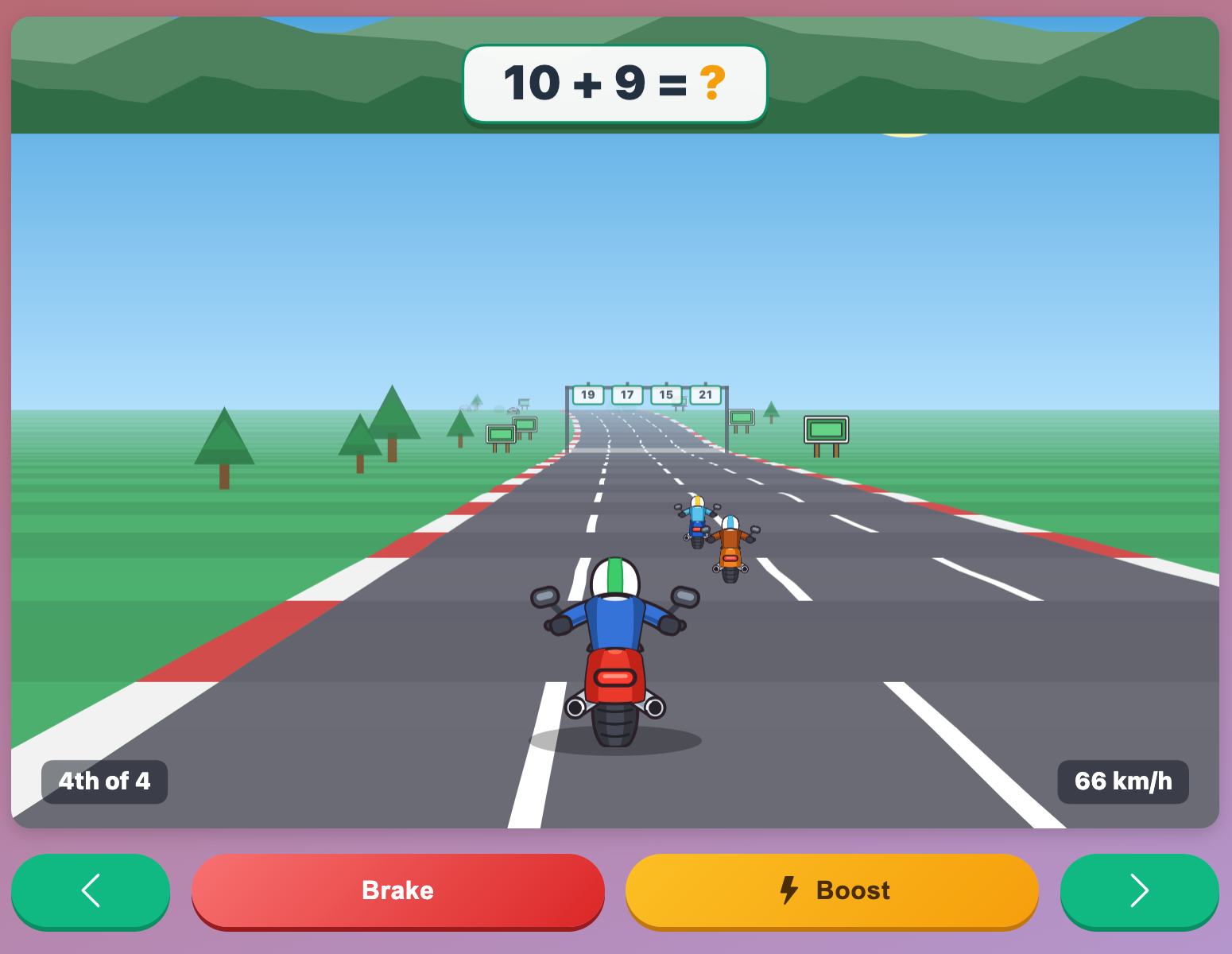
A screenshot when start a new Math Moto Race game for preschool
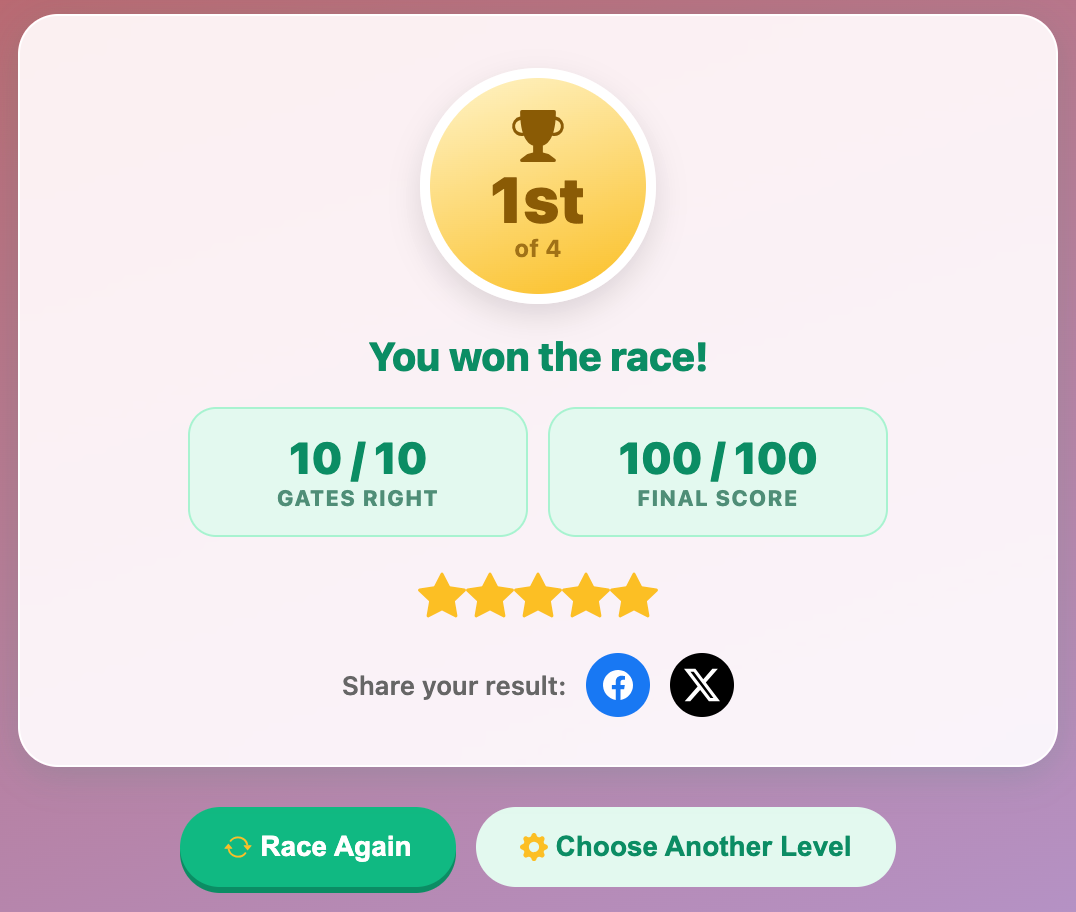
A screenshot when complete a Math Moto Race game
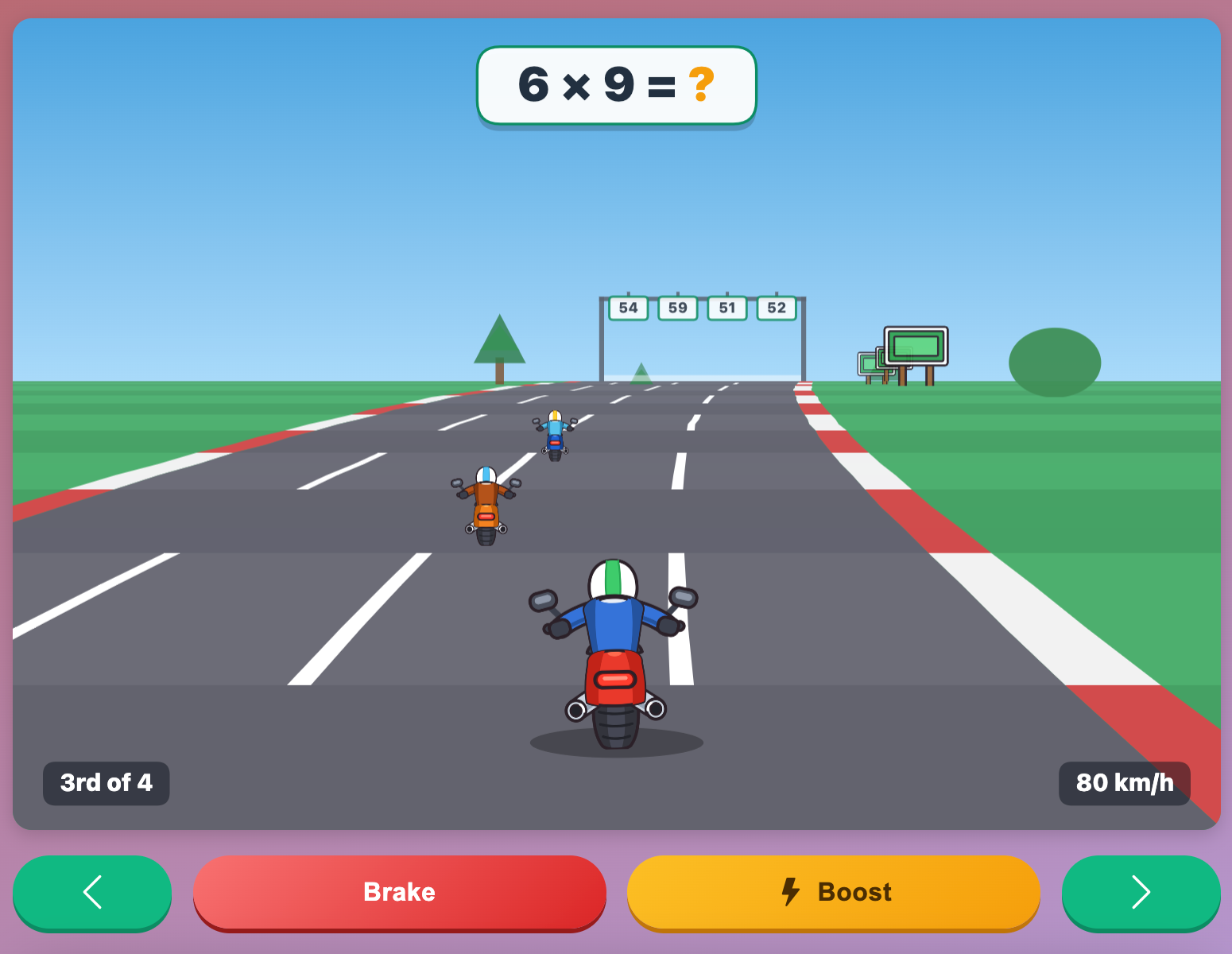
A screenshot when start a new Math Moto Race for elementary
More Math Games
 857.5K plays
5.0
857.5K plays
5.0
Addition Quiz
Pick your age level and answer fun multiple-choice addition questions!
 658.6K plays
5.0
658.6K plays
5.0
Quick Math
Solve simple addition, subtraction, multiplication and division equations before time runs out.
 183.7K plays
5.0
183.7K plays
5.0
Compare Numbers
Pick the correct sign (> < =) to compare two numbers.
 76.5K plays
5.0
76.5K plays
5.0
Count Treasures
Count the pile of treasures and pick the right number.
Most Played Games
 1.8M plays
5.0
1.8M plays
5.0
Color & Draw
A free-drawing canvas with colors and brush sizes to unleash your creativity.
 365.4K plays
4.9
365.4K plays
4.9
Tic-Tac-Toe
Play a game of Tic-Tac-Toe against the computer and see if you can outsmart it.
 1.1M plays
4.9
1.1M plays
4.9
Chess
Play the classic game of chess against the computer or a friend, with FIDE time controls, hints, and undo.
 154.5K plays
4.9
154.5K plays
4.9
Mood Palette
Decide which color best fits a mood or theme before time runs out.
Comments (87)