
Magic Crossbow: Odd One Out
211.4K playsWhich one doesn't belong? Cow, pig, fish, sheep: they're mammals, except the fish! Shoot the odd one out with your magic crossbow and find out why. Animals and fruits for little ones, then real science traps like the bat among the birds, the spider among the insects and the moon among things that shine.
Bats have wings. Bats fly. Bats are not birds. That one surprising fact is the kind of thing this game is built on. You see a group, like Birds, and a row of pictures: a parrot, a swan, a hen, a peacock … and a bat. Four of them belong. One is an impostor. Your magic crossbow is ready to find it.
Welcome to Magic Crossbow: Odd One Out for kids, a science game on KidWorld where you shoot the picture that doesn't fit the group. Every time you hit the right one, the game tells you why it doesn't belong: A bat flies, but it is a mammal with fur. Kids have played it more than 200,000 times, and it has a 4.9 out of 5 rating from more than 1,800 votes. Each game is 10 quick rounds, with no clock and no lives, in a sunny meadow full of smiling mushrooms and peeking bunnies.
🦇 Wings Don't Make a Bird
An odd one out is the one thing in a group that doesn't match the others. In this game, every round starts with a card at the top of the scene. It shows a big picture for the group (a 🪶 feather for Birds, a 🧲 magnet for Magnetic), the group's name in a green label, and a clear job, like Shoot the one that is not a bird!
Under the card is a row of picture tiles. Most of them belong in the group. One doesn't, or two on the Tweens level. A purple crossbow with a pink gem waits at the bottom of a sandy path. Tap a tile and the crossbow turns, aims and fires.
The groups are real science. Little kids sort hot from cold and fruits from vegetables. Older kids sort mammals from reptiles, liquids from solids, and conductors from insulators. There are about a dozen groups on every level, and a game picks 10 different ones, so you never see the same group twice in one game.
The game is also careful to be fair. Every picture in a group belongs there no matter how you think about it, and every odd one is out no matter how you think about it. Tricky cases are left out instead of argued over. For example, you won't find a snake in the Lay eggs group, because some snakes give birth to live babies. So if you think something through carefully, you can trust your answer.
🧭 Getting Started on KidWorld
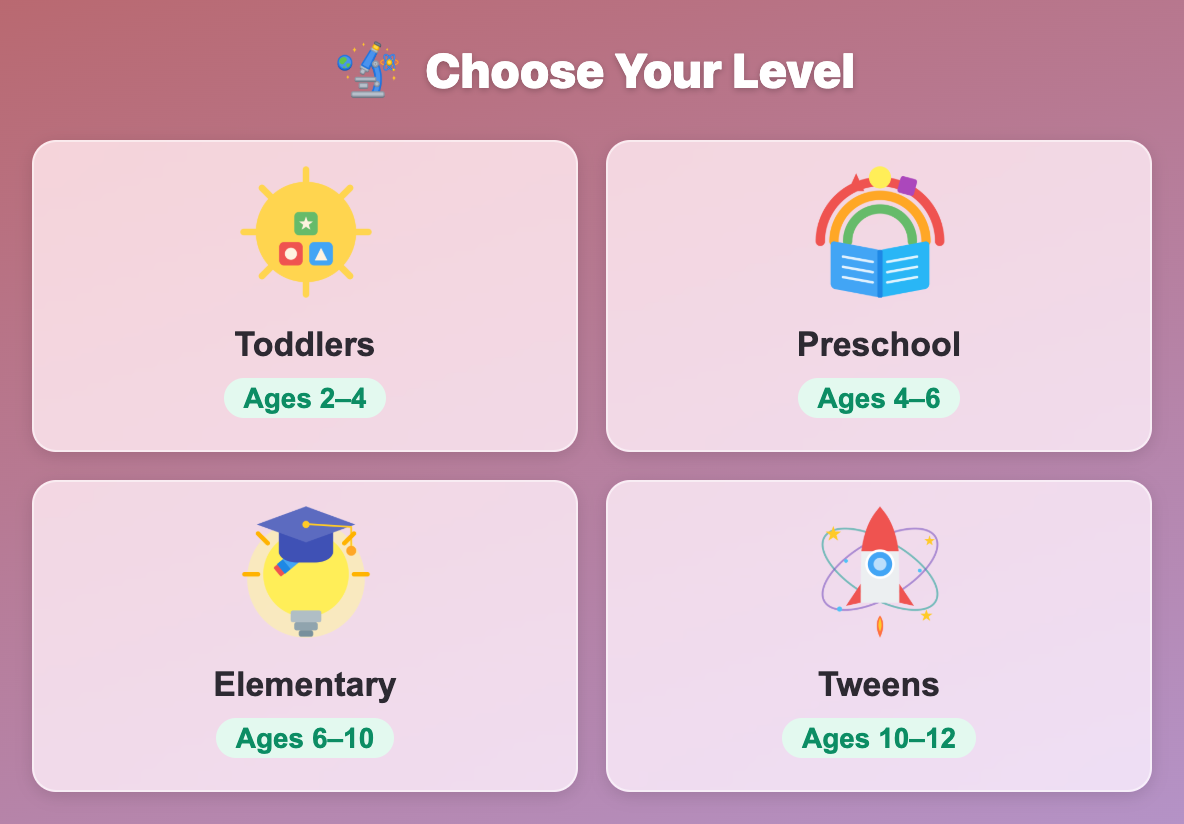
Choose a level. The game may start straight away on Elementary. Tap Change Level to see all four cards: Toddlers (ages 2–4), Preschool (4–6), Elementary (6–10) and Tweens (10–12). Your pick is remembered for next time.
Read the card. Look at the group name and the job. From Elementary up, the card also shows the group's rule, such as Insects have 6 legs and 3 body parts.
Look at every tile. On Toddlers the tiles are just pictures. From Preschool up, each picture has its name underneath, like swan or paper clip.
Listen if you want. The green 🔊 button reads the pictures and the question: Cow, pig, fish, sheep. Which one is not a mammal? On Toddlers and Preschool, the game reads each new round by itself when the sound is on.
Aim and shoot. Move your mouse over a tile and the crossbow follows, with a red target on that tile. Tap or click to shoot. On a keyboard, use ← and → to aim and Space or Enter to fire. You can also press a number key: 1 shoots the first tile, 2 the second, and so on, counting the tiles that are still standing.
Read the reason. When you hit the odd one, a message under the tiles explains why it's out. Each round pauses a little longer here than the other crossbow games, so there's time to read it.
Keep going. The round number shows at the top left (like 4/10) and your points at the top right. Two perfect rounds in a row light up a 🔥 streak badge.
See how you did. After round 10, the result card shows your score out of 100, up to five ⭐ stars, how many rounds you got on the first try, your missed shots and your best streak. Then tap Play Again or Change Level. The fullscreen, reload and music buttons above the game work at any time.
🎯 Hits, Bounces and the Reason Behind Every Pop
A hit bursts the odd tile into sparkles, and the row slides together. If that was the last odd one, the remaining tiles turn green, confetti flies, and the message says something like Bullseye! A bat flies, but it is a mammal with fur. On Tweens, where there are two odd ones, your first hit shows its reason plus One more!
A miss means you shot a picture that belongs. A magic shield pops up, the arrow bounces away, and the message reminds you, for example: Keep the parrot! It belongs in birds. You can shoot again right away.
Every round is worth up to 10 points, and each miss takes away 3. So a round with no misses earns 10, one miss earns 7, two misses earn 4, three misses earn 1, and more than that earns 0. Ten perfect rounds make a perfect 100. A score of 90 or more gets five stars and the title Bullseye! You are a science star! From 70 you get Super shooting!, and from 50 Nice aiming!
If you miss too often, the game helps. On Toddlers and Preschool, the odd one glows yellow after one miss. On Elementary and Tweens it glows after two. The message says Look! The glowing one does not belong. The glow doesn't cost anything extra, so every round always ends with the group sorted.
Any round you missed goes on the Practice these again list on the result card, with the odd one's picture and its reason, like 🦀 A crab has 10 legs. It is a crustacean.
🔬 Think Like a Scientist: Ways to Find the Odd One Fast
Scientists sort things by looking for clues, not by guessing. These tips help you shoot the odd one on your first try, which is worth the most points.
1. Read the job, every single time
Most rounds say Shoot the one that is not … But some flip it around. In the Tweens Invertebrates group (animals with no backbone), the job is Shoot the 2 that have a backbone! In Conductors, it's Shoot the 2 that are insulators! If you skip the job and shoot what looks different, you might hit the wrong thing.
2. Use the rule as a checklist
From Elementary up, the card gives you the group's rule. Turn it into questions. For Birds, the rule is feathers, a beak and wings, and lay eggs. Now go tile by tile: does it have feathers? Does it have a beak? The first picture that fails a question is your target.
3. Don't be fooled by what things do
Many traps are animals that act like the group but aren't part of it. A bat flies like a bird but has fur. A dolphin swims like a fish but breathes air with lungs. Fire grows and moves, but it isn't alive. Ask what a thing is and what it's made of, not just what it does.
4. Find the far-away one first on the younger levels
On Toddlers, the odd one comes from a totally different kind of thing: a car among animals, a lollipop among vegetables, a volcano among cold things. Ask, Which one is a different kind of thing? On Preschool, the odd one is closer, like a penguin among things that fly or a carrot among fruits, so you need to look a bit harder.
5. On Tweens, two odd ones often share a reason
When there are two odd ones, they usually miss the group for the same reason. In Conductors, the crayon and the sock are both insulators. In Lay eggs, a dolphin and a whale are both mammals whose babies are born alive. Once you find one odd one, look for something like it.
6. Aim with a check
Hover first. The red target shows exactly which tile you'll hit. Read its name, ask your question once more, and then shoot. If you use number keys, remember the numbers count the tiles still standing. After you pop one, the tile that was number 4 becomes number 3.
7. Let the reason teach you
The best part of every round comes after the pop. The reason under the tiles is a real science fact, written in kid words. Read it out loud. If you ever see the same trap again, you'll remember it, and your first-try count will climb.
8. Protect your streak
Your 🔥 streak counts perfect rounds in a row, and your best one shows on the result card. When the badge is glowing, slow down. One quick wrong shot resets it to zero.
🧩 Six Rounds, Solved Together
Toddlers: Cold things, with ice, ice cream, a volcano and a snowman
Three of these feel cold: ice, ice cream and a snowman. A volcano has red-hot lava inside. Shoot the volcano and the game says A volcano is hot inside. A grown-up can help by asking, Would you want to touch it?
Preschool: Things that fly, with an eagle, a bee, an airplane, an owl and a penguin
Careful! The penguin is a bird, so it might look like it fits. But this group is about flying, not about birds. The eagle, bee, owl and airplane all fly. The penguin can't. Hit it and you'll read A penguin is a bird, but it can't fly. It swims!
Elementary: Birds, with a bat, a parrot, a swan, a hen and a peacock
Use the rule: feathers, a beak, wings, and eggs. The parrot, swan, hen and peacock all have feathers and beaks. The bat has wings, but it has fur, no beak, and it feeds its babies milk. That makes it a mammal. Shoot the bat.
Elementary: Make their own light, with the sun, a candle, a light bulb, a star and the moon
The moon looks bright at night, so this one tricks lots of people. But the moon has no light of its own. It shines because sunlight bounces off it. The sun, stars, candles and light bulbs all make their own light. Shoot the moon, and you've learned something many grown-ups get wrong.
Tweens: Conductors, with a crayon, a coin, a wrench, a spoon, a sock and a paper clip
The job says Shoot the 2 that are insulators! An insulator is a material that electricity can't flow through. Metal lets electricity flow, so the coin, wrench, spoon and paper clip are conductors. The crayon is wax and the sock is cloth. Both are insulators, so shoot those two. If you like testing metals, Magnet Experiment lets you drag a magnet across a table and find out which everyday objects it picks up.
Tweens: Make their own food, with a tree, a sunflower, a cactus, wheat, a mushroom and a cow
Plants use sunlight, water and air to make their own food. The tree, sunflower, cactus and wheat are all plants. The cow eats grass, so it can't make its own food. The mushroom is the sneaky one. It grows in the ground like a plant, but it's a fungus, and it can't use sunlight to make food. Shoot the cow and the mushroom.
🪤 The Sneakiest Traps in the Game
These are the odd ones that fool players most often. Knowing them ahead of time is like having a secret map.
The bat is out of Birds. It's a mammal with fur.
The spider and the scorpion are out of Insects. They have 8 legs, not 6.
The dolphin, the whale and the seal are out of Fish. They breathe air with lungs.
The octopus is out of Fish too. It has no bones at all and is a mollusk.
The frog is out of Reptiles. Its skin is smooth and wet, not scaly. It's an amphibian.
Fire and clouds are out of Living things. They grow and move, but they aren't alive.
Ice is out of Liquids. It's water frozen into a solid.
The moon is out of Make their own light. It only reflects the Sun.
The mushroom is out of Make their own food. It's a fungus, not a plant.
👪 Magic Crossbow: Odd One Out for Every Age
Each level changes how many tiles you see, how close the odd one is to the group, and how much help you get.
🐣 Magic Crossbow: Odd One Out for toddlers (ages 2–4)
Toddlers see 3 pictures that belong plus 1 that clearly doesn't, like a car among animals or a dog among fruits. There are no words under the pictures, so a child who can't read yet can still play. The game reads each round aloud when sound is on, reads the reason after a hit, and makes the odd one glow after just one miss. Groups include animals, fruits, hot things, cold things, weather and parts of your body.
🎨 Magic Crossbow: Odd One Out for preschoolers (ages 4–6)
Preschoolers see 4 pictures that belong plus 1 odd one, each with its name underneath. The odd one is a closer match now: a penguin among things that fly, a lion among farm animals, a cloud among things in space. Rounds are still read aloud automatically, and the hint still glows after one miss. Groups include farm animals, sea animals, things that hatch from eggs, healthy foods and animals with shells.
📐 Magic Crossbow: Odd One Out for elementary kids (ages 6–10)
Elementary kids get real science groups like mammals, insects, reptiles, liquids, solids, magnetic things, nocturnal animals and herbivores. The group's rule appears on the card, and the odd ones are the classic traps from the list above. Reading aloud happens only when you tap 🔊, and the glow waits for two misses.
🚀 Magic Crossbow: Odd One Out for tweens (ages 10–12)
Tweens see 6 tiles with two odd ones in each round. The groups are bigger ideas: invertebrates, renewable energy, conductors, pollinators, mollusks, natural materials and carnivores. Some jobs flip the question around, like shooting the ones that have a backbone. Tweens who enjoy spotting what doesn't fit can try the same crossbow on colorful rows in Magic Crossbow: Pattern Breaker, where the job is to find what breaks a repeating pattern.
🌈 Why Sorting Things Grows Big Thinkers
Science starts with sorting. Long before microscopes, scientists learned about nature by putting living things into groups. When you decide that a bat goes with mammals and not birds, you're doing the same kind of thinking.
Looking past the first clue. A penguin is a bird, but it can't fly. A mushroom grows in the ground, but it isn't a plant. The game keeps asking kids to check the real rule instead of trusting how something looks at first glance.
Every round teaches one fact. The reason after each hit is short and clear. Over a few games, kids pick up dozens of real facts: how many legs an insect has, why the moon shines, what an insulator is.
New words, explained. Words like nocturnal, herbivore, invertebrate and pollinator show up with pictures next to them and a rule that explains them. That makes big words feel friendly.
Careful beats fast. There's no timer, and only misses cost points. Kids learn that stopping to check pays off. If your child enjoys putting pictures into groups, Classify It! is another way to practice, picking the right science group for one picture at a time.
A note for grown-ups
Magic Crossbow: Odd One Out for kids is calm and kind. The arrows only hit picture tiles, the meadow scene is cheerful, and a wrong shot simply bounces off a shield. There's no timer and no way to lose a round. The groups were picked so that every answer is fair, and every hit comes with a one-sentence explanation. It practices classification, reading a rule, and real science facts about animals, plants, materials, weather and space. After a game, read the Practice these again list together and talk about each reason.
Grab your crossbow and take aim! Read the group, check the rule, and pop out the picture that doesn't belong. With 10 rounds per game and new groups to explore on every level, Magic Crossbow: Odd One Out for kids turns every shot into a small science lesson.
🖼️ See the Game in Action
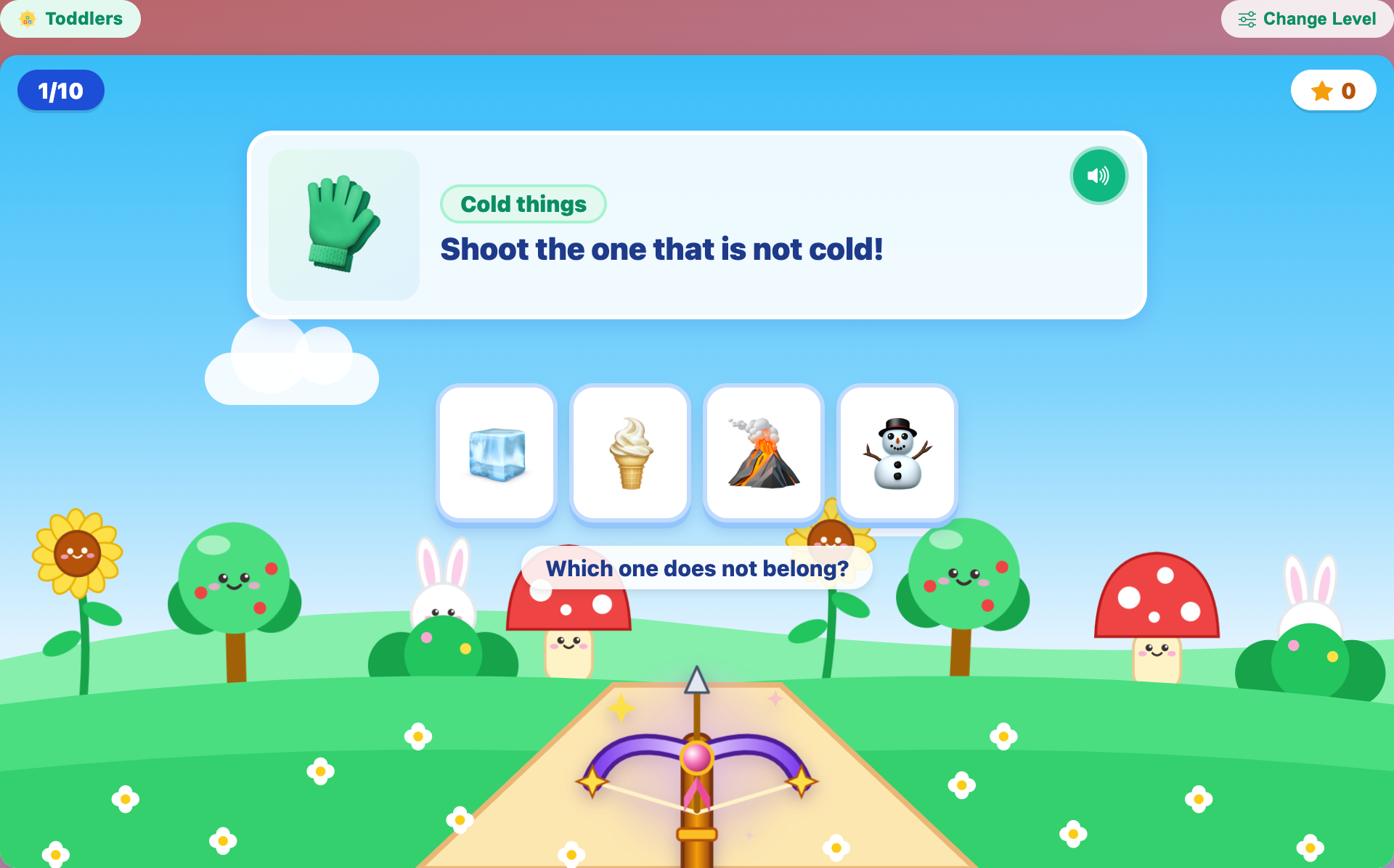
A Cold things round for toddlers with ice, ice cream, a volcano and a snowman, where the volcano is the odd one out
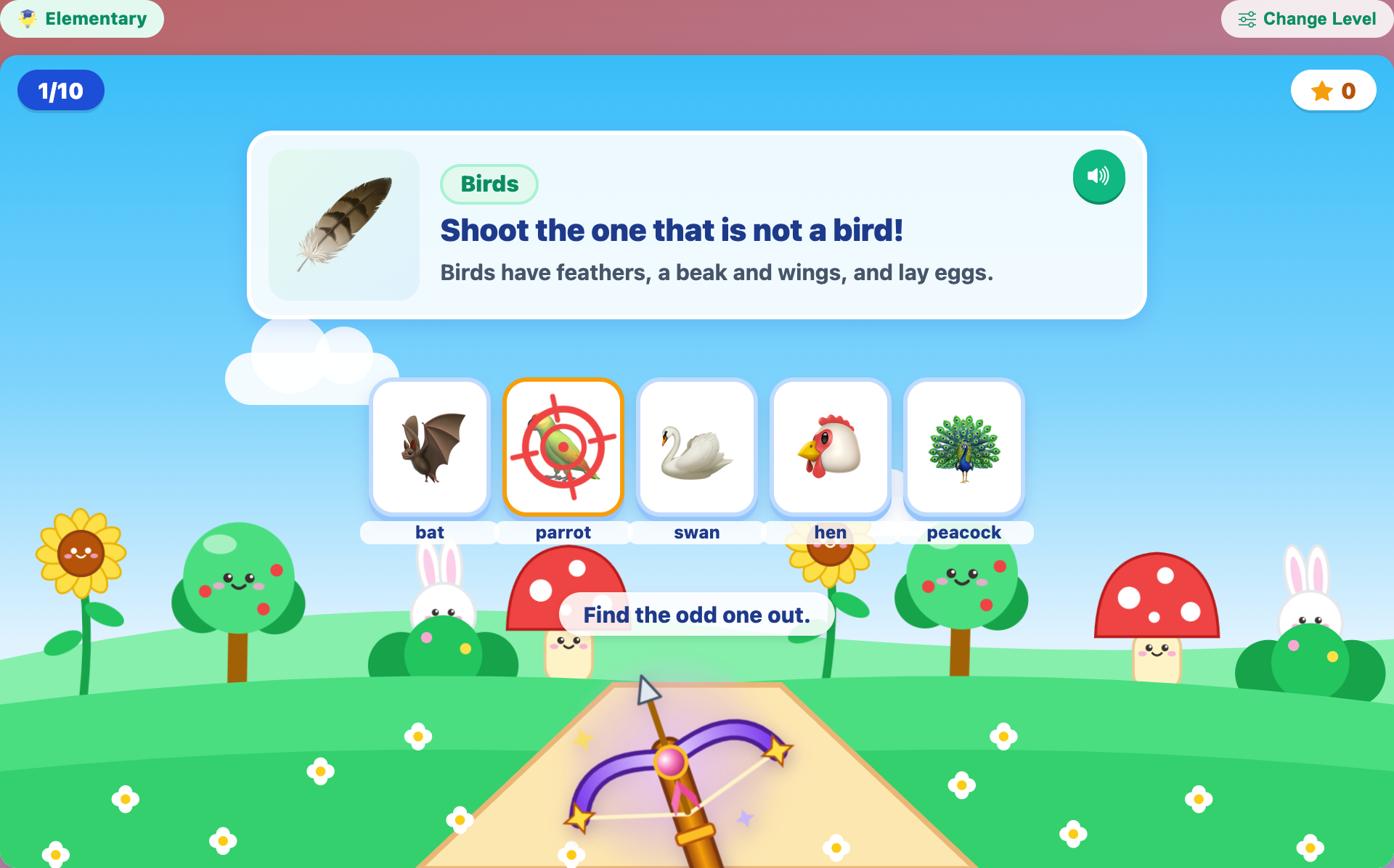
A Birds round with a bat, parrot, swan, hen and peacock, and the crossbow aiming its red target at the parrot
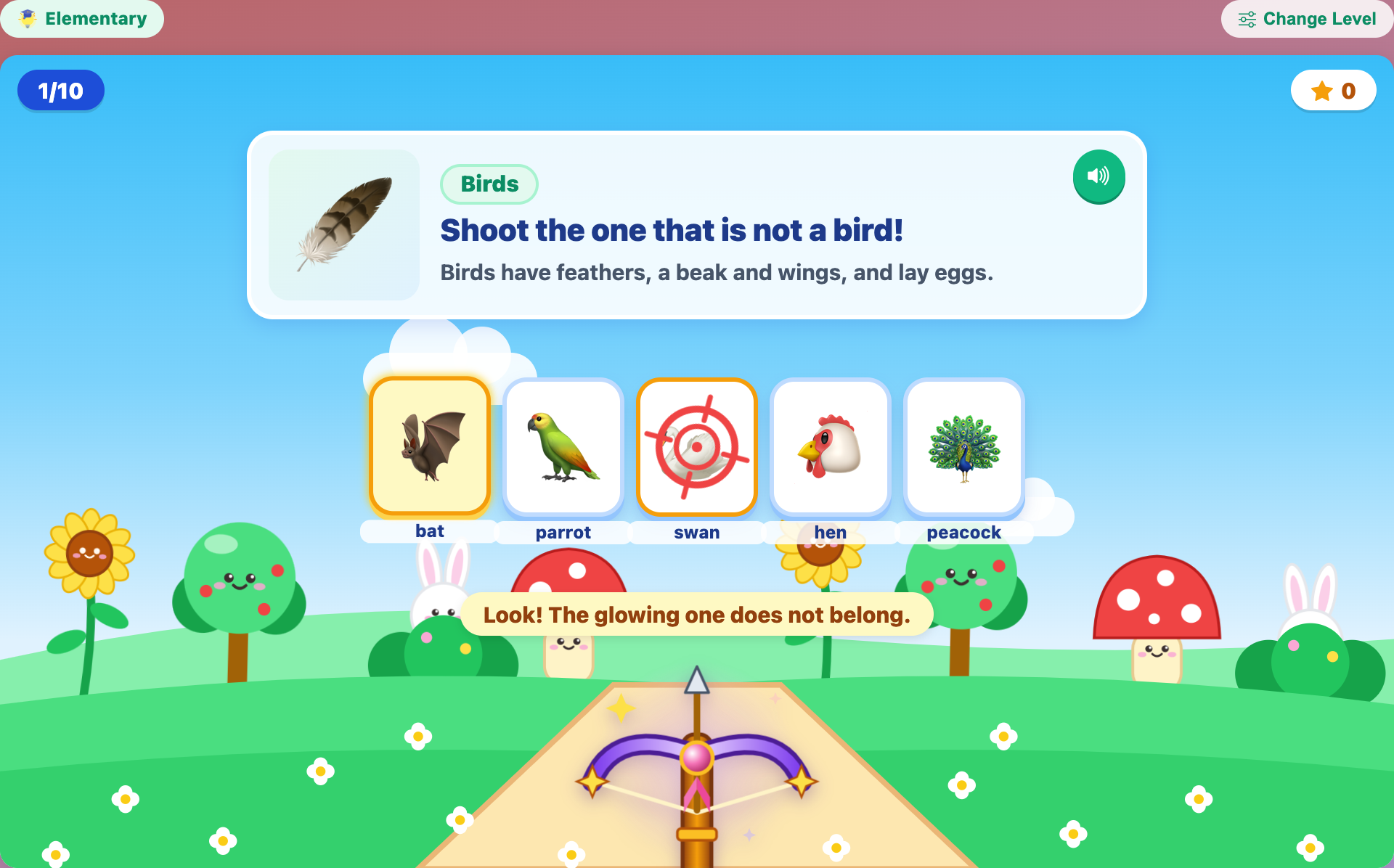
The bat glowing yellow as a hint after two missed shots, in Magic Crossbow: Odd One Out for elementary kids
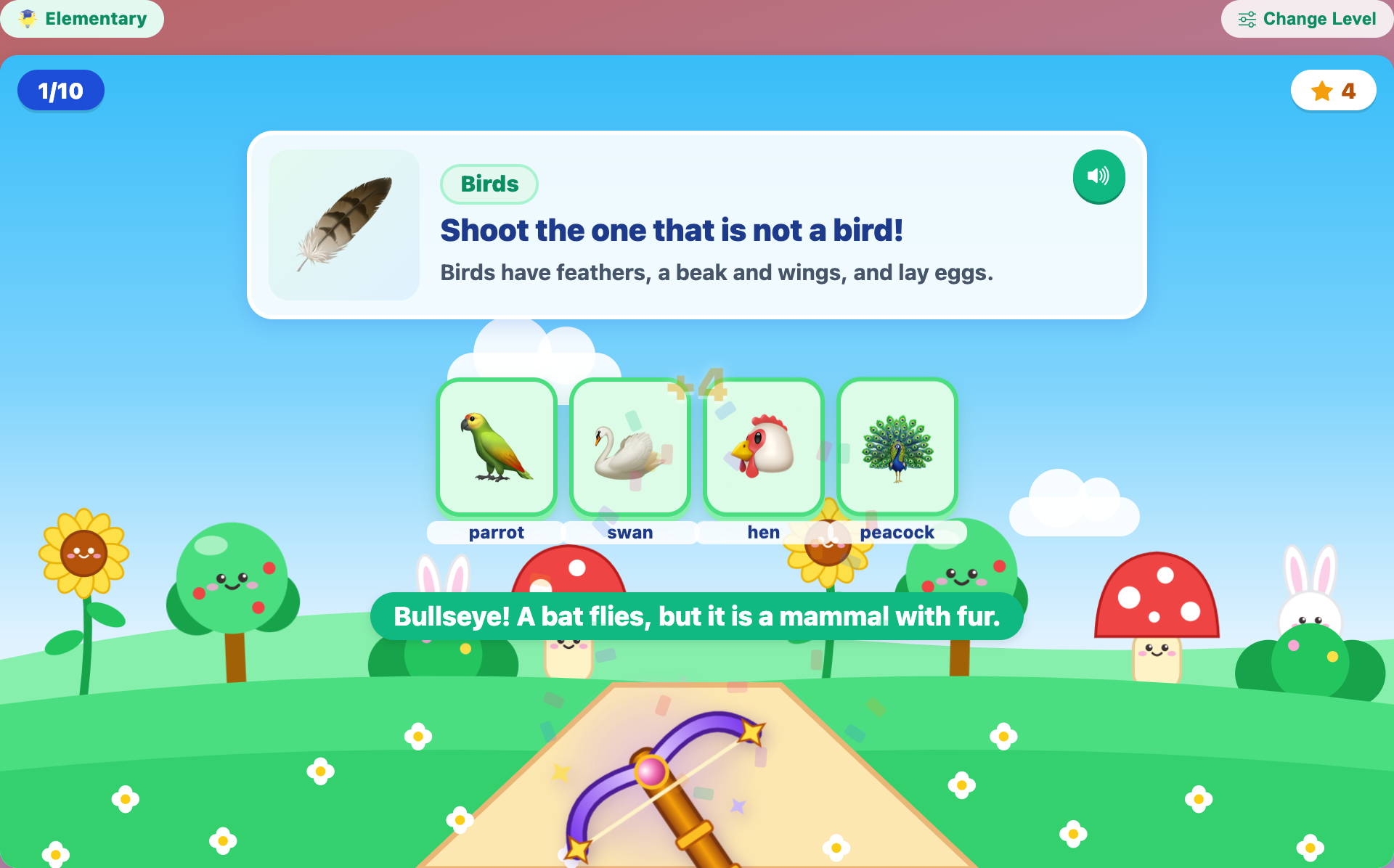
The four birds turned green after the bat was shot, with the message that a bat is a mammal with fur
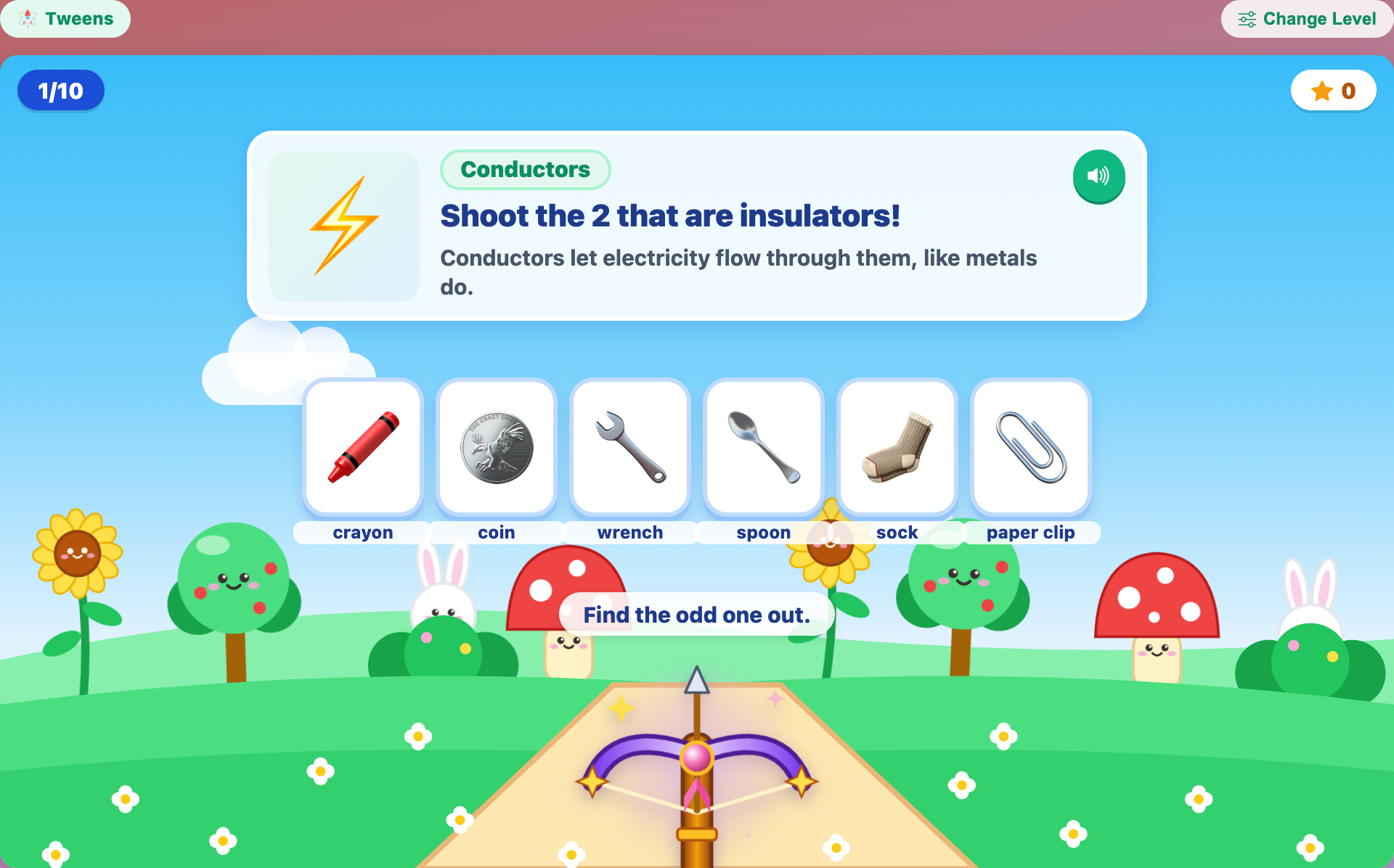
A Conductors round for tweens with a crayon, coin, wrench, spoon, sock and paper clip, asking for the 2 insulators
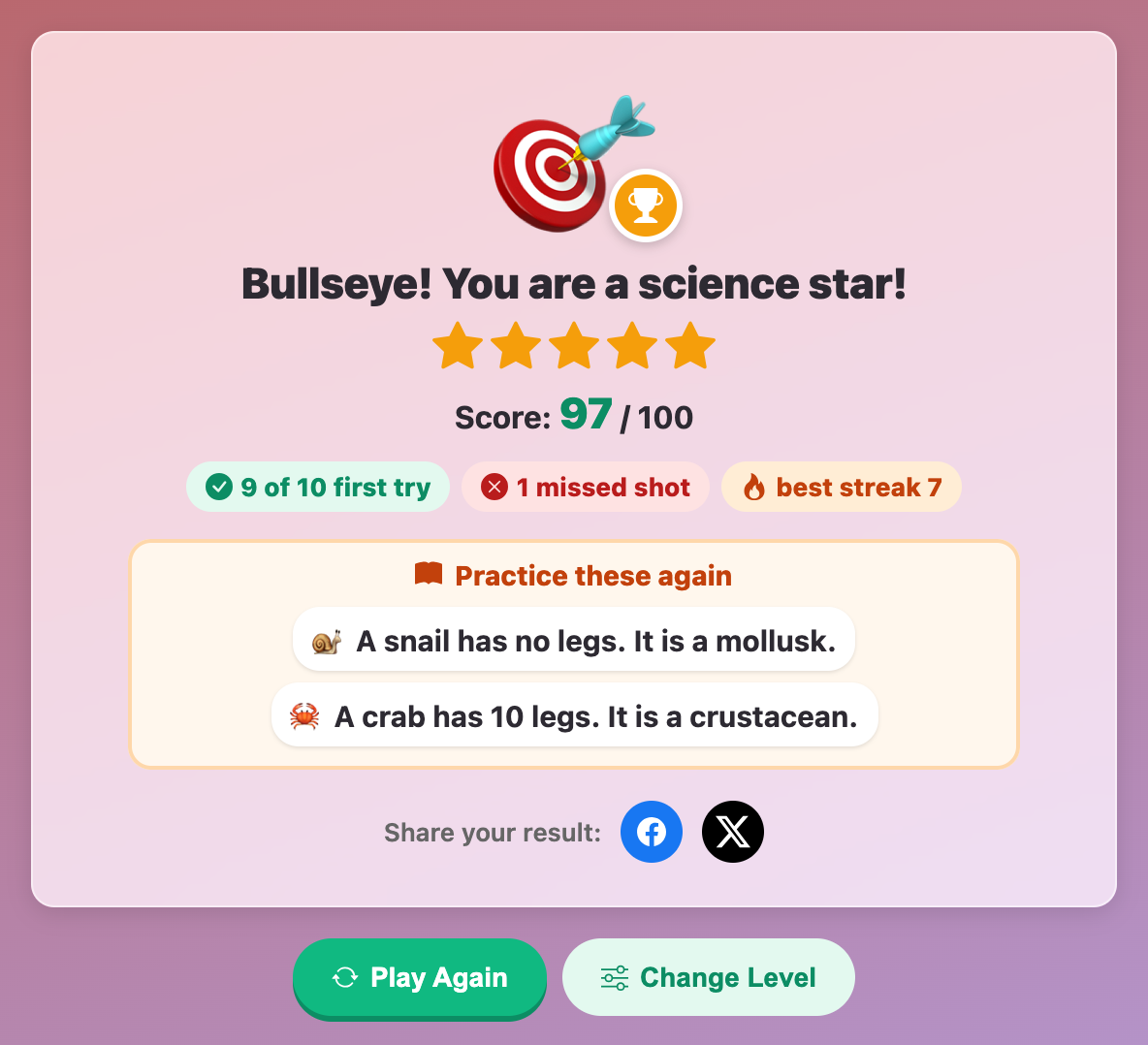
The result card in Magic Crossbow: Odd One Out with 97 out of 100, five stars and a snail and crab to practice again
More Science Games
 59.4K plays
5.0
59.4K plays
5.0
Recycling Sort
Sort everyday items into the Recycle, Compost, or Trash bin before time runs out!
 85.7K plays
4.9
85.7K plays
4.9
Grow a Plant
Plant seeds in sunny and shady garden beds, then water, feed and protect them day by day. Watch the roots grow underground and harvest sunflowers, tomatoes, carrots and more!
 438.6K plays
5.0
438.6K plays
5.0
Magnet Experiment
Drag a magnet around the table and discover which objects it can pick up!
 386.8K plays
5.0
386.8K plays
5.0
Five Senses Match
Decide which of your five senses you would use for each everyday scene before time runs out.
Most Played Games
 1.8M plays
5.0
1.8M plays
5.0
Color & Draw
A free-drawing canvas with colors and brush sizes to unleash your creativity.
59.4K plays
5.0
Recycling Sort
Sort everyday items into the Recycle, Compost, or Trash bin before time runs out!
 365.6K plays
4.9
365.6K plays
4.9
Tic-Tac-Toe
Play a game of Tic-Tac-Toe against the computer and see if you can outsmart it.
 1.1M plays
4.9
1.1M plays
4.9
Chess
Play the classic game of chess against the computer or a friend, with FIDE time controls, hints, and undo.
Comments (16)