
Camouflage Hide & Seek
84.8K playsCan you spot the animals hiding in plain sight? Find a snowy owl in the Arctic snow, a stonefish on the coral reef and a woodcock among the fallen leaves, then learn how each one hides. Next, paint a moth or a frog so the hungry bird can't find it. Big kids become the bird and watch a family of peppered moths change color over the generations, just like it really happened.
Hold very still and don't make a sound. That is the first trick every hiding animal in the wild knows. Camouflage Hide & Seek for kids is a free science game about camouflage: the colors, patterns and shapes that help animals blend in with where they live. You find real animals hiding in six wild places, then paint a moth or a frog so a hungry bird can't see it, and on the older levels you become the bird yourself.
It is made for children from age 2 to 12, with four levels that change how well the animals hide. You play it right here in your web browser, with no download and no sign-up. It works with a mouse or a finger on a phone or tablet, and has a few handy keyboard keys too. Every animal in the game is real, and each one comes with a short, true fact about how it stays hidden.
🦎 Three Games in One: Seek, Hide, Then Be the Bird
A game of Camouflage Hide & Seek has up to three parts, played one after another. Each part looks at camouflage from a different side.
Part 1, Seek. You visit three habitats (a habitat is the kind of place an animal lives in). In each one, some animals are hiding, and you tap to find them all.
Part 2, Hide. Now you are the one hiding. You color a moth or a frog to match the spot where it sits. Then a hungry bird flies in to look for it.
Part 3, Be the bird. On the Elementary and Tweens levels, you turn into the bird. A tree is covered in peppered moths, and you watch what happens to their colors over many generations. A generation is one family step: parents, then their babies, then the babies' babies.
The six habitats are a forest floor full of dry leaves 🍂, Arctic snow ❄️, a coral reef 🪸, a tree trunk 🌳, dry grassland 🌾 and rainforest leaves 🌿. Each game picks three of them at random, so your next game can take you somewhere new. The animals are all drawn in the colors of their home, which is exactly what makes them hard to spot.
🔍 A Tour of the Game, From Level Card to Score Card
Pick your level. The first time you play, the game starts you on Elementary. Press Change Level at the top right to choose Toddlers (ages 2–4), Preschool (ages 4–6), Elementary (ages 6–10) or Tweens (ages 10–12). Each card says what that level does, like "Find 6 tiny hiders, natural selection" for Tweens. The game remembers your choice.
Read the task. A card at the top tells you what to do, such as "Find the 5 animals hiding in the Arctic snow before time runs out." Press the green 🔊 button and the game reads it out loud.
Check the shapes. Under the task you see a row of dark shapes, one for each hidden animal. They are outlines, so you know what to look for. When you find an animal, its shape fills in with real colors and gets a green check.
Tap the animals. Tap or click right on an animal to find it. A green circle pops around it, and a fact card shows its name and how it hides. A tap on empty ground shows a little red X.
Use a hint if you're stuck. The purple Hint button darkens the scene everywhere except near one animal you haven't found. On a keyboard, the H key does the same.
Watch the clock. From Preschool up, a green bar counts down the seconds. If time runs out, the game circles the animals you missed and tells you about them.
Press Next. After each part, a big green Next button fills up and moves on by itself after 5 seconds. Press it, or the Enter key or space bar, to go on right away.
Hide your critter. In Part 2, choose a Color, and on bigger levels a Pattern (Plain, Speckles or Stripes) and a Pattern color. On most levels, the number keys can pick colors too. Then press Hide! and watch the bird.
Hunt the moths. In Part 3, press Start hunting and tap 6 moths before the clock runs out. Then press Eggs hatch to see the next generation grow on the chart.
See your score. The last card lists every part with its points, your total out of 100, up to five gold stars and your best score at this level. Press Play Again for a fresh set of habitats, or Change Level to try another level.
Use the page buttons. Next to the game you'll find a fullscreen button for a bigger picture, a reload button to start over, and a music button to turn the music on or off.
📊 Where the 100 Points Come From
Every level adds up to 100 points, so you can compare your scores fairly from game to game.
Each seek scene is worth 20 points. You get your share for every animal found, so 4 of 5 animals earns 16. On Preschool, each hint costs 2 points. On Elementary and Tweens, each hint costs 3 points, and each wrong tap costs 1 point (never more than 6 in one scene).
Each hide is worth up to 20 points. The game measures how hidden your critter is, from 0% to 100%. Under 65%, the bird spots it and you get 2 points. At 65% you get 1 star and 8 points, at 80% you get 2 stars and 14 points, and at 90% or more you get 3 stars and all 20.
Toddlers and Preschool play 2 hides. Elementary and Tweens play 1 hide plus the moth challenge.
The moth challenge is worth 20 points. Up to 10 come from catching your 6 moths in every generation. The other 10 come from the last question: 10 if you are right the first time, 5 on the second try.
🕵️ Camouflage Hide & Seek for Kids: Sharp-Eyes Tricks for Finding Every Animal
Finding all the animals quickly, with no hints and no wrong taps, is the biggest part of your score. These tricks work because of the way the game really hides its animals.
1. Hunt for eyes first 👀
The task card even says it: "Tip: look for eyes!" On the older levels, the game lays a leaf, a bit of snow, coral or grass over part of each animal. But it never covers an eye. So a small, round, dark dot with a shiny spot is often the first clue. Real animals give themselves away the same way. That is one reason the wood frog has a dark stripe across its eyes, like a little mask.
2. Learn the shape before you look
Look at the dark shapes in the row above the scene before you start. A long, thin shape means a snake or a stoat. A round, standing shape is an owl. A flat oval is a flounder. Now your eyes know what outline to hunt for, instead of looking for "something".
3. Sweep the picture in strips
Don't let your eyes jump all over the place. Start at the top left and slide across, like reading a line in a book. Then move down a little and go again. This way you check every part of the scene once, and you don't keep looking at the same corner.
4. Look for the thing that's a little bit wrong
A leaf with legs. A rock with two eyes. A stick that is too smooth. Camouflage is good, but it is never perfect. Look for small things that don't quite fit, like a straight edge where everything else is wavy.
5. Know who lives where
Each habitat has its own team of real hiders, and the game always picks from that team. If you know the list, you know what to look for:
Forest floor 🍂: woodcock, wood frog, fawn (a baby deer) and copperhead snake.
Arctic snow ❄️: Arctic hare, Arctic fox, ptarmigan (a snow bird), snowy owl and stoat.
Coral reef 🪸: stonefish, octopus, pygmy seahorse, flounder and decorator crab.
Tree bark 🌳: peppered moth, screech owl, gray tree frog and leaf-tailed gecko.
Dry grassland 🌾: lion, grasshopper, nightjar (a ground bird) and praying mantis.
Rainforest 🌿: leaf insect, emerald tree boa, katydid and red-eyed tree frog.
Some animals bring a hiding place with them. The pygmy seahorse sits on its sea fan, the peppered moth on a pale patch of lichen, the stonefish on a rock, and the tree boa coils over a branch. The flounder only ever lies on the sandy strip at the bottom of the reef.
6. Slow taps beat fast taps
Tapping everywhere does not work here. On Elementary and Tweens, every wrong tap costs a point. And if you make 3 wrong taps in a few seconds, the game says "Slow down and look carefully!" and stops your taps for a moment. One careful tap is worth more than five fast ones. If you like this kind of careful looking, Spot the Difference trains the same skill with two pictures side by side.
7. Save your hints for the last animal
On Toddlers, hints are free, so use them whenever you want. On Preschool you get 3, and on Elementary and Tweens only 2, and each one costs points. The last animal is usually the best-hidden one, so keep a hint for it. On the older levels the hint is a bigger circle that is not centered right on the animal, so you still have to look inside it. If you go a long time without a find, the Hint button wiggles to remind you it's there.
8. Listen without losing time
When a fact card or a task is read aloud, the clock stops until the voice is done. So you can press 🔊 and listen to every fact without worrying about the timer.
Three scenes, thought through
Arctic snow. Almost everything is white, so look for the dark bits. An Arctic hare's ears have black tips. A stoat's white body ends in a black tail tip. A snowy owl has bright yellow eyes. The Arctic fox has a dark nose and eyes. Find those dots, and the animals around them appear.
Coral reef. Check the sand at the bottom first, because if a flounder is hiding, that's the only place it can be. It is flat, with both eyes on the same side of its head. Then look at the rocks for the lumpy stonefish, and at the sea fan for a pygmy seahorse, which is covered in bumps that look just like it.
Tree bark. Look up and down the trunk for a gray-brown owl shape. The screech owl's feathers look like bark, and when it is worried it stretches tall and thin like a broken branch. A flat lizard pressed against the bark is the leaf-tailed gecko, whose frilly skin hides its shadow.
🎨 How to Paint a Critter the Bird Can't See
In Part 2 the hungry bird flies over your moth or frog and decides if it can see it. The game checks two things: how close your colors are to the spot where your critter sits, and whether the pattern matches. Here is how to get all three stars.
Match the color, not just the color family
On Preschool you get 5 colors: the home's own color, a lighter and a darker one, and two that are far away. Lighter and darker look close, but the bird still notices. If you miss, the game tells you why, for example "Your moth was a little too light for the oak bark." Choose the one that disappears when you squint at the screen.
Copy the pattern
Every home is plain, speckled or striped. Birch bark is creamy white with dark gray speckles. Oak bark is brown with dark brown stripes. A green leaf has pale green stripes, and mud has dark brown speckles. Sooty bark and a lily pad are plain, so any pattern on your critter gives it away. When the pattern is right, the stripes or speckles on your critter line up with the ones behind it and seem to vanish.
Then match the pattern color
On Elementary and Tweens you also choose the pattern's color. This is the last step to a perfect hide. On Tweens, look extra closely: one pattern color is almost right, but not close enough for three stars.
Sit on one spot, not two
On the older levels, you tap the picture to choose where your critter sits, and every home has two different surfaces. One is birch bark with dark knots, one is oak bark with patches of lichen, and one is a leaf over a muddy bank. A critter that sits half on each surface can't match both. The game will tell you: "Pick one and match it!" Choose one surface, match it, and put your critter right in the middle of it.
Read the crowd
On Elementary and Tweens, five wild critters are already sitting there when you arrive. The bird catches every one that it can see before it looks at yours. Use them as clues: the ones that are hard to see are wearing the right look. But be careful. One of them wears the right outfit in the wrong place, and it gets caught.
Use the Hidden meter
Elementary players get a Hidden bar that changes as you design. Try a color, watch the bar, then try another. Once it is near 100%, press Hide! Tweens have no meter, more colors to choose from (8 colors and 5 pattern colors) and colors that are closer together, so it's all up to your eyes.
A perfect hide, step by step
The home is a green leaf above a mud bank, and you are hiding a frog.
You pick the leaf, because it is bigger. You choose the leaf-green color, the Stripes pattern and the pale green pattern color.
You tap the middle of the leaf, far from the mud, so the whole frog sits on it.
The Hidden meter says 100%. You press Hide!
The bird catches the white frog and the striped frog on the mud, because they are easy to see. It looks right at yours and flies away. Three stars!
If you love painting animals to match where they sit, try Chameleon Camouflage, where you color a little chameleon to hide on leaves, rocks, flowers and striped walls.
🐦 Thinking Like the Bird: The Peppered Moth Challenge
Part 3 is based on a true story. In England, peppered moths rest on tree trunks during the day and fly at night. Most of them used to be light with dark speckles, which matched pale bark covered in lichen. About 200 years ago, smoke from factories covered many trees with black soot. Suddenly the light moths were easy for birds to see, and the rare dark moths were hidden. Over many years, dark moths became the most common kind. Later, when the air was cleaned up, the light moths came back.
In the game, a tree holds 12 moths in three real forms: light, medium and dark. You get 12 seconds on Elementary and 9 on Tweens to catch 6 of them. The 6 that are left each have 2 babies that look just like them, and a bar chart shows the new generation. Elementary plays 4 generations on sooty bark, starting with 9 light, 2 medium and 1 dark moth. Tweens play 5 generations, and half the time get the clean-air story instead: pale bark, with most moths starting dark.
Tips for the hunt
Catch what you can see. Real birds catch the moths that stand out, so tap the ones that are easy to see. Your points only count how many you catch, so speed matters more than choosing.
Don't let the clock run out. If time ends, "other birds" catch the rest for you, starting with the easiest to see, and you lose those points.
Watch the chart grow. After each hunt, look at the chart. The color that matches the bark gets taller each time. In our test game on sooty bark, the light moths were gone by generation 3, and by generation 5 all 12 moths were dark.
The big question
At the end, the game asks why the matching moths became common, with three answers to choose from. Two are tricky. "The light moths turn dark by themselves" sounds right, but a moth can't change its wings to hide. "Soot makes the wings dirty" is wrong too: dirt isn't passed on to babies, yet the babies of dark moths hatch already dark. The right answer is that the hidden moths live long enough to lay eggs, and their babies look like them. Scientists call this natural selection, and Tweens hear that name in the explanation.
🌱 From a First Peek to Natural Selection, Age by Age
🐾 Camouflage Hide & Seek for toddlers (ages 2–4)
Toddlers find 3 big animals in each scene. The animals are a little brighter than their home and have a soft outline, so they are easier to see. There is no clock and the hints are free. In the hide part, the critter already has the right pattern, and your child just picks the matching color out of three. A grown-up can point and ask, "Do you see two eyes?" If the bird spots a critter, it just flutters away.
🖍️ Camouflage Hide & Seek for preschoolers (ages 4–6)
Preschoolers hunt 4 animals in 2 minutes, with 3 hints. In the hide part they choose from 5 colors, including look-alike lighter and darker ones, and pick a pattern too. This is a good level for learning words like speckles, stripes, lighter and darker. Every task is read aloud when the sound is on.
🔬 Camouflage Hide & Seek for elementary kids (ages 6–10)
Elementary kids find 5 smaller, better-hidden animals in 100 seconds, with part of each one covered by a leaf or a drift of snow. They design a critter's color, pattern and pattern color, choose where it sits, and use the Hidden meter to check their work. Then they meet the peppered moths for 4 generations. It's a great first look at how living things change over time.
🧬 Camouflage Hide & Seek for tweens (ages 10–12)
Tweens get the hardest seek scenes: 6 small animals in their true colors, with no outline, two covers each and 90 seconds. The hide part has more colors that are closer together and no meter. In the moth challenge they have only 9 seconds per hunt, play 5 generations, and may get either history story. The explanation names natural selection and tells the real story of England's moths. After that, Habitat Rescue is a fun next step, where you match each animal to the place it lives.
🌍 What Kids Learn While They Hide and Seek
Looking closely. When the woodcock vanishes into the dead leaves, your child learns to slow down and search on purpose. This careful kind of looking helps with reading, puzzles and spotting mistakes in math.
Real animal science. Each find teaches a true fact, like how a ptarmigan grows feathers on its feet like snowshoes, or how a red-eyed tree frog sleeps with its bright legs tucked in. Kids start to see why each animal looks the way it does.
Colors and patterns. Matching a moth to birch bark is a real color lesson. Kids learn to tell lighter from darker, plain from speckled, and close from exactly right.
Cause and effect. In the hide part, kids test an idea, see the result and get a tip about what to change. In the moth challenge, they watch their own choices shape a whole population on the chart.
A big idea made small. Natural selection is usually taught much later. Here, kids feel it with their own taps, and then answer a question that checks they really understood it.
👪 Before you hand over the device
The game is gentle. The bird "catches" moths and frogs, but nothing is ever shown being eaten, and on the two youngest levels a spotted critter simply flutters away. There are no scary pictures, no chat and nothing to buy. Every animal and fact was chosen to be true. Task cards, results and facts can be read aloud with the 🔊 button, so children who are still learning to read can play alone. Your best score at each level is saved in the browser on that device.
Ready to test your eyes? Play Camouflage Hide & Seek for kids at the top of this page. Find the snowy owl in the snow, fool the hungry bird with a perfect moth, and see how many points you can score. Then play again, because the next three habitats might be totally different. 🦉
🖼️ See the Game in Action
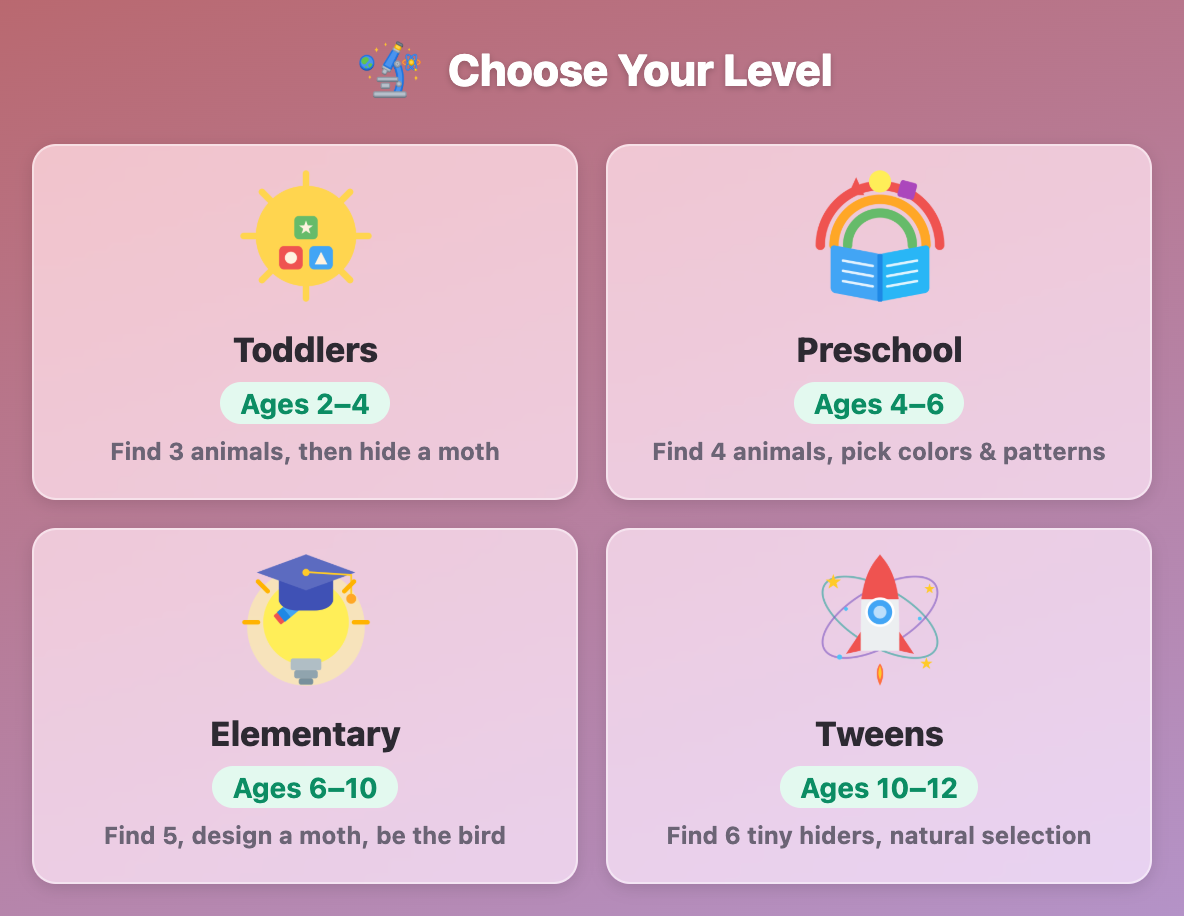
The Choose Your Level screen in Camouflage Hide & Seek for kids, with Toddlers, Preschool, Elementary and Tweens cards
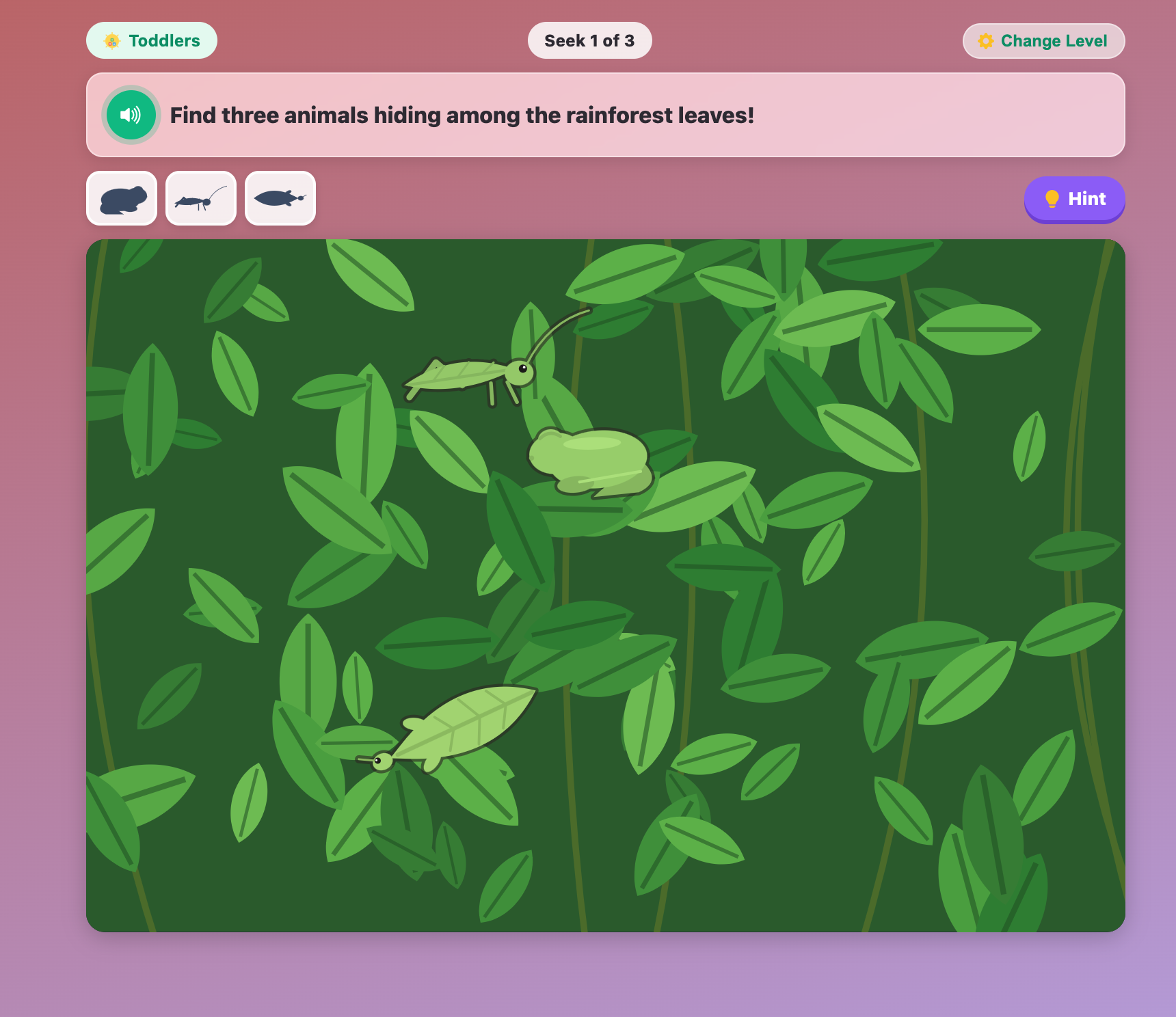
A rainforest scene in Camouflage Hide & Seek for toddlers, with a katydid, a sleeping tree frog and a leaf insect among green leaves
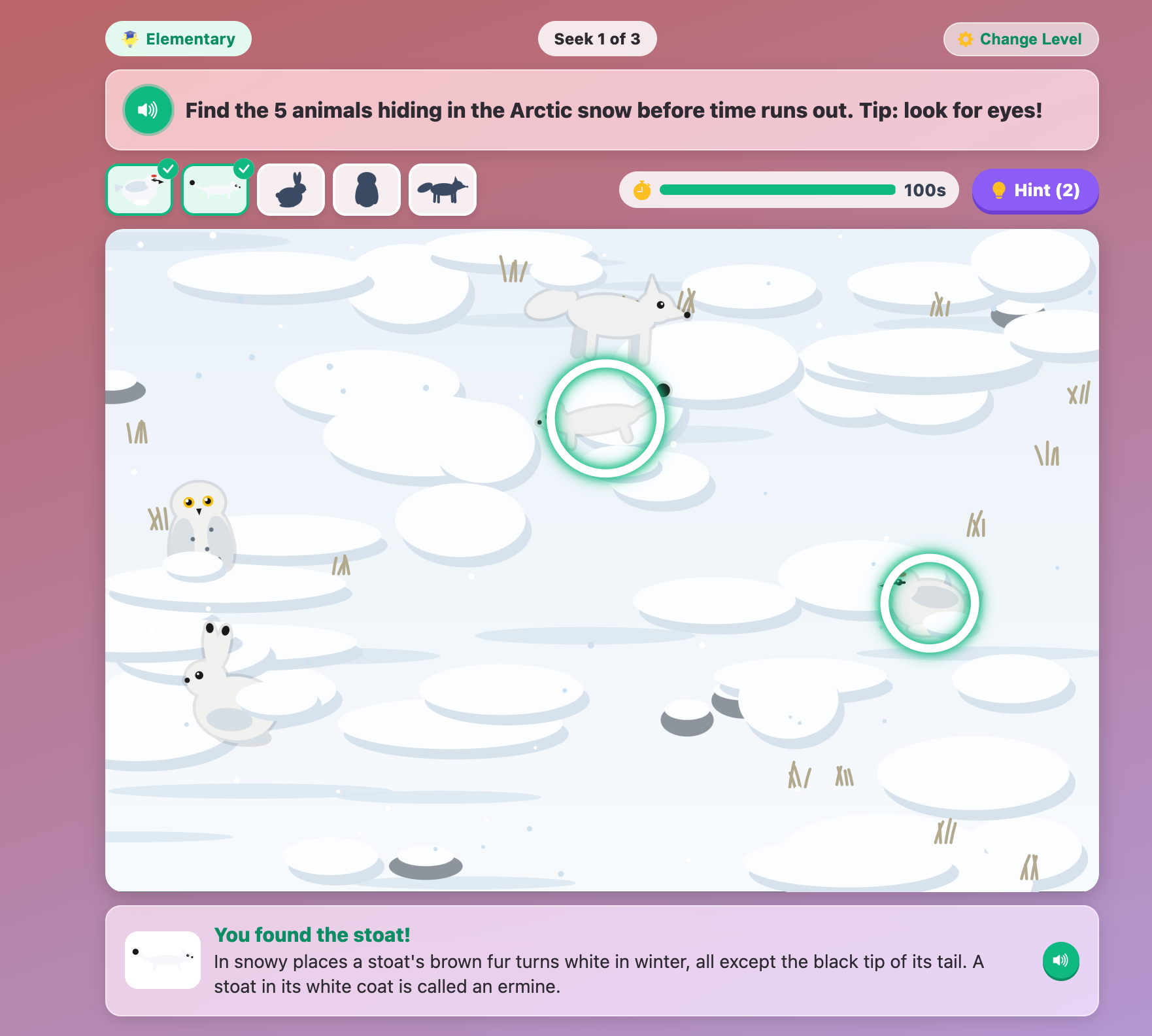
An Arctic snow scene at the Elementary level with the ptarmigan and stoat circled and a fact card about the stoat
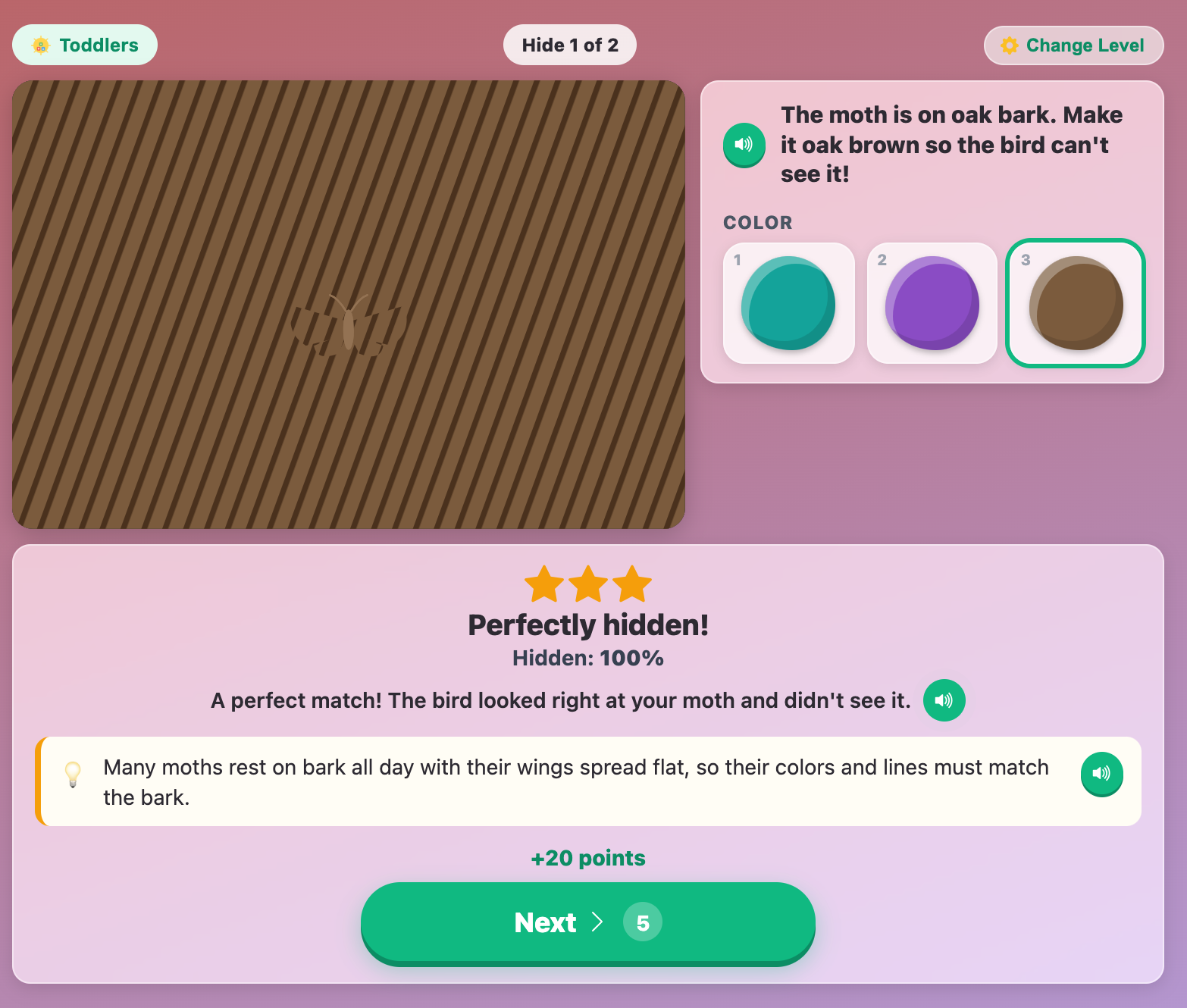
A striped moth painted oak brown and almost invisible on oak bark, with three paint colors and three gold stars
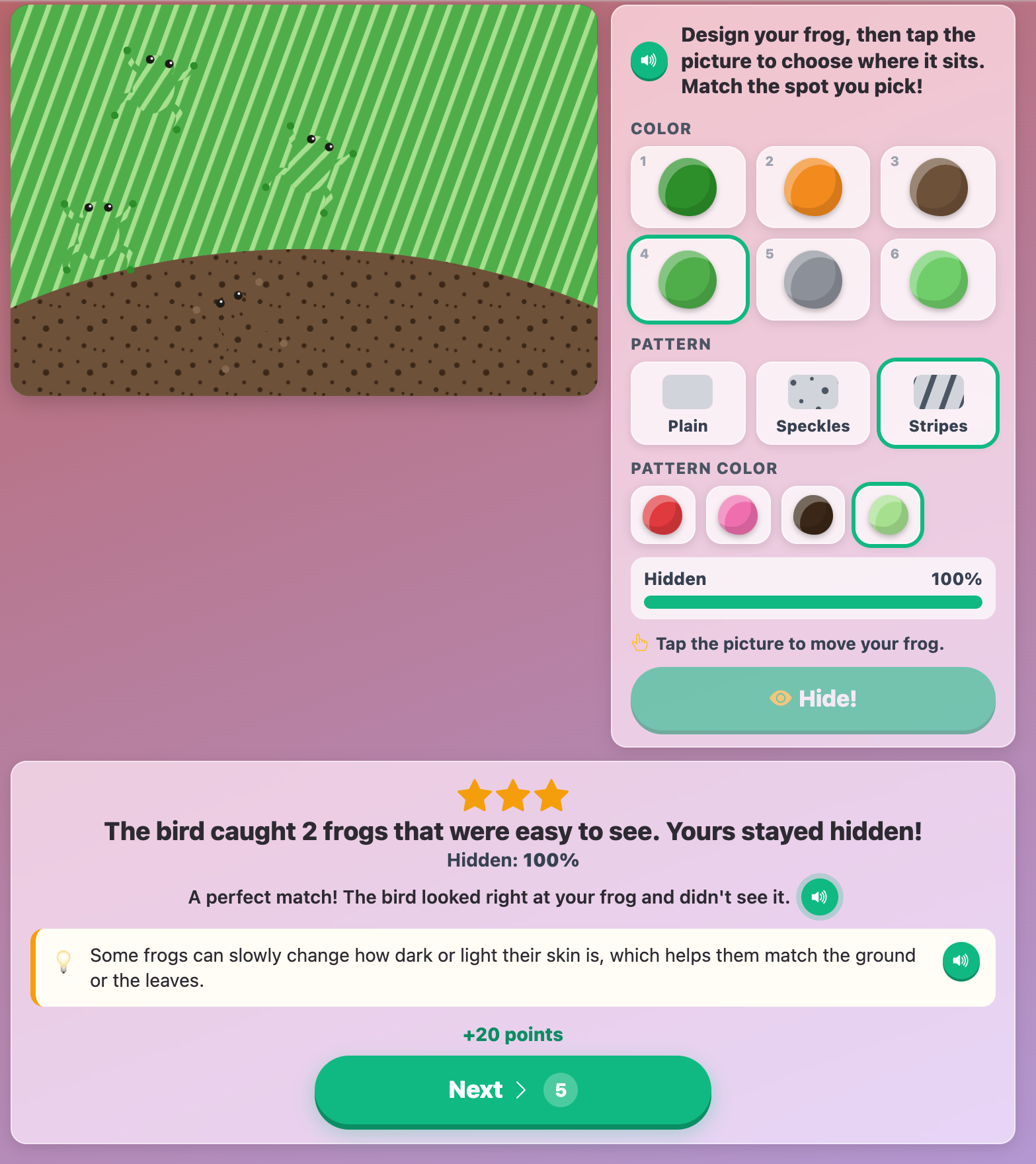
A frog designed with green skin and pale green stripes hiding on a leaf while the bird caught two easy-to-see frogs
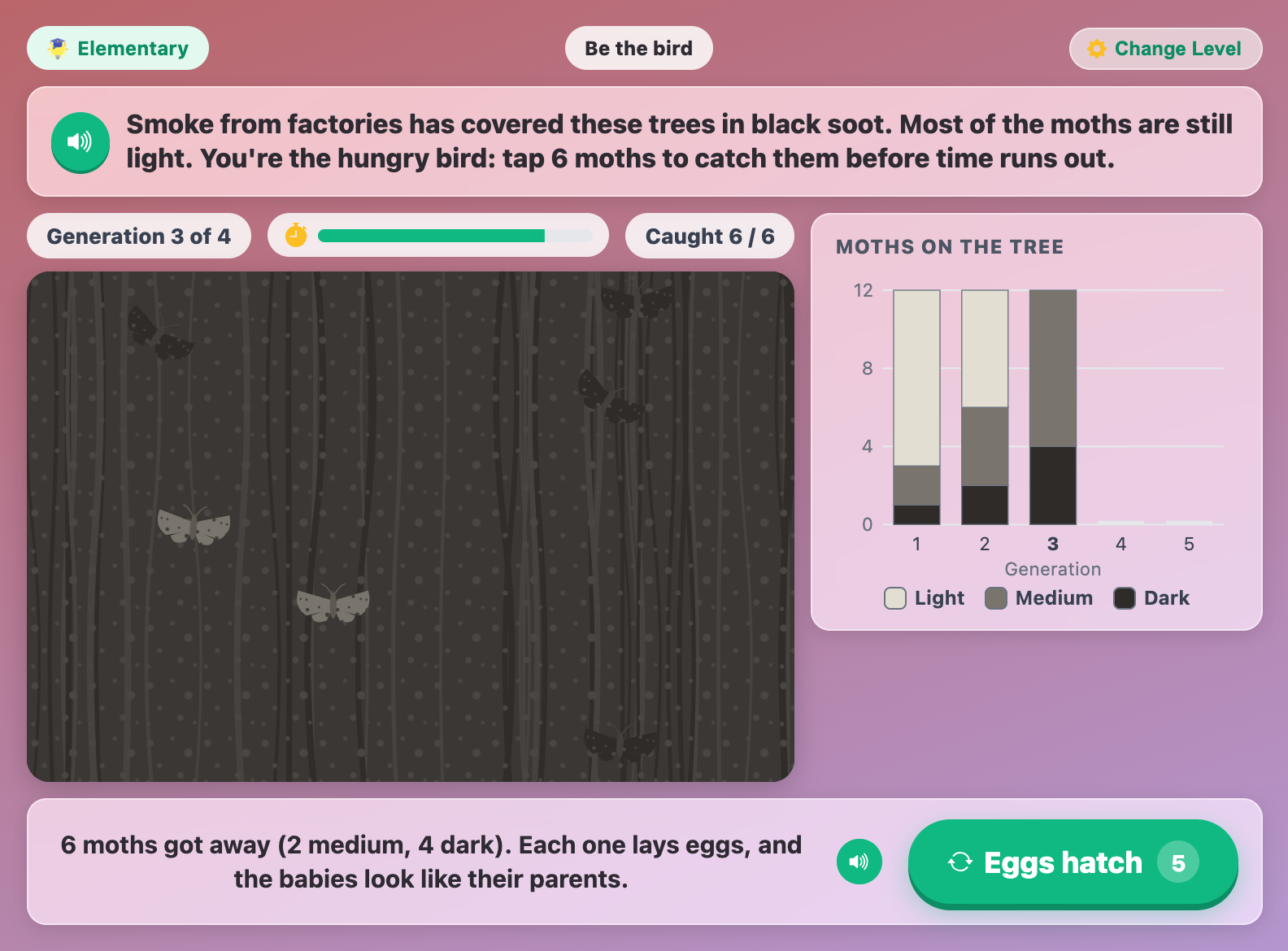
Generation 3 of 4 on a sooty tree trunk, with a bar chart showing the light moths shrinking and the dark moths growing
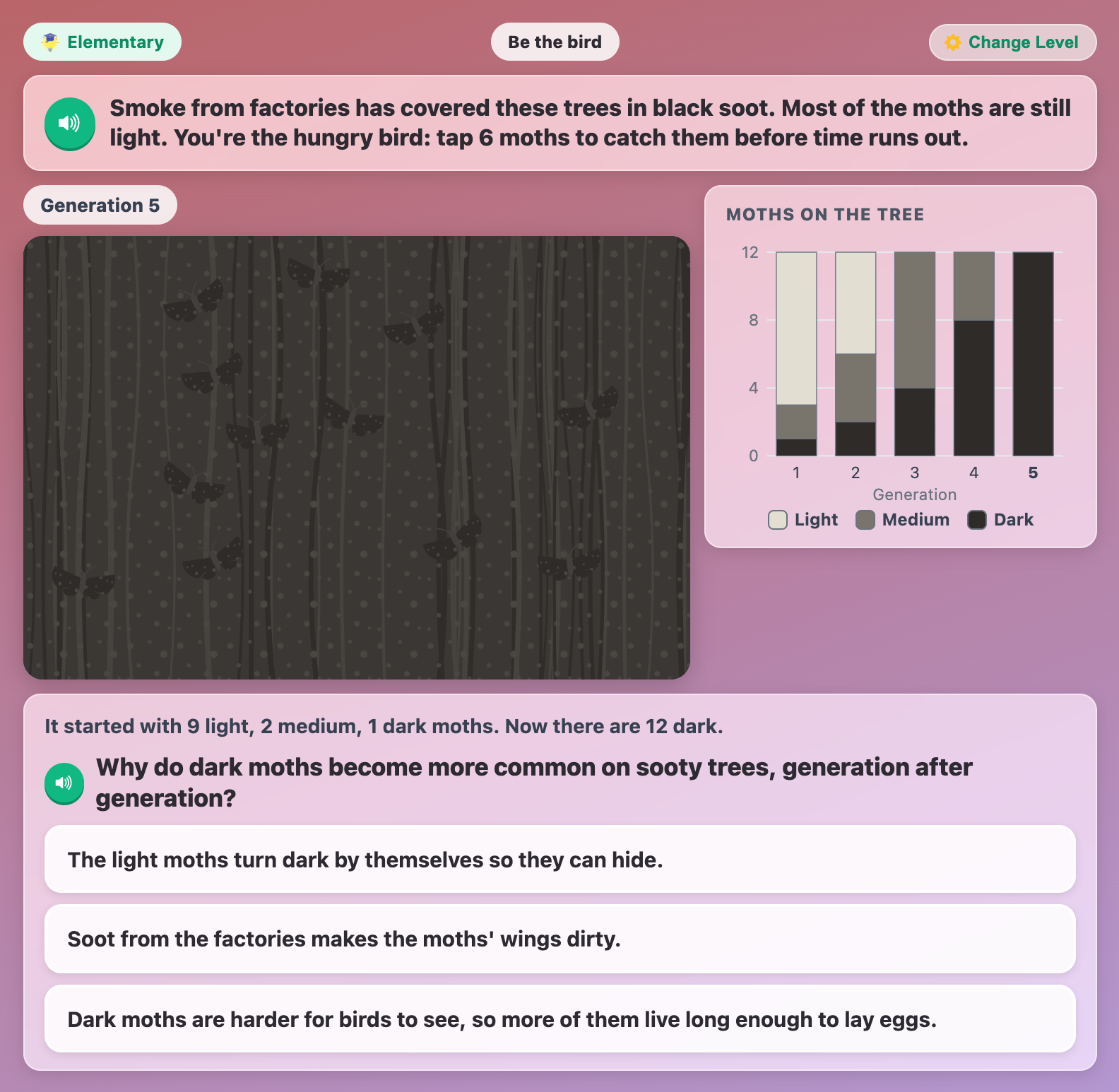
The last question after five generations of peppered moths, with all 12 moths now dark on the sooty tree
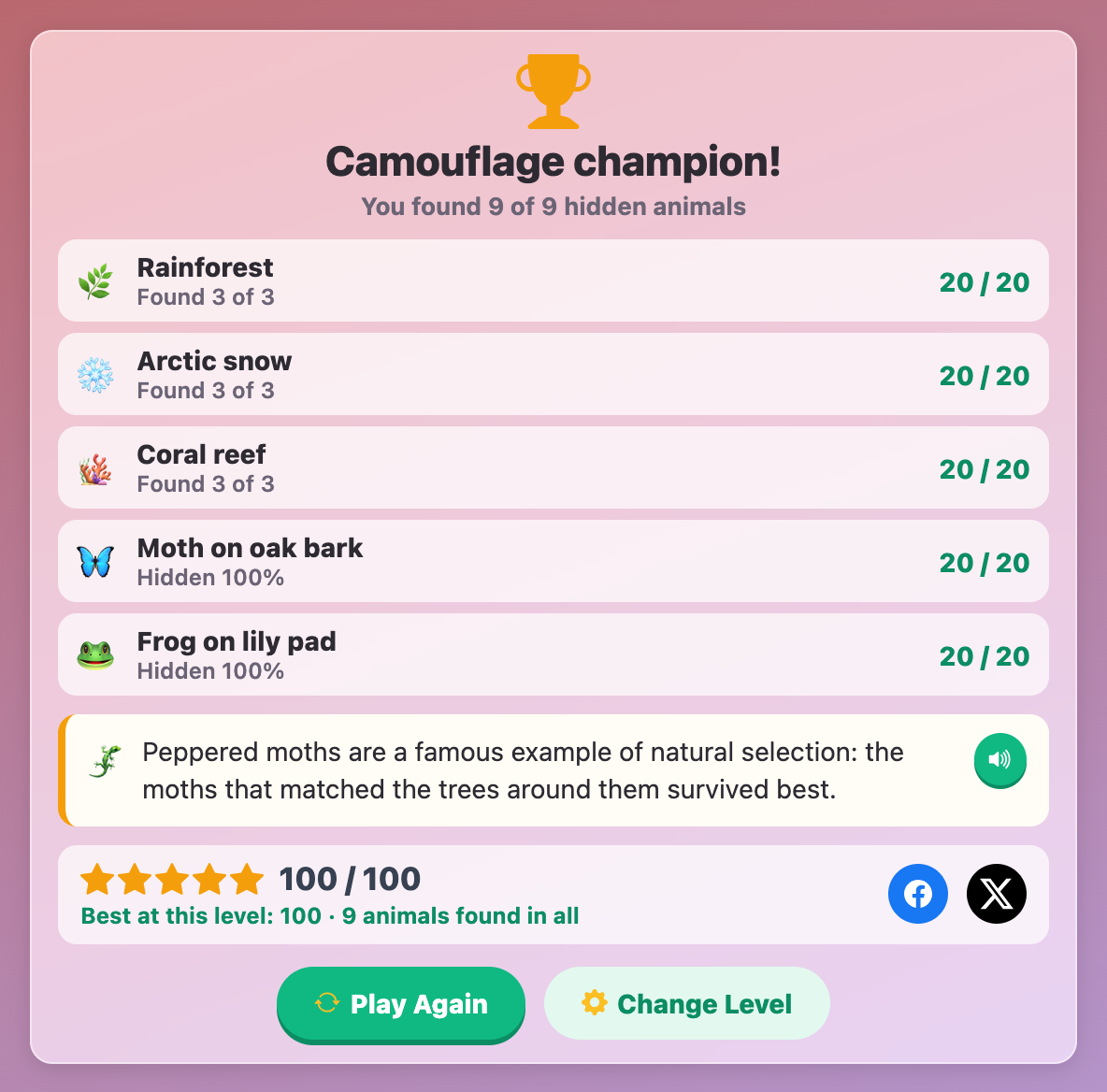
The Camouflage champion finish card with 100 out of 100 points, 9 of 9 animals found and two critters hidden
More Science Games
 59.5K plays
4.8
Recycling Sort
Sort everyday items into the Recycle, Compost, or Trash bin before time runs out!
 85.7K plays
4.9
Grow a Plant
Plant seeds in sunny and shady garden beds, then water, feed and protect them day by day. Watch the roots grow underground and harvest sunflowers, tomatoes, carrots and more!
 438.6K plays
4.9
Magnet Experiment
Guess which objects a magnet will pull, then drag the magnet to test every guess. Does gold stick? Does a battery?
 386.9K plays
4.9
Five Senses Match
Decide which of your five senses you would use for each everyday scene before time runs out.
Most Played Games
 1.8M plays
4.9
Color & Draw
A free-drawing canvas with colors and brush sizes to unleash your creativity.
59.5K plays
4.8
Recycling Sort
Sort everyday items into the Recycle, Compost, or Trash bin before time runs out!
 365.8K plays
5.0
Tic-Tac-Toe
Play a game of Tic-Tac-Toe against the computer and see if you can outsmart it.
 274.1K plays
5.0
Sentence Builder
Pick your age level, then tap the shuffled words in the right order to build the sentence.
Comments (34)