
Habitat Rescue
57.5K playsA storm has blown the animals away from home! Drag each one back to where it lives: the ocean, the desert, the polar ice, the rainforest, the grassland or the pond. Then find out why it fits there, from a camel that goes for days without water to an Arctic fox with fur on its paws.
🌪️ Storm news! A huge wind has swept through the wild places of the world, and the animals are lost. Habitat Rescue for kids is a free science game where you carry each lost animal back to the place it lives. You drag the animal onto the right home on a map (or just tap it), and the game tells you why that home fits, like how a camel can go for days without a drink.
It is made for children from about 2 to 12, with four levels that make the map bigger as kids grow. It plays right in your web browser, with nothing to download and no sign-up. Each game rescues 10 animals, so one round takes only a few minutes. By the end, the map is full of the animals you saved.
🗺️ Habitat Rescue for Kids: One Map, Ten Lost Animals
A habitat is the place where an animal lives. It is where the animal finds its food, its water and a safe place to rest. A polar bear's habitat is cold and icy. A sloth's habitat is warm and full of trees.
In Habitat Rescue, the homes sit on the screen as big colored tiles. The same tiles stay there for the whole game, like a map. Here are all six homes you can meet:
🌊 Ocean: deep, salty sea water.
🌵 Desert: hot and dry, with very little rain.
❄️ Polar Ice: freezing snow and ice near the poles.
🌴 Rainforest: hot, rainy and full of tall trees.
🌾 Grassland: wide, grassy plains with few trees.
💧 Pond: still, fresh water that isn't salty.
You don't see all six at once on every level. Little kids start with three homes that are very different from each other. Each level after that adds one more home, until the Tweens map has all six.
The best part comes after every rescue. The game shares a short reason, and many of these reasons are about an adaptation. That's a body part or a habit that helps an animal live in its home. A fennec fox's giant ears let out body heat. An Arctic fox has fur on the bottoms of its paws. These little facts are the real treasure of the game.
🧭 Your First Rescue, Step by Step
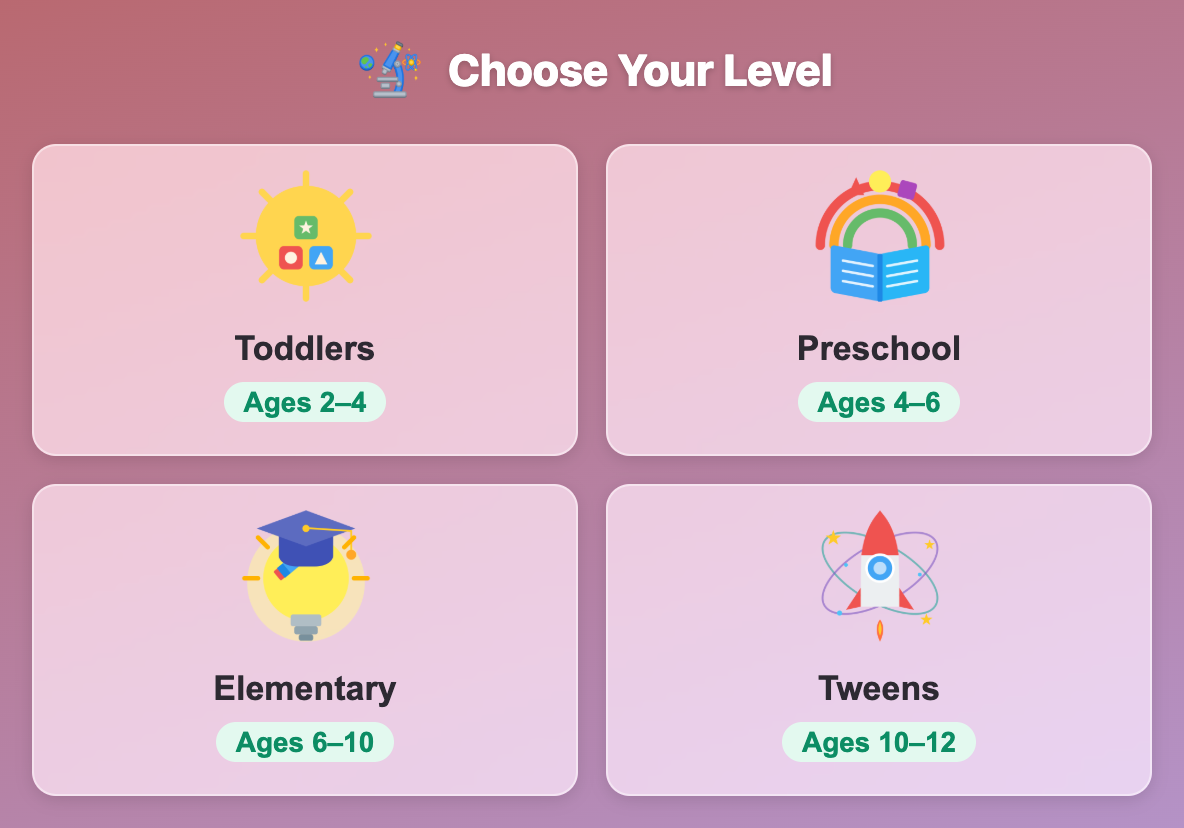
Pick your level. The game opens on the Elementary map the first time. Press Change Level at the top right to choose Toddlers (ages 2–4), Preschool (ages 4–6), Elementary (ages 6–10) or Tweens (ages 10–12). The game remembers your choice for next time.
Meet the lost animal. A card says "The storm blew this animal away!" and shows the animal's picture and name. Read the name carefully. On the bigger maps, the same picture can belong to different animals.
Listen if you like. Press the green 🔊 button on the card, and a voice reads the question, like "Help the camel get home! Ocean, Desert, or Polar Ice?" When the site's sound is on, the game can also read it to you by itself.
Send it home. Drag the animal with your finger or mouse. A floating copy follows you, and the home under it lights up. Let go to drop it. You can also simply tap a home, or press its number key (1 to 6) on a keyboard.
Try again if you miss. A wrong home shakes, gets a big ✖ and says something like "Not the Ocean! Try another home." That home can't be picked again, so your choices get smaller. After two misses, the game carries the animal home for you and explains where it lives.
Read the reason. A right answer says "Home safe!" with a fact about the animal. Its 🔊 button reads the fact out loud. The animal now stays in its home as a small picture.
Move on. Press the big Next Animal button, or press Enter or the space bar. If you wait, the button fills up and counts down from 5, then moves on by itself. It waits while the voice is still reading, so you never miss the end of a fact.
See your score. After the 10th animal, the "All the Animals Are Home!" card shows your score out of 100, up to five ⭐ stars, and a row of every animal you met. Then press Play Again for 10 new animals, or Choose Another Level.
Around the game there are three handy buttons. One turns the music on or off, one reloads the game, and one makes it fill the whole screen.
🔢 How Points and Stars Are Counted
Every animal is worth up to 10 points. Here is how it works:
Right on the first try: 10 points.
Right on the second try: 5 points.
Two misses: 0 points, but the animal still goes home and you still learn why.
Ten animals times 10 points makes a perfect score of 100. The stars on the score card come from your score:
90 to 100 points: 5 stars and a trophy.
70 to 89 points: 4 stars.
50 to 69 points: 3 stars.
25 to 49 points: 2 stars.
Under 25 points: 1 star.
So for five stars, you can make one small slip, but not two. One second-try animal gives 95. One animal with two misses gives 90. Any animal you didn't get on the first try shows up under Practice these again, with its right home and its reason.
🦊 Rescue Ranger Tricks for a Perfect 100
Read the name, not just the picture
On the Elementary and Tweens maps, one picture can mean two or three different animals. The 🦊 can be a fennec fox or an Arctic fox. The 🐢 can be a sea turtle, a desert tortoise or a red-eared slider. The word under the picture is the real clue, so always read it before you move.
Ask: hot or cold? Wet or dry?
Before you pick, ask yourself two quick questions. Is this animal made for heat or for cold? Does it need water, or can it live where it is dry? Thick white fur means cold, so think Polar Ice. Saving water means dry, so think Desert. Fins, flippers and gills mean water.
Look at the animal's body for clues
Animal bodies tell stories. Big ears let out heat, so they help in hot places. Small ears keep heat in, so they help in cold places. Long arms and gripping tails are for climbing trees. Webbed feet are for paddling. If you know what a body part does, you can often guess the home, even for an animal you have never heard of.
Use the tile words on the bigger maps
On Elementary and Tweens, every home has a short line under its name, like "Hot and dry, with very little rain." Match the animal to those words. The Pond tile says "Still, fresh water that isn't salty," and the Ocean tile says "Deep, salty sea water." That one word, salty, decides many tricky rescues.
Turn a miss into a smart second guess
A miss is not the end. The wrong home is crossed out, so you have fewer choices. Think about why your first guess was wrong. If you tried Ocean for an animal that "lives where it's hot and dry", there is only one home left that fits. A smart second try still earns 5 points.
Don't rush the Next button
The fact after each rescue is the most useful part of the game. The countdown waits for the voice, and you can press the 🔊 again to hear it twice. Many facts come back as clues later. Once you learn that small ears save heat, both the Arctic hare and the Arctic fox make sense.
Practice the list, then play again
The Practice these again list is your own study sheet. Read each animal, its home and its reason. Then press Play Again. The game picks animals for every home on your map, so you will soon meet those habitats again.
🐢 Six Tricky Rescues and How to Crack Them
1. The rattlesnake on the Toddlers map
The map shows Ocean, Desert and Polar Ice. A snake has no fins, so it's not an ocean swimmer. It has no fur, so it can't keep warm on the ice. That leaves the Desert. The game's reason agrees: a rattlesnake lives in the dry desert and shakes its tail to say "stay away!"
2. Three turtles, three homes
On the Tweens map, the 🐢 picture can show up for three different animals. Here is how to tell them apart:
Sea turtle: "sea" is in its name, and it swims with flippers. It goes to the Ocean.
Desert tortoise: "desert" is in its name, and it digs a burrow to hide from the heat. It goes to the Desert.
Red-eared slider: no place in its name! The game says it is a fresh-water turtle that suns itself on logs. It goes to the Pond.
3. Two foxes, two kinds of ears
The fennec fox and the Arctic fox share the 🦊 picture on Elementary and Tweens. The fennec fox has giant ears that let body heat out, so it lives in the Desert. The Arctic fox has small ears that keep heat in, plus thick fur on its paws, so it lives on the Polar Ice. Same picture, opposite homes!
4. Koi or lobster: fresh or salty?
Both live in water, and on the Tweens map you have two water homes. A koi is a fresh-water fish, and salty sea water would harm it, so it goes to the Pond. A lobster walks on the sea floor and breathes the salty water through its gills, so it goes to the Ocean. When you see a water animal, always ask, "fresh or salty?"
5. Giraffe or orangutan: few trees or many?
On the Elementary and Tweens maps, both Grassland and Rainforest have trees, so which is which? The Grassland has only a few trees, far apart. A giraffe stretches its long neck up to those lonely trees, so it belongs on the Grassland. An orangutan swings from branch to branch all day and builds a leafy nest every night. It needs lots of trees close together, so it belongs in the Rainforest.
6. Counting a real score card
Say you rescue 8 animals on the first try, one on the second try, and miss one animal twice. That's 8 × 10 = 80, plus 5, plus 0, for a total of 85. That earns 4 stars, and two animals go on your practice list. One more first-try rescue would have reached 90 and five stars.
If you liked aiming for the right home, Magic Crossbow: Habitat Hunt turns the same skill into target practice, where you shoot every animal that lives in the habitat on the card.
🎒 Which Map Fits Your Child?
🐣 Habitat Rescue for toddlers (ages 2–4)
Toddlers get just three big homes: Ocean, Desert and Polar Ice. They are as different as homes can be, so the choice is easy to see. The animals are ones little kids know, like a whale, a camel and a polar bear. The reasons are short and gentle: "Its thick white fur keeps it warm." Sit together, read the name out loud, and let your child tap the home instead of dragging.
🌈 Habitat Rescue for preschoolers (ages 4–6)
Preschoolers get a fourth home, the Rainforest. Now kids meet a sloth, a spider monkey, a macaw and a gorilla. There are some surprising desert animals too, like the kangaroo rat, which gets its water from the seeds it eats. The 🔊 buttons are a big help for kids who are just starting to read.
📚 Habitat Rescue for elementary kids (ages 6–10)
Elementary kids add the Grassland, with zebras, giraffes, lions, white rhinos and bison. Every tile now shows its short description, so kids can match the animal to the words. This is also where the same picture starts to mean different animals, like the two foxes. The reasons talk about real body features, such as a polar bear's layer of fat called blubber.
🚀 Habitat Rescue for tweens (ages 10–12)
Tweens get the full map of six homes, including the Pond. Telling fresh water from salty water becomes the big challenge, with koi, a beaver, a mallard duck and a common frog. The facts go deeper too. Did you know a camel's hump stores fat, not water? Tweens who aim for a perfect 100 have to read every name and every clue.
🌍 What a Storm of Animals Teaches
Each rescue is a tiny science lesson. When a child wonders where a desert tortoise goes, they have to think about heat, water and shelter, the three things every habitat must give. That is real science thinking, not just memory.
The game also teaches kids to look closely. A child who sends the wrong turtle to the Ocean learns, right then, to read the name first. That habit of checking before acting helps in reading, math and much more.
Mistakes feel safe here. A miss only crosses out one home, and the second try still earns points. Even after two misses, the animal always gets home, and the child always gets the answer. The practice list at the end shows exactly what to learn next.
Many kids also start to see animals in a new way. Ears, fur, feet and tails become clues. That is a great step toward understanding why every animal is shaped the way it is. If your child loves those body clues, Camouflage Hide & Seek shows how colors and patterns help animals hide in their homes, from a snowy owl in the Arctic snow to a stonefish on a coral reef.
💚 For grown-ups
Habitat Rescue is gentle and kind. The storm is only a story idea, no animal is ever hurt, and every lost animal makes it home in the end. The facts were written by hand for each level and checked so that every animal has only one right home on that level's map. The game practices sorting, reading, careful looking and early life science about habitats and adaptations. It runs in the browser on computers, tablets and phones, with touch, mouse and keyboard controls, and there is nothing to install.
Ready to grab your rescue gear? Pick a level, read the first name on the storm card, and bring every animal home safe. Once you know where animals live, you can find out who eats whom in Food Chain Builder. Have fun playing Habitat Rescue for kids, and see if you can save all ten on the first try!
🖼️ See the Game in Action
The Choose Your Level screen in Habitat Rescue for kids, with Toddlers, Preschool, Elementary and Tweens cards
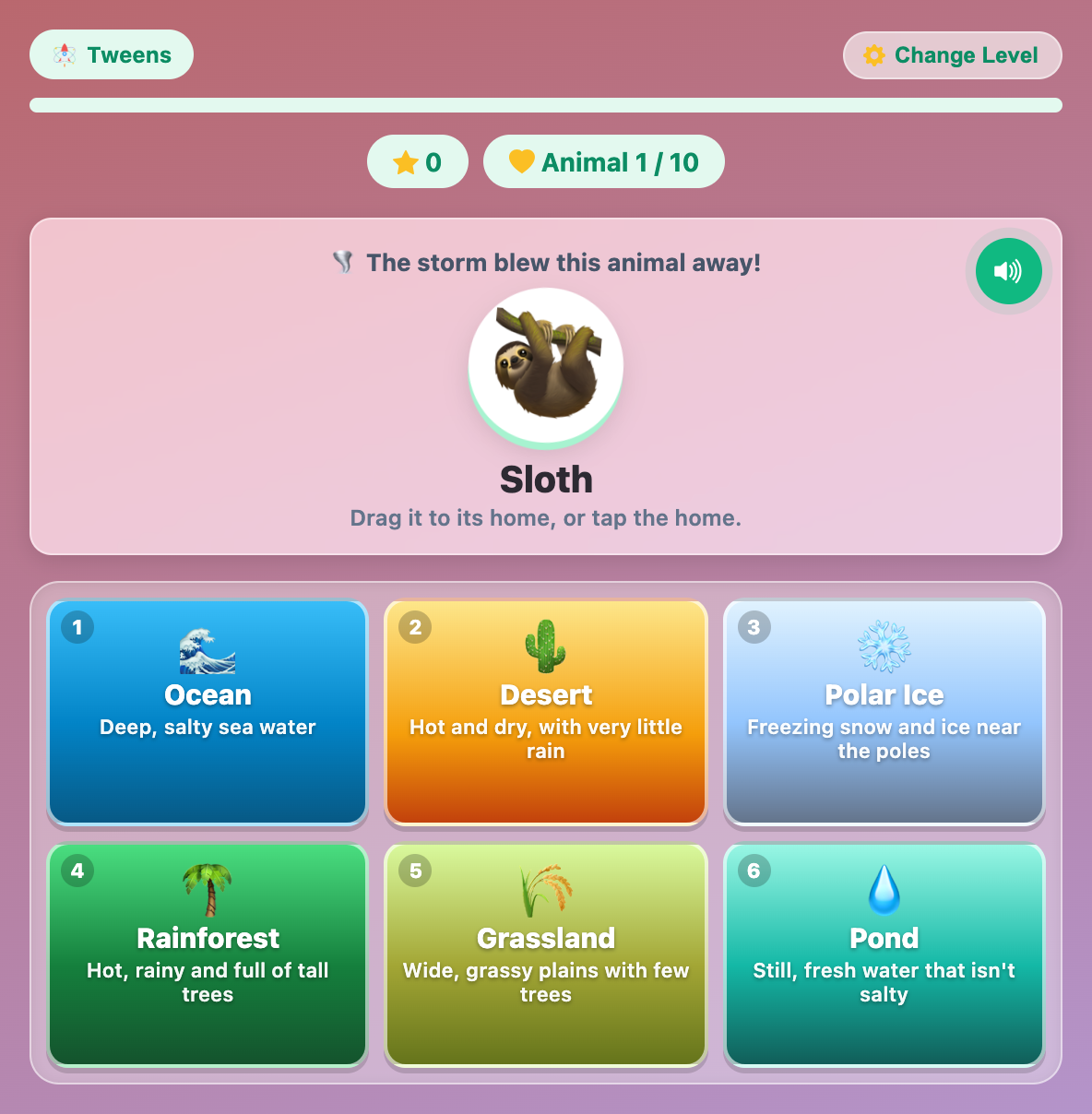
A sloth waiting on the storm card above six numbered habitat tiles at the Tweens level of Habitat Rescue
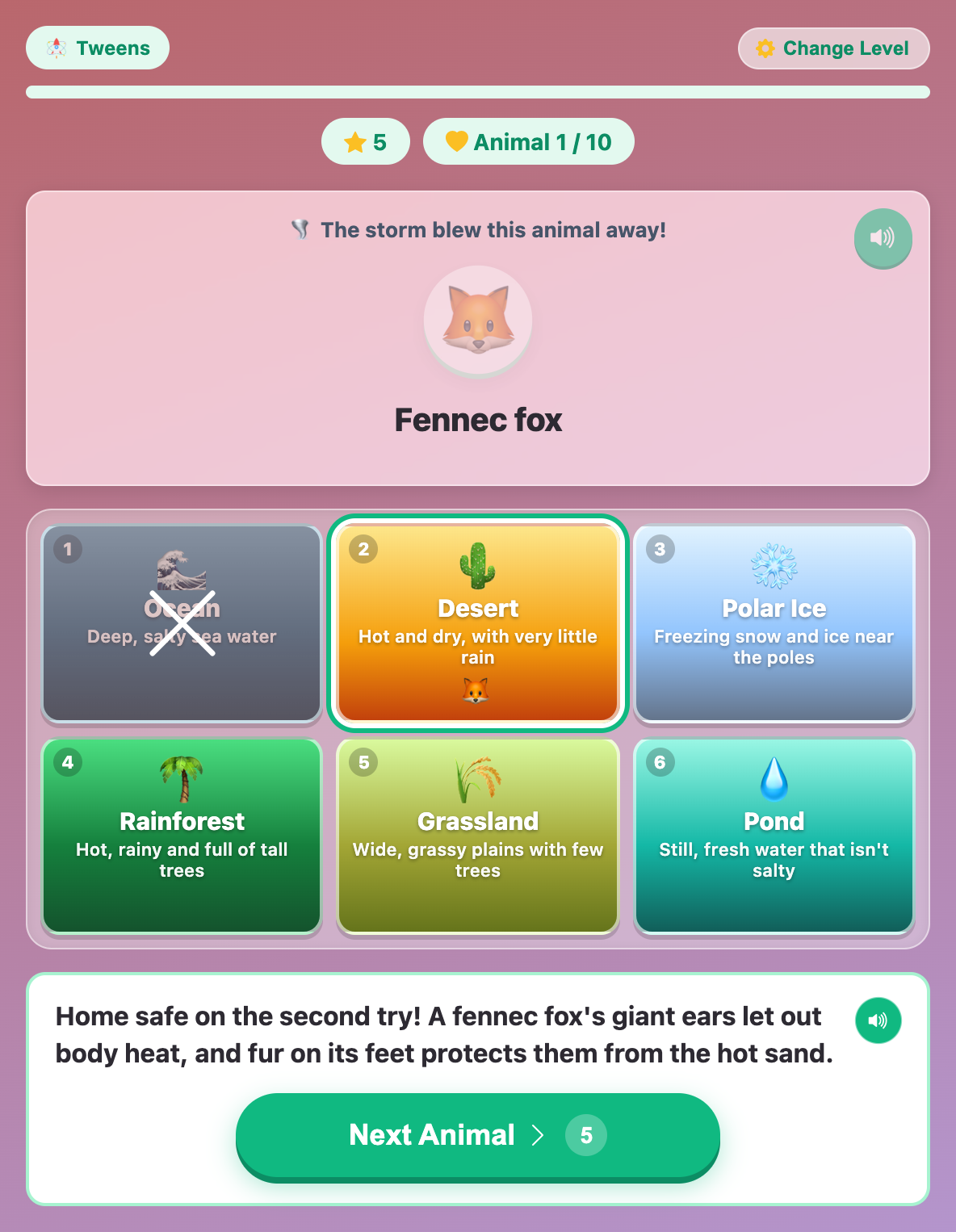
A fennec fox rescued into the Desert on the second try, with the Ocean tile crossed out and a Next Animal button
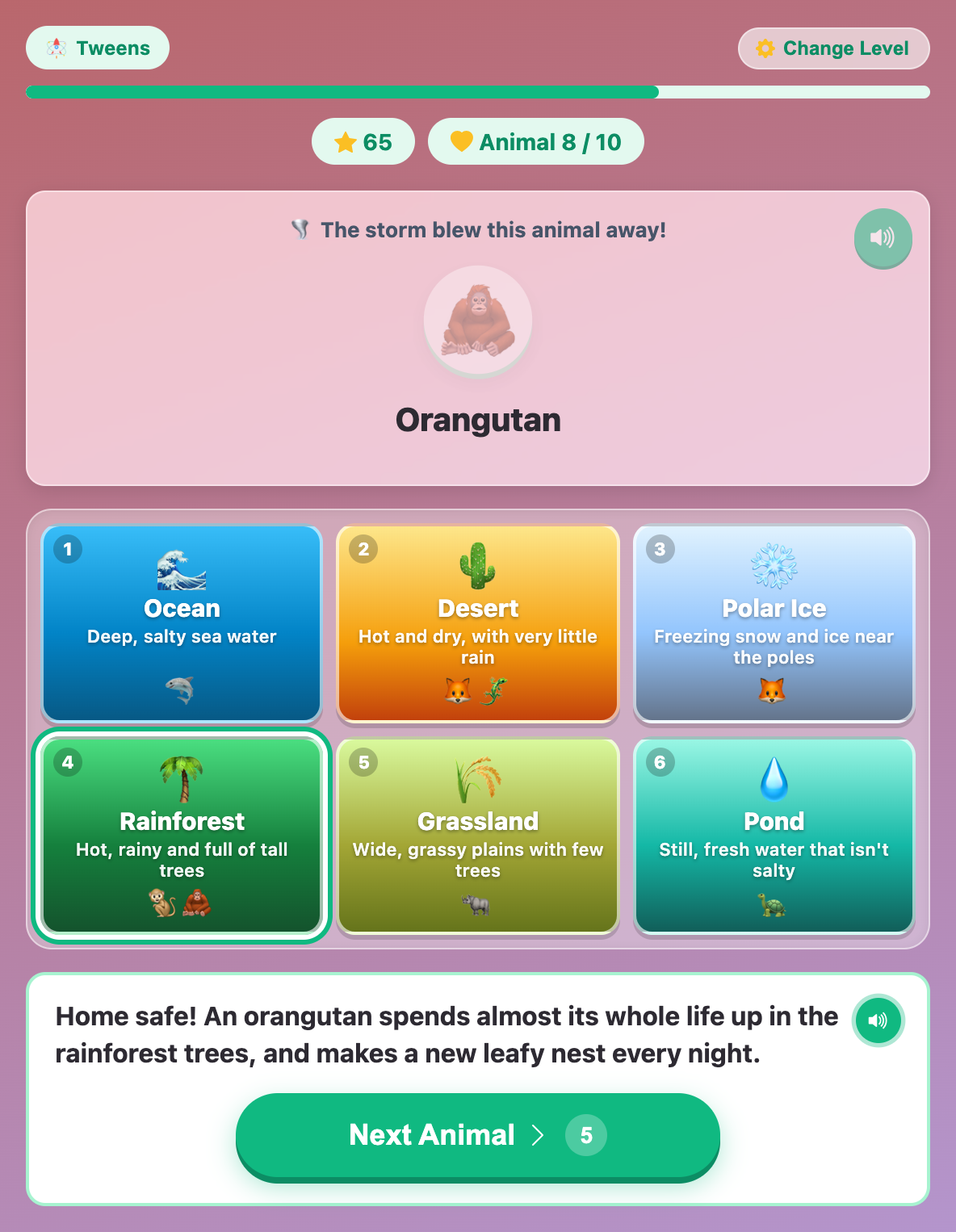
The habitat map filling up with rescued animals as an orangutan reaches the Rainforest in round 8
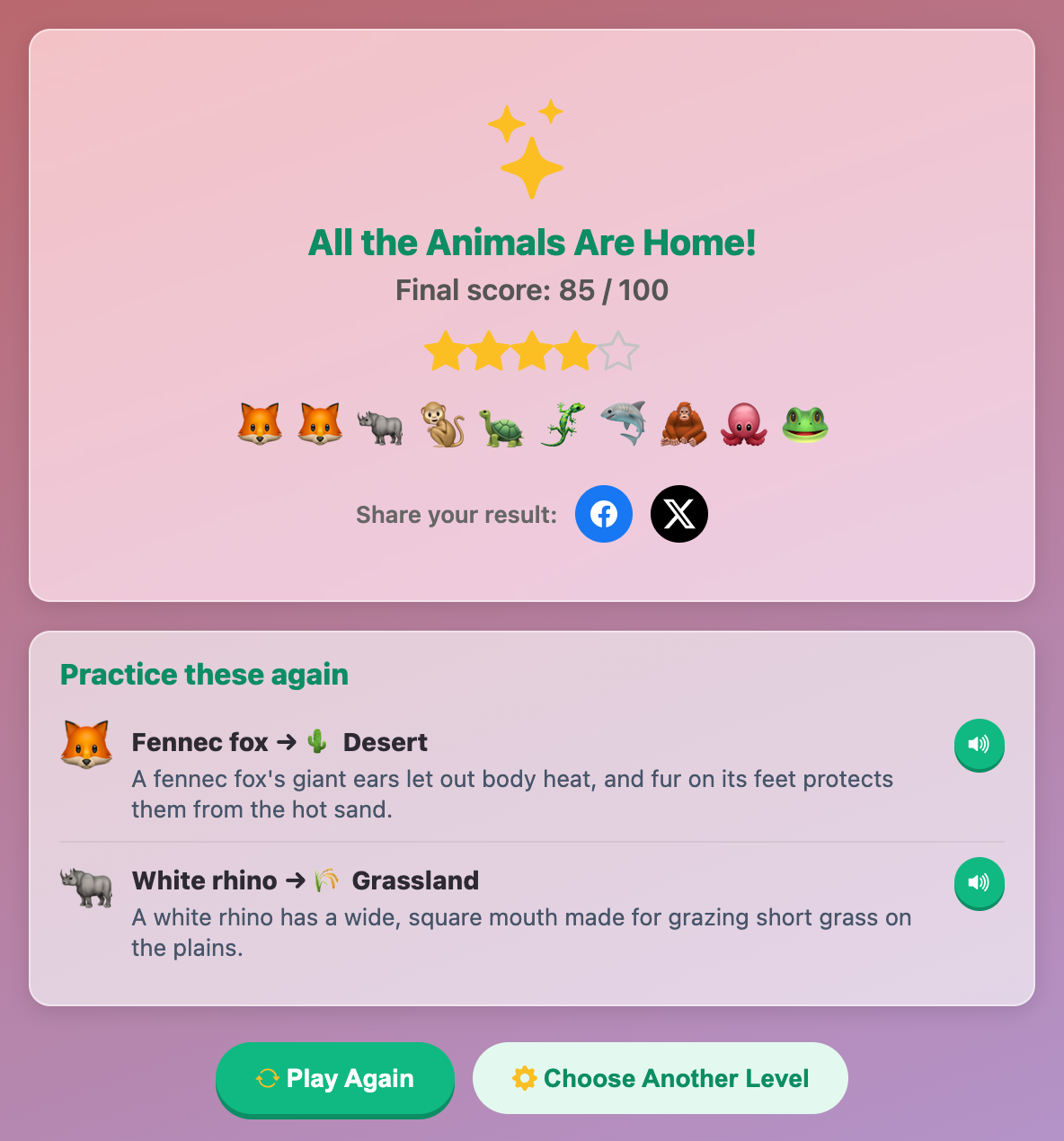
The All the Animals Are Home score card with 85 out of 100, four stars and a Practice these again list
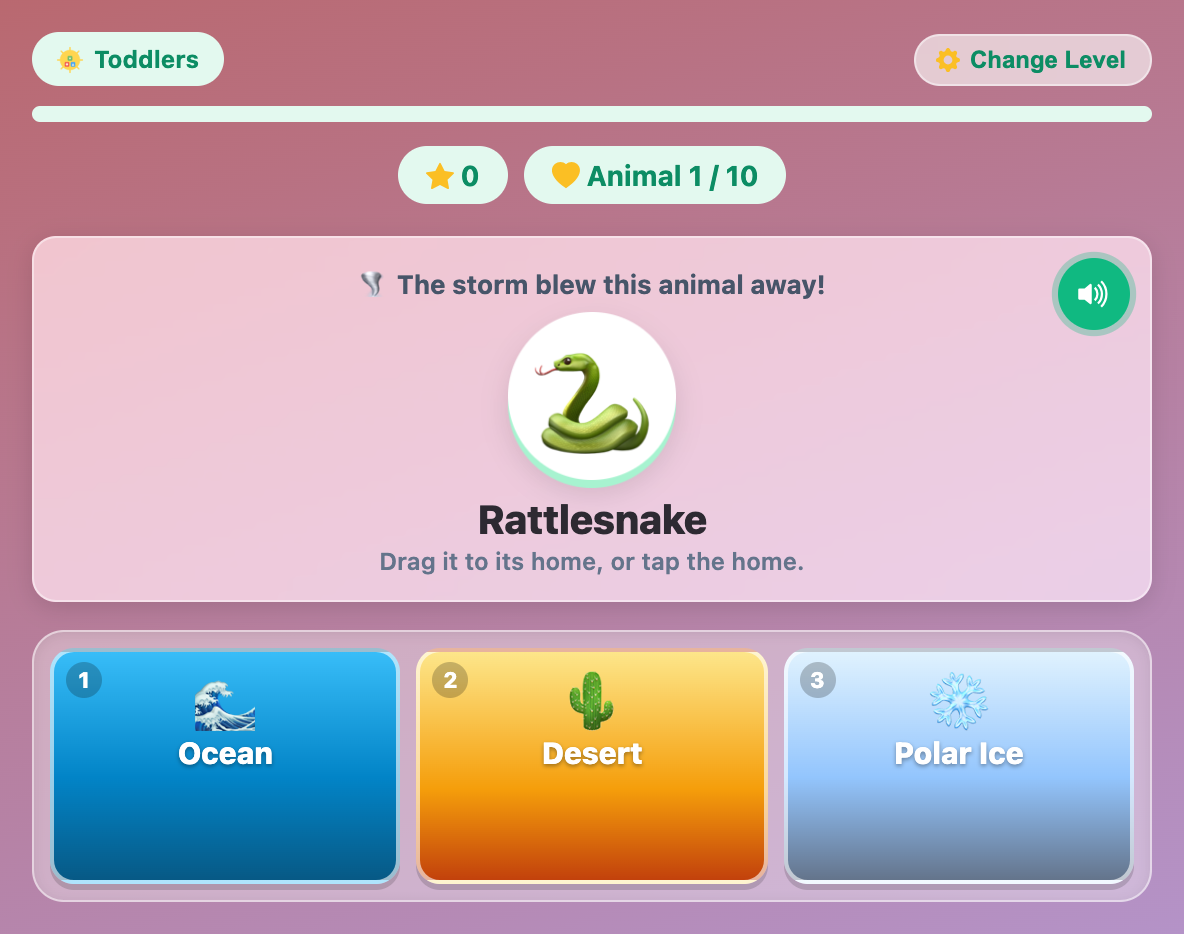
A rattlesnake card above just three big tiles, Ocean, Desert and Polar Ice, at the Toddlers level of Habitat Rescue
More Science Games
 59.5K plays
4.8
Recycling Sort
Sort everyday items into the Recycle, Compost, or Trash bin before time runs out!
 85.7K plays
4.9
Grow a Plant
Plant seeds in sunny and shady garden beds, then water, feed and protect them day by day. Watch the roots grow underground and harvest sunflowers, tomatoes, carrots and more!
 438.6K plays
4.9
Magnet Experiment
Guess which objects a magnet will pull, then drag the magnet to test every guess. Does gold stick? Does a battery?
 386.9K plays
4.9
Five Senses Match
Decide which of your five senses you would use for each everyday scene before time runs out.
Most Played Games
 1.8M plays
4.9
Color & Draw
A free-drawing canvas with colors and brush sizes to unleash your creativity.
59.5K plays
4.8
Recycling Sort
Sort everyday items into the Recycle, Compost, or Trash bin before time runs out!
 365.8K plays
5.0
Tic-Tac-Toe
Play a game of Tic-Tac-Toe against the computer and see if you can outsmart it.
 274.1K plays
5.0
Sentence Builder
Pick your age level, then tap the shuffled words in the right order to build the sentence.
Comments (49)