
Magic Crossbow: Habitat Hunt
154.9K playsWhich animals live in the ocean? Which ones live in the desert? Shoot every animal that belongs with your magic crossbow, and find out how each one is made for its home. Farms, ponds and jungles for little ones, then real science traps for big kids: penguins don't live in the Arctic, polar bears don't live in Antarctica, and a shark can't breathe air!
Every animal has a home address. A camel's is the hot, dry desert. A polar bear's is the icy Arctic. A beaver's is a river, right next to the dam it built. In Magic Crossbow: Habitat Hunt for kids, you read the address on a card, look at a row of animals, and shoot every animal that lives there with a sparkly magic crossbow.
Each hit pops the animal's picture in a burst of magic and tells you how that animal is made for its home. Shoot the wrong animal, and your arrow bounces off a magic shield while the game tells you where that animal really lives. Either way, you learn something new about animals every single shot.
🏠 Habitats: Where Animals Belong
A habitat is the place where an animal lives and finds everything it needs: food, water, shelter and the right weather. Animals have special body parts and habits that help them survive in their own habitat. A polar bear has thick fur and fat to stay warm on the ice. A camel can go many days without drinking. An octopus hides in rocky holes on the ocean floor.
Habitat Hunt is part of KidWorld's Magic Crossbow family of games. Each crossbow game has a different puzzle, and this one is all about animal homes. Little kids sort animals into easy places like the farm, the sea or the snow. Older kids explore real science habitats, like the savanna and the rainforest, and even sort animals by how they live: awake at night, cold-blooded, or breathing air in the sea.
🏹 How to Play Habitat Hunt on KidWorld
Pick your level. Choose Toddlers, Preschool, Elementary or Tweens. The game remembers your level, and you can switch with the Change Level button.
Read the card. At the top, a picture and a green label name the habitat, like 🌊 Live in the ocean. Under it is your job, like "Shoot all 3 ocean animals!" The card always tells you how many animals to find. Tap the 🔊 button to hear the question and the animals still standing.
Look at the animal tiles. A row of 4 to 6 animal pictures waits in the middle. From Preschool up, each picture has its name under it.
Aim and shoot. Tap an animal. The crossbow turns, aims and fires! You can also use the left and right arrow keys to aim and Space or Enter to shoot, or press a number key from 1 to 6 to shoot that tile.
Hit or bounce. If the animal lives there, it bursts in a shower of magic and the message says why it belongs, plus how many are left. If it doesn't, the arrow bounces off a shield and the message starts with "Keep it!" and says where it lives instead.
Get a hint if you need it. After a miss (two misses on Elementary and Tweens), one of the right animals starts to glow, and the game says something like "Look! The glowing one is an Arctic animal." So every round always ends with all the animals found.
Play 10 rounds. The counter in the corner shows which round you're on, and a 🔥 streak badge appears when you hit every animal with no misses, round after round.
See your result. After round 10, the result card shows your score out of 100, up to 5 stars, how many rounds you finished on the first try, your missed shots and your best streak. A Practice these again list shows each animal you missed and the reason, so you can learn it for next time. Then tap Play Again.
Above the game are three handy buttons: fullscreen to make the scene bigger, reload to start over, and music to turn the music on or off.
🎯 How the Score Works
Each round is worth 10 points. Every missed shot takes away 3 points from that round, but a round never goes below 0. Ten perfect rounds make 100 points. So one miss in a whole game still gives you 97, and that's still a top score with a "Bullseye! You are a habitat expert!" title.
That means the best way to win isn't speed. There's no timer at all! The best way is to think before you shoot.
🧭 Smart Hunter Tips
1. Count the targets first
The card says "Shoot both…" or "Shoot all 3…". That number is a big clue. If it says both, there are exactly two right animals on the board. Once you've found two, you know the rest are all wrong.
2. Find the easy ones first
Start with the animal you're most sure about. In "Live in the ocean", a whale or an octopus is a safe first shot. Every hit leaves fewer animals to think about, and the hit message often teaches you something that helps with the next one.
3. Read the rule on the card
On Elementary, a short rule sits on the card from the start, like "Ocean water is salty. Rivers, lakes and ponds have fresh water." On Tweens, the rule appears after your first miss. The rule is the key to the trickiest animals, so read it before you aim.
4. Watch out for animals that live near the habitat
The sneakiest wrong answers are animals that live close by. A frog and a hippo both love water, but they live in fresh water, not the salty sea. A beaver lives by rivers, not the ocean. Ask yourself: does this animal live in this exact place, or just somewhere like it?
5. Remember the North and South Pole trap
Penguins and polar bears both live in icy, cold places, so it's easy to think they live together. They don't! Polar bears live in the Arctic, at the North Pole, the top of the world. Wild penguins live in the southern half of the world, many of them around Antarctica, at the South Pole. On Tweens, this trap really comes up, and the game even starts its message with "Trick!"
6. Think about the body, not just the place
Some Tweens hunts aren't about a place at all. "Cold-blooded animals" means animals whose bodies get as warm or as cold as the air or water around them, like snakes, lizards, crocodiles, frogs and turtles. "Sea animals that breathe air" means animals with lungs that must swim up to breathe, like whales, dolphins and seals. For these hunts, ask what kind of animal it is: a mammal, a bird, a reptile, an amphibian or a fish.
7. Read every message
Hit or miss, the message under the tiles always explains why. Those reasons are the real treasure of this game. If you read them, you'll get the same habitat right next time.
If you like spotting the one that doesn't belong, Magic Crossbow: Odd One Out uses the same crossbow to find the odd picture in science groups like birds, insects and things that make their own light.
🦉 Five Hunts, Solved Together
Toddlers: Live in the snow and ice
The tiles show a penguin, a polar bear, a giraffe and a crocodile. The card says "Shoot both animals that live in the snow and ice!" Penguins slide on icy ground, and a polar bear has thick white fur to keep warm. Shoot those two. The giraffe and the crocodile like warm, sunny places, so leave them alone.
Preschool: Live in the sea
Imagine an octopus, a dolphin, a frog, a hippo and a squirrel. The octopus and the dolphin are easy hits. Now look closely at the frog and the hippo. They both love water, so they look tempting. But a frog lives in ponds and a hippo lives in rivers and lakes, not the salty sea. The squirrel lives in trees. So the answer is just the octopus and the dolphin.
Elementary: Live in fresh water
The rule says "Rivers, lakes and ponds have fresh water. Ocean water is salty." Picture a beaver, a duck, a lobster, a reef fish, a hippo and a camel. The beaver builds dams in rivers, the duck finds food in ponds, and the hippo spends hot days in rivers and lakes. Those are your three. The lobster and the reef fish need salty ocean water, and the camel lives in the dry desert.
Tweens: Sea animals that breathe air
Picture a whale, a seal, a penguin, a shark, an octopus and a crab. Everything here lives in the sea, so you have to think about breathing. Whales and seals are mammals with lungs. A penguin is a bird, and birds have lungs too, so it must come up for air. Those are the three to shoot. The shark is the trap: it's big and swims like a dolphin, but it's a fish that breathes through gills. The octopus and the crab use gills too.
Tweens: Cold-blooded animals
Imagine a snake, a frog, a turtle, a penguin, a polar bear and an owl. Snakes and turtles are reptiles that lie in the sun to warm up. A frog is an amphibian whose body warms and cools with its surroundings. Shoot all three. The penguin is the trick this time: it lives in icy places, but birds make their own body heat, so it's warm-blooded, just like the polar bear and the owl.
🌍 Magic Crossbow: Habitat Hunt for Kids of Every Age
Magic Crossbow: Habitat Hunt for toddlers (ages 2–4)
Four big picture tiles with no words, and only 1 or 2 animals to find. The habitats are far apart and easy to picture: the sea, the farm, the snow and ice, the desert, the jungle, the pond and the woods. The question is read aloud when the site's sound is on, and a right animal glows after just one miss. It's a lovely game to play on a grown-up's lap, naming each animal together.
Magic Crossbow: Habitat Hunt for preschoolers (ages 4–6)
Five tiles with names under them, 2 or 3 animals to find, and a new habitat: the grassland. The wrong animals are closer now, like a frog or a beaver in a sea round, or a zebra or a wolf among the farm animals. Kids start to notice the difference between "lives near water" and "lives in the sea".
Magic Crossbow: Habitat Hunt for elementary kids (ages 6–10)
Six tiles and real science habitats: the ocean, the desert, the Arctic, the rainforest, the savanna, fresh water and the woods. The habitat's rule is on the card from the start, and every message explains an adaptation, like the camel's fat-storing hump or the seal's thick blubber.
Magic Crossbow: Habitat Hunt for tweens (ages 10–12)
Six tiles with 2 to 4 targets, and the trickiest hunts: the Arctic versus Antarctica, nocturnal animals, cold-blooded animals, sea animals that breathe air, grasslands, fresh water, the rainforest, and animals that live wild only in Australia. The rule only appears after a miss, so tweens have to think like real scientists first.
🌱 Why Hunting for Habitats Grows Young Scientists
It teaches why, not just what. Kids don't just learn that camels live in the desert. They learn it's because a camel can go many days without drinking. That's the big idea of adaptation, explained one animal at a time.
It builds careful thinking. The tricky animals teach kids to slow down and check: is a hippo a sea animal, or a river animal? That habit of checking a guess before acting helps in every school subject.
It clears up common mix-ups. Penguins at the North Pole, sharks breathing air, and frogs in the ocean are mistakes many grown-ups make too. Kids who play will know the real answers. To meet animals and the places they live all around the world, kids can spin the 3D globe in Discovery Earth and open each country's animals.
It mixes learning with play. The crossbow, the magic bursts and the streaks make kids want to play "just one more round". Kids who enjoy sorting things into groups can also try Classify It!, where each picture goes into the right science group before time runs out.
For parents: This game is gentle and friendly. The "shooting" pops pictures with sparkles, no animal is ever hurt, and there's no timer. Every answer is checked so that a fair answer is never marked wrong. It practices animal names, reading, habitats, adaptations and careful thinking, and the Practice list at the end makes a great chat at the dinner table.
Your crossbow is loaded with magic, and a whole world of animals is waiting to find its way home. Ready, aim, learn! Start a round of Magic Crossbow: Habitat Hunt for kids today. 🏹
🖼️ See the Game in Action
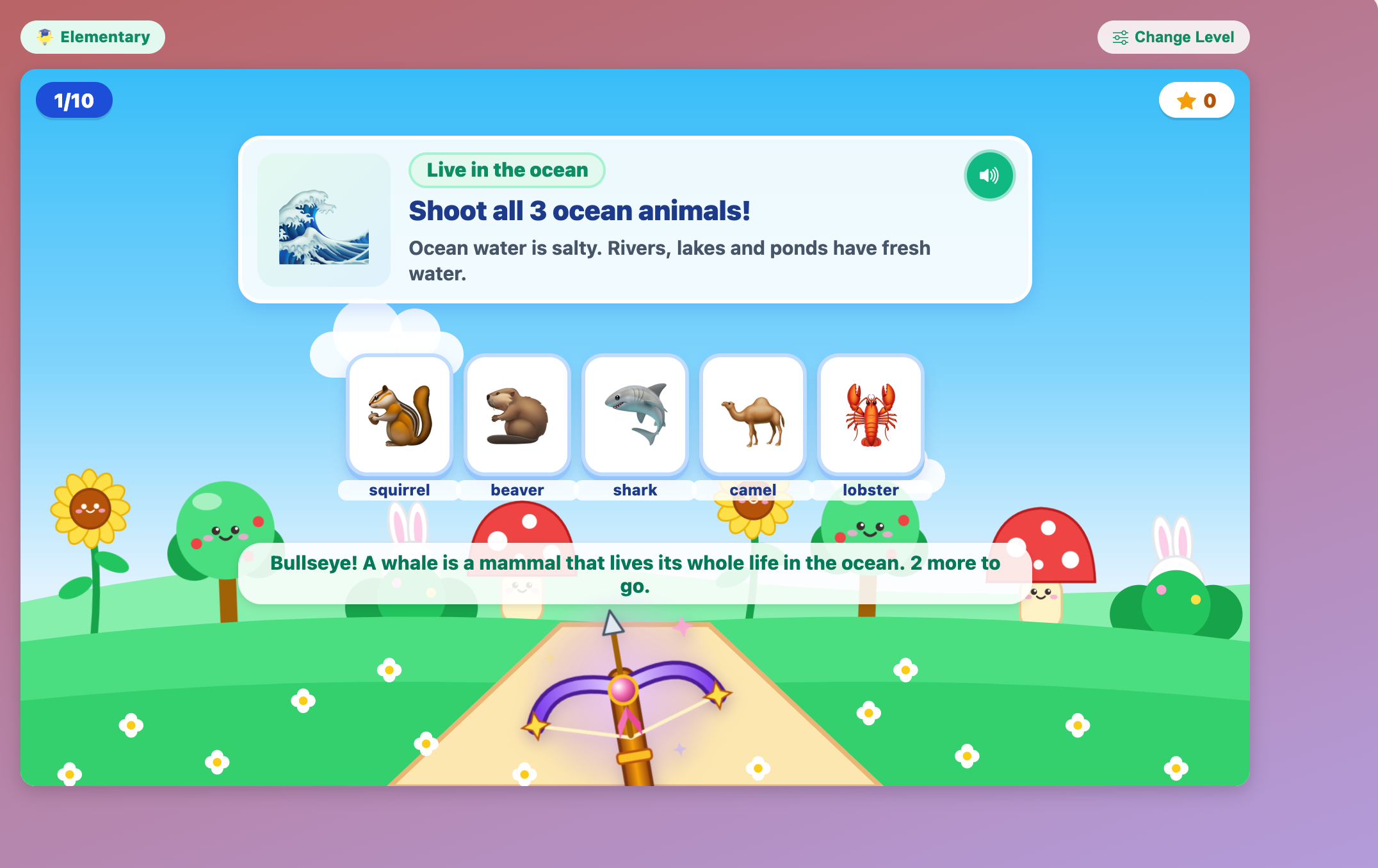
A Live in the ocean round in Magic Crossbow: Habitat Hunt for kids, right after the whale was hit
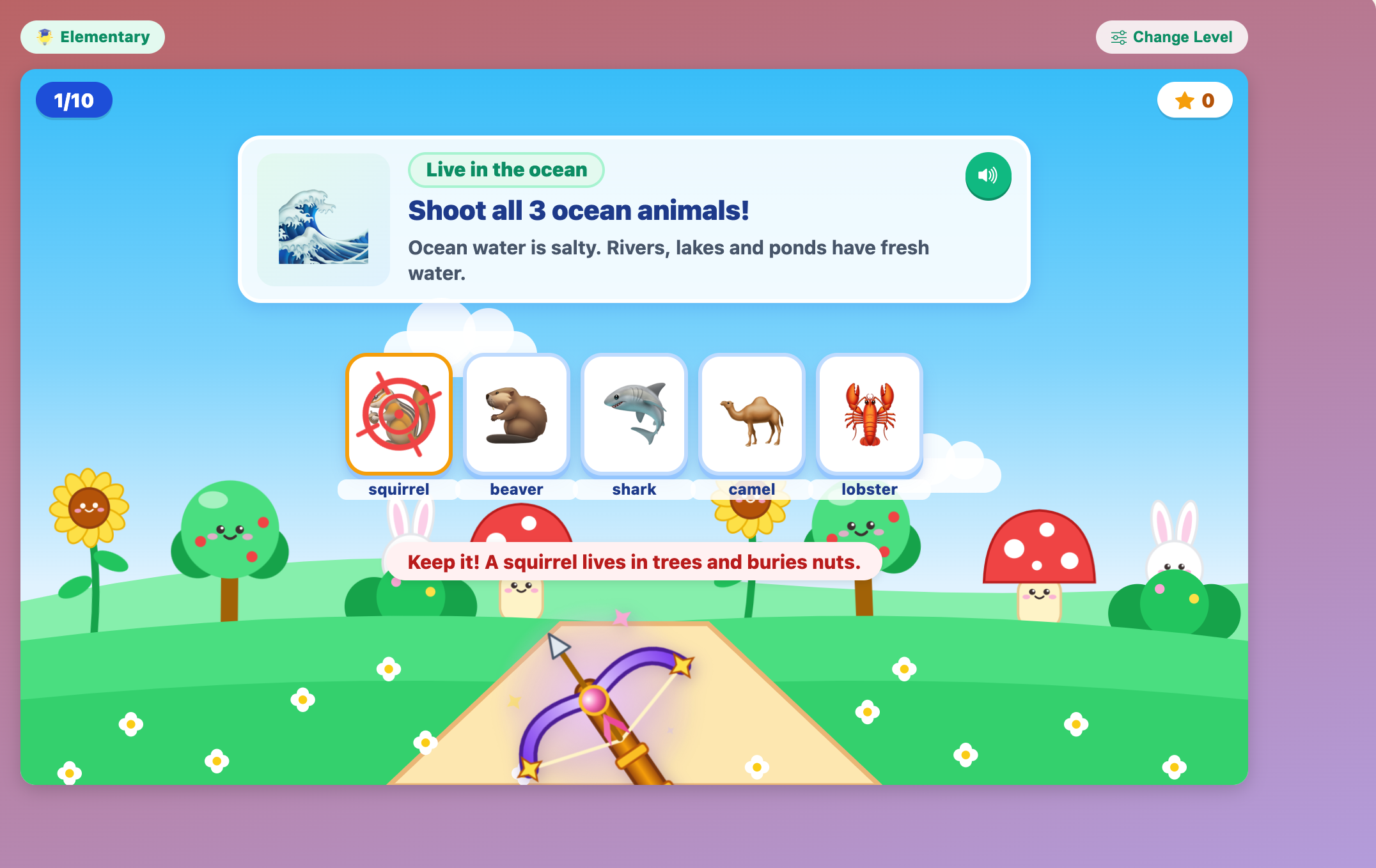
The crossbow aimed at a squirrel in an ocean round, with the message Keep it! A squirrel lives in trees and buries nuts
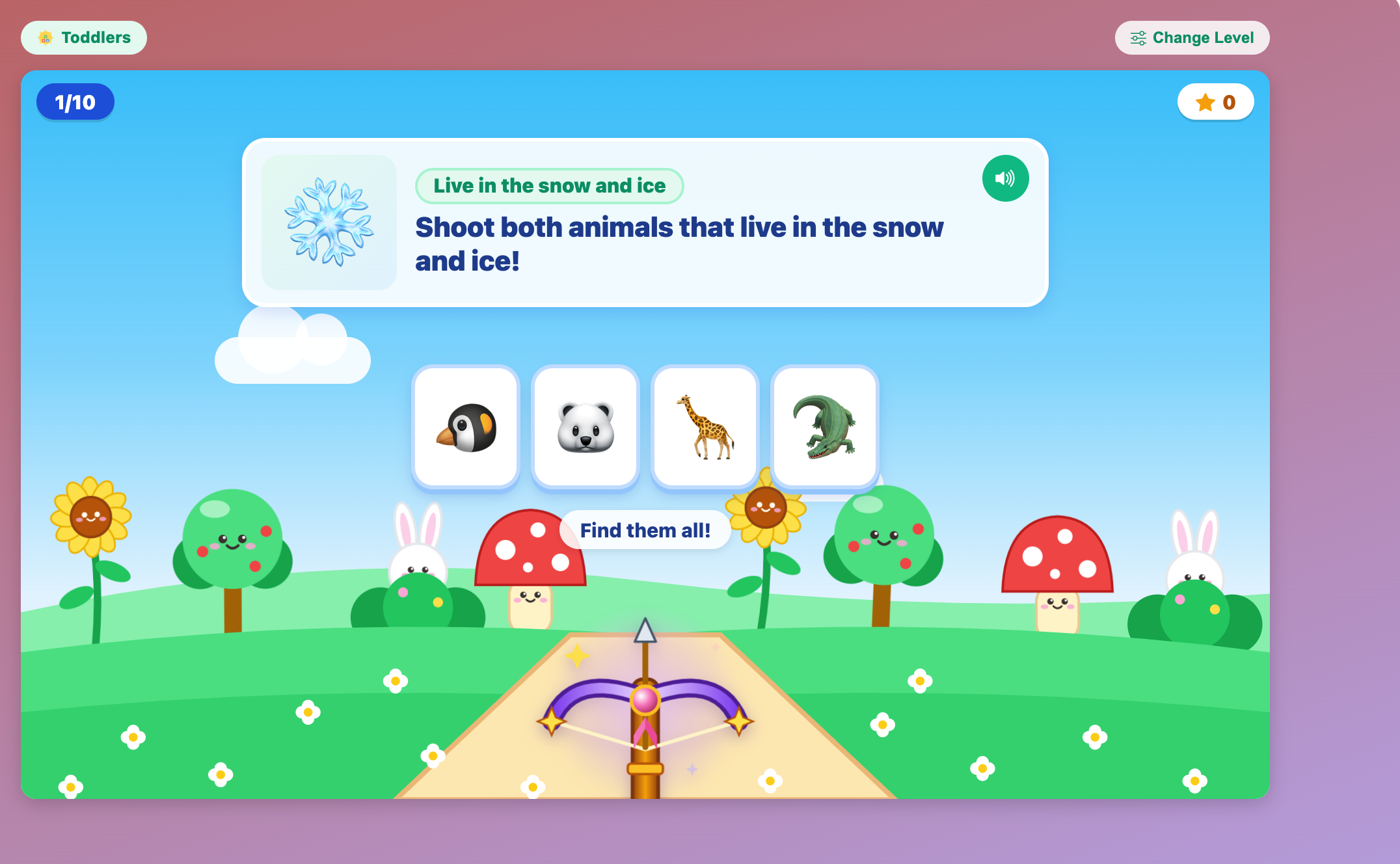
A Toddlers round asking for both snow and ice animals, with a penguin, polar bear, giraffe and crocodile
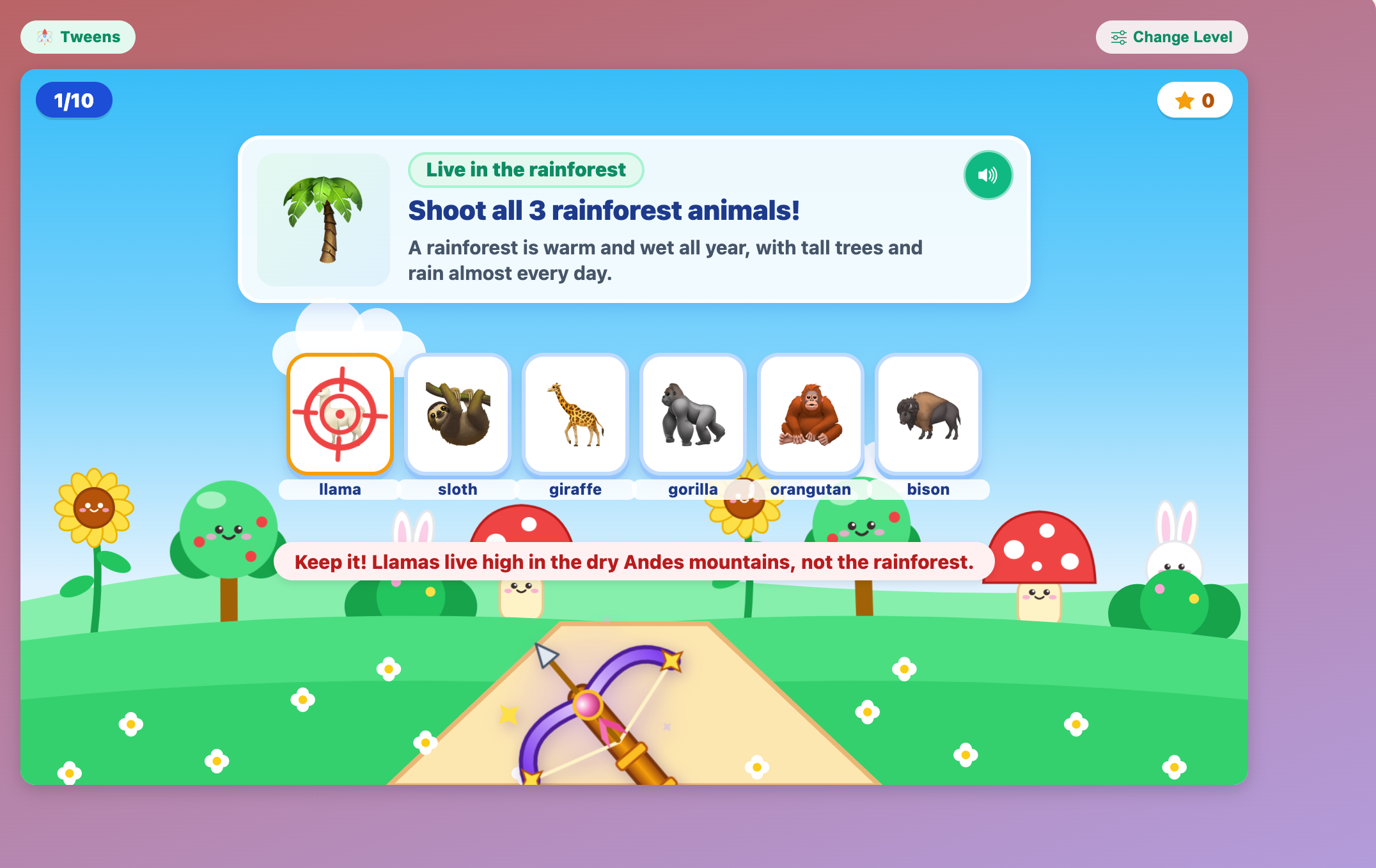
A rainforest round in Magic Crossbow: Habitat Hunt for tweens, after a miss on the llama, with the rule shown
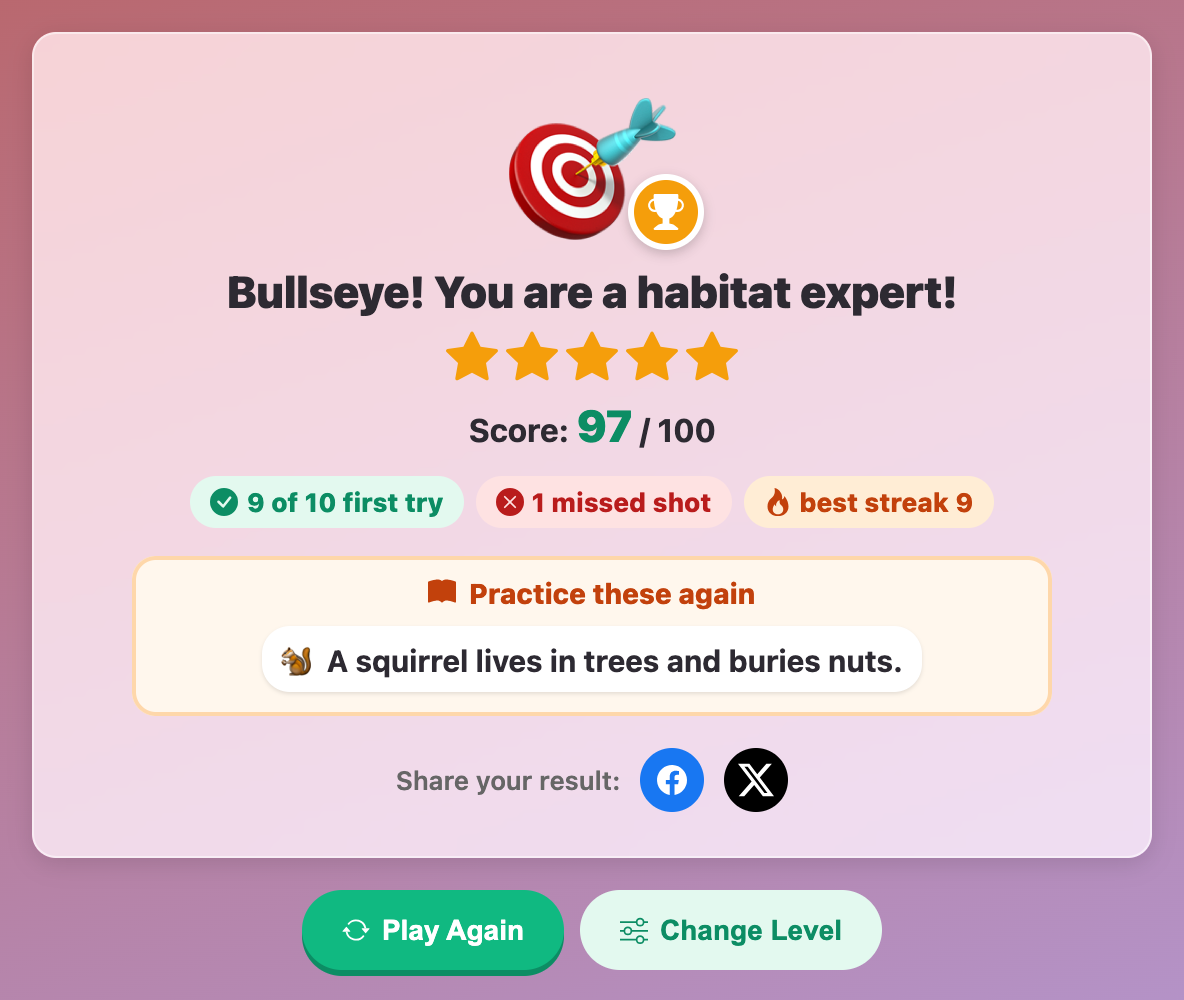
The results card with a score of 97 out of 100, 9 of 10 first try, and a Practice these again list
More Science Games
 59.5K plays
4.8
Recycling Sort
Sort everyday items into the Recycle, Compost, or Trash bin before time runs out!
 85.7K plays
4.9
Grow a Plant
Plant seeds in sunny and shady garden beds, then water, feed and protect them day by day. Watch the roots grow underground and harvest sunflowers, tomatoes, carrots and more!
 438.6K plays
4.9
Magnet Experiment
Guess which objects a magnet will pull, then drag the magnet to test every guess. Does gold stick? Does a battery?
 386.9K plays
4.9
Five Senses Match
Decide which of your five senses you would use for each everyday scene before time runs out.
Most Played Games
 1.8M plays
4.9
Color & Draw
A free-drawing canvas with colors and brush sizes to unleash your creativity.
59.5K plays
4.8
Recycling Sort
Sort everyday items into the Recycle, Compost, or Trash bin before time runs out!
 365.8K plays
5.0
Tic-Tac-Toe
Play a game of Tic-Tac-Toe against the computer and see if you can outsmart it.
 274.1K plays
5.0
Sentence Builder
Pick your age level, then tap the shuffled words in the right order to build the sentence.
Comments (33)