
Food Chain Builder
173.8K playsWho eats whom? Drag grass, rabbits, foxes, krill and penguins into a food chain and watch the Sun's energy flow along the arrows when the order is right. Big kids build longer chains and put the decomposer, mushrooms or bacteria, in its spot.
Every bite of food carries a little bit of sunshine. Food Chain Builder for kids is a free science game where you put plants and animals in the right order to show who eats whom, starting with the Sun. Get the order right and the arrows light up, so you can watch the Sun’s energy travel from grass to rabbit to fox.
It is made for ages 2 to 12. Little ones match one plant with the animal that eats it. Big kids build longer chains and find the right spot for a decomposer, the living thing that cleans up after everyone else. You play it right here in your browser, on a computer, phone or tablet, with nothing to download and no sign-up.
📖 Four Science Words You Will Use in Every Habitat
The game uses a few science words. Here is what they mean, in plain words.
Producer. A living thing that makes its own food from sunlight. In this game, producers are always plants or algae, like grass, an oak tree, a cactus or seaweed. A producer always goes first, right after the ☀️ Sun.
Consumer. An animal that eats something else to get its energy. A zebra eats grass. A lion eats zebras. Both are consumers.
Decomposer. A living thing that breaks down dead plants and animals. In the game it is 🍄 mushrooms or 🦠 bacteria. They put goodness back into the soil or water, so new plants can grow.
Food chain. A line of living things where each one is eaten by the next. It always starts with the Sun and a producer. In real life, many chains cross and join into a bigger food web, because most animals eat more than one thing.
The arrows in a food chain always point the way the energy goes: from the food to the one that eats it. So the arrow goes from the grass to the rabbit, because the rabbit gets the grass’s energy. This one rule is the key to the whole game.
🕹️ Building a Food Chain on KidWorld, Step by Step
Pick your level. The game may open straight at Elementary. Tap Change Level to see all four cards: Toddlers (ages 2–4), Preschool (4–6), Elementary (6–10) and Tweens (10–12). The game remembers your choice next time.
Read the goal. A pink box at the top names the habitat, like “Antarctic Food Chain”, and tells you what to build. Tap its green 🔊 button to hear it read aloud.
Look at the chain. The ☀️ Sun sits first. After it come empty spots with a question mark, joined by arrows. Your mixed-up cards wait in a tray under the chain.
Move a card to a spot. Drag a card onto a spot. Or tap a card, then tap a spot. Both work with a mouse or a finger. You can fill the spots in any order you like.
Watch what happens. The right card sticks and the message strip shows a fun fact, like “A fox hunts rabbits.” A wrong card shakes and bounces back, and the message tells you why and where it really goes.
Use the 💡 Hint if you are stuck. It makes the next card and its spot glow. For toddlers hints are free. At the other levels a hint counts like one mistake.
See the energy flow. When every spot is full, the arrows glow orange and the living things hop one after another, as if the energy were jumping along the chain. You get 1, 2 or 3 stars for the round. Then a big green Next button fills up and counts down from 5, and the next habitat starts by itself. The countdown waits until the last fun fact has been read aloud. Tap Next if you want to go on right away.
Check your score. After the last habitat, the button says See My Score. You see your points, how many stars you earned, and a “What you learned” list with one line for each habitat. Each line has its own 🔊 button.
Play again. Play Again starts a new set of habitats. The game tries to pick ones you did not play last time. Choose Another Level takes you back to the four cards.
Use the page buttons. The buttons around the game turn the music on or off, make the game fill the whole screen, and restart it.
When the site’s sound is on, the game also reads the goal, each fun fact and each “Not quite!” message out loud by itself. That helps children who are still learning to read.
⭐ How Stars and Points Add Up
Every habitat gives you up to 3 stars. A round with no mistakes earns 3 stars. One or two mistakes still earn 2 stars. Three or more mistakes earn 1 star. You never get zero, so a round is never wasted.
Every wrong card counts as a mistake. A 💡 Hint counts as one mistake too, except at the Toddlers level. Each star is worth 10 points. That makes 150 points the top score for Toddlers (5 habitats), and 180 points for Preschool, Elementary and Tweens (6 habitats each).
🏆 Food Chain Builder for Kids: How to Get Three Stars Every Time
Three stars means a perfect round. Here are the tricks that get you there, from the easiest to the smartest.
1. Find the plant first
Look through your cards for the one that eats nothing. That is the producer, and it always goes in the first spot, right after the Sun. Grass, wheat, a cactus, algae, seaweed, an oak tree or a cabbage are always producers here. Placing it first gives you a safe start and lights up the first arrow.
2. Build up from the bottom
Once the plant is in, ask: “Who eats this plant?” Put that animal next. Then ask the same question again for the animal you just placed. Working up from the plant is much easier than guessing the top hunter.
Example: the Garden chain at Elementary. Your cards are a fox, a cabbage, mushrooms, a bird and a caterpillar.
The cabbage eats nothing, so it goes first.
What eats cabbage leaves? The caterpillar munches them. It goes second.
What eats caterpillars? The bird catches them. It goes third.
What eats birds? The fox sneaks up on them. It goes last.
The mushrooms are left over. They break down dead things, so they go in the ♻️ decomposer spot.
3. Fill the spots you are sure of in any order
You don’t have to go left to right. Every spot takes only its own card, so you can place the ones you know first. If you are sure the lion is the top of the savanna chain, drop it in the last spot right away. Fewer cards in the tray means fewer ways to slip.
4. Don’t judge by size
Bigger animals do not always eat bigger food. A giant blue whale eats tiny krill, by gulping huge mouthfuls of them. And a harpy eagle is strong enough to grab a whole sloth from a branch. Think about what each animal really eats, not how big it is.
5. Know where the decomposer goes
From Elementary up, a card like 🍄 mushrooms or 🦠 bacteria joins the tray. It never goes in the chain. It always goes in the ♻️ spot under the chain, next to the words “When plants and animals die… a decomposer breaks them down.” Mushrooms show up on land, like the meadow, woods and garden. Bacteria show up in water habitats like the ocean, river and coral reef, and in the soil of the desert and the savanna. You can put the decomposer in its spot first, as an easy win.
6. Think before you drop
A wrong card does tell you exactly where it goes, for example “So it goes right after the rabbit.” That is helpful, but it costs you a mistake. Two quick guesses can already drop you to 2 stars. Take a breath, say the chain out loud, and then move the card.
7. Use a hint instead of a wild guess
A hint costs the same as one mistake. If you have no idea at all, one hint is better than two or three wrong guesses. The hint always lights up the first empty spot from the left, and the card that belongs there.
8. Read the habitat name before you start
The same animal can eat different food in different places. The mouse nibbles acorns in the Woods, grain in the Wheat Field, and cactus fruit and seeds in the Desert. The fish eats shrimp in the Ocean but snails in the River. So look at the habitat in the pink goal box first, then picture what grows and lives there.
9. Count the empty spots
The number of question-mark spots tells you how long the chain is. Three spots means a plant, a plant-eater and one hunter, like grass, a zebra and a lion on the savanna. Four spots means a small hunter sits in the middle and gets eaten by a bigger one, like the ocean’s seaweed, shrimp, fish and seal. With four spots, look for the animal that both eats and gets eaten.
🧐 Try It in Your Head: Three Quick Puzzles
Try these before you play. The answers are just below each one.
Puzzle 1 (Elementary, Meadow). Your cards are a snake, grass, mushrooms, a frog and a grasshopper. What is the order, and where do the mushrooms go?
Answer: Sun, then grass, then the grasshopper (it eats grass), then the frog (it catches grasshoppers with its sticky tongue), then the snake (it eats frogs). The mushrooms go in the decomposer spot.
Puzzle 2 (Tweens, River). Your cards are an otter, water plants, bacteria, a fish and a snail. Which card goes right after the snail?
Answer: The fish, because a fish eats snails. The otter dives to catch fish, so it goes last. The bacteria go in the decomposer spot, since this is a water habitat.
Puzzle 3 (Tweens, Lake). Four cards wait in the tray: a fox, water plants, a duck and bacteria. But the chain has only three spots. Where does each card go?
Answer: Water plants first, then the duck (it eats water plants), then the fox (it hunts ducks by the water’s edge). The bacteria are the decomposer, so they go in the ♻️ spot, not in the chain.
🎒 Which Level Fits? Food Chain Builder From Age 2 to 12
🐣 Food Chain Builder for toddlers (ages 2–4)
The Toddlers level is the tiniest food chain possible: the Sun, one plant and one animal. A cow eats grass, a panda munches bamboo, a koala eats gum tree leaves. There are only two cards, five rounds, and hints are free. Sit next to your child, read the goal together, and let them drag the cards. If your little one loves this, Science Memory Match is another gentle way to pair an animal with the food it eats.
🌈 Food Chain Builder for preschoolers (ages 4–6)
The Preschool level adds a third link: a plant, a plant-eater and a hunter. Grass, a zebra and a lion. Algae, krill and a penguin. Seaweed, a shrimp and a fish. There are six habitats in a session, picked from twelve. Many children can play alone once they know the “plant goes first” rule, especially with the sound on so the facts are read to them.
📚 Food Chain Builder for elementary kids (ages 6–10)
The Elementary level uses the real science words, like “producer”, and chains of three or four links, such as the desert: cactus, desert mouse, snake, hawk. It also adds the decomposer spot. Food chains are a common school topic at this age, so it makes good practice before or after a lesson.
🚀 Food Chain Builder for tweens (ages 10–12)
The Tweens level plays the same food chains as Elementary: six habitats per session, picked from twelve, with chains of three or four links and the decomposer spot. For tweens, the real challenge is a perfect 180 points with no hints, and explaining out loud why each animal sits where it does. Tweens who like this kind of habitat science can also try Habitat Crush, a match-3 puzzle whose older levels fill food chains and food webs in many of the same habitats.
🌱 What Kids Learn by Following the Energy
Where food really comes from. Every chain starts with the ☀️ Sun, every single time. After a few rounds, children see for themselves that even a lion’s energy began as sunshine caught by grass.
Learning from mistakes, kindly. A wrong card never just says “wrong”. It shares a real fact, like “A hawk swoops down to catch snakes,” and then says where the card belongs. Children learn the reason, not only the answer.
Careful reading. Every right card shows a short fact, and every wrong card explains where it really goes. Reading those messages closely is the fastest way to a perfect round. That is the same careful reading children need for science questions at school.
Thinking about nature as a team. A food chain only works when every link is in place. Children see that the snake needs the frog, the frog needs the grasshopper, and the grasshopper needs the grass. It is a simple, calm first look at why every living thing in a habitat matters.
Many habitats in one game. Children meet the farm, the bamboo forest, the savanna, Antarctica, the rainforest, the coral reef and more, each with its own scene and animals.
💚 A note for parents and teachers
Food Chain Builder is safe for young children. Hunting is described in simple, gentle words, like “A fox hunts rabbits,” with no scary pictures. All the plants and animals are friendly emoji. There is no chat inside the game and nothing to install. Children practice putting things in order, careful reading, and the science words producer, consumer, decomposer and food chain. The read-aloud buttons make it easy for pre-readers to play with just a little help.
Ready to follow the sunshine? Pick a level, find the plant, and build your first chain in Food Chain Builder for kids. When you are done, you can keep exploring how animals fit their homes in Habitat Rescue, where you drag each animal back to the place where it lives. 🌞
🖼️ See the Game in Action
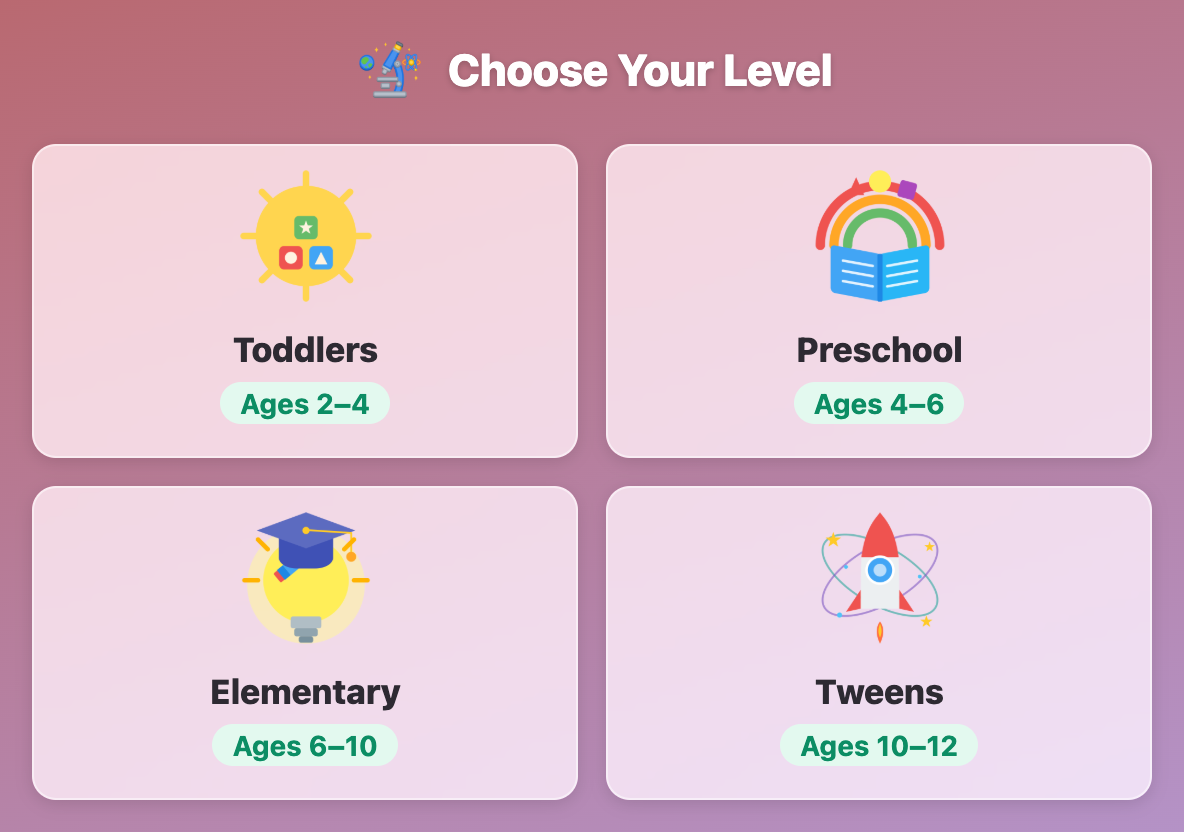
The Choose Your Level screen in Food Chain Builder for kids, with Toddlers, Preschool, Elementary and Tweens cards
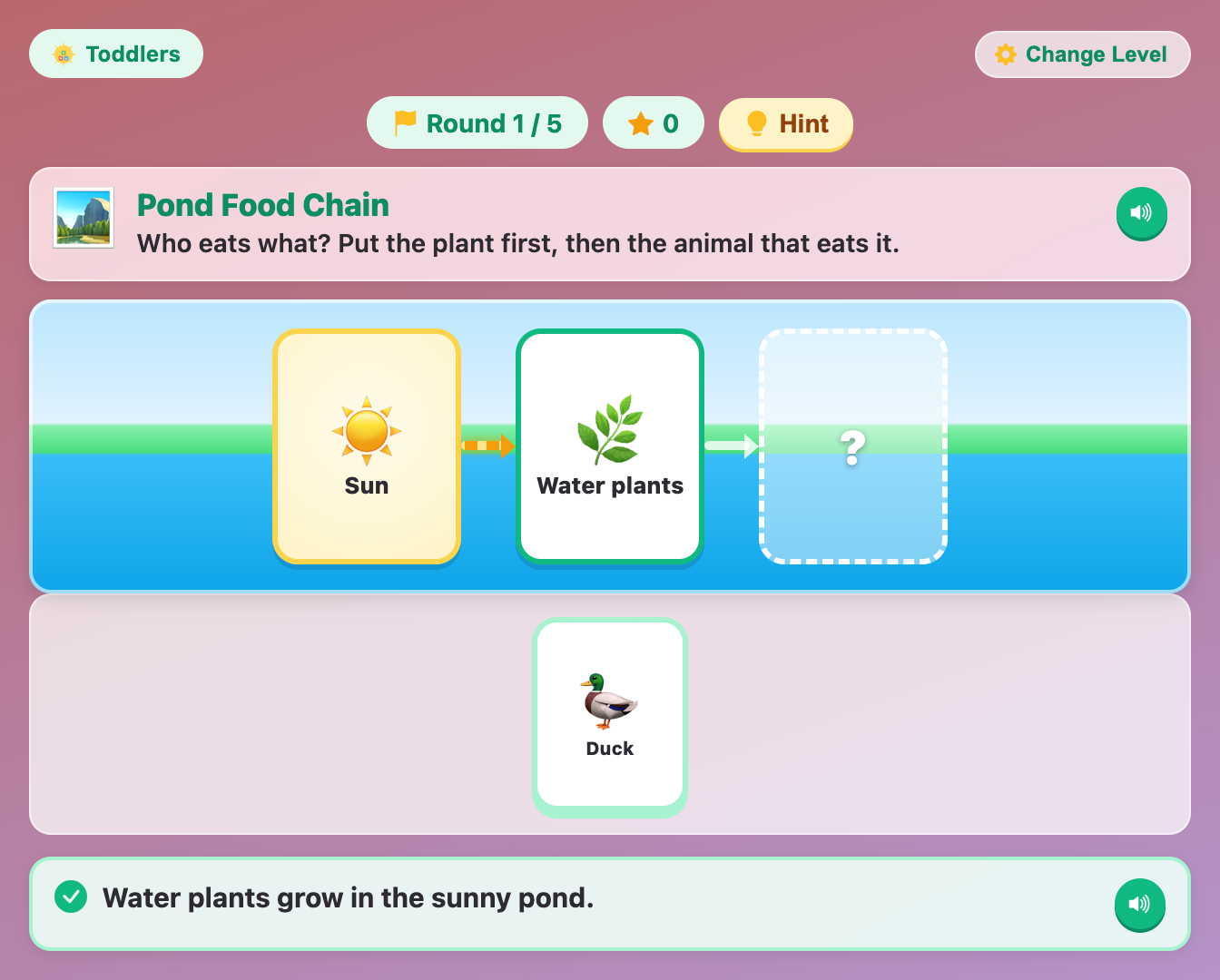
A Pond food chain for toddlers with the Sun and water plants in place and a duck card waiting below
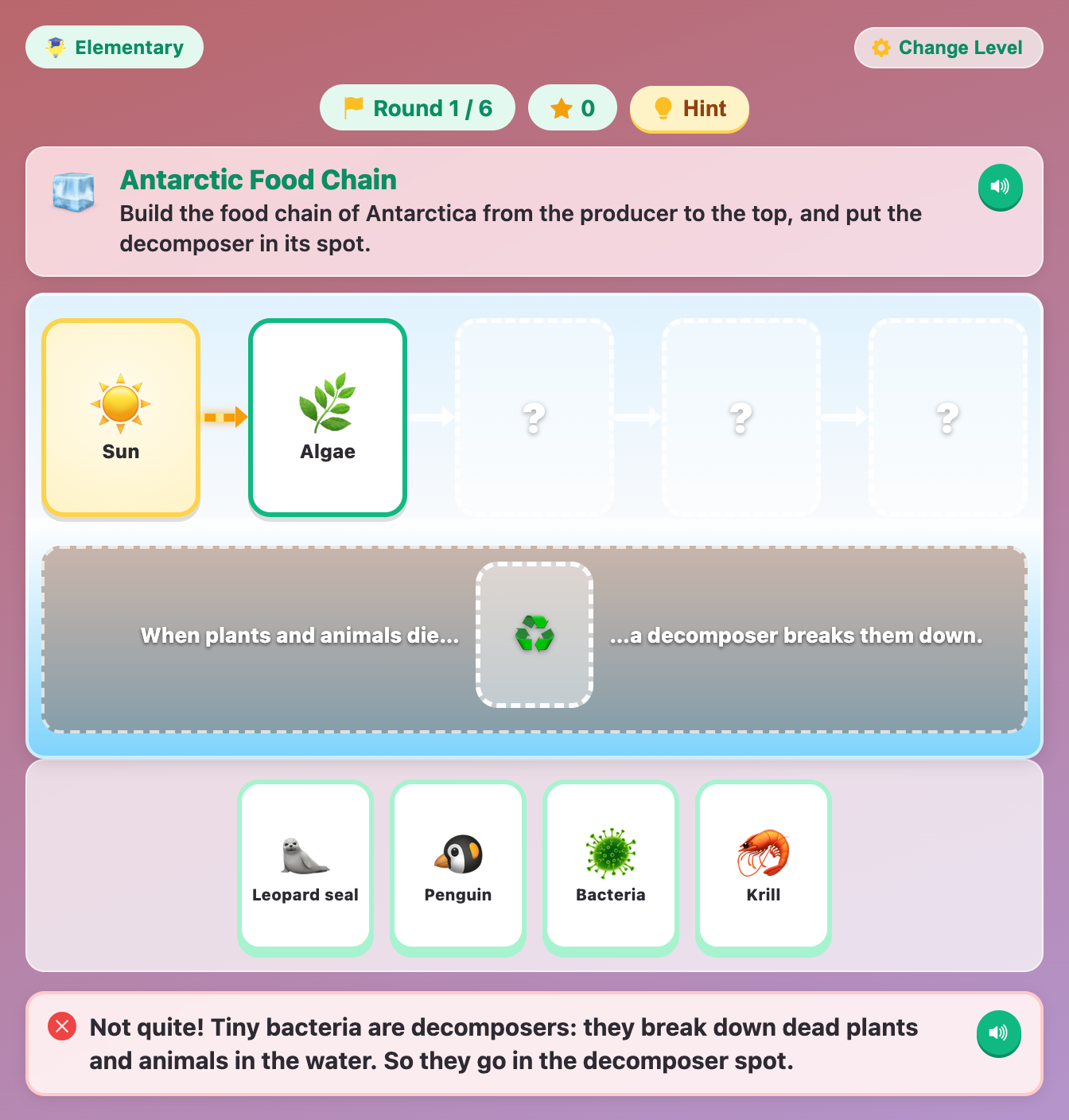
An Antarctic food chain at the Elementary level with a red Not quite message after bacteria went in the wrong spot
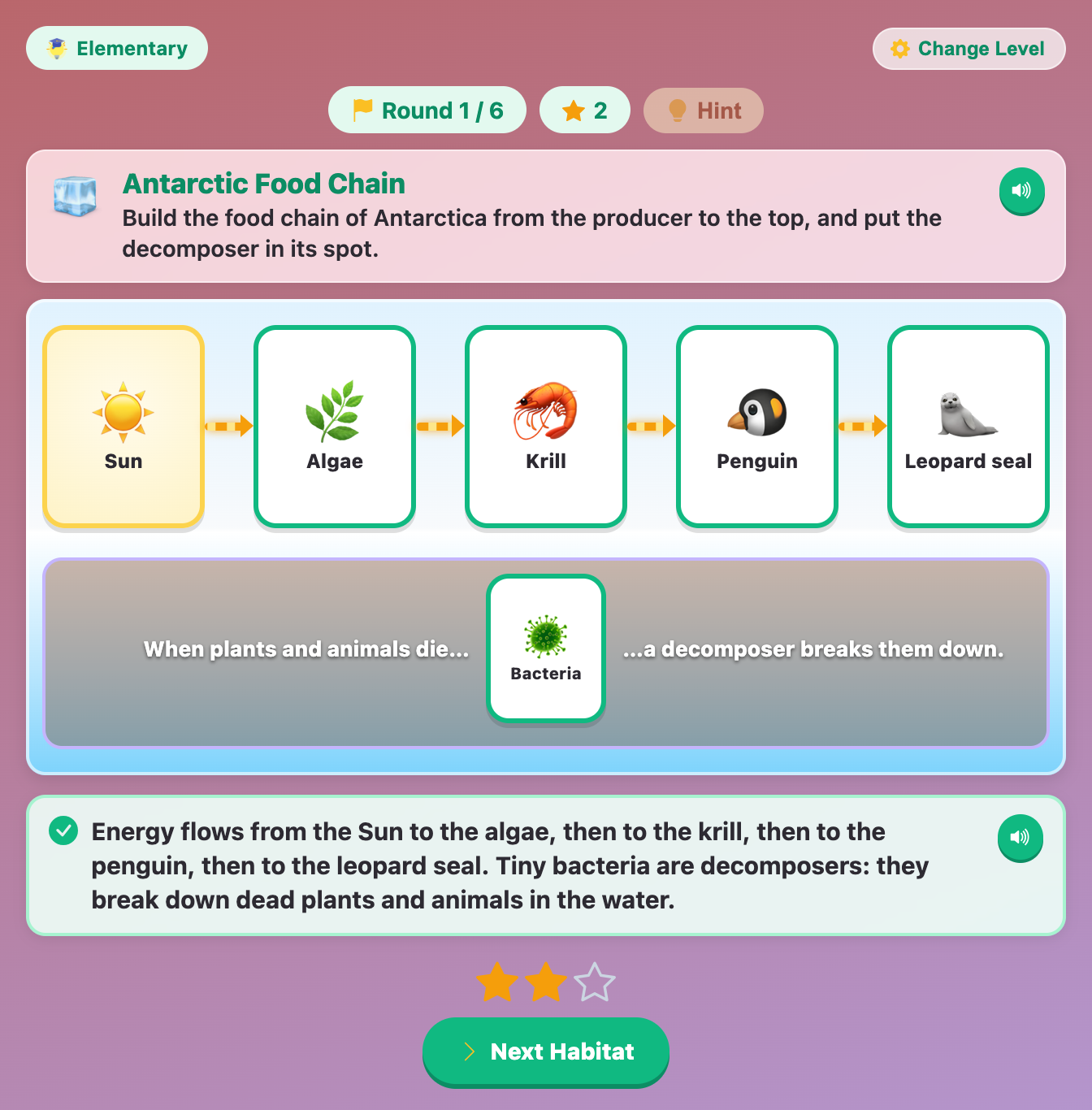
The finished Antarctic food chain from the Sun to algae, krill, a penguin and a leopard seal, with bacteria as the decomposer
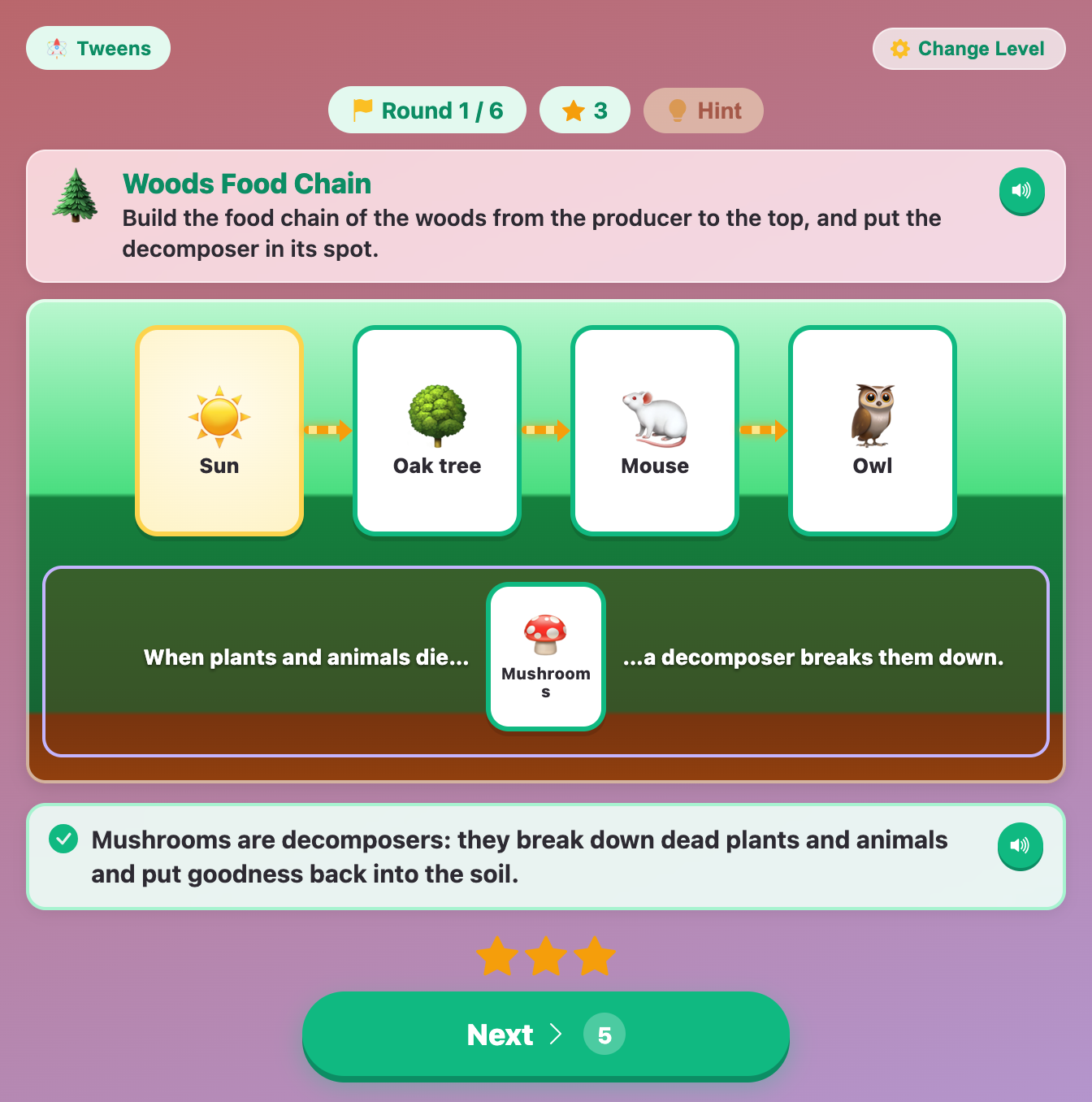
A finished Woods chain in Food Chain Builder for tweens, with three stars and a green Next button counting down
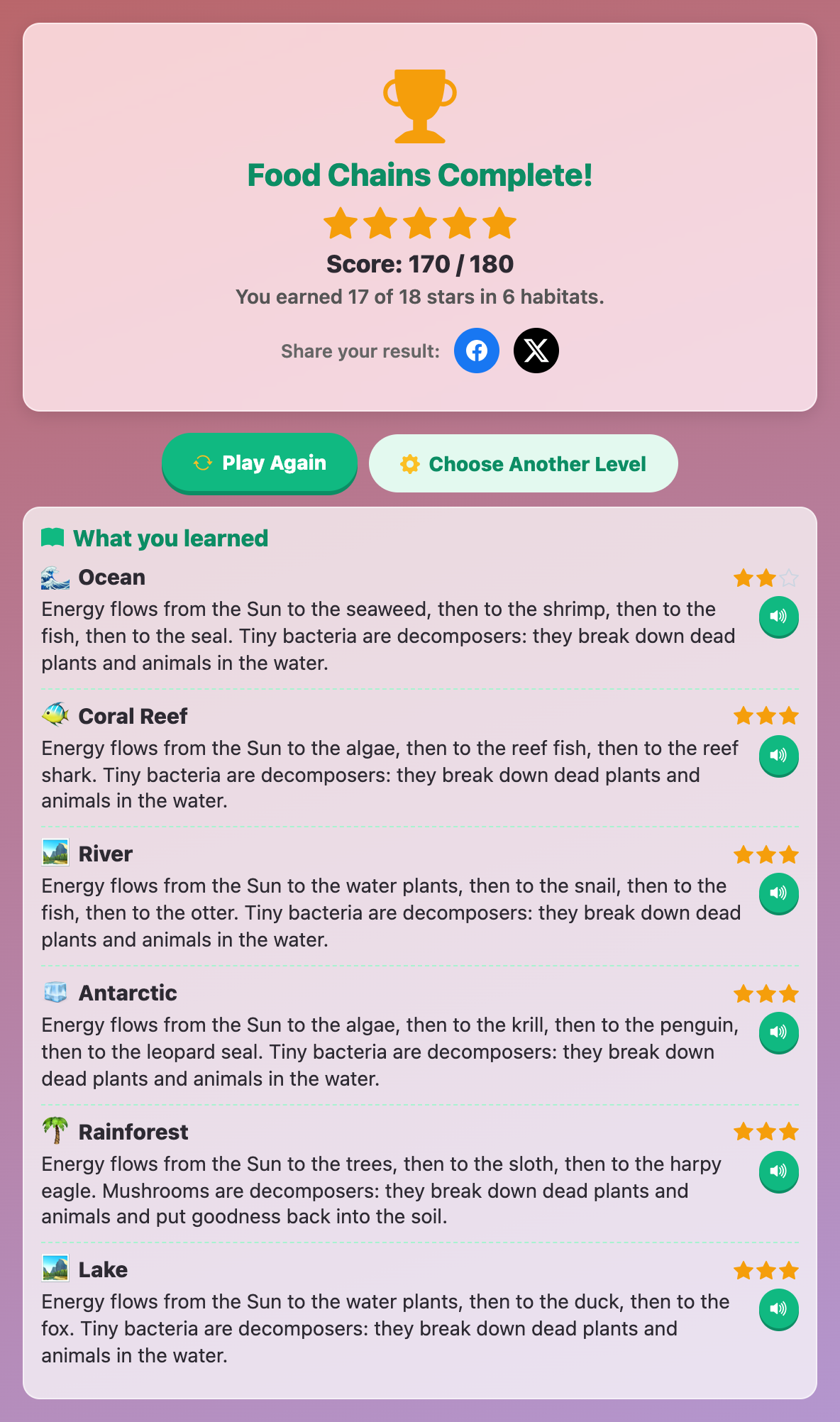
The Food Chains Complete card with a score of 170 out of 180 and a What you learned list of six habitats
More Science Games
 59.5K plays
4.8
Recycling Sort
Sort everyday items into the Recycle, Compost, or Trash bin before time runs out!
 85.7K plays
4.9
Grow a Plant
Plant seeds in sunny and shady garden beds, then water, feed and protect them day by day. Watch the roots grow underground and harvest sunflowers, tomatoes, carrots and more!
 438.6K plays
4.9
Magnet Experiment
Guess which objects a magnet will pull, then drag the magnet to test every guess. Does gold stick? Does a battery?
 386.9K plays
4.9
Five Senses Match
Decide which of your five senses you would use for each everyday scene before time runs out.
Most Played Games
 1.8M plays
4.9
Color & Draw
A free-drawing canvas with colors and brush sizes to unleash your creativity.
59.5K plays
4.8
Recycling Sort
Sort everyday items into the Recycle, Compost, or Trash bin before time runs out!
 365.8K plays
5.0
Tic-Tac-Toe
Play a game of Tic-Tac-Toe against the computer and see if you can outsmart it.
 274.1K plays
5.0
Sentence Builder
Pick your age level, then tap the shuffled words in the right order to build the sentence.
Comments (50)