
Science Memory Match
92.7K playsFlip the cards and find the pairs that go together! In this memory game the two cards of a pair are never the same: match the frog with the fly it eats, milk with the cow, the duck with its quack, your eyes with seeing, or the thermometer with checking for a fever. Every match shows a fun science fact you can listen to. Little ones match 4 pairs, and big kids take on boards of up to 20 cards.
In most memory games, you hunt for two cards that look exactly the same. Not here. In Science Memory Match for kids, the two cards of a pair are different things that go together: a frog and the fly it eats, milk and the cow it comes from, a duck and its "Quack!", your eyes and seeing.
So you need two kinds of smart at once. Your memory finds where a card is hiding, and your science brain knows what goes with it. Every match shows a short science fact you can listen to. It's a free game for kids from about 2 to 12, it plays in your web browser on a computer, tablet or phone, and there's nothing to download and no sign-up.
🃏 Green Cards, Blue Cards and the Pairs Between Them
Every board uses one card set, and the set's name and rule sit at the top, like Helpful Tools: "Match each tool with what it helps you do!" There are seven card sets in all:
Weather Days: Sunny goes with sunglasses, Rainy with an umbrella, Snowy with a snowman, Windy with a kite.
Growing Up: a chick grows into a hen, an acorn into an oak tree, a baby into a grown-up.
Animal Snacks: a panda and bamboo, a koala and eucalyptus leaves, a penguin and fish.
Where Does It Come From?: honey and the bee, fries and the potato, paper and wood.
Who Says That?: a cow and "Moo!", an owl and "Hoot!", a rooster and "Cock-a-doodle-doo!"
My Busy Body: the heart and "Pump blood", the brain and "Think", the ears and "Hear".
Helpful Tools: a thermometer and "Check for a fever", a magnet and "Pick up paper clips", goggles and "See underwater".
Here's the clever part. The cards have two different backs. One kind shows a green back with a ● circle, and the other shows a blue back with a ■ square. Little chips under the rule tell you which is which, like green ● Animals and blue ■ Foods. A pair is always one green card and one blue card. Even kids who see red and green differently can tell the backs apart by the circle and the square.
👀 Playing Science Memory Match on KidWorld
Pick your level. Choose Toddlers, Preschool, Elementary or Tweens. The level sets how many pairs are on the board. You can switch later with the Change Level button.
Peek at the cards. Every board starts with all the cards face up and a "Remember the cards!" countdown: 3 seconds for Toddlers and 2 seconds for everyone else. Then they flip over. Tap a card to skip the peek if you're ready.
Flip a green card first. Tap any green card to turn it over. The tip under the board says something like "Now find the blue card that goes with Soap."
Then flip a blue card. If the two go together, it's a match! Both cards stay face up, get a matching color and a number badge, and the fact for that pair appears under the board with a 🔊 button.
No match? Try again. The cards wiggle, the tip says "Not a pair. Try again!", and after a moment they turn back over. You can also tap the next card right away.
Changed your mind? If you flip a second card of the same color, it simply takes the first card's place. That doesn't count as a try.
Use a hint if you're stuck. Press the 💡 Hint button. If a card is already face up, its partner glows. If not, two cards that go together glow, and the game tries to pick a pair you've already seen one card of.
Watch your counters. Above the board you can see your tries, the pairs found (like 3 / 8) and how many hints are left. A green bar fills up as you match.
Finish the board. When the last pair is found, the All Matched! card shows your score, your stars and a What you learned list with every pair and its fact.
The play page also has buttons for fullscreen, reloading the game and turning the music on or off. The 🔊 button next to the rule reads it out loud. On Toddlers and Preschool, the game also reads the rule, each card's name as you flip it and each fact by itself when the site's sound is on.
📊 How Tries Turn Into Points
A try is every time you turn over one green card and one blue card. Your score is out of 100. Finishing the board always gives you 60 points. The other 40 points depend on how few tries you needed.
Each level has a goal number of tries: 6 for Toddlers, 9 for Preschool, 12 for Elementary and 16 for Tweens. Finish in that many tries or fewer and you get all 40. The result card says it plainly, like "Full points for 12 tries or fewer." Take more tries and you get a little less, but finishing is never worth less than a big chunk of points.
Hints are free and unlimited on Toddlers. On the other levels you get 3 hints per board, and each one costs 3 points. So a perfect Elementary board with one hint scores 97. The game also remembers your best score for each card set in your browser, says "New best!" when you beat it, and tells you how many card sets are left to play at your level. Play Again always picks a set you haven't played yet, if there is one.
🧩 Smart Ways to Find Every Pair
1. Make the peek count
Two or three seconds goes fast, so don't try to remember everything. Pick two or three pairs and lock them in. For example, on a Where Does It Come From? board you might see Salt in the top left corner and the Sea down in the bottom row. Say it in your head: "Salt, top left. Sea, bottom." That's one pair you can match on your very first try.
2. Always start with the green card you know best
Since every try is one green and one blue, start with a green card whose partner you think you've seen. If you flip Soap and remember where "Wash dirty hands" is hiding, that's a quick match. Starting with a card you know is the fastest way to keep your tries low.
3. When you don't know, explore a new blue card
If you flip a green card and have no idea where its partner is, turn over a blue card you haven't seen yet. Even if it's not a match, you've just learned two new cards. A try that shows you two new cards is never wasted.
4. Think about the science, not just the picture
Some pairs look nothing alike. Popcorn goes with Corn, because popcorn is a kind of corn. Paper goes with Wood, because most paper is made from wood chips. If a card puzzles you, ask "where does this come from?" or "what does this do?" and the partner often pops into your head.
5. Read the word on sound cards
In Who Says That?, each sound card has a word and a little picture. The "Woof!" card shows a bone, the "Meow!" card shows a mouse, and the "Moo!" card shows a glass of milk. Don't match the picture. Match the sound: "Woof!" goes with the dog, and "Moo!" goes with the cow.
6. Save hints for the end
On Preschool and up, each hint costs 3 points, but a long string of wrong tries can cost more. A good time to use one is when you've flipped a green card and truly have no idea where its partner is. The hint makes that exact partner glow, so you don't waste tries guessing.
7. Listen to the facts
Every match shows a fact, like "A frog catches flies with its long, sticky tongue." Remembering the fact helps you remember the pair, and next time you play that set, you'll find it faster.
🔬 Four Boards, Thought Through
Toddlers: Animal Snacks, 8 cards
The board has 4 green animals and 4 blue foods. You flip the green Cow. Cows eat grass, so you look for the blue Grass card. Found it! The fact says that cows eat grass, then bring it back up and chew it again. Next, the green Penguin. Penguins dive into the cold sea to catch fish, so the blue Fish card is its partner.
Preschool: My Busy Body
You flip the green Heart. Which job does the heart do? Not "See" or "Think". It pumps blood all around your body, so you hunt for "Pump blood". The game never puts two body parts with the same kind of job on one board, like the nose and the lungs, which both help you breathe. So there's always just one fair answer.
Elementary: Where Does It Come From?, 16 cards
You flip the green Salt and then a blue Rice plant by mistake. "Not a pair. Try again!" That's okay: you now know where the Rice plant is. Later, when you flip the green Rice, you can go straight to it. And Salt? Some salt comes from drying out seawater, so its partner is the Sea.
Tweens: Helpful Tools, 20 cards
Tweens have 10 pairs and a goal of 16 tries. You flip the green Magnifying glass. It bends light to make tiny things look bigger, so you look for the blue "Make bugs look big" card with the ant on it. Then the green Thermometer goes with "Check for a fever", because it measures how warm your body is.
👨👩👧 Science Memory Match for Kids of Every Age
Science Memory Match for toddlers (ages 2–4)
Toddlers play the smallest board: just 4 pairs, 8 cards. Their sets are Weather Days, Growing Up, Animal Snacks and Where Does It Come From?, all with clear, friendly pictures. The peek lasts 3 seconds, hints are unlimited and free, and the game reads the cards and facts out loud when sound is on. A parent can point and ask, "What does the bee like to eat?"
Science Memory Match for preschoolers (ages 4–6)
Preschoolers get 6 pairs, 12 cards, and new sets: Who Says That?, My Busy Body and Helpful Tools, along with Animal Snacks and Where Does It Come From? Each card has a picture and a short label, so kids who are just starting to read can still play by picture. The game still reads aloud for this level.
Science Memory Match for elementary kids (ages 6–10)
Elementary kids match 8 pairs on a 16-card board from the same five sets. The bigger board really stretches memory, and kids can read the facts on their own and tap 🔊 when they want to hear one. Three hints per board help when a pair is truly lost.
Science Memory Match for tweens (ages 10–12)
Tweens take on the biggest board: 10 pairs, 20 cards, in five columns on a computer. They play Animal Snacks, Where Does It Come From?, Who Says That? and Helpful Tools. The science is friendly, so the real challenge is memory and planning: finishing in 16 tries or fewer for full points.
🌟 Why Matching Science Pairs Is Good for Growing Brains
Matching a cow with "Moo!" or milk with the cow is more than a memory trick. It teaches kids that things in nature are connected: animals need food, foods come from plants and animals, and every part of your body has a job. That's the start of thinking like a scientist.
The game also trains working memory, the brain's little notepad. Holding "Salt, top left" in your head while you look for something else is the same skill kids use to follow steps in class or do a sum in their heads. And the green-then-blue rule gently teaches planning: pick the card you know first.
If you'd like a classic memory game with matching pictures, try Memory Match. For a flip-card game with words, Rhyme Match asks kids to find two words that rhyme. And kids who loved the My Busy Body cards can learn more in Five Senses Match, where they decide which sense they'd use for each everyday moment.
A note for parents and teachers: Science Memory Match is free, needs no account, has no chat, and shows nothing scary, just friendly pictures and true facts. It practices memory, early science vocabulary, animal and food knowledge, and body awareness. There's no timer, so kids can take their time, and a wrong guess just means the cards turn back over.
Ready to flip? Peek at the cards, find every pair and collect a new fact with each match in Science Memory Match for kids. 🃏
🖼️ See the Game in Action
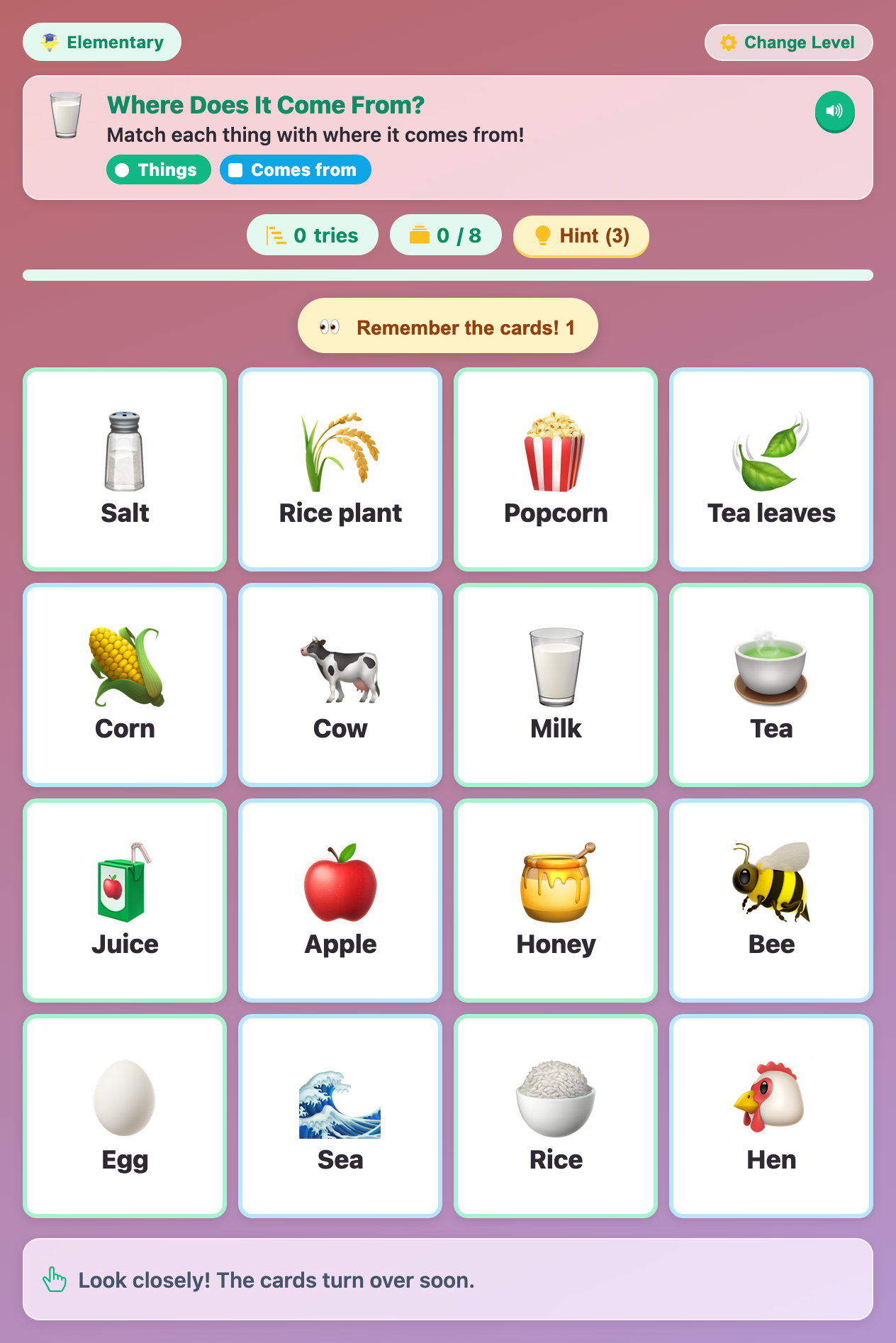
The Where Does It Come From? board in Science Memory Match for kids during the peek, with all 16 cards face up
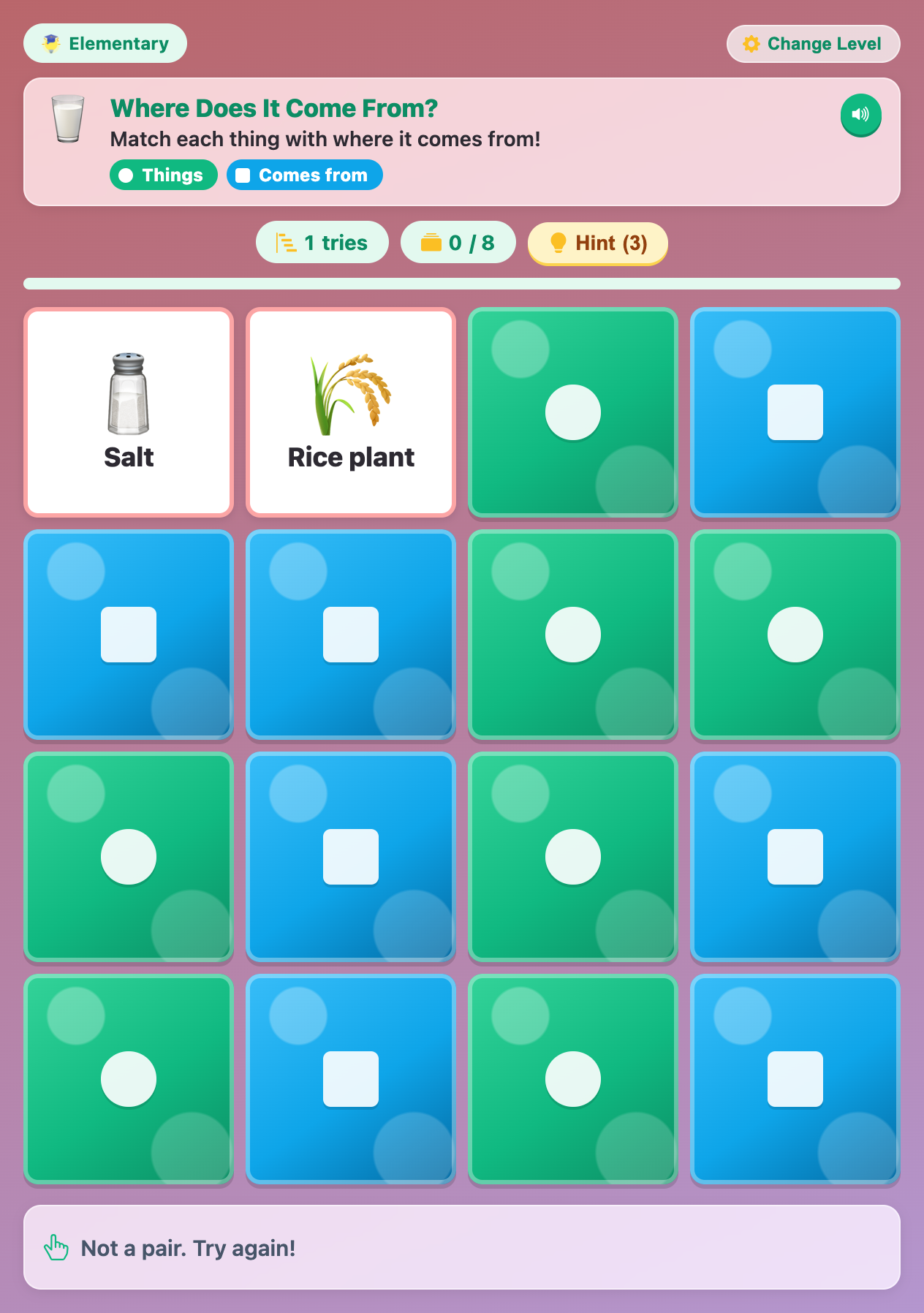
Salt and rice plant turned over by mistake, with the tip Not a pair. Try again!
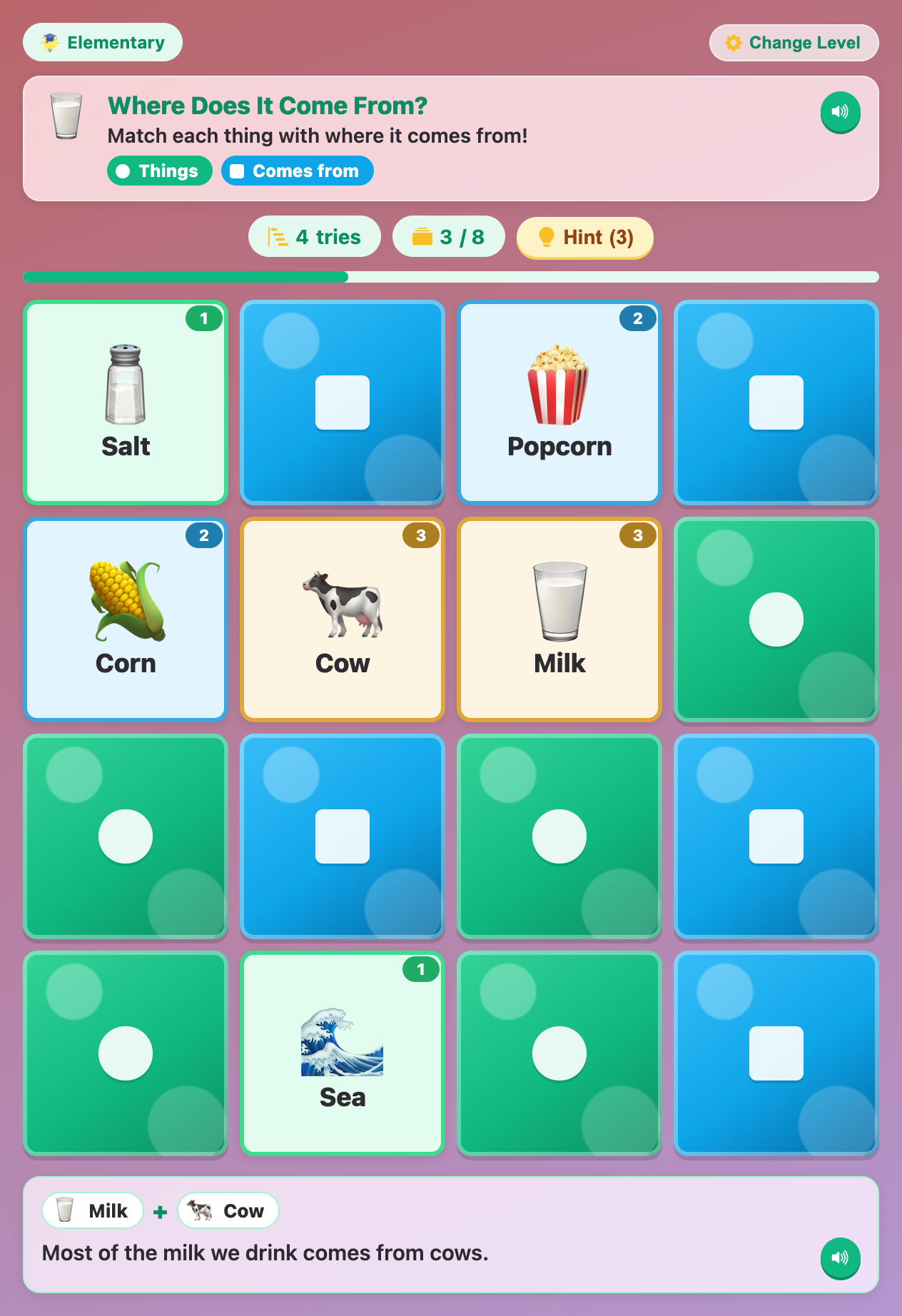
Three matched pairs on the board, salt and sea, popcorn and corn, milk and cow, with the milk fact below
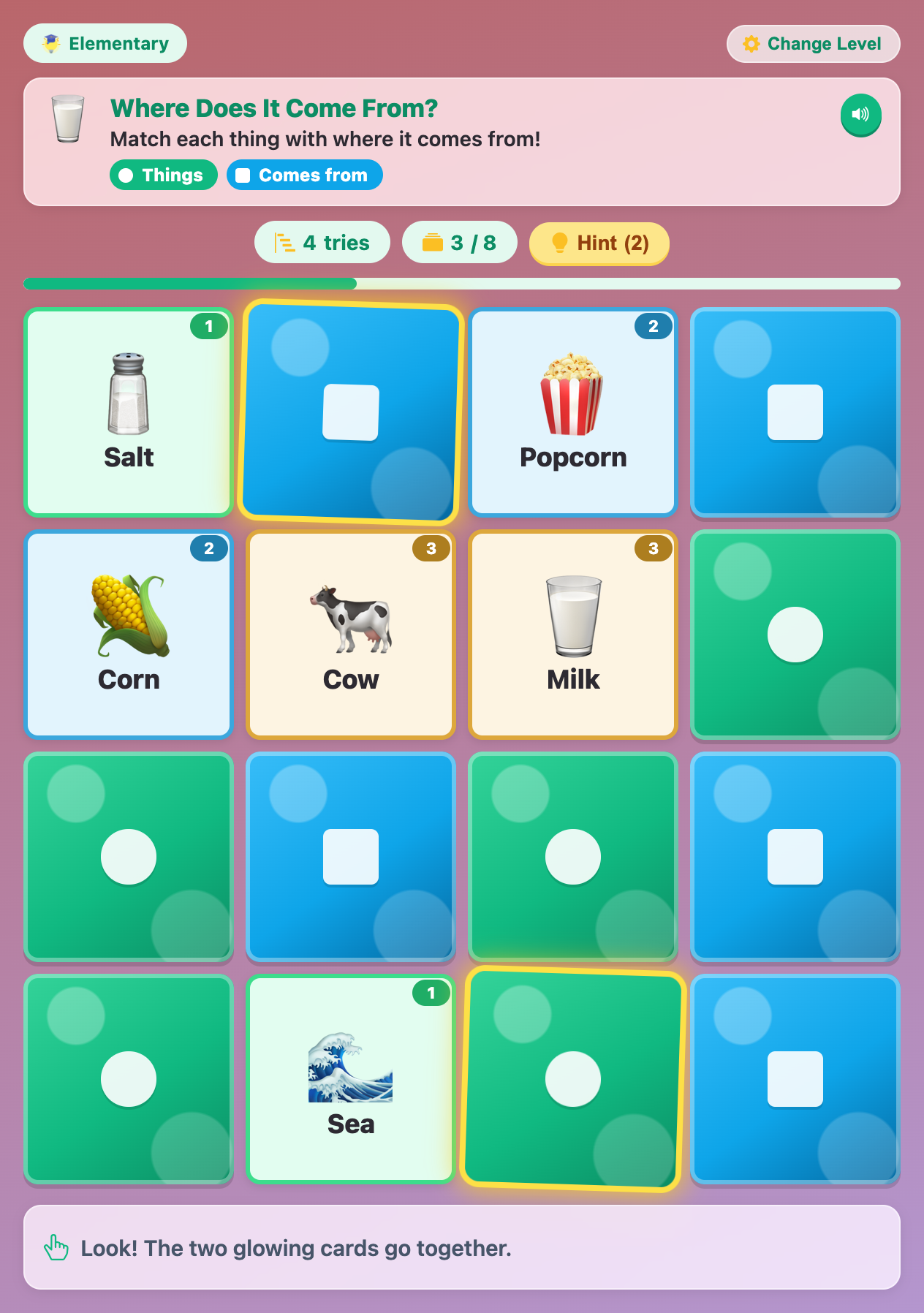
A hint making a blue card and a green card glow in Science Memory Match, with the tip Look! The two glowing cards go together.
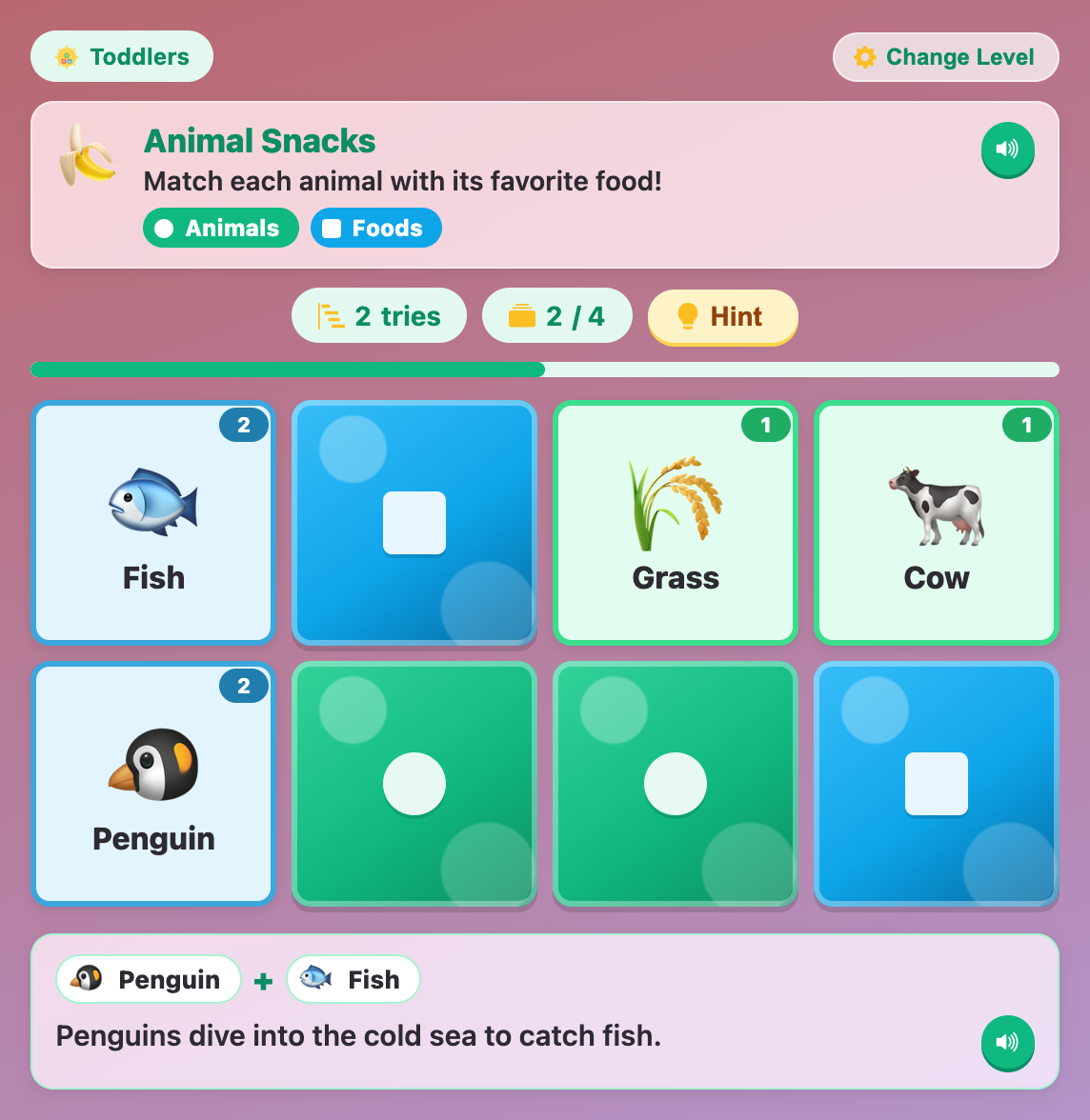
A small 8-card Animal Snacks board in Science Memory Match for toddlers, with the cow and grass and penguin and fish pairs found
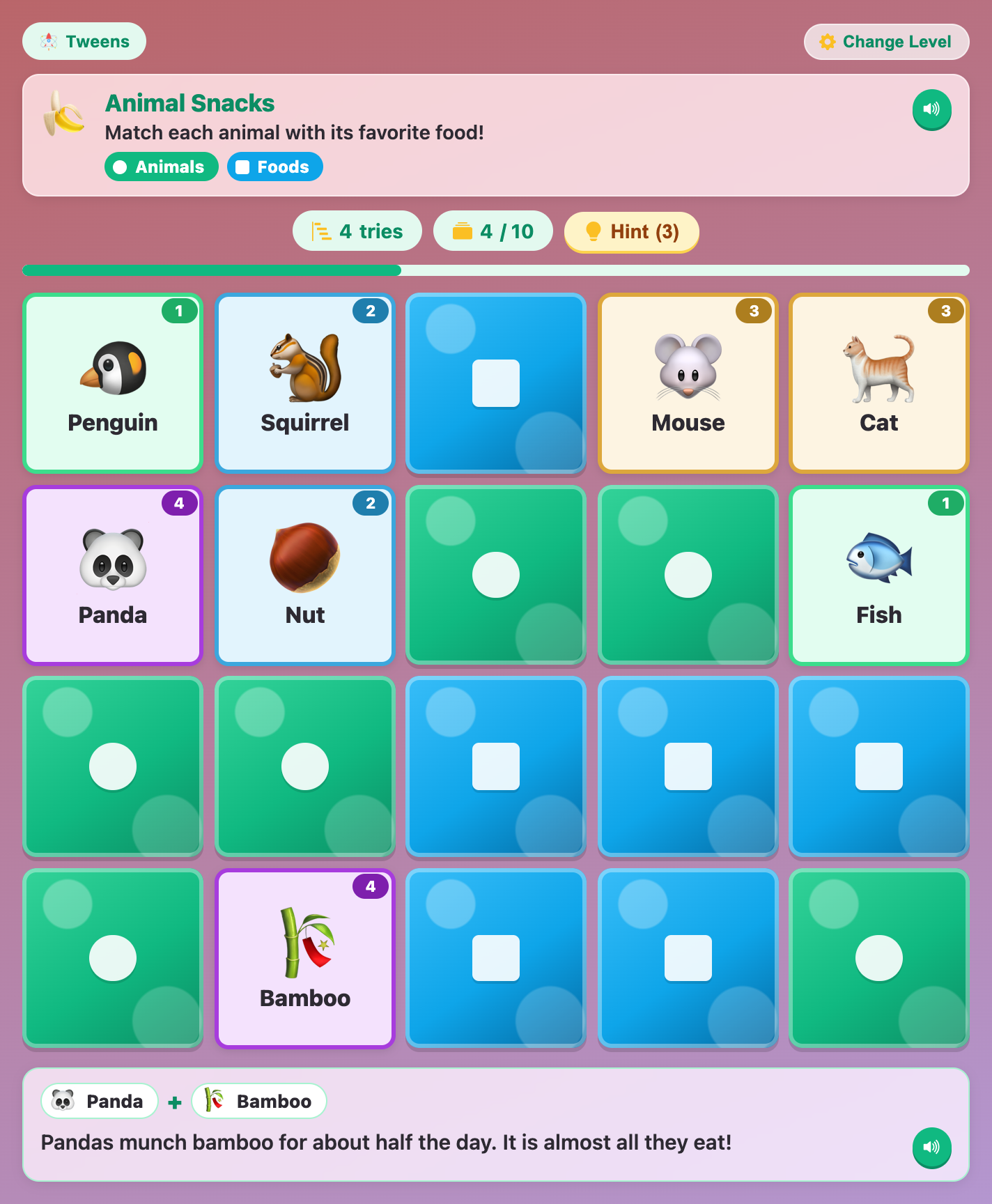
A 20-card Animal Snacks board for tweens with four numbered pairs found and the panda and bamboo fact
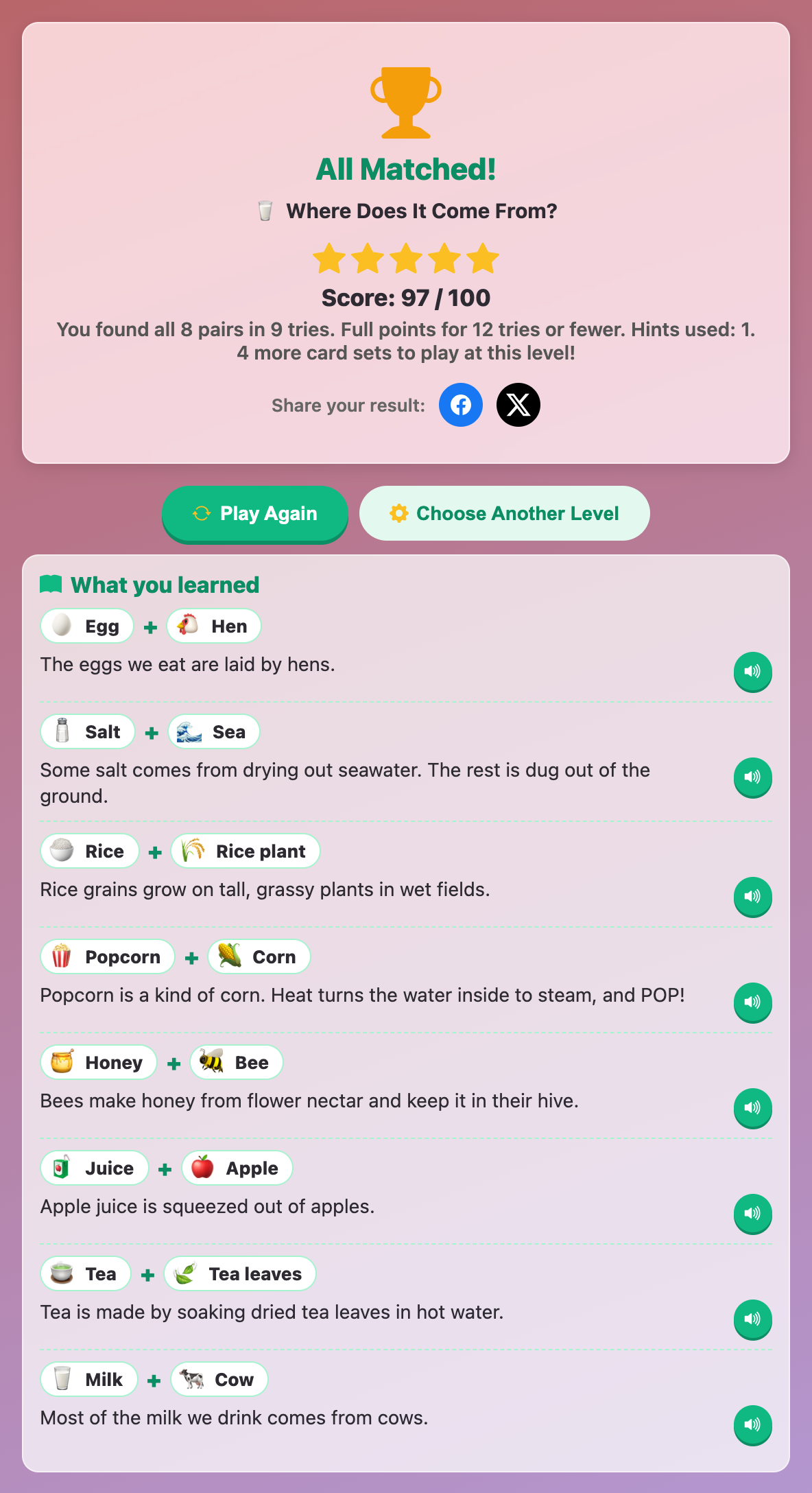
The All Matched! card with a score of 97 out of 100 and a What you learned list of every pair
More Science Games
 59.5K plays
4.8
Recycling Sort
Sort everyday items into the Recycle, Compost, or Trash bin before time runs out!
 85.7K plays
4.9
Grow a Plant
Plant seeds in sunny and shady garden beds, then water, feed and protect them day by day. Watch the roots grow underground and harvest sunflowers, tomatoes, carrots and more!
 438.6K plays
4.9
Magnet Experiment
Guess which objects a magnet will pull, then drag the magnet to test every guess. Does gold stick? Does a battery?
 386.9K plays
4.9
Five Senses Match
Decide which of your five senses you would use for each everyday scene before time runs out.
Most Played Games
 1.8M plays
4.9
Color & Draw
A free-drawing canvas with colors and brush sizes to unleash your creativity.
59.5K plays
4.8
Recycling Sort
Sort everyday items into the Recycle, Compost, or Trash bin before time runs out!
 365.8K plays
5.0
Tic-Tac-Toe
Play a game of Tic-Tac-Toe against the computer and see if you can outsmart it.
 274.1K plays
5.0
Sentence Builder
Pick your age level, then tap the shuffled words in the right order to build the sentence.
Comments (21)