
Habitat Crush
148.5K playsSwap the animals to line up 3 in a row and crush them! Every frog, duck and fish you crush swims into the pond, but a camel doesn't belong there. Fill habitats like the sea, the jungle and the desert, then build food chains from the plant up and food webs where each animal needs its food in place first. Make rockets, bombs and rainbows, and learn a fact about every living thing you bring home.
Some tiles on this board belong, and some never will. Habitat Crush for kids is a free match-3 science game: you swap animal and plant tiles to line up three in a row, and every living thing that really lives in the habitat flies into its home. Young players fill a pond, a farm or a jungle, and older players build real food chains and food webs, from the plant at the bottom to the hunter at the top.
It plays right in your browser on a computer, tablet or phone, with nothing to download and no sign-up. There are four levels, from toddlers to tweens, and 12 habitats to fill on every level. Along the way you meet a camel that wandered into a pond, a polar bear that ended up in Antarctica, and many more animals that are in the wrong place. Each one comes with a short, true reason why it doesn't belong.
🐸 Habitat Crush for Kids: A Match-3 Board Full of Living Things
A habitat is the place where a plant or animal lives and finds everything it needs: food, water and shelter. A pond is a habitat for frogs and ducks. The desert is a habitat for camels and scorpions.
In Habitat Crush, each stage is one habitat. At the top of the screen there is a card with a picture of the place and a row of empty round slots, one for each living thing that belongs there. The Pond card has slots for a 🐸 frog, a 🦆 duck and a 🐟 fish. Below the card is the board, a grid of colorful candy-like tiles, and each tile has an animal or plant on it.
When you crush three or more matching tiles, the ones that belong zoom up into their slot. Fill every slot to the top before your moves run out, and the habitat is complete.
But one kind of tile on the board never fits. On the Pond board it is a 🐪 camel. These tiles are called decoys (things that look like they might fit but don't). When you crush a decoy, the tiles just disappear, and the first time it happens a message under the board tells you why: "A camel lives in the dry desert, not in a pond."
🔗 Food chains and food webs for older players
From the Elementary level up, the game asks a harder question: not just who lives here? but who eats whom?
A food chain is a line of living things where each one is food for the next. In the Meadow stage it goes 🌿 grass → 🦗 grasshopper → 🐸 frog → 🐍 snake. The arrows on the card point to who eats it.
A food web is many food chains joined together, because most animals eat more than one thing. In the Tweens Pond web, a duck eats water plants and snails, and a snapping turtle eats fish and ducklings.
Every food chain starts with a producer: a plant or tiny algae that makes its own food from sunlight. The game marks it with a little ☀️ sun. The animals that come after it are consumers, because they get their food by eating something else.
🕹️ Your First Habitat, From Level Card to Three Stars
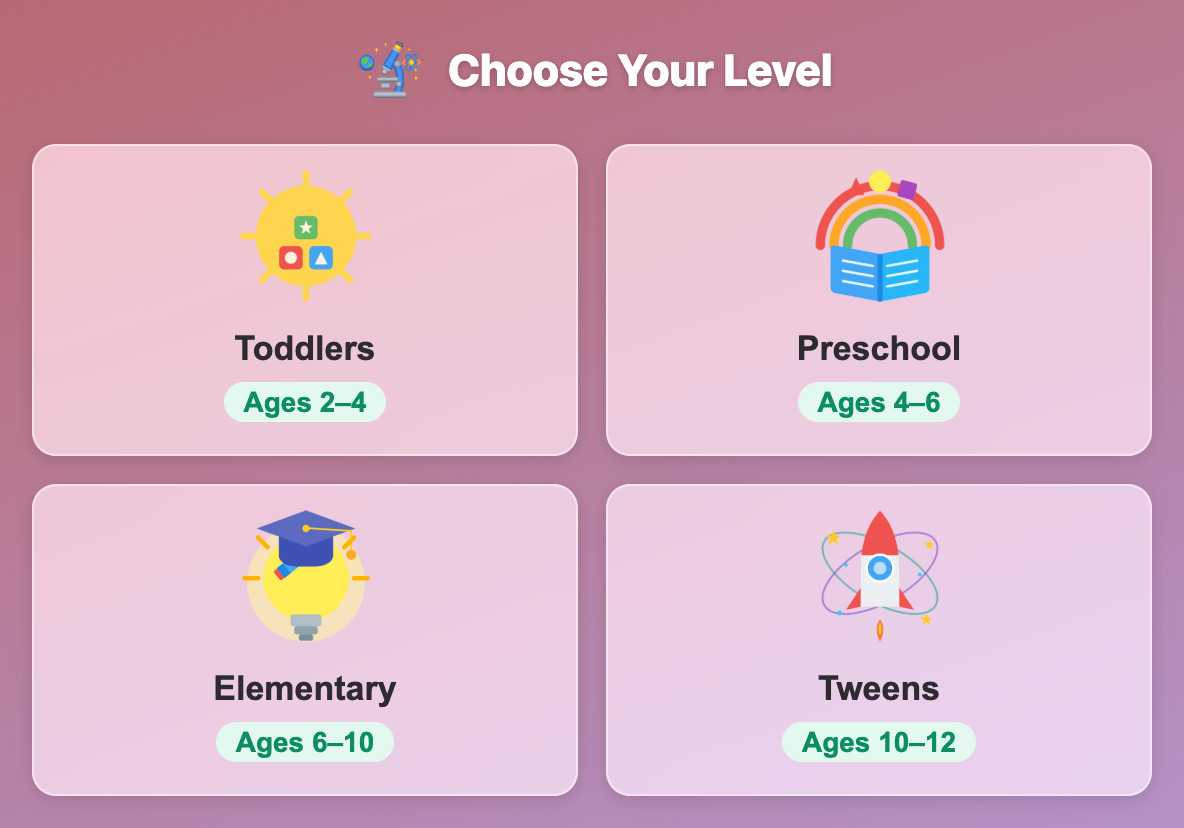
Choose your age level. On your first visit the game drops you straight into the Elementary level, so you can play at once. To pick another level, tap Stages at the top, then Change Level, and choose Toddlers (ages 2–4), Preschool (ages 4–6), Elementary (ages 6–10) or Tweens (ages 10–12). After that, the game remembers your level and opens your next stage.
Read the habitat card. Look at the slots before you move. Each slot shows its animal or plant, how many tiles it still needs (for example 0/11), and on older levels what it eats. Tap the green 🔊 button to hear the card read out loud.
Swap two tiles. Drag a tile one square up, down, left or right, or tap one tile and then the tile next to it. If the swap makes a line of three or more matching tiles, they crush. If it doesn't, the tiles slide back and you don't lose a move.
Watch the slots fill. Crushed tiles that belong fly into their slot, and a ring around the slot grows. A full slot gets a green check mark, and its fact appears under the board, like "A duck paddles across the pond with its webbed feet."
Keep an eye on the moves box. The number in the top corner shows the moves you have left. Every stage has its own number, from 11 moves for a toddler pond to 34 for the Tweens Arctic web.
Stuck? Wait a moment. If you don't touch the board for a few seconds, two tiles start to wiggle. That is a free hint, and you can use it as often as you like. If no swap is possible at all, the board shuffles itself.
Read the result card. When the stage ends you see your stars, your points, a What you learned list with a fact about every living thing in the habitat, and a Didn't belong list that explains each decoy. Each fact has its own 🔊 button.
Move on or try again. Choose Next Stage, Play Again, or Stages to see the map. The page's music button turns the background tune on or off, the fullscreen button gives you a bigger board, and the reload button starts the game fresh.
The stage map shows all 12 habitats of your level as cards, each with its tiles and your best stars. A new stage opens once you have played the one before it to the end, whether you won or not, so no one ever gets stuck behind a hard stage. Your stars are saved in this browser, and a small Start this level over link at the bottom wipes them if you want a fresh start.
💥 Rockets, Bombs and Rainbows on the Habitat Board
Bigger matches make special tiles. They are the fastest way to fill a slot, because tiles blasted by a special fly into their slots just like crushed ones.
Match 4 in a line to make a rocket. It shows a little ↔ or ↕ arrow, and when it goes off it clears a whole row or column.
Match in an L or T shape to make a bomb 💥. It clears the 3x3 square around it.
Match 5 in a line to make a rainbow ★. Swap it with any tile, and every tile of that kind on the board is crushed at once.
Swap two specials together for a bigger blast. A rocket swapped with a bomb makes a giant cross three rows and three columns wide.
🏆 How to Fill Every Habitat With Moves to Spare
Finishing a habitat is great. Finishing it with moves left over is how you earn three stars. Here are the tricks that work best in this game, and why they work.
1. Count the slots, then find the stranger
Before your first swap, look at the card and name the animals out loud. Then look at the board and find the tile that isn't on the card. That is your decoy. Now you know which matches help you and which ones only clear space.
2. Swap low on the board when you can
When tiles crush near the bottom, everything above them falls down. Falling tiles often land in new lines of three and crush by themselves. These free crushes are called cascades, and they don't cost a move. A match at the top of the board only moves a few tiles, so it rarely starts a cascade.
3. Feed the slot that is open
In a food chain only one slot is open at a time, and it glows. Tiles of a later link don't count yet. If you crush three frogs before the grasshopper slot is full, the message says "Not yet! The frog comes after the grasshopper in the food chain." and those frogs are gone. So in a chain, always look for matches of the glowing slot first.
4. Save rainbows for the animal you need most
A rainbow crushes every tile of one kind, which can be ten or more tiles at once. Swap it with the animal whose slot is emptiest and open right now, never with the decoy. One good rainbow can fill most of a slot in a single move.
5. Make a decoy match only when nothing better is there
Crushing decoy tiles fills nothing, but it isn't always wasted. It clears space, and if you do it low on the board it can start a cascade of the tiles you need. Use it as a last choice, not a first one.
6. Let the new tiles help you
The tiles that drop in from the top are not completely random. They lean a little toward the living things your habitat still needs. That means the board slowly fills with the right tiles if you keep crushing, so don't give up on a slot that looks empty.
7. Learn from the wiggle hint
The wiggling tiles show a swap that helps a slot you still need to fill. On the youngest level the hint comes after 3 seconds, and on the Tweens level after 6. Before you take it, try to guess why the game picked that swap. Soon you will spot good swaps before the wiggle starts.
8. Know the star rule
You need to finish with about a third of your moves left for three stars (the exact rule is 30% of the stage's moves). On the 23-move Meadow chain that means 7 moves left. If you finish with fewer, the result card tells you exactly how many moves you would have needed to save.
🔍 Five Habitats, Solved Together
Toddlers: the Pond (11 moves)
The pond needs a frog, a duck and a fish, 20 tiles each. The camel is the decoy. With only four kinds of tile on a 7x7 board, lines of three appear everywhere, so a toddler can tap almost any wiggling pair and see something fly home. A grown-up can point at each slot and ask, "Does a frog live in a pond? Does a camel?" Crushing the camels shows the answer on the screen.
Preschool: the Farm (16 moves)
Four slots this time: cow, pig, hen and sheep, 14 tiles each. The decoy is trickier: a 🦓 zebra. It looks a bit like a horse, so it seems to fit on a farm. When you crush it, the game explains that a zebra is a wild animal of the African grasslands. This is a good moment to talk about the difference between farm animals and wild animals.
Elementary: the Meadow food chain (23 moves)
The grass slot glows first, because grass is the producer. Hunt for green 🌿 matches only.
When grass is full, the grasshopper slot opens. The card says it eats 🌿.
Next comes the frog, which catches grasshoppers with its sticky tongue.
Last is the snake, which eats frogs. The 🦈 shark is the decoy: it lives in the sea, so it isn't in a meadow food chain.
Tip: while you work on the grass, try to keep a few grasshopper tiles side by side without crushing them. When the grasshopper slot opens, you already have a match ready.
Elementary: the Antarctic food chain
This chain lives in the icy sea: algae → krill → penguin → leopard seal. Krill are tiny shrimp-like animals that eat algae, penguins eat krill, and leopard seals hunt penguins. The decoy is a 🐻❄️ polar bear, and the reason is a surprise for many kids: polar bears live in the Arctic, at the other end of the world, so there are none in Antarctica.
Tweens: the Pond food web (26 moves)
Five slots, nine tiles each, on a big 9x9 board: water plants, snail, duck, fish and snapping turtle. The octopus is the decoy, because it needs salty sea water and a pond has fresh water.
Here is the clever part. The duck eats water plants and snails, so the duck slot opens as soon as the water plants are full. The fish only eats snails, so it waits for the snail slot. The snapping turtle eats fish or ducks, so it opens as soon as either of them is full. A smart order is: water plants first, then duck, then turtle, while you pick up snails and fish along the way. That way more slots are open at once, and more of your crushes count.
🎒 Habitat Crush for Every Age
🐣 Habitat Crush for toddlers (ages 2–4)
Toddlers fill simple habitats like the Pond, the Sea, the Farm, Snow and Ice, and the Desert. Each one has three animals and one decoy from a very different place, like a giraffe in the snow. The board has only four kinds of tile, so matches are easy to find, and the hint wiggles after just 3 seconds. When the site's sound is on, the game reads each habitat and each fact out loud, so a child who can't read yet can still learn. Sit with your child and say the animal names together.
🌈 Habitat Crush for preschoolers (ages 4–6)
Preschoolers get four animals per habitat (or three and two decoys) on an 8x8 board, and the decoys are closer to home: a frog in the salty sea, a beaver in the desert, a crocodile on a cold mountain. These are the mix-ups young children really make. The read-aloud is still automatic, and the new Mountains habitat brings a mountain goat, an eagle and a llama.
📚 Habitat Crush for elementary kids (ages 6–10)
Elementary kids build 12 food chains, from the Meadow and the Woods to the Rainforest, where a harpy eagle is strong enough to grab a sloth from a branch. Slots open one at a time in order, so kids practice the idea that energy passes from the plant to the plant-eater to the meat-eater. This matches the food chain lessons many schools teach at this age.
🚀 Habitat Crush for tweens (ages 10–12)
Tweens build food webs where many animals eat more than one thing, on a 9x9 board with six kinds of tile. The decoys are classic science traps: a penguin in the Arctic web (penguins live in the southern half of the world) and a tiger on the African savanna (wild tigers live in Asia). Planning which slot to open next is a real puzzle, so it suits kids who like strategy.
🌍 Why Habitat Crush Is Good for Growing Minds
A worksheet tells you that a camel doesn't live in a pond. Habitat Crush lets you watch it happen: you crush three camels, nothing flies into the pond, and a sentence pops up with the reason. Kids remember things they find out for themselves.
Real science words, used again and again. Habitat, producer, food chain, food web and decoy aren't just definitions here. Kids use them on every stage until they feel easy.
Thinking in order. A chain only works when you fill it from the bottom up, which is exactly how energy moves through nature.
Planning ahead. In a food web, choosing which slot to open first is a small strategy problem, like planning moves in a board game.
Calm, kind feedback. A wrong match never scolds. It just explains, and a lost stage still opens the next one.
If your child likes sorting animals by where they live, Magic Crossbow: Habitat Hunt asks the same question with a crossbow and a target.
If spelling is the skill you want to practice, Word Crush uses the same kind of match-3 board with letters that fill a word.
💚 A note for parents and teachers
Habitat Crush is gentle: animals "eat" only in the facts, and nothing scary happens on screen. Tiles simply fly into slots. All the facts were written by hand and checked so that every animal really lives where the game says, and every decoy really doesn't. Animals with well-known exceptions (like penguins that live on warm coasts) are left out on purpose, so a child never learns something wrong. A stage takes a few minutes, which makes it easy to fit into a short break or a science lesson.
Ready to bring the frogs home and send the camel back to the desert? Start with the first habitat on your level and see how many stars you can collect. And if you want to keep matching animals with their food, Science Memory Match pairs animals with their favorite snacks. Have fun playing Habitat Crush for kids! 🐸🦆🐟
🖼️ See the Game in Action
The Choose Your Level screen in Habitat Crush for kids, with Toddlers, Preschool, Elementary and Tweens cards
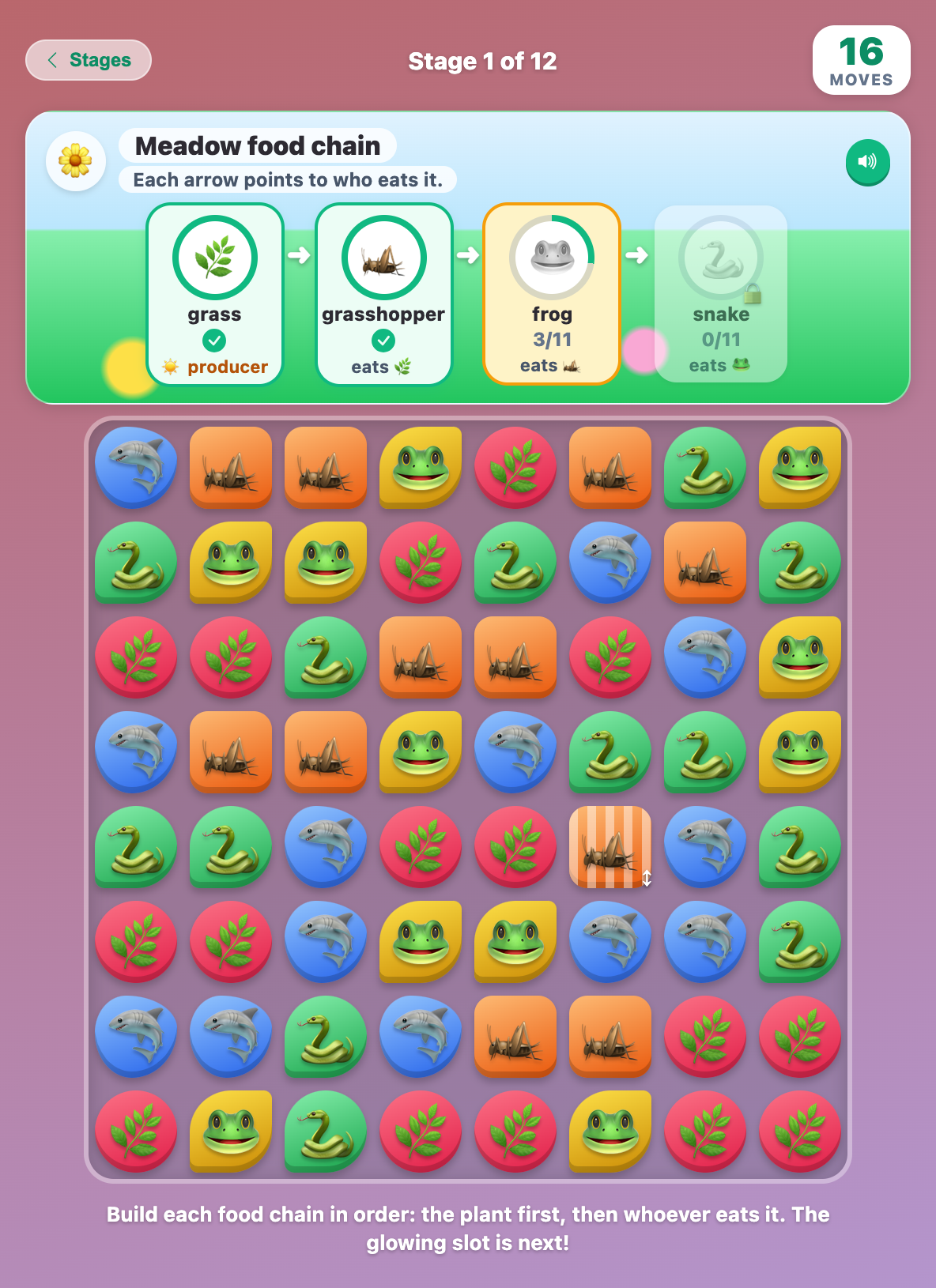
A Meadow food chain in Habitat Crush with grass and grasshopper slots full and the frog slot glowing at 3 of 11
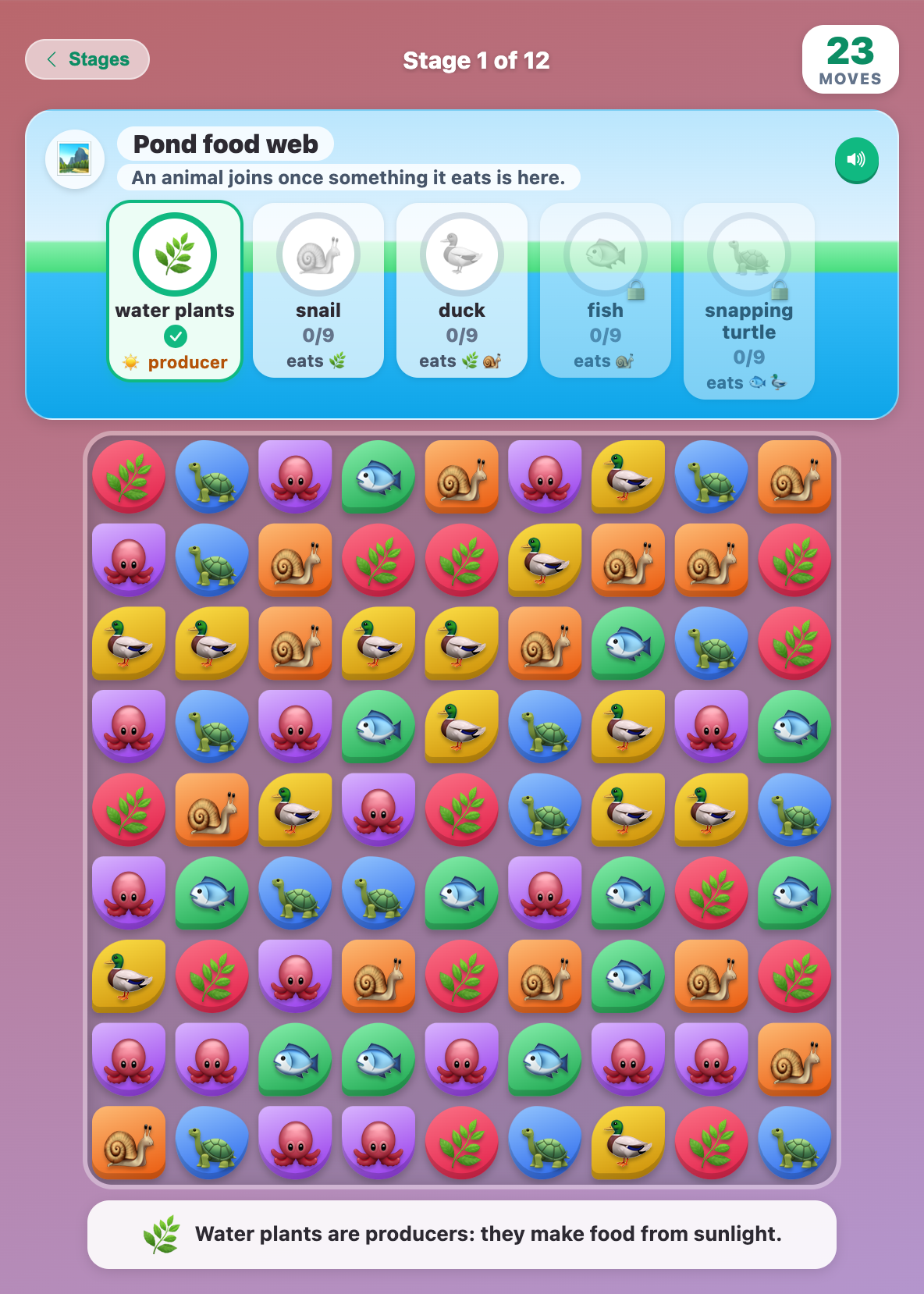
The Pond food web for tweens, with water plants filled, snail and duck open, and fish and snapping turtle still locked
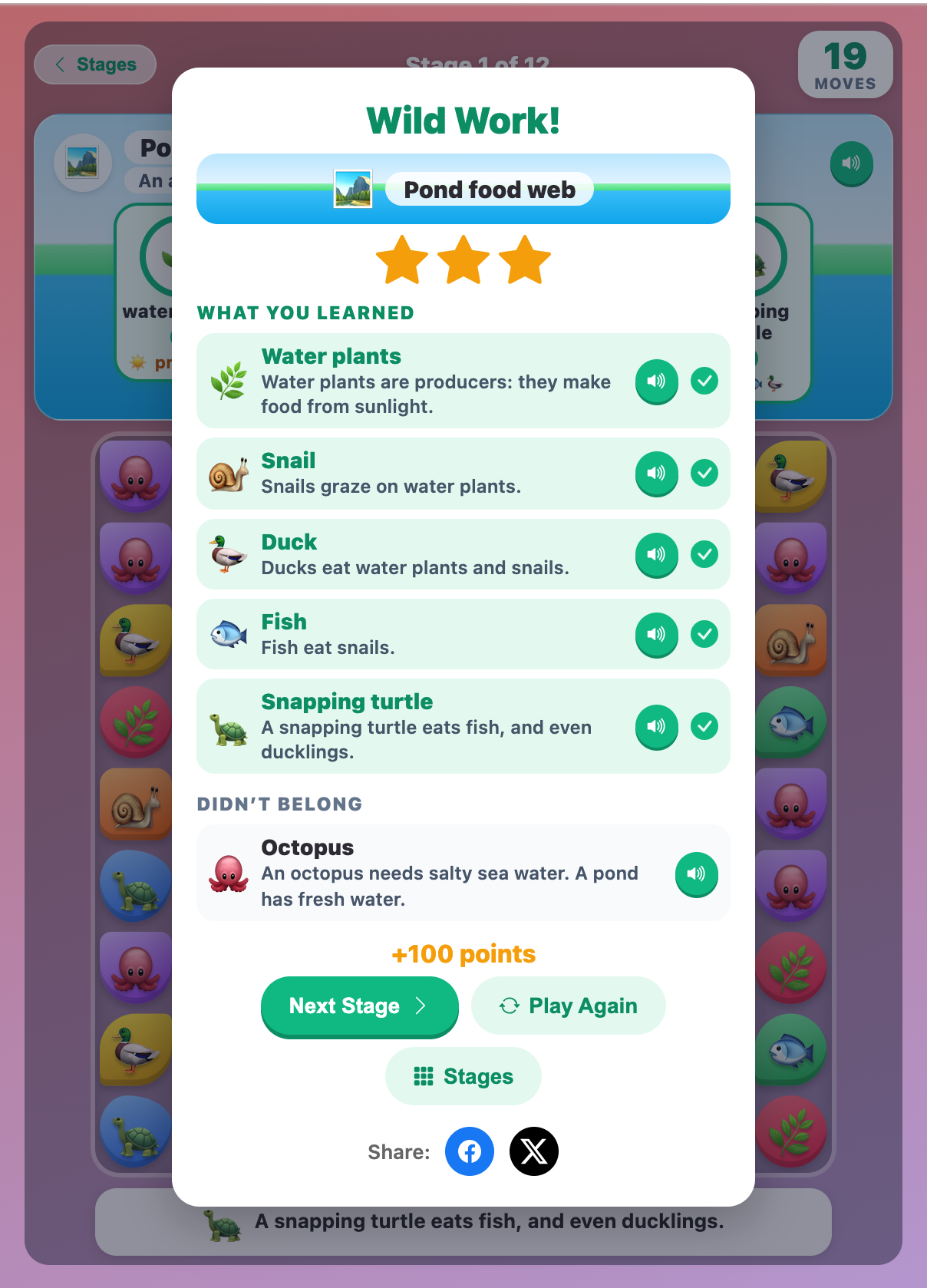
The Wild Work result card for the Pond food web with three stars, five animal facts and the octopus that didn't belong
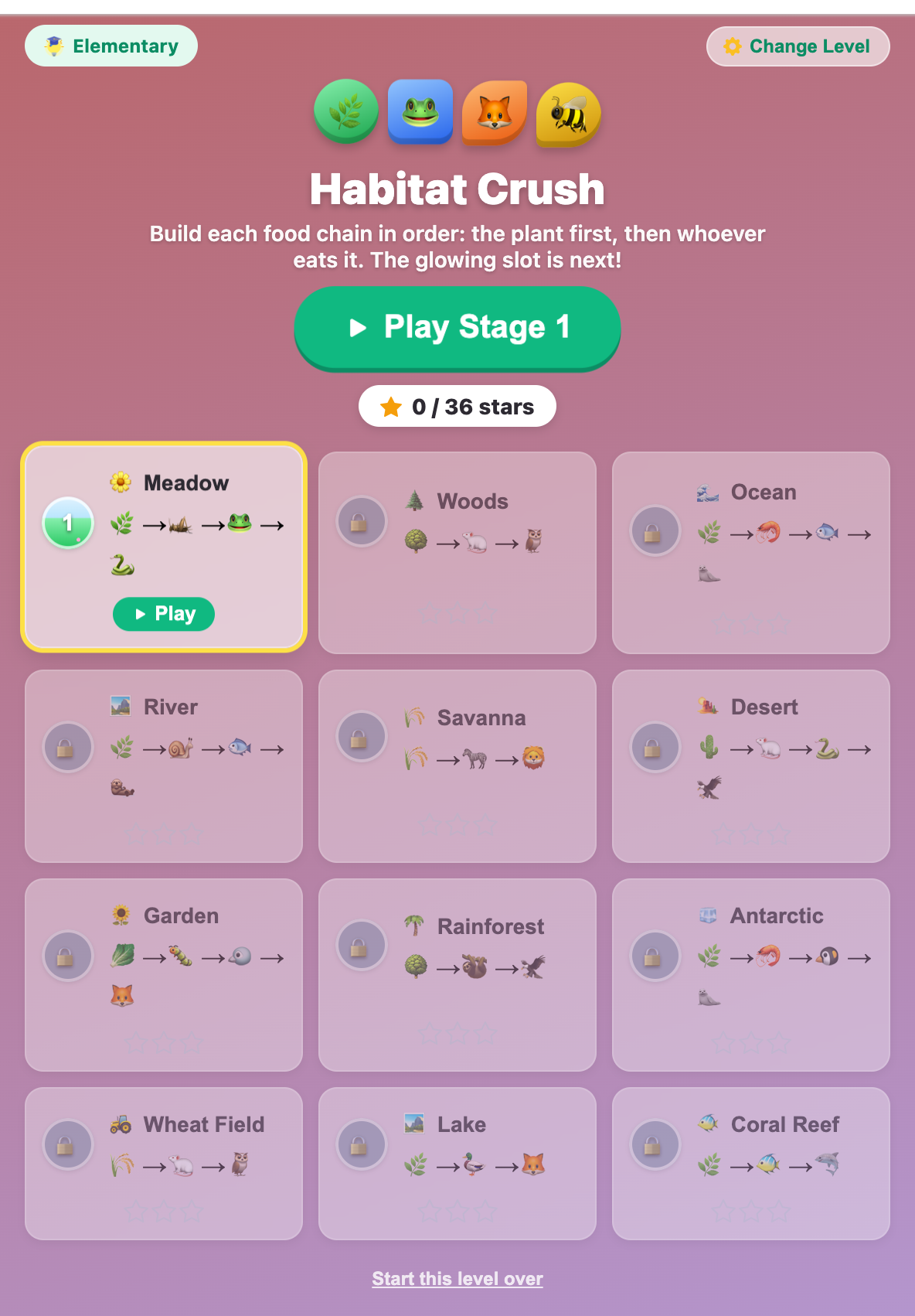
The Habitat Crush stage map at the Elementary level with Meadow, Woods, Ocean and nine more food chain stages
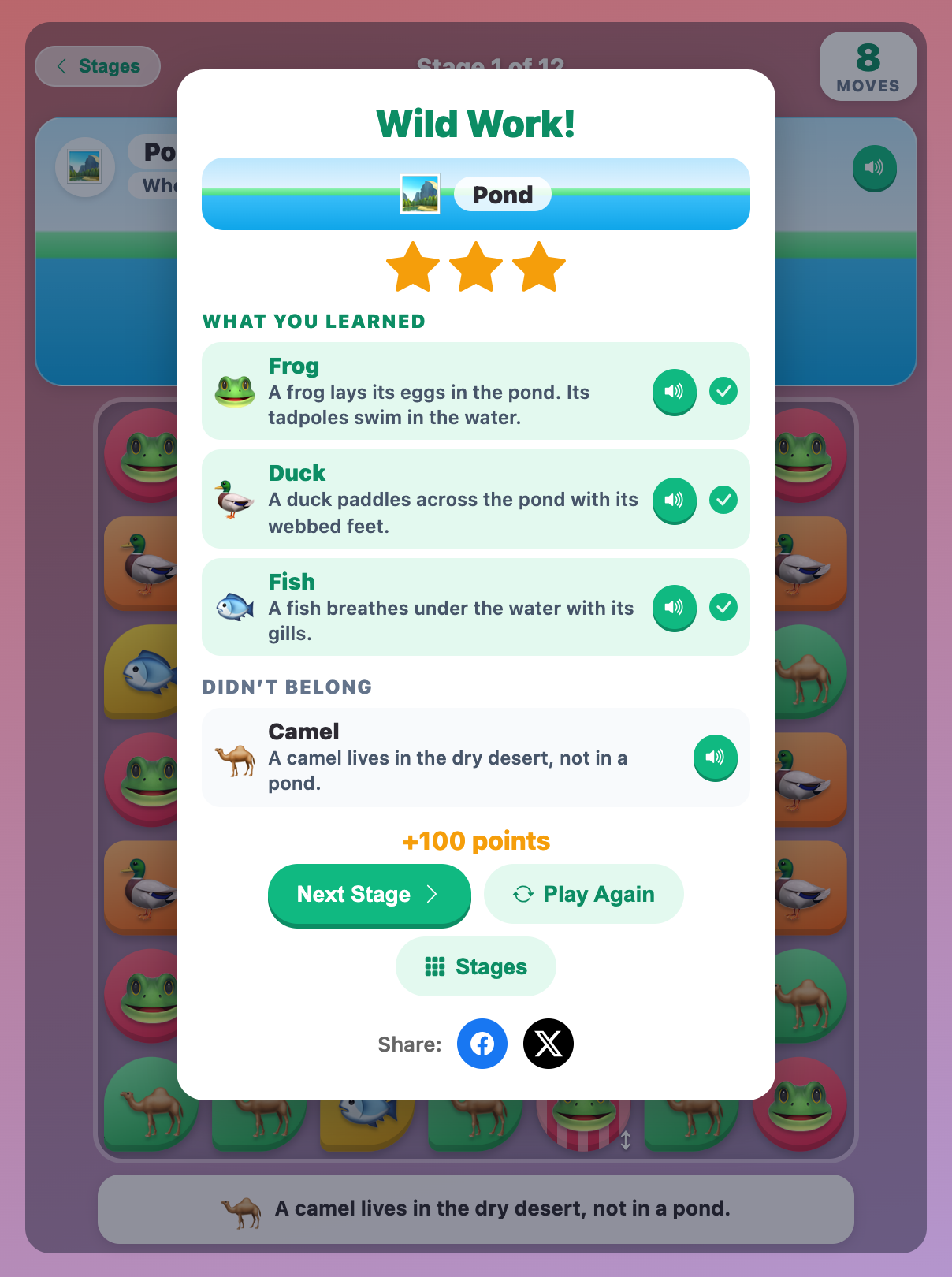
Habitat Crush for toddlers finished with three stars, showing facts about the frog, duck and fish and why a camel can't live in a pond
More Science Games
 59.5K plays
4.8
Recycling Sort
Sort everyday items into the Recycle, Compost, or Trash bin before time runs out!
 85.7K plays
4.9
Grow a Plant
Plant seeds in sunny and shady garden beds, then water, feed and protect them day by day. Watch the roots grow underground and harvest sunflowers, tomatoes, carrots and more!
 438.6K plays
4.9
Magnet Experiment
Guess which objects a magnet will pull, then drag the magnet to test every guess. Does gold stick? Does a battery?
 386.9K plays
4.9
Five Senses Match
Decide which of your five senses you would use for each everyday scene before time runs out.
Most Played Games
 1.8M plays
4.9
Color & Draw
A free-drawing canvas with colors and brush sizes to unleash your creativity.
59.5K plays
4.8
Recycling Sort
Sort everyday items into the Recycle, Compost, or Trash bin before time runs out!
 365.8K plays
5.0
Tic-Tac-Toe
Play a game of Tic-Tac-Toe against the computer and see if you can outsmart it.
 274.1K plays
5.0
Sentence Builder
Pick your age level, then tap the shuffled words in the right order to build the sentence.
Comments (20)