
Chameleon Camouflage
584.8K playsA hungry bird is coming! Help the little chameleon hide by coloring it to match whatever it sits on: a green leaf, a gray rock, a pink flower, a striped wall or a spotted mushroom. The closer the match, the better it hides, until it melts right into the picture and the bird flies away confused. Little artists pick the right color, big kids mix tints and shades with white and black and copy stripes, spots and zigzags too. A playful way to practice matching colors by eye.
Shhh… a little chameleon has just walked onto a big green leaf, and it is wearing the wrong color! High in the sky, a hungry bird is flapping closer. Only you can help. In Chameleon Camouflage for kids, you color the chameleon to match whatever it sits on, so the bird can't spot it.
Match the color well, and the chameleon melts right into the picture. Its outline fades away until only its eye and its smile are left, and the bird flies off with a puzzled "?". Miss the color, and the bird spots it with a "!". Don't worry: nobody gets eaten. The chameleon just scurries off to try again. Little artists pick the right color from a few paint blobs. Big kids mix tints and shades and copy stripes, spots and zigzags, too.
🦎 Chameleon Camouflage for Kids: The Art of Hiding
Camouflage means hiding by looking like the things around you. Lots of animals do it. A stick insect looks like a twig. A snowshoe hare turns white in the snowy winter. Zebras have stripes and leopards have spots.
In this game, the chameleon visits five hiding places in a row. There are six kinds of place: a 🍃 leaf, a 🪨 rock, a 🌸 flower, a 🧱 wall, a 🍄 mushroom and a 🛋️ cushion. Each one has its own color. On the older levels, many also have a pattern: stripes, spots or zigzags in a second color.
The game uses the same color words that painters use. A color with white mixed in is lighter. Painters call it a tint. A color with black mixed in is darker, and that is a shade. The game names them simply: "light green" is green with a drop of white, "pale teal" has more white, "dark red" has a drop of black and "very dark gray" has more black. Learning to see those differences is the secret to hiding well.
🎮 Playing on KidWorld, Step by Step
Pick a level. The Choose Your Level screen explains each one in a few words: "Pick 1 of 3 colors" (Toddlers), "Light or dark? Pick from 6" (Preschool), "Mix colors, add stripes & spots" (Elementary) and "Mix shades & match patterns" (Tweens). Change Level, at the top right, lets you switch later.
Read the task. The task card tells you where the chameleon is. For the younger levels, it names the color too: "The chameleon is on a light green leaf. Make it light green so the bird can't see it!" The 🔊 button reads it out loud.
Watch the bird. The bird flying across the sky is your clock. The bar under the picture counts down the seconds. You get 30 seconds on Toddlers, 35 on Preschool, 60 on Elementary and 75 on Tweens. The clock stands still while the game is reading aloud. If time runs out, the bird swoops in anyway.
Color the chameleon. On Toddlers and Preschool, tap a paint blob under "Pick a color" (or press its number key, 1 to 6). On Elementary and Tweens, you mix: choose a Body color, then tap + and − to add or take out drops of white and black. Next choose a Pattern (No pattern, Stripes, Spots, and Zigzags for tweens) and a Pattern color. A little chip shows your recipe, like "2 green + 1 white".
Tap Hide! (or press Enter). Toddlers don't need to: the bird comes by itself a moment after they pick a color. Before you hide, Elementary players can check the Hidden meter, which shows a percentage and up to three stars.
Need help? Tap 💡 Hint. Preschool gets 2 hints for each hiding place, and Elementary and Tweens get 3. A hint makes the right button glow and tells you what to fix, like "Add a drop of white to make the body lighter."
See how well you hid. The result card shows the place and your chameleon side by side, says what the place really looked like ("It was a light green leaf."), and gives a tip. Then the Next Hiding Place button counts down from 5 and moves on by itself. Tap it, or press Enter, to go sooner.
Check your finish card. After the fifth place, you see all five hiding spots with their stars, your score out of 100 and a chameleon fact. Play Again starts five new places. The music, fullscreen and reload buttons around the game work like on every KidWorld game.
⭐ How Hiding Is Scored
When the bird arrives, the game checks how close your chameleon's colors are to the place it's sitting on, and turns that into a "hidden" percentage:
90% or more: ⭐⭐⭐ "Totally hidden!" and 20 points.
80% or more: ⭐⭐ "Hidden! The bird flew away." and 14 points.
65% or more: ⭐ "Spotted! It got away just in time." and 8 points.
Less than that: no stars, "Spotted! It ran off to hide." and 2 points.
Two stars or more means the bird didn't see the chameleon. Each hint you use takes 3 points off that place's points (never below 0). Five places at 20 points each make the top score of 100. On a patterned place, the body color counts the most, but the pattern color counts too.
There is one big rule: the pattern has to be the right kind. Stripes on a plain rock, or no spots on a spotted mushroom, give the chameleon away. Even with perfect colors, a wrong pattern can never earn a star.
🎨 Secrets of a Master of Disguise
Name the color in your head first
Before you tap anything, look at the place and say its color to yourself: "light green", "dark red", "pale teal". Is it the plain color, lighter or darker? Once you have a name, finding or mixing it is much easier.
Light means white, dark means black
On the mixing levels, every color starts as 2 drops of the color you choose. Each drop of white makes it lighter, and each drop of black makes it darker. One drop of white makes a "light" color, and two or more make it "pale". One drop of black makes a "dark" color, and two or more make it "very dark".
Pick the color family before the drops
Get the main color right first, then fix light and dark. Light green is still green, not yellow. Pink and red are different families in this game, so a pale pink flower needs pink with white, not red with lots of white.
Too light? Take white out
If your chameleon is too pale, don't add black to fix it. Press − on the white instead. Adding black to a light color makes it grayer and duller, not just darker. That is what the hints do too: they take extra drops out before they add new ones.
Check the pattern next
After the body color is right, look again. Are there stripes? Spots? Zigzags? Or is the place plain? Choose the matching pattern, then its color. On Elementary, pattern colors are always plain colors like white, yellow or black. On Tweens, you mix them with white and black too.
Use the meter, then trust your eyes
Elementary players have the Hidden meter, with marks where each star starts. Watch it jump as you add or remove a drop. Tweens don't have a meter, so they compare the chameleon with the place by eye, just like a real artist matching paint.
Read the tips
Every result card has a tip about what gave the chameleon away or how the color was mixed, like "The cushion has stripes, so the chameleon needs stripes too." Reading them is the fastest way to get better.
🔎 Five Hiding Places, Solved Together
A light green leaf (Preschool). The six blobs are light green, green, dark green, gray, red and dark yellow. The leaf is soft and pale, so it isn't plain green and it isn't dark green. Tap light green, then Hide! The chameleon disappears: "Totally hidden!" The tip explains that light green is green mixed with white, which is called a tint.
A striped cushion (Elementary). The cushion is a soft light green with white stripes. Choose green as the body color and add 1 drop of white. The chip reads "2 green + 1 white". Then choose Stripes, and white as the pattern color. The Hidden meter climbs to 100%.
A cushion with zigzags (Tweens). This cushion is light yellow with dark orange zigzags. Body: yellow plus 1 white. Pattern: Zigzags. Pattern color: orange plus 1 black. The finish card calls it a "light yellow cushion with dark orange zigzags".
A spotted mushroom (Tweens). A dark red mushroom has light pink spots. Body: red plus 1 black. Pattern: Spots. Pattern color: pink plus 1 white. Watch out: the spots are pink, not light red!
The perfect color with the wrong pattern. Say a wall has stripes, and you mix the exact body color but forget the stripes. Your hiding score is cut down so far that it can't reach even one star. The bird spots the chameleon, and the tip reminds you to copy the pattern too.
🧸 Chameleon Camouflage for Every Age
Chameleon Camouflage for toddlers
Toddlers choose from just 3 paint blobs, and the two wrong ones are very different from the right one. The task card names the color, and with the site's sound on, the game reads it out loud. As soon as they tap a color, the bird comes. There are no hints to worry about, just picking and watching the chameleon vanish.
Chameleon Camouflage for preschoolers
Preschoolers see 6 blobs: the right color, its lighter and darker versions, and some other colors. The places are often light or dark versions of a color, so this level is all about the difference between "green", "light green" and "dark green". They tap Hide! when they are ready and have 2 hints per place.
Chameleon Camouflage for elementary kids
Elementary kids mix the body color from 9 paint colors plus drops of white and black, and they meet patterns: stripes and spots in a plain second color. The Hidden meter shows how well they are doing before the bird arrives. They get 60 seconds and 3 hints per place.
Chameleon Camouflage for tweens
Tweens get the trickiest disguises: zigzags join the patterns, teal joins the colors, and the pattern color has to be mixed with white and black too. There is no meter and no color name on the task card, so they match everything by eye. They have 75 seconds and 3 hints per place.
🌿 Why Playing Hide-and-Seek With Colors Helps Kids Grow
It trains careful looking. To hide the chameleon, kids must really study a color. Is it light or dark? Plain or patterned? That kind of close looking helps in art, in reading charts and maps, and in science.
It makes tints and shades feel real. Kids don't just hear that white makes colors lighter. They add a drop and watch the chameleon change. After a few rounds, words like tint and shade make sense. If your child wants more of this, Tint & Shade Ladder lets them mix whole ladders of lighter and darker colors, drop by drop.
It brings science into art. Every finish card shares a real chameleon fact, like how a chameleon's skin has tiny crystals that reflect different colors when the skin stretches or relaxes. Kids see that camouflage is a real survival trick in nature.
It teaches patterns. Stripes, spots and zigzags are simple patterns artists use all the time. For a closer look at zigzag, wavy and spiral lines, Magic Crossbow: Line Hunt turns them into a fun target game.
A note for grown-ups: the bird never catches the chameleon. When it is spotted, it simply runs off, so the game stays gentle even for the youngest players. One game is five quick hiding places. It practices color matching, mixing with white and black, pattern recognition and listening, with read-aloud help along the way.
The bird is already flapping across the sky. Grab your paints, look closely, and give that little chameleon the perfect disguise. Chameleon Camouflage for kids turns every color into a game of hide-and-seek.
🖼️ See the Game in Action
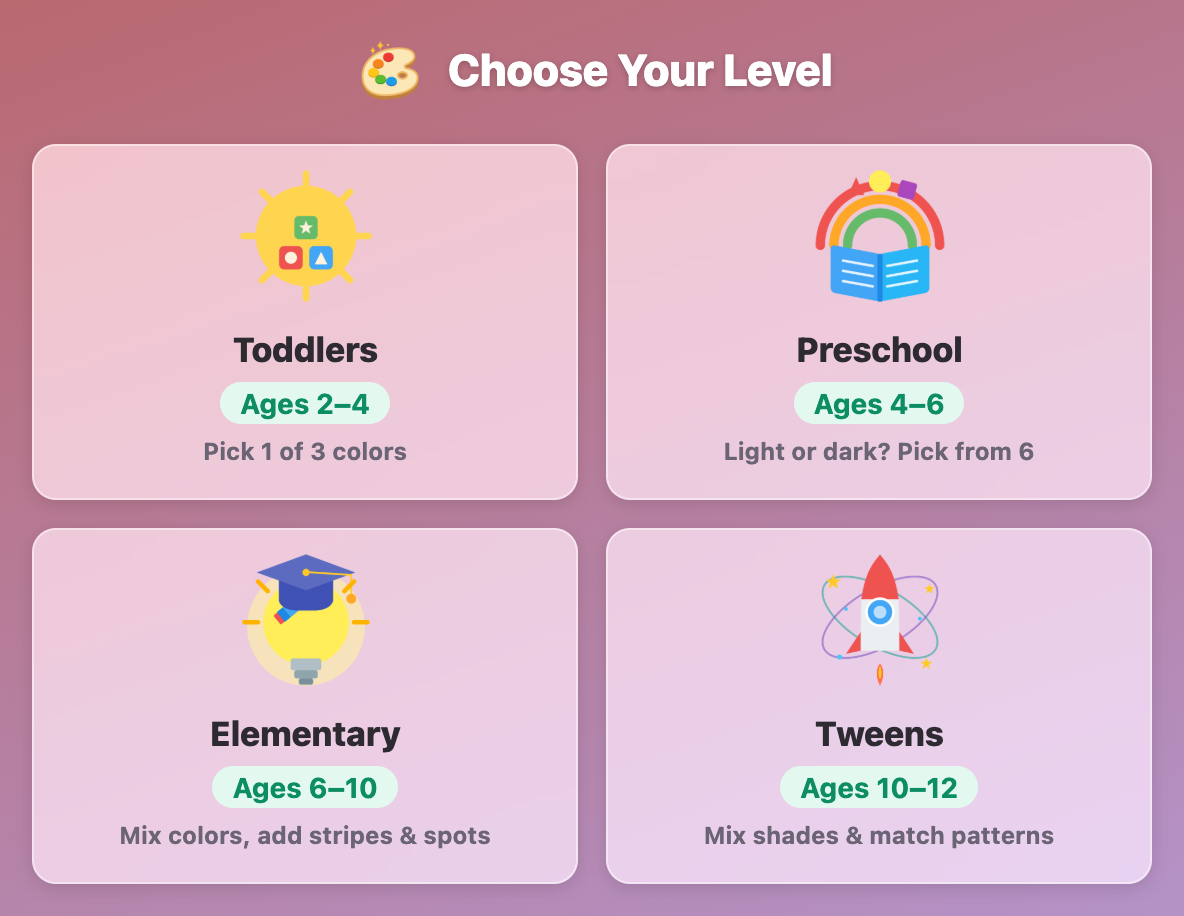
The Choose Your Level screen in Chameleon Camouflage for kids, from Pick 1 of 3 colors to Mix shades and match patterns
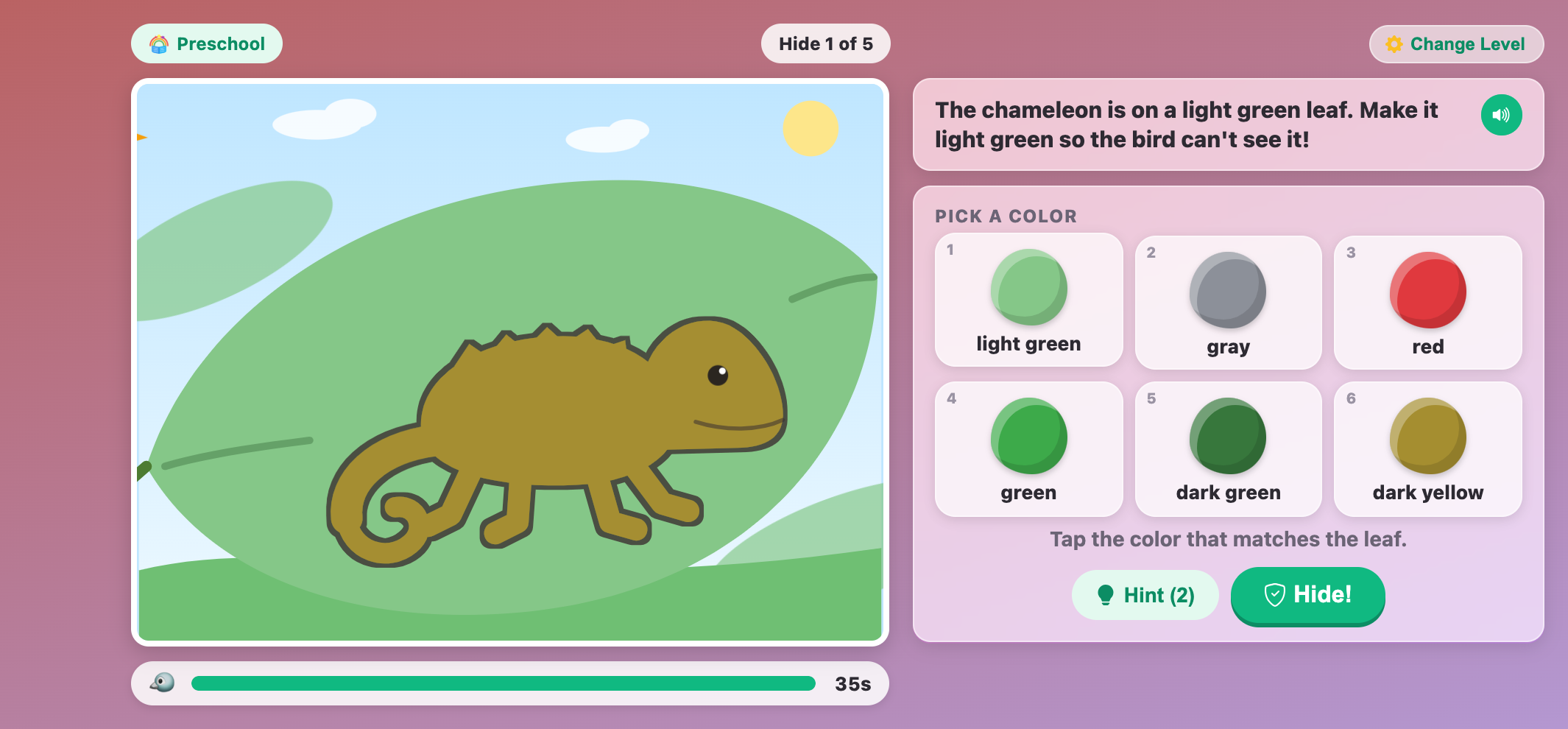
A dark yellow chameleon on a light green leaf in Chameleon Camouflage for preschoolers, with six paint colors to pick from
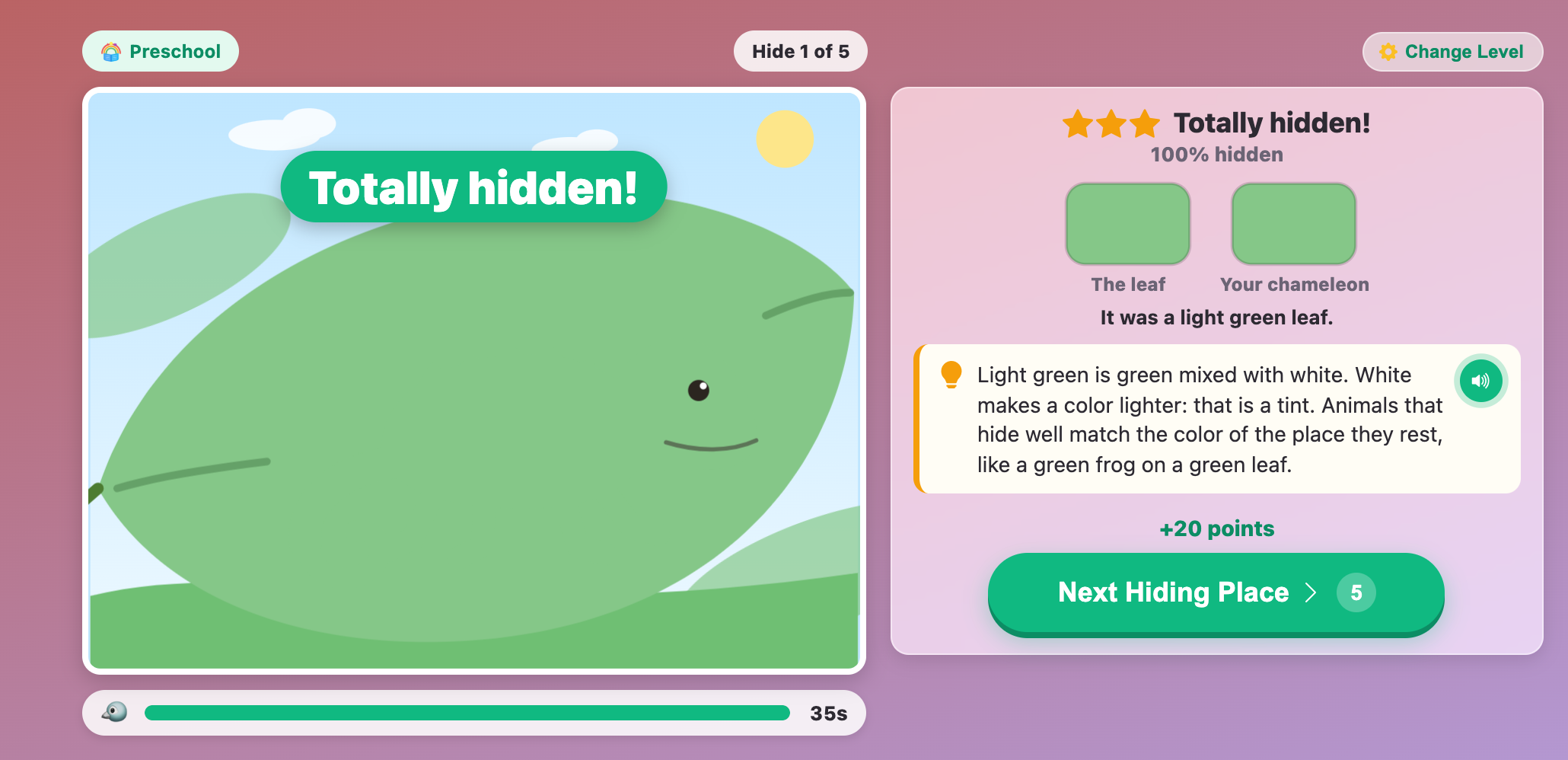
The chameleon totally hidden on the light green leaf, with the two matching swatches and a tip about tints
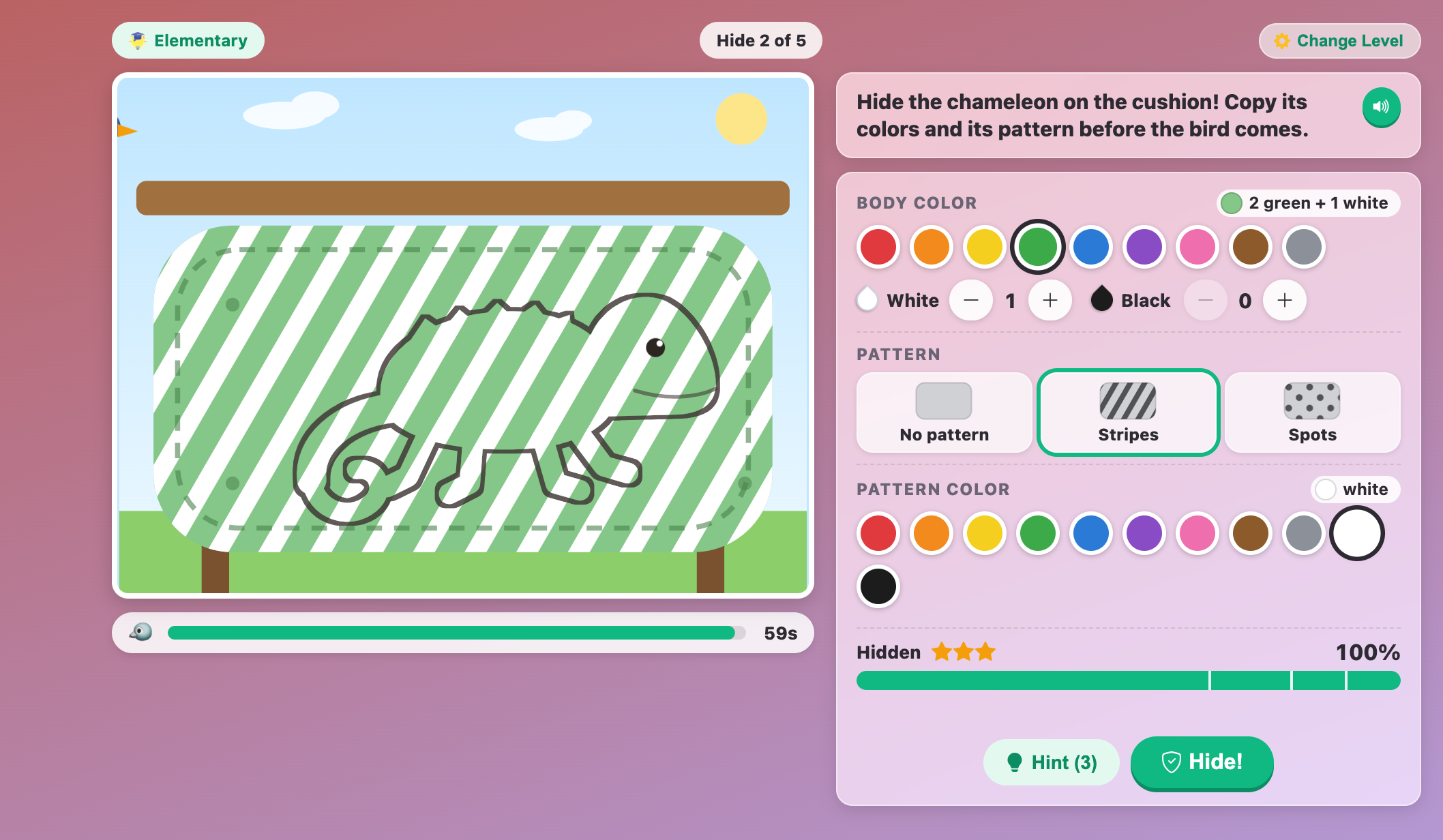
A light green chameleon with white stripes on a striped cushion, with the Hidden meter at 100 percent on Elementary
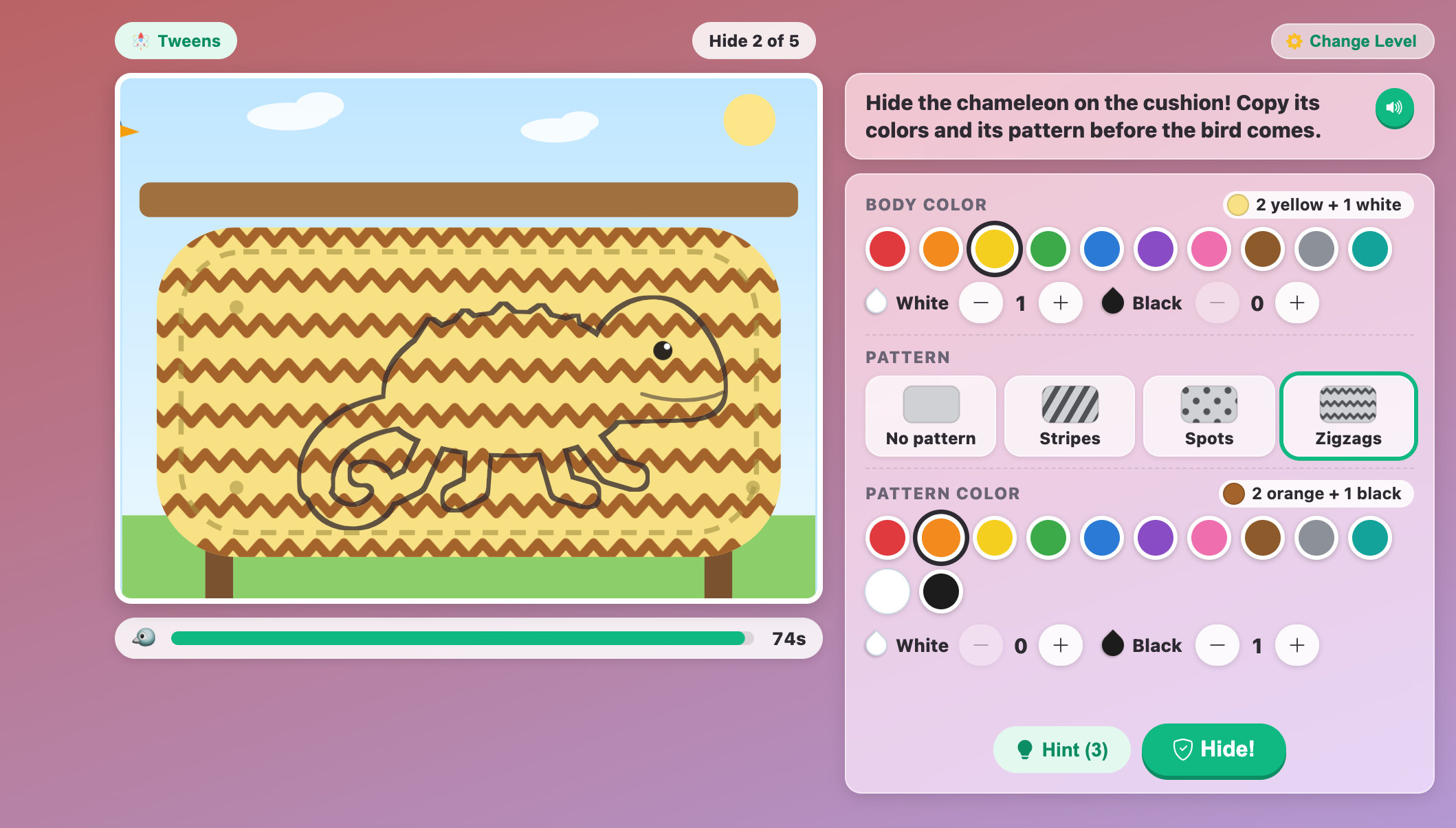
A light yellow chameleon with dark orange zigzags on a matching cushion in Chameleon Camouflage for tweens
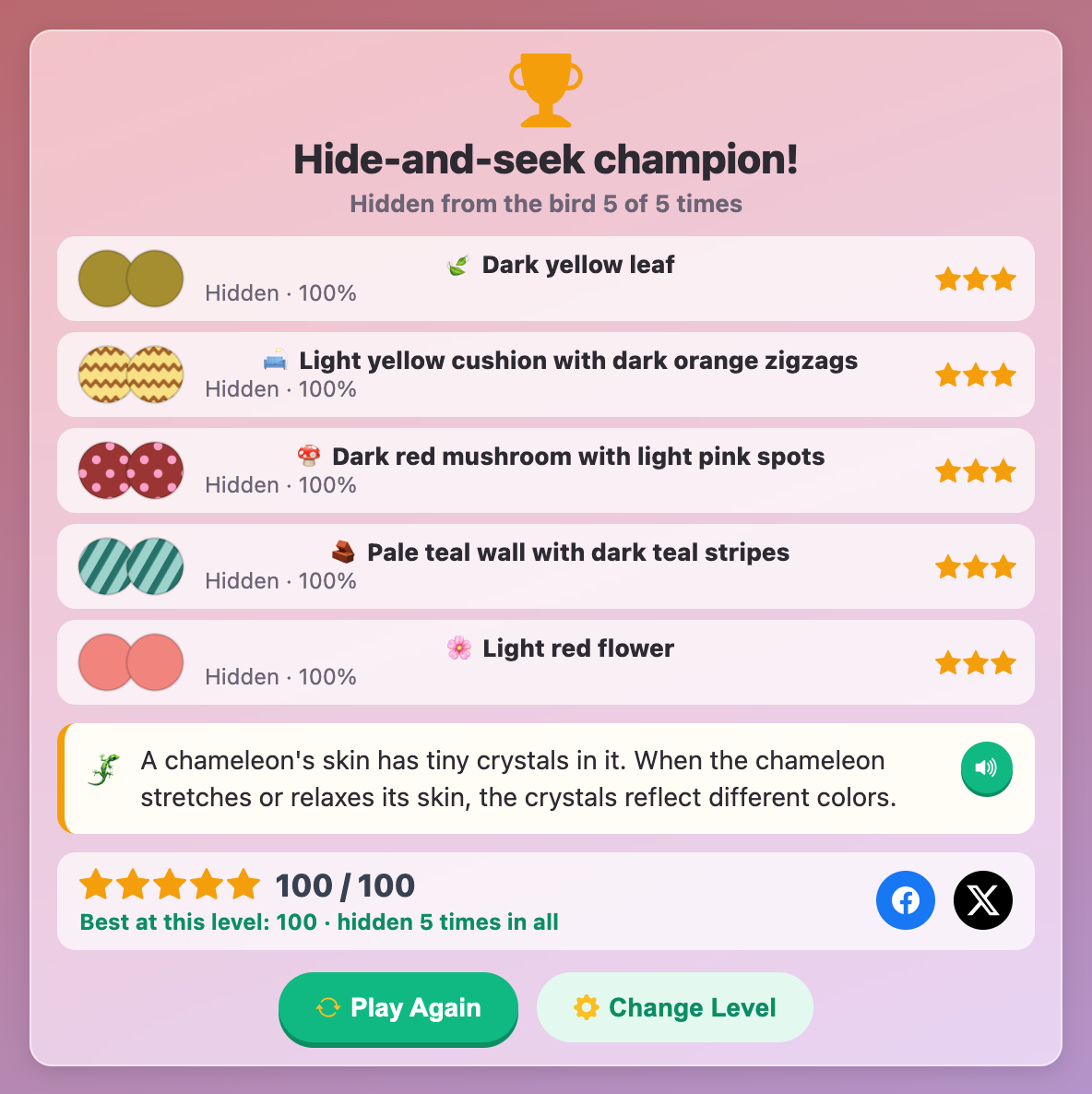
The Hide-and-seek champion finish card listing five hiding places, each hidden 100 percent, for 100 points
More Art Games
 1.8M plays
4.9
Color & Draw
A free-drawing canvas with colors and brush sizes to unleash your creativity.
 154.5K plays
5.0
Mood Palette
Decide which color best fits a mood or theme before time runs out.
 584.9K plays
5.0
Tiny World Builder
Start with a tiny empty island and build your own blocky village — plant grass and trees, lay roads, and unlock houses, farms, a school and more!
 174.6K plays
4.9
Color Mixing
Look at two paint colors and pick which color they mix together to make.
Most Played Games
1.8M plays
4.9
Color & Draw
A free-drawing canvas with colors and brush sizes to unleash your creativity.
 59.5K plays
4.8
Recycling Sort
Sort everyday items into the Recycle, Compost, or Trash bin before time runs out!
 365.8K plays
5.0
Tic-Tac-Toe
Play a game of Tic-Tac-Toe against the computer and see if you can outsmart it.
 274.1K plays
5.0
Sentence Builder
Pick your age level, then tap the shuffled words in the right order to build the sentence.
Comments (36)