
Magic Crossbow: Line Hunt
68.4K playsHunt down every zigzag, wavy or spiral line with your magic crossbow and learn the lines artists use! Little ones spot straight, zigzag, wavy, thick and thin lines, bigger kids find dotted, dashed, parallel and crossing lines and tell geometric shapes from organic ones, and big kids track down textures like hatching, cross-hatching and stippling.
Artists have their own alphabet. It isn’t made of A, B and C. It’s made of lines: straight ones, zigzag ones, wavy ones, spirals, dots and dashes. Every picture you have ever seen, from a cartoon cat to a famous painting, is built from these marks. Magic Crossbow: Line Hunt for kids is a fun way to learn that alphabet, one sparkly arrow at a time.
Each round names one kind of mark, like “zigzag” or “stippling”, and shows a row of little drawings. Your job is to shoot every drawing of that kind and leave all the others standing. It sounds easy until a wavy line sits right next to a zigzag, or a soft blended patch hides beside a patch of tiny dots. Then you need a real artist’s eye!
🖍️ Hunting for Lines, Shapes and Textures
The game is set in a sunny meadow with smiling trees, red mushrooms and bunnies peeking over the hill. A purple magic crossbow waits at the bottom. At the top, a card gives you the job, such as “Shoot both zigzag lines!” A green badge on the card names the kind you’re hunting.
Under the card is a row of white tiles, each with one drawing. Some match the badge and some don’t. A round can have one, two or three targets, so you keep shooting until every match is gone. A game is 10 rounds.
Here’s the clever part: the game draws every tile fresh, in a random color, size and direction. A zigzag might be red and tall in one round, then purple and lying on its side in the next. So you can’t just remember one picture. You have to learn what makes a zigzag a zigzag.
Line Hunt is part of the Magic Crossbow family on KidWorld. Its art-class cousin, Magic Crossbow: Odd Color Out, uses the same crossbow to find the one color that doesn’t belong in a group.
📏 Meet Every Mark You Can Hunt
These are all the kinds of drawings in the game, grouped the way the game groups them. A round only mixes marks from one group, so a line round never has textures in it, for example. Each description is the same one the game uses.
Kinds of lines
Straight: it goes one way and never bends.
Curved: it bends once, smoothly, like a rainbow.
Zigzag: it has sharp points, like lightning.
Wavy: it goes up and down smoothly, like water.
Spiral: it winds round and round, like a snail shell.
Loopy: it rolls along in little loops, like a spring.
Dotted: it is made of little dots.
Dashed: it is made of short dashes with gaps.
Thick and thin
A thick line is wide and bold. A thin line is narrow, like a hair. These rounds use straight, curved, zigzag and wavy lines, so only the width matters, not the shape.
Which way a line goes
A horizontal line lies flat, like the horizon (the line where the sky meets the land). A vertical line stands straight up, like a tree trunk. A diagonal line slants, like a slide.
Pairs of lines
Parallel lines stay the same distance apart and never meet, like train tracks. Crossing lines go over each other, like an X. Perpendicular lines meet at a square corner, like the corner of a page. In the game they can look like a +, a T or an L.
Shapes
Geometric shapes have exact, even edges, as if they were made with a ruler: circles, squares, rectangles, triangles, pentagons, hexagons, stars and diamonds. Organic shapes are free and uneven, like things in nature: lumpy blobs, puddles, leaves and clouds.
Textures (ways to shade)
Hatching: shading with lines that all go the same way.
Cross-hatching: shading with two sets of lines that cross.
Stippling: shading with lots of tiny dots.
Scribbling: shading with loose, loopy scribbles.
Blending: the color fades softly, with no marks at all.
🎯 Playing a Round, Step by Step
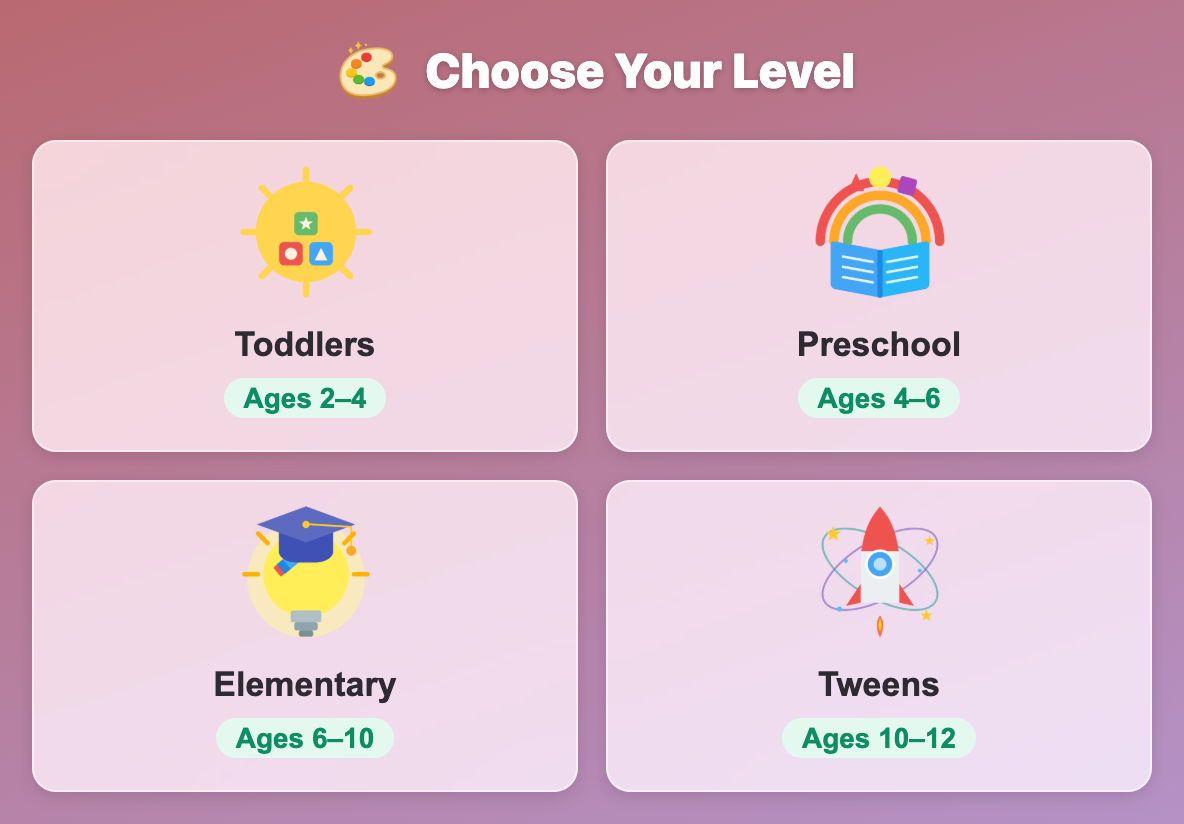
Choose your level. New players start on Elementary. Tap Change Level at the top right to pick Toddlers (ages 2–4), Preschool (ages 4–6), Elementary (ages 6–10) or Tweens (ages 10–12). Your pick is remembered.
Read the card. The job tells you what to hunt and how many: “Shoot the spiral!”, “Shoot both thin lines!” or “Shoot all 3 dashed lines!” On Toddlers and Preschool, the card also shows an example drawing and the rule right away. On Elementary and Tweens, a friendly animal sits there instead, and the example and rule only show up after your first miss.
Listen. The green 🔊 button reads the job (and the rule, once it’s on the card). If the site’s sound is on, the game reads every new round out loud by itself, on every level.
Aim. Move your mouse over a tile and the crossbow swings toward it, with a red target circle on the drawing. You can also aim with the ← and → arrow keys.
Shoot. Tap or click a tile, press Space or Enter, or press a number key to shoot that tile (1 for the first, 2 for the second, and so on).
Hit or bounce. A match bursts into sparkles, and the message says what it was and how many are left: “Got it! That is a dashed line: it is made of short dashes with gaps. 2 more to go.” Shoot a drawing of another kind and the arrow bounces off a magic shield: “Keep it! That is a curved line…”
Follow the glow. If you miss a few times (once on the two youngest levels, twice on the older ones), a target starts to glow and the message points it out. Every round ends with the hunt finished.
Read the name tags. When the last target pops, each drawing still standing gets a little tag with its name, like “curved” or “loopy”. It’s a free mini lesson.
See how you did. After round 10, the result card shows up to five stars, your score out of 100, rounds you finished with no misses, missed shots and your best 🔥 streak. A “Practice these again” list shows a tiny copy of each drawing you mixed up, like “wavy line, not zigzag”.
Play again. Tap Play Again or Change Level. Around the game, the page also has buttons for fullscreen, reload and music.
Each round is worth 10 points, and each missed shot takes away 3, so a round with no misses earns 10, one miss earns 7 and two misses earn 4. There’s no timer. The best score, 100, earns the title “Bullseye! You have an artist’s eye!”
🦉 Sharp-Eyed Tricks for a Perfect Hunt
You can’t lose points for taking your time, but every miss costs 3. So the winning plan is simple: look closely, think, then shoot once. These tricks help.
1. Count your targets first
The job tells you how many to find. “The” means one, “both” means two, and “all 3” means three. Before you shoot anything, find all of them with your eyes. If you can only spot two when the card says three, look again before you fire. Hunting for several targets at once is also how Magic Crossbow: Odd or Even Hunt works, with numbers instead of lines.
2. Turn the drawing in your head
Drawings come in every direction. A zigzag lying on its side is still a zigzag, and a spiral can start anywhere. In most rounds, ask “what kind is it?”, not “which way does it point?” The one exception is a direction round. Then only the way it points matters: flat, straight up, or slanting. The game’s diagonal lines always lean clearly, never almost flat, so trust your first look.
3. Sharp points or smooth bumps?
This is the big one for little hunters. Run your eye along the line. If it has sharp corners like lightning, it’s zigzag. If it rolls smoothly like water, it’s wavy. If it bends just once, like a rainbow or a smile, it’s curved.
4. One center or many loops?
A spiral winds round and round one middle point, like a snail shell. A loopy line travels along, making a row of little loops, like a stretched-out spring. The game never puts these two together in a round hunting either one. But in a loopy hunt, wavy and curved lines can still show up, so look for the little loops.
5. Dots or dashes?
A dotted line is a row of tiny round dots. A dashed line is a row of short strokes with gaps between them. Look at one piece of the line: is it round or long? You don’t have to worry that a dotted line might count as “straight”. The game never puts dotted or dashed lines in a straight-line hunt, just to keep things fair.
6. In thick or thin rounds, ignore the shape
A thick round can show a thick zigzag next to a thin zigzag. The shape is the same; only the width is different. So look at how wide the line is and nothing else. Thick ones look like a marker. Thin ones look like a pencil.
7. Train tracks, an X, or a square corner?
For pairs of lines, imagine a little train. Could it ride along the two lines without them ever meeting? Parallel! Do the lines go over each other at a slant, like an X? Crossing. Do they meet at a perfect square corner, like a +, a T or an L? Perpendicular. A + is also two lines that cross, so the game keeps squares out of crossing hunts.
8. Could a ruler make it?
For shapes, ask if you could draw it neatly with a ruler or a stencil. Even sides and exact curves mean geometric. Lumpy, bumpy, leaf-like or cloud-like edges mean organic. The game makes its blobs lumpy enough that they never look like a real circle.
9. Look inside the patch
Texture rounds are the trickiest. Zoom your eyes into each square patch. Lines all one way? Hatching. Two sets of lines making a net? Cross-hatching. Lots of tiny dots? Stippling. Loose loops? Scribbling. No marks at all, just a soft fade from strong color to pale? Blending. A hatching hunt never includes cross-hatching, since cross-hatching is made of hatching.
10. Let your misses teach you
On Elementary and Tweens, your first miss makes the example drawing and the rule appear on the card. That’s a big clue, so read it before your next shot. The “Keep it!” message also tells you exactly what you hit, so you learn even when you miss.
🔎 Real Hunts, Solved Together
Here are rounds like the ones in the game. Try to solve each one in your head first.
Toddlers: “Shoot both zigzag lines!”
The row shows a red zigzag, a pink spiral, a wavy teal line, a purple zigzag and a straight pink line. Look for sharp points like lightning. The red one and the purple one both have them, so shoot those two. The wavy line is smooth, so it stays.
Elementary: “Shoot all 3 dashed lines!”
The row: a purple curve, a teal zigzag, a loopy teal line, and three lines made of little strokes.
Look for gaps. Only the last three are broken into short dashes, so those are the targets.
Shoot all three. The curve, the zigzag and the loopy line get their name tags when the hunt is done.
Elementary: “Shoot both organic shapes!”
Imagine a star, a hexagon, a circle, a square, a leaf shape and a puddle shape. Ask, “Could a ruler make it?” The star, hexagon, circle and square are neat and even, so they’re geometric. The leaf and the puddle are uneven, like nature, so shoot those two.
Elementary: “Shoot the vertical line!”
In a direction round, every tile is a plain straight line. Some lie flat, some lean like slides, and one stands straight up like a tree trunk. That last one is your target. Nothing else matters here, not the color and not the length.
Tweens: “Shoot all 3 smooth, blended patches!”
Seven patches: blue fading to white, blue hatching, red fading to white, blue stippling, orange cross-hatching, green scribbles, and green fading to white.
Ignore the colors. Look for patches with no marks inside at all.
The three faded ones (blue, red and green) are blending. Shoot them, and leave the hatching, stippling, cross-hatching and scribbling alone.
🌱 Magic Crossbow: Line Hunt for Kids, Level by Level
🐣 Magic Crossbow: Line Hunt for toddlers (ages 2–4)
Toddlers see five tiles and hunt one or two at a time. The hunts are straight, zigzag, wavy and spiral lines, plus thick and thin. The card shows an example drawing from the start, so a child who can’t read yet can match the picture. After a single miss, a target glows. Parents can trace each line in the air with their child’s finger: “Zig, zag, zig, zag!”
🎨 Magic Crossbow: Line Hunt for preschoolers (ages 4–6)
The Preschool level adds curved and dotted lines and shows six tiles. The example drawing and rule are still on the card from the start, and the glow still comes after one miss. This is the age where telling curved from wavy really clicks.
📚 Magic Crossbow: Line Hunt for elementary kids (ages 6–10)
Elementary adds loopy and dashed lines, horizontal, vertical and diagonal lines, parallel and crossing pairs, and geometric and organic shapes. There can be up to three targets in a row of six. The example and rule wait until after a miss, and the glow waits for two misses, so kids really have to look.
🚀 Magic Crossbow: Line Hunt for tweens (ages 10–12)
Tweens get seven tiles and two or three targets every round. They hunt loopy, spiral and dashed lines, all three kinds of line pairs (including perpendicular), shapes, and the five textures artists use for shading. Telling cross-hatching from hatching, or stippling from scribbling, is real art-class skill.
💡 Why Line Hunting Builds Young Artists
It teaches the words art teachers use. Line, shape and texture are some of the first things taught in art class. Here, kids hear and read the real names, from “zigzag” all the way to “stippling”.
It helps kids see lines everywhere. The game links every line to the real world: lightning, water, snail shells, springs, train tracks, slides and tree trunks. After playing, a walk outside turns into a line hunt too.
It makes drawing better. A child who knows hatching and stippling can shade a drawing on purpose. A child who knows thick and thin can make a picture pop. For a place to try it all out, Color & Draw has a pen, shapes and a whole set of brushes for drawing your own lines.
It shares words with math class. Horizontal, vertical, parallel and perpendicular show up in geometry lessons too, so the hunt gives kids a head start.
It rewards careful looking. Since every drawing is new each time, kids can’t memorize answers. They have to stop, look closely and think, which is a habit that helps in every subject.
For parents and teachers
Line Hunt is calm and friendly: no timer, no scary pictures, just bright drawings in a cheerful meadow. Missed shots only bounce off a shield, and a glowing hint makes sure every round is finished. The “Practice these again” list is a handy guide for a quick paper activity afterward: draw each line together with crayons, or hunt for textures around the house, like hatching on a woven basket.
Ready to read the artist’s alphabet? Load your crossbow, pick a level, and see how many zigzags, spirals and dotted lines you can find in 10 rounds. Magic Crossbow: Line Hunt for kids is waiting for you. 🏹🖍️
🖼️ See the Game in Action
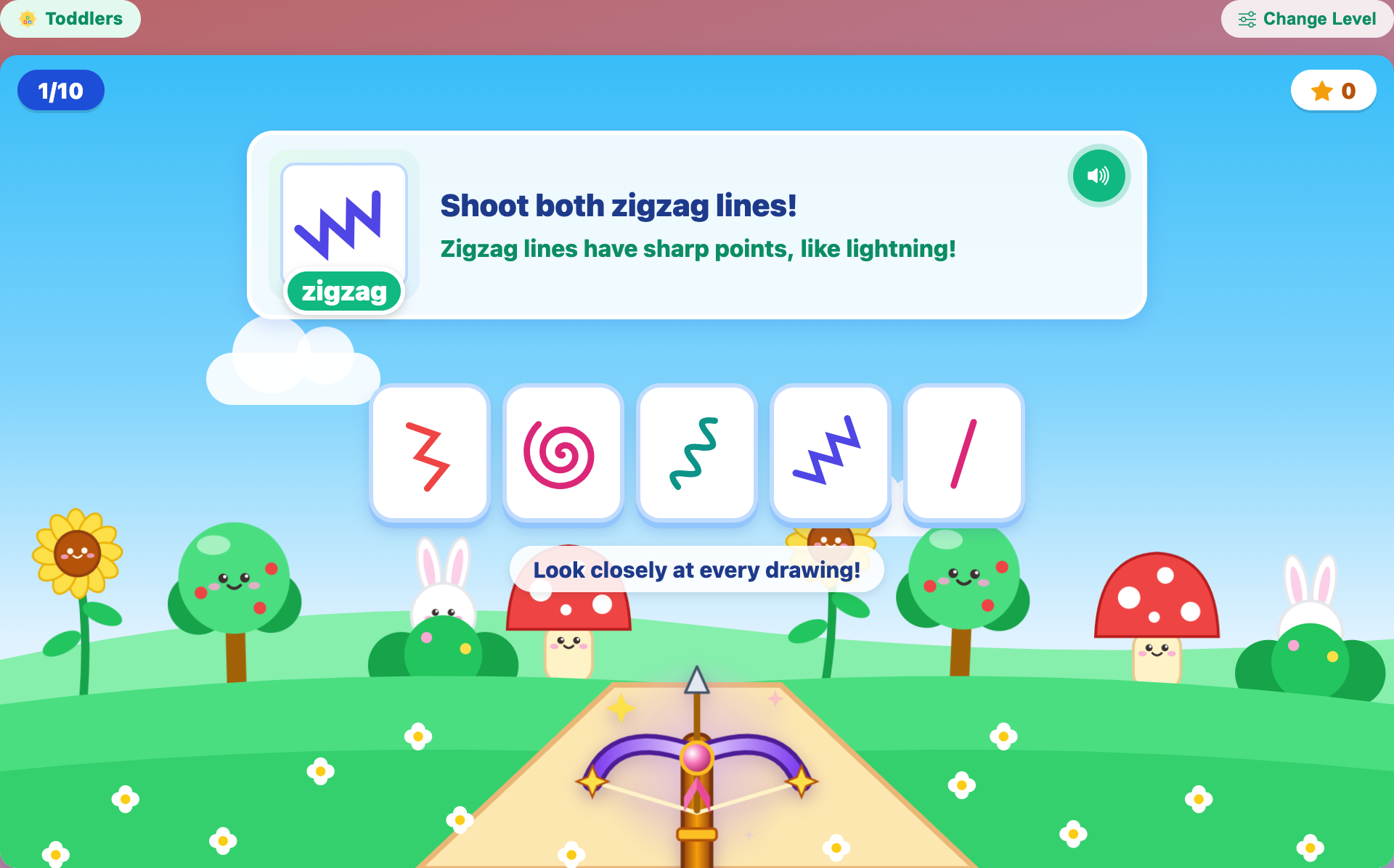
A toddler zigzag hunt with an example zigzag and its rule on the card, above five colorful line drawings
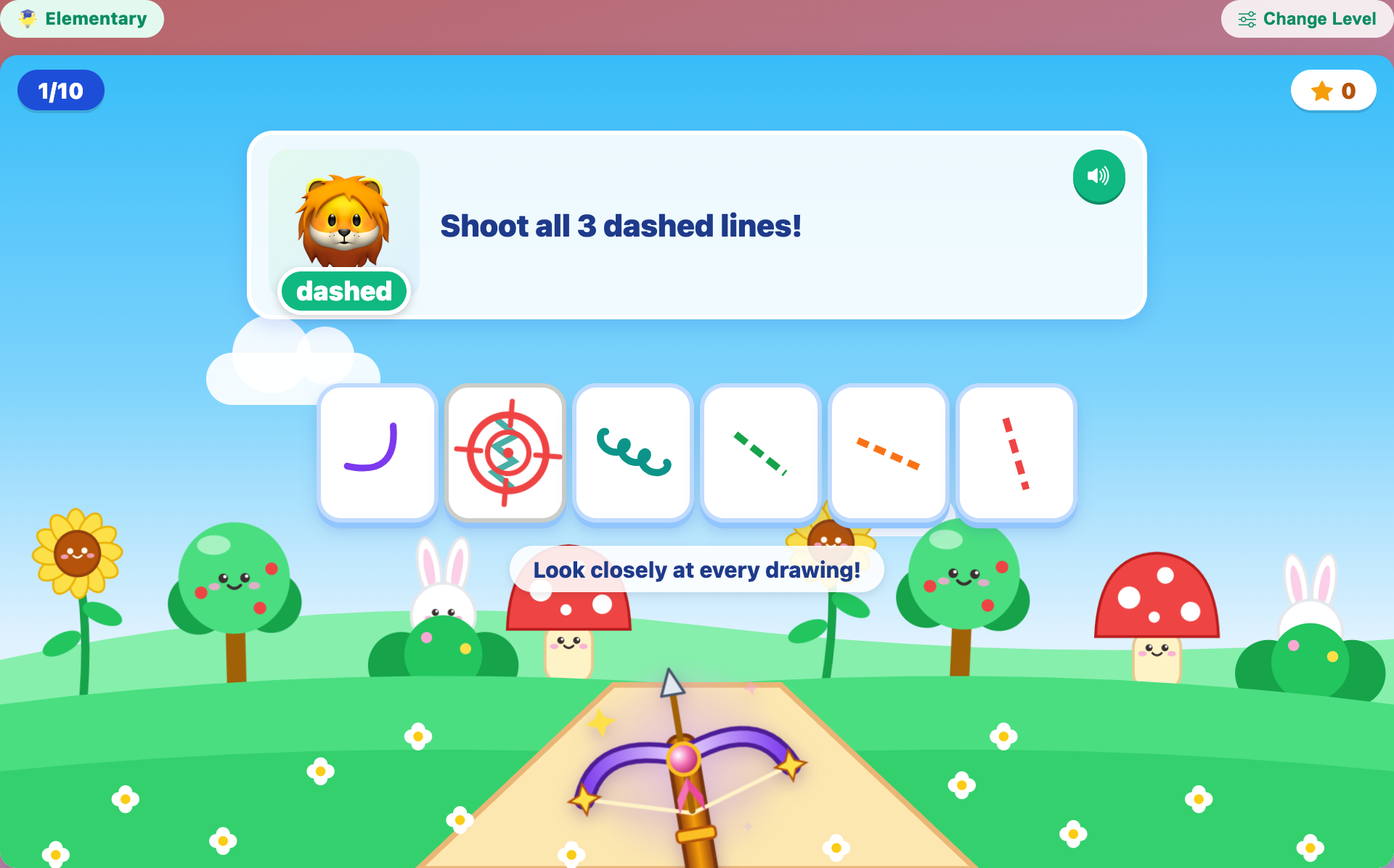
An Elementary round in Magic Crossbow: Line Hunt for kids asking to shoot all 3 dashed lines, with a lion on the card
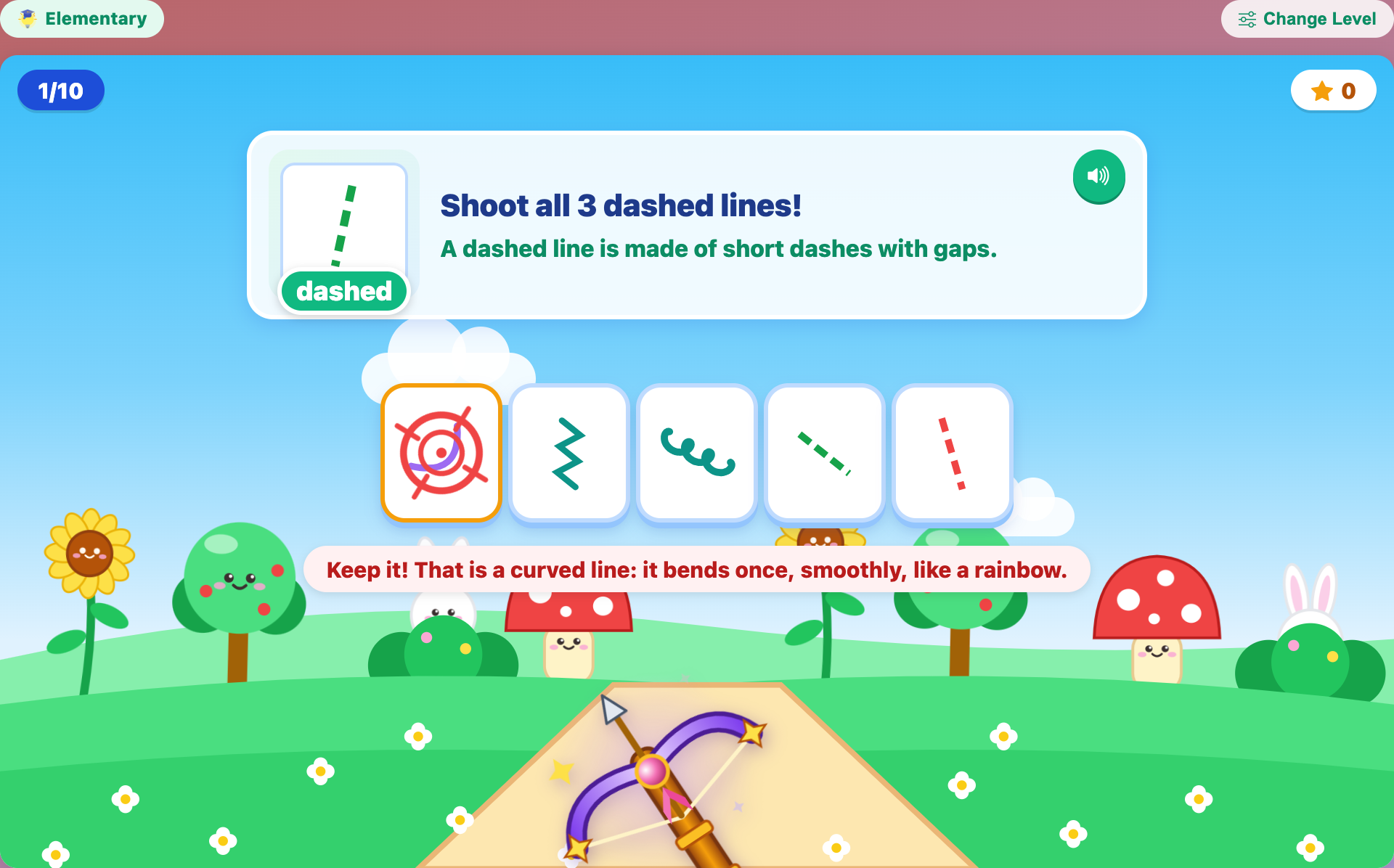
An arrow bouncing off a curved line in the dashed-line hunt, as the rule and an example dashed line appear on the card
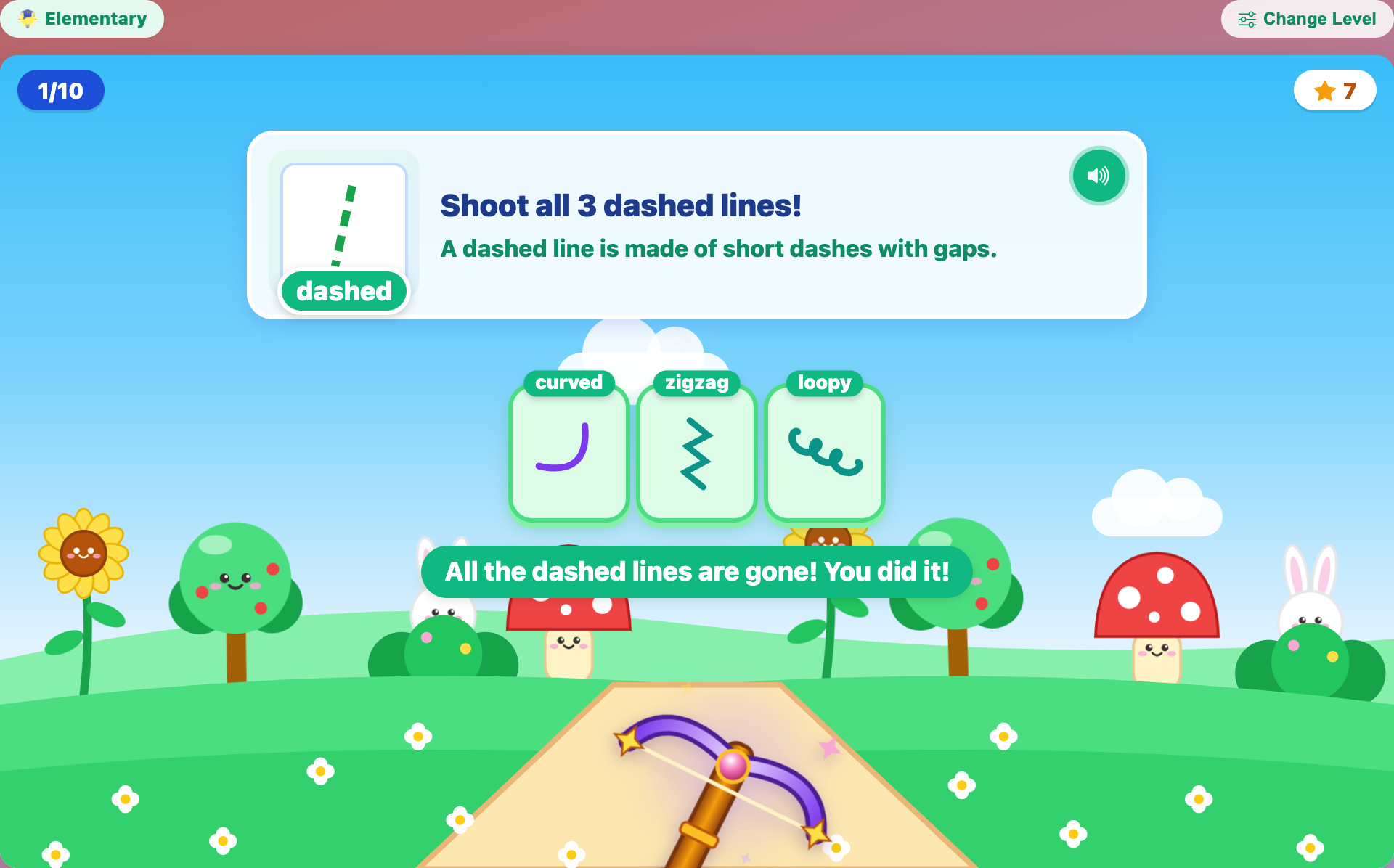
The dashed-line hunt finished, with curved, zigzag and loopy name tags on the three drawings left standing
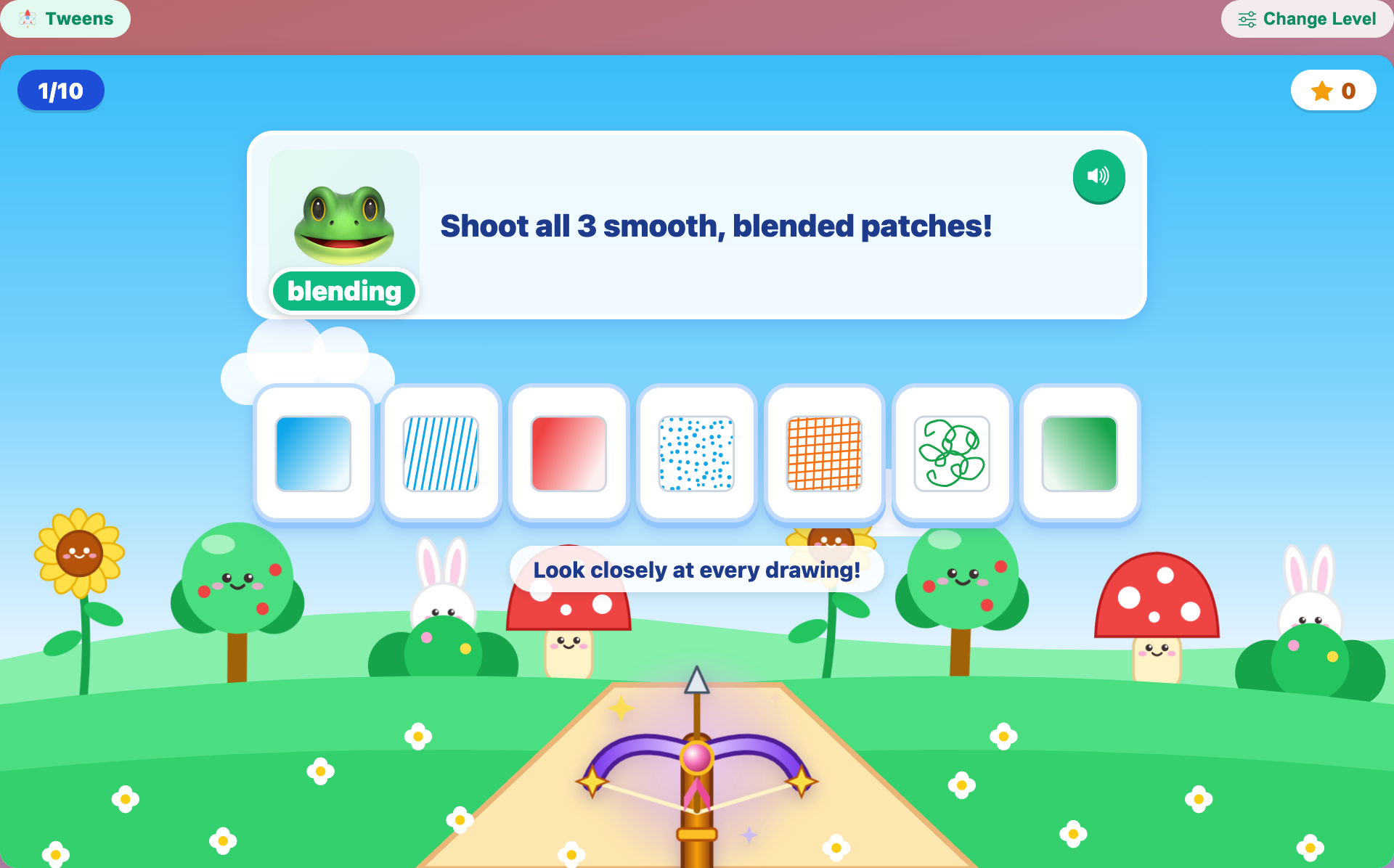
A blending hunt in Magic Crossbow: Line Hunt for tweens, with seven texture patches including hatching, stippling and cross-hatching
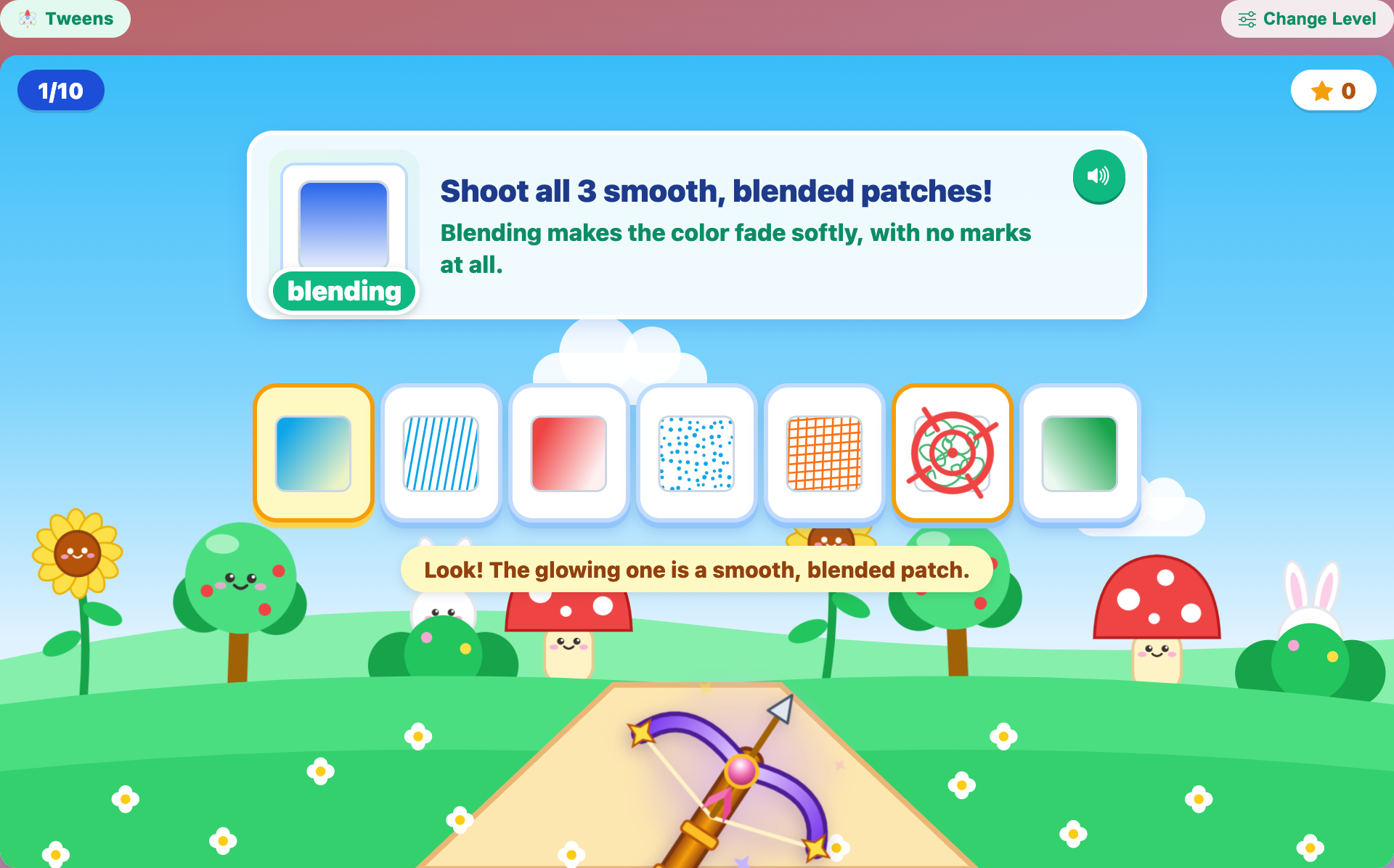
A blended blue patch glowing as a hint after two missed shots, with the message Look! The glowing one is a smooth, blended patch
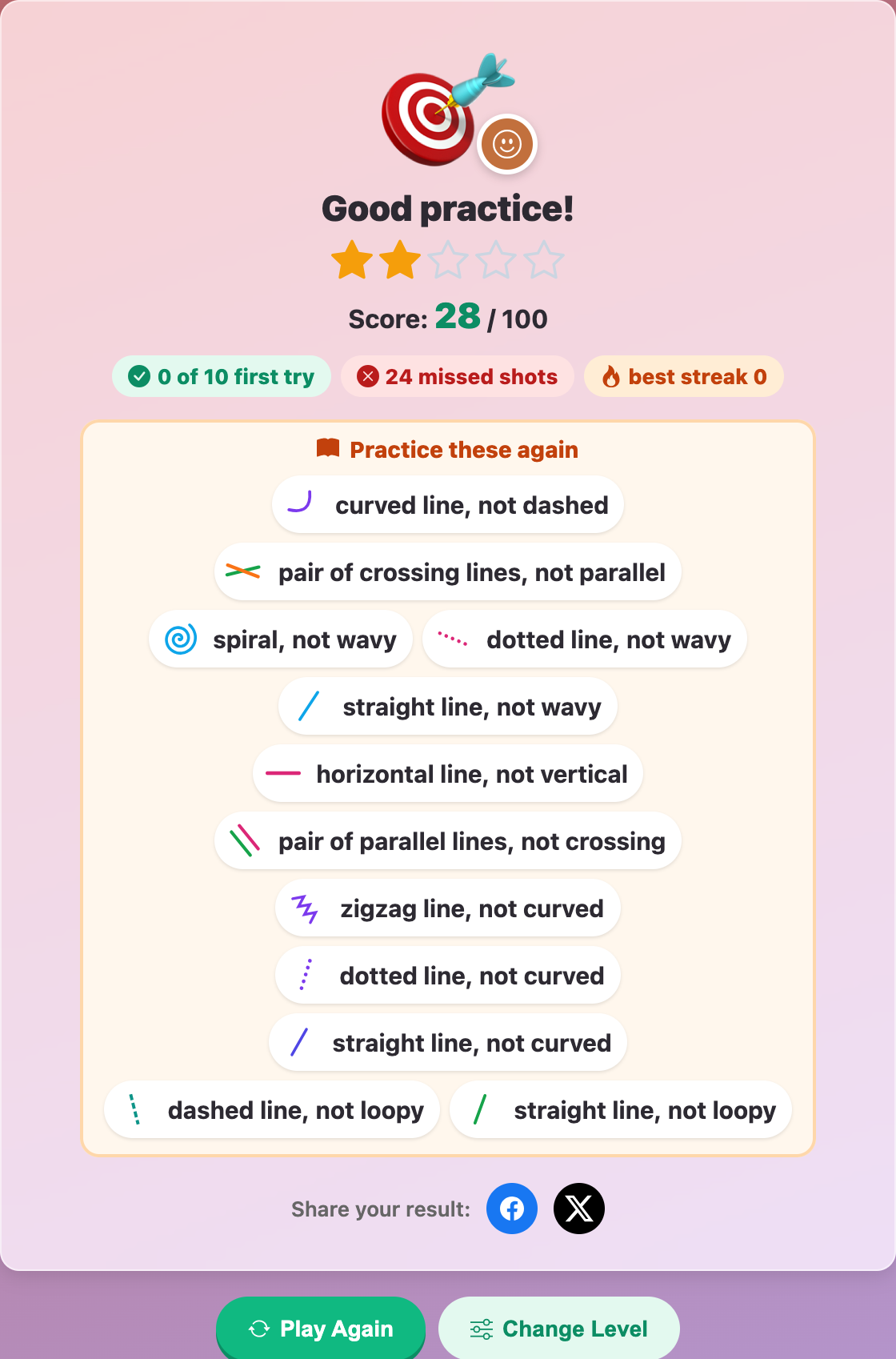
The result card in Magic Crossbow: Line Hunt with a Practice these again list of small drawings, such as curved line, not dashed
More Art Games
 1.8M plays
4.9
Color & Draw
A free-drawing canvas with colors and brush sizes to unleash your creativity.
 154.5K plays
5.0
Mood Palette
Decide which color best fits a mood or theme before time runs out.
 584.9K plays
5.0
Tiny World Builder
Start with a tiny empty island and build your own blocky village — plant grass and trees, lay roads, and unlock houses, farms, a school and more!
 174.6K plays
4.9
Color Mixing
Look at two paint colors and pick which color they mix together to make.
Most Played Games
1.8M plays
4.9
Color & Draw
A free-drawing canvas with colors and brush sizes to unleash your creativity.
 59.5K plays
4.8
Recycling Sort
Sort everyday items into the Recycle, Compost, or Trash bin before time runs out!
 365.8K plays
5.0
Tic-Tac-Toe
Play a game of Tic-Tac-Toe against the computer and see if you can outsmart it.
 274.1K plays
5.0
Sentence Builder
Pick your age level, then tap the shuffled words in the right order to build the sentence.
Comments (9)