Magic Crossbow: Odd Color Out
54.9K playsWhich color doesn't belong? Red, orange, blue, yellow: they're warm colors, except the blue! Shoot the odd color out with your magic crossbow and find out why. Little ones spot the one that isn't red among red things, then primary and secondary colors, warm and cool, tints and shades, and color-wheel neighbors and partners for big kids.
A color wheel works a little like a clock. Instead of 12 numbers, it has 12 colors in a circle, from red all the way round to red-violet. Colors that sit close together get along. Colors that sit across from each other are partners. Artists learn this map by heart, and Magic Crossbow: Odd Color Out for kids turns learning it into target practice.
Every round gives you a team of colors and one color that sneaked in. Your job is to spot the one that doesn’t belong and fire a sparkly arrow at it. The little ones find a banana hiding among red things. Big kids hunt for two colors that aren’t neighbors on the color wheel. And after every single shot, the game tells you why, so you learn something new each time the arrow flies.
🎨 Every Color Belongs to a Team
In this game, colors come in groups. The group’s name sits in a green chip on the card at the top, like “Warm colors”, “Tints” or “Red things”. Under it is the job, such as “Shoot the one that is not a warm color!” Below the card is a row of tiles.
For older players, each tile is a shiny blob of paint with its name under it. For the youngest players, each tile is a picture, like a frog, a pumpkin or a snowman. Most tiles belong to the group. One doesn’t (on the Tweens level, two don’t). Find it, shoot it, and the row is fixed.
A game is 10 rounds, and each round is a new group. It’s part of the Magic Crossbow family of games on KidWorld. All of them share the same purple crossbow, the same sunny meadow with smiling mushrooms and peeking bunnies, and the same magic shield. This one is all about color, the way an art teacher would teach it.
🏹 Loading Your Crossbow: How to Play on KidWorld
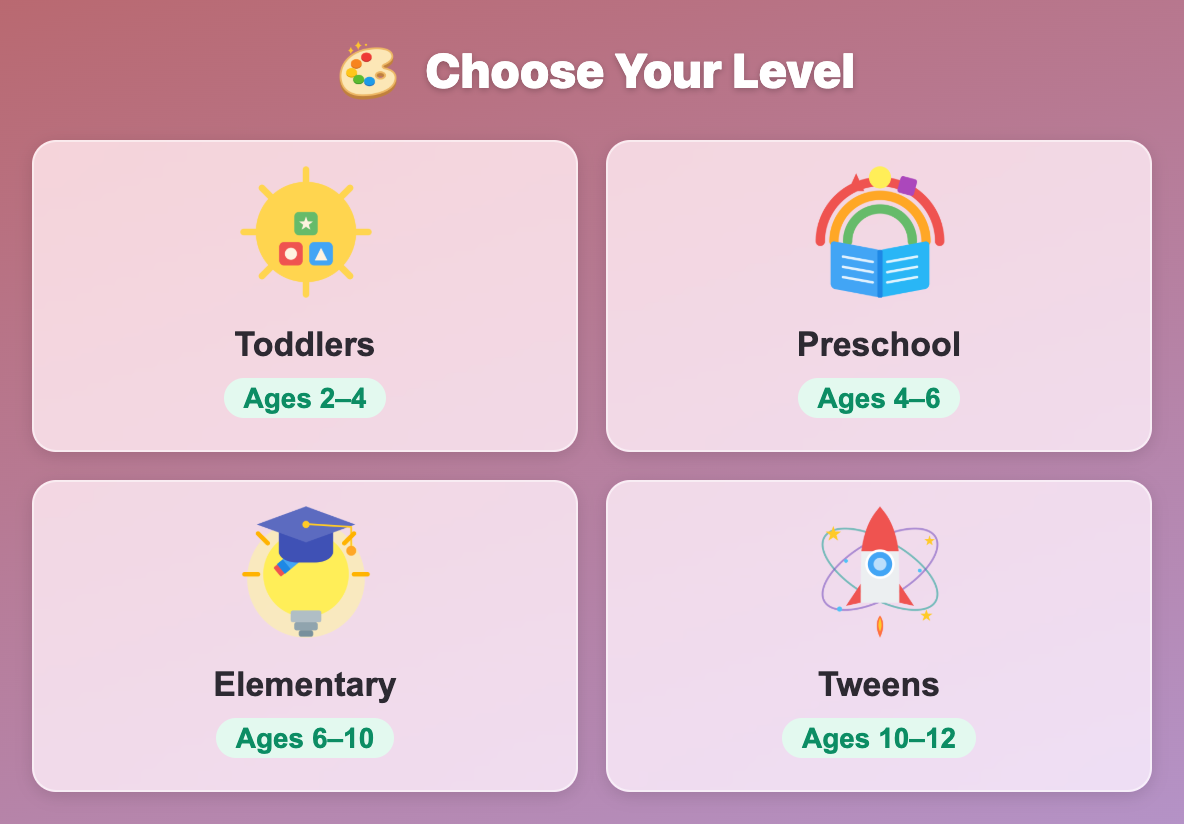
Pick your level. If you’ve never played, the game starts you on Elementary. Tap Change Level at the top right to see all four cards: Toddlers (ages 2–4), Preschool (ages 4–6), Elementary (ages 6–10) and Tweens (ages 10–12). The game remembers your choice next time.
Read the card. Look at the group chip and the job under it. On Elementary and Tweens, a third line gives the rule, like “A tint is a color mixed with white, so it looks lighter.”
Listen if you like. The round green 🔊 button reads the job out loud, then names every color or picture still standing. When the site’s sound is on, the game also reads each new round and each answer by itself.
Aim. Move your mouse over a tile and the crossbow turns to face it, with a red target circle on the tile. On a keyboard, the ← and → arrows move your aim from tile to tile.
Shoot. Tap or click a tile. Or press Space or Enter to shoot the tile you’re aiming at. You can also press a number key: 1 shoots the first tile, 2 the second, and so on.
Watch what happens. Hit the odd color and it bursts into sparkles. Hit a color that belongs and your arrow bounces off a magic shield. Either way, a message under the tiles explains it, like “Keep red! It is in the red family.”
Use the glow if you’re stuck. After a miss or two, the odd tile starts to glow and the message says “Look! The glowing one does not belong.” So every round always ends with the right answer.
Keep an eye on the top of the scene. The blue badge on the left counts rounds (1/10, 2/10…). The ⭐ badge on the right shows your points. A 🔥 badge appears with your streak when you get rounds right on the first shot in a row.
See your result. After round 10, a result card shows up to five stars, your score out of 100, how many rounds you got on the first try, your missed shots and your best streak. Any color you missed is listed under “Practice these again”.
Go again. Tap Play Again for 10 fresh rounds, or Change Level to try another age. Around the game on the page you’ll also find buttons for fullscreen, reload (a fresh start) and music on or off.
Scoring is simple. A round is worth 10 points. Each missed shot takes away 3. So a round with no misses earns 10, one miss earns 7, two misses earn 4, and three misses earn just 1. There is no timer at all, so you never lose points for thinking.
🖌️ Painter’s Secrets for Spotting the Odd Color
Since there’s no clock, the best players aren’t the fastest. They are the ones who stop, think like a painter, and then shoot once. Here’s how to do that.
Read the chip before you look at the colors
The same colors can be right in one round and wrong in the next. Blue belongs in “Cool colors” but is the odd one in “Warm colors”. Pink is out in “Primary colors” but in for “The red family”. So read the group name first, every round. Then look at the tiles with that one question in mind.
Count how many arrows you need
The job tells you how many odd tiles there are: “Shoot the one…” or “Shoot the 2…”. On the Tweens level there are always two. When you hit the first one, the message ends with “One more!” Don’t relax yet. The round isn’t over until both are gone.
Ask: what paints make this color?
Many groups are about mixing. Primary colors (red, yellow and blue) can’t be mixed from other paints. Secondary colors are two primaries mixed: red and yellow make orange, yellow and blue make green, red and blue make purple. Tertiary colors mix a primary with a secondary, so their names have two parts, like red-orange or blue-green.
So in a “Primary colors” round, look for any color you could make. In a “Tertiary colors” round, look for the color with a one-word name. If mixing is your favorite part, Color Mixing lets you guess what two paint blobs turn into when they swirl together.
Think “sun and fire” or “water, ice and leaves”
The game’s own rule says warm colors make us think of sun and fire. Cool colors make us think of water, ice and leaves. So picture each blob. Is it a flame, a pumpkin or golden honey? Warm. Is it grass, the sea or the night sky? Cool. The game’s messages use these same pictures, like “Navy is a cool color, like the night sky.”
Colors can carry feelings, too. If you like that idea, Mood Palette asks you to pick the color that fits a mood or a place before the time runs out.
Light or dark? Think about what was mixed in
A tint is a color mixed with white, so it looks lighter, like pink, peach or mint green. A shade is a color mixed with black, so it looks darker, like maroon or navy. In a “Tints” round, the odd one is the deep, dark blob. In a “Shades” round, it’s the pale one.
A color family is one color made lighter and darker. The red family runs from light pink to pink, red, dark red and maroon. So in a family round, the odd one is a completely different color, not just a lighter or darker one.
Black, white and gray stand apart
Neutral colors are black, white and every gray in between. In a “Neutral colors” round, any rainbow color is the odd one. In a “Rainbow colors” round it’s the other way around: brown, black, gray and white are the ones that don’t belong, because there is no brown in a rainbow.
Use the color wheel picture on the card
On Tweens, some rounds show a little color wheel on the card. That’s your map! For “Analogous colors” (colors that sit side by side on the wheel), find four tiles that make a row on the wheel. The two left over are your targets.
For “Complementary colors” (colors that sit opposite each other), match every color with its partner across the wheel. On this painter’s wheel the partners are red and green, orange and blue, yellow and violet, red-orange and blue-green, yellow-orange and blue-violet, and yellow-green and red-violet. Any color whose partner isn’t on the board is a target.
Picture the real thing, not the word
On the two youngest levels, the tiles are pictures. On Preschool, the odd one is often a close color, like a carrot or an orange heart among red things. Close isn’t the same! Ask, “Is a carrot really red?” It’s orange, so it goes.
Check your aim before you let go
With a mouse or the arrow keys, the target circle shows where your arrow will land before you shoot. Take one second to look. A miss costs 3 points, and it also breaks your 🔥 streak. One careful shot is worth more than three quick ones.
Let every bounce teach you
When your arrow bounces off the shield, read the message. It tells you why that color stays, like “Keep orange! It is a warm color, like a pumpkin.” That reason often points straight at the real odd one. And the “Practice these again” list at the end is a perfect short list for next time.
🧪 Can You Solve These Rounds?
Here are real kinds of rounds from the game. Read each row, find the odd color in your head, then check the answer.
Toddlers, Red things: banana · red heart · ladybug · fire truck
Say each color out loud. The heart is red. The ladybug is red. The fire truck is red. The banana is yellow! Shoot it, and the game says, “A banana is yellow, not red.”
Preschool, Red things: apple · cherries · fire truck · strawberry · carrot
This one is trickier, because a carrot is close to red. But close isn’t the same. The carrot is orange, so it’s the odd one: “A carrot is orange, not red.”
Preschool, Primary colors: red · yellow · blue · green
Only three colors can’t be mixed: red, yellow and blue. Green can be made, so it’s out. The game explains: “Green is not a primary color. Yellow and blue make green.”
Elementary, Cool colors: blue · sky blue · navy · green · orange
Read the rule: cool colors make us think of water, ice and leaves.
Blue is water. Sky blue is a summer sky. Navy is the night sky. Green is leaves.
Orange is a pumpkin. That’s warm! Shoot it: “Orange is a warm color, like a pumpkin.”
Elementary, Tints: pink · peach · mint green · lavender · navy
Tints are colors mixed with white, so they look soft and light. Four of these look pale and gentle. Navy is deep and dark, so it’s a shade: “Navy is a shade: blue mixed with black.”
Tweens, Analogous colors: violet · yellow-green · red-violet · red · red-orange · green
Remember the wheel is a circle, so the row can wrap from red-violet back round to red.
Find the row: violet, red-violet, red, red-orange. Those four sit side by side.
Yellow-green and green are left over. They’re far away on the other side of the wheel, so shoot both.
The game sums it up: “Violet, red-violet, red and red-orange sit side by side on the color wheel.”
Tweens, Complementary colors: orange · blue · yellow · violet · red-orange · yellow-green
Match the partners. Orange and blue are opposite each other. So are yellow and violet.
Red-orange needs blue-green, which isn’t here. Yellow-green needs red-violet, which isn’t here either.
So red-orange and yellow-green are the two targets. The message for one says, “Red-orange’s partner is blue-green, and blue-green is not here.”
🪜 Magic Crossbow: Odd Color Out for Kids, From Age 2 to 12
Every level has the same crossbow and 10 rounds a game, but the color groups grow up with you.
🐣 Magic Crossbow: Odd Color Out for toddlers (ages 2–4)
Toddlers see four big pictures and no words: three things of one color and one of a very different color, like a whale among yellow things. The groups are red, yellow, green, blue, orange, purple, pink, white, brown and black things. After just one miss, the odd picture glows. A grown-up can help by pointing and naming each color together, then letting the child tap.
🎨 Magic Crossbow: Odd Color Out for preschoolers (ages 4–6)
The Preschool level adds names under the tiles and some real art words: primary and secondary colors, rainbow colors, and light and dark colors. The picture rounds come back too, but the odd one is closer now, like a lemon among green things. The glow still helps after one miss.
📚 Magic Crossbow: Odd Color Out for elementary kids (ages 6–10)
Elementary kids get paint blobs and a rule on every card. They learn warm and cool colors, tints and shades, neutral colors, tertiary colors, and the blue and red families. The glow waits for two misses, so there is more time to think it through.
🚀 Magic Crossbow: Odd Color Out for tweens (ages 10–12)
Tweens get six tiles and two odd colors in every round. The color wheel rounds (analogous and complementary) are made fresh each time, so you can’t just remember the answers. The warm and cool rounds come back with harder in-between colors like yellow-orange and blue-violet, along with tint, shade and tertiary rounds. Tweens who enjoy this kind of hunt can try Magic Crossbow: Line Hunt, which uses the same crossbow to hunt zigzag, spiral and dotted lines.
💡 What Kids Take Home From a Color Hunt
Art words that stick. After a few games, words like tint, shade, tertiary and complementary stop sounding strange. Your child hears them, sees them on the card and reads them in the messages, again and again.
Smarter painting. A child who knows that yellow and blue make green doesn’t need to guess at the easel. Knowing warm and cool colors helps a sunset picture feel warm and a snowy picture feel chilly.
Stopping to check. Every bounce off the shield costs 3 points. That gently teaches kids to look at the target circle and think before they act.
Sorting and reasons. Each round is a small puzzle: what makes these colors a team, and who doesn’t fit? The message after every shot gives a reason in a short sentence, so kids practice reading, too.
Lots of new color names. Maroon, lavender, peach, navy and mint green aren’t in every crayon box. Here, each one comes with its own paint blob.
A note for grown-ups
The game is gentle and bright: a sunny meadow, smiling trees and a sparkly arrow, with nothing scary. There’s no timer, so no rushing. A color is only put in or out of a group when art books agree. For example, yellow-green and purple are left out of the warm and cool rounds, and brown is left out of the neutral round, so a child is never marked wrong for a fair answer. It’s a nice warm-up before real painting at home: let your child mix the colors they just shot!
Your crossbow is loaded and the meadow is waiting. Pick a level, read the card, and see how many odd colors you can pop in 10 rounds. Grab a grown-up or a friend and give Magic Crossbow: Odd Color Out for kids a try today. 🏹🎨
🖼️ See the Game in Action
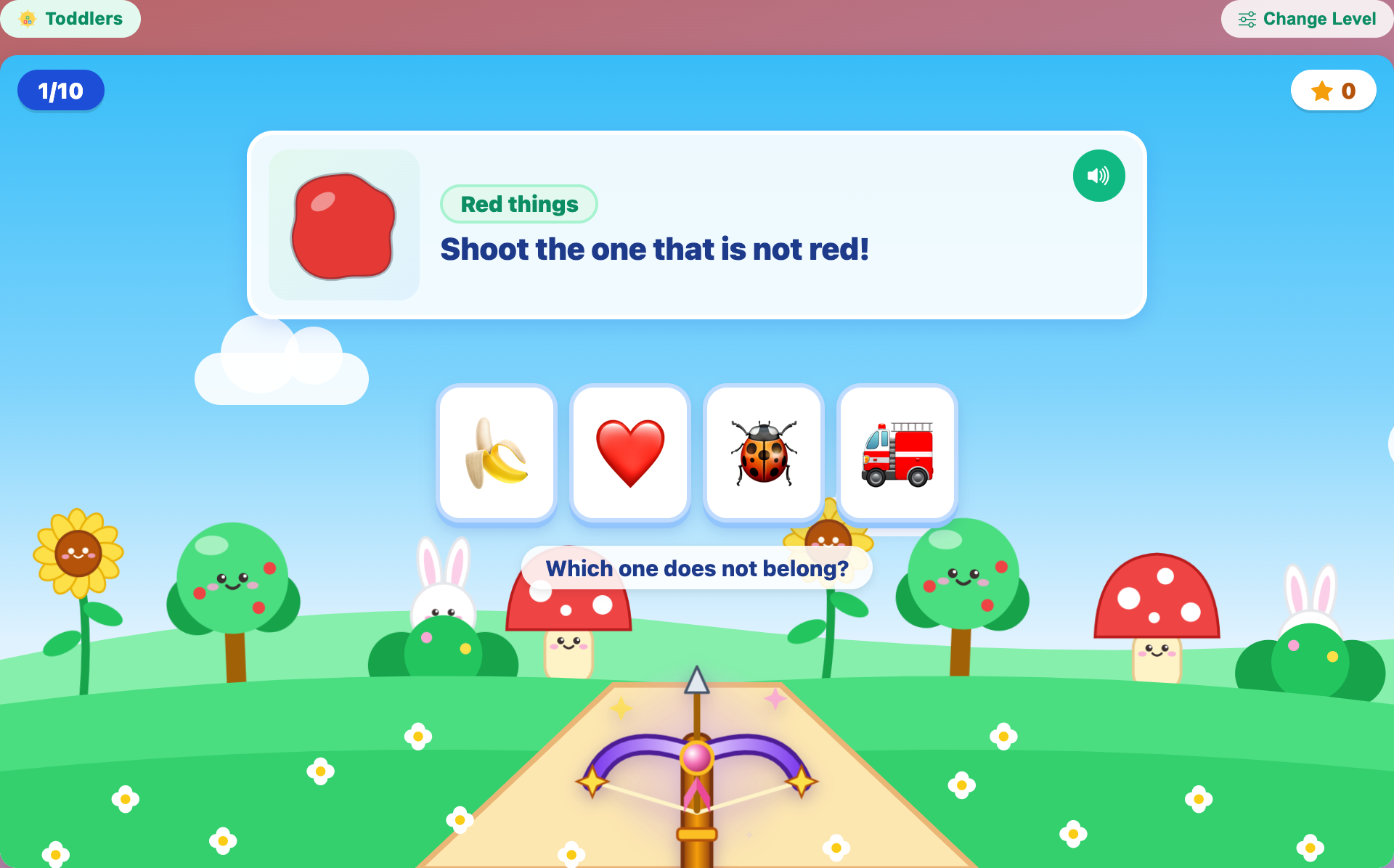
A Red things round for toddlers with a banana, a red heart, a ladybug and a fire truck above the magic crossbow
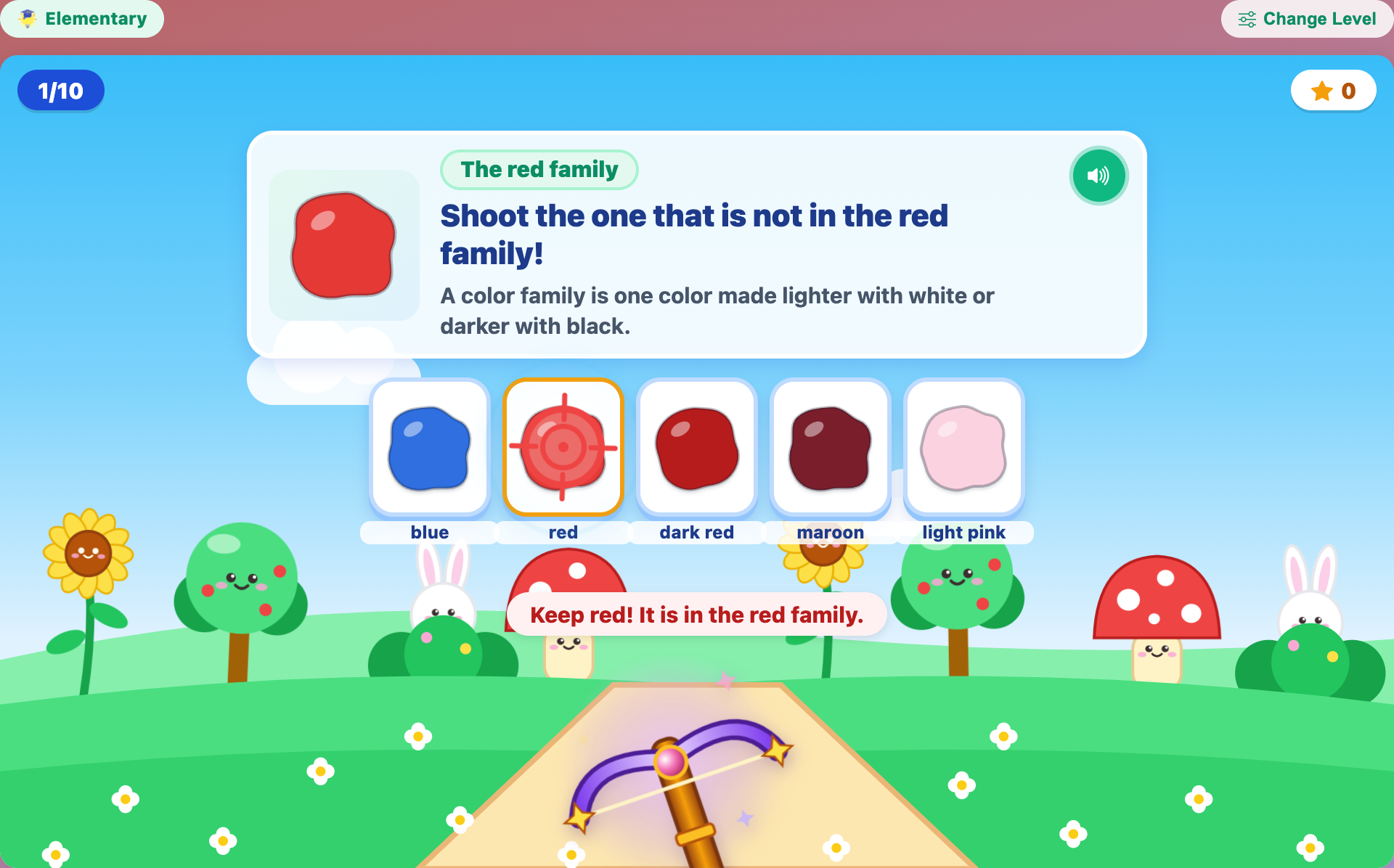
An arrow bouncing off the red tile in The red family round, with the message Keep red! It is in the red family
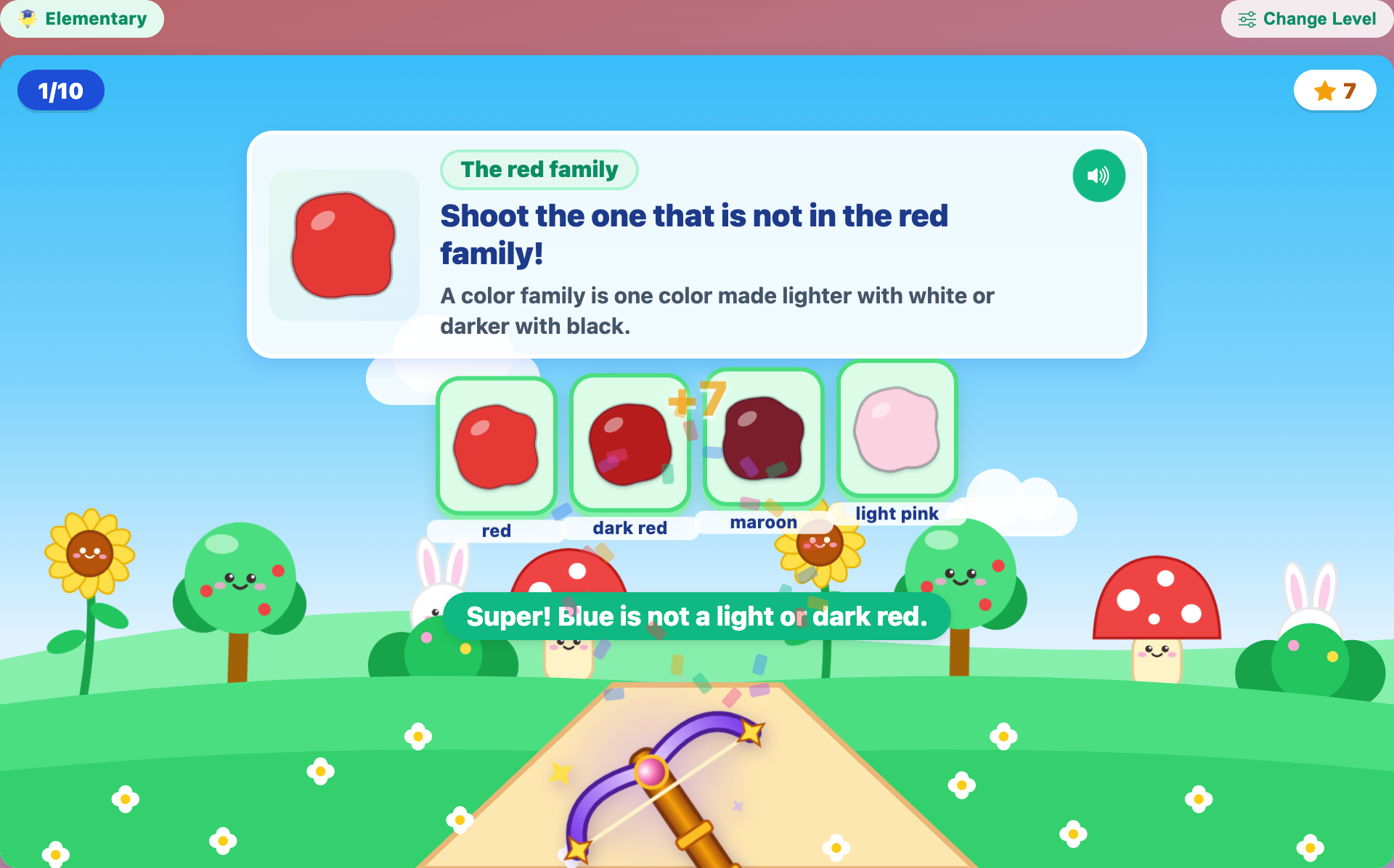
The red family round solved after the blue blob burst, with confetti and the message Blue is not a light or dark red
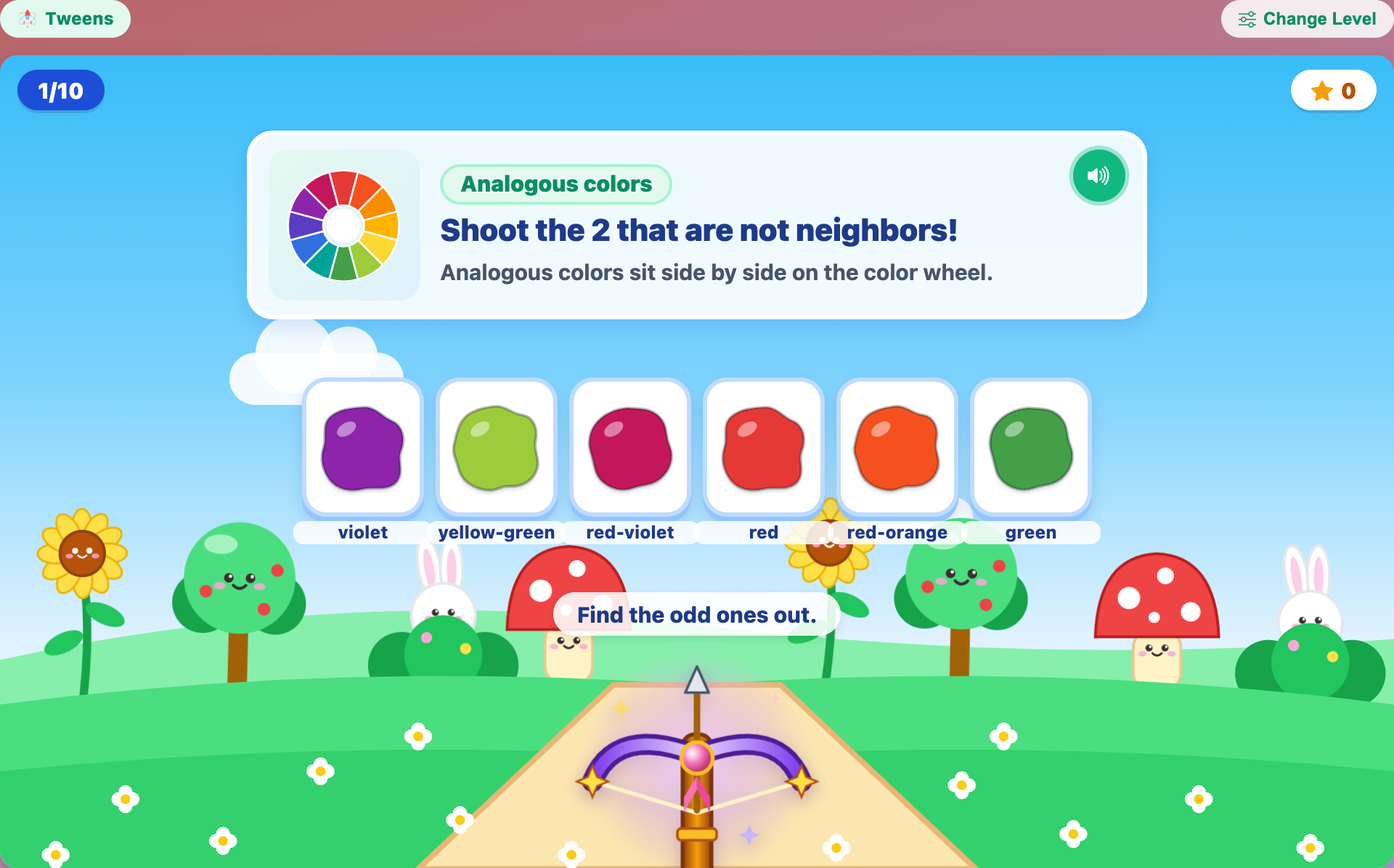
An Analogous colors round in Magic Crossbow: Odd Color Out for tweens, with six paint blobs and a color wheel on the card
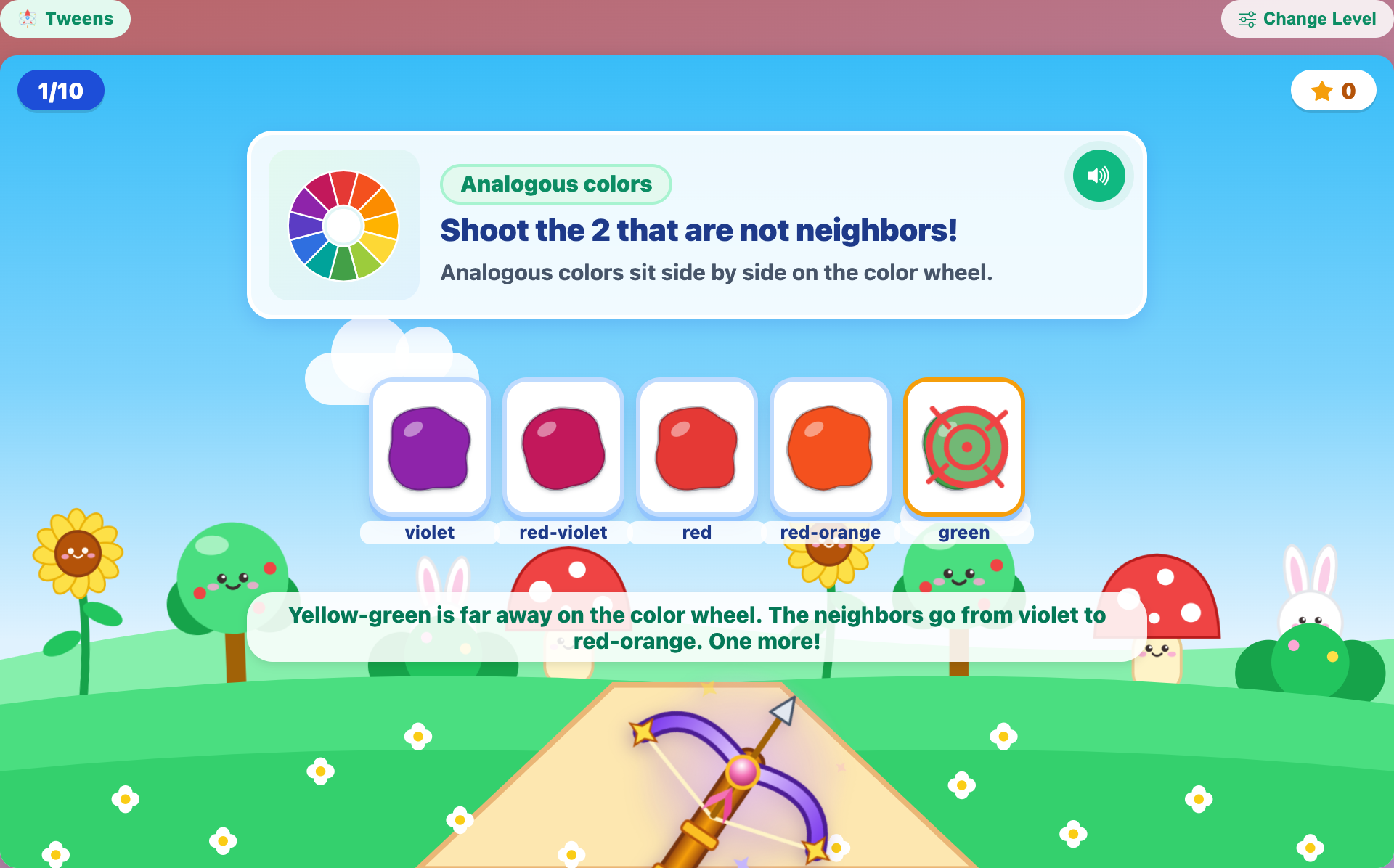
The crossbow aiming at green after yellow-green burst, with a message saying the neighbors go from violet to red-orange
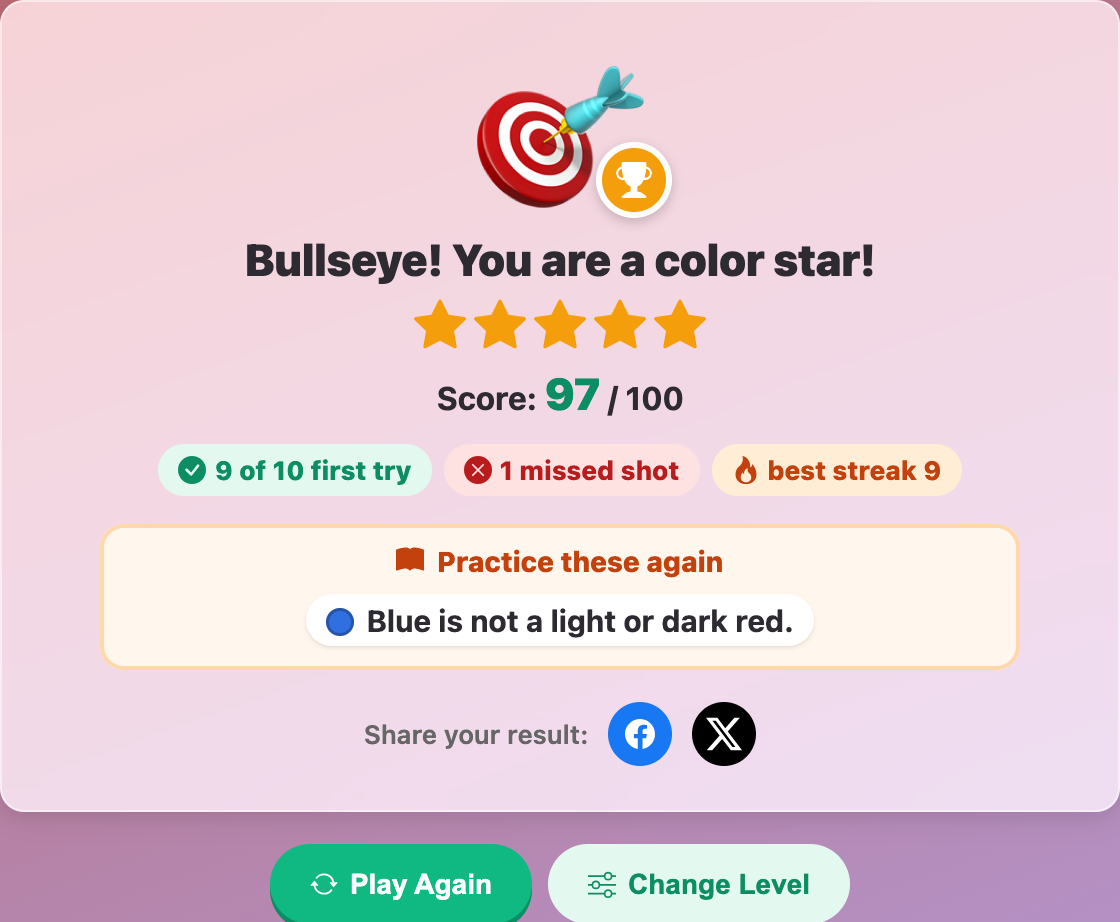
The result card in Magic Crossbow: Odd Color Out for kids, with five stars, a score of 97 out of 100 and a Practice these again list
More Art Games
 1.8M plays
4.9
Color & Draw
A free-drawing canvas with colors and brush sizes to unleash your creativity.
 154.5K plays
5.0
Mood Palette
Decide which color best fits a mood or theme before time runs out.
 584.9K plays
5.0
Tiny World Builder
Start with a tiny empty island and build your own blocky village — plant grass and trees, lay roads, and unlock houses, farms, a school and more!
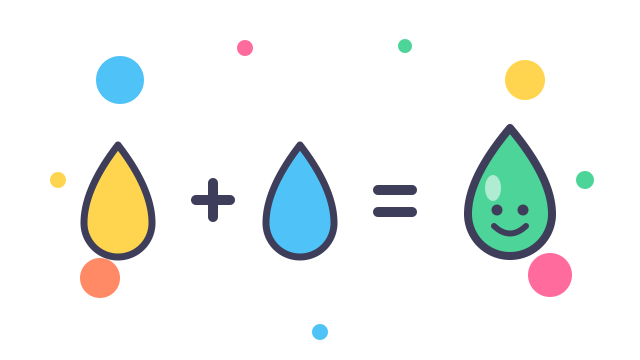 174.6K plays
4.9
Color Mixing
Look at two paint colors and pick which color they mix together to make.
Most Played Games
1.8M plays
4.9
Color & Draw
A free-drawing canvas with colors and brush sizes to unleash your creativity.
 59.5K plays
4.8
Recycling Sort
Sort everyday items into the Recycle, Compost, or Trash bin before time runs out!
 365.8K plays
5.0
Tic-Tac-Toe
Play a game of Tic-Tac-Toe against the computer and see if you can outsmart it.
 274.1K plays
5.0
Sentence Builder
Pick your age level, then tap the shuffled words in the right order to build the sentence.
Comments (16)