
Tint & Shade Ladder
52.6K playsClimb the color ladder! A color sits in the middle, with lighter tints above it and darker shades below, but some rungs are still blank. Mix drops of white or black into your paint pot until it matches the sample, then paint the rung. Too much white? Add more color to fix it, just like a real painter. The closer the match and the fewer the drops, the more points you earn. Little artists paint short ladders with help from the pot, big kids judge by eye and mix tones with gray too.
Here is a color secret: pink is really red with white mixed in, and navy is really blue with a little black. Painters have special names for colors like these. In Tint & Shade Ladder for kids, you mix them yourself, one drop at a time.
Every round shows a wooden ladder. One color sits on the middle rung, like red, teal or purple. The rungs above it get lighter, and the rungs below it get darker. A few rungs are still blank, each with a little dot of the color it needs. You fill them by mixing paint in a glass pot until your paint matches the dot. When the last rung is painted, the whole ladder glows from the palest color at the top to the deepest one at the bottom.
🪜 Tint & Shade Ladder for Kids: Lighter Up, Darker Down
A rung is one step on a ladder. In this game, every rung is a different version of the same color. There are three kinds:
Tint = the color + white. A tint is lighter. Pink is a tint of red.
Shade = the color + black. A shade is darker. Navy is a shade of blue.
Tone = the color + gray. A tone is duller, which means less bright, a bit like a color on a cloudy day. Only the Tweens level mixes tones.
Artists call how light or dark a color is its value. Painters learn to mix a ladder of values early on. Light parts and shadows are what make a painting look real.
The game uses six ladder colors: red, orange, green, teal, blue and purple. Yellow is left out on purpose. It is so light already that its tints would hardly change. A ladder where every rung looks the same would not be fair.
Here is the one rule that makes every puzzle work: your pot never starts empty. It already holds a few drops of the ladder's own color. Your job is to add just the right drops of white, black or gray. Sometimes you add more of the color, too. That slides your paint up or down the ladder.
🖌️ Painting a Ladder on KidWorld, Screen by Screen
Choose your level. The Choose Your Level screen has four cards: Toddlers, Preschool, Elementary and Tweens. Each card says how many ladders you get and what you will mix. The game remembers your choice, and the Change Level button at the top right brings the cards back any time.
Read the ladder. The ladder stands on the left. Labels above and below it remind you which way is which, such as "Lighter: add white" and "Darker: add black". Blank rungs are striped, with a "?" and a dot of the color they need. The first blank rung gets a gold border, so you know where to start.
Pick a rung. To work on a different blank rung, tap it, or press the ↑ and ↓ arrow keys. Each rung keeps its own pot, so you can switch back and forth.
Compare two colors. On the right, the big square marked "Match this" shows the rung's color. Next to it is the glass pot marked "Your paint".
Tap a bottle to add a drop. The bottles stand on a little shelf: White, Black, the ladder's own color, and on the Tweens level also Gray. Each tap tips one drop into the pot. You can also press the number keys 1 to 4. Under the shelf, a line says what is in the pot ("In the pot: 3 red + 2 white") and how many drops you have added.
Listen to your helper. On the two youngest levels, the pot tells you what to do next, like "Too dark. Add a drop of white!" On Elementary, a "How close?" bar fills up as your paint gets closer. On Tweens there is no helper at all: you judge with your own eyes.
Tap Paint it! (or press Enter). Your paint fills the rung, and a message pops up: "Perfect match!", "So close!", "Nearly" or "Not quite". A perfect rung gets a gold star.
Start over if you need to. Empty pot (or the Backspace key) pours out your mix and leaves just the color you started with. The drops you already poured still count in your drop total, so it is not a free do-over.
Ask for a hint. Elementary and Tweens get 2 💡 Hints per ladder (the H key works too). A hint tells you the next drop to add and makes that bottle glow for a few seconds.
Check your ladder card. When every blank rung is painted, a card such as "Green ladder painted!" lists each rung. Two dots sit side by side, the sample and your paint, with the recipe, your rating, your drops and your points. Tap Next Ladder to go on.
See all three ladders. After the third ladder comes the "Your color ladders!" card. It shows tiny copies of your ladders and the words you learned: tint, shade, and on Tweens, tone. Below them are a paint fact you can hear with 🔊, your score and 1 to 5 stars. Play Again starts three new ladders.
Use the page buttons. Fullscreen makes the ladder bigger, Reload starts the game fresh, and the music button turns the tunes on or off. The 🔊 button next to each task reads it out loud.
🧮 How Each Rung Earns Up to 10 Points
Every blank rung is worth up to 10 points, split into two parts:
Up to 6 points for the color. A perfect match earns 6, "So close!" earns 4, "Nearly" earns 2, and "Not quite" earns 0.
Up to 4 points for using few drops. The game knows the fewest drops that can make each rung. Use that many or fewer and you get all 4. Two extra drops still earn 3, and a messier mix earns 2 or 1. If the color is "Not quite", there are no drop points at all, because a cheap wrong color isn't a win.
On Toddlers and Preschool, the Paint it! button won't paint until your color really matches. Each time it says "Not yet!", the rung loses 1 point. On Elementary and Tweens, each hint costs 2 points. A rung can't go below 0.
A whole game is three ladders, so the best scores are 60 for Toddlers, 90 for Preschool, 120 for Elementary and 150 for Tweens.
🎨 Mixing Tricks From the Paint Pot
These tips all come from how the pot really mixes. Try them one at a time.
Start with one drop
Your pot already holds the ladder's color, so the rung right next to the middle often needs only one drop. Add one drop, then look at "Match this" and "Your paint" side by side. Only add another if the pot is still too far from the sample. Fewer drops means more points.
Count the steps away from the middle
The further a rung is from the middle color, the more drops it needs. The first tint above the color needs the least white, the next one needs more, and the very top tint needs the most. Shades work the same way going down. So if the middle rung is your friend, the top and bottom rungs are the big jobs.
Use the neighbors
A blank rung always sits between two other colors on the ladder. Your paint should look lighter than the rung below it and darker than the rung above it. If your pot looks lighter than the rung on top, you added too much white.
Too much white? Add more color
This is what real painters do. If your mix gets too light, you can't take white out of the pot. But you can add more of the ladder's color to pull it back. It costs drops, so it's better to go slowly at the start.
Never mix black into a tint
A tint is only the color plus white. If a drop of black sneaks in, the pot can never match exactly, and on the young levels it will say "Oops! That won't match now. Empty the pot and try again." The same goes for white in a shade. Check which bottle you are tapping, or use the number keys (white is always 1 and black is always 2).
A bigger batch can still match
2 drops of green + 1 drop of white makes the same color as 4 green + 2 white. The pot only cares about the mix, not the size. That's handy for fixing mistakes: if you poured one white too many, adding color until the mix is "doubled" brings it right back.
For tones, forget about light and dark
Each ladder's gray is exactly as light as the color itself. So a tone isn't lighter or darker, only duller. When you mix a tone, ask yourself one question: "Is my paint as gray as the dot?" Then add gray until it is.
Save your hints for the last rungs
Hints are shared by the whole ladder, and there are only 2. Use your eyes on the easy rungs next to the middle. Keep a hint for the top tint or the bottom shade, where colors are hardest to tell apart.
🔍 Five Rungs to Mix in Your Head
A Toddlers red ladder
The ladder has three rungs: a light red on top, red in the middle, and a dark red below. The task says "Make it darker! Add black." The black bottle glows. One tap, then Paint it!, and the rung is perfect: 6 points for the color and 4 for using one drop. That's a full 10.
A Preschool green tint
The pot starts with 2 drops of green. The sample is a soft, light green, the first tint above the middle. One drop of white, and the pot says "Just right! Tap Paint it!" The ladder card then shows the recipe: "Tint: 2 green + 1 white".
An Elementary orange that went too pale
The pot holds 3 drops of orange, and the rung needs 2 drops of white. Say you pour 3 whites by accident. Now the mix is too light, and the How close? bar drops. You have two ways out:
Keep going. 3 orange + 2 white is the same color as 6 orange + 4 white. So add 3 more orange and 1 more white. That's 7 drops in all.
Tap Empty pot and pour 2 whites. That's the 3 drops you already used plus 2, so 5 drops in all.
Both ways give a perfect color, but with so many drops, the rung earns 8 points instead of 10. Next time, you'll stop after two!
An Elementary blue shade, with a hint
The bottom rung of the blue ladder is very dark, almost like the night sky. You poured some black but aren't sure if it's enough. You tap 💡 Hint, and the helper says something like "Too light. Add a drop of black!" while the black bottle glows. You add one, the How close? bar turns green, and you paint. The hint costs 2 points, but a perfect color is still worth it.
A Tweens purple tone
On Tweens, the two tones sit on a shelf under the ladder, labeled "tone". The first tone looks only a little grayer than purple, so it needs just a drop or two of gray. The second tone is clearly duller, so it needs more. Gray doesn't change how light the paint is. So watch how bright the color is. Is your purple as bright as the sample, or as dull?
🧒 From Tiny Painters to Big Ones
Tint & Shade Ladder for toddlers
Toddlers (ages 2 to 4) get short ladders of three rungs, with two blank rungs to paint. Each one needs a single drop, and the right bottle glows so little hands know where to tap. When the site's sound is on, the game reads the task aloud ("Make it lighter! Add white."). A grown-up can sit beside them and say the words "lighter" and "darker" together.
Tint & Shade Ladder for preschoolers
Preschoolers (ages 4 to 6) paint three blank rungs on ladders of five. Some rungs need one drop and some need two or three. The pot always says what to add, and if Paint it! is pressed too early, the right bottle starts to glow. Tasks and the pot's advice are read out loud when sound is on. Do they love finding the lightest and the darkest? Then they can also hop through Rainbow Temple Escape. It's a bunny run whose gates ask color questions like which paint is the darkest.
Tint & Shade Ladder for elementary kids
Elementary kids (ages 6 to 10) get full ladders of seven rungs, with four blanks to paint. The pot no longer tells them what to add. Instead, the "How close?" meter fills up as the color gets closer. The labels use the real art words: "Tints: + white" and "Shades: + black". Two hints per ladder help on the hard rungs.
Tint & Shade Ladder for tweens
Tweens (ages 10 to 12) paint five blank rungs. They are spread over a seven-rung ladder and a shelf of two tones, and a Gray bottle joins the shelf. There's no meter: the screen only says "Look closely, then add drops until the colors match." Pots start with 3 or 4 drops of color. That makes the steps between rungs smaller and harder to see. A perfect game here is worth 150 points.
🌈 Why a Paint Ladder Is Good for Growing Artists
It teaches light and shadow. One of the fact cards at the end says it well. Painters often paint a shadow with a shade of the object's own color, not plain black, so the picture stays colorful. A child who has mixed a blue ladder knows how to paint the dark side of a blue ball.
It trains careful eyes. The sample and the pot sit side by side, and some steps are tiny. Looking back and forth until two colors truly match is the same patient looking that drawing and painting need.
It sneaks in early math. "2 green + 1 white looks the same as 4 green + 2 white" is a first taste of ratios, like doubling a recipe. Counting drops against the fewest possible is a gentle push to plan before pouring.
It shows that mistakes can be fixed. Too much white isn't the end. Adding more color brings the mix back, just like on a real palette. Kids learn to repair, not give up.
If your child enjoys putting colors in order from light to dark, Rainbow Hue Sort turns that same skill into a tile-swapping puzzle. And when they're ready to mix brand-new colors from red, yellow and blue, Paint Match Lab hands them five paints and a target to match.
A note for grown-ups: there is no timer and no lives, nothing scary, and nothing to type. Young players hear their tasks read aloud, and the pot guides them so they always finish their ladder. The game practices color words, value, comparing, counting and patient problem solving.
Ready to climb? Pick a level, grab the white and black bottles, and see how many perfect rungs you can paint. Tint & Shade Ladder for kids turns every drop into a little art lesson.
🖼️ See the Game in Action
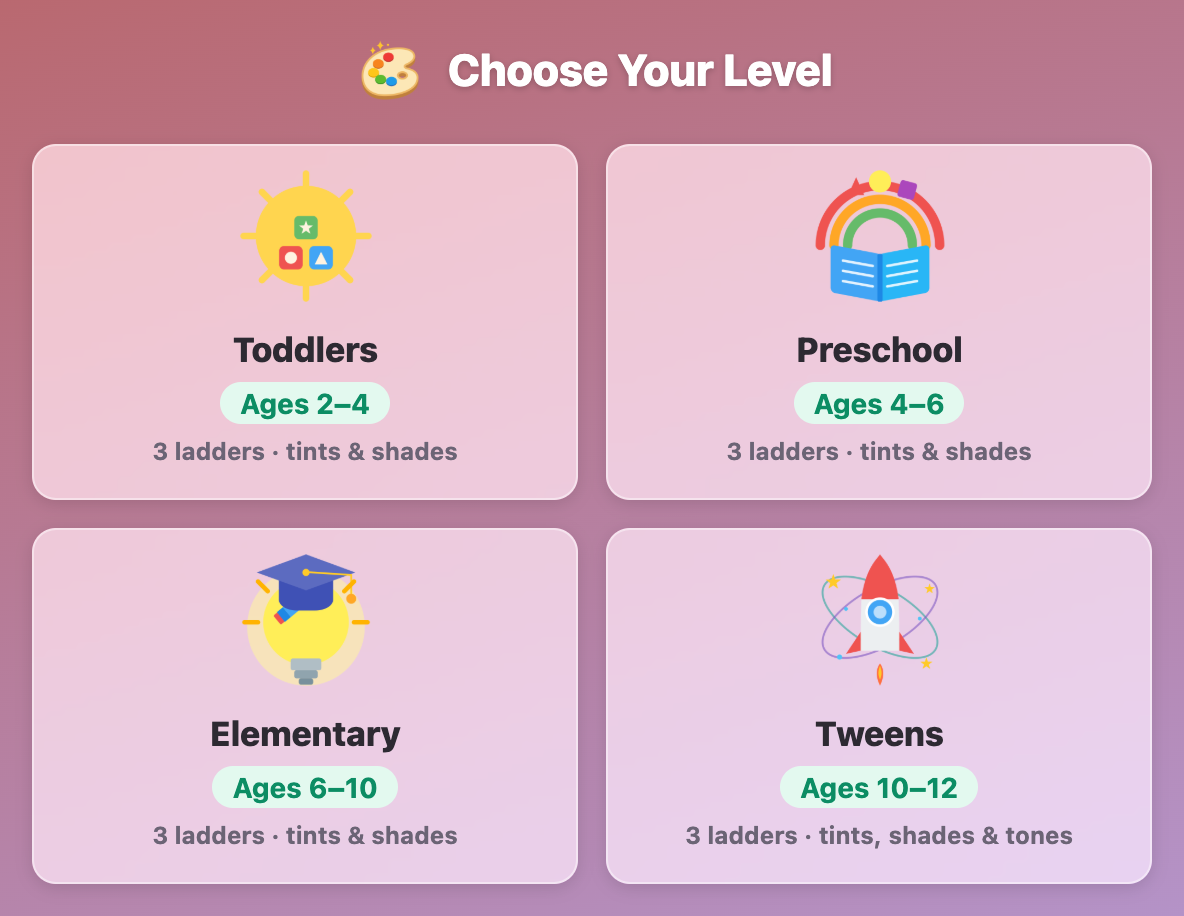
The Choose Your Level screen in Tint & Shade Ladder for kids, with Toddlers, Preschool, Elementary and Tweens cards
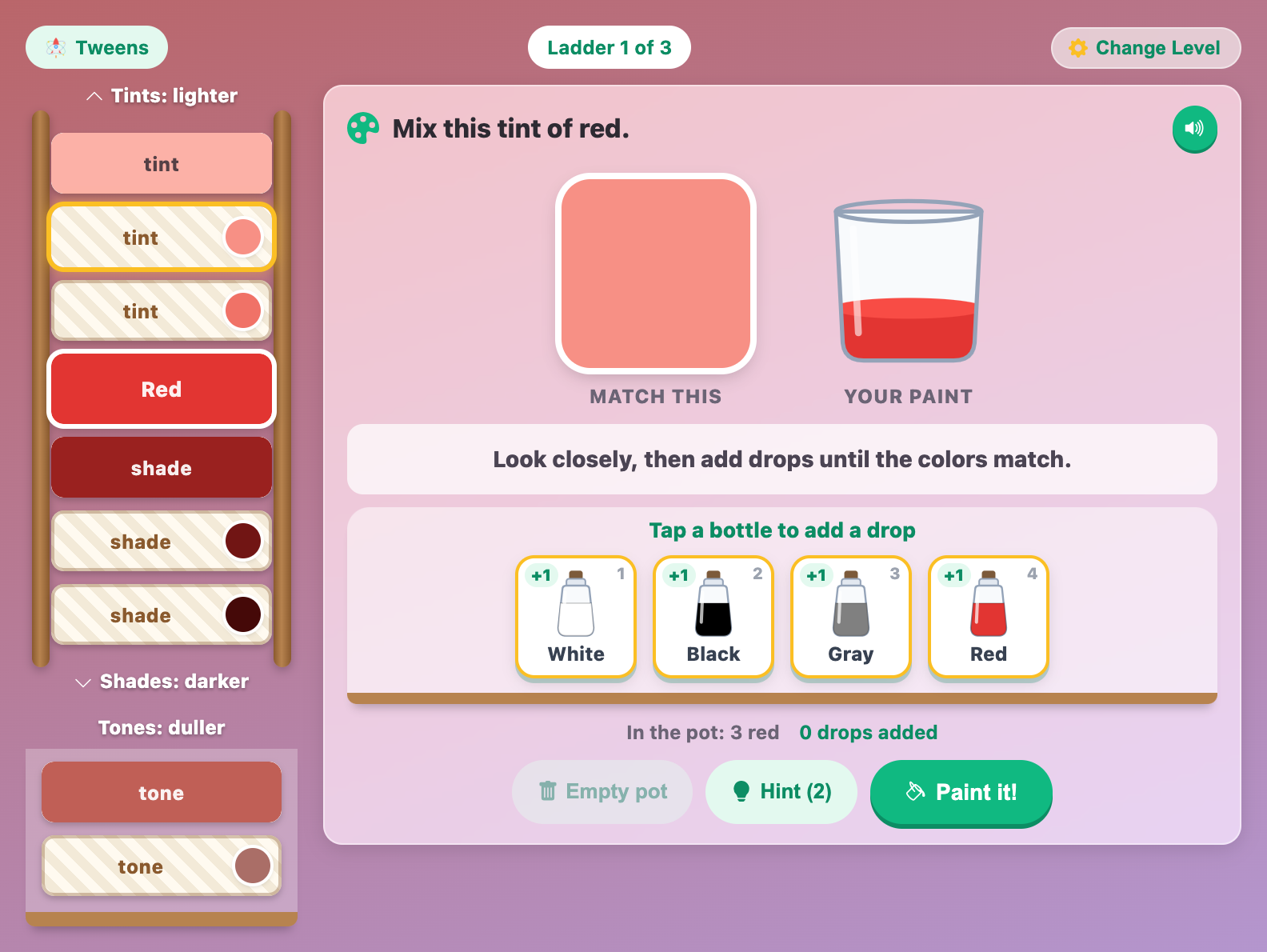
A red ladder in Tint & Shade Ladder for tweens, with tints, shades, two tones on a shelf and four paint bottles
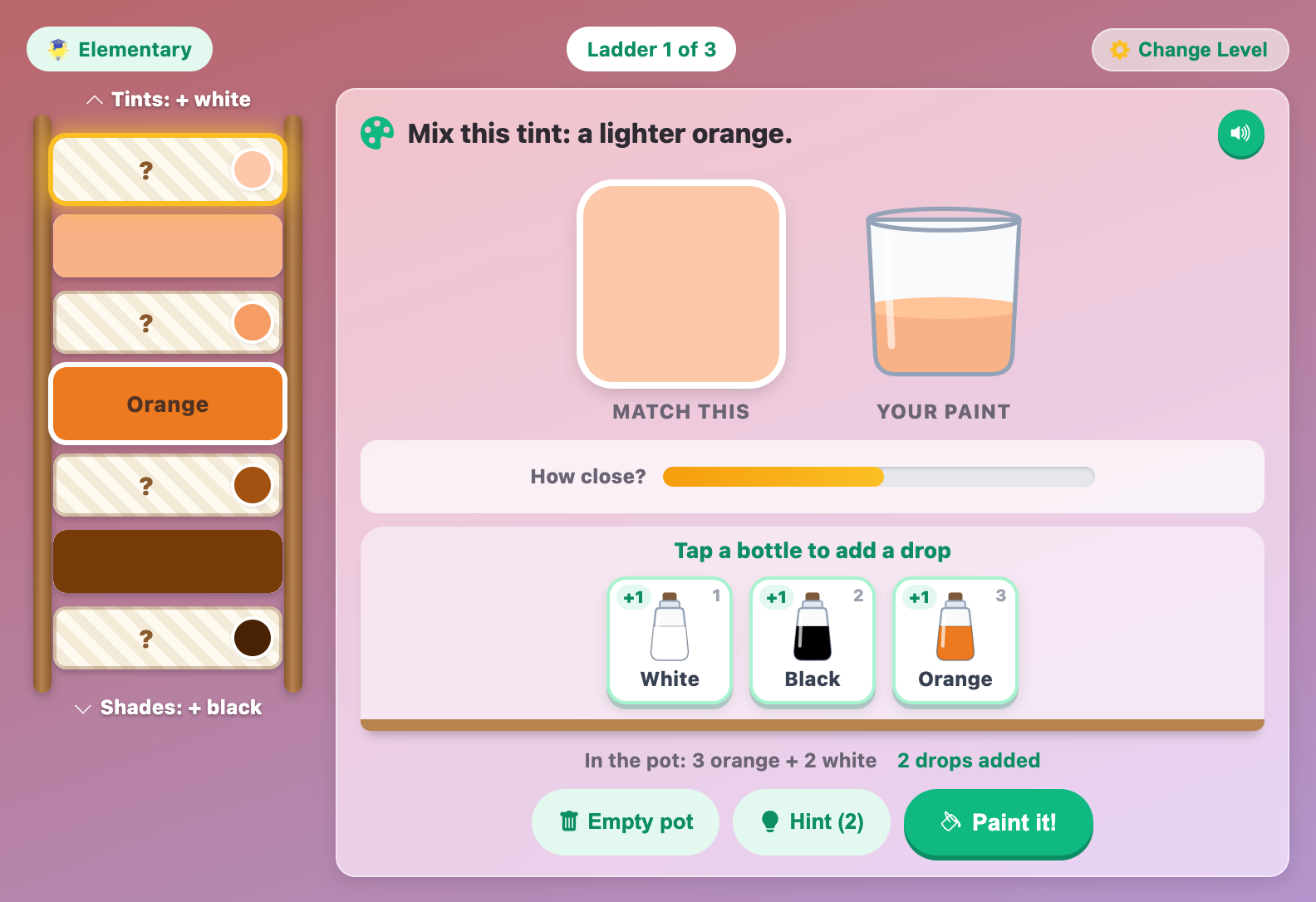
An orange ladder at the Elementary level with 3 orange and 2 white in the pot and a half-full How close meter
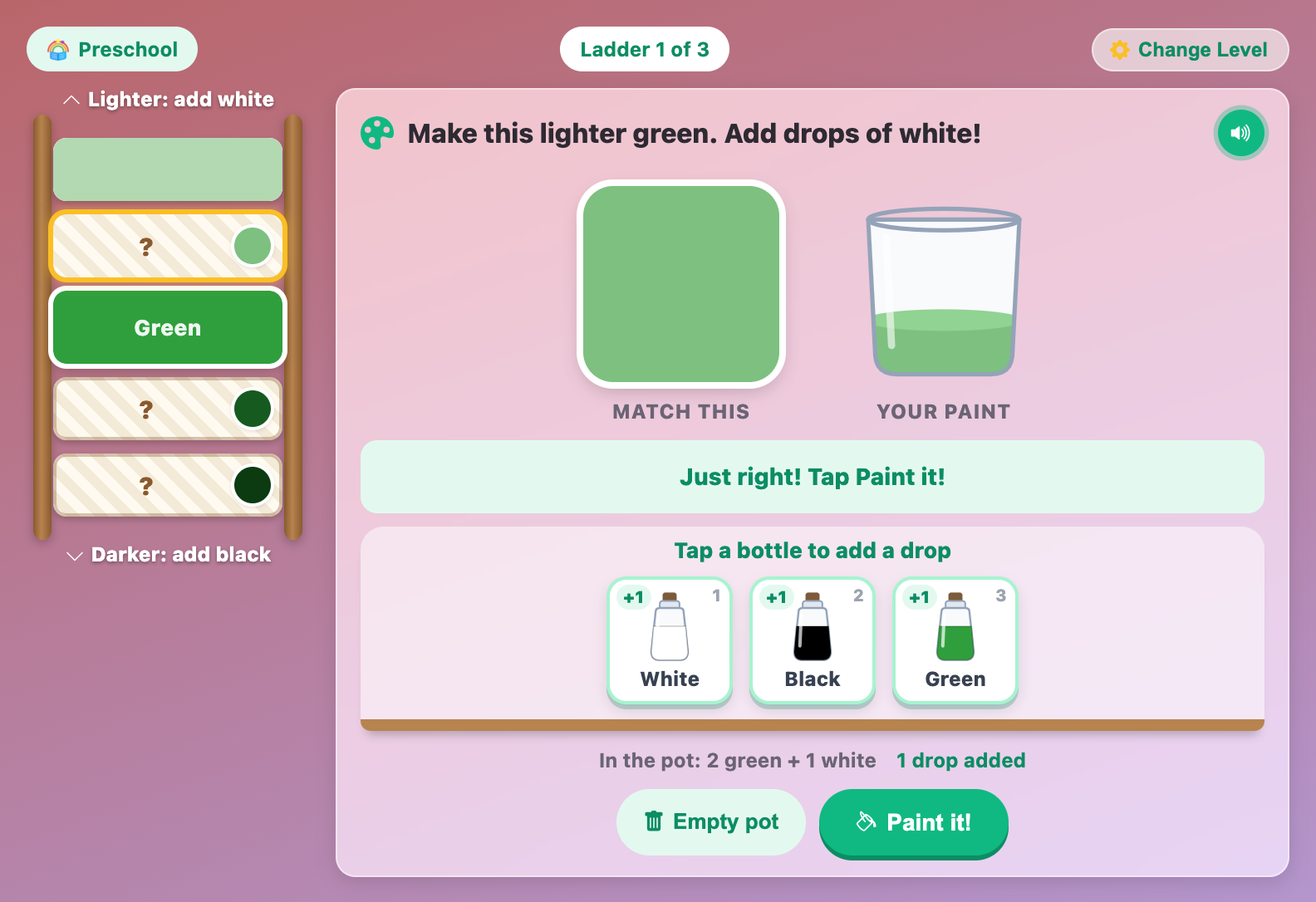
A green ladder at the Preschool level where the pot says Just right! Tap Paint it! after one drop of white
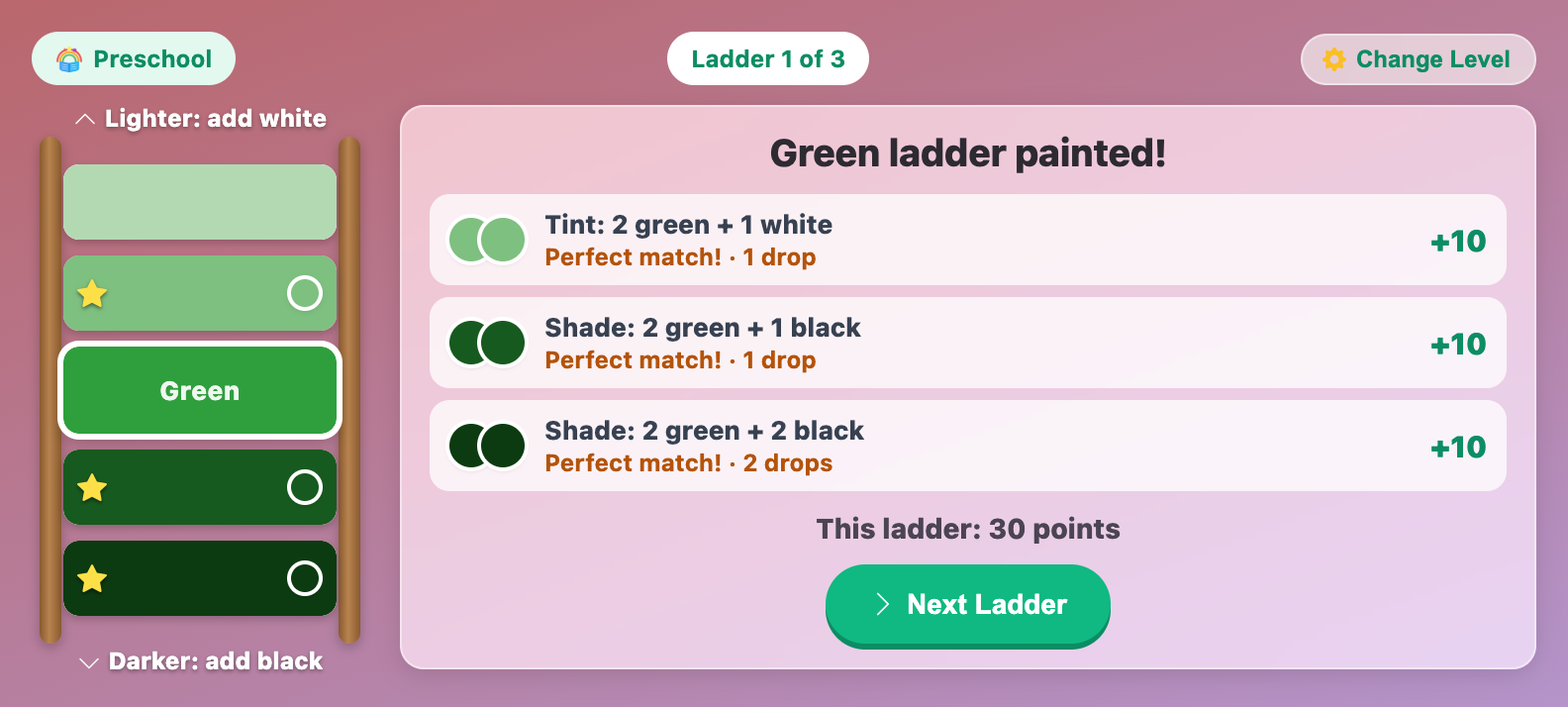
The Green ladder painted card, listing each rung recipe with a perfect match and 10 points for every rung
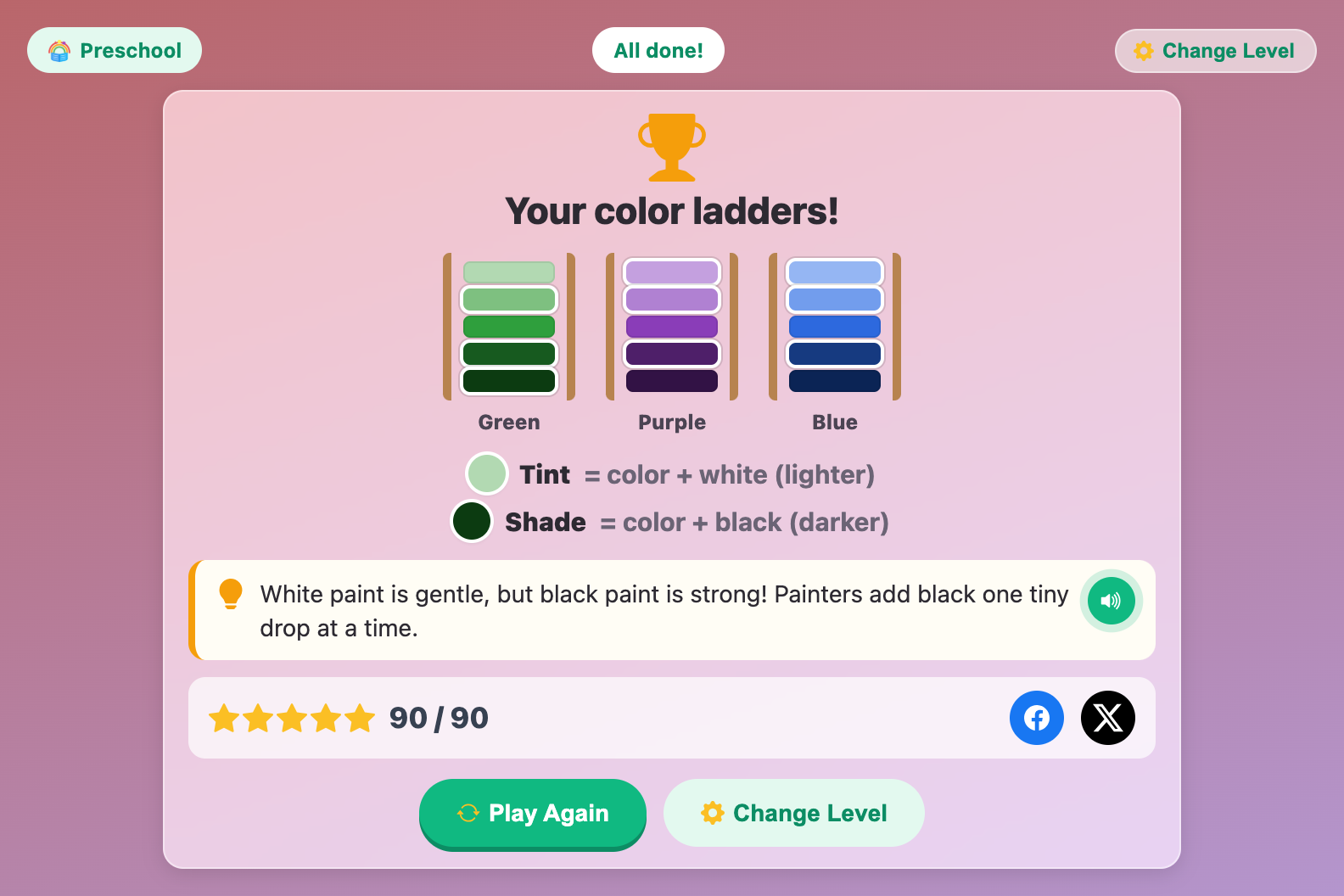
The finish card with green, purple and blue ladders, the tint and shade words, a paint fact and 90 out of 90
More Art Games
 1.8M plays
4.9
Color & Draw
A free-drawing canvas with colors and brush sizes to unleash your creativity.
 154.5K plays
5.0
Mood Palette
Decide which color best fits a mood or theme before time runs out.
 584.9K plays
5.0
Tiny World Builder
Start with a tiny empty island and build your own blocky village — plant grass and trees, lay roads, and unlock houses, farms, a school and more!
 174.6K plays
4.9
Color Mixing
Look at two paint colors and pick which color they mix together to make.
Most Played Games
1.8M plays
4.9
Color & Draw
A free-drawing canvas with colors and brush sizes to unleash your creativity.
 59.5K plays
4.8
Recycling Sort
Sort everyday items into the Recycle, Compost, or Trash bin before time runs out!
 365.8K plays
5.0
Tic-Tac-Toe
Play a game of Tic-Tac-Toe against the computer and see if you can outsmart it.
 274.1K plays
5.0
Sentence Builder
Pick your age level, then tap the shuffled words in the right order to build the sentence.
Comments (49)