
Paint Match Lab
172.6K playsBecome a color scientist! A target color waits next to an empty paint jar: add drops of red, yellow, blue, white and black and watch the paint swirl into new colors until it matches. The jar mixes just like real paint, so yellow and blue really make green, and all three primaries make brown. A match meter shows how close you are, and the closest matches earn three stars. Little artists mix orange, green and pink; big kids mix olive, chocolate, khaki and skin tones that need four or five paints.
Every color has a recipe. Orange is one drop of red and one drop of yellow. Salmon is two drops of red, one of yellow and three of white. Chocolate needs five different paints! In Paint Match Lab for kids, you are the color scientist who works out each recipe.
A target color sits on the left, next to an empty glass jar. You add drops of red, yellow, blue, white and black, and watch the paint in the jar swirl into new colors. A match meter tells you how close you are. When your jar looks like the target, you earn up to three stars. Then the game shows you the real recipe, so you can see how your mix compares.
🧪 Paint Match Lab for Kids: A Jar That Mixes Like Real Paint
Colors on a screen are made of light, and light mixes in a different way from paint. If a game simply blended screen colors, yellow and blue would turn a dull gray instead of green. Paint Match Lab is built to mix the way paint from a real paint box does. Each paint soaks up some colors of light and bounces back others, and the jar works out what a mix of them would look like. That's why:
Yellow + blue makes green, just like in art class.
Red + yellow + blue makes brown, the color of mud, bears and chocolate.
White makes a tint. A tint is a lighter color, like pink from red.
Black makes a shade. A shade is a darker color, like navy from blue. Black is strong, so a little goes a long way.
Red, yellow and blue are the primary colors: the three paints you can mix most other colors from. White and black help you make them lighter or darker.
One more thing makes the lab fair: only the color is judged, never the exact drops. Any mix that looks the same as the target counts. And a recipe made twice as big, like 2 red + 2 yellow instead of 1 red + 1 yellow, makes exactly the same color.
🔬 Running an Experiment on KidWorld
Choose your level. Each card on the Choose Your Level screen says what that level mixes. Toddlers use "Red, yellow, blue & white". Tweens mix "Browns, olives & skin tones". The game remembers your level, and the Change Level button switches it.
Meet your target. A big circle shows the color to match, with a little picture beside it (🍊 for orange, 🐸 for green, 🍣 for salmon) and its name underneath. Tap 🔊 to hear the name. The pill at the top says which color you're on, like "Color 1 of 5".
Add drops. Tap a paint to drop it into the jar, or press the number keys (1 is red, 2 yellow, 3 blue, 4 white and 5 black). A badge on each paint counts its drops. The small − button under a paint takes one drop of it back out. Under the jar, "2 / 12 drops" tells you how full it is. The jar holds 6 drops for Toddlers, 8 for Preschool, 12 for Elementary and 16 for Tweens.
Watch the match meter. The Match bar fills from 0% to 100%, with marks where you earn each star. Under it, little messages help. "Closer!" means your last drop helped, and "Further away." means it didn't. "Your paint is too light." or "Your paint is too dark." means brightness is the main problem.
Fix your mix. Undo (or Backspace) takes back your last move, even an Empty. Empty pours the whole jar out.
Ask for a hint. 💡 Hint names one drop to add or take out, like "Try adding a drop of white." or "Too much blue! Take a drop out.", and makes that button glow.
Tap Done. Press Done (or Enter) when you think your color matches. If your mix reaches 98% or more, you don't even need to: the game says "Perfect match!" and judges it by itself.
Read your lab report. A card shows your stars and your match percent. Below that, the target and your paint sit side by side. Then come the real Recipe, what You used, a mixing tip you can hear with 🔊, and your points. The Next Color button fills up and moves on after 5 seconds, and it waits while anything is being read aloud.
Finish the session. After 5 colors, the "Lab work done!" card lists each color with its recipe and stars. It shows your score out of 100, and how many of the level's colors you've matched with 3 stars so far. Mix Again starts 5 new colors. Your browser remembers which colors you've already mastered, so new ones come first.
Use the page buttons. Fullscreen, Reload and music sit around the game, just like on every KidWorld game.
⭐ How Stars and Points Work
Your stars come from the match meter when the color is judged:
65% or more: 1 star, worth 8 points.
80% or more: 2 stars, worth 14 points.
90% or more: 3 stars, worth 20 points.
Under 65%: no stars, but you still get 2 points for trying.
Hints cost points: 2 each on Preschool and 3 each on Elementary and Tweens, with 3 hints for each color. On Toddlers, hints are free and you can use as many as you like. A color never scores below 0, and five perfect colors with no hints make a full 100.
🎯 Lab Tricks for Three-Star Matches
Find the color family first
Before you tap anything, name the family. Is the target a kind of orange? Then it needs red and yellow. A kind of green? Yellow and blue. A purple? Red and blue. A brown? All three. Getting the family right first saves lots of drops.
Mix the color, then fix light and dark
Get the main color right before you add white or black. Salmon is a light orange-pink, so mix the orange-red part first, then lighten it with white. If you add white too early, it's hard to tell whether you need more red or more yellow.
Be gentle with black
Black is the strongest paint in the lab. Navy blue needs only 1 drop of black for every 3 drops of blue. Add black one drop at a time, and look at the meter after each one.
Listen to "Closer!" and "Further away."
These two words are your best tools. If a drop makes the message say "Further away.", press Undo right away. That drop was the wrong paint, and Undo takes it back without a trace.
Use − instead of Empty
If you have one drop too many of something, tap the − under that paint. You keep the rest of your mix and fix only the mistake. Save Empty for when the whole mix has gone wrong.
Think in doubles
Because a bigger batch of the same recipe makes the same color, you can fix a mistake by making everything bigger. Too much blue in your green? Add more yellow to match. Just keep an eye on the drop counter, because the jar has a limit.
Steer browns warmer or cooler
When red, yellow and blue all go in, you get brown. The lab's own tip explains how to steer it: more red makes it warmer, and more blue makes it cooler. Warm means closer to sunny reds and oranges, and cool means closer to blues and greens. If those two words are new, Warm or Cool? is a quick sorting game that teaches which colors belong on each team.
Trust the hints when you're stuck
A hint always points toward the target's recipe, or a bigger copy of it that still fits in the jar. So if you follow hints, you will reach the target. Each one costs a few points (but never on Toddlers), so try on your own first and save hints for the last step.
🧾 Five Recipes, Worked Out Together
🍊 Orange on Toddlers
The red and yellow paints sparkle ✨ to show they're the ones you need. Tap red once and yellow once. The jar turns orange, the meter jumps to 100%, and the game calls "Perfect match!" by itself. Recipe: 1 red + 1 yellow.
🍣 Salmon on Elementary
Salmon looks like a light orange-pink. Say you start with 2 drops of red. The meter says 57% and "Your paint is too dark." You tap 💡 Hint, and it says "Try adding a drop of white." while the white paint glows. Now you add 1 yellow and 3 whites in all. The jar matches at 100% for three stars. With one hint, the color earns 20 − 3 = 17 points. Recipe: 2 red + 1 yellow + 3 white.
🍀 Leaf green on Preschool
Leaf green is a bright, yellowy green. Its recipe is 3 yellow + 1 blue. What if you poured 2 blues first by mistake? No problem: think in doubles. 6 yellow + 2 blue makes the same leaf green, and that's exactly 8 drops, which fits the Preschool jar. But if you had poured 3 blues, you'd need 9 yellows, which won't fit. Then the hint says "Too much blue! Take a drop out."
👖 Navy blue on Elementary
Navy is a shade: blue with black. Start with 3 blues and watch the meter. The message will say your paint is too light. Now add just 1 black. The color drops into a deep navy, the same as the jeans in the picture. Recipe: 3 blue + 1 black.
✋🏾 The skin tone ladder on Tweens
Tweens mix five skin tones, from light to dark. Every one of them starts from the same idea: red, yellow and a little blue make a warm brown. Medium-dark skin tone is just that, 3 red + 2 yellow + 1 blue. Add 2 black to it and you get the dark skin tone. Add white instead, and more of it, to climb toward the lighter tones, like the light skin tone's 1 red + 1 yellow + 8 white. It's a lovely lesson: every skin color can be mixed from the same few paints.
🥼 A Lab Coat in Every Size
Paint Match Lab for toddlers
Toddlers (ages 2 to 4) use four paints (red, yellow, blue and white) in a small 6-drop jar. Every target is a one-and-one mix: orange, green, purple, pink, sky blue or butter yellow. The paints they need sparkle, and hints are free and unlimited. When the site's sound is on, the game reads the target aloud: "Mix this color: Pink. Use red and white." A grown-up can help count the taps.
Paint Match Lab for preschoolers
Preschoolers (ages 4 to 6) keep the same four paints, but the jar holds 8 drops. The recipes get uneven, like 3 yellow + 1 blue for leaf green or 1 red + 3 white for light pink. Teal, baby blue, peach and lavender join the list. There are no sparkles now, and each color has 3 hints that cost 2 points each. The target and the lab report are still read aloud.
Paint Match Lab for elementary kids
Elementary kids (ages 6 to 10) get black paint and a 12-drop jar. Their targets include maroon, navy blue, elephant gray, olive, forest green, bear brown, plum and mint green. This is the level for learning shades. Want to practice light and dark on its own? Try Tint & Shade Ladder, where kids mix lighter and darker steps of one color with white and black.
Paint Match Lab for tweens
Tweens (ages 10 to 12) get a 16-drop jar and the trickiest colors. They mix chocolate, terracotta, khaki, mustard, burgundy, mauve, slate blue, sage and five skin tones. Many need four or even five paints, so planning the color family first really pays off.
💡 What a Color Scientist Learns
How real paint behaves. Kids who have mixed green, brown and navy in the lab know what to expect when they open a real paint box. They can plan a color instead of hoping for one.
How scientists work. Every round is a small experiment: guess, try a drop, check the meter, change one thing, check again. "Closer!" and "Further away." teach kids to change one thing at a time and watch what happens.
Early fractions and ratios. "3 blue for every 1 black" and "the same recipe doubled" are the first steps toward ratios, learned with colors instead of numbers on a page.
Looking closely. Telling 80% from 90% means noticing small differences in color and brightness, a skill every artist uses.
If your child enjoys watching colors mix, Color Crush puts mixing on a match-3 board. On its older levels, red, yellow and blue drops splash into new colors to fill paint pots.
A note for grown-ups: there's no timer and no lives, and nothing scary. Each session is 5 colors, so it fits a short break. The hints always lead to the right color, and the youngest players get sparkles, free hints and read-aloud help. The game practices color mixing, primary colors, tints and shades, careful comparing and gentle step-by-step problem solving.
Put on your lab coat and pick a target. Can you mix all five with three stars? Paint Match Lab for kids is waiting with its jar and five paints.
🖼️ See the Game in Action
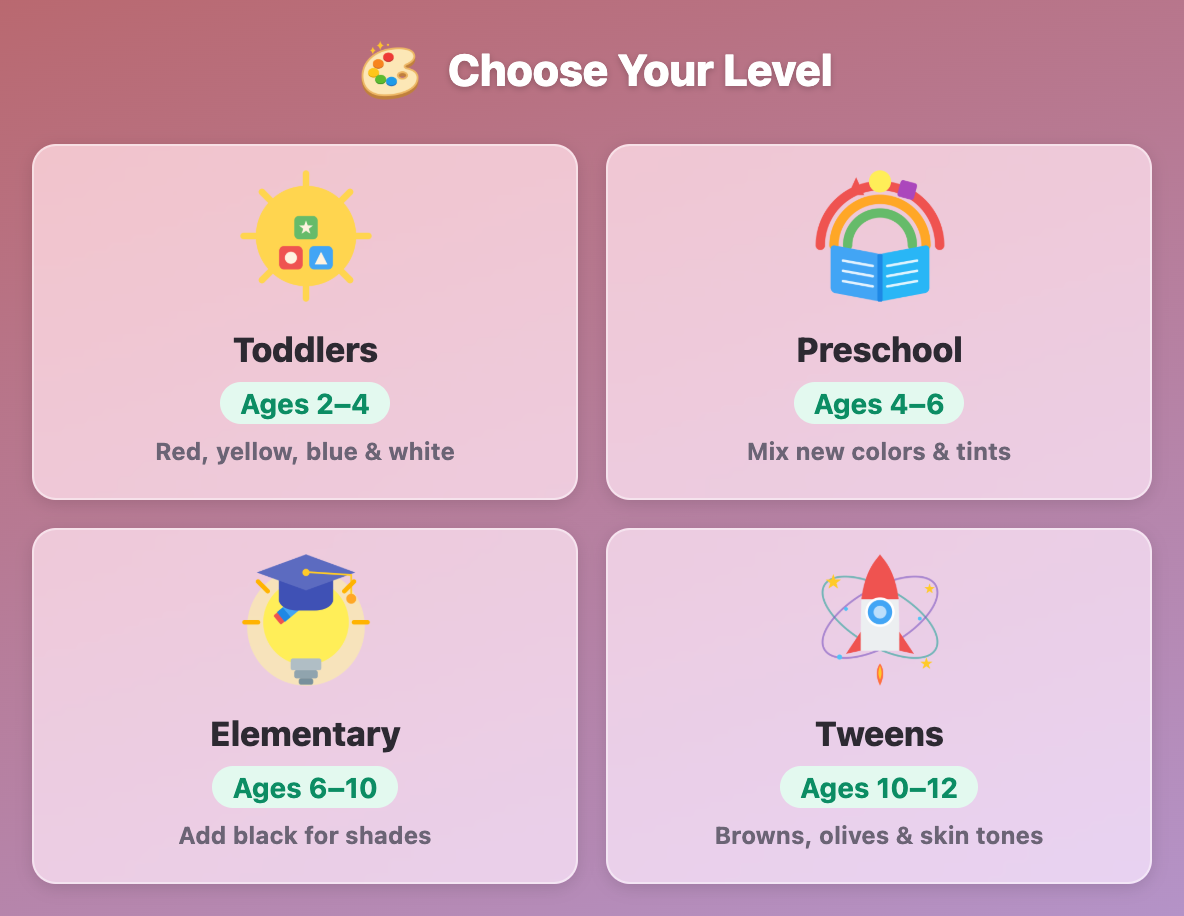
The Choose Your Level screen in Paint Match Lab for kids, from four paints for Toddlers to skin tones for Tweens
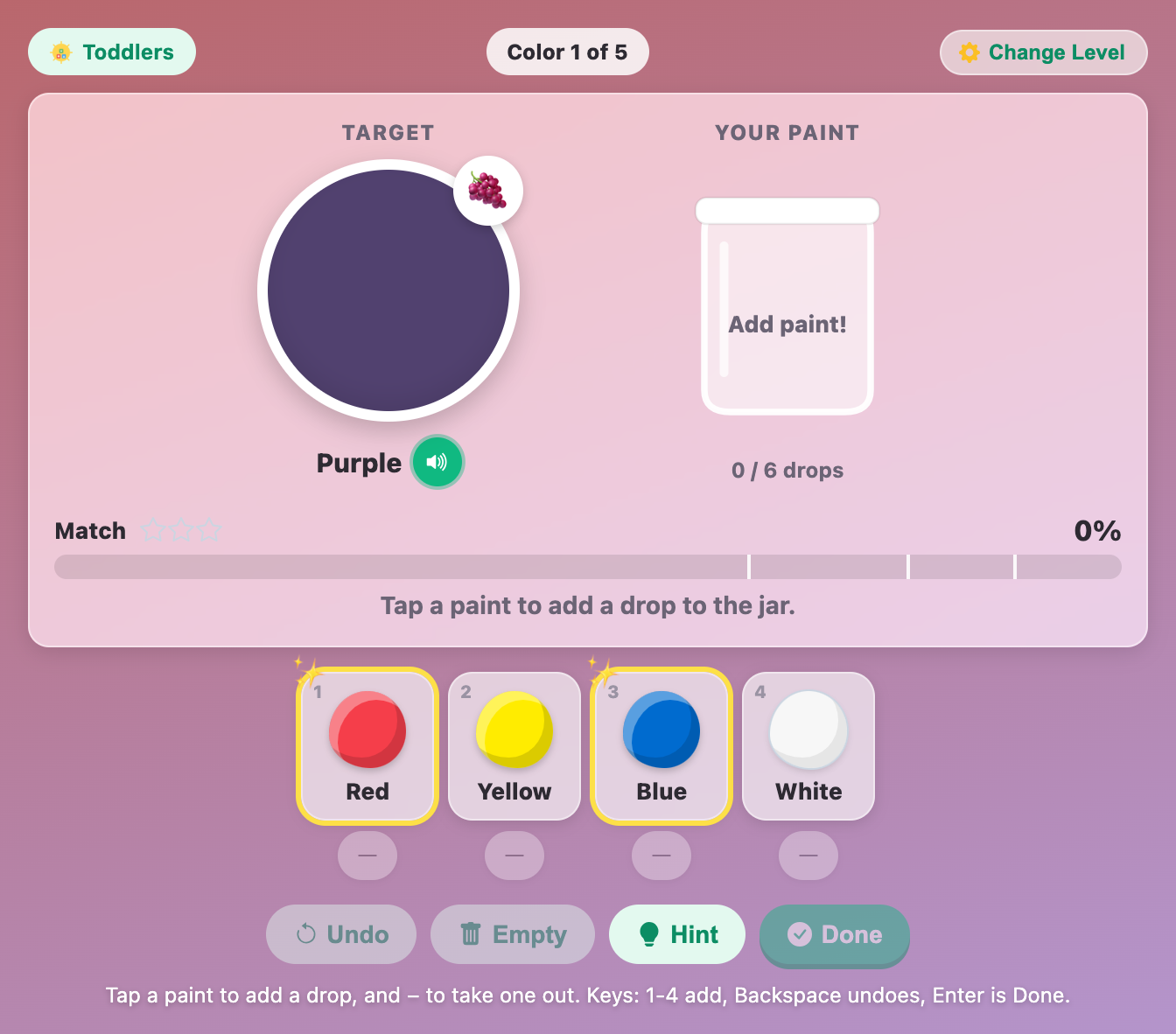
A purple target at the Toddlers level with an empty jar and sparkles on the red and blue paints
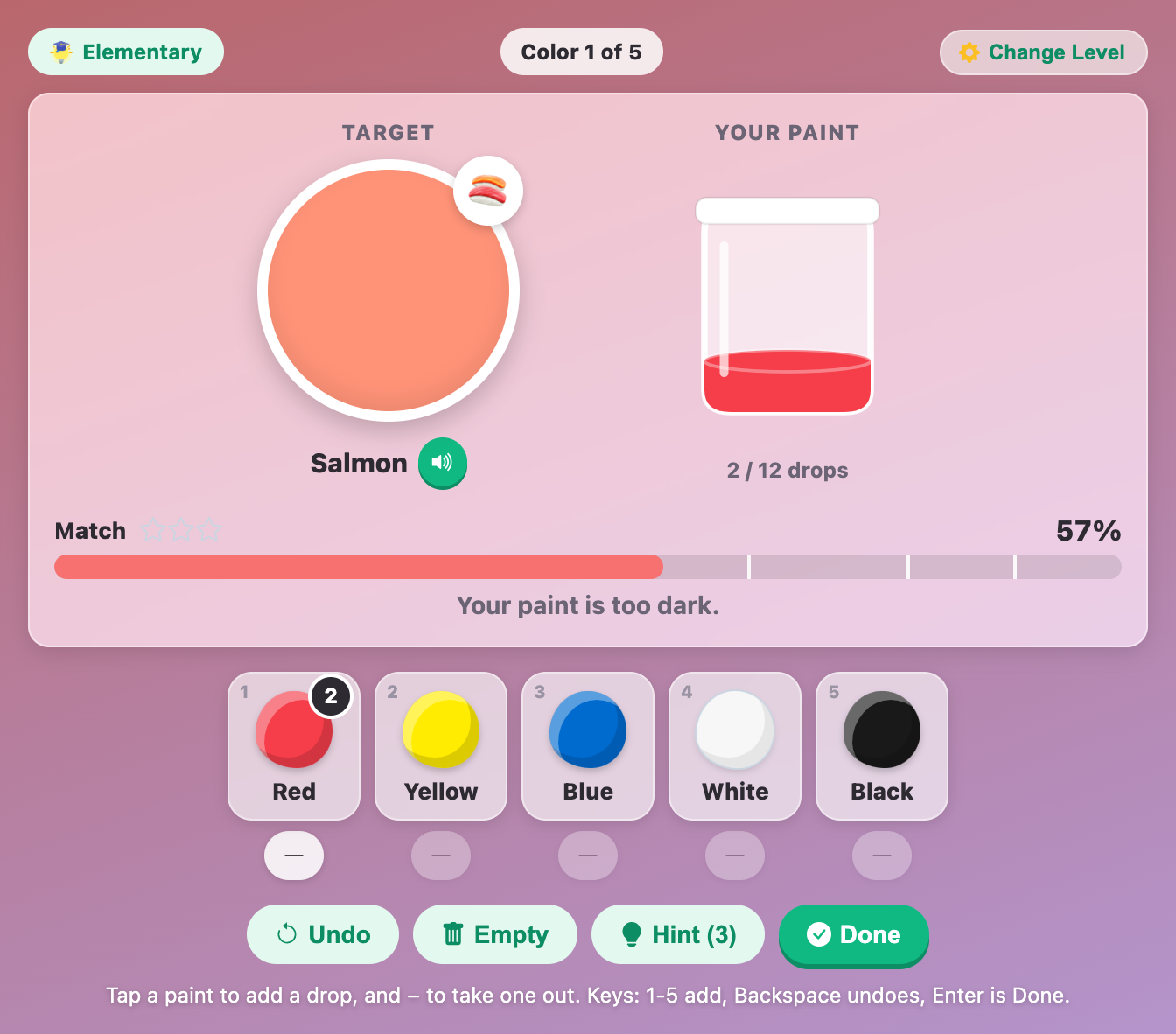
A salmon target at the Elementary level with 2 drops of red in the jar and a 57 percent match that is too dark
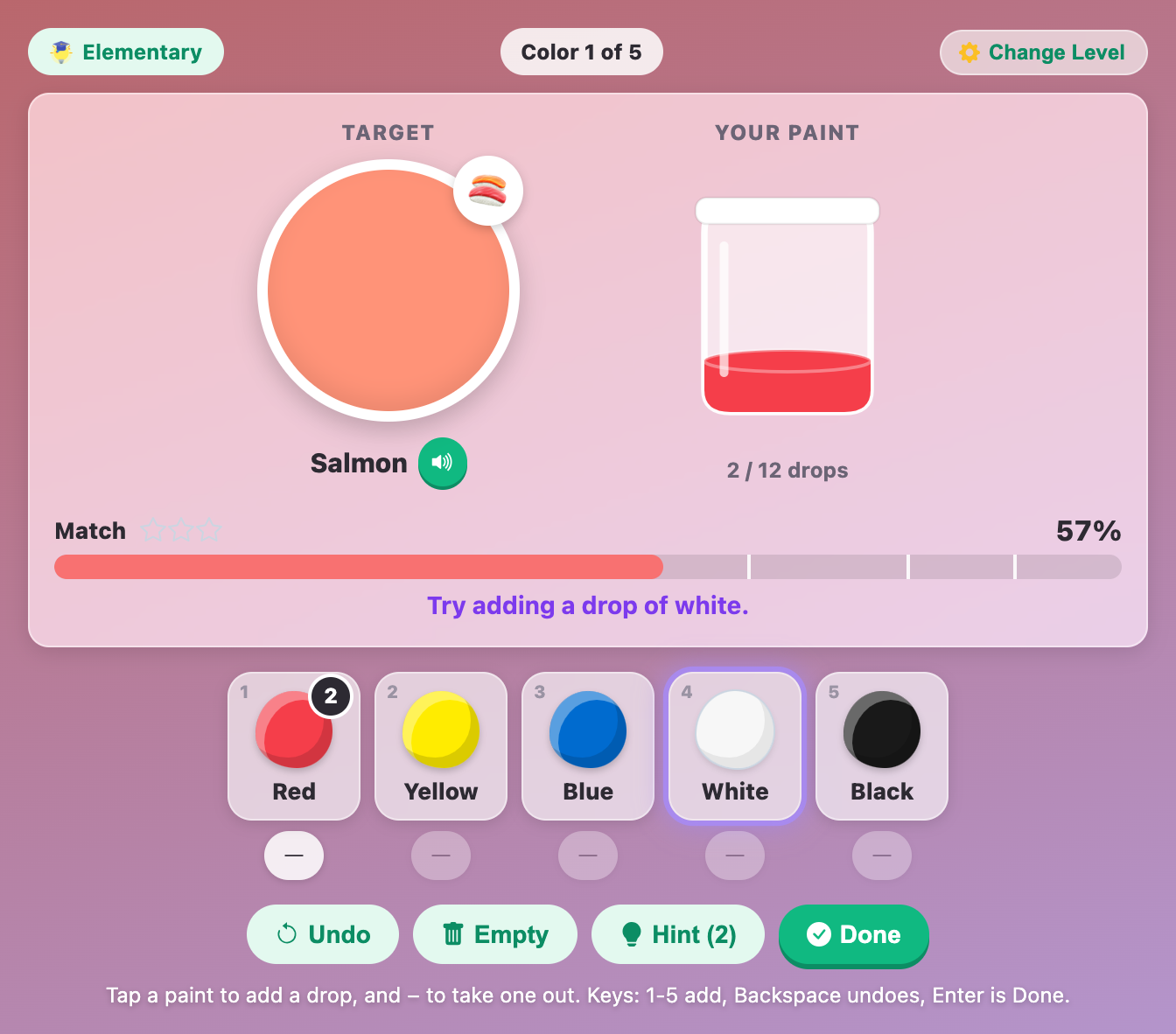
The hint in Paint Match Lab glowing on the white paint and saying Try adding a drop of white
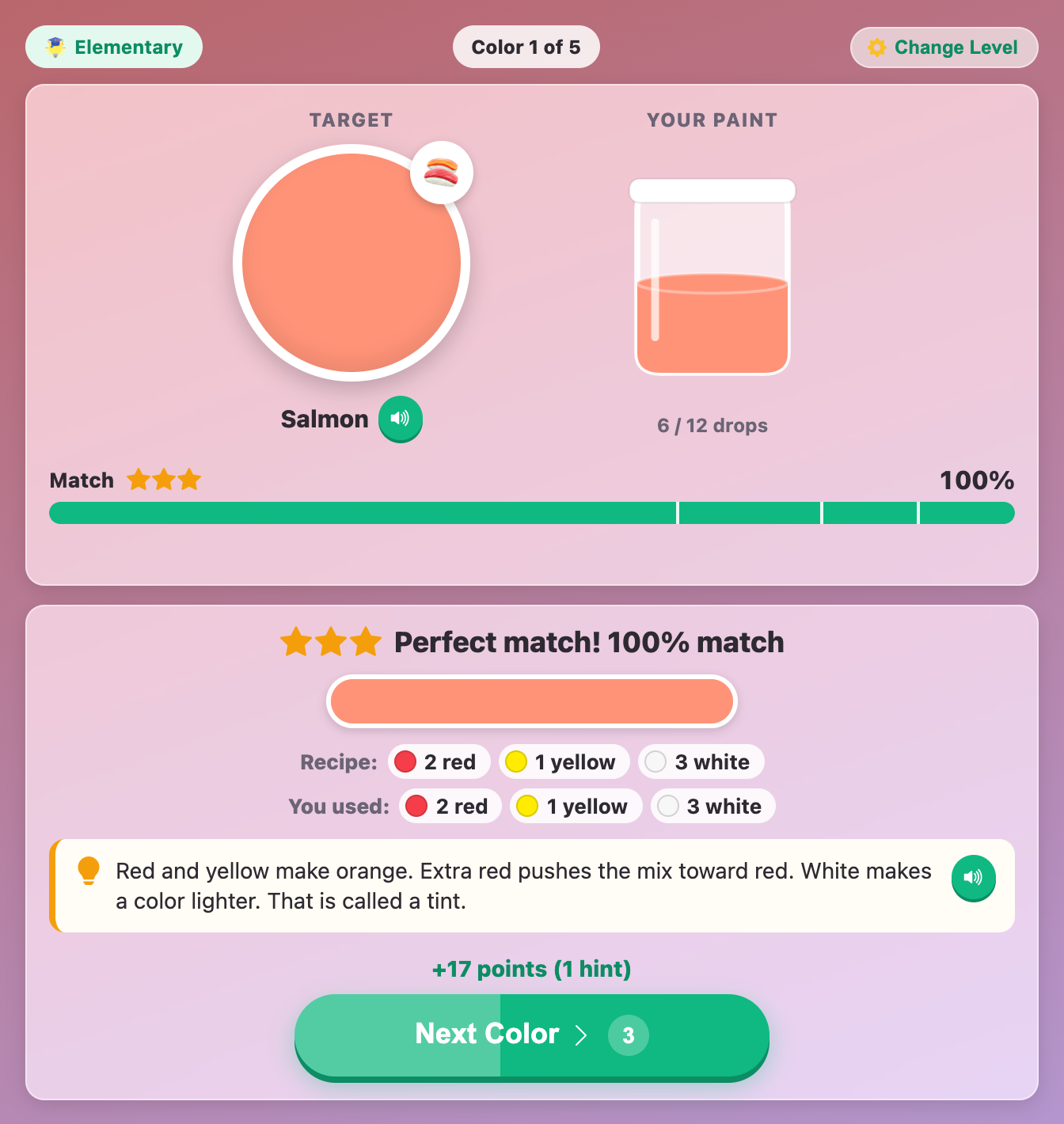
A perfect salmon match with three stars, the recipe of 2 red, 1 yellow and 3 white, a mixing tip and 17 points
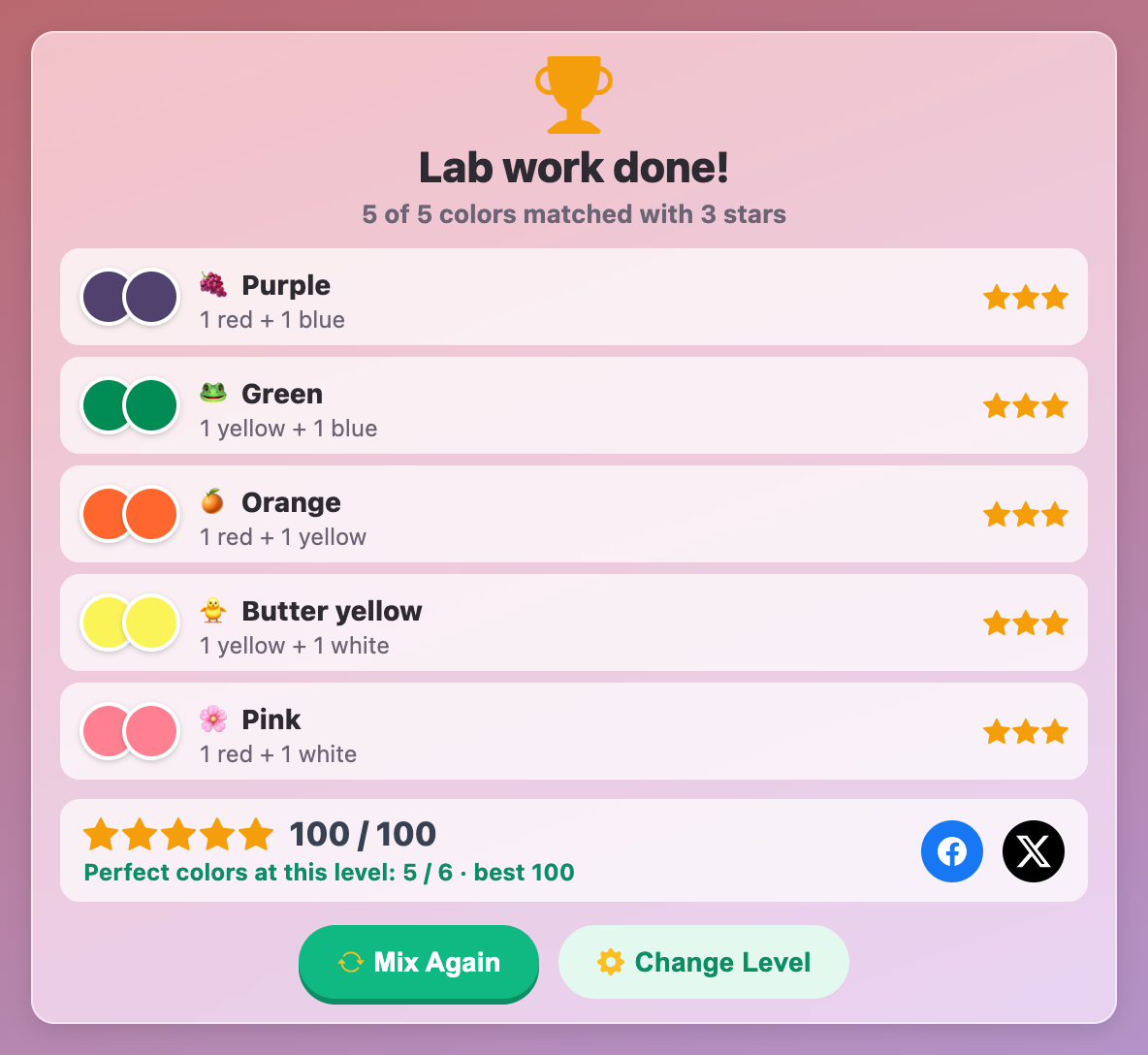
The Lab work done card in Paint Match Lab for toddlers, with five colors matched with 3 stars and 100 out of 100
More Art Games
 1.8M plays
4.9
Color & Draw
A free-drawing canvas with colors and brush sizes to unleash your creativity.
 154.5K plays
5.0
Mood Palette
Decide which color best fits a mood or theme before time runs out.
 584.9K plays
5.0
Tiny World Builder
Start with a tiny empty island and build your own blocky village — plant grass and trees, lay roads, and unlock houses, farms, a school and more!
 174.6K plays
4.9
Color Mixing
Look at two paint colors and pick which color they mix together to make.
Most Played Games
1.8M plays
4.9
Color & Draw
A free-drawing canvas with colors and brush sizes to unleash your creativity.
 59.5K plays
4.8
Recycling Sort
Sort everyday items into the Recycle, Compost, or Trash bin before time runs out!
 365.8K plays
5.0
Tic-Tac-Toe
Play a game of Tic-Tac-Toe against the computer and see if you can outsmart it.
 274.1K plays
5.0
Sentence Builder
Pick your age level, then tap the shuffled words in the right order to build the sentence.
Comments (29)