
Warm or Cool?
82.7K playsIs it warm or cool? Drag each thing or paint color into the sunny Warm bin or the frosty Cool bin before the clock runs out. Fire, bananas and pumpkins feel warm, ice, whales and frogs feel cool, and every answer tells you why. Little artists sort things they know, older kids sort paint swatches like peach, navy and turquoise, and big kids learn the painter's secret: even a red can be cooler, and a green can be warmer!
Fire. Ice. A banana. A frog. Quick, sort them in your head: which ones feel warm, and which ones feel cool? Fire and the banana feel warm. Ice and the frog feel cool. If you sorted them that way, you already know the big idea behind Warm or Cool? for kids.
Artists split colors into two teams. Warm colors are the colors of sunshine and flames. Cool colors are the colors of water, ice and leaves. In this game, one thing or one blob of paint shows up at a time. You drag it into the sunny ☀️ Warm bin or the frosty ❄️ Cool bin before the clock runs out. Every answer comes with a short reason, so you learn the rule while you play. And for the oldest players, there's a painter's secret waiting: even a red can be a little cooler, and a green can be a little warmer!
☀️ Warm or Cool? for Kids: The Sun Team and the Ice Team ❄️
Warm colors are red, orange and yellow, and the colors you get by mixing them, like red-orange and yellow-orange. Think of a campfire, a pumpkin or the sun. The game's Warm bin even says "sun & fire" right under its name.
Cool colors are blue and green, and their mixes, like blue-green and turquoise. Think of a swimming pool, a whale or a pine tree. The Cool bin says "water & ice".
A color stays on its team when you make it lighter or darker. Mixing white into a color makes a tint (a lighter color), and mixing in black makes a shade (a darker color). So pale peach is still warm, because it's orange with white. Dark navy is still cool, because it's blue with black.
Some colors are left out on purpose. Art books don't agree whether purple, pink or brown is warm or cool, so the game never asks you to sort them. It also skips tricky things, like a cactus, which is green (a cool color) but lives in a hot desert. That way, every answer in the game is one that every art teacher would agree with.
🧺 Sorting on KidWorld, One Card at a Time
Pick your level. The Choose Your Level screen shows Toddlers, Preschool, Elementary and Tweens. The game remembers your pick, and the Change Level button at the top right lets you switch.
Look at the card. A big card shows one thing (like 🫐 blueberries) or one blob of paint with its name (like "turquoise"). Above it is the question: "Warm or cool?" for the youngest players, or "Is it a warm color or a cool color?" for everyone else. Tap 🔊 to hear it.
Drag it into a bin. Press on the card and pull it down into ☀️ Warm or ❄️ Cool. If you let go somewhere else, it floats back so you can try again. You can also just tap a bin, or use the keys: 1, ← or A for Warm, and 2, → or D for Cool.
Keep an eye on the clock. The stopwatch counts down from 30 seconds for Toddlers, 25 for Preschool and 20 for Elementary and Tweens. It stands still while the game is reading out loud and while you are dragging. If it reaches zero, the card shows "Time's up!" and the right bin.
Read the reason. A right answer shows "✔ Yes, warm! +15" (or however many points you got). A wrong one shows "✘ Oops! It goes in Cool." Either way, a sentence explains why, with its own 🔊 button.
Go to the next card. The big Next button fills up and moves on by itself after 5 seconds. Tap it, or press Enter or Space, to go sooner. The countdown waits while the reason is being read aloud.
Watch your bins fill up. Every right answer on a warm-or-cool card drops a little chip into its bin: an emoji for a thing, or a color dot for a paint.
See your results. After 10 cards, the "Warm or Cool? Complete!" card says how many you sorted right and your score out of 150, with 1 to 5 stars. It shows your sorted piles, with any missed cards outlined in red, and a "Practice these again" list that repeats the reason for each miss. Play Again starts 10 new cards, and Choose Another Level goes back to the levels.
Use the page buttons. Fullscreen, Reload and the music button sit around the game. When the site's sound is on, the game also reads each question and each reason out loud by itself.
⏱️ Points, Seconds and the Speed Bonus
A right answer earns 10 points, plus a speed bonus of 1 point for every 2 seconds left on the clock, up to 5. A wrong answer, or running out of time, earns 0. So each card is worth up to 15 points, and a perfect game is 150.
Here's how that works on a 20-second clock: answer with 12 seconds left and you get 10 + 5 = 15. Answer with 7 seconds left and you get 10 + 3 = 13. On the Toddlers' 30-second clock, you still get the full bonus if you answer with 10 seconds left, which gives you 20 whole seconds to think.
Notice that a right answer is worth twice as much as the biggest bonus. Getting it right always matters more than getting it fast.
🧠 How to Sort Like an Artist
Ask the bins' question
Each bin has a hint under its name: "sun & fire" and "water & ice". When you're not sure, ask yourself: does this color look more like a flame or more like a lake? Red, orange and yellow look like flames. Blue and green look like water and leaves.
Think about the color, not the thing
On the toddler and preschool cards, the game cares about the thing's color, not whether it's hot or cold to touch. A frog isn't hot or cold, but it's green, so it goes in Cool. A pumpkin is orange, so it goes in Warm. Say the color out loud first, then pick the bin.
Light or dark never switches teams
This is the biggest trap on the Elementary level. Pale colors can look soft and calm, but peach is still a warm color, because it's orange mixed with white. Dark colors can look heavy, but navy is still a cool color, because it's blue mixed with black. Find the "parent" color hiding inside, and the answer follows.
Split a two-part name
A name with a dash is two colors mixed together. Red-orange is red and orange, two warm colors, so it's warm. Blue-green is blue and green, two cool colors, so it's cool. Blue-violet is a little different: it's mostly blue, so it's a cool color, "like the sky at dusk", as the game says.
In a "warmer or cooler" round, compare the two blobs
On Tweens, some cards show two blobs side by side: a plain color and a new one, with "vs" between them. The bins change to Warmer ("more red, orange, yellow") and Cooler ("more blue"). The card shows the rule, too. Leaning toward red, orange or yellow makes a color warmer. Leaning toward blue makes it cooler. Don't ask "is this warm?" Ask "which way does it lean compared to the plain one?"
Remember: a cooler red is still red
A crimson is a cooler red, but red is still a warm color. That's why the game keeps warmer and cooler cards out of your Warm and Cool piles. On the result card, they get their own Warmer and Cooler boxes. It's a small detail that shows the game is being careful about the rule.
Let the reading help you
The clock stops while the game is reading out loud. So if a word like "turquoise" is new to you, tap 🔊 and listen. You won't lose any time, and you'll learn the word.
Turn misses into a mini lesson
The "Practice these again" list on the result card repeats the reason for every card you missed. Read it out loud once, then tap Play Again. The same colors often come back, and this time you'll know them.
🔎 Six Cards, Sorted Out Loud
🐸 A frog (Toddlers)
A frog is green. Green is like grass and leaves, so it goes in the Cool bin. The game says: "A frog is green, a cool color."
🌞 The sun (Toddlers and Preschool)
The sun is yellow, the easiest warm color of all. Drag it to Warm and watch the yellow chip land in the bin. "The sun is yellow, a warm color."
Peach (Elementary)
Peach is a pale, soft orange. Pale might make you think "cool", but look for the parent color: orange. "Peach is orange mixed with white. Orange is warm, so peach is warm too."
Navy (Elementary)
Navy is very dark, almost black. But the color hiding inside is blue. "Navy is blue mixed with black. Blue is cool, so navy is cool too."
Lemon yellow vs plain yellow (Tweens)
Both blobs are yellow, and yellow is a warm color. But lemon yellow has a tiny touch of green, and green has blue in it. So it leans toward blue: drop it in Cooler. "Lemon yellow leans toward green, which has blue in it, so it is a cooler yellow."
Red-violet vs plain purple (Tweens)
Purple never gets sorted as warm or cool, but it can still be warmer or cooler than another purple. Red-violet has more red in it than plain purple, and red is a sun-and-fire color. So it goes in Warmer: "Red-violet leans toward red, so it is a warmer purple."
👪 Warm or Cool? From Age 2 to 12
Warm or Cool? for toddlers
Toddlers (ages 2 to 4) sort 10 things they know, shown as big pictures. They meet 🔥 fire, 🍌 a banana, 🦊 a fox, 🧊 ice, 🐳 a whale, 🥦 broccoli and more. The question is short ("Warm or cool?"), the clock gives 30 seconds, and a tap on a bin is enough if dragging is still tricky. A grown-up can name the color with them before they tap.
Warm or Cool? for preschoolers
Preschoolers (ages 4 to 6) sort 4 things and 6 plain paint blobs: red, orange, yellow, green, blue and sky blue. Moving from pictures to blobs of paint is the big step here, since the color is all they have to go on. They get 25 seconds a card.
Warm or Cool? for elementary kids
Elementary kids (ages 6 to 10) sort 10 paint blobs with real art names. Think maroon, peach, red-orange, navy, mint green, turquoise and blue-green. This is where tints and shades come in, and every reason explains how the color was mixed. Kids who like this can race with the same idea in Paint Kart Circuit. It's a 3D kart race, and at this age its gates ask warm and cool questions.
Warm or Cool? for tweens
Tweens (ages 10 to 12) get 4 harder blobs, like blue-violet and maroon. Then come 6 "warmer or cooler?" rounds. Scarlet or crimson faces red, and golden or lemon yellow faces yellow. Lime green or teal green faces green, and red-violet or blue-violet faces purple. The clock is 20 seconds, and the rule sits right on the card to help.
💛 Why Sorting Colors Helps a Young Artist
It helps kids pick colors on purpose. A cozy campfire picture wants warm colors. A calm ocean picture wants cool ones. Once kids know the two teams, they start choosing colors for how a picture should feel. If your child likes that idea, Mood Palette asks which color best fits a mood or a theme.
It builds "because" thinking. Every card ends with a reason: maroon is red mixed with black, red is warm, so maroon is warm too. Kids hear how one fact leads to the next, which is how good explanations work in every subject.
It grows color words. Turquoise, maroon, scarlet, crimson, mint green: by the Elementary level, kids use the same names painters use. And each name comes with a blob of the real color.
It opens the door to color mixing. Knowing that peach is orange plus white is the first step to mixing peach yourself. Tint & Shade Ladder lets kids do exactly that, mixing lighter and darker versions of a color drop by drop.
A note for grown-ups: a game is 10 quick cards, so it fits into a few spare minutes. There are no lives and nothing scary, and every answer, right or wrong, comes with a kind explanation. The clock waits while the game reads aloud, so slower readers aren't rushed. It practices sorting, color vocabulary, listening and reasoning.
So, is a pumpkin warm or cool? Is navy? Is lemon yellow warmer or cooler than plain yellow? Grab a card and find out. Warm or Cool? for kids makes every color a little puzzle with a happy answer.
🖼️ See the Game in Action
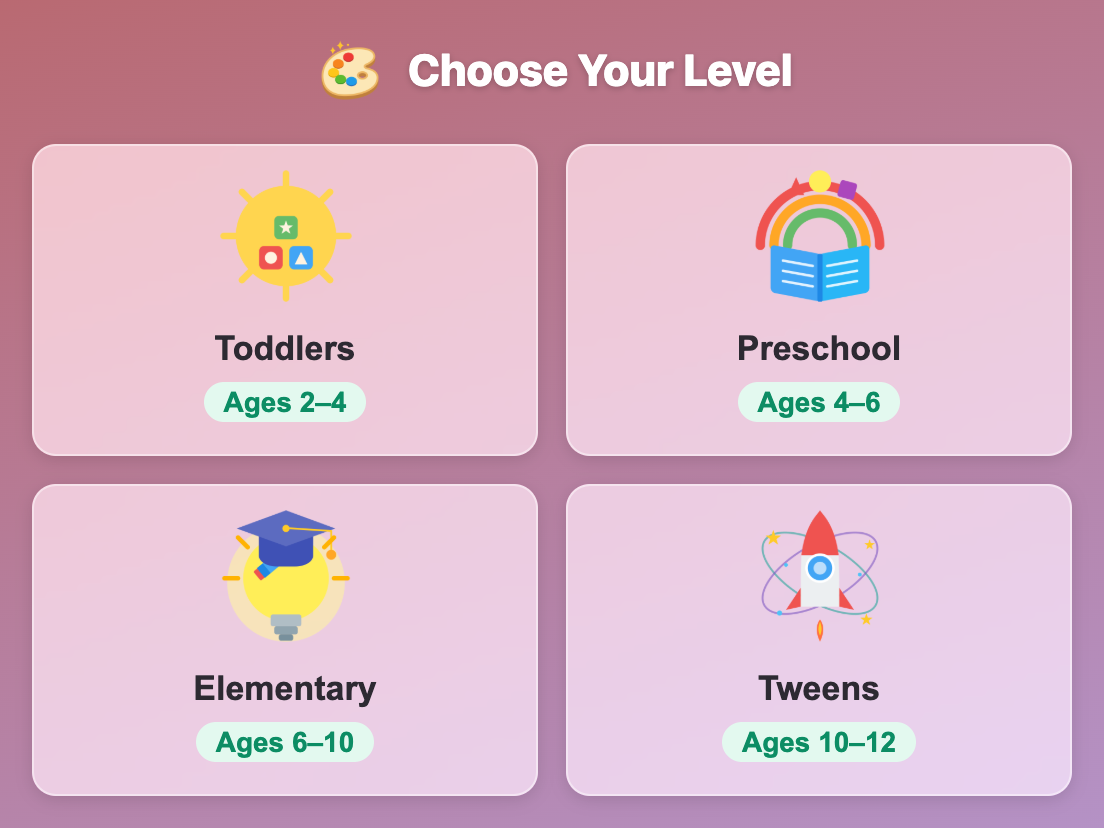
The Choose Your Level screen in Warm or Cool? for kids, with Toddlers, Preschool, Elementary and Tweens cards
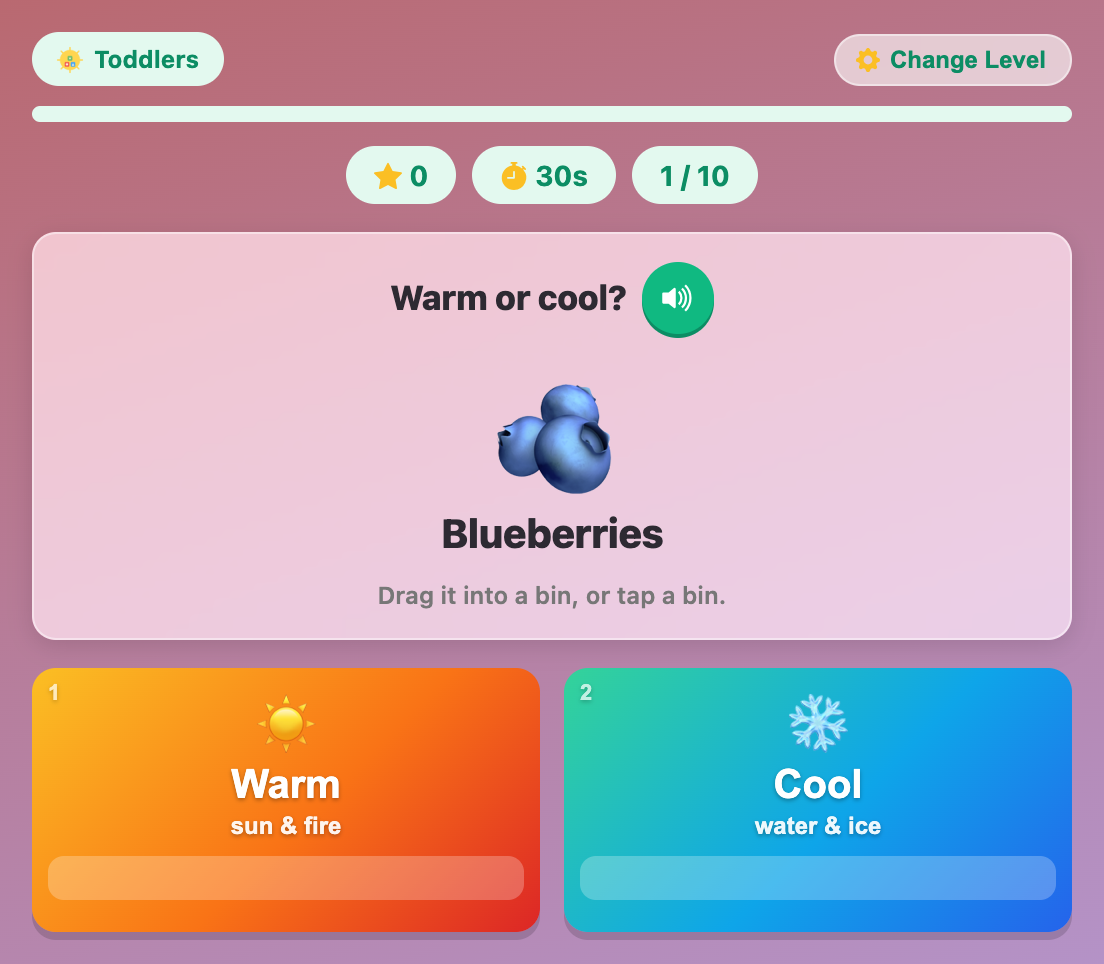
Blueberries waiting to be sorted at the Toddlers level, above the sunny Warm bin and the frosty Cool bin
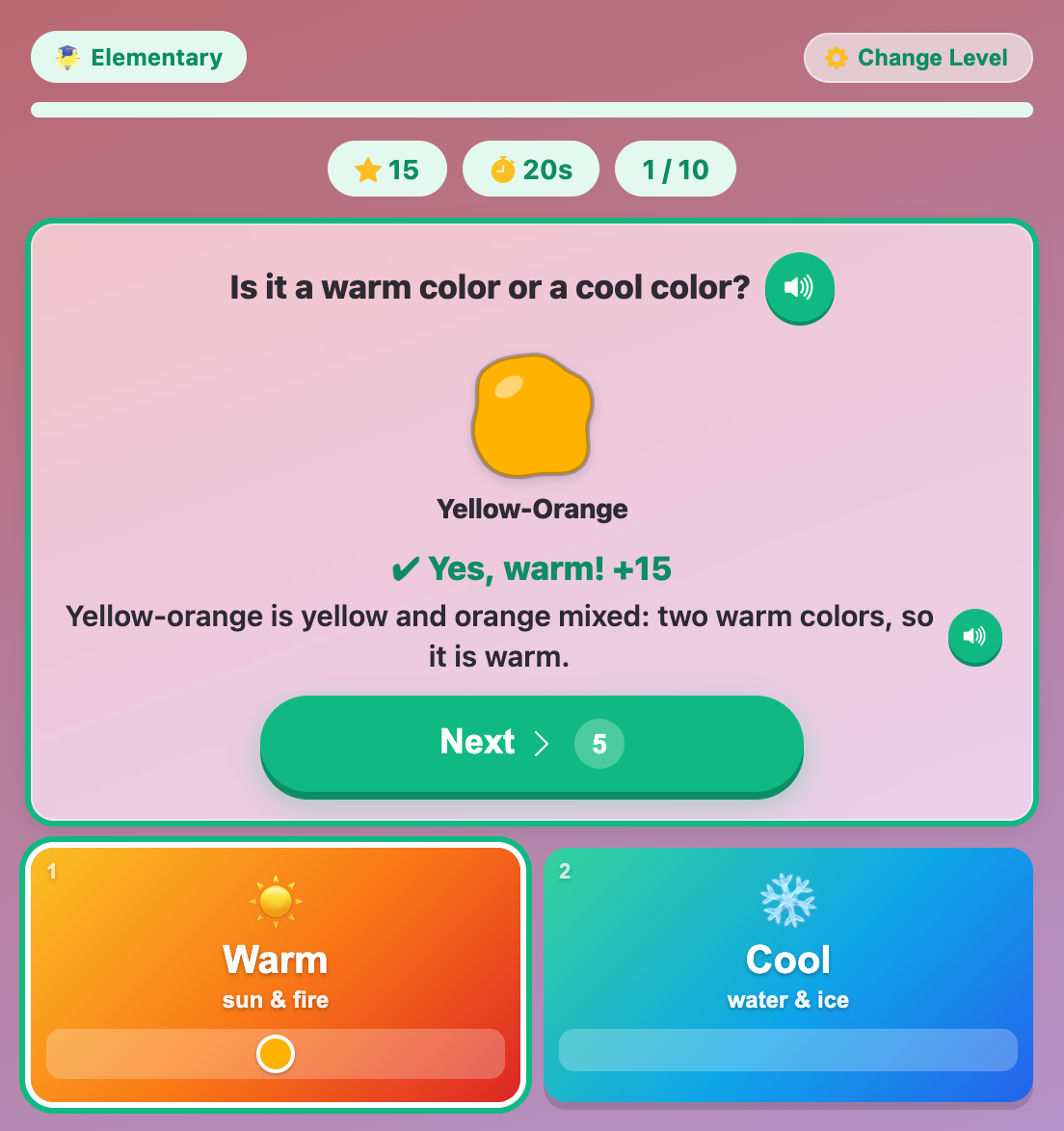
A yellow-orange paint swatch sorted into the Warm bin at the Elementary level, with the reason and a Next button
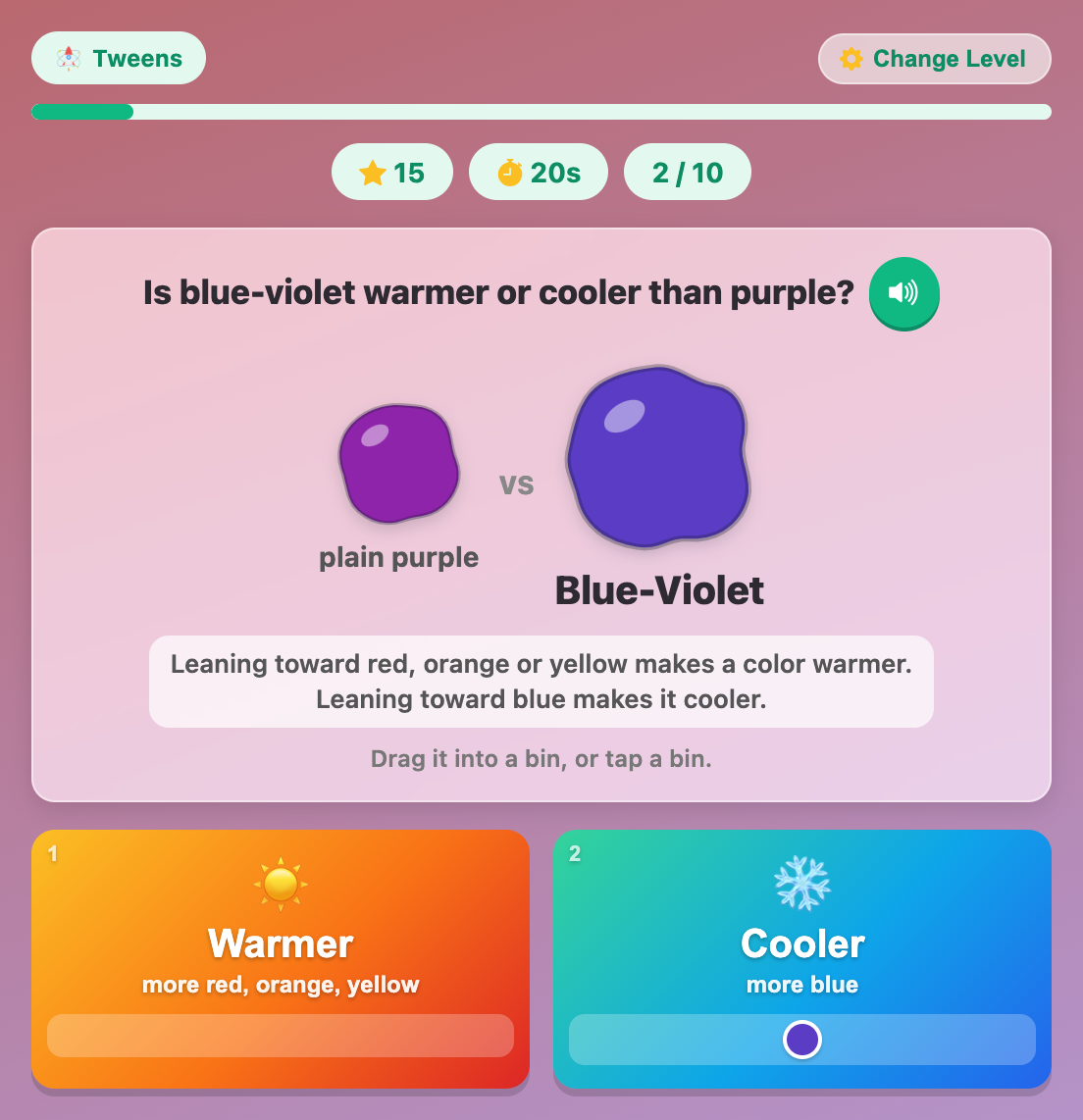
A Warm or Cool? for tweens round asking if blue-violet is warmer or cooler than plain purple
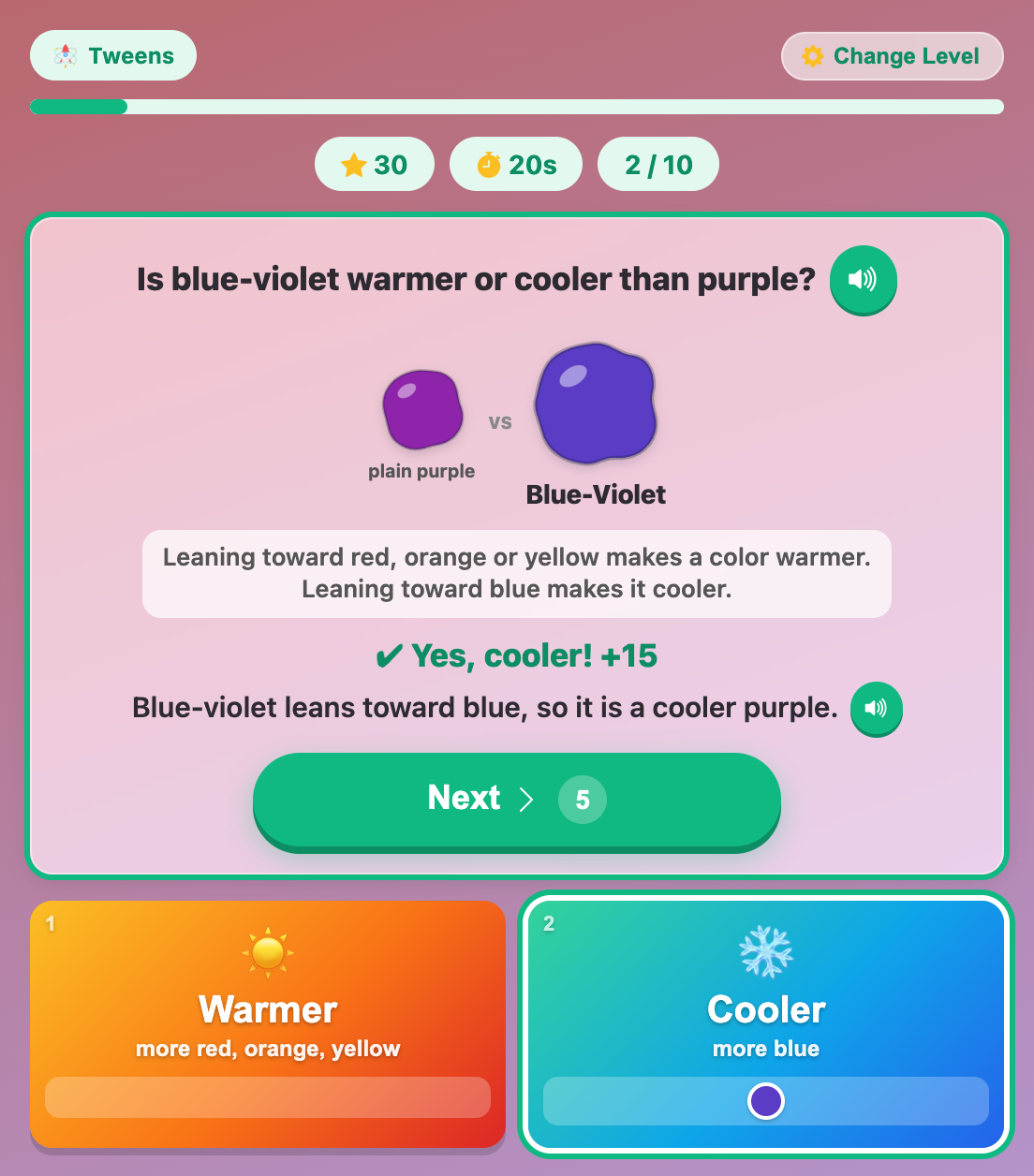
The answer to the blue-violet round, explaining that it leans toward blue, so it is a cooler purple
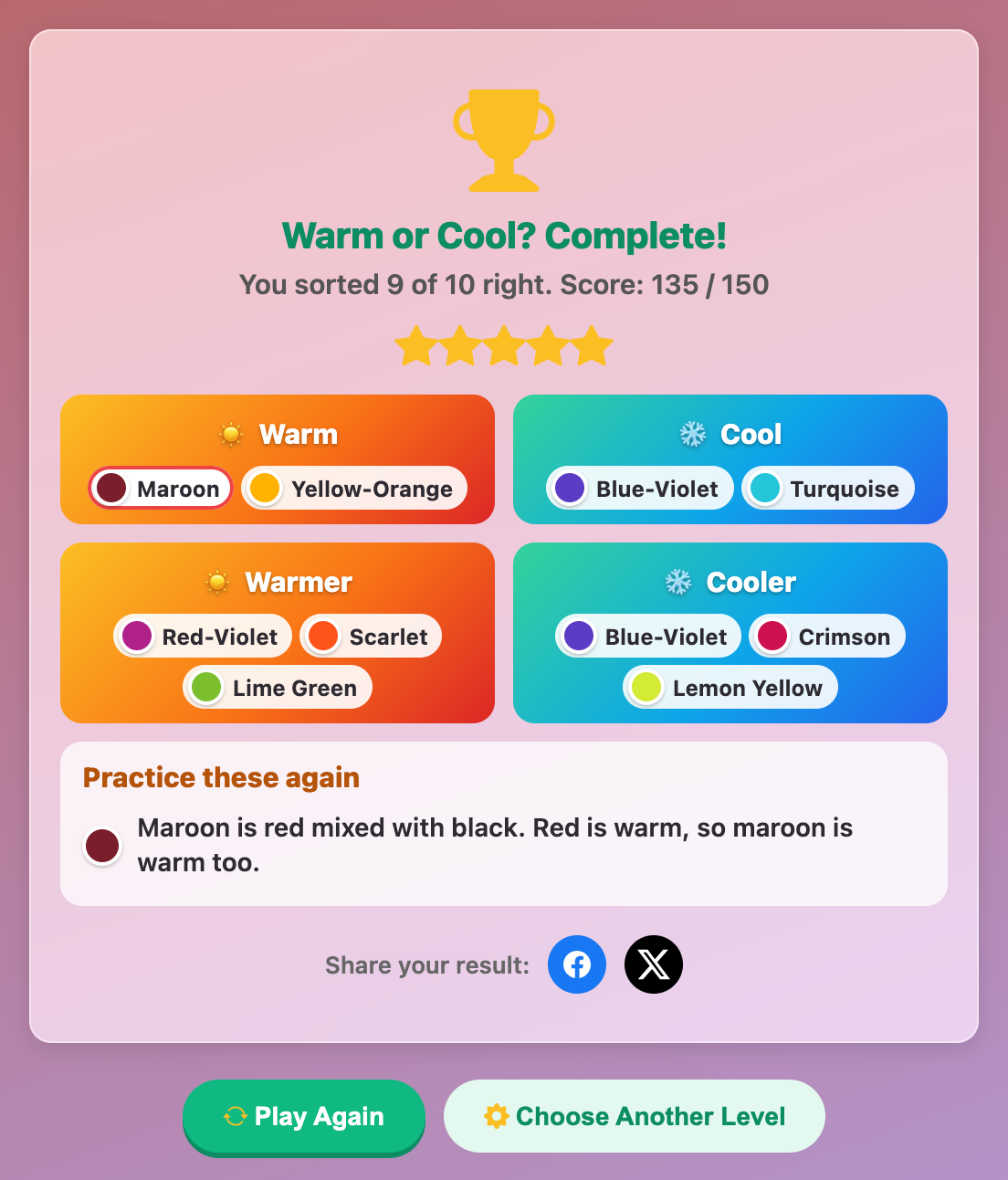
The Warm or Cool? Complete card with 9 of 10 right, four sorted piles and a practice note about maroon
More Art Games
 1.8M plays
4.9
Color & Draw
A free-drawing canvas with colors and brush sizes to unleash your creativity.
 154.5K plays
5.0
Mood Palette
Decide which color best fits a mood or theme before time runs out.
 584.9K plays
5.0
Tiny World Builder
Start with a tiny empty island and build your own blocky village — plant grass and trees, lay roads, and unlock houses, farms, a school and more!
 174.6K plays
4.9
Color Mixing
Look at two paint colors and pick which color they mix together to make.
Most Played Games
1.8M plays
4.9
Color & Draw
A free-drawing canvas with colors and brush sizes to unleash your creativity.
 59.5K plays
4.8
Recycling Sort
Sort everyday items into the Recycle, Compost, or Trash bin before time runs out!
 365.8K plays
5.0
Tic-Tac-Toe
Play a game of Tic-Tac-Toe against the computer and see if you can outsmart it.
 274.1K plays
5.0
Sentence Builder
Pick your age level, then tap the shuffled words in the right order to build the sentence.
Comments (50)