
Rainbow Hue Sort
314.3K playsSomeone mixed up the rainbow! Look closely at the colors, then swap the tiles back so every row goes from light to dark: pale pink to deep red, sky blue to navy, mint to forest green. Tiles with a dot stay in place to help you. Little artists sort 2 rows, big kids sort 5 rows of colors that sit close together. Every puzzle is new, and every one trains your eye to see tints, shades and tiny differences in color, just like a real artist.
For about two seconds, the board is perfect. Each row of color tiles melts from a pale tint on the left to a deep, dark shade on the right, like a ladder of paint. Then the tiles jump, and the rainbow is a jumble. Your job in Rainbow Hue Sort for kids is to swap every tile back where it belongs.
It sounds easy, and the first board is. But the tiles don't only move inside their own row. A dark blue tile might land in the orange row, and a pale peach tile might hide among the blues. So you have to ask two questions about every tile: which color family is it from, and how light or dark is it? Artists ask the same two questions every time they mix paint. Every board is made fresh by the game, so no two puzzles are ever the same.
🎨 A Rainbow Puzzle Made of Tints and Shades
Every row in the game is one color. Say the row is blue. The tile on the far left is blue with lots of white mixed in. Artists call that a tint. The tile on the far right is blue with lots of black mixed in. That is a shade. The tiles in between take small, even steps from light to dark.
The rows can be red, orange, yellow, green, teal, blue, purple or pink. The game picks a few of them for each board, and it makes sure no two tiles look the same. That means there is always exactly one right answer, and your eyes can always find it if you look carefully.
Some tiles never move. Both end tiles of every row have a small dot. A dot means "I'm already home, use me as a guide." The lightest tile of each row is pinned on the left and the darkest is pinned on the right. Everything between them is yours to sort.
Above the board sits a little bar that fades from white to black, with Light on one end and Dark on the other. It is there to remind you which way each row should go.
🕹️ Sorting Your First Rainbow, Screen by Screen
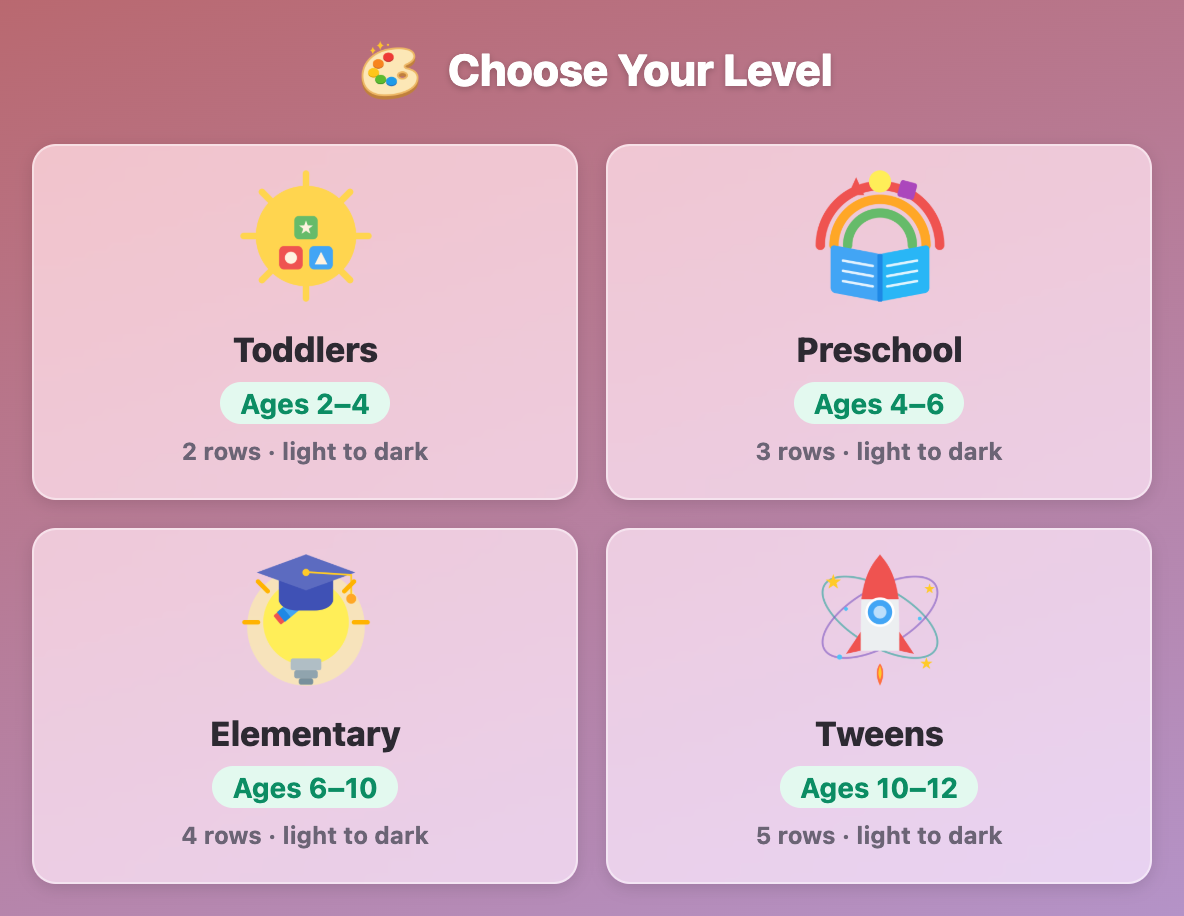
Pick your level. The Choose Your Level screen shows four cards: Toddlers with 2 rows, Preschool with 3 rows, Elementary with 4 rows and Tweens with 5 rows. Tap one. The game remembers it next time. You can switch whenever you like with the Change Level button in the top corner.
Look closely before the shuffle. The finished board appears first, with a note that says "Look closely… then sort it back!" This is your peek at the answer. If you are ready sooner, tap the board to shuffle right away.
Swap two tiles. Tap one tile, then tap another, and they trade places. You can also drag a tile and drop it on another one. On a computer, the arrow keys move a little frame around the board, and Space or Enter does the tapping for you.
Watch for check marks. When a tile reaches its true home, a small ✔ appears in its corner. Under the board you can see how many swaps you have made, how many tiles are in place (like "11 / 16 in place") and a stopwatch. The stopwatch is just for fun. It does not change your score.
Ask for a hint if you are stuck. The 💡 Hint button has 3 uses per puzzle. Each one glows a wrong tile and moves it straight home for you. Hints cost a few points, so save them for when you really need one.
Enjoy the finish. Once the last tile clicks home, the gaps between the tiles close up. Each row turns into one smooth band of color. A card says "Light to dark, just right!" and shows your swaps next to the fewest swaps possible, your time and your hints. It also tells you a color fact, which you can hear with the 🔊 button.
Play again. Tap Next Puzzle for a brand-new board, or Change Level to try more rows. The game keeps count of how many puzzles you have sorted on each level and your best score, right in your browser.
The play page also has three handy buttons: fullscreen for a bigger board, reload to start over and a music button to turn the sound on or off. The green 🔊 button next to the instructions reads them aloud, including the names of the row colors.
⭐ Where Your 100 Points Come From
Every finished puzzle earns 50 points just for sorting it. The other 50 points are about being clever with your swaps.
The game always knows the fewest swaps possible for your board. If you sort it in exactly that many, you get the full 50 extra points. If you use more swaps, you get a smaller share. A hint counts as one swap, and each hint also takes away 5 points.
Perfect: the fewest possible is 13 and you sort it in 13 swaps with no hints. That's 50 + 50 = 100 points.
One hint: the fewest possible is 12, and you use 11 swaps plus 1 hint. You still hit 12, so you get 50 + 50, minus 5 for the hint. That's 95 points.
A few extra swaps: the fewest possible is 12, but you take 16 swaps. You get 50 + 38 = 88 points.
Your result card turns the score into one to five stars. Even a slow, careful sort earns at least the 50 finishing points, so nobody leaves empty-handed.
🧠 How to Sort Like a Painter
Here is the good news: you can get 100 points on every puzzle. You don't need luck. You need a plan. These tips go from easy to clever.
1. Use the peek
Before the shuffle, don't just admire the colors. Pick one row and say its colors in your head: "peach, orange, dark orange, brown." Notice which colors are in the puzzle. When the tiles jump, you already know where the families belong.
2. Sort by family first, then by light and dark
Ask the easy question first: "Is this tile blue, or is it orange?" Get each tile into the right row. Then ask the harder question: "Is it lighter or darker than its neighbors?" Splitting the job in two makes a big board feel small.
3. Let the dotted tiles guide you
The dot on the left is the palest tile of that row. The dot on the right is the darkest. If you are not sure which row a mystery tile belongs to, hold it up next to each row's end tiles. A pale tile that matches a left dot, or a dark one that matches a right dot, has found its family.
4. The brightest tile lives in the middle
This is a secret about how the rows are made. The tiles near the ends are calmer and softer, because white or black is mixed in. The tiles in the middle of each row are the boldest, most colorful ones. So if you spot a really bright, strong tile, it probably goes near the center of its row.
5. Every swap should send a tile home
This is the big one. Never swap a tile into a spot that is just "closer." Swap it into its exact home, even if that pushes another wrong tile out. Every swap that puts a tile home is a swap that counts. If you always do this, you will use the fewest swaps possible, every single time.
6. Look for a double win
Sometimes two tiles are sitting in each other's homes. Swap them and both get a ✔ at once. Those are the best swaps on the board, so grab them whenever you see them.
7. Watch out for tricky darks and pales
Very dark and very pale colors play tricks on your eyes. A very dark yellow can look like olive green. A very pale red can look pink. A deep teal can look almost black. When two dark tiles confuse you, put them side by side and compare. One will lean warm, like sand or mud, and the other cool, like the sea.
8. Save hints for the last few tiles
A hint always moves a tile all the way home, and it likes to pick a tile whose home is next to one already placed. That makes hints most useful near the end, when the last tiles look alike. Early in the puzzle, your own eyes are faster and free.
🔍 Let's Sort Some Boards Together
Example 1: A Toddler board with orange and blue
The peek shows two rows: peach to brown on top, pale blue to navy below. After the shuffle, the top row has two blue tiles in it, and the bottom row has two orange ones.
Look at the darker of the two blue tiles. It is darker than a bright blue, but not as dark as the navy dot. So it belongs second from the right in the blue row.
Tap it, then tap that exact spot in the blue row. It gets a ✔.
Now look at whatever tile got pushed out. Send it straight to its own home the same way. Keep going until every tile has a ✔.
With only 6 tiles that can move, a toddler and a grown-up can talk through every swap: "Is this one blue or orange? Light or dark?"
Example 2: Counting the fewest swaps
Imagine three tiles in a little circle. Tile A sits in B's home, B sits in C's home and C sits in A's home. How many swaps do you need?
Swap the tile in A's home (that's C) with the tile in C's home (that's B). Now C is home.
Swap again so A and B trade places. Now both are home.
Three tiles, two swaps. A circle of tiles always needs one swap fewer than the number of tiles in it. That is how the game works out the fewest swaps possible, and it is why "every swap sends a tile home" always reaches it.
Example 3: The dark olive puzzle on Elementary
An Elementary board has pink, teal, yellow and blue rows. Near the end, two tiles are left in the yellow row. One is a dark olive and one is a brown-gold. Which goes further right?
Compare both with the yellow row's right-hand dot, the darkest yellow. The olive tile is closer to that dot, so it goes second from the right. The brown-gold tile goes one step left of it. Remember, the right end is the darkest, and each step to the left gets a little lighter.
Example 4: Five rows on Tweens
On Tweens, the rows sit closer together on the color wheel. You might get yellow and green, or teal and green, on the same board. A pale green tile and a pale yellow tile can look almost alike.
Here is a trick. Fill in the teal row first, because blue-greens stand out. Then do the purples and reds. Leave the yellow and green rows for last. By then, only a few pale or dark tiles are left, and you can compare them side by side with the dotted end tiles.
🎯 Rainbow Hue Sort for Kids of Every Age
🐣 Rainbow Hue Sort for toddlers (ages 2–4)
Toddlers get 2 rows of 5 tiles, and the two colors are always far apart on the color wheel, like orange and blue. Only 6 tiles move. The game also reads the instructions out loud when the puzzle starts, if your sound is on, and says "You did it!" with a color fact at the end. Little ones can drag tiles with a finger, while a grown-up helps them name each color.
🌈 Rainbow Hue Sort for preschoolers (ages 4–6)
Preschool boards have 3 rows of 6 tiles, so 12 tiles move. The colors are still easy to tell apart, which makes it a great place to practice the words "lighter" and "darker." Preschoolers also hear the instructions and the end fact read aloud.
📚 Rainbow Hue Sort for elementary kids (ages 6–10)
Elementary boards have 4 rows of 6 tiles, with 16 tiles to sort, and the colors sit a bit closer together. Elementary kids can start chasing the fewest swaps for 100 points, and they will learn the words tint, shade and value from the facts on the finish card.
🚀 Rainbow Hue Sort for tweens (ages 10–12)
Tweens sort 5 rows of 6 tiles, 20 tiles in all, and some rows are close neighbors on the color wheel. This is where the dark-olive and pale-pink tricks really matter. It is a real test of a sharp artist's eye.
💡 What a Mixed-Up Rainbow Teaches
Seeing tiny differences. When two dark tiles look almost alike, you learn to slow down and compare them side by side. Painters, designers and photographers use that skill every day.
Real art words. After a few puzzles, kids know that a tint has white in it, a shade has black in it and value means how light or dark a color is. The game teaches these words by showing them, row after row.
Planning ahead. Chasing the fewest swaps teaches kids to think before they tap. "Where does this tile really belong?" is a question that helps in math and puzzles too.
Calm focus. There is no countdown and no way to lose. The stopwatch never changes the score, so kids can take all the time they need.
If you love spotting small color changes, try Art Spot the Difference, where a copycat painter makes color and shade mistakes in a copy of a painting.
If you want to put your light-and-dark know-how to work at top speed, Rainbow Temple Escape has a bunny running under paint-splat signs, with questions like "Which one is the darkest?"
And for more practice with tints, shades and warm and cool colors, Magic Crossbow: Odd Color Out lets you shoot the color that doesn't belong.
For grown-ups: Rainbow Hue Sort is calm and safe, with no timers to beat, no chat and nothing scary. It trains careful looking, color words (tint, shade, value, gradient), patience and simple planning. Progress is saved only in your own browser.
Ready to fix a rainbow? Pick your level, take a good look and start swapping. Rainbow Hue Sort for kids is waiting with a fresh board of colors every time you play.
🖼️ See the Game in Action
The Choose Your Level screen in Rainbow Hue Sort for kids, showing Toddlers with 2 rows up to Tweens with 5 rows
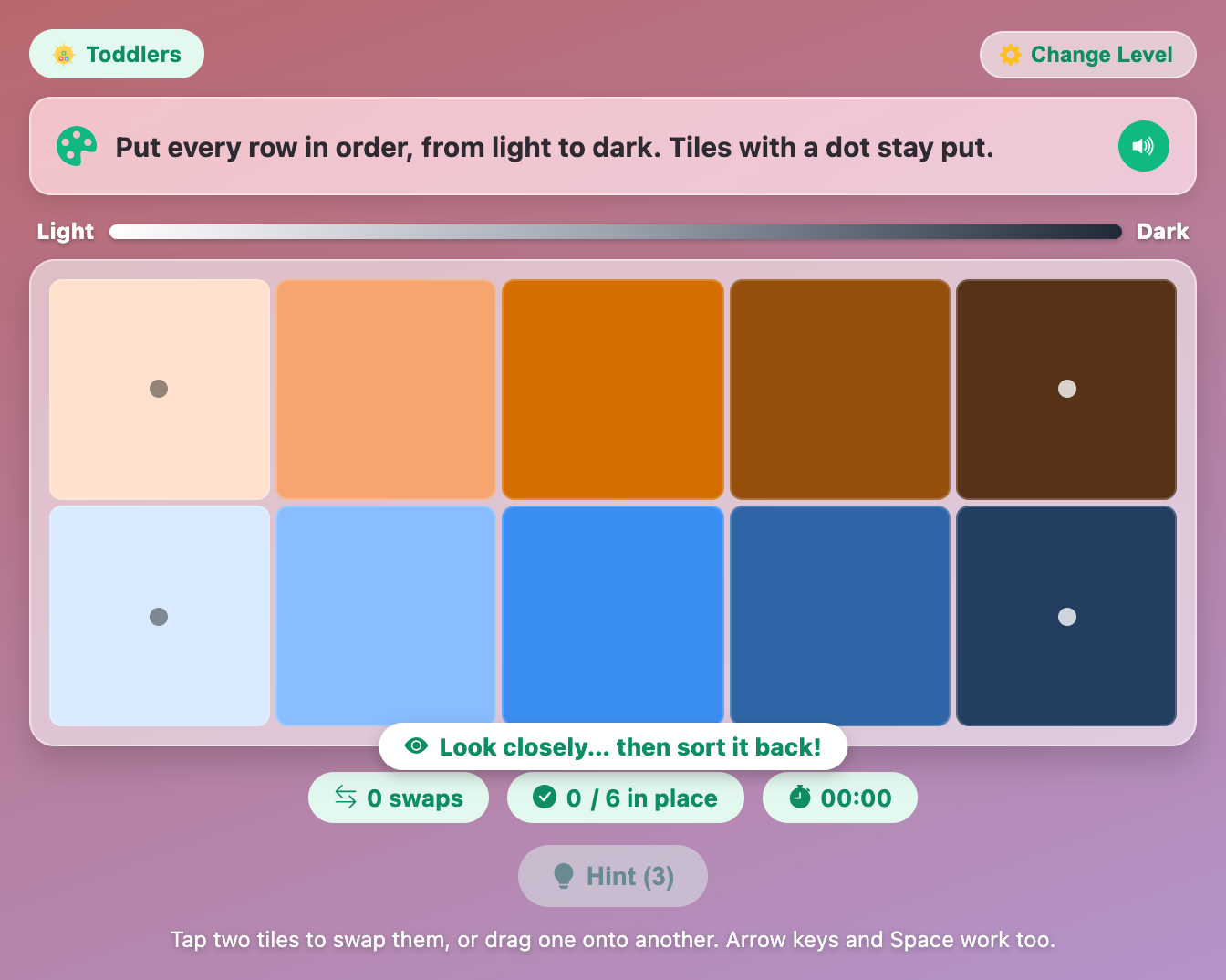
A sorted board in Rainbow Hue Sort for toddlers, with a peach-to-brown row and a pale-to-navy blue row before the shuffle
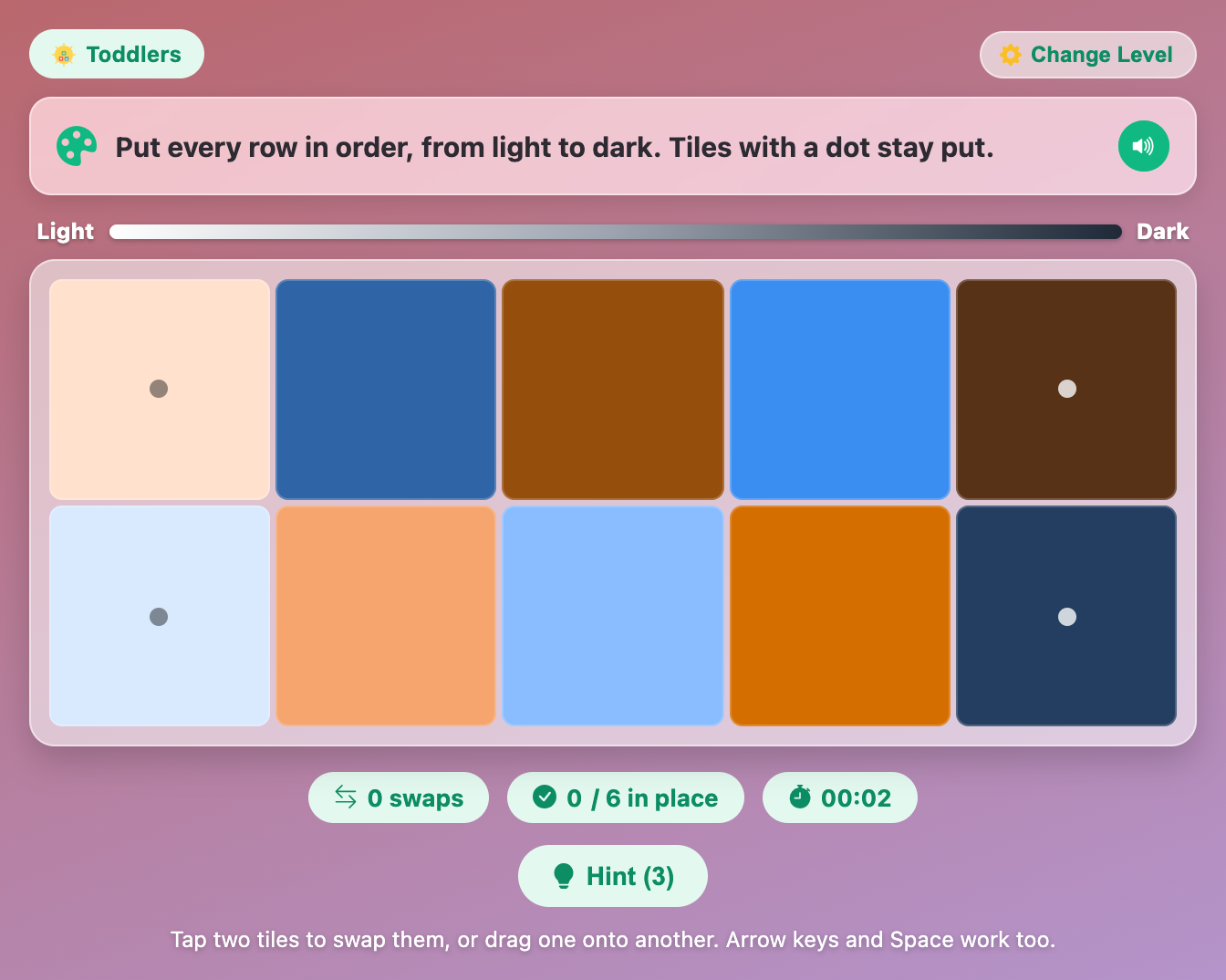
The same two rows shuffled in Rainbow Hue Sort, with blue and orange tiles mixed up and the dotted end tiles still in place
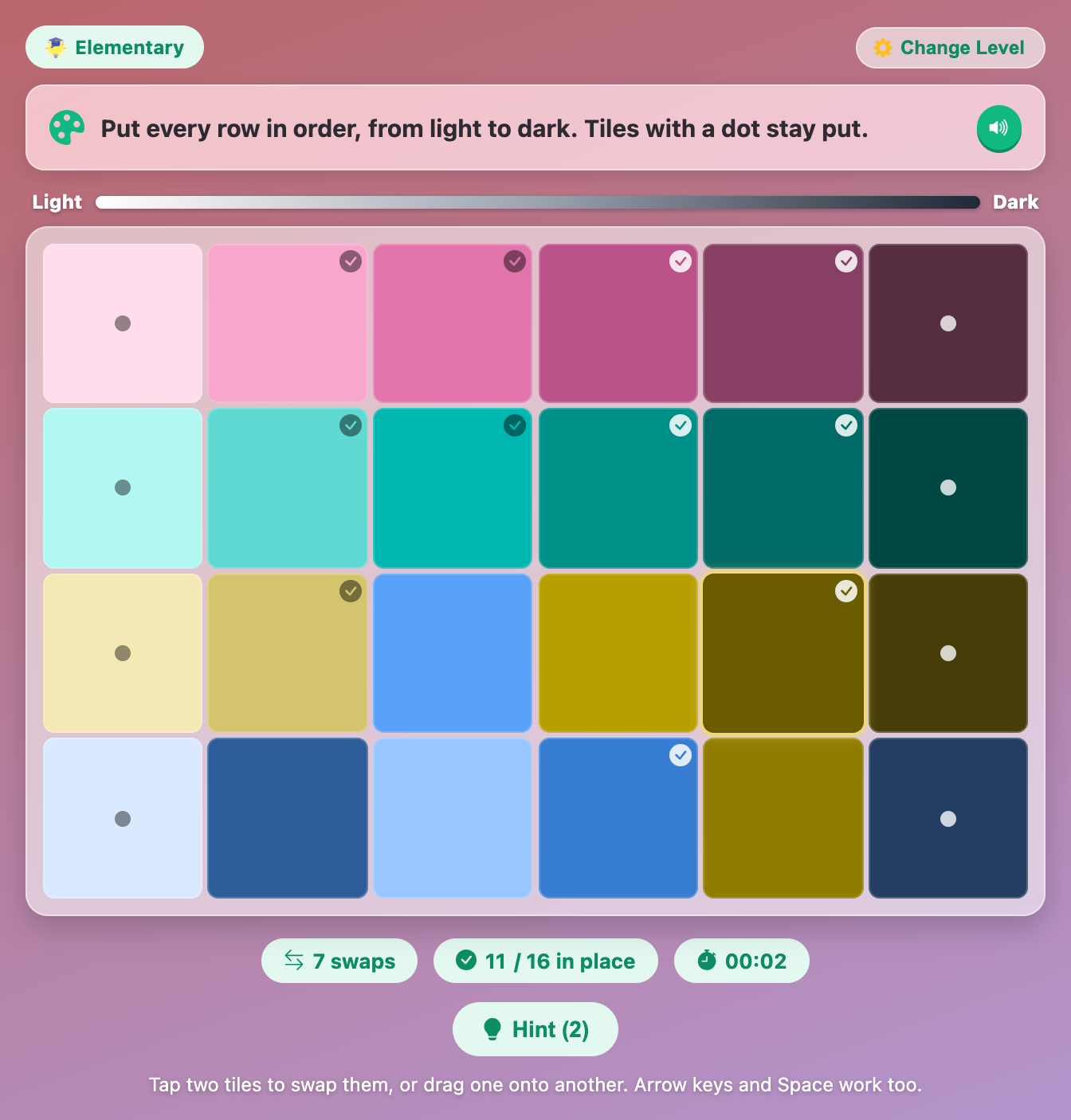
An Elementary board in Rainbow Hue Sort halfway sorted, with check marks on 11 tiles and a hint glowing on a dark olive tile
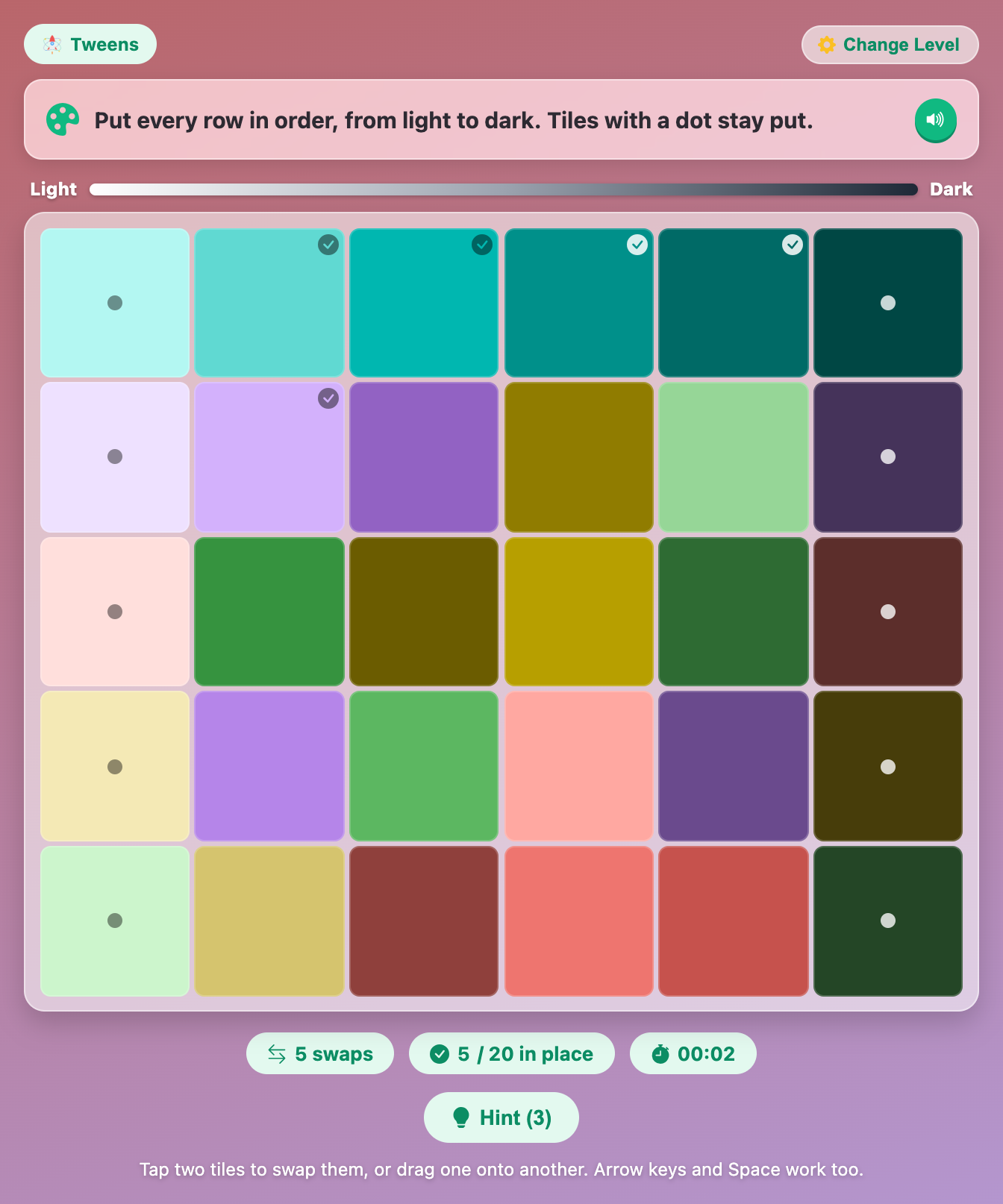
A board in Rainbow Hue Sort for tweens with five rows of teal, purple, red, yellow and green tiles still mixed up
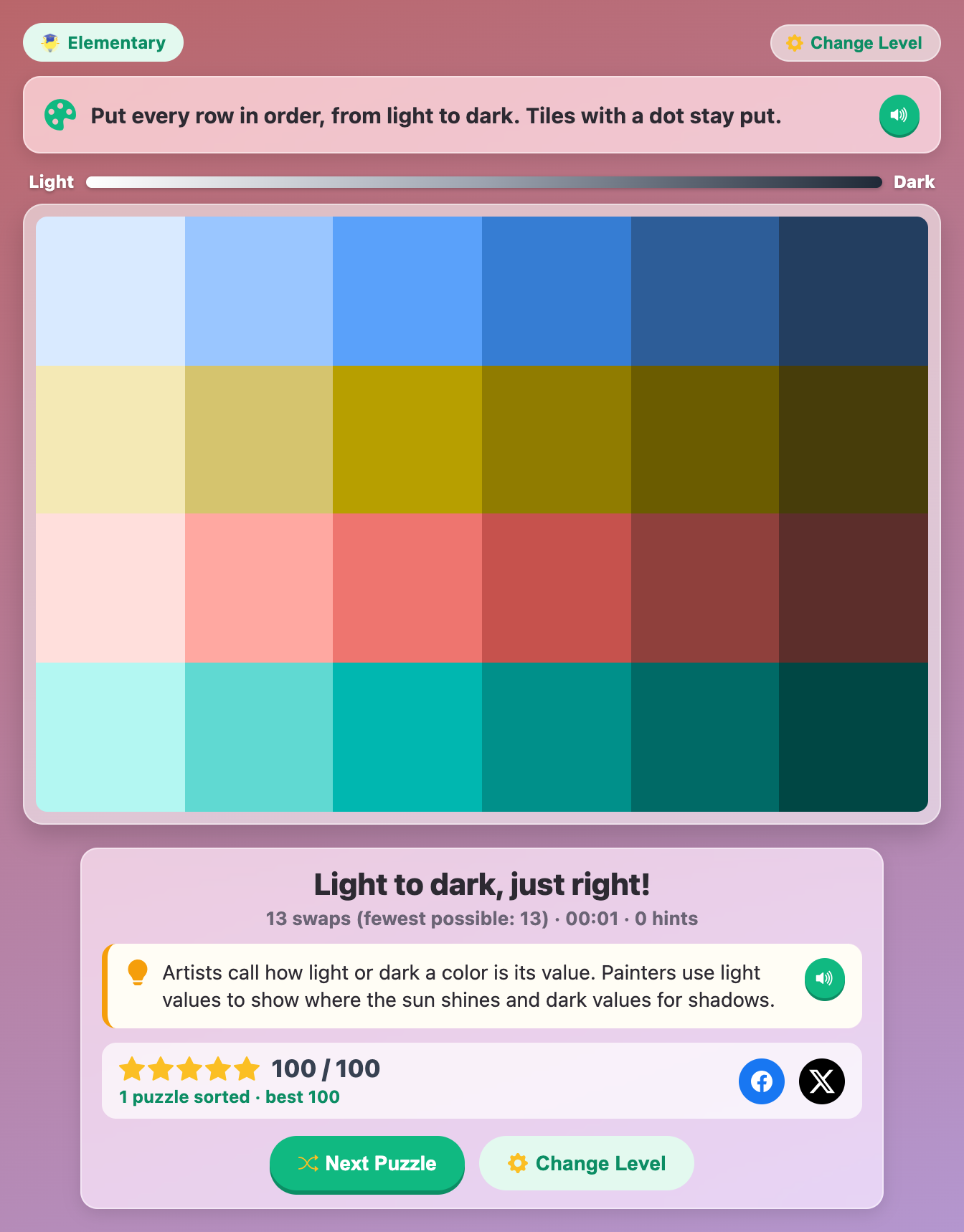
A finished Elementary puzzle in Rainbow Hue Sort with smooth blue, yellow, red and teal rows and a 100 out of 100 score card
More Art Games
 1.8M plays
4.9
Color & Draw
A free-drawing canvas with colors and brush sizes to unleash your creativity.
 154.5K plays
5.0
Mood Palette
Decide which color best fits a mood or theme before time runs out.
 584.9K plays
5.0
Tiny World Builder
Start with a tiny empty island and build your own blocky village — plant grass and trees, lay roads, and unlock houses, farms, a school and more!
 174.6K plays
4.9
Color Mixing
Look at two paint colors and pick which color they mix together to make.
Most Played Games
1.8M plays
4.9
Color & Draw
A free-drawing canvas with colors and brush sizes to unleash your creativity.
 59.5K plays
4.8
Recycling Sort
Sort everyday items into the Recycle, Compost, or Trash bin before time runs out!
 365.8K plays
5.0
Tic-Tac-Toe
Play a game of Tic-Tac-Toe against the computer and see if you can outsmart it.
 274.1K plays
5.0
Sentence Builder
Pick your age level, then tap the shuffled words in the right order to build the sentence.
Comments (33)