
Art Spot the Difference
202.1K playsThe Copycat Painter copied some paintings and made mistakes! Compare the original with the copy and tap every change: a new color, a lighter shade, a missing stripe, a flipped cup, a bigger tree. Each mistake you find tells you which art element changed, so you learn to look like an artist. Little ones find 3 big changes, big kids hunt for 7 tiny ones.
The Copycat Painter loves art. Every day this little painter sets up an easel next to a famous kind of painting and tries to copy it exactly. But the Copycat Painter is a bit careless! A starfish comes out too small. A beach ball turns green. An arrow points the wrong way. Your job in Art Spot the Difference for kids is to find every mistake in the copy before it goes on the museum wall.
This isn't an ordinary spot-the-difference game. Every mistake is one of the things real artists look at, like color, shade, shape or pattern, and the game tells you which one you found. So while you hunt, you learn to look at pictures the way an artist does. And because the paintings are drawn fresh by the game each time, you will never see the same pair twice.
🖌️ The Original, the Copy, and the Seven Art Elements
Each round shows two paintings in gold frames. The one on the left has a gold plaque that says Original. The one on the right says Copy by the Copycat Painter 🐱. All the mistakes are in the copy.
Artists have names for the building blocks of a picture. They call them art elements. The game uses seven of them, and every mistake belongs to one:
🎨 Color: something is painted a different color, like a red ball that turned green, or white dots that turned black.
🌗 Shade: the color is the same, but lighter or darker. Mixing in white makes a lighter color, called a tint. Mixing in black makes a darker one, called a shade.
📏 Size: something got bigger or smaller.
🔷 Shape: the outline changed, like a round window that became square, or a star with more points.
🦓 Pattern: stripes became dots, or one stripe is missing.
↔️ Direction: something faces, points, leans or goes the other way, like a cup handle on the wrong side.
👻 Missing & Extra: a whole thing (or part of it) has vanished, or something new appeared.
🏛️ Eight Kinds of Paintings to Explore
The paintings come in eight genres. A genre is a kind of painting. Each game picks three different ones, and a short fact about each genre sits under the paintings while you play:
Still Life: fruit, cups, vases and teapots on a table. A still life is a painting of things that stay still.
Landscape: hills, trees, houses, sheep and hot-air balloons.
Seascape: boats, lighthouses, seagulls, starfish and beach balls.
Abstract Art: triangles, zigzags, wavy lines and targets, with no real things at all, the way Wassily Kandinsky liked to paint.
Pattern Quilt: a grid of fabric squares full of stripes, dots, zigzags and checks. It starts at the Preschool level.
Starry Night: a moon, stars and swirls over little houses, cypress trees and streetlamps, inspired by Vincent van Gogh's famous painting.
Art Studio: easels, paint cans, brush jars, paint tubes, palettes and little framed paintings.
Flower Garden: tulips, sunflowers, butterflies, bees, ladybugs and snails, like the garden Claude Monet painted again and again.
🕹️ How a Round Works on KidWorld
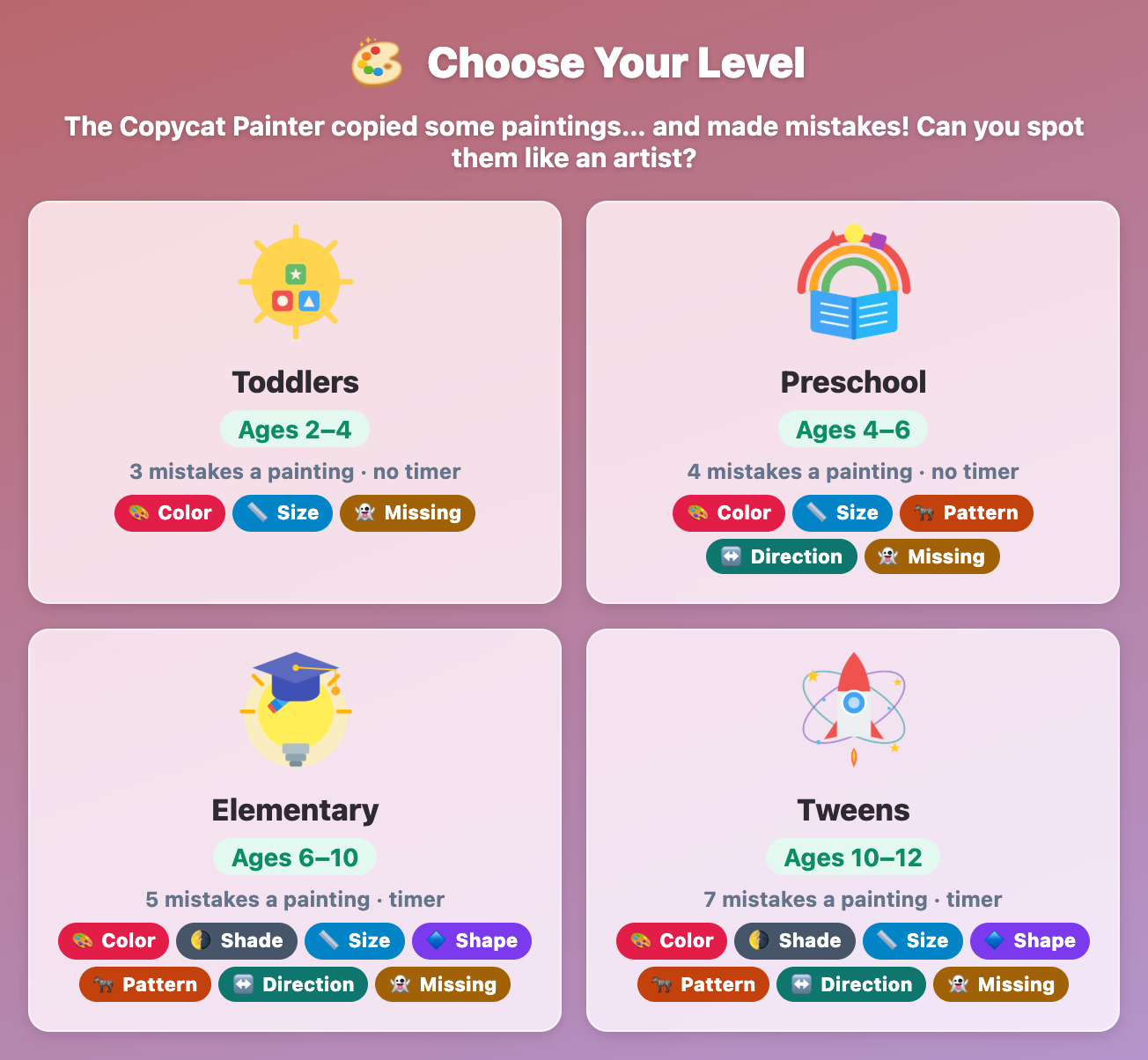
Choose your level. The Choose Your Level screen shows four cards. Each one says how many mistakes there are in a painting, whether there's a timer, and which art elements you'll meet, shown as colored chips. Change Level at the top lets you switch at any time.
Look at the top bar. It shows the genre's name, "Find 5 mistakes in the copy!" (or 3, 4 or 7), a row of magnifying-glass dots that turn into green checks as you find mistakes, your points, the Hint button, and on Elementary and Tweens a timer bar. A pill in the corner says "Painting 1 of 3".
Tap a mistake. Tap the spot on either painting. A gold circle appears on both paintings, a small label pops up (like "🎨 Color +10"), and a sentence below tells you exactly what changed, such as "The beach ball changed from red to green." Tap the 🔊 button next to a sentence to hear it read aloud. On Toddlers and Preschool, the game reads it for you when the sound is on.
Watch out for wrong taps. A tap on a spot with no mistake shows a red ✕. On Preschool it takes away 1 point, and on Elementary and Tweens 2 points. On Toddlers it costs nothing. If you tap wrong three times in a row very fast, the game says "Slow down — look like an artist! 👀" and pauses taps for a moment.
Ask for a hint. A hint dims the painting and shines a light around a mistake. It also says which art element to look for, like "Look for a direction mistake". On Toddlers and Preschool the light sits right on the mistake. On Elementary and Tweens it only shows the neighborhood, so you still have to find it. If you don't find anything for a while, the Hint button gives a little wiggle to remind you it's there.
Finish the painting. When you find every mistake, confetti falls and a bar shows your stars for that painting. If the timer runs out first, the game circles the ones you missed so you can see them, and the list shows them as "Missed". Tap Next Painting, and after the third one, See My Score.
Read your results card. You get a title (like "Art Detective!"), up to 5 stars, your total score, how many mistakes you caught, and a small copy of each original with its stars. The best part is Your artist's eye: one bar for each art element, showing how many of that kind you found. The game gives a tip for your weakest element. Play Again brings three brand-new paintings.
Use the page buttons. The music, reload and fullscreen buttons on the page work all the time. On a phone, the two paintings stack one above the other.
🧮 Stars and Points
Every mistake you find is worth 10 points. Wrong taps and hints take a few points away, but a painting's points never drop below 0. Find every mistake and you also earn a bonus of up to 10:
On Toddlers and Preschool (no timer), the bonus is 10, or 5 if you used a hint or made more than two wrong taps.
On Elementary and Tweens (with a timer), the bonus depends on how much time is left. Finish with lots of time and you get nearly all 10.
Each painting also gets up to 3 stars: 3 stars for finding everything with no hints and at most one wrong tap, 2 stars for finding everything, and 1 star otherwise. Hint costs are 2 points on Toddlers and 3 on the other levels.
🔎 How to Look Like an Artist (and Find Every Mistake)
Fast tapping doesn't win this game. Careful looking does. Here's how the best art detectives work.
Check one art element at a time
Instead of staring at the whole picture, do a quick "color check": go over every object and ask only "is it the same color?" Then do a "size check", then a "which way is it facing?" check. Your eyes find much more when they look for one thing at a time. The level card shows which elements your level uses, so you know what to check.
Count things in each part
Missing & Extra mistakes are easiest to find by counting. Count the things in the sky, then on the ground, in both paintings. If the original sky has a sun and a seagull and the copy's sky has only a sun, you've found it.
Look inside patterns
Patterns hide two kinds of mistakes. The pattern can change (stripes to dots), or one piece can go missing. Count the stripes or dots on each patterned thing. Also check which way stripes run: up and down, or across.
Compare a color with its neighbor
Shade mistakes are sneaky, because the color is still "blue". Look at the object next to something of a similar color, and compare it with the same object in the original. Is it lighter, like it had white mixed in? Darker, like it had black mixed in?
Trace the outline
For Shape mistakes, trace the edge of each object with your eyes. Is the window round or square? How many points does the star have? Is the half circle's round side at the top or the bottom?
Ask "which way?"
Direction mistakes include arrows, cup handles, birds, boats, triangles that point up or down, and wavy lines that go across or up and down. Check every object that has a front or a point.
Tap only when you're sure
On the older levels, every wrong tap costs 2 points and can cost you a star. Find the mistake in your eyes first, and then tap once.
Save hints for the end
Each hint costs points and takes the bonus down to 5 on the untimed levels. Hunt on your own first. If one mistake is still hiding and the clock is running low, that's the moment for a hint. The hint even tells you which element to look for, so read it carefully.
🧩 Real Paintings, Solved Together
Example 1: A Toddlers seascape
The original shows a sailboat, a big sun, a seagull, a palm tree, a beach ball, two starfish and a shell. The copy has three mistakes:
Color: the beach ball changed from red to green.
Missing: the seagull in the sky is gone.
Size: the yellow starfish on the left is much smaller.
A good way to find them: first look at the colors (the ball!), then count the things in the sky (one is missing), then compare sizes along the sand.
Example 2: An Elementary abstract painting
This painting is full of shapes: a striped square, zigzags, triangles, an arrow, a wavy line, a target and a star. The copy hides five mistakes, and they come from four different elements:
Direction: one triangle's pink stripes go across in the copy, not up and down.
Shade: the blue triangle is a darker blue in the copy, a shade.
Pattern: the red triangle has stripes instead of dots.
Direction: the yellow arrow points left instead of right.
Color: the orange triangle's dots changed from white to black.
Notice that three triangles had mistakes! When you find one changed shape, check the shapes that look like it.
Example 3: Counting the points
On that Elementary painting, the player found all 5 mistakes (50 points) but used one hint (−3). That leaves 47. They finished with almost all the time left, so the time bonus added 10, making 57 out of 60. Because of the hint, the painting got 2 stars instead of 3. The other two paintings were found with no hints and no wrong taps, so the whole game scored 177 out of 180 and earned the title "Art Detective!"
Example 4: Color or shade?
A blue cup that turns green is a Color mistake. A blue cup that turns light blue, or dark navy-like blue, is a Shade mistake. Here's the trick: if you would still call it the same color name with "light" or "dark" in front, it's a shade.
Example 5: The quilt squares
On a Pattern Quilt, every square has its own pattern. Don't jump around! Go square by square, row by row, like reading a book. For each square, check three things: the pattern (stripes, dots, zigzags or checks), its colors, and which way it runs.
🎯 Art Spot the Difference for Kids of All Ages
🐣 Art Spot the Difference for toddlers (ages 2–4)
The Toddlers level keeps things big and simple. Each painting has 7 to 9 large objects and only 3 mistakes, all of them Color, Size or Missing & Extra. There's no timer, wrong taps cost nothing, and hints never run out. When the sound is on, the game says how many mistakes to find and reads each one out loud. A grown-up can help by asking "What color is the ball here? And here?"
🎨 Art Spot the Difference for preschoolers (ages 4–6)
The Preschool level adds Pattern and Direction, with 4 mistakes among 9 to 11 objects, 5 hints, and still no timer. The Pattern Quilt shows up from this level on. It's a lovely age to learn words like "stripes", "dots" and "facing the other way", and when the sound is on, the game says each one out loud.
📚 Art Spot the Difference for elementary kids (ages 6–10)
The Elementary level uses all seven elements, including Shade and Shape. There are 5 mistakes among 12 to 14 objects, 3 hints that only show the neighborhood, and a 2:30 timer. Kids who like naming the kinds of lines in a picture can also try Magic Crossbow: Line Hunt, where you shoot every zigzag, wavy or spiral line.
🚀 Art Spot the Difference for tweens (ages 10–12)
The Tweens level is the real test of an artist's eye: 7 mistakes hidden among 15 to 18 smaller objects, a 3-minute timer and just 2 hints. The shade and size changes are gentler too, so a slightly lighter pink or a slightly bigger cup can slip past. Tweens who want more spotting can try the Mind version, Spot the Difference, with parks, candy lands and toy rooms.
🌈 What Kids Learn From Catching the Copycat
The language of art. Every find comes with a word: tint, shade, pattern, direction. After a few games, kids can say why two pictures look different, not just that they do. That's how art teachers want children to talk about pictures.
Looking closely and slowly. The game rewards careful eyes, not fast fingers. The "slow down" pause and the cost of wrong taps gently teach kids to look before they act.
Knowing what to practice. The "Your artist's eye" bars show which elements a child spots easily and which ones they miss. A tip like "A pattern repeats. Count the stripes and dots: is one missing?" points at exactly what to try next time.
A first taste of art history. Genres like still life, landscape and seascape are real words from museums, and the facts mention artists like Van Gogh, Monet and Kandinsky. Kids who get curious can rebuild Van Gogh's real Starry Night in Masterpiece Jigsaw.
A note for grown-ups
Art Spot the Difference is a gentle, safe game with friendly pictures of fruit, boats, flowers and shapes. There's nothing scary and no chat. Every mistake is fully visible and never hidden behind another object. Color changes always differ in brightness or in blue and yellow, so they still show for children who see red and green differently. The game builds visual attention, vocabulary for describing art, and patience.
The Copycat Painter has already started on the next painting, and it's sure to be full of mistakes. Can you catch them all? Pick your level and become an art detective in Art Spot the Difference for kids!
🖼️ See the Game in Action
The Choose Your Level screen in Art Spot the Difference for kids, with the art elements each level uses
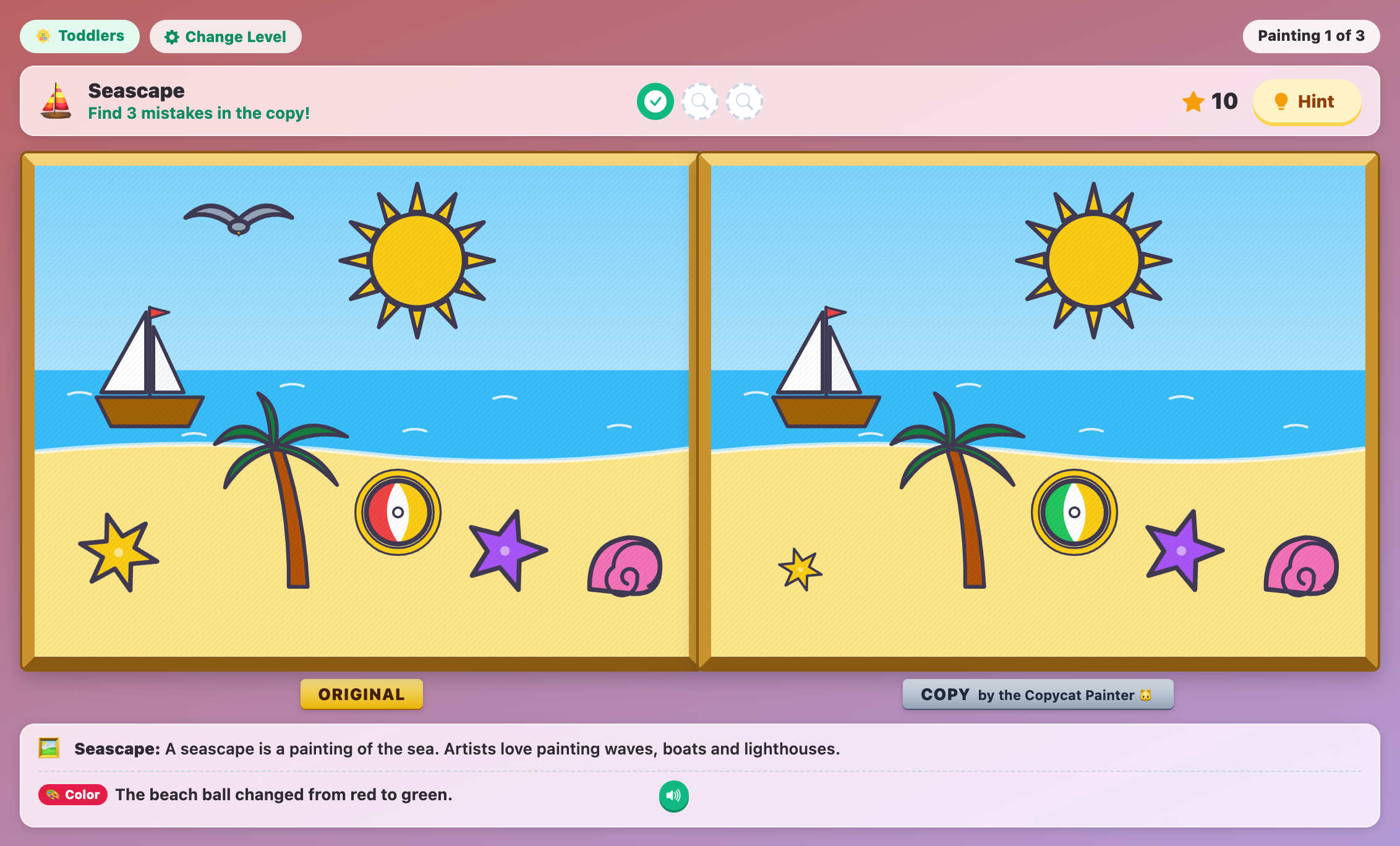
A seascape original and copy in Art Spot the Difference for toddlers, with the green beach ball found
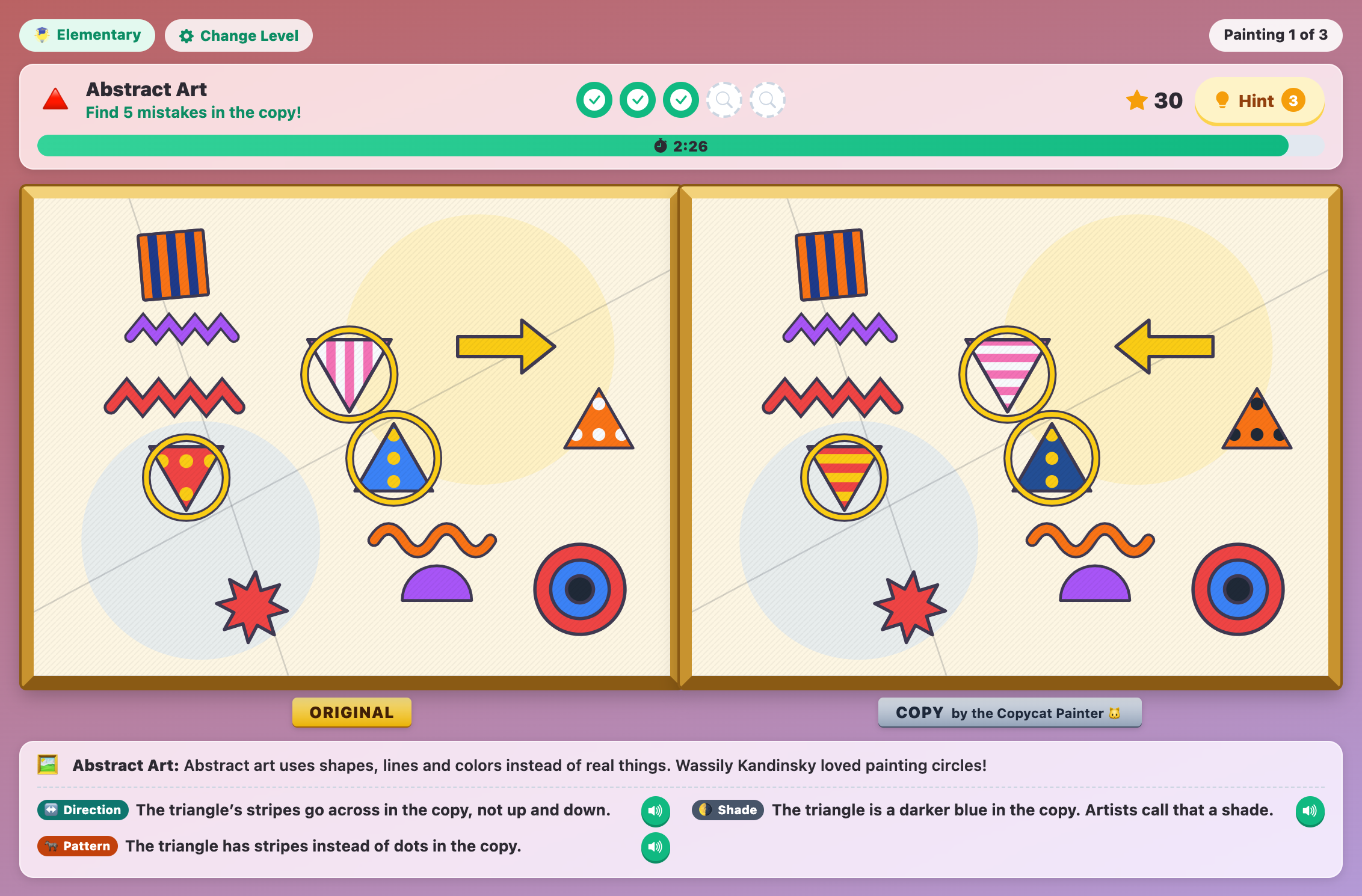
An abstract art painting at the Elementary level with three of five mistakes circled and explained below
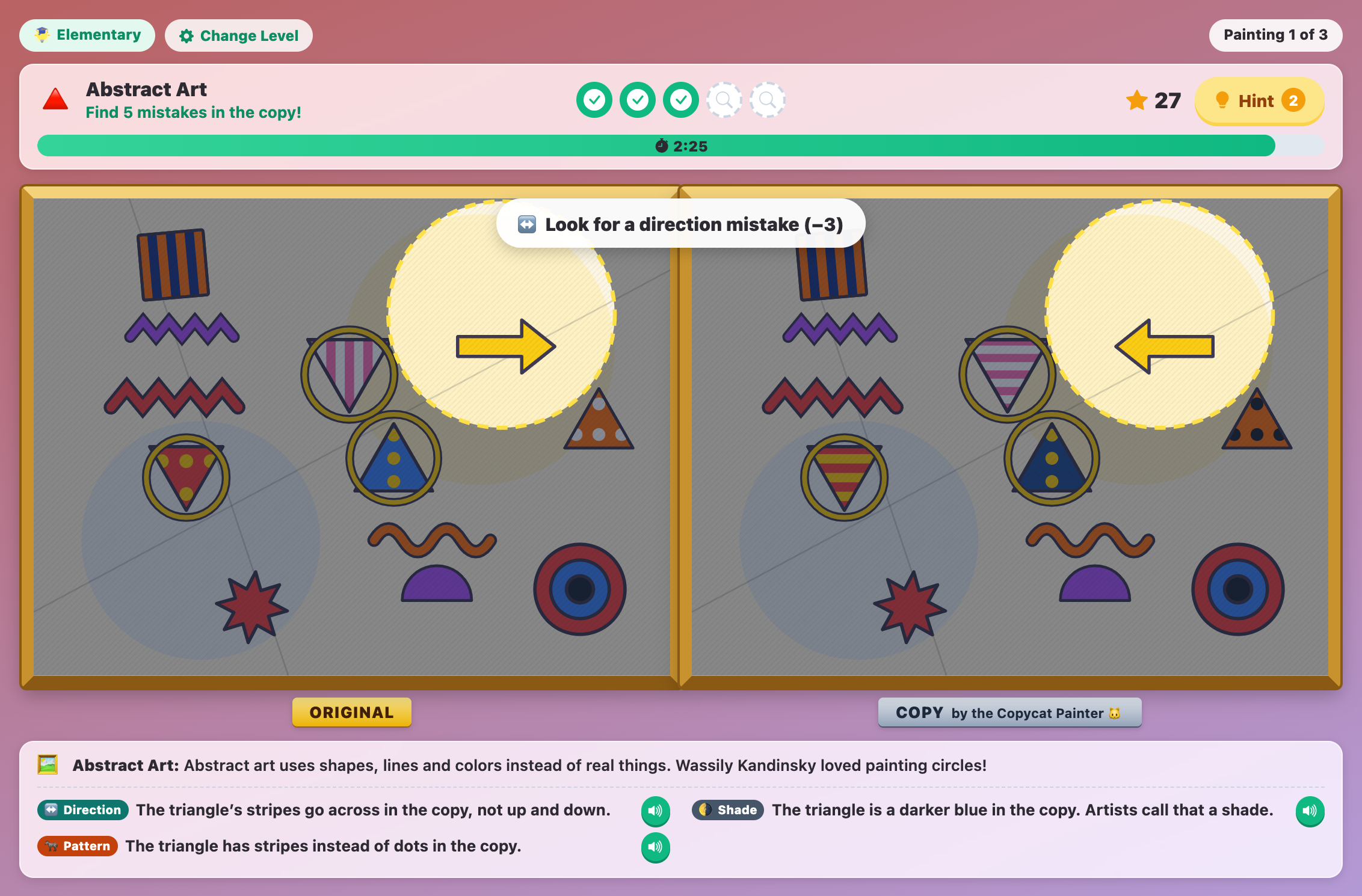
A hint spotlight around the yellow arrow, with a Look for a direction mistake message
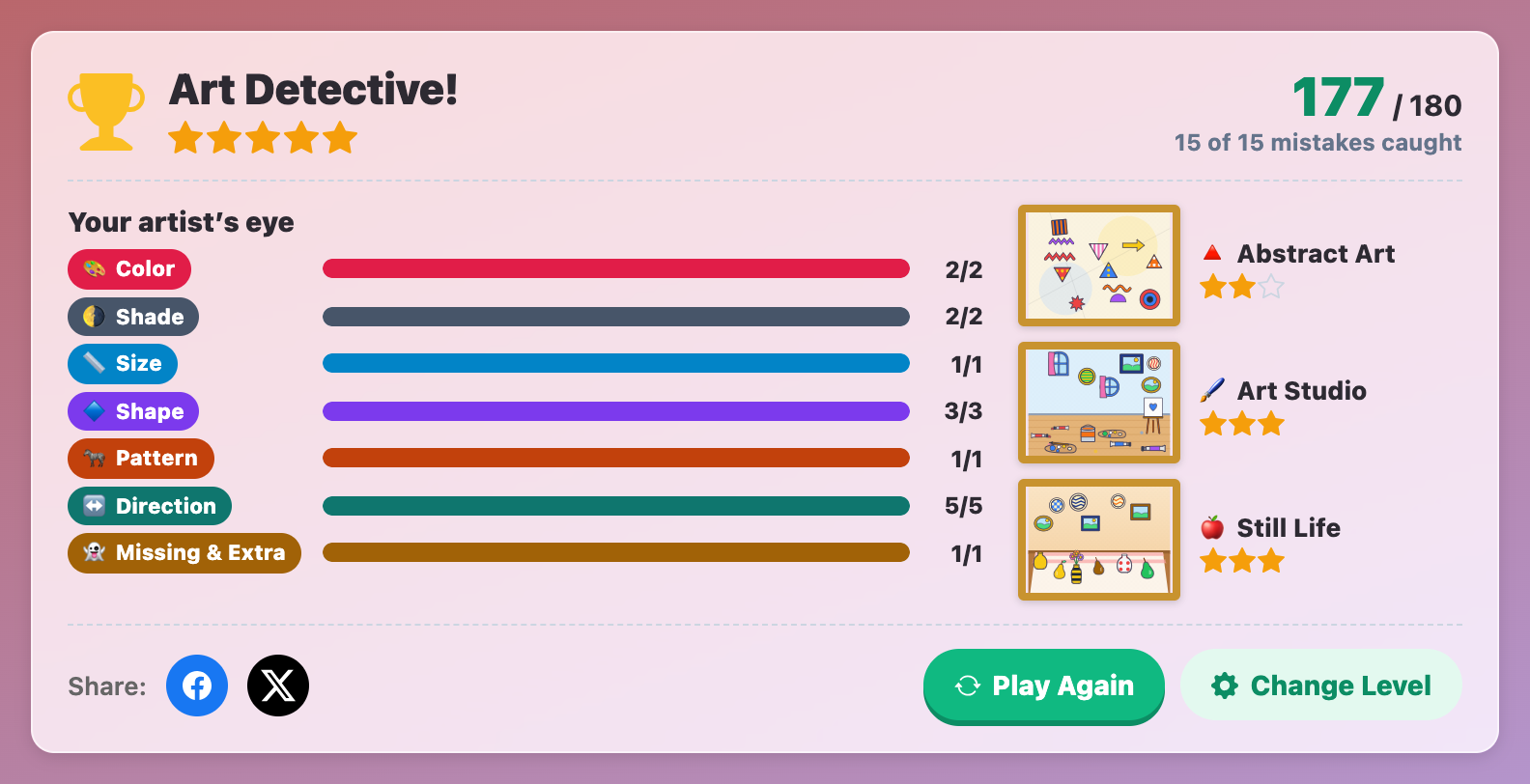
The Art Detective results card with 177 out of 180 points and the Your artist’s eye bars for each element
More Art Games
 1.8M plays
4.9
Color & Draw
A free-drawing canvas with colors and brush sizes to unleash your creativity.
 154.5K plays
5.0
Mood Palette
Decide which color best fits a mood or theme before time runs out.
 584.9K plays
5.0
Tiny World Builder
Start with a tiny empty island and build your own blocky village — plant grass and trees, lay roads, and unlock houses, farms, a school and more!
 174.6K plays
4.9
Color Mixing
Look at two paint colors and pick which color they mix together to make.
Most Played Games
1.8M plays
4.9
Color & Draw
A free-drawing canvas with colors and brush sizes to unleash your creativity.
 59.5K plays
4.8
Recycling Sort
Sort everyday items into the Recycle, Compost, or Trash bin before time runs out!
 365.8K plays
5.0
Tic-Tac-Toe
Play a game of Tic-Tac-Toe against the computer and see if you can outsmart it.
 274.1K plays
5.0
Sentence Builder
Pick your age level, then tap the shuffled words in the right order to build the sentence.
Comments (27)