
Masterpiece Jigsaw
563.6K playsPut famous paintings back together! Drag the jigsaw pieces of The Starry Night, the Mona Lisa, The Great Wave and more into the frame, then read the museum label to find out who painted it, when, and one amazing fact. Every painting you finish hangs in your own My Museum wall. Little ones start with 6 big pieces, big kids take on 30.
Twenty famous paintings have arrived at KidWorld in pieces. The Starry Night is a pile of swirly blue bits. The Mona Lisa is scattered across a table. A giant wave from Japan is broken into 30 little shapes. Your job is to put each one back together and hang it on your own museum wall. That is Masterpiece Jigsaw for kids, and every puzzle ends with a real painting by a real artist.
You drag the pieces into a gold-edged frame until the whole picture is back. Then the lines between the pieces melt away, and a museum label slides up. It tells you the painting's name, who painted it, when, where it hangs today, and one amazing fact. Little ones start with 6 big pieces. Big kids can take on 30.
🧩 A Puzzle Made From Real Art
A jigsaw puzzle is a picture cut into pieces that lock together. Most pieces have little bumps sticking out and little dips cut in. A bump on one piece always fits the dip on the piece next to it, like a key in a lock.
In this game, the pictures are masterpieces. A masterpiece is a work of art so special that people keep looking at it for hundreds of years. You will meet paintings by Vincent van Gogh, Leonardo da Vinci, Claude Monet, Katsushika Hokusai and more.
All 20 paintings are public domain. That means they are old enough that anyone is allowed to share them. The game uses real photos of them from Wikimedia Commons, a big free library of pictures. So the colors and brush marks you see are the real ones.
🏛️ From Empty Walls to a Full Museum: Playing on KidWorld
Pick your level. The Choose Your Level screen shows four cards: Toddlers (6 pieces), Preschool (12 pieces), Elementary (20 pieces) and Tweens (30 pieces). The game remembers your pick. You can switch any time with the Change Level button at the top.
Visit My Museum. This is your home screen. It has 20 frames, one for each painting. At first they are all mystery frames with a big "?" in them. A bar at the top fills up as you collect paintings.
Choose a painting. Tap Play a New Painting and the game picks one you have not finished yet. Or tap any mystery frame to play that exact painting.
Look around the board. The empty frame shows a dashed outline for every piece. The loose pieces wait in a tray below the frame, or beside it on a wide screen. At the top you see your points, a piece counter like "2 / 6", and a tiny picture of the finished painting.
Drag a piece into place. Hold it with your mouse or finger and pull it to its spot. When it is close enough, it snaps in with a happy sound. Pieces are always the right way up, so you never have to turn one.
Use your helpers. 💡 Hint makes one loose piece and its spot glow for 5 seconds, and costs 3 points. Elementary and Tweens players also get 👁 Show Picture, which fades in a faint copy of the painting for 5 seconds. Shuffle Tray deals the loose pieces back into the tray in a new order.
Finish the painting. When the last piece clicks in, the whole painting appears in a gold frame. Its museum label slides up, and a 🔊 button reads the label out loud. You also see your score and up to 5 ⭐ stars.
Keep collecting. Tap Next Painting for a new one, or My Museum to see your wall. Tap a finished frame to read its label again or press Play It Again.
Try the page buttons. The fullscreen button makes the board bigger. The music button turns the sound on or off. The reload button starts the puzzle over, but your museum stays.
🖼️ Meet Some of the Paintings
Every painting comes with its own fact. Here are a few you might find, without giving away all 20 surprises:
The Starry Night by Vincent van Gogh, 1889. He could see this view from his bedroom window, but he painted the swirly sky in the daytime, from memory.
The Great Wave off Kanagawa by Katsushika Hokusai, about 1831. It is a woodblock print, so thousands of copies were made. Look for tiny Mount Fuji far away under the wave.
A Sunday on La Grande Jatte by Georges Seurat. The whole picture is made of tiny dots of color, and it took about two years to paint.
Vertumnus by Giuseppe Arcimboldo. Look again: the face is made of fruit, vegetables and flowers, and the nose is a pear!
Young Hare by Albrecht Dürer, 1502. He painted every hair with a tiny brush, and you can see a window shining in the hare's eye.
Composition with Red, Yellow, Blue and Black by Piet Mondrian. He used only straight black lines, white, gray and the three primary colors.
The label also tells you where each painting lives now, like the Louvre in Paris or the Museum of Modern Art in New York. So every puzzle is a tiny trip around the world's museums.
🔍 Puzzle-Builder Tricks That Really Work
Anyone can finish these puzzles by trying pieces one by one. These tricks help you finish faster, use fewer hints and keep more points.
Start with the corners
A corner piece has two flat sides and no bumps on them. There are only 4 corners in every puzzle, so each one has just one place to go. Find them first, and your frame has four strong anchors.
Build the border next
Edge pieces have one flat side. That flat side always faces the outside of the frame. Once the border is done, the middle pieces have walls to lean on, and there are fewer spots left to try.
Read the dashed shapes on the board
This is the big secret of this game. Every empty spot on the board shows the outline of the piece that belongs there, drawn in dashes. If your piece has a bump on the left and a dip on top, look for a dashed shape with a bump on the left and a dip on top. Shape plus picture together usually tells you the answer.
Sort by color
Paintings have color zones. In The Starry Night, the deep blue sky is on top and the dark village is below. In Sunflowers, yellow flowers stand in front of a yellow background, which makes it extra tricky. Before you start, look at the tiny picture at the top. Ask: "Where is the brightest part? Where is the darkest?" Then match each piece to its zone.
Park pieces in groups
You can drop a loose piece anywhere in the play area, not just on its spot. Try making little piles: sky pieces in one corner, ground pieces in another. If the play area gets messy, tap Shuffle Tray. It sends every loose piece back into neat rows, and the pieces already in the frame stay put.
Get close, then let go
A piece only snaps into its own spot. You do not need to be perfect, just close. If you drop it in the wrong place, nothing bad happens: no points are lost, and you can pick it up again. So it is fine to test an idea.
Save your hints for the end
The hint picks a loose piece at random. At the start, it might glow a piece you could have found easily. Near the end, only the tricky pieces are left, like plain sky with no clues. That is when a hint really helps. Each hint costs 3 points, so make each one count.
Peek as much as you like
On Elementary and Tweens, Show Picture is free and has no limit. It shows a faint copy of the painting for 5 seconds, right under the empty spots. Use it to check where the moon or the boat goes, then press it again after it fades.
🧠 Let's Solve Some Together
Example 1: The Starry Night with 6 pieces (Toddlers)
This painting is wider than it is tall, so the game cuts it into 2 rows of 3 pieces. Every piece is a corner or an edge here!
Find the piece with the big yellow moon. The moon is in the top right of the painting, so it goes in the top right corner.
Find the pieces with the tall dark tree. The tree stands on the left and reaches from bottom to top, so those pieces go in the left column.
The piece with the little church and village goes in the bottom middle.
The faint picture under the board shows where the rest go. Drag each piece on top of its matching colors.
Example 2: The Great Wave with 20 pieces (Elementary)
The Great Wave is wide, so 20 pieces become 4 rows of 5. That puzzle has 14 border pieces and only 6 middle pieces.
Pull out the 4 corners first. The top left corner has dark blue water and writing on it. The top right corner is plain, pale sky.
Build the border. The left side is full of white foam. The bottom edge is waves and long boats.
Fill the middle. Look for the curling claws of foam at the top of the wave, and tiny snowy Mount Fuji low in the middle.
The plain sky pieces look alike. For those, match the dashed shape: count the bumps and dips on each side.
Example 3: The Mona Lisa with 30 pieces (Tweens)
The Mona Lisa is taller than it is wide. So the game turns the grid: instead of 5 rows of 6, you get 6 rows of 5. That keeps each piece close to a square. This puzzle has 18 border pieces and 12 in the middle.
The top rows hold a hazy blue-green landscape. Gather those pieces in one pile.
Her face and hair sit in the upper middle. Pieces with skin color go there.
Her dark dress fills much of the lower half, and her folded hands rest near the bottom. Dark pieces with a bit of skin show the hands.
Lots of dark pieces look the same. Use Show Picture, then match the dashed shapes.
Example 4: How many hints can you use and still get 5 stars?
Each placed piece is worth 8 points, and finishing adds 15 more. A hint takes away 3. You get 5 stars when you keep at least 9 out of every 10 possible points (90%).
Tweens: 30 pieces × 8 + 15 = 255 points. With all 3 hints, you still have 246. That is still 5 stars!
Toddlers: 6 pieces × 8 + 15 = 63 points. 2 hints leave 57, still 5 stars. A third hint leaves 54, which is 4 stars.
Preschool: 12 pieces × 8 + 15 = 111 points. 3 hints leave 102 for 5 stars. The fourth hint drops you to 99, which is 4 stars.
So on small puzzles, every hint matters more. On big puzzles, a hint is cheap compared to all those pieces.
🎯 Masterpiece Jigsaw for Kids From 2 to 12
🐣 Masterpiece Jigsaw for toddlers (ages 2–4)
The Toddlers level uses 6 big pieces with large bumps. A faint copy of the painting always sits under the board, so a little one can match colors to colors. Pieces snap in from further away, there are 5 hints, and the museum label is read aloud when the sound is on. Sit together and name what you see: "Where is the moon? Where is the tree?"
🎨 Masterpiece Jigsaw for preschoolers (ages 4–6)
The Preschool level has 12 pieces. The faint picture under the board is still there to help, with 4 hints and the label read aloud. If your child loves the dragging but wants simpler pictures some days, Jigsaw Puzzle cuts big, bright emoji pictures into pieces the same way.
📚 Masterpiece Jigsaw for elementary kids (ages 6–10)
The Elementary level has 20 pieces and no picture under the board. Instead, the Show Picture button gives a 5-second peek whenever you want. Pieces must land closer to their spot, and there are 3 hints. This is a great level for learning the corners-then-border trick.
🚀 Masterpiece Jigsaw for tweens (ages 10–12)
The Tweens level cuts each painting into 30 pieces with smaller bumps. The snap is the tightest, and there are 3 hints. When all 20 frames are full, the museum says to try them again with more pieces. Each frame shows the most pieces you have ever finished that painting with, so tweens can try to make every frame say 30.
💛 Why Building a Painting Is Good for Growing Minds
Looking closely. To tell two blue sky pieces apart, you look at the tiniest brush marks. That is exactly how artists and museum experts look at paintings too.
Shapes and space. Matching a bump to a dashed outline helps your brain picture how shapes fit together. You learn to think "this side goes up, that side goes left."
Patience that pays off. A 30-piece wave does not happen in one minute. But each snap and happy sound shows you are getting closer, and the gold frame at the end feels great.
Art you will remember. After building The Starry Night with your own hands, you will know it anywhere. The labels add names, dates and places, so kids learn art history without a single test. When a few paintings hang on your wall, see how much you remember with Art Masterpiece Quiz, a quiz about famous artists and paintings.
Reading and listening. Older kids read each label on their own. Younger kids can tap 🔊 to hear it, then talk about it with a grown-up.
A note for grown-ups
This game is calm and safe. The paintings were chosen with children in mind: sunflowers, a hare, ballet dancers, a garden bridge, kids playing games. There is no timer and no way to lose; wrong drops cost nothing. It practices visual attention, shape matching, patience and early art knowledge. Your child's museum is saved in this browser, so on a different device the wall starts empty again.
Ready to fill your walls? Pick a mystery frame, find the four corners, and watch a famous painting come back to life. Masterpiece Jigsaw for kids turns every puzzle into a new piece of art history. And after you finish a few, why not paint a masterpiece of your own in Color & Draw?
🖼️ See the Game in Action
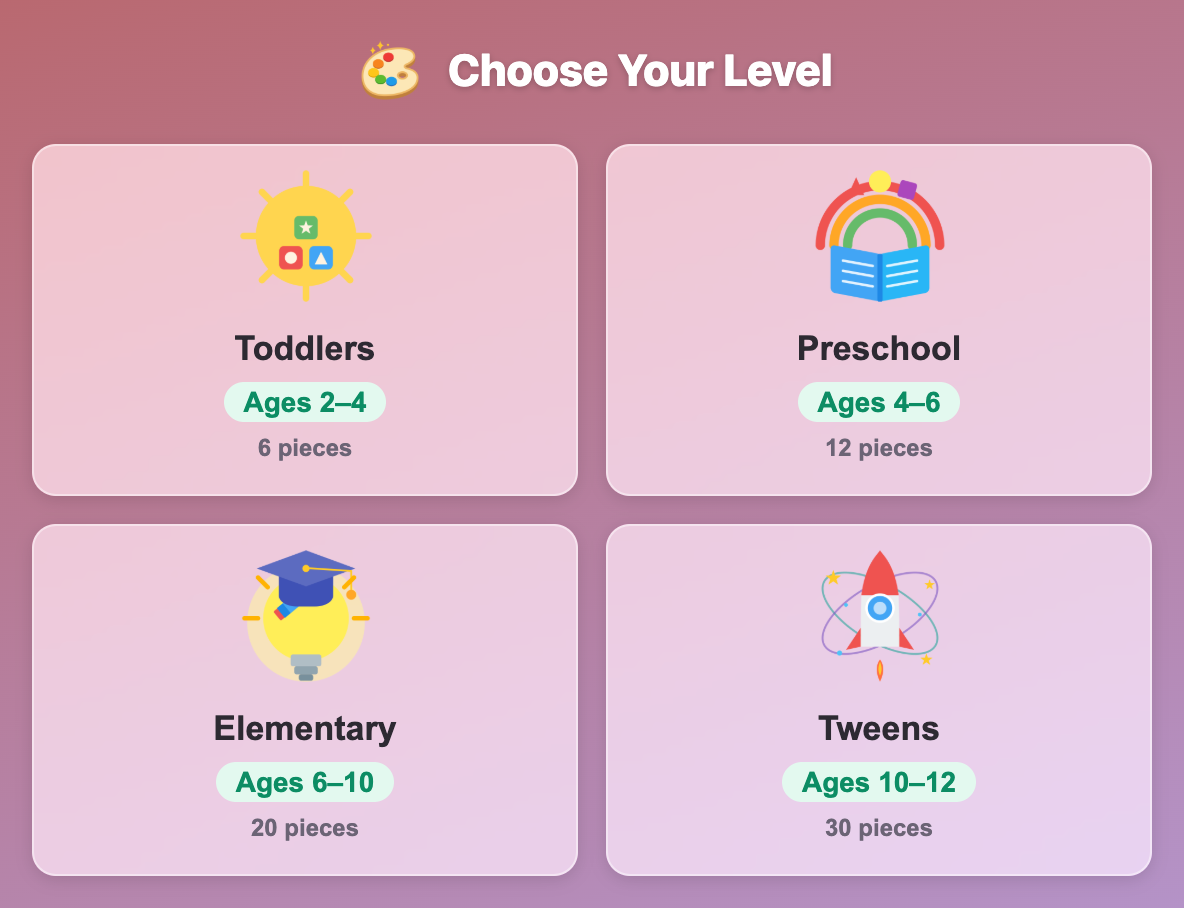
The Choose Your Level screen in Masterpiece Jigsaw for kids, from Toddlers with 6 pieces up to Tweens with 30 pieces
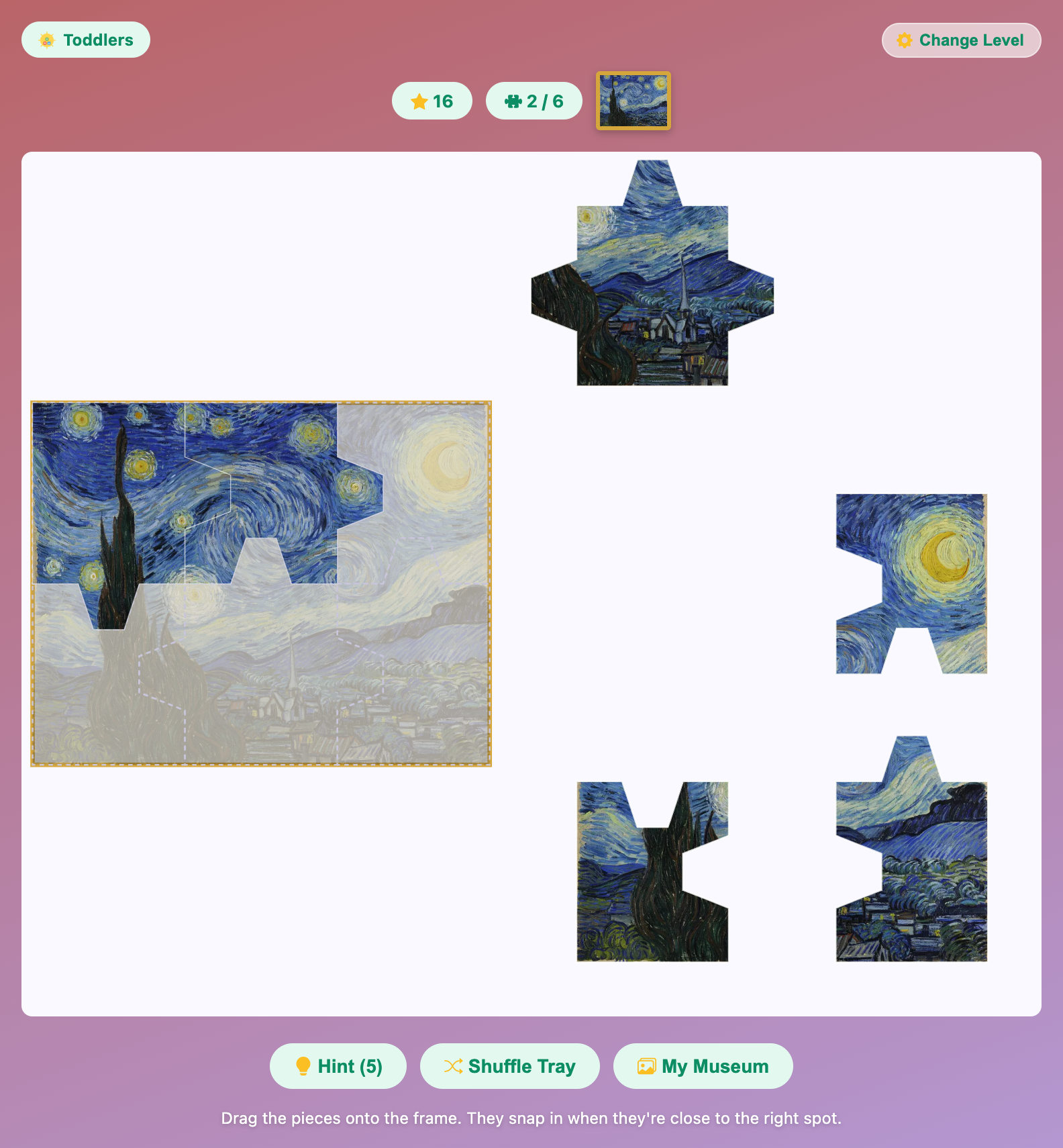
A 6-piece Starry Night puzzle at the Toddlers level, with two pieces placed over a faint ghost picture
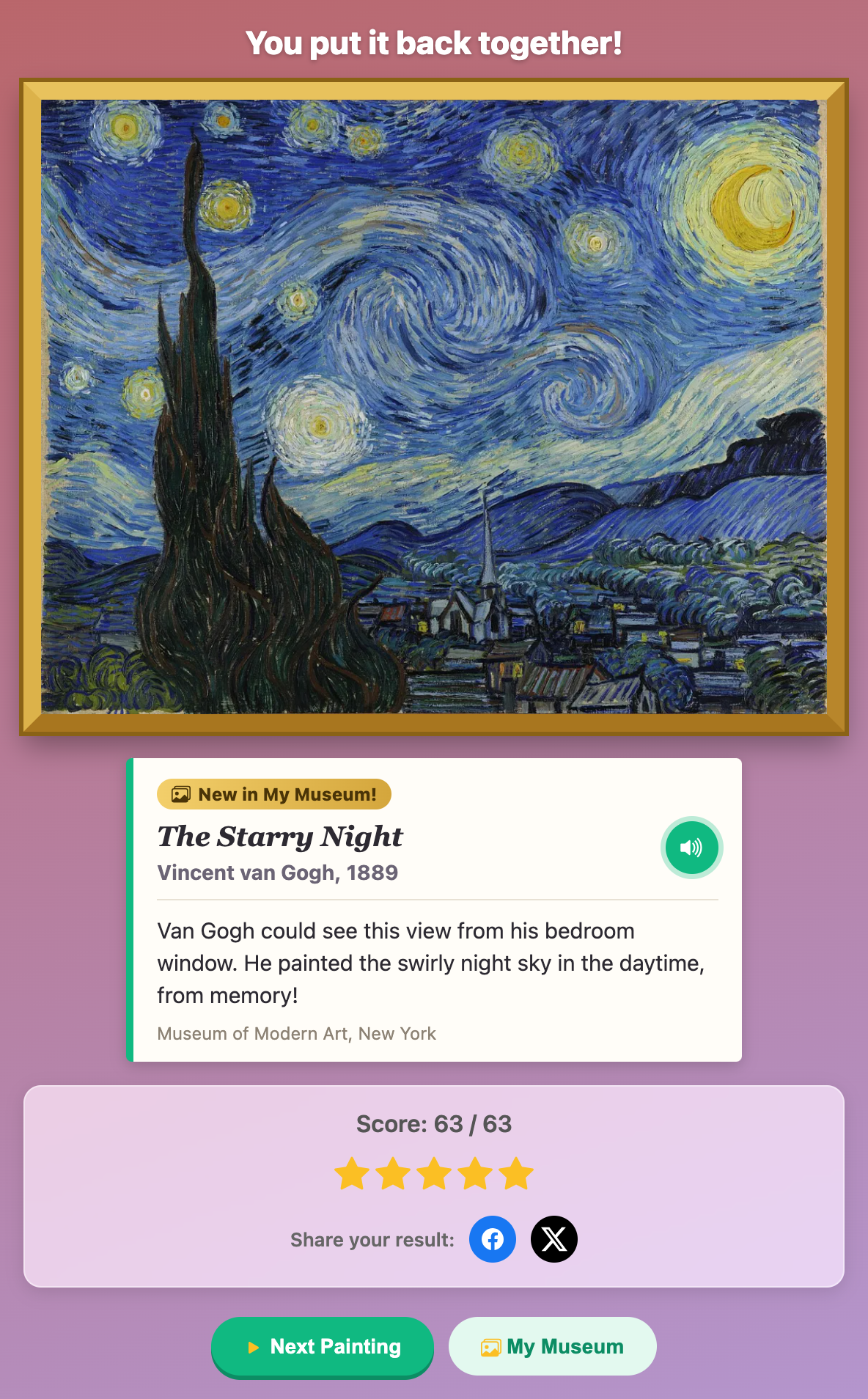
The finished Starry Night in a gold frame with its museum label, a score of 63 out of 63 and five stars
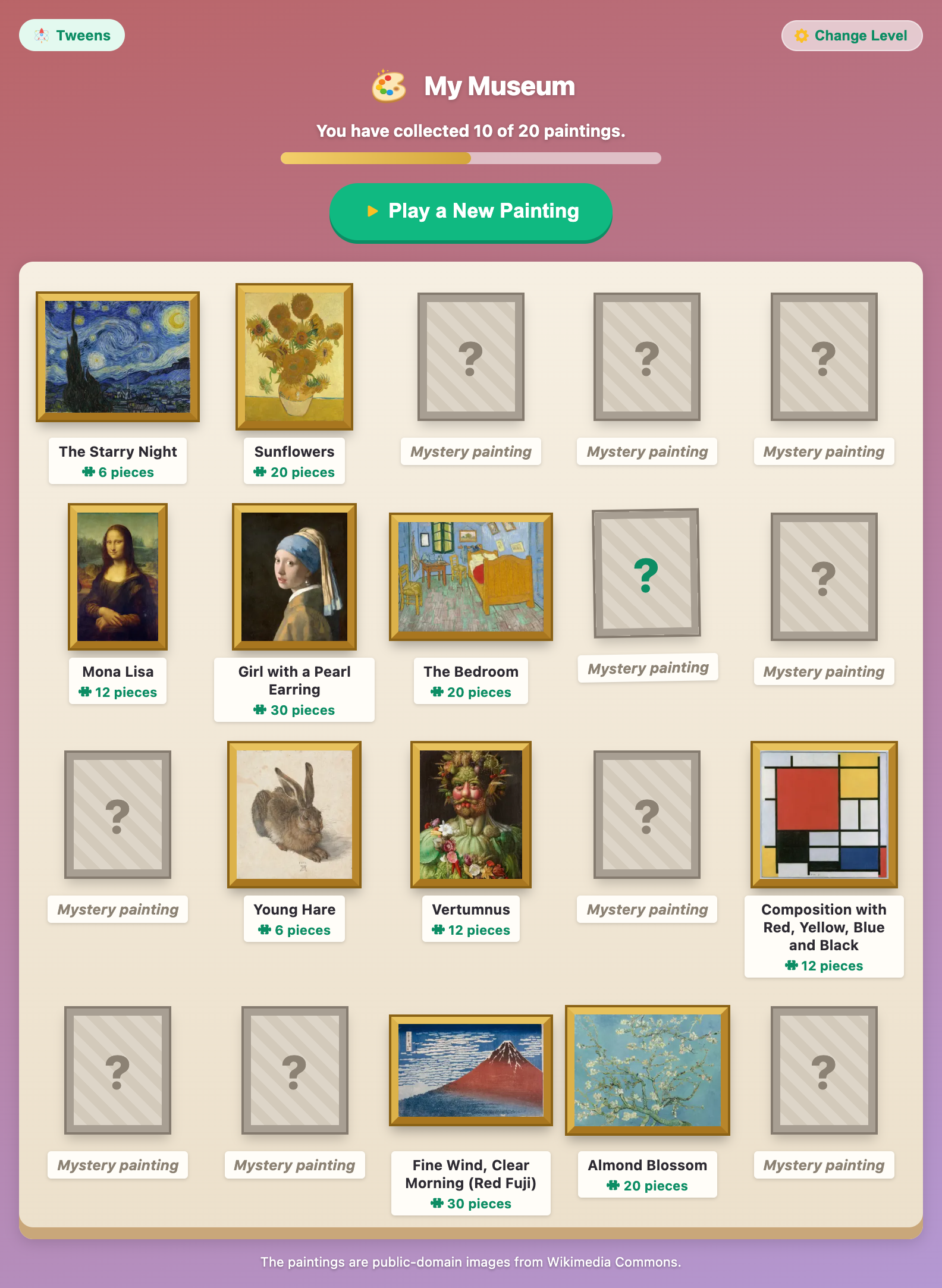
The My Museum wall in Masterpiece Jigsaw with ten framed paintings and ten mystery frames still to fill
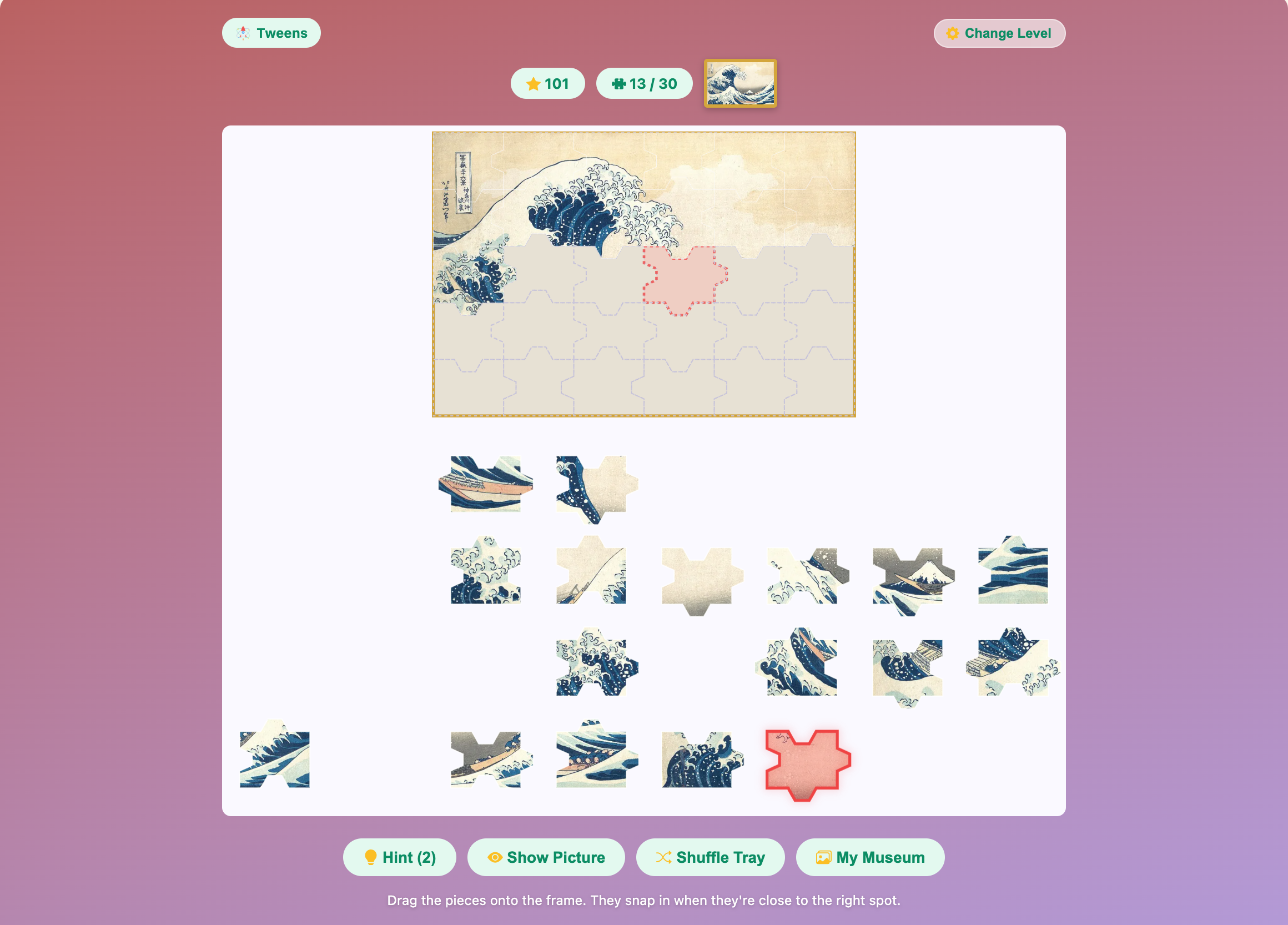
The Great Wave off Kanagawa as a 30-piece Masterpiece Jigsaw for tweens, with a hint glowing on one piece and its spot
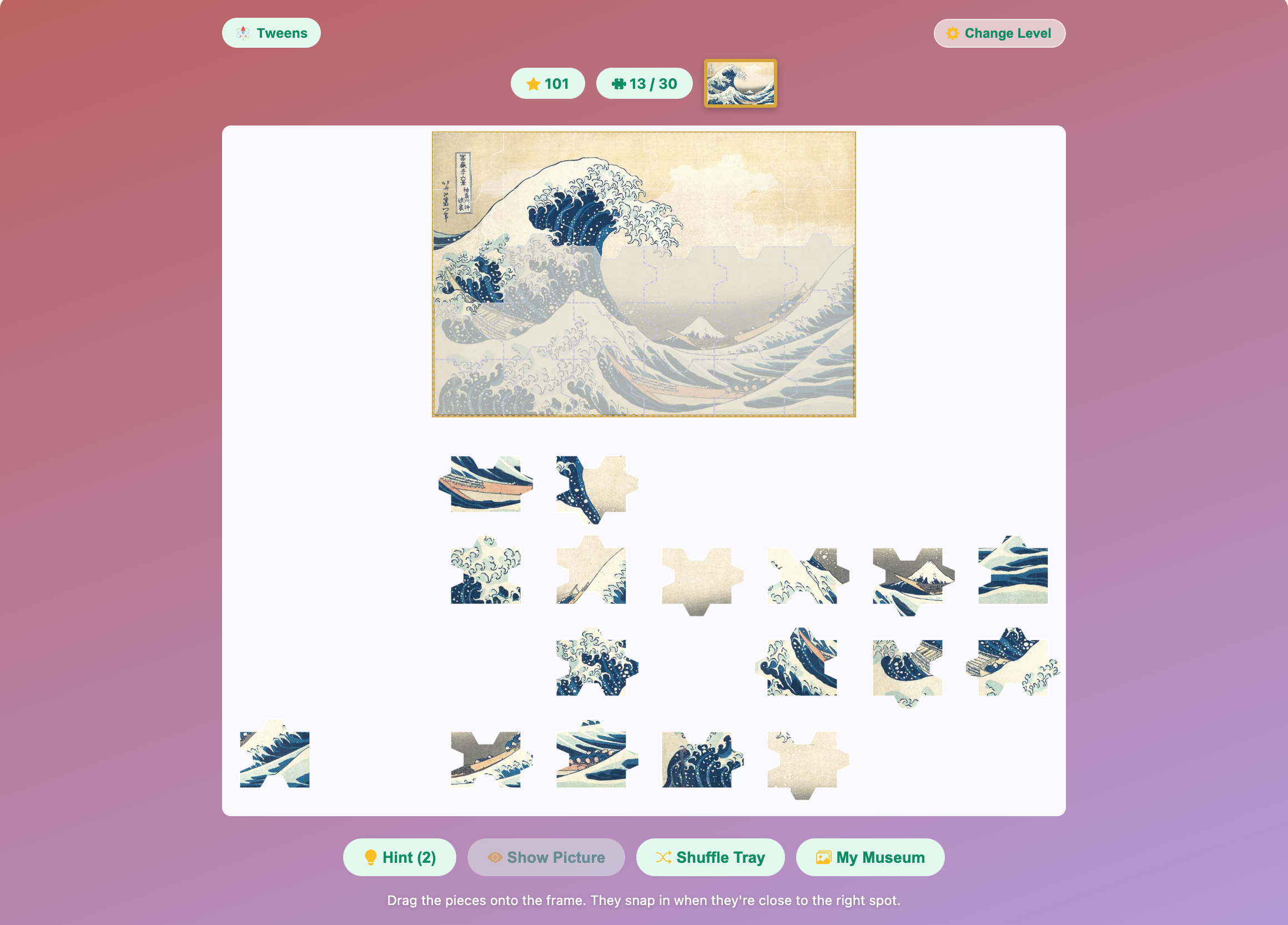
The Show Picture button fading a faint copy of The Great Wave under a half-built 30-piece puzzle
More Art Games
 1.8M plays
4.9
Color & Draw
A free-drawing canvas with colors and brush sizes to unleash your creativity.
 154.5K plays
5.0
Mood Palette
Decide which color best fits a mood or theme before time runs out.
 584.9K plays
5.0
Tiny World Builder
Start with a tiny empty island and build your own blocky village — plant grass and trees, lay roads, and unlock houses, farms, a school and more!
 174.6K plays
4.9
Color Mixing
Look at two paint colors and pick which color they mix together to make.
Most Played Games
1.8M plays
4.9
Color & Draw
A free-drawing canvas with colors and brush sizes to unleash your creativity.
 59.5K plays
4.8
Recycling Sort
Sort everyday items into the Recycle, Compost, or Trash bin before time runs out!
 365.8K plays
5.0
Tic-Tac-Toe
Play a game of Tic-Tac-Toe against the computer and see if you can outsmart it.
 274.1K plays
5.0
Sentence Builder
Pick your age level, then tap the shuffled words in the right order to build the sentence.
Comments (42)