
Fossil Dig
233.7K playsBe a fossil hunter! Dig up a mystery dinosaur with a pickaxe, a chisel and a brush, but dig gently near the bones or they crack. Drag each bone onto the skeleton outline and watch your Tyrannosaurus rex, Triceratops, Stegosaurus, Brachiosaurus or Velociraptor come to life. Learn what it ate from its teeth, how big it was and when it lived, then read the rock layers of a cliff, where deeper means older.
How do you get a dinosaur out of solid rock without breaking it? Very gently, and with the right tool at the right moment. Fossil Dig for kids is a free science game where you dig up a mystery dinosaur with a pickaxe, a chisel and a brush. Then you put its skeleton back together and watch it come to life. It has four levels for ages 2 to 12. It runs in your web browser on a computer, tablet or phone, with no download and no sign-up.
Under the rock wait five real dinosaurs: Tyrannosaurus rex, Triceratops, Stegosaurus, Brachiosaurus and Velociraptor. Each dig takes place at a real fossil site, like Hell Creek in Montana or the Gobi Desert in Mongolia. You never know which dinosaur you are digging up until its bones are out and in place. Along the way, you learn to tell a meat eater from a plant eater by its teeth. You also read the layers of a cliff like a real scientist.
🦖 Five Mystery Dinosaurs Waiting Under the Rock
A fossil is what's left of a living thing from long, long ago, kept in rock: bones, teeth, shells, leaves and even footprints. Scientists who dig up and study fossils are called paleontologists (say it: pay-lee-on-TOL-oh-jists). Near a bone, they put the big tools away and switch to small ones and brushes, because old bones can break. That one idea is the heart of this game.
Every dig in Fossil Dig starts with a Start card that tells you where you are digging. Here are the five dinosaurs and the places where they wait for you:
Tyrannosaurus rex at Hell Creek, Montana: a huge meat eater with teeth like steak knives and tiny arms.
Triceratops at Hell Creek, Montana: a plant eater with three horns and a big bony frill.
Stegosaurus at Garden Park, Colorado: a plant eater with tall plates on its back and spikes on its tail.
Brachiosaurus at Grand Junction, Colorado: a giant plant eater with a super long neck.
Velociraptor in the Gobi Desert, Mongolia: a feathered meat eater about the size of a big turkey.
Each dinosaur is buried as six bones: the skull, the neck, the backbone and ribs, the tail, an arm (or front leg) and a leg. Your job is to get all six out without cracking them, build the skeleton, and find out who it was.
⛏️ From Start Card to Living Dinosaur: Playing on KidWorld
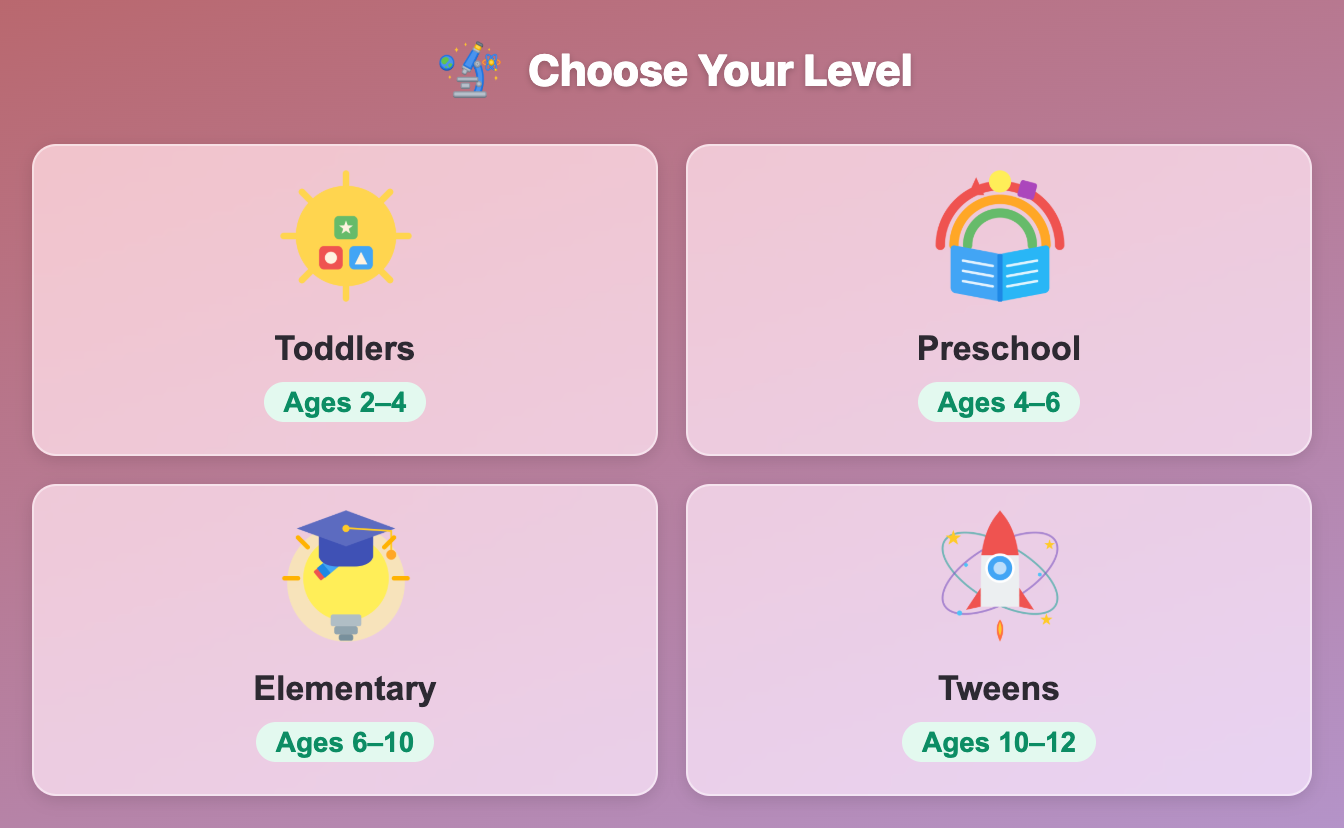
Pick your level. The game uses the KidWorld level picker: Toddlers, Preschool, Elementary or Tweens. The game starts at the level you played last (Elementary on your very first visit). To pick another one, press the Change Level button at the top.
Read the Start card. It says where the mystery dinosaur is buried and what your goal is. Press Start Digging when you're ready.
Choose a tool. Tap the Pickaxe, Chisel or Brush button under the dig site. On a keyboard, press 1, 2 or 3 (or P, C or B).
Find the bone ends. Each bone has one end poking out of the rock. Look for pale bone shapes peeking through near the surface. That's where to start.
Dig. Press and hold on the dig site (or click and hold with a mouse) to work there. Move your finger or the mouse to dig somewhere else. With a keyboard, the arrow keys (or W, A, S, D) move your tool, and you hold Space or Enter to dig.
Watch the rock change. As you dig down, the rock shows rings of color, like the layers of a cake. When the rock over a bone gets thin, the bone's pale shape shows through. When it gets very thin, the bone looks dusty and clear.
Don't crack the bones! If the pickaxe or the chisel hits a bone too close to the surface, you hear a crack. A crack line then stays on that bone. The brush never cracks anything.
Collect all six. When almost all of a bone is uncovered, the last bits of dust fall off and it glows gold. The Bones bar under the tools fills in as you go: 1 of 6, 2 of 6, and so on.
Build the skeleton. The bones move into a tray, and a pale outline of the dinosaur appears above it. Drag each bone onto its place. You can also tap a bone, then tap its place. On a keyboard, press the bone's number, then the letter on its place.
Make a prediction (Elementary and Tweens). A close-up of the skull's teeth appears. Was it a meat eater or a plant eater?
Watch it come alive. Skin grows over the bones, a smoking volcano and ferns appear behind it, and your dinosaur walks. A meat eater shouts "ROAR!" and a plant eater says "Munch, munch!"
Read the report. You see its name, little chips for cracks and building mistakes (and your dig time at the older levels), and facts about its food, size and when it lived. Press Next Dig, or wait for its countdown to move on by itself.
Finish the session. After the last dig come the rock layers and a short quiz, depending on your level. Then the Dig Complete card shows your final score out of 100 and up to five stars. Press Play Again for new dinosaurs, or Choose Another Level.
Use the page buttons. The buttons on the game's corner make it fullscreen, start it again from the beginning, or turn the music on and off. Every card has a 🔊 button that reads it aloud.
🪨 Fossil Dig for Kids: Pickaxe, Chisel or Brush?
Winning at Fossil Dig means two things: no cracked bones, and (at the older levels) a quick dig. The secret to both is choosing the right tool for the rock in front of you. The rock itself tells you which one. Here is how to read it.
Plain, thick rock: swing the pickaxe
The pickaxe has the biggest reach and takes off the most rock with each swing. Use it where the rock looks plain brown, with no bone shape showing at all. Here's the good news: the game is built so that rock with no bone shape showing is always safe to hit with any tool. So if no bone shows near where you swing, swing away!
A pale shape shows through: switch to the chisel
When you see the faint, pale outline of a bone under the rock, a bone is close. The pickaxe could crack it now. Switch to the chisel. It chips away smaller bits with each tap, and it only cracks a bone when the rock over it is very, very thin. The game even reminds you: "See that pale shape? A bone is close under the rock! Switch to the chisel there."
The bone looks dusty: only the brush
When the bone looks clear, with just a thin coat of dust on it, put the chisel down and pick up the brush. The brush can't crack anything, ever. Rub it over the bone until the dust is gone and the bone glows gold. The game tells you this too: "That bone is almost out! Only the brush is gentle enough now."
Follow the bone from its tip
Every bone has one real end sticking out of the rock, and that's where the rock over it is thinnest. So start at the tip and dig along the bone, little by little. As the rock around the tip gets thinner, more of the bone's shape appears, and it shows you which way to dig next. A long tail or a long neck is like a path to follow.
Let the red circle warn you
With a mouse or the keyboard, a dashed circle shows how far your tool reaches, and a smaller solid circle inside it shows its hard middle. If your next strike would crack a bone, both circles turn red. When you see red, don't press! Move a little, or switch to a gentler tool. On a touch screen, the circle only shows while your finger is down. So look for pale and dusty bone shapes before you press.
Don't brush thick rock
The brush is safe, but it is slow. Brushing thick rock takes a long, long time. If you have a pickaxe, use it on the thick rock where no bone shows yet. The game will tell you if you brush thick rock for too long.
Racing the Quick bonus
At Elementary and Tweens, a Quick bonus bar sits under the tools. It stays full while you are on time, then turns orange and shrinks. The time you get is worked out for each dig site. It's based on how fast an expert who knew where every bone lay could dig, plus extra time. But careful digging matters more than speed: one crack costs 2 points, and the whole Quick bonus is only worth 4. A slow, crack-free dig beats a fast, cracked one.
Stuck? Look for the sparkle
If you go about 25 seconds without finding a new bone, a sparkle appears where a bone you haven't found yet pokes out. The game says, "Try digging here, where a bone pokes out! Follow the bone as you dig." And if a dig ever takes 15 whole minutes, the last bones lift out on their own, so nobody stays stuck forever.
🧩 Clues for Building the Skeleton
When the bones are out, they go into a tray, and the dinosaur's pale outline appears above it. Drop a bone near its own place and it snaps in with a happy sound. Drop it on a different bone's place and it counts as a building mistake, which costs 2 points. But if you drop it on an empty part of the picture, it just slides back to the tray, with no harm done. Use the shapes as clues:
The tail is the long, thin row of little bumps. Each bump is one small bone.
The neck is a shorter, curvy chain of bumps between the skull and the body.
The backbone and ribs is the piece with ribs hanging down like the teeth of a comb.
The skull has round eye holes and a row of teeth. Triceratops' skull also has three horns.
Arms and legs: T. rex and Velociraptor walked on two legs, so their arm is tiny and their leg is long and strong. The four-legged dinosaurs have a front leg and a back leg instead.
The Brachiosaurus trick: for Triceratops and Stegosaurus, the back leg is the longer one. But Brachiosaurus means "arm lizard", because its front legs were longer than its back legs. So for Brachiosaurus, the longer leg goes at the front!
Stegosaurus is easy to spot: the tall plates ride along its back, and its tail ends in four sharp spikes.
If putting bones in their places is your favorite part, try Build a Skeleton, where you rebuild a human skeleton on an X-ray, bone by bone.
🔍 Field Notes: Five Digs, Thought Through
Here are five moments from real games, and how a careful fossil hunter thinks them through.
The tail sticking out of the corner
You start an Elementary dig and see a small pale tip near a corner of the site. Everything else is plain brown rock.
Grab the pickaxe and swing at the plain rock next to the tip, not on it.
As the rock thins, a row of pale bumps appears, leading away from the tip. That's a tail!
Keep the pickaxe on the plain rock beside the row. Switch to the chisel on the pale bumps, then the brush once they look dusty.
In this game the whole tail counts as one bone, so it's quick to finish once you follow it. That's one of six found!
A skull under thin rock
You find a pale shape that looks wide and lumpy, with a dark hole in it. That's a skull, and it is close to the surface. With the mouse, you hold the chisel over it, and the circle turns red. That means even the chisel would crack it now. Switch to the brush and sweep across the whole shape. In a few seconds the dust is gone and the skull glows gold. Three seconds of patience saved 2 points.
Six bones in a tray
You have dug up six bones, and the outline shows a dinosaur with a very long neck and a small head. Two of the bones are legs. Which one goes in front? Look closer: one leg is a bit longer. Most four-legged dinosaurs have longer back legs, but this outline belongs to Brachiosaurus, the "arm lizard". So the longer leg is the front leg. Drop it under the neck, then put the shorter one under the hips.
Steak knives or a beak?
At Elementary and Tweens, the game shows you a close-up of the skull before the dinosaur comes alive, and asks: meat eater or plant eater? Right gives you 5 points. Look at the teeth:
Sharp, jagged, pointy teeth, like steak knives, are for biting meat. T. rex and Velociraptor have these.
Teeth made for leaves mean plants: rows of slicing teeth behind a beak (Triceratops), small leaf-shaped teeth behind a beak (Stegosaurus), or chisel-shaped teeth for stripping branches (Brachiosaurus).
After you choose, the report explains it. For Velociraptor it says its teeth were "small, sharp, curved and jagged, for gripping and slicing meat".
The cliff with four fossils
After the digs, Elementary players see a cliff with four layers of rock. In one game, the layers held a mammoth tooth at the top, then a shark tooth, then an ammonite (a sea animal with a curly shell), and a fern leaf at the very bottom. Which fossil is the oldest? Rock layers pile up one on top of another, like a stack of pancakes. The first layer laid down is at the bottom. So the fern leaf, in the deepest layer, is the oldest. The game adds that fern leaves like that one are common in coal rocks about 300 million years old.
🗿 After the Digs: Rock Layers and the Fossil Quiz
Fossil Dig doesn't stop at bones. Once all the dinosaurs are dug up, older kids get a Read the Rock Layers round, and then a quiz.
Elementary: one question about the cliff: which fossil is the oldest? It's worth 10 points on the first try and 5 on the second, with a hint after a wrong answer.
Tweens: two cliff questions. First, name the fossil in the glowing circle. It could be an ammonite, a trilobite (an old sea animal with a shell in three parts), a fern leaf, a shark tooth or a mammoth tooth. Then tap all four fossils in order, from the oldest to the youngest. That means starting at the bottom and going up. Each wrong tap costs 3 of the 10 points.
The Fossil Quiz: Elementary and Tweens players answer four questions. Two are about the dinosaurs you just dug up, like "How big was Velociraptor?" The other two are about fossils, like "What is a fossil?" or "Why are fossils rare?" After each answer, the game shows the right one, and the fossil questions come with a short explanation.
Preschool: instead, there are three picture questions, one about each dinosaur you dug, like "How many horns did Triceratops have?" Each has three big picture answers, and a hint after a wrong one.
The questions only ask about dinosaurs you really dug up in that game, so paying attention to the reports pays off.
⭐ How Your Score Adds Up
Each dig is worth up to 16 points: 6 for careful digging (2 off for each crack), 4 for the Quick bonus, and 6 for building (2 off for each building mistake). Toddlers and preschoolers have no clock, so they always get the full Quick bonus. At Elementary and Tweens, a right teeth prediction adds 5 more, so each dinosaur is worth up to 21 points.
Here's one dig added up: no cracks (6), a quick dig (4), one building mistake (4), and a right prediction (5). That's 19 out of 21. At the end, all your points (from the digs, the rock layers and the quiz) are turned into a final score out of 100. A score of 90 or more earns five stars and a trophy. The Dig Complete card shows each dinosaur you found with its own points, and says so if you didn't crack a single bone.
👧 Fossil Dig for Kids from 2 to 12
The four levels change the tools, how deep the rock is, how many building pieces there are, and the questions at the end.
Fossil Dig for toddlers (ages 2–4): the gentlest dig of all. There's only one tool, a big brush, and the bones lie under a thin layer of sand that always lets them show a little. Little ones just rub the brush over the sand, a lovely first way to practice moving a finger or a mouse with care. The skeleton has only three big pieces (head and neck, body and tail, arm and leg) that snap in easily. The dinosaurs are T. rex, Triceratops, Stegosaurus and Brachiosaurus. There's no clock and no quiz, and when the sound is on, the cards are read aloud. A grown-up can name each bone as it appears.
Fossil Dig for preschoolers (ages 4–6): now there's a chisel as well as the brush, and real rock to chip through. This is where kids learn the big rule: chisel the rock, brush the bone. The skeleton has four pieces, Velociraptor joins the dig, and the report tells them what the dinosaur was and what it ate. At the end come three picture questions. There's still no clock, and the cards are read aloud when the sound is on.
Fossil Dig for elementary kids (ages 6–10): all three tools, deeper rock, six skeleton pieces, the Quick bonus clock and the teeth prediction. The report adds where the dinosaur lived and a fun fact. After three digs come the rock-layer question and the four-question Fossil Quiz. This is the level that teaches the most science.
Fossil Dig for tweens (ages 10–12): the hardest dig. There are four dinosaurs instead of three. The rock is deeper, the bones are smaller, and the clock is tighter. The pickaxe also needs a bit more rock over a bone to be safe. The reports add extra facts, and the cliff asks you to name a fossil and then put all four in order. The quiz questions are harder too, like why Brachiosaurus is called the "arm lizard".
🌱 What Digging Up Dinosaurs Teaches
Patience that you can see. When you rush with the pickaxe, a bone cracks, and the crack stays on it all the way to the finished skeleton. When you slow down and brush, it glows gold. Kids feel the difference between hurrying and taking care, without anyone telling them.
Choosing the right tool. Big tool for big jobs, small tool for small jobs. Every few seconds, the rock asks "Which tool now?", and the answer changes as you dig. That's real problem solving.
How scientists know things they never saw. No person ever saw a living T. rex. Yet the teeth prediction shows how we still know what it ate: sharp, jagged teeth mean meat. The rock layers show how we know which fossil is older. Kids start to see that science is a way of reading clues.
Shapes and body parts. Building the skeleton means looking closely at shapes: a long tail, a curvy neck, ribs like a comb. It also shows how the bones in a body fit together, just like in our own bodies.
Real facts about real places. Every report has checked facts: how long the dinosaur was, when it lived, and where its fossils were found. The Fossil Quiz says even footprints can become fossils. Kids who love reading clues in the ground can follow fresh footprints across snow and mud in Animal Tracks Detective.
A word for grown-ups: Fossil Dig is calm and kind. Nothing is scary: the dinosaurs walk, roar or munch, and that's all. Mistakes only show a crack line or send a bone back to the tray, and the game always explains what to do next. There's no chat, and no download or account needed to play. It practices careful hand control, shape matching, and cause and effect. It also teaches early earth science (fossils, teeth and rock layers), at four levels that grow with your child.
Ready to grab your pickaxe? Start a dig, follow the bones out of the rock, and see which dinosaur you bring back to life. Fossil Dig for kids has a new mix of dinosaurs every time you press Play Again. And when you want a speedy dinosaur adventure, race your dino to the finish line by answering science questions in Dino Science Dash.
🖼️ See the Game in Action
The Choose Your Level screen in Fossil Dig for kids, with Toddlers, Preschool, Elementary and Tweens cards
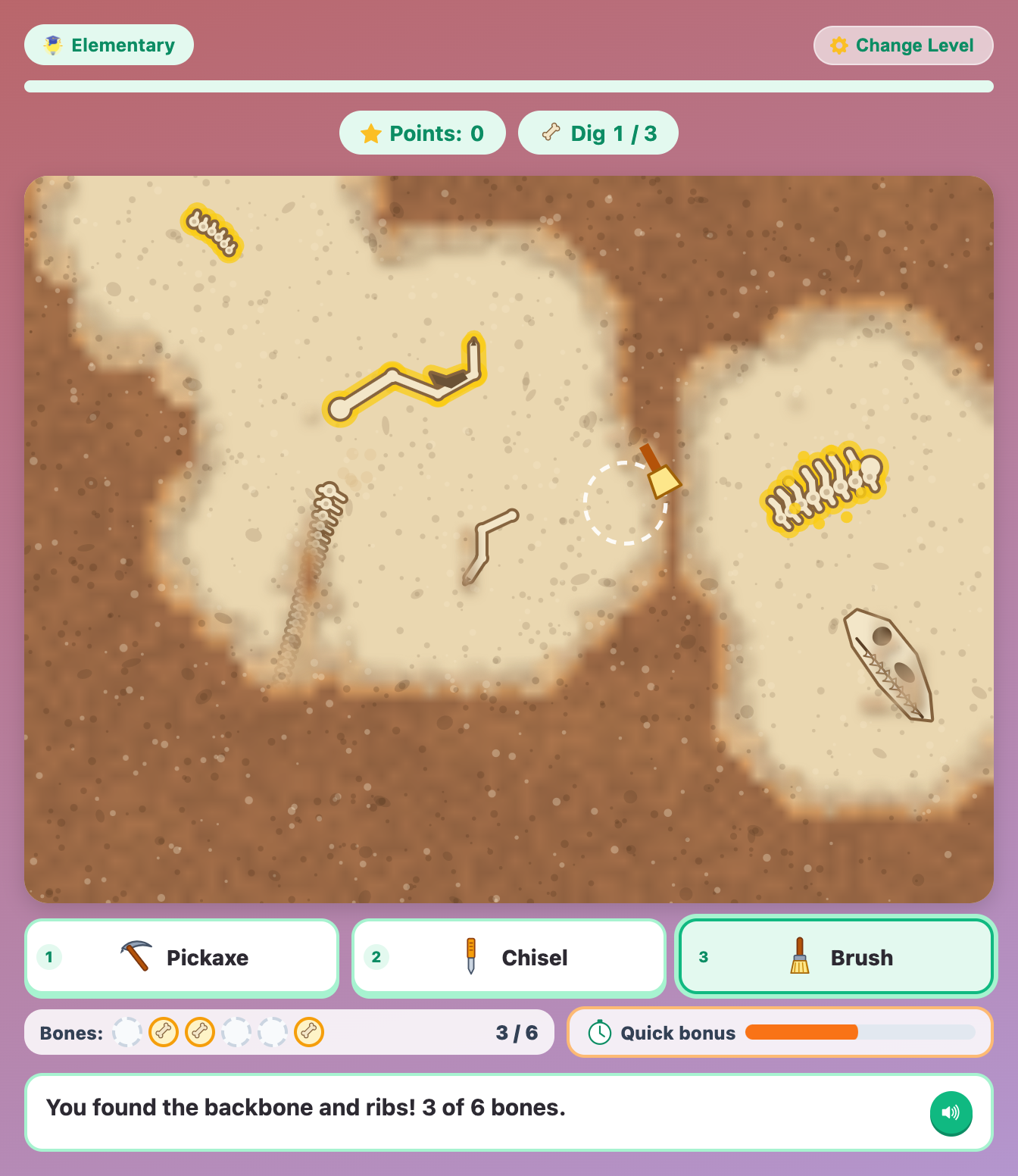
A half-dug rock site in Fossil Dig at the Elementary level, with three found bones glowing gold
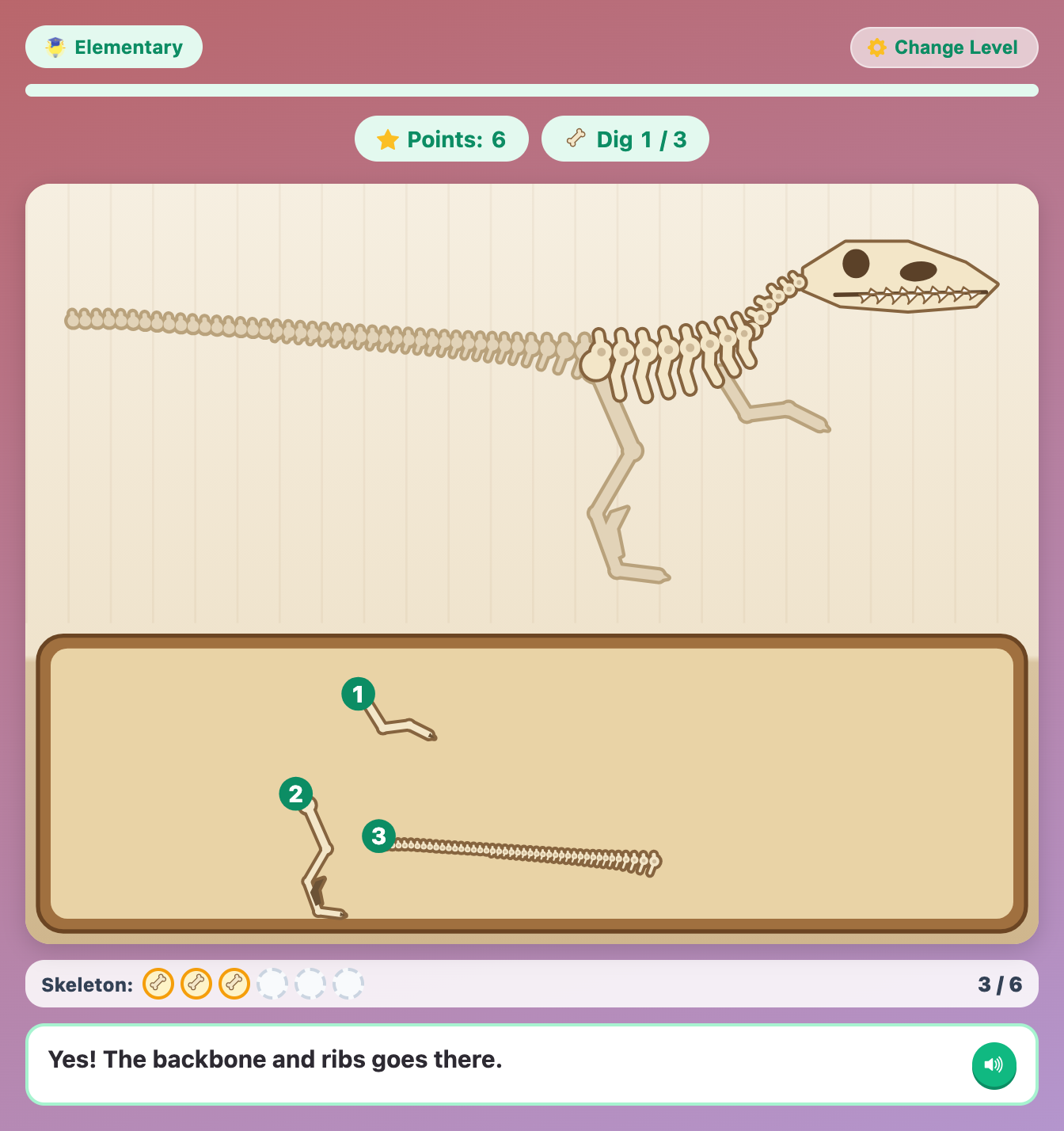
A Velociraptor skeleton outline with the skull, neck and backbone in place and three numbered bones left in the tray
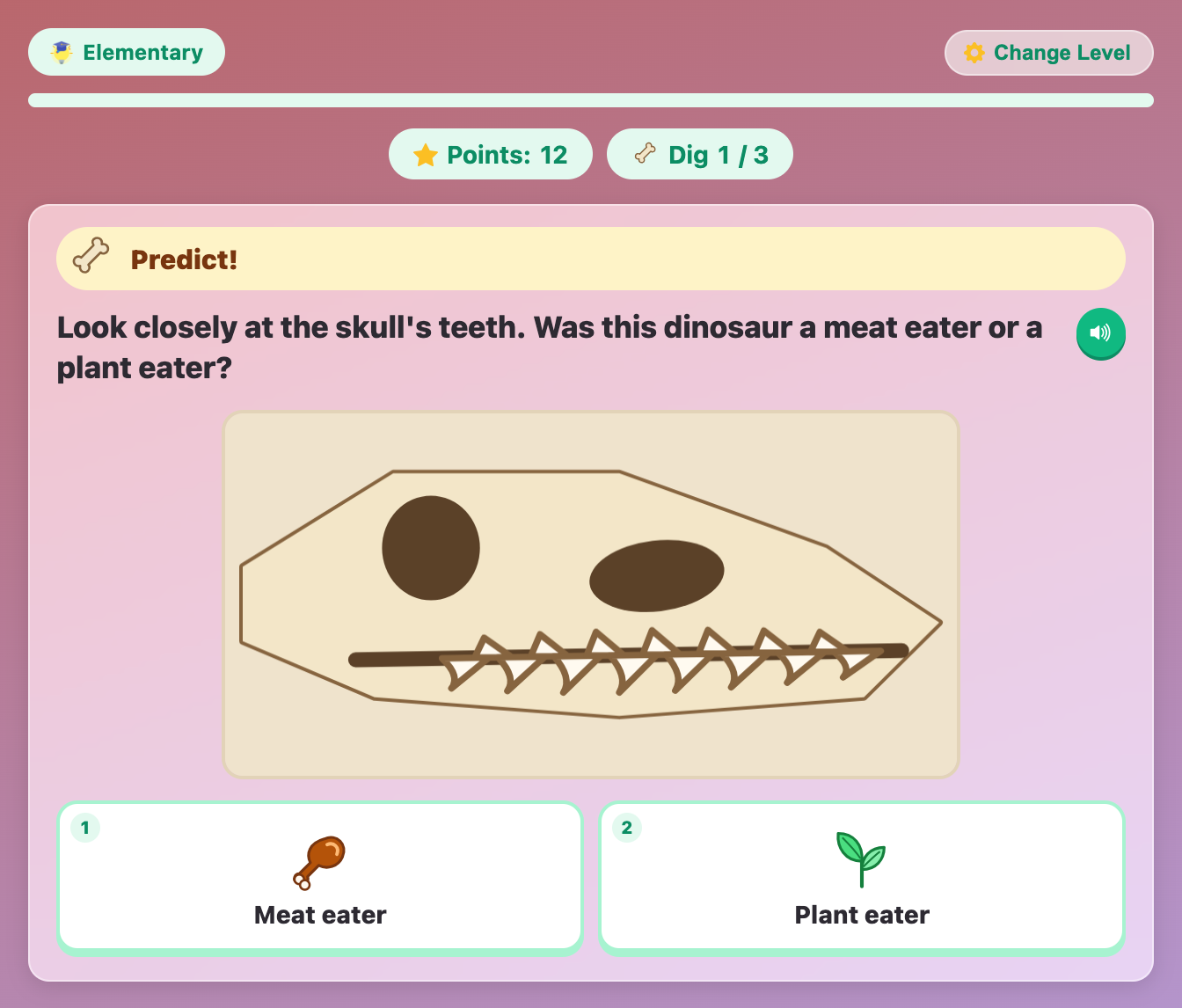
The Predict card with a close-up skull full of sharp, jagged teeth and Meat eater or Plant eater buttons
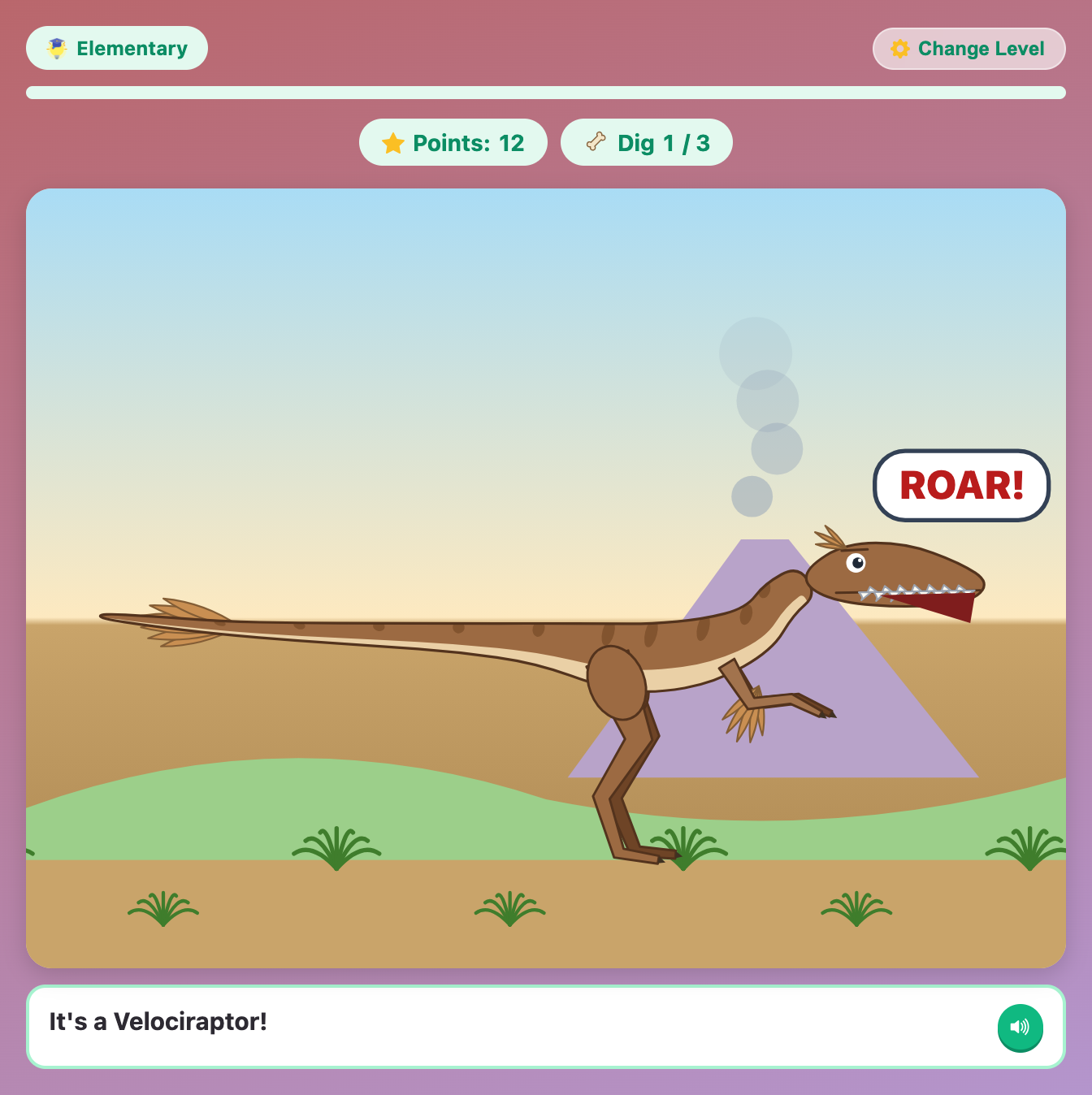
A feathered Velociraptor come to life in front of a smoking volcano, with a big ROAR speech bubble
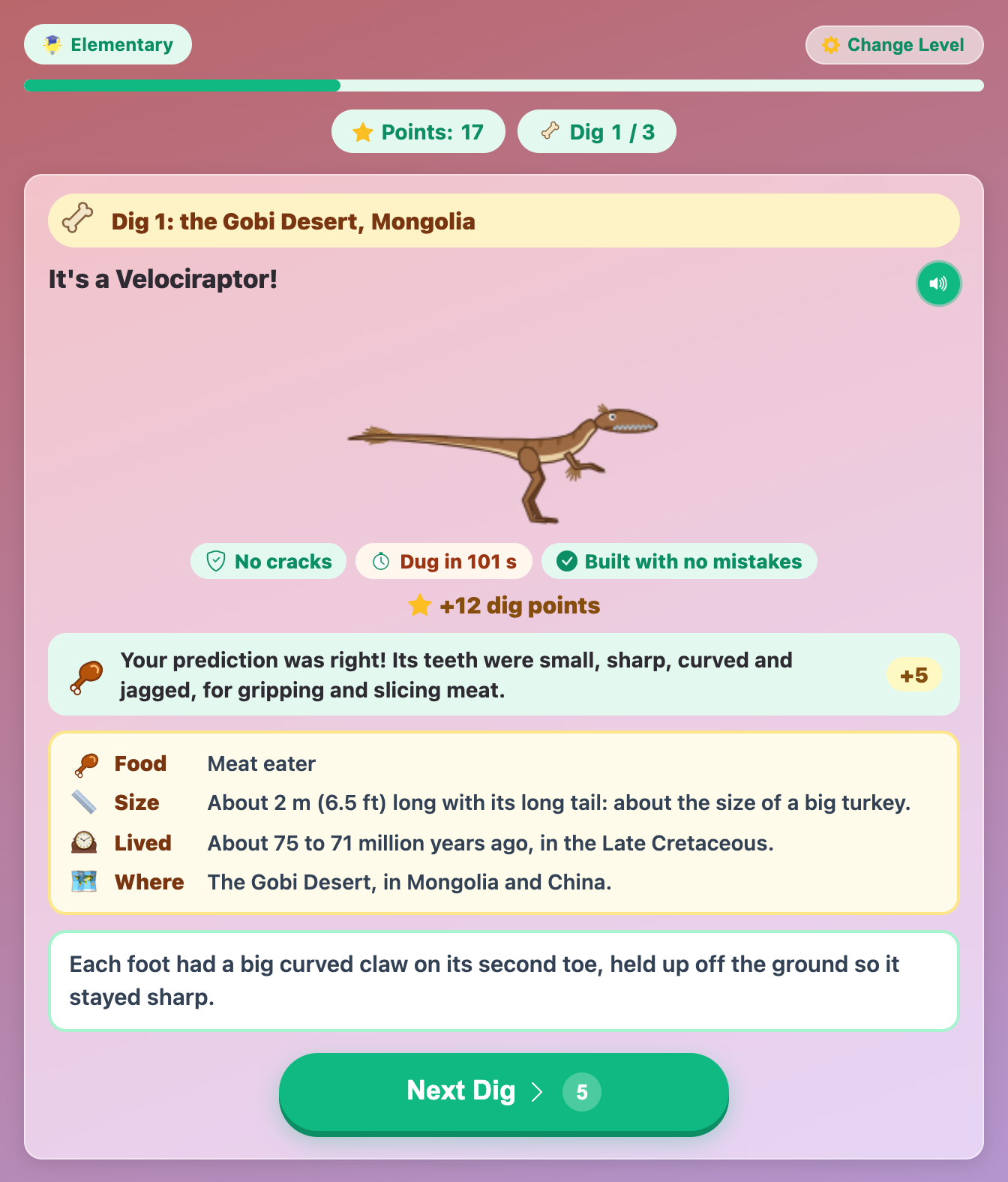
The Velociraptor report card with No cracks and Built with no mistakes chips, a right prediction and fact rows
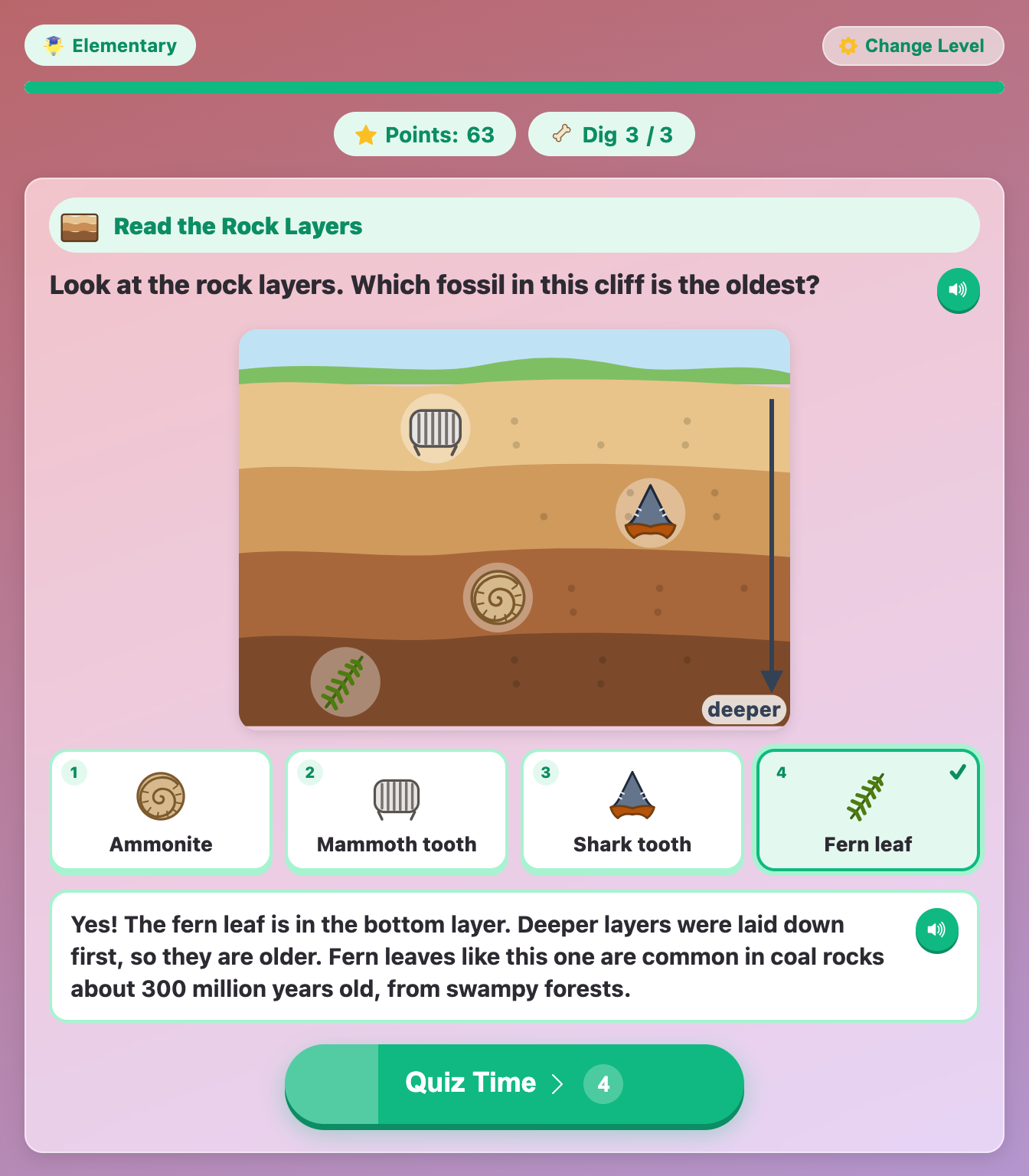
The rock layers cliff in Fossil Dig for elementary kids, with the bottom-layer fern leaf picked as oldest
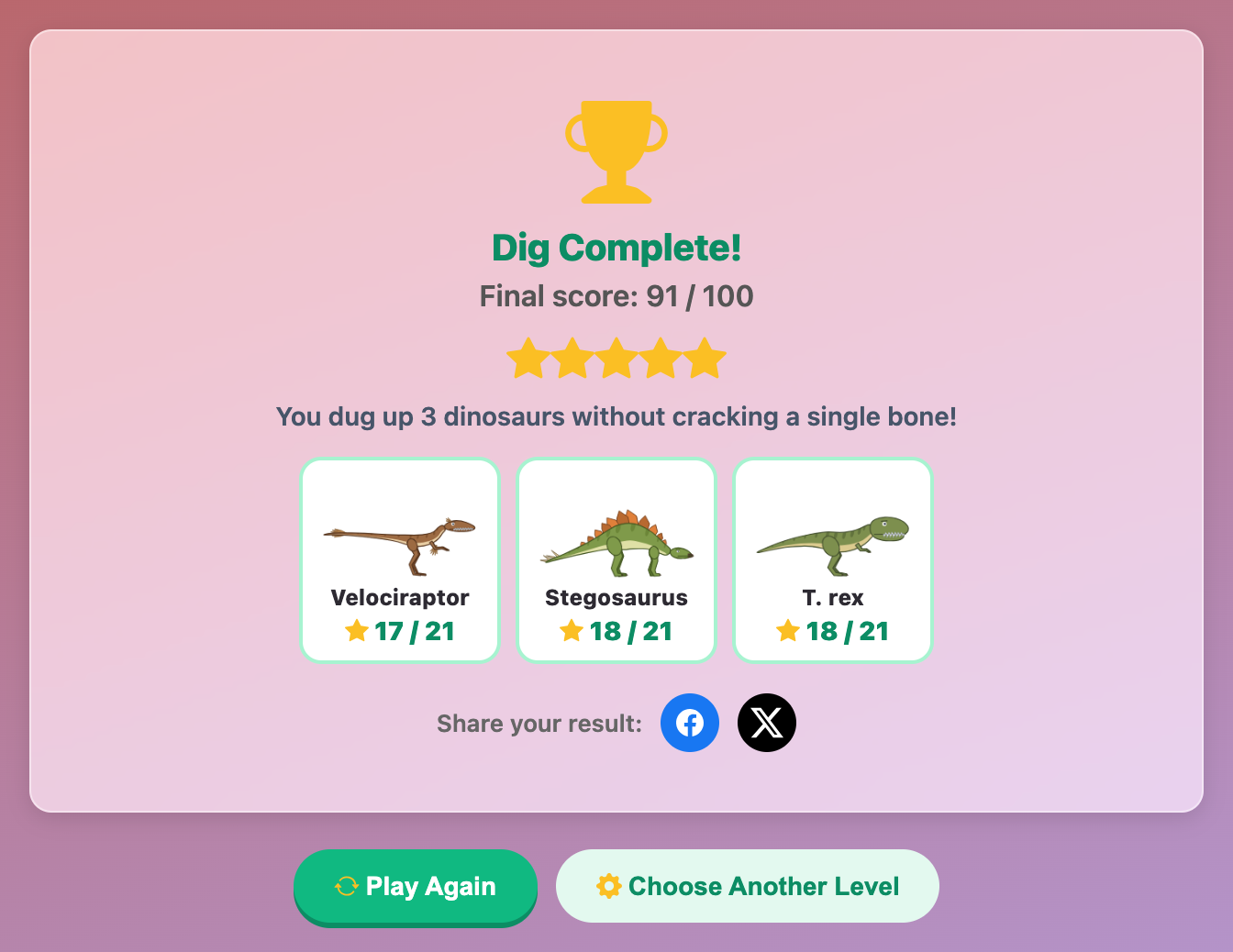
The Dig Complete card with a score of 91 out of 100, five stars and three dinosaur cards
More Science Games
 59.5K plays
4.8
Recycling Sort
Sort everyday items into the Recycle, Compost, or Trash bin before time runs out!
 85.7K plays
4.9
Grow a Plant
Plant seeds in sunny and shady garden beds, then water, feed and protect them day by day. Watch the roots grow underground and harvest sunflowers, tomatoes, carrots and more!
 438.6K plays
4.9
Magnet Experiment
Guess which objects a magnet will pull, then drag the magnet to test every guess. Does gold stick? Does a battery?
 386.9K plays
4.9
Five Senses Match
Decide which of your five senses you would use for each everyday scene before time runs out.
Most Played Games
 1.8M plays
4.9
Color & Draw
A free-drawing canvas with colors and brush sizes to unleash your creativity.
59.5K plays
4.8
Recycling Sort
Sort everyday items into the Recycle, Compost, or Trash bin before time runs out!
 365.8K plays
5.0
Tic-Tac-Toe
Play a game of Tic-Tac-Toe against the computer and see if you can outsmart it.
 274.1K plays
5.0
Sentence Builder
Pick your age level, then tap the shuffled words in the right order to build the sentence.
Comments (19)