
Animal Tracks Detective
37.4K playsBe a nature detective! Follow trails of footprints across snow and mud, look closely at each clue, from droppings and feathers to chewed pine cones and nibbled twigs, and work out which animal made them. Spot a deer's split hooves, a rabbit's hops, a duck's webbed feet and a snake's wavy track. Big kids use a field guide to tell a fox from a dog and read what happened at the end of the trail.
Animal Tracks Detective for kids is a free science game where you follow a trail of footprints across snow or mud and work out which animal made it. You slide a magnifying glass along the trail, stop at every clue, and then pick the right animal from a row of pictures. It works for ages 2 to 12, right in your browser, with no download and no sign-up.
Every trail is a little mystery. A few round droppings, a pine cone chewed down to its core, a stripy feather: each one is a clue. At the end, the animal pops out from its hiding place, and you learn a real fact about how it lives. There are 14 animals to meet, from a tiny deer mouse to a huge black bear, and even a snake that leaves no footprints at all.
🐾 Footprints Are Stories Written in the Ground
When an animal walks over soft snow or mud, its feet press down and leave a shape. That shape is called a track. A row of tracks is called a trail. Real wildlife scientists read trails to learn which animals live in a forest, even when the animals stay hidden.
In this game, every trail is drawn from above, like you are a bird looking down. The prints follow the way each animal really moves. A deer leaves heart-shaped hoof prints, one after another. A rabbit leaves groups of four. A sparrow hops with both feet together, so its prints come in pairs. A garter snake leaves a long, wavy line.
Your job is to look closely, gather the clues, and name the animal. On the Tweens level, you also work out what the animal did at the end of the trail.
🔎 Your First Case: How the Game Works on KidWorld
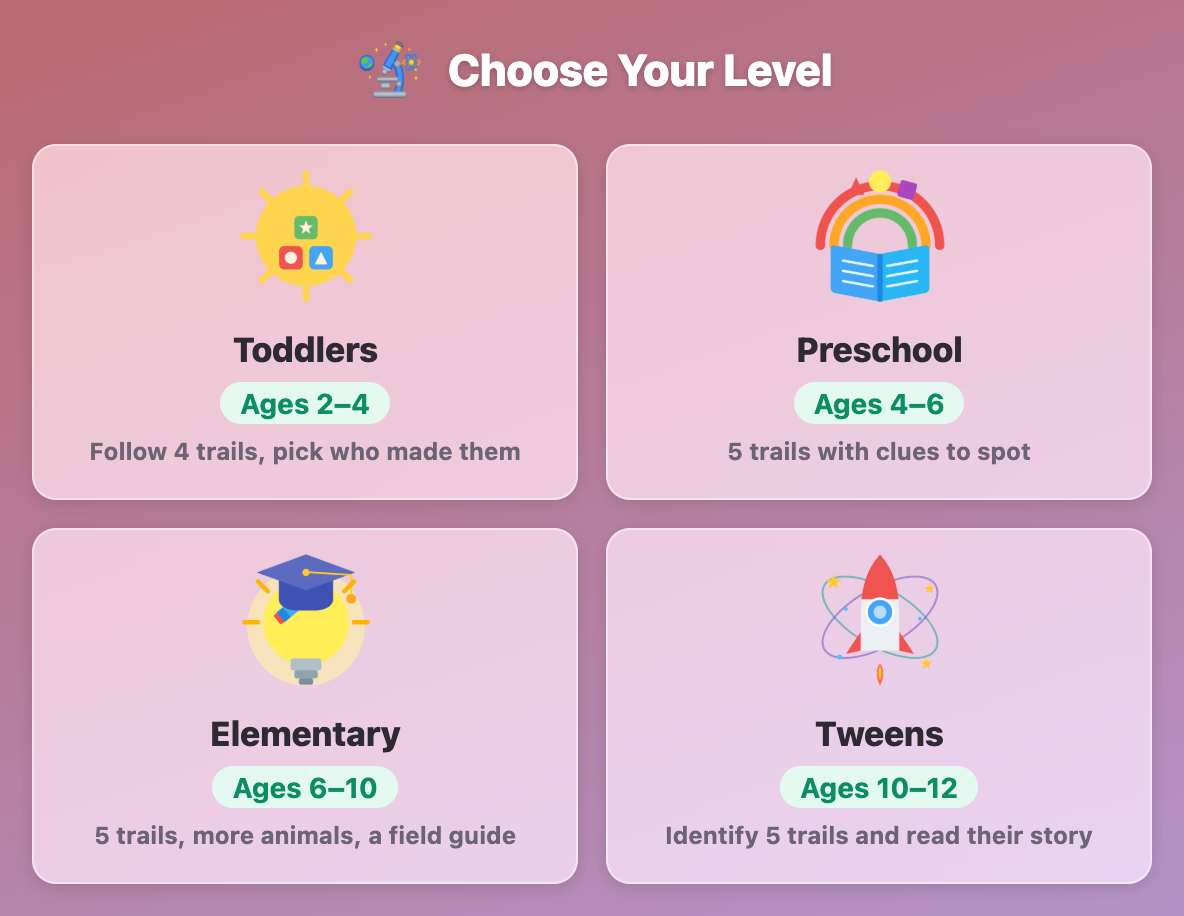
Pick your level. The first screen shows four cards: Toddlers (ages 2–4), Preschool (ages 4–6), Elementary (ages 6–10) and Tweens (ages 10–12). If the game starts on a level already, tap Change Level at the top right to switch.
Look at the scene. A trail crosses a snowy field or a muddy patch. A bar at the top says which trail you are on, such as "Trail 1 of 5".
Tap the glowing circle. One circle on the trail glows green. Tap it, and the magnifying glass glides along the trail to it. On a computer you can press Enter, Space or the right arrow key instead. If you tap somewhere else, the game just reminds you to tap the glowing circle.
Read each clue card. The first stop is always the footprints. A card under the scene shows a close-up of the prints and tells you about them. The next stops are clues lying beside the trail, like a nibbled twig or a feather. The last stop is the end of the trail. Each visited stop gets a green check mark, and you can tap it again to see its card again.
Answer "Who made these tracks?" After the last stop, picture buttons appear with an animal on each. Tap one, or press its number key (1 to 4).
Use the field guide (Elementary and Tweens). Tap Field guide, or press G, to see every animal on your level with a drawing of its prints and a short note, like "Four toes with claw marks, in a neat straight line."
Watch the animal appear. Pick right and the animal pops out at the end of the trail: from behind a bush, up a tree, out of a hole, in the water, or flying away. A fact card tells you something true about it.
Move on. The big Next trail button fills up and counts down 5 seconds, then moves on by itself. Tap it, or press Enter, to go at once. The countdown waits if the game is reading something out loud.
See your score. After the last trail, the finish card lists every animal, how many points you got for each, a tracking fact, up to 5 ⭐ stars, and your score out of 100. Your best score on each level is saved on your device. Tap Play Again for new trails, or Change Level.
Use the page buttons. The play page also has buttons to go fullscreen, reload the game, and turn the music on or off. Every card also has a 🔊 button that reads it out loud.
You can play with a mouse, a keyboard, or your finger on a phone or tablet.
⭐ How the Points Add Up
Every level of Animal Tracks Detective for kids is worth 100 points in all. You get full points for a right answer on your first try, and half the points on your second try. If you miss twice, the game shows you the answer, and that trail gets 0 points.
Toddlers: 4 trails, 25 points each.
Preschool and Elementary: 5 trails, 20 points each.
Tweens: 5 trails. 12 points for naming the animal, plus 8 more for saying what happened at the end of the trail.
Score 90 or more and the game calls you a "Master tracker!" with 5 stars. Score 60 or more and you get "Super detective work!"
🕵️ Animal Tracks Detective for Kids: Tracking Tips That Really Work
Good trackers don't guess. They look at a few things, one at a time, and let the prints tell them the answer. Here is how to do that in this game.
1. Look at the shape of one print first
The shape of a single print is the biggest clue of all, and it works on every level. There are six kinds of print in this game:
A hoof split in two, like a heart: the white-tailed deer.
Thin bird toes, three pointing forward and one pointing back: the sparrow or the wild turkey.
Toes joined by skin (we call that "webbed"): the mallard duck or the beaver.
Round toe pads around one big pad: paw animals, like the rabbit, squirrel, mouse, fox, dog, cat and bear.
Five long fingers, like a little hand: the raccoon.
No footprints at all, just a wavy line: the garter snake.
Once you know the shape, you have only one or two animals left to think about, even before the other clues.
2. Then look at the pattern of the whole trail
Next, step back and look at how the prints are laid out. Are they one after another, left, right, left, right? That animal walks. Do they come in groups of four? That animal hops, like a rabbit, squirrel or mouse. Do they come in pairs, side by side? That's a little bird hopping with both feet together.
Also look between the prints. A thin line means a long tail was dragging, like a mouse's. A wide smudge over the prints means a big flat tail, like a beaver's.
3. Size matters, but only when it's very different
Big animals leave big prints. A black bear's back prints are about 17 cm long, longer than your hand. A deer mouse's back feet leave prints only about 1.5 cm long, smaller than a coin. When the size is very different, it's an easy way to tell two animals apart.
On the Tweens level, the footprint card gives you the real size in centimeters. Match it with the sizes in the field guide.
4. Count toes and look for claw marks
From the Elementary level on, the footprint card tells you how many toes each print has, and whether there are tiny claw marks in front of them. This is how you tell paw prints apart:
Four toes and claw marks: a red fox or a dog. Dogs can't pull their claws in.
Four toes, no claw marks, round prints: a house cat. Cats tuck their claws in when they walk, which keeps them sharp.
Five toes and claw marks, and huge: a black bear.
5. Let the clues cut down the choices
Here's a smart trick. The wrong answers in this game never belong to an animal that leaves the same kind of clue you just saw. So if the trail shows a feather, only one bird will be in the answer buttons. If it shows a nibbled twig, you won't see both the deer and the rabbit together. Spot the clue, and you can often rule out every other answer.
The clues also teach real nature facts. A twig with a ragged, torn end was nibbled by a deer, because deer have no top front teeth. A twig with a clean, slanted cut was snipped by a rabbit's sharp teeth. Round droppings like peas mean a rabbit; oval ones like beans, in a little pile, mean a deer.
6. Snow or mud? Check the ground
In this game, the mallard duck, beaver, black bear and garter snake only leave trails in the mud. Bears and snakes sleep through most of the winter, and ducks and beavers need open water. So if you're looking at a snowy trail, you can cross those four off your list. Two clues, the empty shells and the scratched-up leaves, only turn up in mud too.
7. Read the hint after a wrong pick
If you pick the wrong animal, its button shakes and can't be picked again, and a 💡 hint appears. The hint points to the one thing that is different, like "Look at the pattern: the prints come in groups of four." It never names the right animal, so you still get to solve it yourself. Read it, look at the scene again, then make your second pick for half the points.
If you like hunting for small details in a picture, Camouflage Hide & Seek asks you to spot animals hiding in plain sight in snow, leaves and coral.
🧩 Four Trails, Solved Step by Step
Trail A: tiny prints and a nibbled acorn (Elementary)
The footprint card says: "Tiny prints. Round toe pads around one big pad. They come in groups of four. A thin line runs between the prints."
The next clue is an acorn with a small, round hole nibbled in it.
The trail ends at a bush. "Somebody is hiding behind it!"
The choices are deer mouse, beaver, black bear and mallard duck. Tiny paw prints in groups of four with a tail line can only be the deer mouse. Out it pops from behind the bush!
Trail B: groups of four in the snow (Tweens)
Both the rabbit and the squirrel hop in groups of four, so look at the two small front prints in each group.
If the two small prints are one behind the other, it's a cottontail rabbit. Its back prints are about 8 cm long.
If the two small prints are side by side, it's a grey squirrel. Its back prints are about 6 cm long.
A chewed pine cone beside the trail is another squirrel clue. Squirrels pull off the scales to eat the seeds hidden underneath.
Trail C: four toes and claws (Tweens)
The fox and the dog both show four toes and claw marks. So look at the whole trail. A red fox walks in a neat, straight line, putting each back foot into the print of its front foot. A dog wanders this way and that, sniffing everything. A tuft of reddish-orange fur means fox; a stick covered in tooth marks means dog.
Trail D: huge prints in the mud (Tweens)
The footprint card says: "The back prints are about 17 cm long." That's the biggest size in the field guide.
Next comes a tree trunk with deep claw marks high up, then an old log ripped open. Bears tear open rotten logs to eat the ants and grubs inside.
The trail stops at the bottom of a tree, and no prints lead away again.
It's a black bear. For the story question, "It climbed a tree" is the answer.
📖 The Tweens Challenge: What Happened at the End?
On the Tweens level, after you name the animal, the game asks one more question: "Now read the trail: what happened at the end?" You choose from three answers. Here's how to read each ending:
It started to run. Compare the last prints with the first ones. The gaps grow to about two or three times as long, and the trail runs off the edge. Longer jumps mean the animal sped up.
It climbed a tree. The trail stops at a tree trunk, and no prints come away again.
It went down a hole. The prints lead right up to a hole and stop.
It went into the water. The prints lead into a pond and don't come out.
It flew away. The footprints stop, and there are brush marks on both sides of the last ones. Those marks come from wing feathers as the bird took off.
Only "run" trails have uneven gaps, so if the prints stay evenly spaced right to the end, look at what's waiting there instead. The water and flying endings are never offered side by side, because a bird at the edge of a pond could do either one.
🎯 Animal Tracks Detective for Every Age
🐣 Animal Tracks Detective for toddlers (ages 2–4)
Animal Tracks Detective for toddlers keeps things short and simple: 4 trails, 3 picture choices, and no extra clues. There are just the footprints and the end of the trail. The seven animals have very different feet: a deer, a duck, a sparrow, a rabbit, a bear, a snake and a wild turkey. With the sound on, the game reads the task, the clue cards, the question and the fact out loud, so a child who can't read yet can still play. A grown-up can help by pointing at the prints and asking, "Are they big or tiny? Hooves or toes?"
🌈 Animal Tracks Detective for preschoolers (ages 4–6)
Animal Tracks Detective for preschoolers has 5 trails, each with one extra clue to find, and adds the house cat, deer mouse and beaver. The footprint card now also talks about the pattern (one after another, groups of four, or pairs) and any tail line. Cards and questions are still read aloud automatically when the sound is on.
📚 Animal Tracks Detective for elementary kids (ages 6–10)
Animal Tracks Detective for elementary kids brings in all 14 animals, adding the red fox, dog, raccoon and grey squirrel. There are 4 choices and up to 2 clues per trail. The footprint card counts toes and mentions claw marks, and the field guide is there to check your thinking. After each answer, "What the clues meant" explains every clue. Kids who enjoy looking closely and naming what they find can also try Pond Dip Detective, where you net creatures from a pond and identify them with yes-or-no questions.
🚀 Animal Tracks Detective for tweens (ages 10–12)
Animal Tracks Detective for tweens is the real tracker's test. The footprint card only gives the size in centimeters and says, "Look closely, then check the field guide." You read the drawing yourself. Some animals can only be told apart here by the smallest details: where a rabbit's or squirrel's front prints land, or whether a trail wanders like a dog's or runs straight like a fox's. Then you answer the story question about the end of the trail.
🌲 Why Tracking Is Great for Young Scientists
It trains sharp eyes. To tell a cat from a fox, you have to notice tiny claw marks in front of the toes. That kind of close looking helps in science, in reading, and in math.
It teaches you to use evidence. Every answer in this game can be worked out from what's on the screen. Kids learn to say "I know it's a deer because the prints are split hooves," not "I just guessed."
It connects bodies to lives. Why are a duck's toes webbed? To paddle in water. Why does a mouse dig under the snow? Because it's warmer and safer there. Each fact links what an animal looks like with how it lives.
It makes the outdoors more exciting. After a few rounds, a walk in the snow or along a muddy path turns into a treasure hunt. Kids start spotting real prints, nibbled twigs and chewed cones.
👪 For parents and teachers
Animal Tracks Detective is calm and gentle. Nothing chases you, there's no timer pressure (the Next countdown can be skipped or simply waited out), and animals are never hurt. A wrong answer just gets a gentle hint and a second try. The game practices observation, sorting by features, and reasoning from evidence, and it shares checked facts about 14 real animals and their tracks. It's a nice warm-up before a winter nature walk.
🧭 Pick Up Your Magnifying Glass
The trails are waiting, and every game gives you new animals, new clues and new endings. Choose your level, follow the glowing circles, and see if you can earn the title of Master tracker in Animal Tracks Detective for kids. When you're ready to dig even deeper into nature's mysteries, Fossil Dig lets you uncover a hidden dinosaur with a pickaxe, a chisel and a brush.
🖼️ See the Game in Action
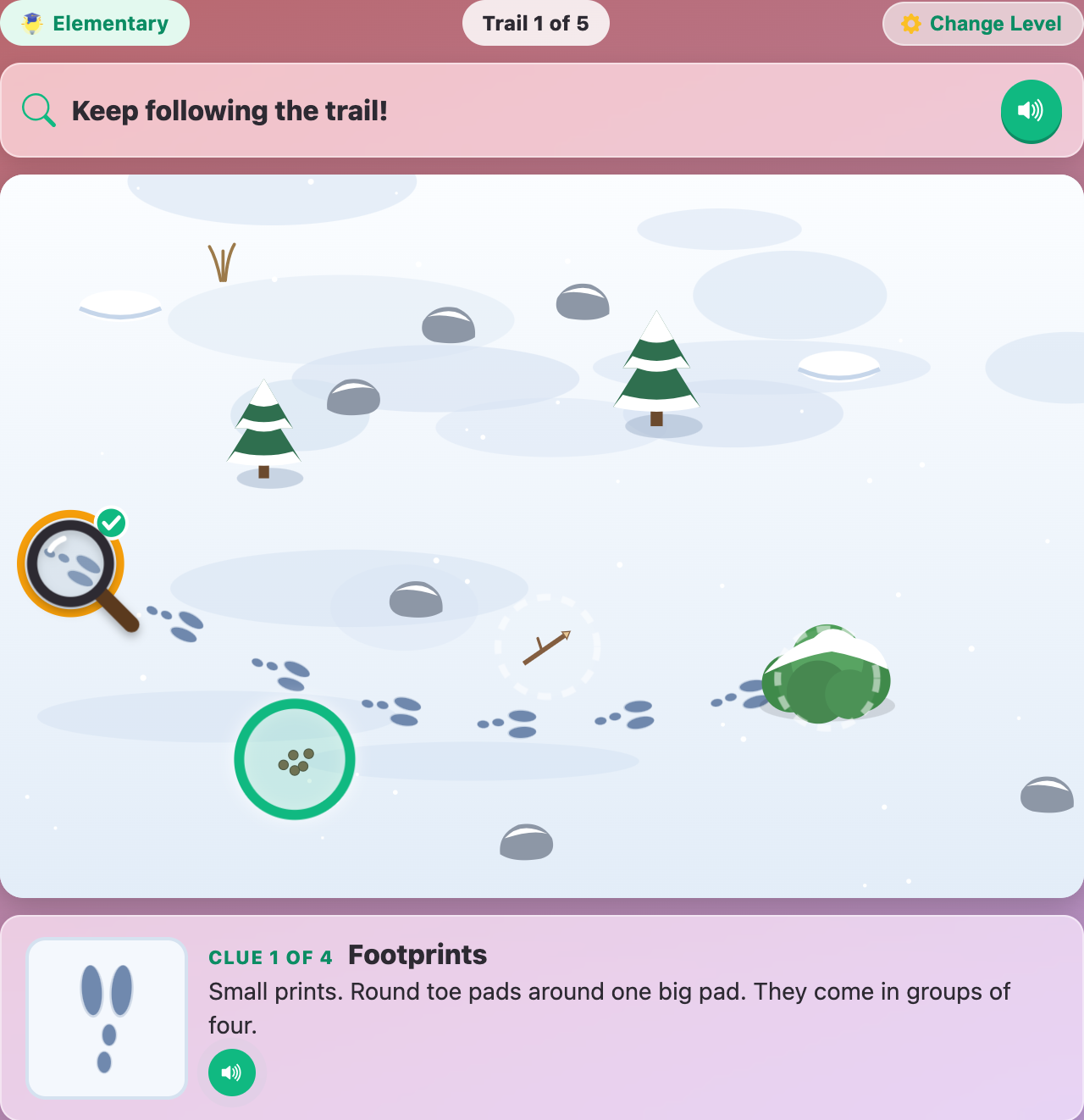
A rabbit trail in the snow at the Elementary level, with the magnifying glass on the first prints and the Footprints clue card below
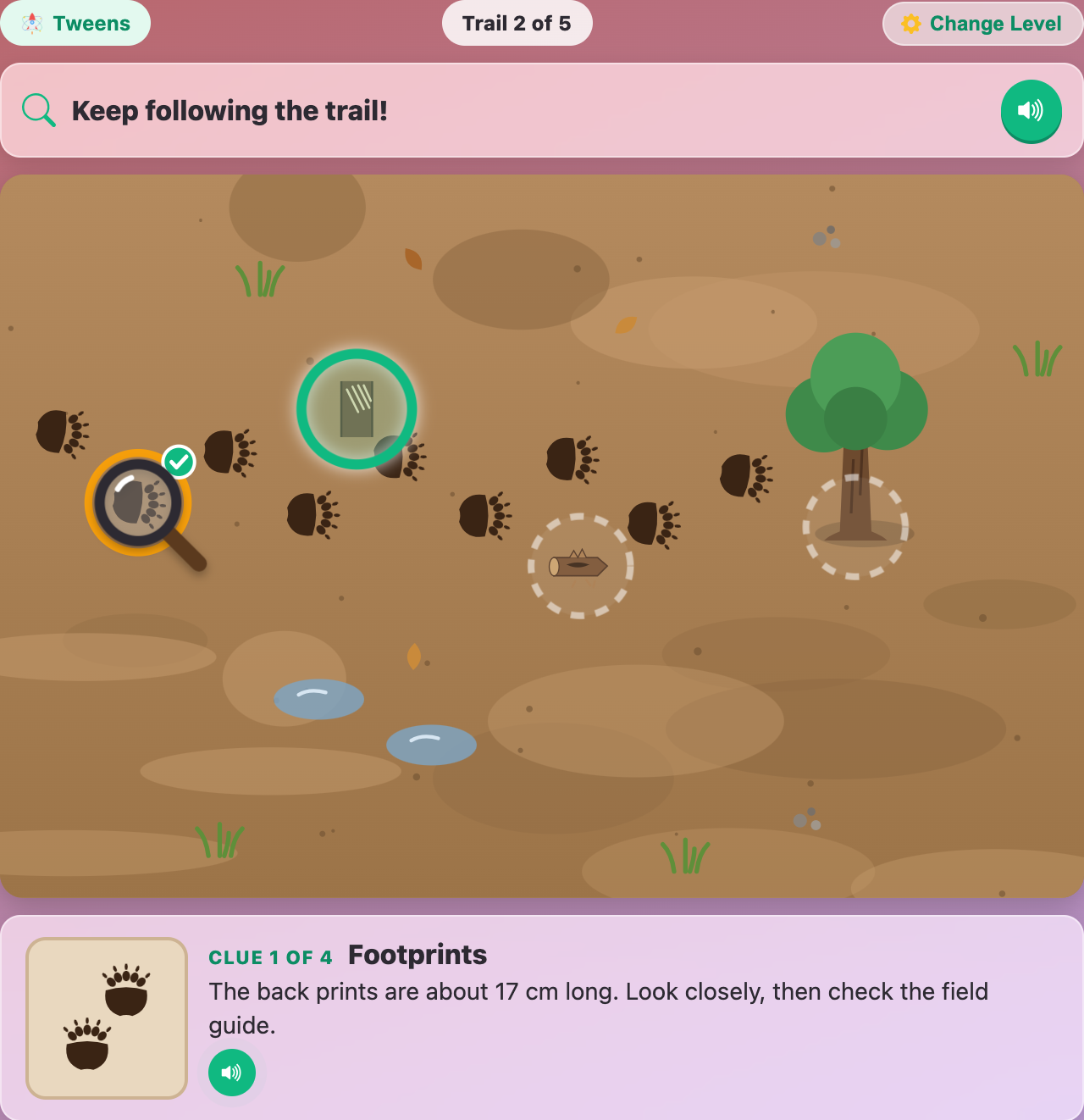
A black bear trail across the mud in Animal Tracks Detective for tweens, with the footprint card giving the size in centimeters
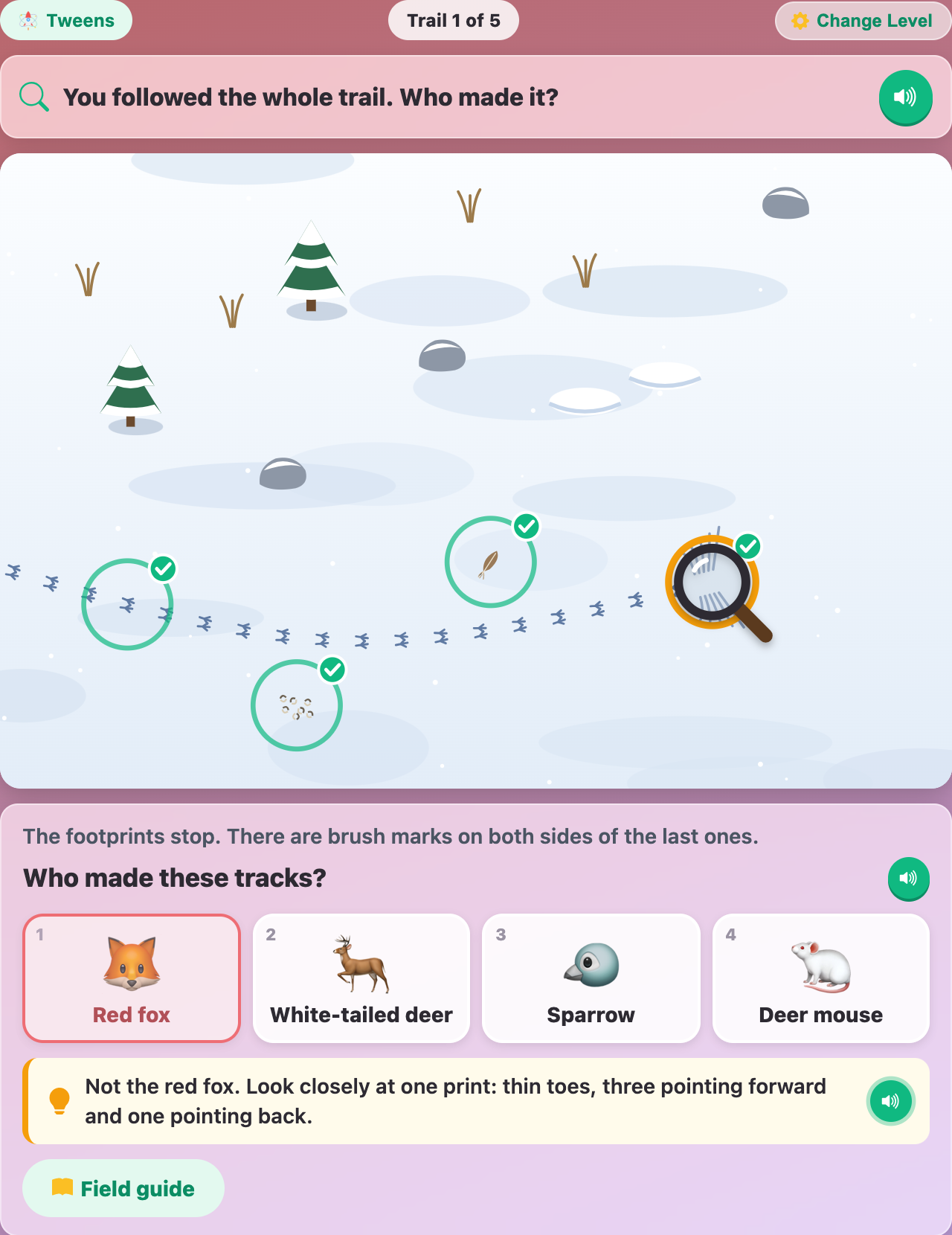
A wrong pick of the red fox on a bird trail, with a hint telling you to look at the thin toes
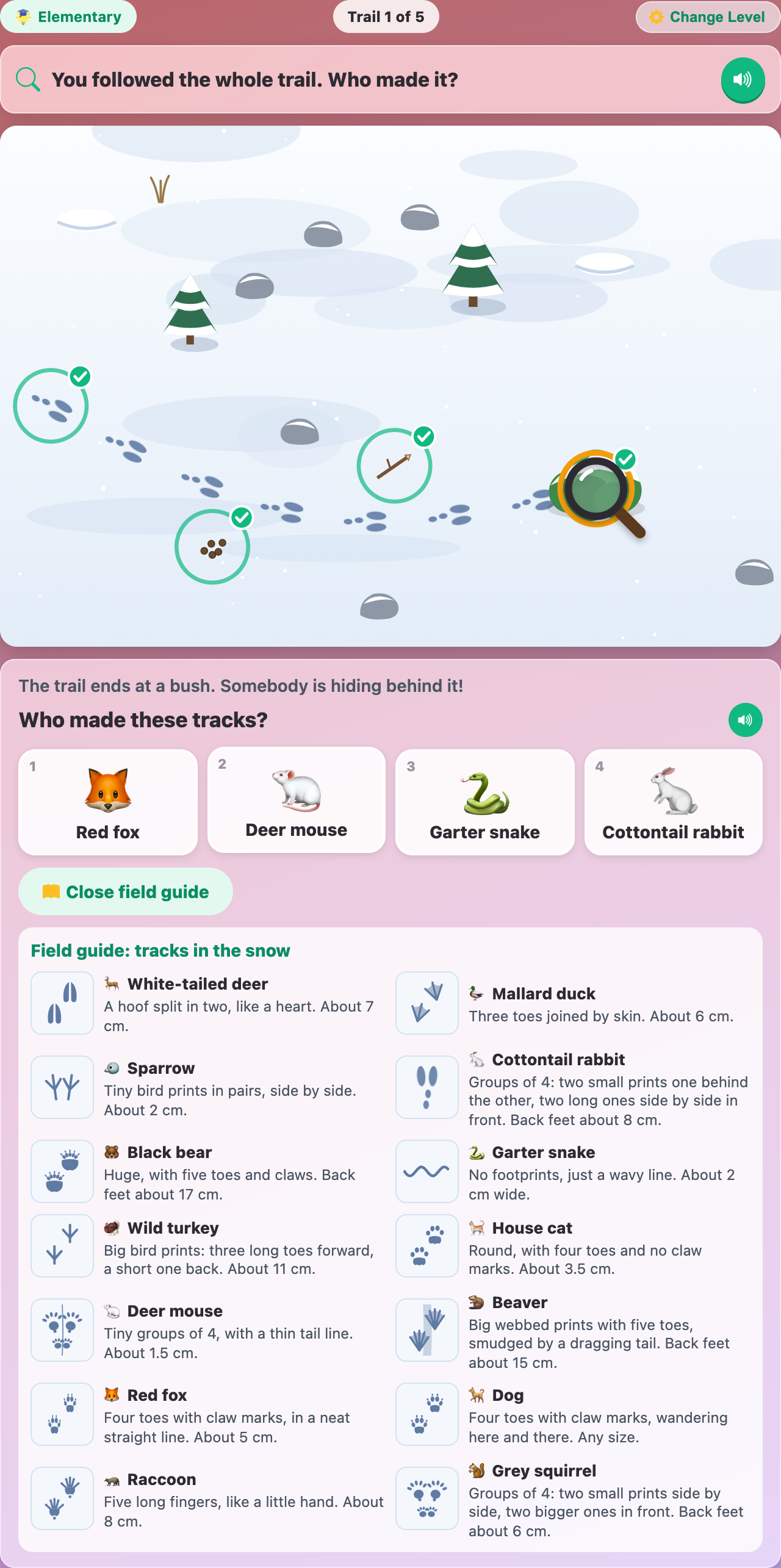
The open field guide listing every animal track in the snow, from the white-tailed deer to the grey squirrel
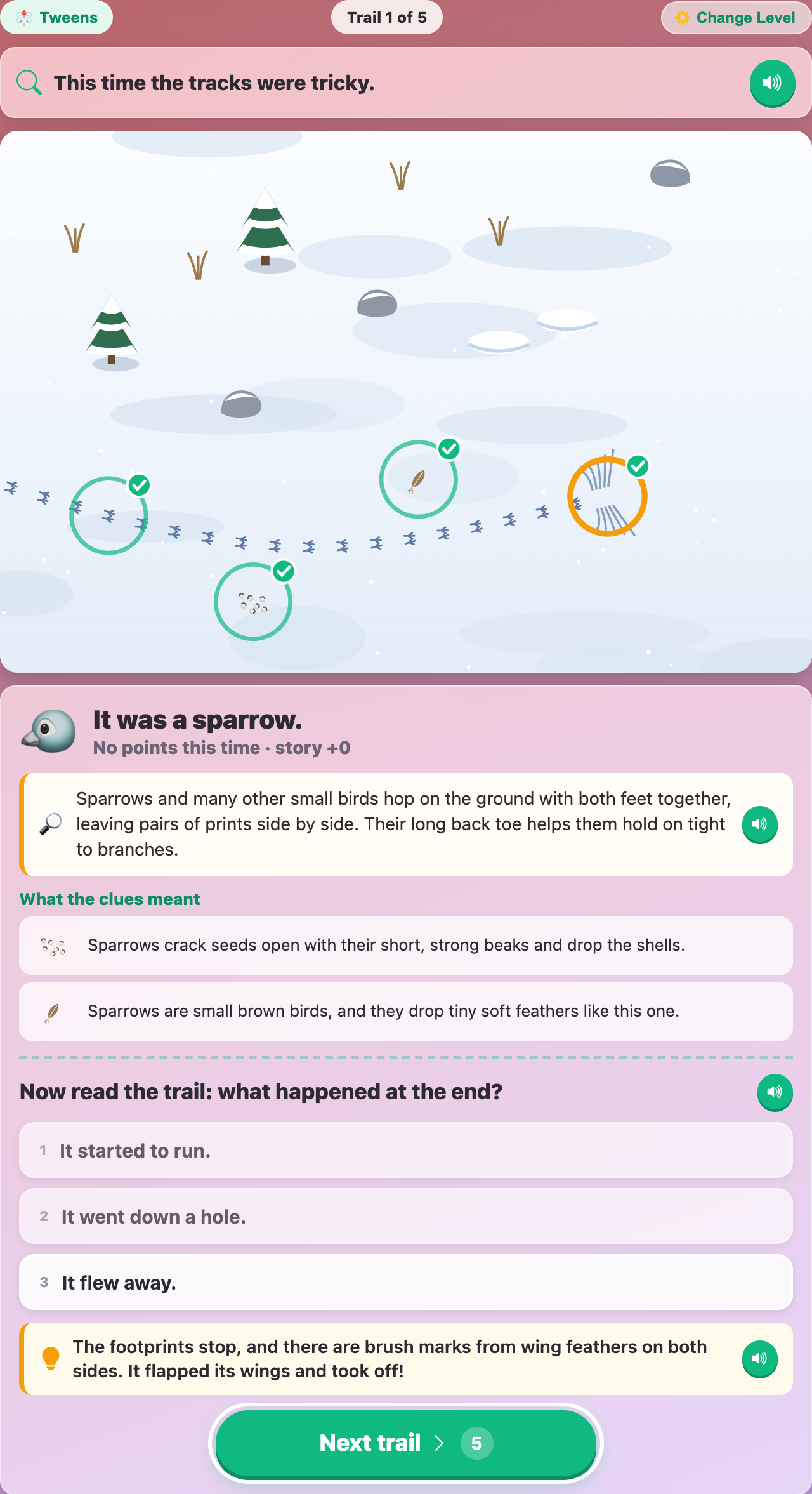
A sparrow result card with what the clues meant, and the tweens question about what happened at the end of the trail
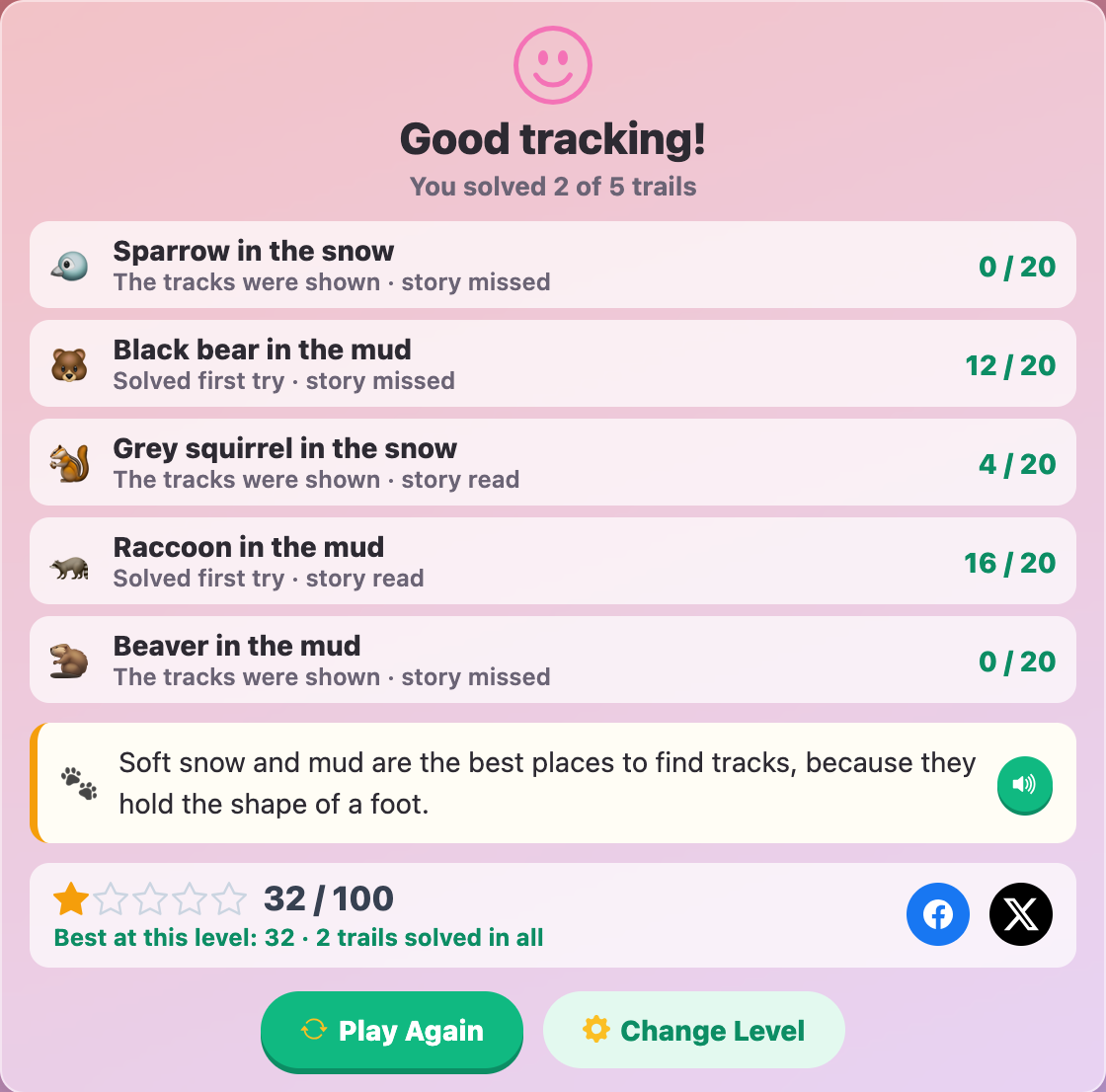
The finish card in Animal Tracks Detective, with each trail's points, a tracking fact and a score out of 100
More Science Games
 59.5K plays
4.8
Recycling Sort
Sort everyday items into the Recycle, Compost, or Trash bin before time runs out!
 85.7K plays
4.9
Grow a Plant
Plant seeds in sunny and shady garden beds, then water, feed and protect them day by day. Watch the roots grow underground and harvest sunflowers, tomatoes, carrots and more!
 438.6K plays
4.9
Magnet Experiment
Guess which objects a magnet will pull, then drag the magnet to test every guess. Does gold stick? Does a battery?
 386.9K plays
4.9
Five Senses Match
Decide which of your five senses you would use for each everyday scene before time runs out.
Most Played Games
 1.8M plays
4.9
Color & Draw
A free-drawing canvas with colors and brush sizes to unleash your creativity.
59.5K plays
4.8
Recycling Sort
Sort everyday items into the Recycle, Compost, or Trash bin before time runs out!
 365.8K plays
5.0
Tic-Tac-Toe
Play a game of Tic-Tac-Toe against the computer and see if you can outsmart it.
 274.1K plays
5.0
Sentence Builder
Pick your age level, then tap the shuffled words in the right order to build the sentence.
Comments (43)