
Science Horse Derby
317.4K playsSaddle up for a science steeplechase! Every fence has a science question: answer right to gallop and jump clean, get three in a row for Carrot Power, and race your horse past the pack to the finish. Learn about animals, your body, weather, plants, space, matter, Earth and energy.
A horse can’t read. It has never heard of gravity, and it can’t tell a frog from a lizard. Luckily, it has you. In Science Horse Derby for kids, you are the rider, and every fence on the track comes with a science question. Answer it right and your horse gallops up and over. Answer it wrong and the fence gets a bump. What you know about animals, plants, space and energy decides who wins.
There are nine fences, five horses and one finish post. The questions grow with you, from “Which animal says moo?” all the way up to cells, rocks and electric circuits. The game has been played more than 300,000 times, and it holds a perfect 5 out of 5 from almost 4,000 ratings. Grab your riding hat. The starting stalls are about to open!
🧪 Nine Fences, Nine Science Questions
A steeplechase is a horse race with jumps. The horses gallop around a grass track and leap over fences on the way. The first steeplechases were run in Ireland more than 250 years ago. Riders raced across the fields from one church steeple to the next, and that is where the funny name comes from. A derby is simply a big, important race.
In this game the track is 1,000 meters long, with a fence about every 100 meters. Signs on the rail count the meters, so you always know how far you’ve come. Before each fence, a question card pops up under the track. Your answer decides how your horse meets that fence: with a fast gallop and a clean jump, or with a bump and a wobble.
The other four horses don’t answer anything. They just run. So the race is really you and your science brain against them.
🗺️ From Starting Stall to Finish Post on KidWorld
Choose your level. The first screen shows four cards: Toddlers (ages 2–4), Preschool (ages 4–6), Elementary (ages 6–10) and Tweens (ages 10–12). Your level picks the questions. If you’ve played before, the game may skip ahead to the next screen. Tap ⚙️ Change Level to pick again.
Pick your horse. Six horses are waiting: Thunder the bay, Daisy the palomino, Pepper the dapple gray, Midnight the black horse, Snowflake the white horse and Rusty the chestnut. Each jockey wears different colors. Every horse runs at the same speed, so pick the one you like best.
Pick your science. Choose 🎲 Mixed for a bit of everything, or one topic, like 🐾 Animals or 🪐 Space. Each level has its own topics (you can read about them below). The game remembers your horse and topic for next time.
Tap Start Race! A 3, 2, 1 countdown plays, then GO! The first question appears right away.
Answer the question. Tap an answer button, or press the number key shown in its corner. Tap the 🔊 button to hear the question read out loud.
Watch the fence bar. Above the question, a tiny 🐎 slides along a bar toward a fence. It shows how close your horse is to the next jump. A red chip tells you which fence it is, like “Fence 3 of 9”.
Keep an eye on the race. The badge in the top corner shows your place, like 1st or 4th. A small oval map shows where every horse is on the track. When a horse is off the screen, a tag like “◀ Thunder 30m” tells you who it is and how far away it is. ◀ means behind you, ▶ means ahead.
Take a break if you need one. Tap Pause, or press P or Esc. The race also pauses by itself if you switch to another browser tab. Tap Setup to change your horse or topic.
Gallop home. After fence 9 comes the home stretch. That is the last straight part of the track. Your horse races to the finish by itself, and confetti flies when the race ends.
Read your result card. You’ll see your place, up to five ⭐ stars, your score out of 100, your clean jumps, your best carrot streak and your race time. Then tap Race Again, Change Horse or Topic, or Change Level.
Use the page buttons. Next to the game are buttons for fullscreen, reload and music. Fullscreen makes the track big. Reload starts a fresh race. The music button turns the race music and sounds on or off.
🔬 What Your Answer Does to Your Horse
Every fence works the same way. A new question pops up the moment your horse lands the jump before it. From then on, one of these things happens.
✅ You answer right
“Gallop!” Your horse speeds up to a fast gallop. That’s more than twice as fast as its easy canter, which is a calm, bouncy run. It sails over the fence without touching it. That is called a clean jump.
🥕 You answer right three times in a row
Your third right answer in a row gives you Carrot Power! Your horse gets a super gallop that is even faster, with orange sparkles flying behind it. A 🥕 counter on the question card shows your streak once you have two in a row. Carrot Power comes again at 6 and 9 in a row, so a perfect race has three of them.
❌ You answer wrong
The card says “Oops!” and shows you the right answer. Your horse keeps going, but at a slow, careful canter. At the fence it knocks the top rail with a “Bump!” and wobbles when it lands, which costs more time. Your carrot streak goes back to zero, and the question is saved for your result card.
⏳ You haven’t answered yet
Here is the kind part. If your horse reaches the fence before you answer, it doesn’t crash. It slows down and waits in front of the fence, pawing the ground, with an orange ? bubble over its head. The card says “Your horse is waiting!” As soon as you answer, off it goes. Thinking longer costs a few seconds, but it never counts as a wrong answer.
🏆 Smart Riding in Science Horse Derby for Kids
Now you know the rules. Here is how to use them to finish first, from easy tips to clever plans.
1. Use the free thinking time
After each landing, your horse canters toward the next fence. That trip takes about 11 to 15 seconds, depending on your level. Any answer you give during that time is free: your horse never has to stop. And the sooner you answer right, the more of the trip it spends galloping. So start reading the moment a new card pops up.
2. A clean jump is worth almost 7 points
Your score has two parts. Your place gives 40 points for 1st, 32 for 2nd, 25 for 3rd, 18 for 4th and 12 for 5th. Clean jumps give up to 60 more points, shared across the nine fences. So each clean jump is worth about 7 points. That is almost as much as moving up one place!
A wild guess that turns out wrong loses those points, slows your horse and breaks your carrot streak. If you aren’t sure, take a few more seconds and think. Your horse will wait for you.
3. Guard the question after two in a row
Carrot Power comes on your 3rd, 6th and 9th right answer in a row. One mistake sends the counter back to zero. When the 🥕 counter shows 2, the next question is the one that switches on the super gallop. Read that one twice before you tap.
4. Rule out answers like a scientist
Scientists often find an answer by crossing out what can’t be true. You can do the same. In this game, every wrong button is wrong for sure. There are no half-right tricks. So each button you rule out brings you closer to the answer.
Try it: “Which one floats on water?” A rock, a coin and an iron nail are all heavy and solid, and they sink. Only the wooden stick is left. Wood is light for its size, so it floats.
5. Let the picture point the way
Many questions show a big emoji above them, like 🐳 for “A whale is a kind of…”. The picture tells you what the question is about, but it never gives the answer away. You still have to think. A whale lives in the sea like a fish. But it breathes air and feeds its babies milk, so it’s a mammal.
6. Answer from the keyboard
On a computer, rest your fingers on the number keys. Each answer button shows its number in the top corner, from 1 to 4. Pressing a key is quicker than moving the mouse, and quick right answers mean more galloping.
7. Pick a practice topic
The setup screen lets you choose one topic instead of Mixed. If space questions keep tripping you up, ride a few races on 🪐 Space only. You’ll hardly ever see the same question twice in one race, so every race teaches you new facts.
8. Turn mistakes into next race’s points
The “Practice these again” box on the result card lists up to six questions you missed, each with its right answer. Read them out loud before you tap Race Again. Those same facts may be waiting at a fence in your next race.
9. Know your rivals
The fastest rival is set to run about as fast as a rider who answers every question right after about eight seconds. The slowest rival is much slower. So if you get most questions right, you will usually finish near the front. To beat the fastest horse, you need to be right and a little quick.
Rival horses sometimes clip a fence and wobble too. And horses far in front ease up a tiny bit. So never give up, even if you are behind at fence 5!
🧠 Five Fence Questions, Worked Out Together
Here is how a good rider thinks through real questions from Science Horse Derby for kids, from the youngest level to the oldest.
Toddlers: “Which animal is the biggest?”
The buttons show a 🐘 elephant and two small animals, like a 🐭 mouse and a 🐱 cat. With sound on, the game reads the question and all three answers out loud. A good way to think: which animal could you never pick up? The mouse and the cat fit in your arms. The elephant is bigger than a car. Tap 🐘 and your horse gallops!
Preschool: “Which sense tells you a lemon is sour?”
The buttons show two other senses, like 👂 Hearing and 👀 Sight, plus 👅 Taste. Think about how you find out a lemon is sour. Looking tells you it’s yellow. Listening tells you nothing at all. Only a lick tells you how sour it is. The answer is 👅 Taste.
Elementary: “Which one is really a fruit, because it has seeds inside?”
The choices are Tomato, Carrot, Potato and Lettuce. The question hands you a clue: seeds inside. Picture each one cut in half.
A carrot is a root. No seeds inside.
A potato grows under the ground. No seeds inside either.
Lettuce is a bunch of leaves.
A tomato is full of little seeds!
So the answer is Tomato. Scientists call it a fruit because it grows from a flower and holds seeds, even though we eat it in salads.
Tweens: “A straw looks bent in a glass of water because light is…”
The choices are Refracted, Reflected, Evaporated and Vibrating. Evaporated is about water drying up, and vibrating is how sound is made, so cross those out. Reflected means light bounces back, like in a mirror. But the straw isn’t a mirror picture. The light is passing from water into air, and it bends as it goes. Bending light is called refraction, so the answer is Refracted.
Tweens: “Which planet spins tipped over on its side?”
The choices are Uranus, Mars, Earth and Mercury. You can cross out Earth right away, since you live on it and it isn’t on its side. Earth is only tilted a little, and that tilt gives us seasons. Uranus is tipped so far over that it rolls around the Sun like a ball rolling across the floor. The answer is Uranus.
Want to visit Uranus yourself? In Solar System Explorer, you can spin and zoom a 3D model of the Sun and all the planets.
🎒 A Race for Every Age, From Moo to Mitochondria
Your level changes the topics, the number of answer buttons and how much help you get with reading.
🧸 Science Horse Derby for toddlers (ages 2–4)
Toddlers race with three topics: 🐾 Animals, 👀 My Body and 🌦️ Weather. Every question has three big picture answers. With sound on, the game reads the question and the answers out loud, like “Cow, Dog, or Duck?”. So a child who can’t read yet can still play. Questions ask which animal says “baa”, what you see with, and what keeps you warm in the snow. Sit together, listen, and let your little one tap the picture.
🌼 Science Horse Derby for preschoolers (ages 4–6)
Preschool adds 🌱 Plants. There are still three answers, and they are still read out loud. Kids learn what a baby horse is called (a foal!), which season comes after winter, and what a plant needs to grow. Some answers are words with a big picture above the question, which makes this a gentle first step into reading.
If the senses questions are a favorite, Five Senses Match asks which sense you’d use in everyday scenes.
🔭 Science Horse Derby for elementary kids (ages 6–10)
Elementary riders get four word answers and four topics: 🐾 Animals, 🌱 Plants, 🪐 Space and 🧊 Matter. Questions don’t read themselves out, but the 🔊 button still works any time. Kids sort mammals from reptiles, learn how leaves make food, name the planets, and follow water as it melts, freezes and evaporates. These are real school science words, practiced at a gallop.
🚀 Science Horse Derby for tweens (ages 10–12)
Tweens race through 🔬 Living Things, 🪐 Space, 🌋 Earth and ⚡ Energy. Questions cover cells and organs, eclipses and light-years, the three kinds of rock, the water cycle, forces, electric circuits and light. It feels like a fast review of middle-school science. At this level, quick right answers are what beat the fastest rival.
🥇 Reading Your Result Card
Your score is your place points plus your clean-jump points, up to 100. Here are three races to show how it adds up.
1st place with 8 clean jumps: 40 + 53 = 93 points. That earns five stars.
2nd place with all 9 clean jumps: 32 + 60 = 92 points. Also five stars!
1st place with only 6 clean jumps: 40 + 40 = 80 points. That is four stars.
See that? A perfect ride in 2nd place scores more than a messy win. Stars go like this: 90 or more gets five stars, 70 or more gets four, 50 or more gets three, and 25 or more gets two. When you are logged in to KidWorld, your score is saved and adds stars to your account.
💡 Why Science Sticks Better on Horseback
Facts that stay put. When you miss a question, the right answer shows up at once, and again on your result card. Seeing the answer right after a mistake is one of the best ways to remember it.
Thinking before tapping. The waiting horse teaches a big lesson in a small way. A careful right answer beats a rushed guess, and the game proves it with points.
Real science words. Habitat, condensation, friction, pollen. These words show up in a fun place, so they don’t feel like homework. Then one day they pop up in class, and they already feel familiar.
Reading for a reason. Every question is a full sentence. Kids want to read it quickly, because their horse is waiting. The 🔊 button is there whenever a word is tricky.
Bouncing back. A knocked rail isn’t the end. The horse wobbles, gets up to speed again, and the next fence is a fresh chance. A race takes about a minute and a half, so trying again is easy.
A quick note for grown-ups
Science Horse Derby for kids is gentle and safe. The horses never fall or get hurt; a wrong answer only means a knocked rail and a little wobble. The game itself has no chat and no typing. The questions are hand-written, and each one has a single clear right answer. They cover life science, earth and space science and physical science, matched to your child’s age. Your horse and topic are remembered in your browser only.
Your horse is saddled, the crowd is cheering, and fence 1 is waiting. Pick your level and ride into Science Horse Derby for kids! And when you want the same horses with word questions, English Horse Derby has letters, rhymes and spelling at every fence.
🖼️ See the Game in Action
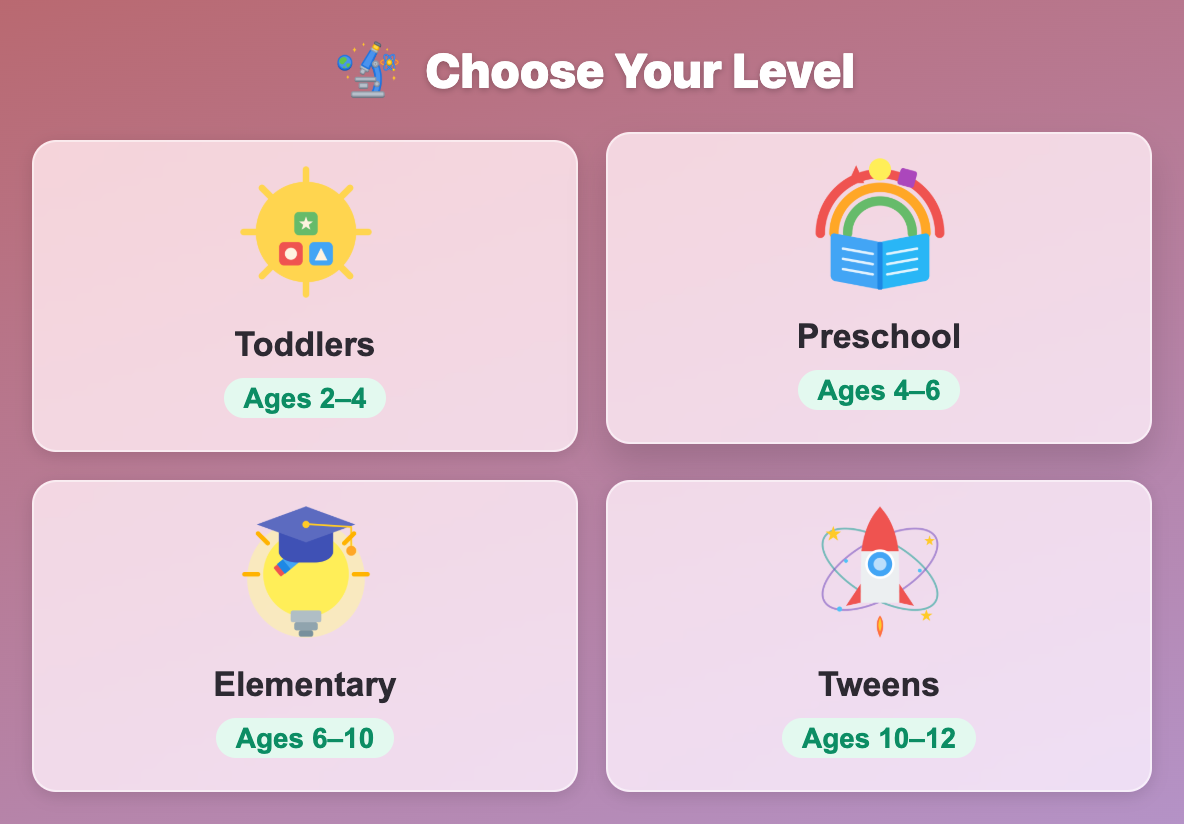
The Choose Your Level screen in Science Horse Derby, with Toddlers, Preschool, Elementary and Tweens cards and their ages
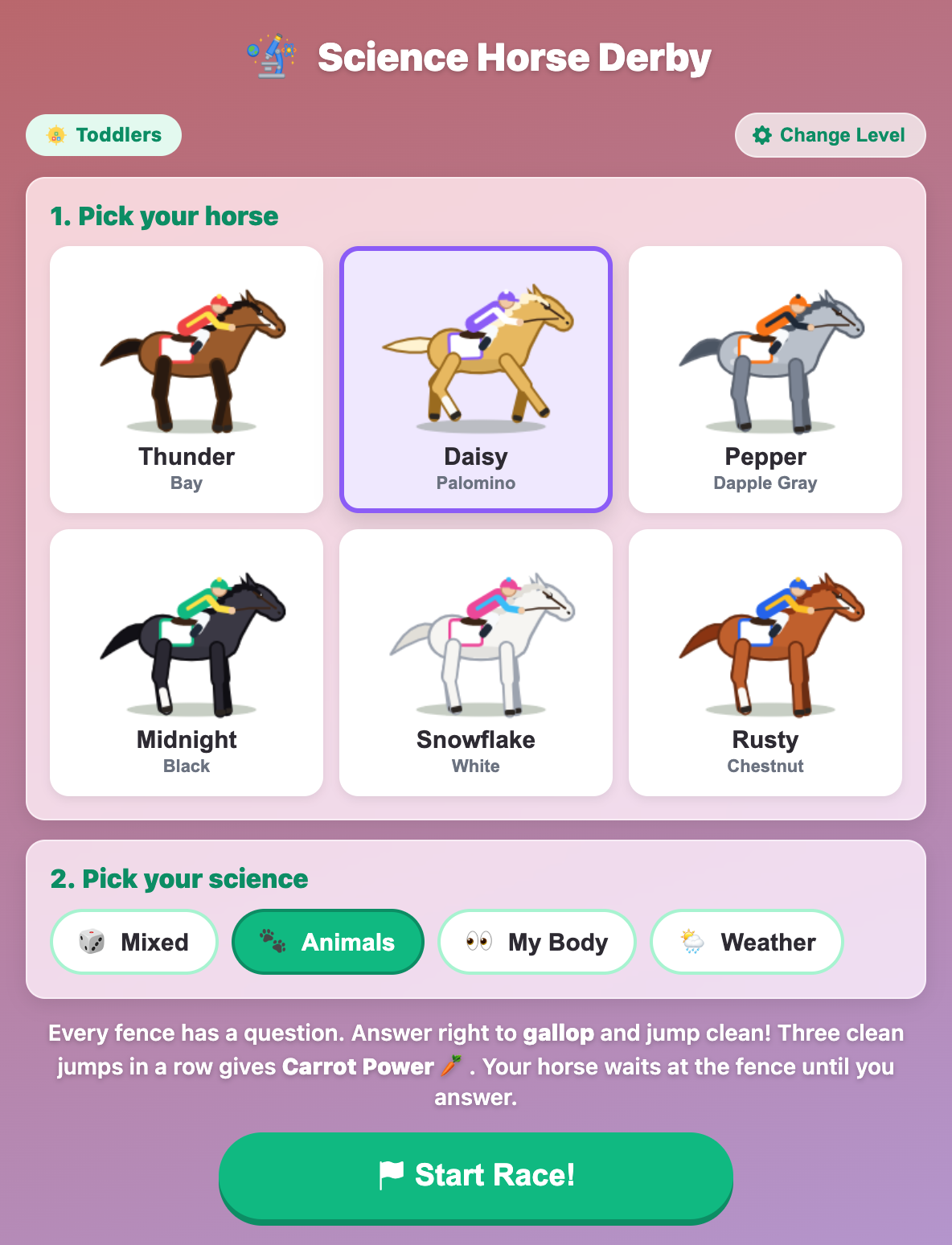
The Science Horse Derby setup screen for toddlers, with Daisy the palomino picked and the Animals science button lit up
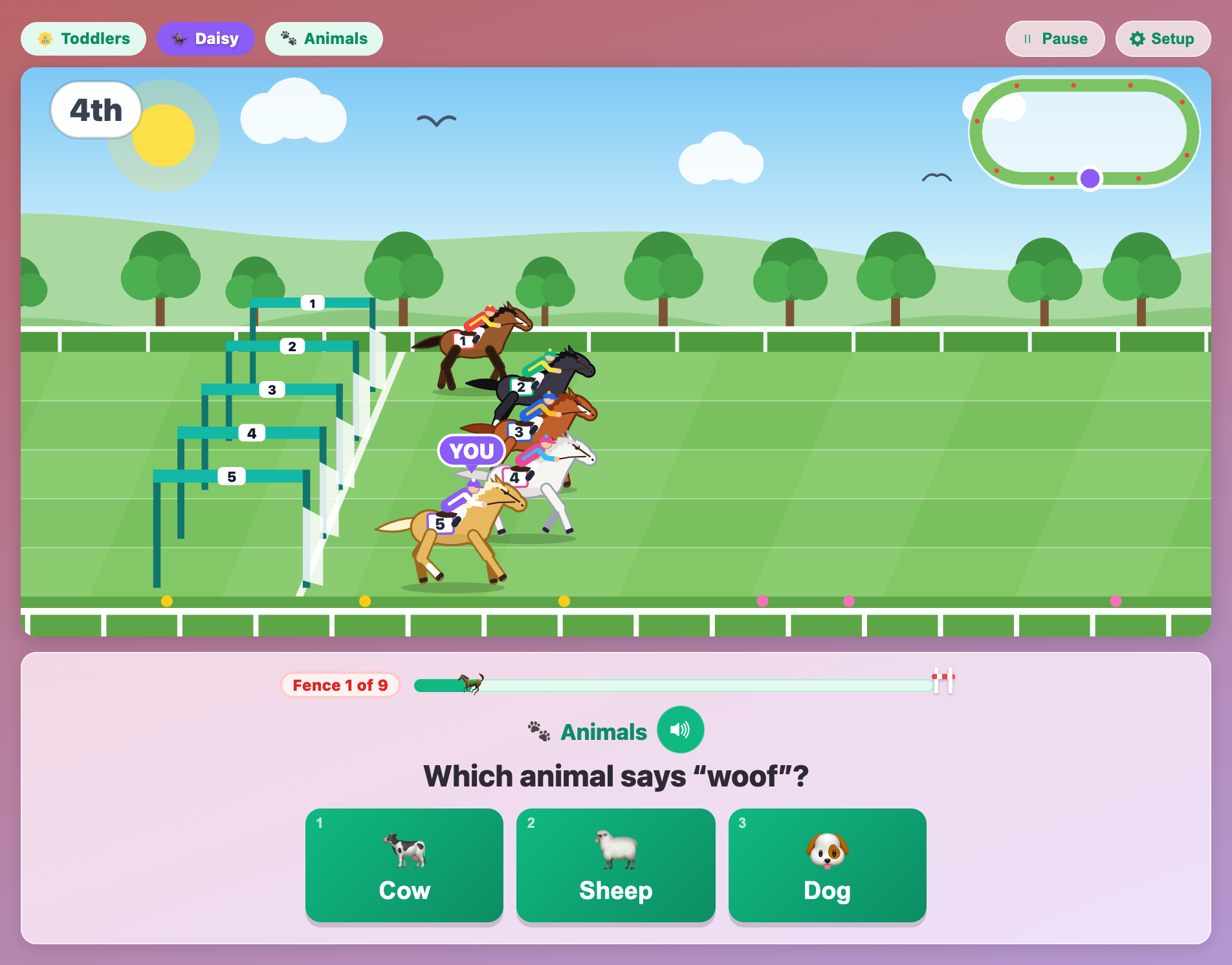
Five horses in the starting stalls in Science Horse Derby for toddlers, with a question about which animal says woof
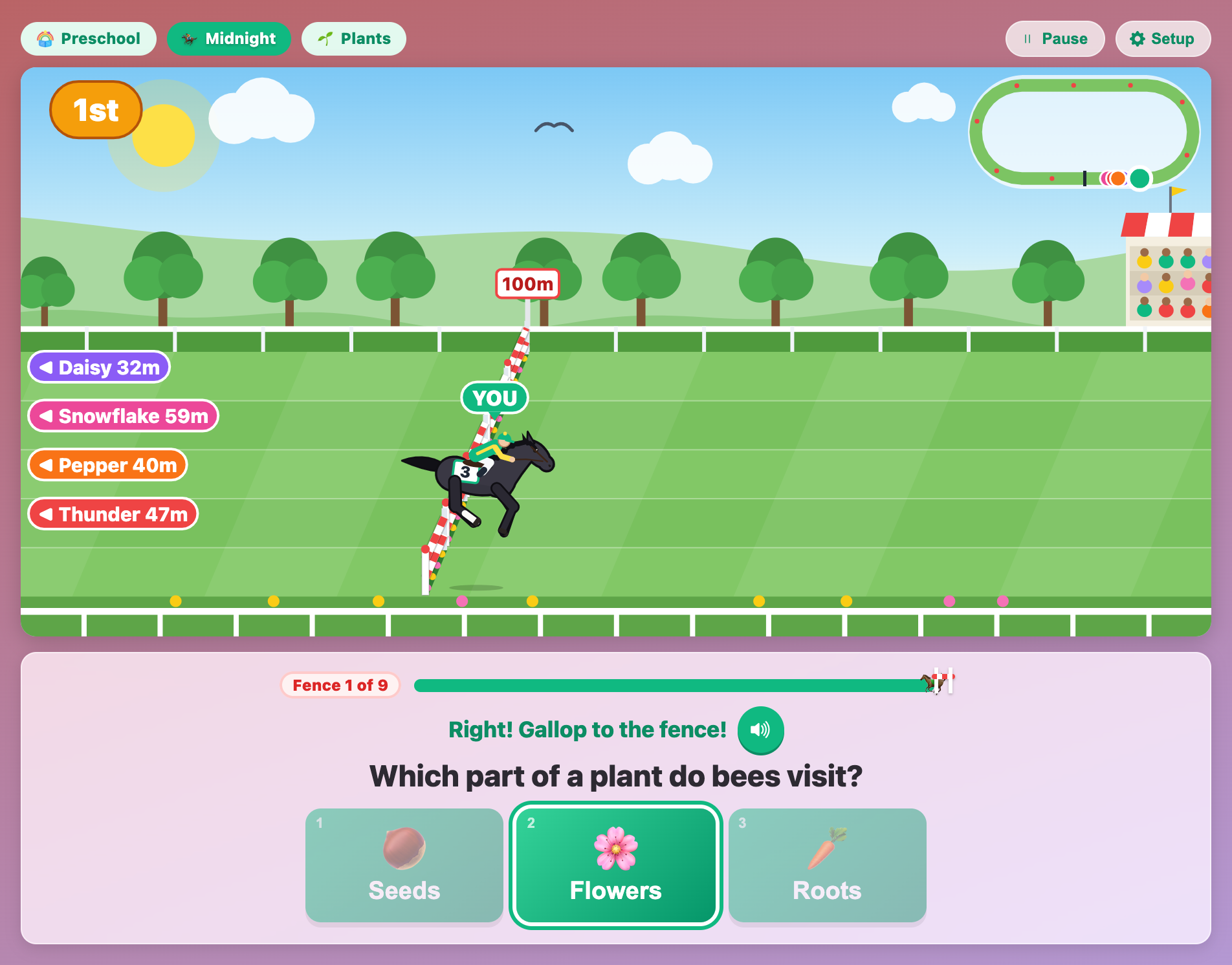
A black horse sailing over the first fence in Science Horse Derby for preschoolers after a right answer about bees
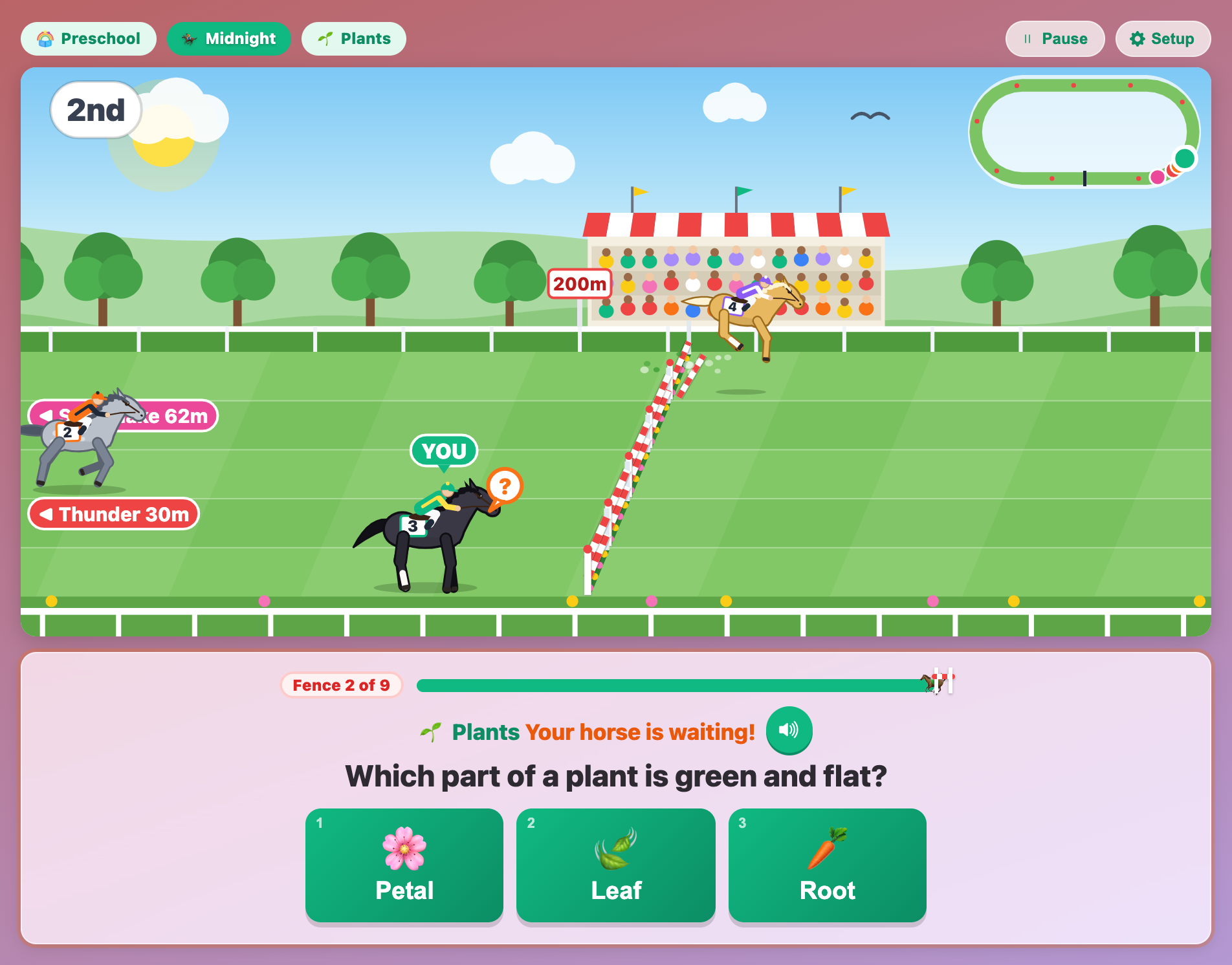
A black horse stopped at fence 2 with an orange question bubble while the card asks which plant part is green and flat
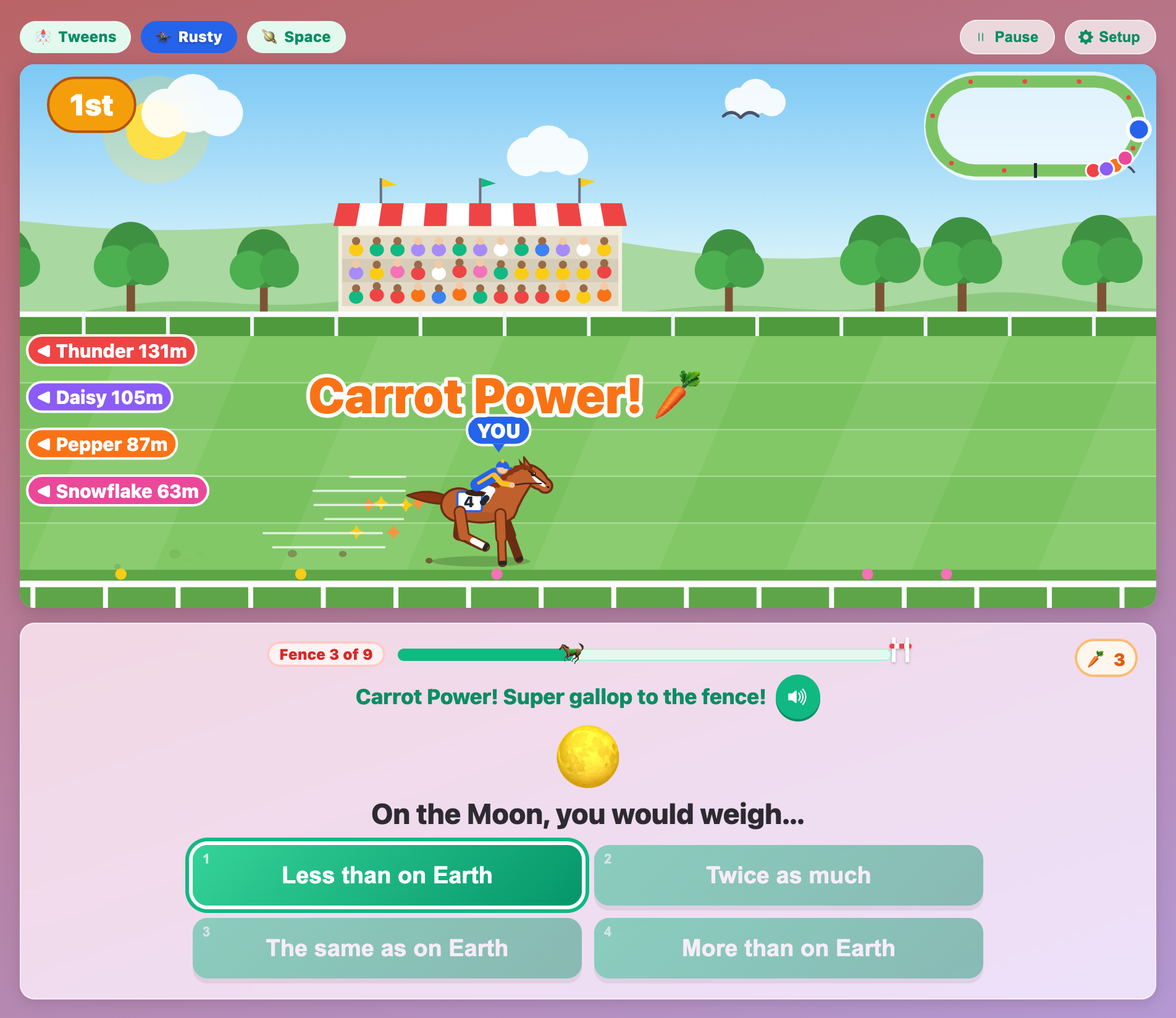
A Carrot Power gallop with orange sparkles in Science Horse Derby for tweens after a right answer about the Moon
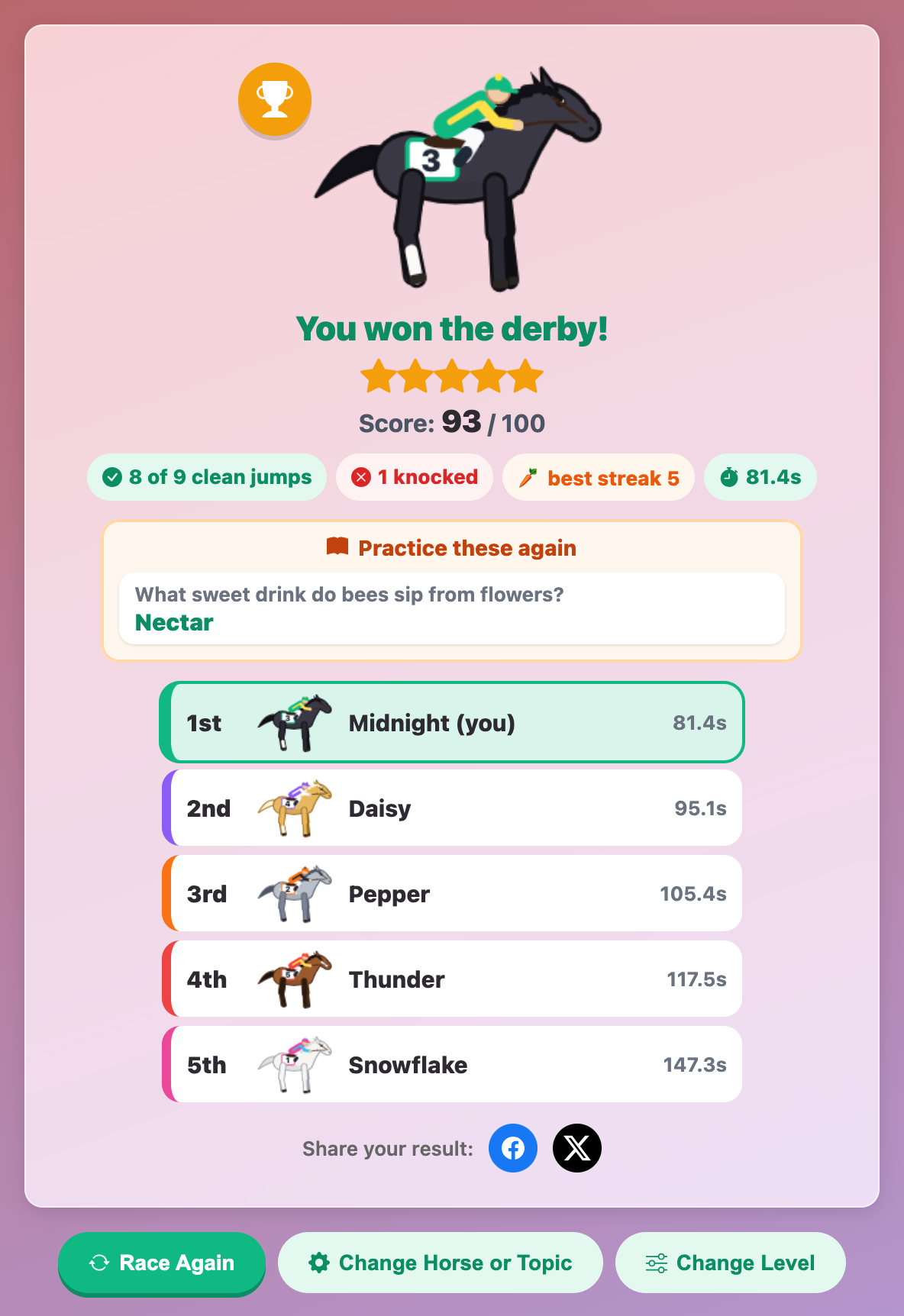
The Science Horse Derby result card with 1st place, five stars, a score of 93 and a practice box about nectar
More Science Games
 59.4K plays
5.0
59.4K plays
5.0
Recycling Sort
Sort everyday items into the Recycle, Compost, or Trash bin before time runs out!
 85.7K plays
4.9
85.7K plays
4.9
Grow a Plant
Plant seeds in sunny and shady garden beds, then water, feed and protect them day by day. Watch the roots grow underground and harvest sunflowers, tomatoes, carrots and more!
 438.6K plays
5.0
438.6K plays
5.0
Magnet Experiment
Drag a magnet around the table and discover which objects it can pick up!
 386.8K plays
5.0
386.8K plays
5.0
Five Senses Match
Decide which of your five senses you would use for each everyday scene before time runs out.
Most Played Games
 1.8M plays
5.0
1.8M plays
5.0
Color & Draw
A free-drawing canvas with colors and brush sizes to unleash your creativity.
59.4K plays
5.0
Recycling Sort
Sort everyday items into the Recycle, Compost, or Trash bin before time runs out!
 365.5K plays
4.9
365.5K plays
4.9
Tic-Tac-Toe
Play a game of Tic-Tac-Toe against the computer and see if you can outsmart it.
 1.1M plays
4.9
1.1M plays
4.9
Chess
Play the classic game of chess against the computer or a friend, with FIDE time controls, hints, and undo.
Comments (25)