
Migration Journey
213.3K playsLead real animal migrations across the map! Guide Canada geese south ahead of winter, monarch butterflies to the mountain forests of Mexico, sockeye salmon up the Fraser River, a green sea turtle across the Atlantic to Ascension Island and a humpback whale from Alaska to Hawaii. Tap to steer along the real route, refuel at marshes and flower fields or live on stored fat, and dodge storms, nets and bears. Big kids predict, compare the distances on a chart and learn why each animal migrates.
🛫 Now leaving: Canada geese from Hudson Bay, monarch butterflies from Point Pelee, sockeye salmon from the Pacific Ocean, a green sea turtle from Brazil and a humpback whale from Alaska. Migration Journey for kids is a free science game where you lead five real animal migrations across real maps. You tap the map to guide each animal through the glowing rings of its true route. Along the way you keep its energy up, steer around storms and fishing nets, and find out why it makes the trip at all. It's made for kids from about 4 to 12, with a gentle version for little ones. It plays right in your web browser, with no download and no sign-up.
A migration (say it: my-GRAY-shun) is a long trip that an animal makes again and again, often every year. Animals migrate to find food, to escape the cold, or to find a safe place for their babies. In this game you don't just read about it. You feel it. The geese race the winter south. The whale must fill up on krill before she leaves. The salmon push up a rushing river past hungry bears. When the trips are done, a short quiz checks what you found out.
🧭 Five Animals, Five Real Routes
Every journey in Migration Journey has its own map, drawn from real coastlines, lakes and rivers. The routes follow places these animals really travel through. Here is where each one goes:
🪿 Canada geese (about 2,100 km): from Hudson Bay in Canada, past Oak Hammock Marsh and Lac qui Parle, to Swan Lake in Missouri. They stop at marshes and a grain field to rest and eat.
🦋 Monarch butterflies (about 3,300 km): from Point Pelee in Canada, down through Texas, to the fir forests high in the mountains of Mexico. They sip nectar from flower fields on the way.
🐟 Sockeye salmon (about 800 km on the map): in from the Pacific Ocean, past Vancouver Island, and up the Fraser and Thompson rivers to the Adams River, the stream where they hatched.
🐢 A green sea turtle (about 2,200 km): from the coast of Brazil, across the Atlantic Ocean, to tiny Ascension Island. An ocean current pushes against her the whole way.
🐋 A humpback whale (about 4,600 km): from the cold water of Alaska, across the Pacific, to warm Hawaii, where her calf (baby whale) is born.
Two bars sit under every map. The Energy bar shows how much strength your animal has left. The season bar shows time passing, like "Autumn → Winter" for the geese or "Leaving Brazil → Nesting time" for the turtle. Your job is to reach the last ring, an orange flag, before the season runs out.
🗺️ How to Play Migration Journey on KidWorld
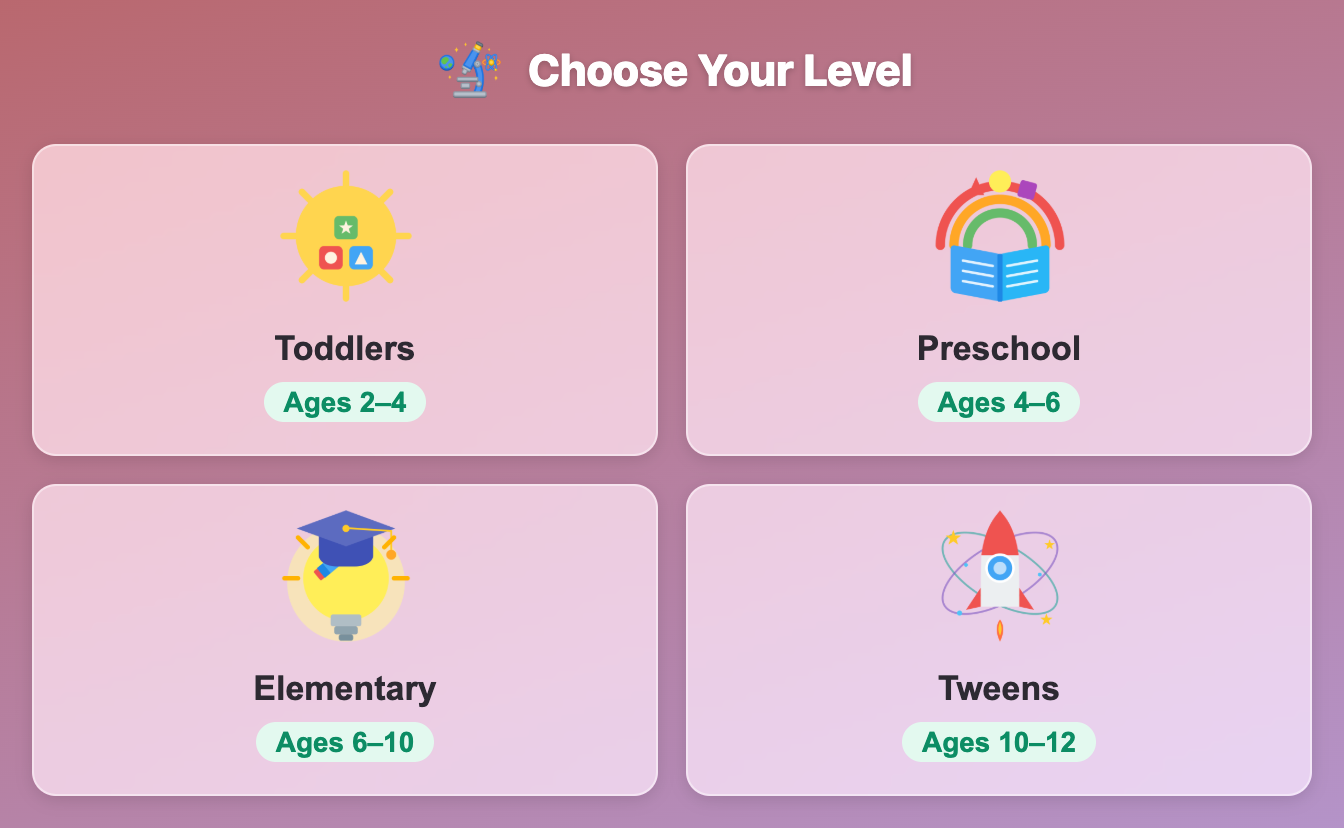
Pick your level. If you aren't logged in, the game starts on Elementary. Tap Change Level at the top right to see all four levels: Toddlers, Preschool, Elementary and Tweens. The game remembers your choice next time.
Make a prediction (Tweens only). Before each trip you guess: will this animal "Find food along the way" or "Live on stored fat"? A right guess is worth 5 points.
Read the Start card. It tells you which animal is next and what to do, like "Reach Swan Lake before winter does!" Then press Start the Journey.
Steer with a tap. Tap the map where you want the animal to go, and it flies or swims straight there. You can also drag your finger to steer, or hold the arrow keys (or W, A, S, D) on a computer. It works on phones, tablets and computers.
Follow the glowing rings. The next ring on the route glows. Reach it and the one after it lights up. The orange flag at the end is home.
Read the message strip. The box under the map gives tips while you play, like "A storm is coming! Fly around it, or wait for it to pass." Press 🔊 to hear any message read aloud.
Check your report. After each trip a card shows how it went: "Arrived on time", "Never ran out of energy" and "No bumps" (or how many). It also shows your journey points and a true fact about the animal. The Next Journey button fills up and moves on by itself after a few seconds, or you can press it.
Take the Migration Quiz. On Preschool, Elementary and Tweens, a short quiz comes after the last trip. A right answer on the first try earns 10 points, and on the second try 5. A wrong answer gives you a hint.
See your score. The "Migration Complete!" card shows your final score out of 100, up to five stars, and the points each animal earned. Press Play Again for a new order of trips, or Choose Another Level.
Use the page buttons. The buttons around the game turn on fullscreen, restart the game, or switch the music on and off. On a computer, the number keys pick answers and Enter presses Start and Next.
⚡ What Uses Up Energy (and What Fills It)
Winning a trip starts with knowing how the Energy bar works. These are the game's real rules:
Moving uses energy. The bar slowly drops as your animal travels.
Waiting uses energy too, just less of it. Standing still is not a free rest.
Food fills it back up. Marshes, grain fields, flower fields and pink krill swarms show up as dashed circles. Inside one, the bar climbs again. And here's a secret: eating doesn't slow you down at all.
Storms and cold drain it twice as fast. A storm cloud also slows your animal to less than half its speed.
Running out means a rest. At zero, the animal stops to rest for a few seconds and wakes up with about a third of its energy. You lose 2 points each time.
Each trip is worth up to 10 points: 4 for never running out of energy, 3 for no bumps (you lose 1 for each bump), and 3 for arriving on time. A bump is any storm, net, bag, ship, orca or bear you run into. Each one can only bump you once.
🏆 Migration Journey for Kids: Tips for a Perfect Trip
1. Tap on the ring, or just past it
Your animal goes straight to the spot you tap, then stops. If you tap a little past the glowing ring, toward the next one, the animal passes through the ring and keeps going. That means fewer taps and no stopping. Stopping wastes time, and it still costs some energy.
2. Plan your food stops
On Elementary and Tweens, one full tank of energy isn't enough for the geese or the monarchs to go all the way. Look at the map before you press Start. Find the food circles near the route, and pick the ones you'll pass through. Since eating doesn't slow you, the best way to eat is to fly right through the middle of a circle without stopping.
3. Fill up before a long, empty stretch
The whale and the salmon start the trip tired, with less than half a tank. Their only food (krill) is at the start, near the coast. If you rush past it, you'll run dry in the open sea. Swim into the pink krill swarm and stay a moment until the bar is nearly full. Then go.
4. Let storms pass
Storm clouds drift slowly across the route. They don't chase you. When you see one coming, you have two choices: go around it, or wait until it moves away. Waiting is often smarter, because a storm slows you down so much. Better still, wait at a food circle: storms are never set to cross right beside one, and you refill while you wait.
5. Watch the bears' paws
Near the end of the salmon's trip, a bear stands on the riverbank. Its paw only swipes now and then, about one second out of every three. Wait until the paw goes up, then dash past. Or swim along the other side of the river, away from the bear.
6. Find the fish ladder
At Hell's Gate the river rushes so hard that the salmon slows to a crawl and gets tired fast. But one side of the river has a fish ladder: a set of little steps that real salmon use to get past. Steer onto the side with the steps, and you swim through at full speed.
7. Keep ahead of winter
On Elementary and Tweens, winter chases the geese and the monarchs. A snowy haze spreads across the map behind them. If your animal falls behind it, energy drains twice as fast. The haze reaches the flag right when the season ends, so if you're on time, you're safe. Don't wander off the route.
8. Don't worry about getting stuck
If a trip takes far too long, the animal knows the way and finishes by itself: "The geese know the way from here. Watch them go!" You'll get fewer time points, but you'll never be stuck on one map.
🔍 Five Tricky Moments, Worked Out
Example 1: The hungry whale
The humpback starts in Alaska with her Energy bar under half full. The message says "Fill up on krill before the long swim!" Here's how to think it through:
Tap the pink krill swarm right next to her and swim inside it.
Wait there until the bar is almost full. It only takes a few seconds.
Now tap a spot just past the next ring, out in the Pacific. There's no more food from here to Hawaii.
Watch for fishing nets on the way and swing around them. On Elementary and Tweens, cross the shipping lanes behind the big ships, and on Tweens give the circling orcas plenty of room.
Example 2: A storm over the marsh country
Your geese are heading for Oak Hammock Marsh when a storm cloud drifts toward the route. If you fly into it, you lose a point for the bump, your geese slow down, and your energy drains twice as fast. Instead, stop inside the marsh circle. You eat while the storm floats past, and your bar fills up. When the cloud has moved off, tap the next ring and fly on.
Example 3: The turtle against the current
Little arrows on the turtle's map point west. That's the South Equatorial Current, and it pushes the turtle back toward Brazil. If you stop tapping, she drifts backward. So keep a target in front of her, to the east, the whole time. There's no food in the open ocean, but she starts with a full tank, so just swim steadily and go around the floating plastic bags and nets.
Example 4: Counting a report card
Say your whale reaches Hawaii on time, never runs out of energy, but bumps into one fishing net. Her points are 4 (no rests) + 2 (3 minus 1 bump) + 3 (on time) = 9 journey points. That's exactly what the report card shows. To make it 10, you only had to swim around that net.
Example 5: A tricky Tweens prediction
"After filling up in Alaska, will the whale find food along the way, or live on stored fat?" It's tempting to pick food, because you just watched her eat krill! But the question is about the trip. Humpbacks hardly eat on the way or in Hawaii. They live on blubber (body fat) built up in Alaska. So the answer is "Lives on stored fat." A good trick: look at the map. If food circles sit only at the start, or there are none at all, the animal lives on fat. If they're spread along the whole route, like the geese's marshes and the monarchs' flowers, it eats along the way.
👨👩👧 Which Level Fits Your Child?
🐣 Migration Journey for toddlers (ages 2–4)
Toddlers lead three trips: the geese, the monarchs and the whale. The animals follow the rings by themselves, so there's no steering at all. The child's job is to tap storm clouds to blow them away. Energy lasts longer, the rings are big, and there's no quiz. When the sound is on, every card is read aloud, so a little one who can't read yet can still follow the story with a grown-up.
🌈 Migration Journey for preschoolers (ages 4–6)
Preschoolers get four trips, adding the sea turtle. The autopilot still steers, but there are a few more things to tap away, like fishing nets and plastic bags. At the end comes a picture quiz of three questions, each with three emoji answers, such as "Where do the monarchs spend the winter?" A wrong tap brings a friendly hint.
📚 Migration Journey for elementary kids (ages 6–10)
Elementary kids play all five trips in a shuffled order and steer every one themselves. Winter chases the geese and monarchs, and the salmon's river adds the rapids at Hell's Gate and a bear. After each trip, the report explains why the animal migrates. The quiz has four questions, like "How do salmon find the stream where they hatched?"
🚀 Migration Journey for tweens (ages 10–12)
Tweens get the full challenge: smaller rings, energy that runs down a little faster, an orca pod, a second ship and a second bear. They predict each animal's food plan, watch a kilometre counter as they travel, and read an extra fact after each trip. At the end, a bar chart compares all five routes and asks which one was the longest and which was the shortest. Then comes a four-question quiz with harder questions. Tweens who enjoy watching animals and seasons change could try Ecosystem Balance, a game about keeping an island's grass, rabbits and foxes in balance next.
🌎 What Kids Learn on the Long Way South
Why animals move. Every report ties the trip to a reason. The geese leave because ice and snow cover their food. The monarchs can't survive a freezing winter. The turtle swims back to the beach where she hatched to lay her eggs. Kids learn that migration is about food, warmth and babies, not just travel.
How bodies store energy. The Energy bar turns a hard idea into something you can see. Some animals refuel on the way, and others live on fat stored before the trip. When the salmon swims into the Fraser River, the game tells you it stops eating. Kids feel why the krill stop at the start matters so much.
Maps and distances. Kids see real places: Hudson Bay, the Gulf of Mexico, Vancouver Island, the equator. Tweens compare kilometres on a bar chart and find that the whale's trip is more than five times the salmon's. Plants travel too! In Seed Travelers, kids help dandelion seeds, pea pods and coconuts find new homes, which pairs nicely with this game.
Planning ahead. Should I wait for the storm or go around it? Do I have enough energy to reach the next marsh? Each choice is small, but it trains kids to look before they act.
Caring for wild animals. Fishing nets, plastic bags and big ships are real dangers for sea animals. The game says so gently, for example that sea turtles can mistake floating bags for jellyfish, and it lets kids clear them away on the younger levels.
👪 A note for parents and teachers: Migration Journey is a calm, safe science game with nothing scary in it. A bump just costs a little energy, and if a trip takes too long, the animal finishes it by itself. There are no accounts or downloads needed to play. It practices life science (animal migration, habitats, life cycles and energy), simple map reading, comparing distances, and careful reading, with every card available read aloud through the 🔊 button. The facts in the game come from real migration science.
Ready to pack your bags? Pick a level, press Start the Journey, and lead the geese, the butterflies, the salmon, the turtle and the whale all the way home. Migration Journey for kids is waiting, and the season is already changing. If the real maps were your favorite part, you can also spin a 3D globe and explore the world's countries in Discovery Earth. 🌍
🖼️ See the Game in Action
The Choose Your Level screen of Migration Journey, with cards for Toddlers, Preschool, Elementary and Tweens and their ages
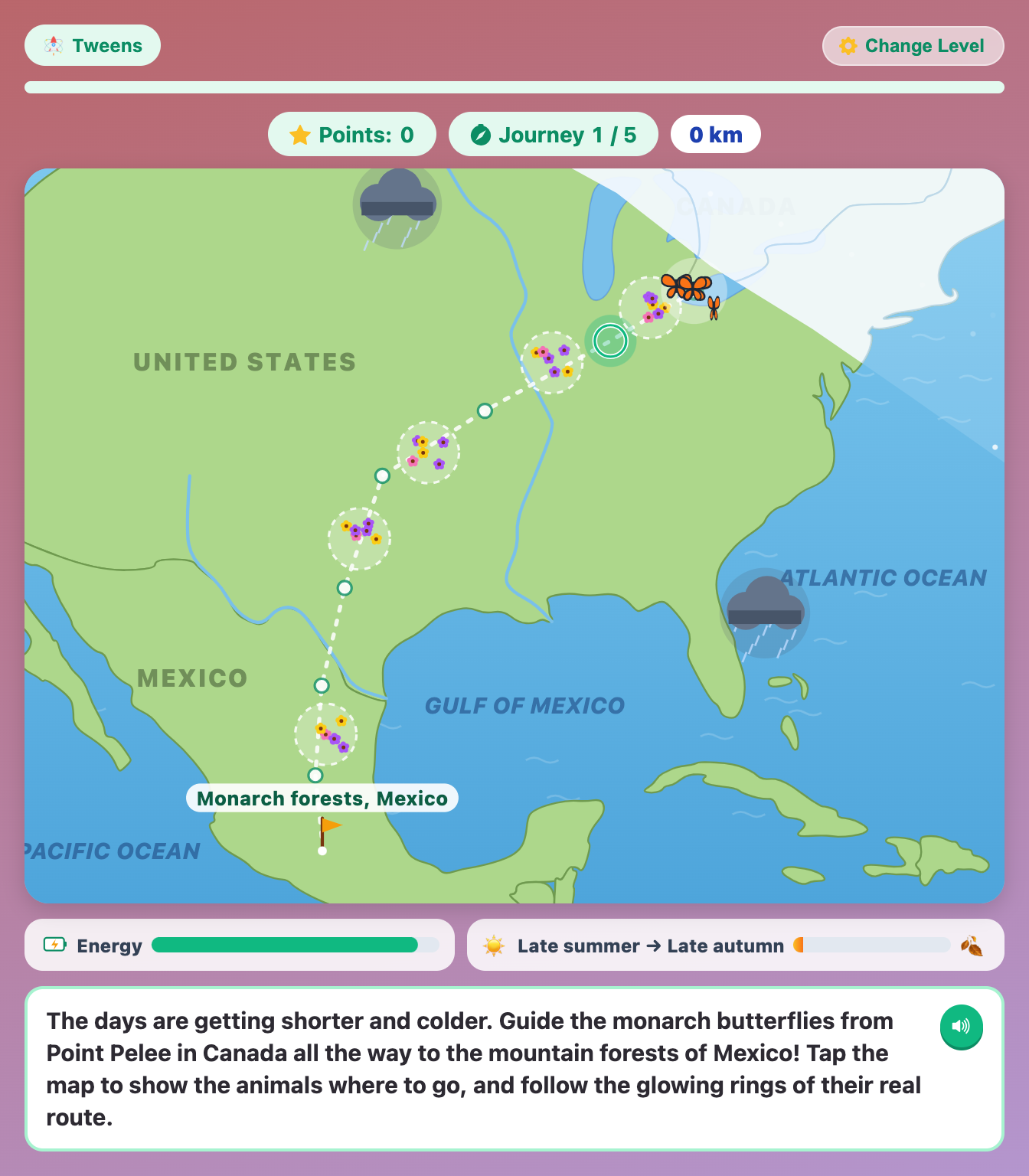
A Tweens map in Migration Journey with monarch butterflies leaving Canada, flower fields along the dotted route, two storm clouds and winter creeping in at the corner
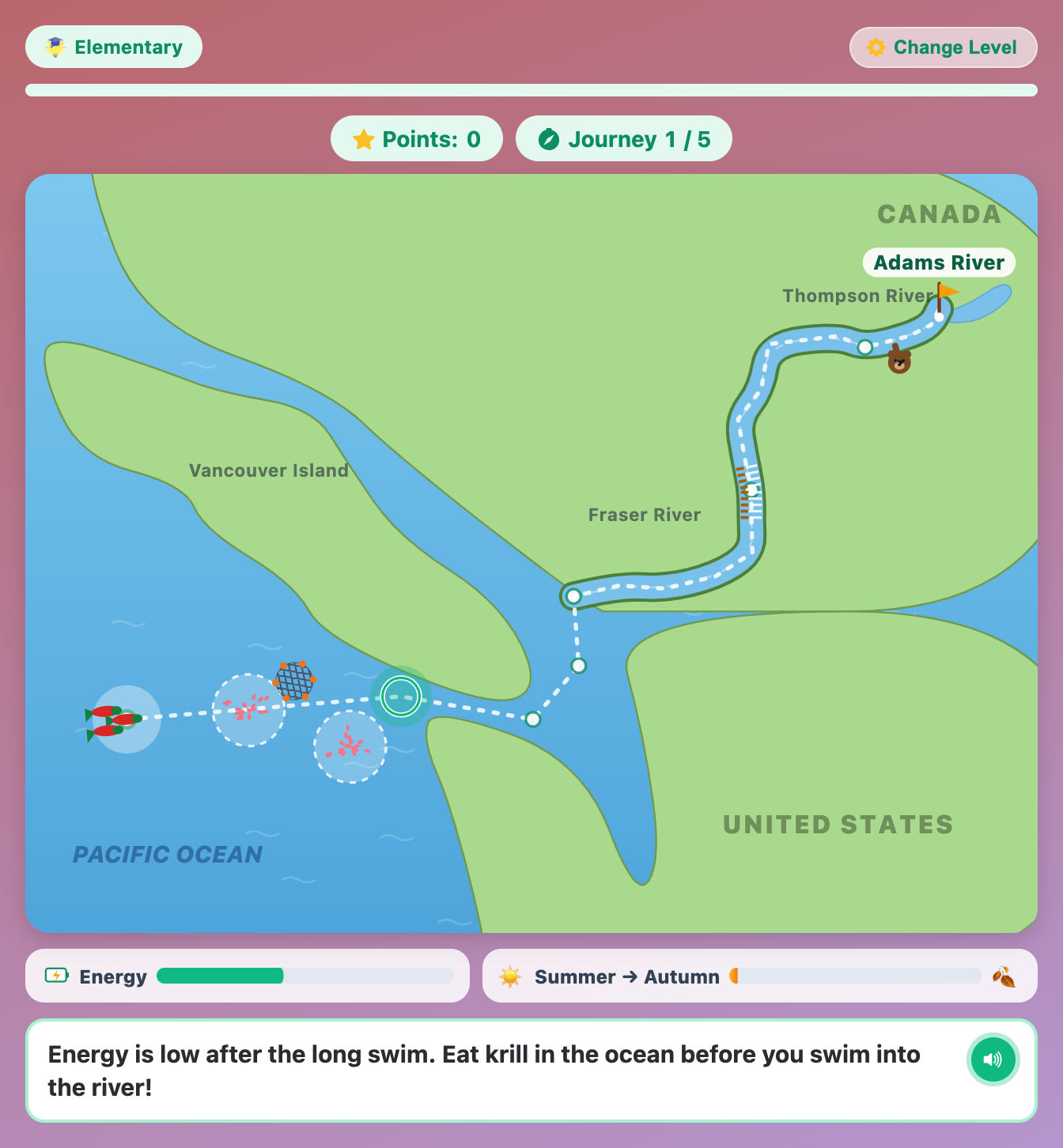
The sockeye salmon map in Migration Journey for elementary kids, with krill swarms, a fishing net, the winding Fraser River and a bear near Adams River
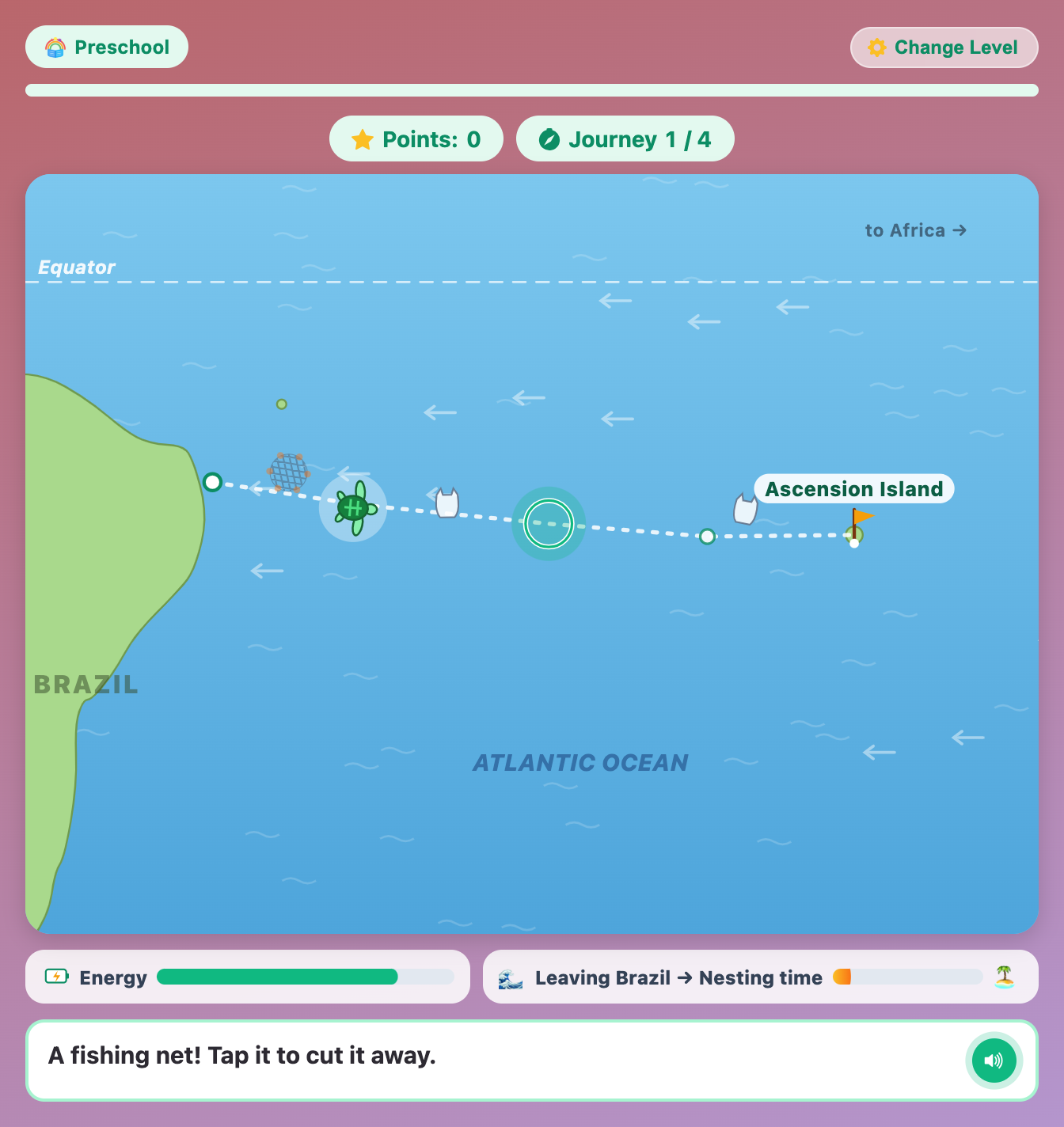
A green sea turtle swimming from Brazil toward Ascension Island past a fishing net and plastic bags, with arrows showing the westward current
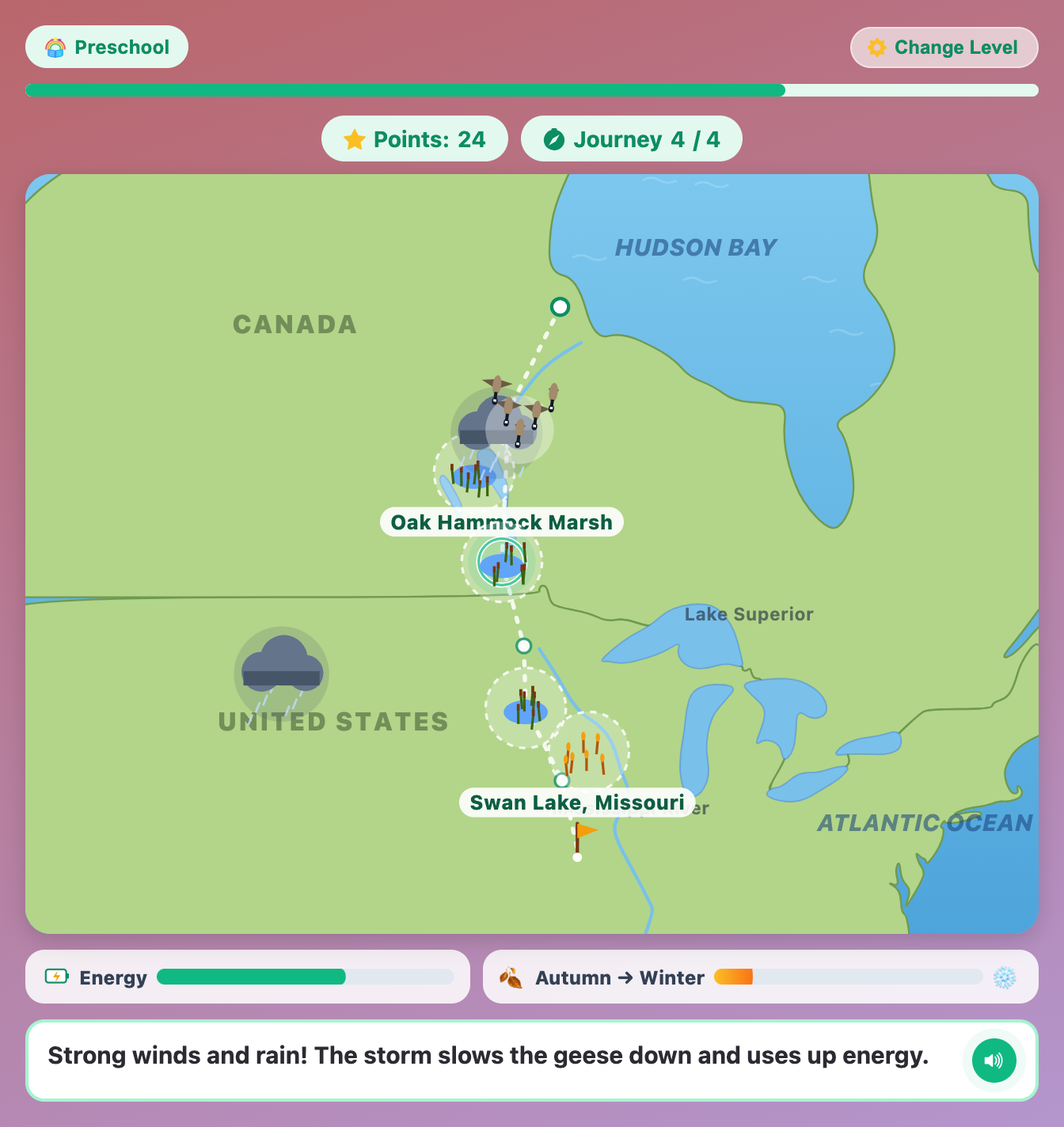
Canada geese caught in a storm cloud near Oak Hammock Marsh on their way to Swan Lake, Missouri in Migration Journey for preschoolers
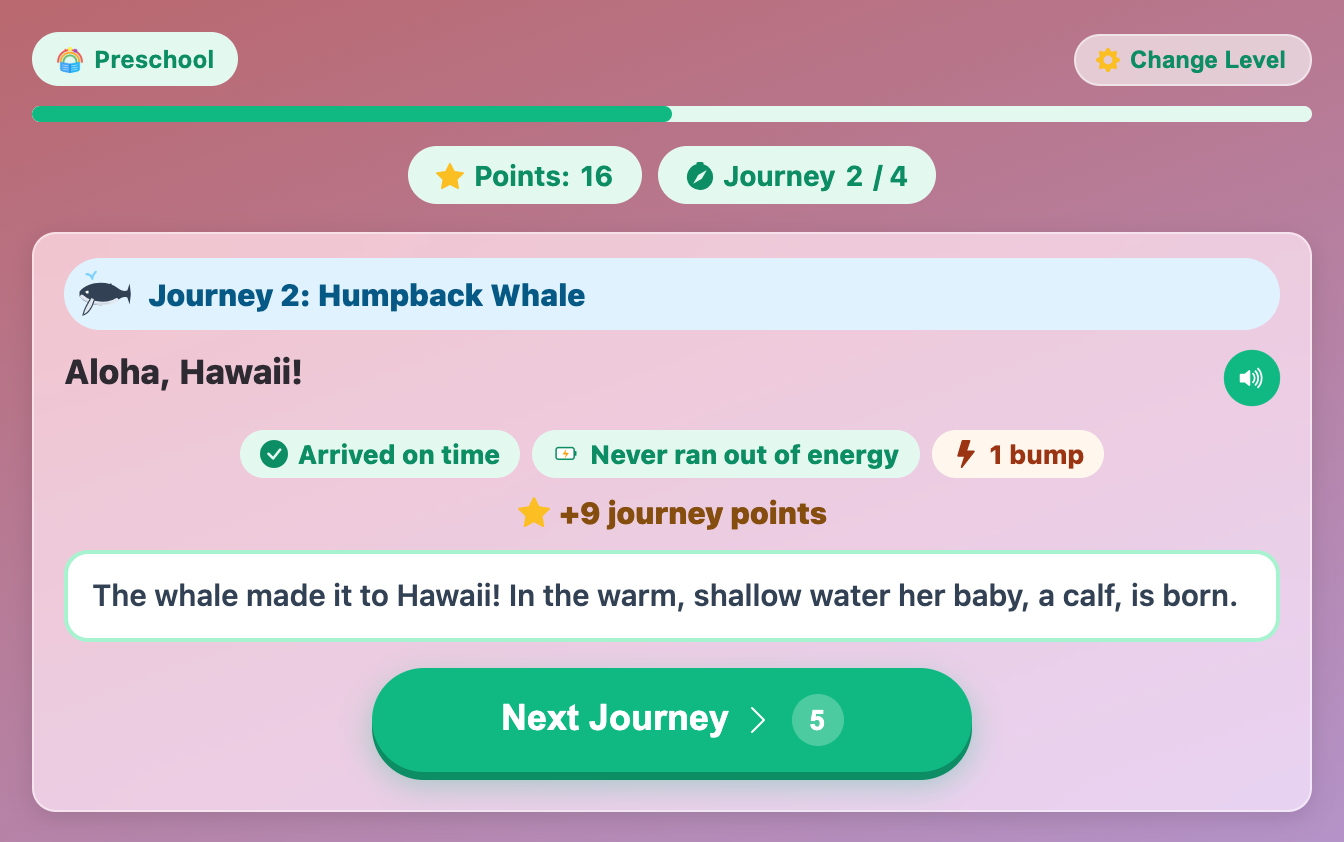
The report card after the humpback whale reaches Hawaii, showing Arrived on time, Never ran out of energy, 1 bump and 9 journey points
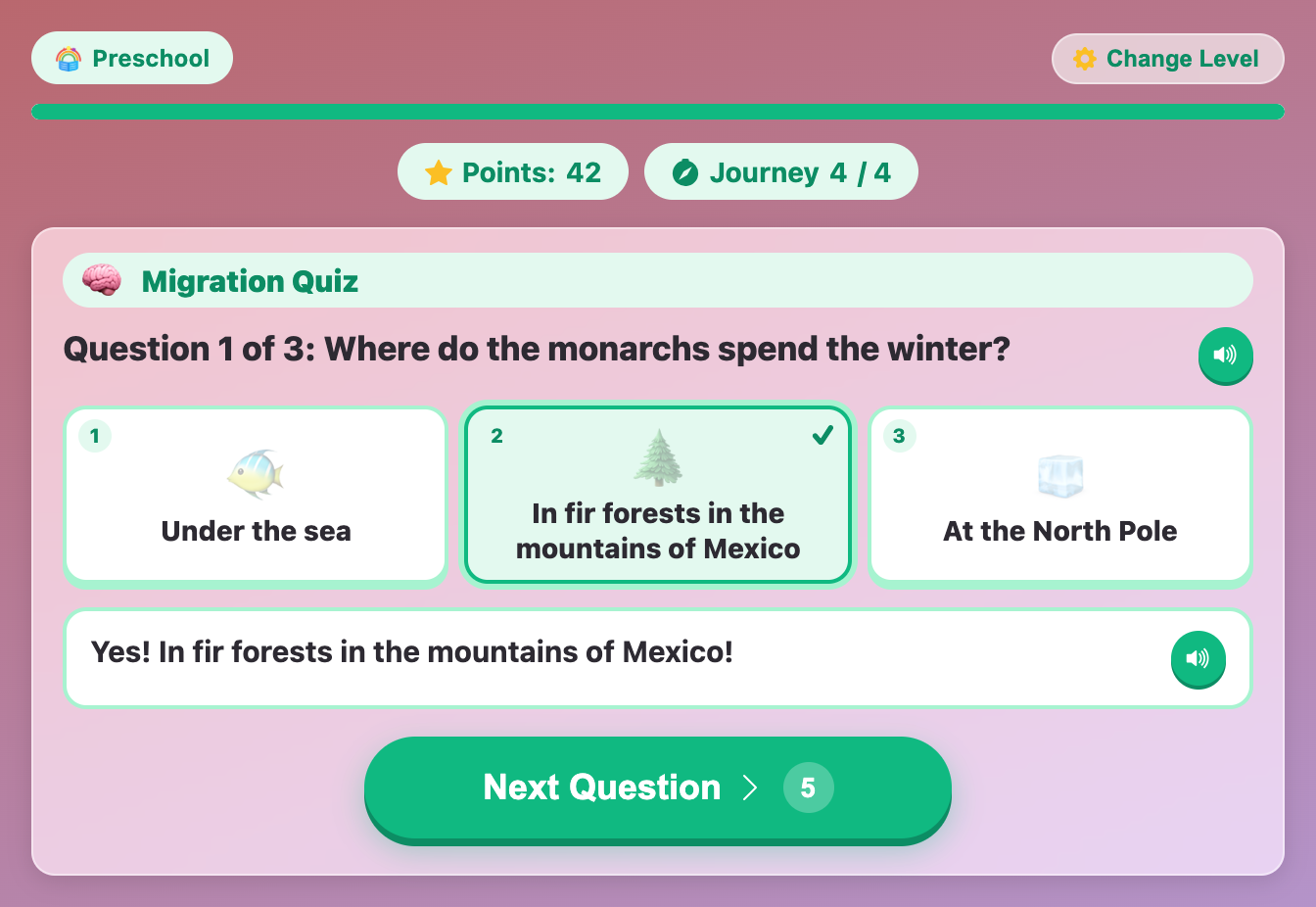
A picture question in the Migration Quiz asking where monarchs spend the winter, with the fir forests answer marked right
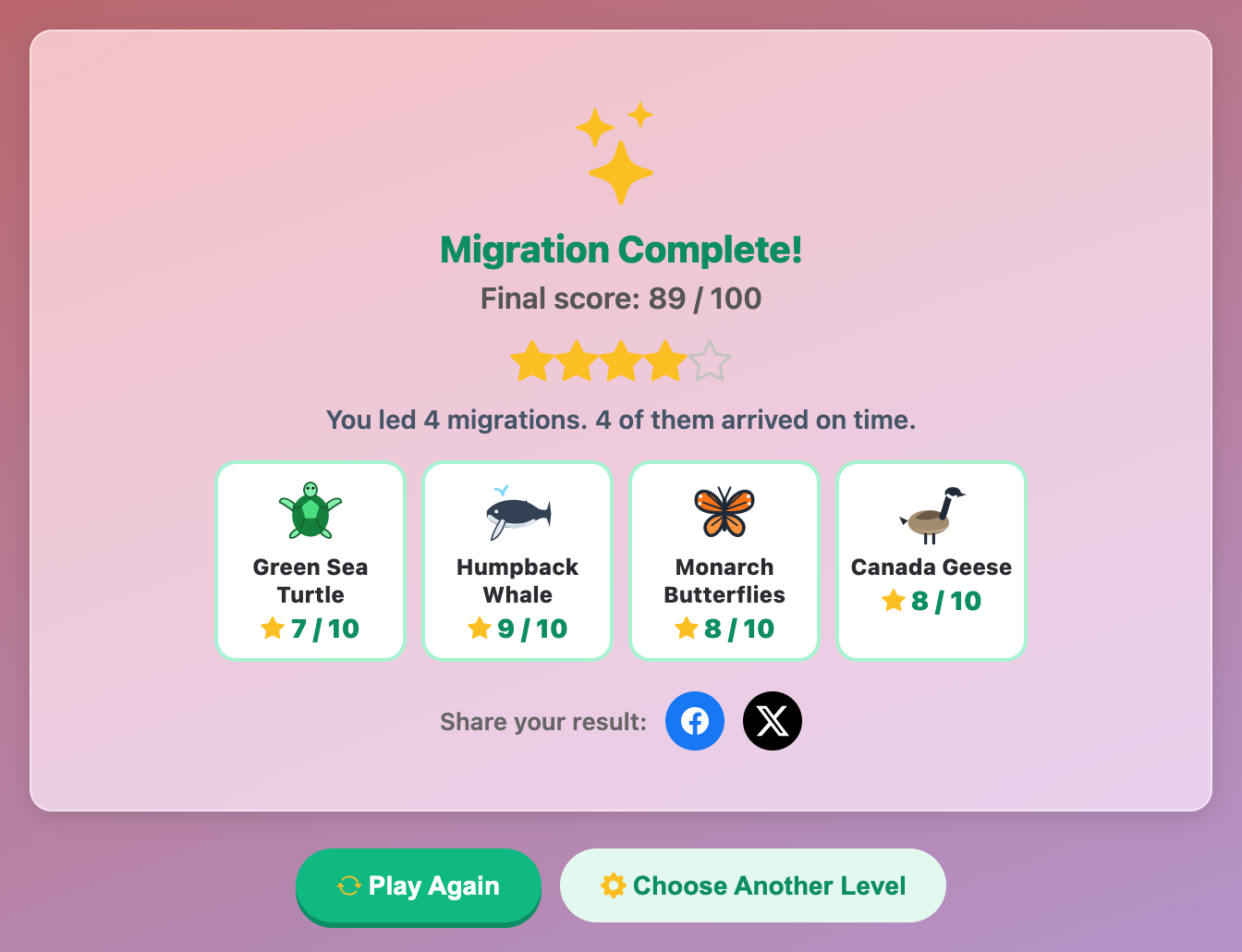
The Migration Complete! card in Migration Journey for kids with a final score of 89 out of 100 and points for each animal
More Science Games
 59.5K plays
4.8
Recycling Sort
Sort everyday items into the Recycle, Compost, or Trash bin before time runs out!
 85.7K plays
4.9
Grow a Plant
Plant seeds in sunny and shady garden beds, then water, feed and protect them day by day. Watch the roots grow underground and harvest sunflowers, tomatoes, carrots and more!
 438.6K plays
4.9
Magnet Experiment
Guess which objects a magnet will pull, then drag the magnet to test every guess. Does gold stick? Does a battery?
 386.9K plays
4.9
Five Senses Match
Decide which of your five senses you would use for each everyday scene before time runs out.
Most Played Games
 1.8M plays
4.9
Color & Draw
A free-drawing canvas with colors and brush sizes to unleash your creativity.
59.5K plays
4.8
Recycling Sort
Sort everyday items into the Recycle, Compost, or Trash bin before time runs out!
 365.8K plays
5.0
Tic-Tac-Toe
Play a game of Tic-Tac-Toe against the computer and see if you can outsmart it.
 274.1K plays
5.0
Sentence Builder
Pick your age level, then tap the shuffled words in the right order to build the sentence.
Comments (27)