
Ecosystem Balance
22.6K playsBe the island ranger! Grass grows, rabbits eat the grass and have babies, and foxes catch the rabbits. Each season, bring animals by boat, move them to the mainland or plant grass, then watch the live graph. Too many rabbits and the grass is gone; too few foxes and the rabbits boom. Keep all three alive through a rabbit boom, hungry foxes and a dry year, and learn how predator and prey numbers rise and fall.
Forty rabbits, two foxes, one small island, and the grass is already shrinking. Ecosystem Balance for kids is a free science game where you are the island ranger. Each season you bring animals by boat, move them to the mainland or plant grass. Your goal is to keep the grass, the rabbits and the foxes alive and healthy. It has four levels for ages 2 to 12, and it plays right in your browser, with no download and no sign-up.
Here is the tricky part: the island never sits still. Rabbits eat grass and have babies. Foxes catch rabbits and have cubs. Change one number and the other two change as well. You watch it all happen, season after season, on three colored bars and a little line graph. By the end you will know why nature needs a balance, and how hard it is to keep one.
🌿 Grass, Rabbits and Foxes: Who Needs Whom?
An ecosystem is a group of living things that share one home and depend on each other. This island has just three of them, so you can see every link.
🌿 Grass is the producer. That means it makes its own food from sunlight. The game shows it as a share of the island, from 0% to 100%.
🐇 Rabbits eat the grass. When they find lots of grass, they have lots of babies. When the grass runs low, fewer babies are born.
🦊 Foxes are the predators. A predator is an animal that hunts other animals. The rabbits are their prey, the animals that get caught. Well-fed foxes have cubs, and hungry foxes die off.
Scientists call the number of one kind of animal its population. In this game you look after three populations at once. If you want to see the same grass, rabbit and fox as a food chain, with the Sun's energy flowing along the arrows, try Food Chain Builder. Ecosystem Balance picks up where it ends: it shows what happens to the numbers over time.
🚤 Your First Season as Island Ranger
Pick a level. The game starts on Elementary. Tap Change Level at the top to choose Toddlers, Preschool, Elementary or Tweens instead. Your level decides your missions, how many moves you get and how wide the green zones are.
Read the mission card. Each mission opens with a card that tells the island's story, like "Only two foxes live here, and the rabbits are having lots of babies." Tap ▶ Start when you're ready.
Check the three bars. At the top of the island you see the rabbits, the foxes and the grass. Each one has a number, a bar with a green part, and a dot. Under the bar it says Green zone ✓, Too many, Too few or None left! Your job is to keep every dot in the green part.
Read the ranger's message. The white box says what happened last season and why, such as "The foxes caught lots of rabbits." On most levels a green tip follows it (Tweens get none). Tap the 🔊 button to hear the message read out loud.
Make your moves. You have six buttons. The top row is +5 🐇 by boat, +1 🦊 by boat and +15% 🌿 plant. The bottom row is −5 🐇 to mainland, −1 🦊 to mainland and undo for planting. Toddlers and Preschool get 3 moves each season, and Elementary and Tweens get 2. The dots next to "Your moves" show how many are left.
Watch the arrow. When you plan a move, the bar shows where the number is going, like 40 → 30. A small badge such as ×2 shows that you pressed a button twice. Tap the opposite button to take a move back.
Tap Next Season. If you made moves, the little boat sails to the mainland and back. Then the island changes in front of you. The seasons go round from Spring to Summer, Autumn and Winter, and the corner shows how far along you are, like "Spring · 1/8".
Handle the island news. Some missions bring surprises, like pet rabbits set free or a season with no rain. A news card pops up first, and you tap OK to carry on.
Read your mission report. After the last season you get up to 3 stars, a count such as "Alive 8/8 · Green zone 6/6", and a line graph for each of the three. The report also tells you what was out of the green zone most often, and what the mission teaches.
See your final score. After the last mission, the Island Ranger Report shows your score out of 100, up to 5 stars and how each mission went. Tap Play Again or Choose Another Level.
Use the extras. It works with taps on phones and tablets and with a mouse on a computer. On a keyboard, keys 1 and 2 move rabbits out and in, 3 and 4 do the same for foxes, 5 plants grass, 6 undoes planting and Enter goes on. The buttons around the game page make it fullscreen, start it over or switch the music on and off.
🌊 Why the Island Won't Stay Still
You might think a ranger could just leave the island alone. Try it once and see! With no moves at all, every mission slides out of the green zone.
The reason is a chain of changes that goes round and round:
Lots of grass means lots of baby rabbits.
Lots of rabbits means lots of food for foxes, so more fox cubs are born.
Lots of foxes catch lots of rabbits, so the rabbits get fewer.
With fewer rabbits to catch, the foxes go hungry and get fewer too. Then the grass grows back, and it all starts again.
Scientists call this the predator and prey cycle. In real life, the number of predators usually peaks a little after the number of prey. On this island the waves grow bigger each time unless a ranger steps in. That's you!
The seasons matter too. In Spring the grass grows fastest and the rabbits have the most babies. In Winter the grass grows slowest and fewer babies are born. So a rabbit number that looks fine in Winter can jump in Spring.
🦊 Ecosystem Balance for Kids: Ranger Tricks That Keep All Three Alive
1. Look one season ahead, not just at today
A dot sitting in the green part can still be heading out of it. On the Welcome to the Island mission, 30 rabbits looks fine. With no moves it becomes 37, then 42, and by then the grass is dropping fast. A good ranger acts while the trouble is still small.
2. The rabbits are usually the key
Rabbits sit in the middle of everything. They eat the grass and they feed the foxes. When the grass is falling, the cause is nearly always too many rabbits. Moving 5 or 10 rabbits to the mainland fixes the grass and the rabbits in one go.
3. One fox is a big deal
A fox move is only 1 animal, but a balanced island has just about 4 foxes. So one fox more or less is a quarter of them! Foxes also change slowly, because they only have cubs when they catch plenty. Use fox moves for the long run, and rabbit moves for quick fixes.
4. Plant grass when the rain stops
Planting adds 15% grass. In a normal season, moving rabbits away often helps more. But when there is no rain, the grass can hardly grow by itself, so planting is the best way to keep the rabbits fed.
5. Don't overdo it
Too few rabbits is a problem too. If you move too many away, the foxes go hungry next season. The best rangers often bring 5 rabbits back by boat a few seasons after moving lots away. Small, steady changes beat one giant one.
6. Get ready before Spring
Spring is baby season. If the rabbits are near the top of their green zone in Winter, move a few away before you tap Next Season. Otherwise the Spring babies can push them right out.
7. Let the message tell you the cause
The ranger's message always gives a reason. "Not much grass, so fewer baby rabbits" tells you the grass is the problem. "The foxes couldn't catch enough rabbits, so there are fewer foxes" tells you the foxes need more food. Fix the cause, not just the number.
8. It's fine to do nothing sometimes
When all three dots sit near the middle of their green parts, the best move can be no move. You don't have to use every move. Just tap Next Season and watch.
9. The island news comes at the same time on every try
Each mission plays out the same way when you make the same moves. On the Tweens Ten-Season Challenge, the pet rabbits arrive in season 3, the rain stops in seasons 6 and 7, and the fox sickness comes in season 9. Once you know that, you can plan ahead on your next try.
📒 From the Ranger's Logbook: Five Missions Played Through
These examples use the real numbers from the game. Try them yourself and check!
Logbook 1: Taming the Rabbit Boom (Elementary)
The island starts with 40 rabbits, 2 foxes and 75% grass. At Elementary, the green zone for rabbits is 10 to 35, so 40 is already too many.
If you do nothing: after Spring there are 57 rabbits, then 75 in Summer and 87 in Autumn. The grass falls to 6%. In Winter the message says "Oh no! The rabbits ate all the grass." Then the hungry rabbits fade away.
A ranger's way:
Spring: move 10 rabbits to the mainland (two −5 taps). Lots of grass means lots of babies, so there are still 42 rabbits afterwards. That's OK, keep going.
Summer: move 10 more away. Now 41 rabbits and 59% grass.
Autumn: move 10 more away. Now 35 rabbits, back in the green zone!
Winter: move 10 more away. Now 27 rabbits and 46% grass.
Next Spring: bring 1 fox by boat and move 5 rabbits away. Do the same in Summer. Now there are 20 rabbits and 4 foxes, just right.
After that, small fixes keep it there: plant grass once, and bring 5 rabbits back when they dip. All three stay alive for all 8 seasons, and the report gives 3 stars.
Logbook 2: Too Many Foxes (Elementary)
Here 8 hungry foxes share the island with just 12 rabbits. If you do nothing, the rabbits drop to 6, then 2, then none at all by Autumn. After that the foxes starve one by one, and by the last Winter there are none left either.
A ranger's way: in Spring, bring 5 rabbits by boat and move 1 fox to the mainland. In Summer, move 2 foxes away. In Autumn, bring 10 rabbits. In Winter, bring 5 rabbits and move 1 more fox. Now there are about 23 rabbits and 4 foxes. One small rabbit move in the next Spring, and the island stays in the green zone for all 8 seasons. Notice the trick: you help the rabbits and you take away foxes at the same time.
Logbook 3: The Dry Year (Elementary)
This island starts balanced: 60% grass, 20 rabbits and 4 foxes. Then a news card says no rain is coming, for four seasons in a row.
If you do nothing, the grass falls from 63% to 52%, then 41%, 32% and 26%. At Elementary the grass needs to stay at 35% or more, so it leaves the green zone in Winter and stays out. Soon the rabbits get fewer too, down to 8 by the end.
A ranger's way: when the rain stops, move 5 rabbits away so the grass has fewer mouths to feed. Next season, plant grass and bring those 5 rabbits back. Plant grass again in Winter. The grass stays between 53% and 61% the whole dry year, and one more planting later keeps everything green. Grass is at the bottom of the food chain, so saving the grass saves the rabbits and foxes too. To see how grass and other plants make their food from sunlight and water, try Photosynthesis Factory.
Logbook 4: The Calm Island That Isn't (Toddlers)
The first Toddlers mission starts with 30 rabbits, 4 foxes and 60% grass. It looks peaceful! But with no moves the rabbits grow to 37, 42, 43, and the grass sinks to 47%, 34%, 19% and 11%. Even with the Toddlers' wide green zone, that's too much.
The green tip helps a lot here. Before the first season it says "It looks balanced for now. To keep it that way, try this: Move 10 rabbits to the mainland." Follow it, then follow the next tip, and the island stays green every season.
Logbook 5: Surviving the Ten-Season Challenge (Tweens)
The Tweens' last mission is ten seasons long, with three bits of island news and no tips at all.
Season 3, pet rabbits: someone sets 12 pet rabbits free, so 18 rabbits jump to 30. Move 10 away right away.
Seasons 6 and 7, no rain: the grass hardly grows. Plant grass once, then bring 5 rabbits back after the rain returns.
Season 9, fox sickness: half the foxes die, so 4 foxes become 2. Bring 2 foxes by boat to fill the gap.
Add a few small rabbit moves in between, and every season can end in the green zone. With no moves, the grass is gone by season 7 and only 3 rabbits are left at the end.
🏅 Stars, Goals and the Final Ranger Score
Each mission report gives up to 3 stars: one for finishing, one for keeping all three alive in every season, and one for meeting the green-zone goal. "Alive" means at least 1 rabbit, 1 fox and 1% grass at the end of a season.
The green-zone goal is always fair. The game works out how many green seasons a careful ranger could get on that same island, and that becomes your goal. On the Elementary Rabbit Boom, the goal is 6 seasons out of 8, because the island starts out of balance.
Your final score is out of 100. For each mission, keeping things alive and meeting the green-zone goal both count, and the green zone counts more. A ranger who never makes a move ends up with about 30 or less. A careful ranger can reach 100 at every level and earn all 5 stars on the Island Ranger Report.
🧒 A Ranger Badge for Every Age
🐣 Ecosystem Balance for toddlers (ages 2–4)
Toddlers get two short missions, "Welcome to the Island" and "Rabbit Boom", with 5 seasons each and 3 moves a season. The green zones are wide: 8 to 40 rabbits, 1 to 8 foxes and 25% grass or more. Every tip says exactly which buttons to tap, and with the site's sound on, the cards and messages are read out loud. A grown-up can sit close, read the tip together and let the child tap the buttons and count the bunnies hopping off the boat.
🌈 Ecosystem Balance for preschoolers (ages 4–6)
Preschoolers play three missions of 6 seasons: "Welcome to the Island", "Rabbit Boom" and "Too Many Foxes". They still get 3 moves and tips that name the moves. The green zone is a little narrower (8 to 38 rabbits, 2 to 8 foxes, 30% grass or more), so they start to see that too few is a problem, not only too many.
📚 Ecosystem Balance for elementary kids (ages 6–10)
Elementary kids face "Rabbit Boom", "Too Many Foxes" and "Dry Year", with 8 seasons each and only 2 moves a season. The green zone is 10 to 35 rabbits, 2 to 7 foxes and 35% grass or more. A "Ranger tip" appears only when something is heading out of the green zone, and it gives general advice, like "Move some rabbits to the mainland, or bring a fox." The child has to choose the exact moves. The mission report also explains why things happened.
🚀 Ecosystem Balance for tweens (ages 10–12)
Tweens play "Rabbit Boom" and "Too Many Foxes" (8 seasons each), then the ten-season challenge. They get 2 moves and no tips at all. The green zone is the tightest: 12 to 32 rabbits, 2 to 6 foxes and 35% grass or more. Tweens have to read the graph, think about the seasons and plan ahead for the news. If they enjoy planning across seasons, Migration Journey lets them lead real animal migrations, like Canada geese flying south before winter.
🌍 What a Tiny Island Teaches About the Big World
Every living thing is linked. When you move rabbits away to save the grass, you see the foxes get hungrier the next season. Kids learn that you can't change one part of nature without changing the rest.
Predators are helpers, not villains. In the Rabbit Boom, the foxes are the ones who protect the grass. Without them, the rabbits eat until there's nothing left, and then they go hungry too.
Thinking ahead pays off. The best rangers act before the trouble starts. That is planning, and kids practice it each time they ask, "What will happen next season if I tap this?"
Graphs start to make sense. Each report draws three line graphs with the green zone shaded. Kids see the rabbit line go up, then the fox line follow it. That's a real science idea, shown with their own numbers.
Real stories, small and safe. More than 150 years ago, a few rabbits were let go in Australia. With few predators to catch them, they grew to hundreds of millions and ate the plants other animals needed. The game's pet rabbit news teaches the same lesson in one line: "Pets should never be set free in the wild!"
💚 A note for parents and teachers
Ecosystem Balance for kids is gentle. Animals are never hurt by the player: rangers only carry them to and from the mainland by boat. The game never shows a fox catching a rabbit; the numbers just change, and the messages stay calm and kind. The game practices food chains, producers and consumers, predator and prey, and reading line graphs, along with planning ahead and cause and effect. It plays in any web browser on a computer, tablet or phone, with nothing to install. Kids can play as guests, and a free account saves their scores and stars.
So hop in the boat, count your bunnies and keep an eye on those foxes. Ecosystem Balance for kids is waiting, and the island needs a ranger who thinks one season ahead. 🏝️
🖼️ See the Game in Action
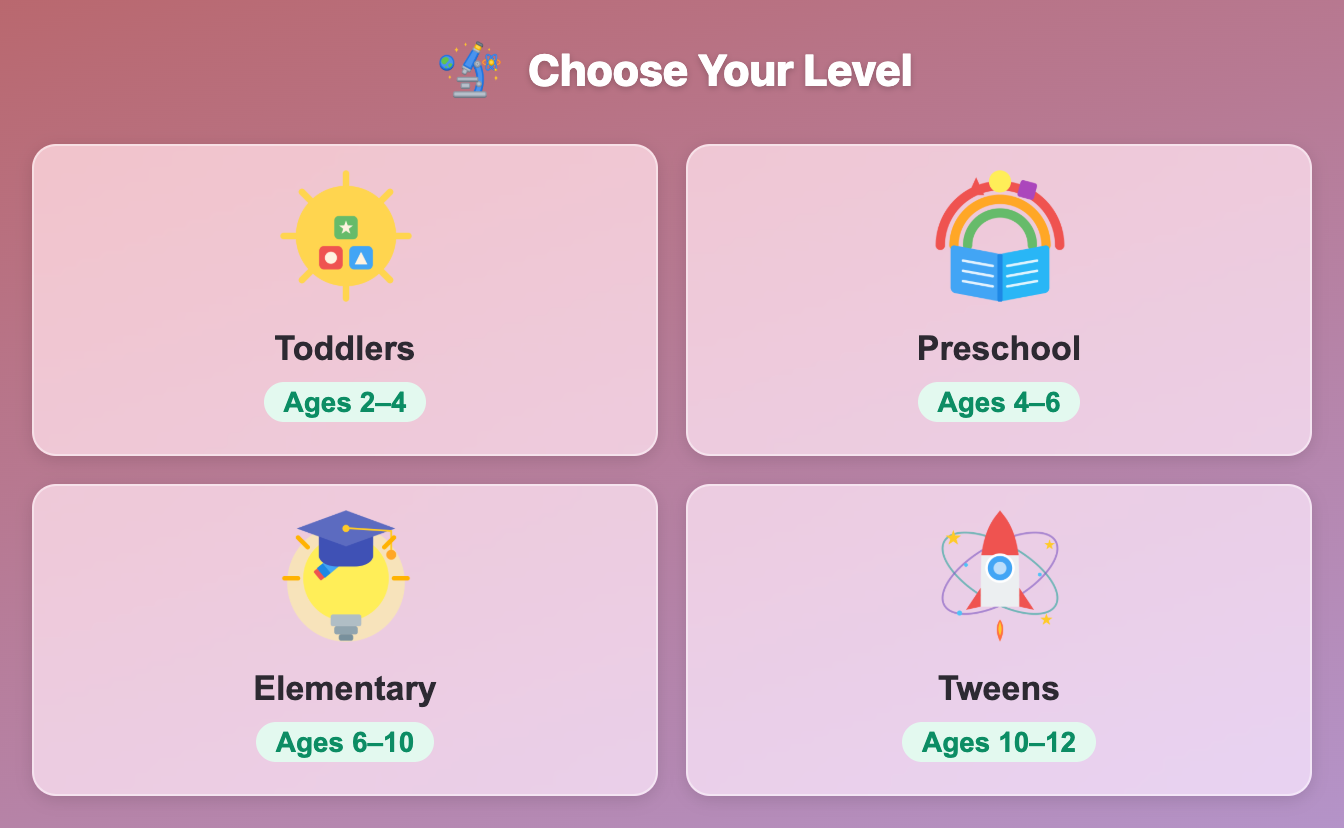
The Choose Your Level screen in Ecosystem Balance for kids, with Toddlers, Preschool, Elementary and Tweens cards
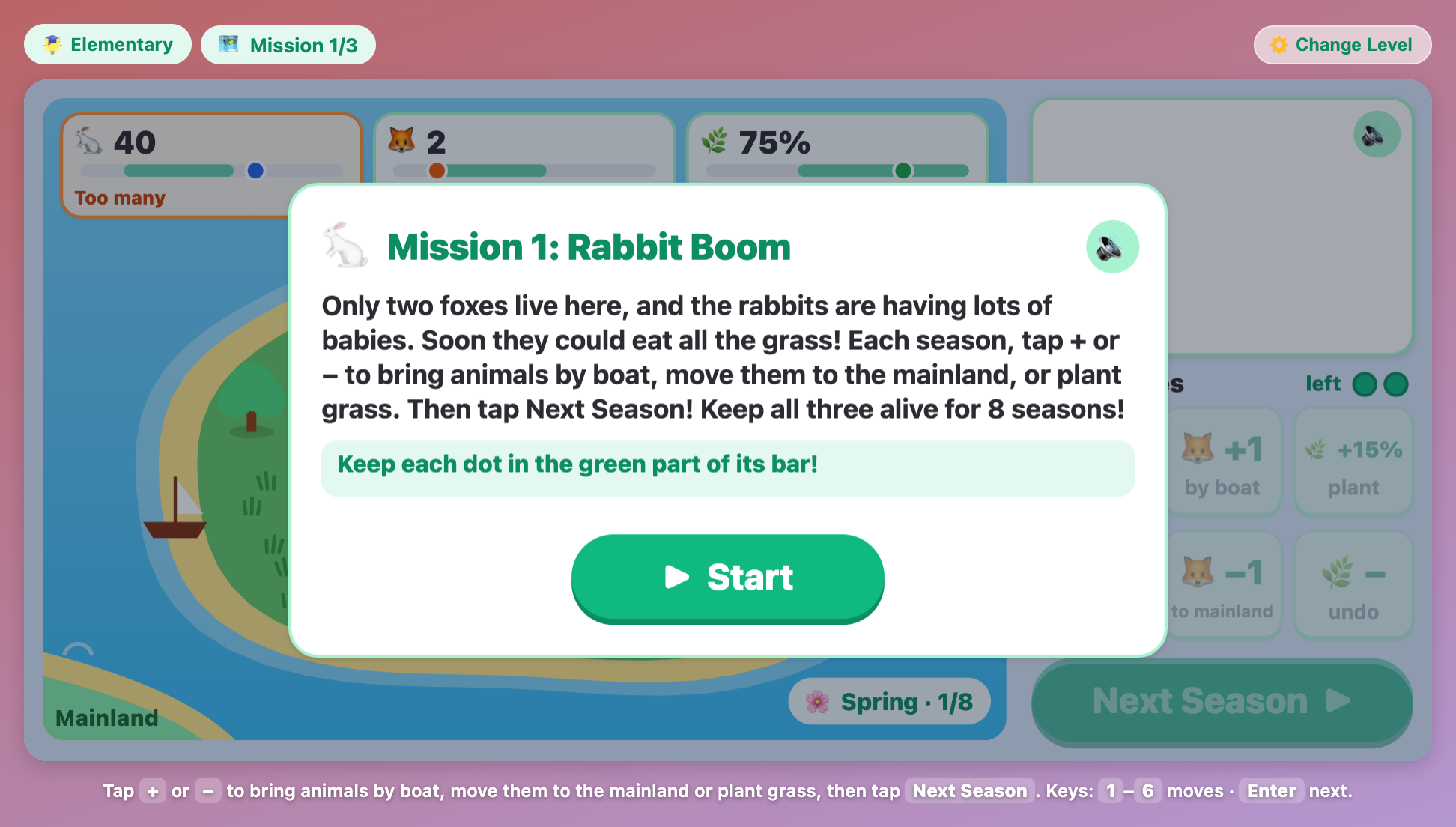
The Rabbit Boom mission card in Ecosystem Balance, over an island with 40 rabbits, 2 foxes and 75% grass
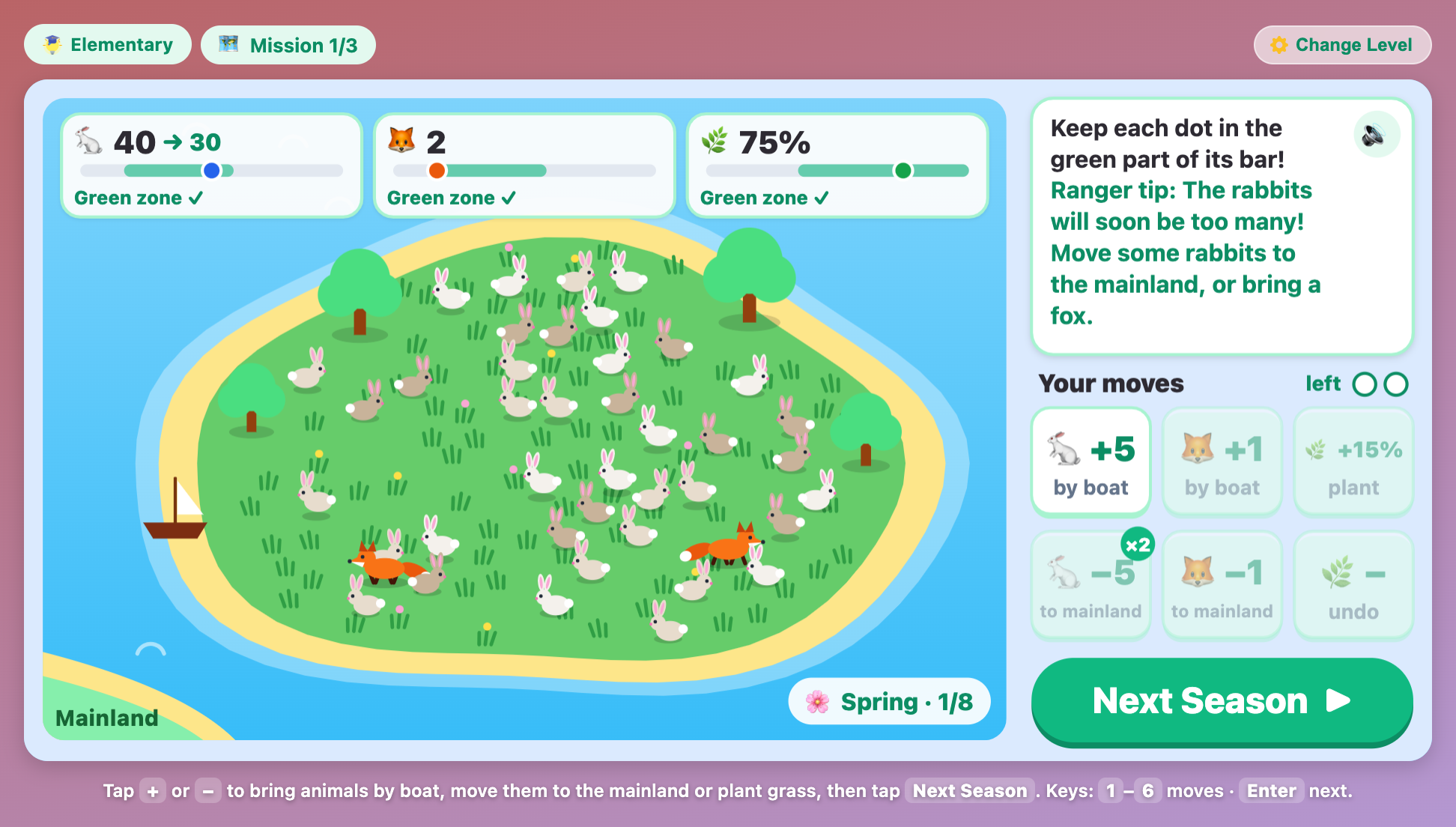
An island crowded with rabbits while the ranger plans to move 10 of them to the mainland, with a Ranger tip beside it
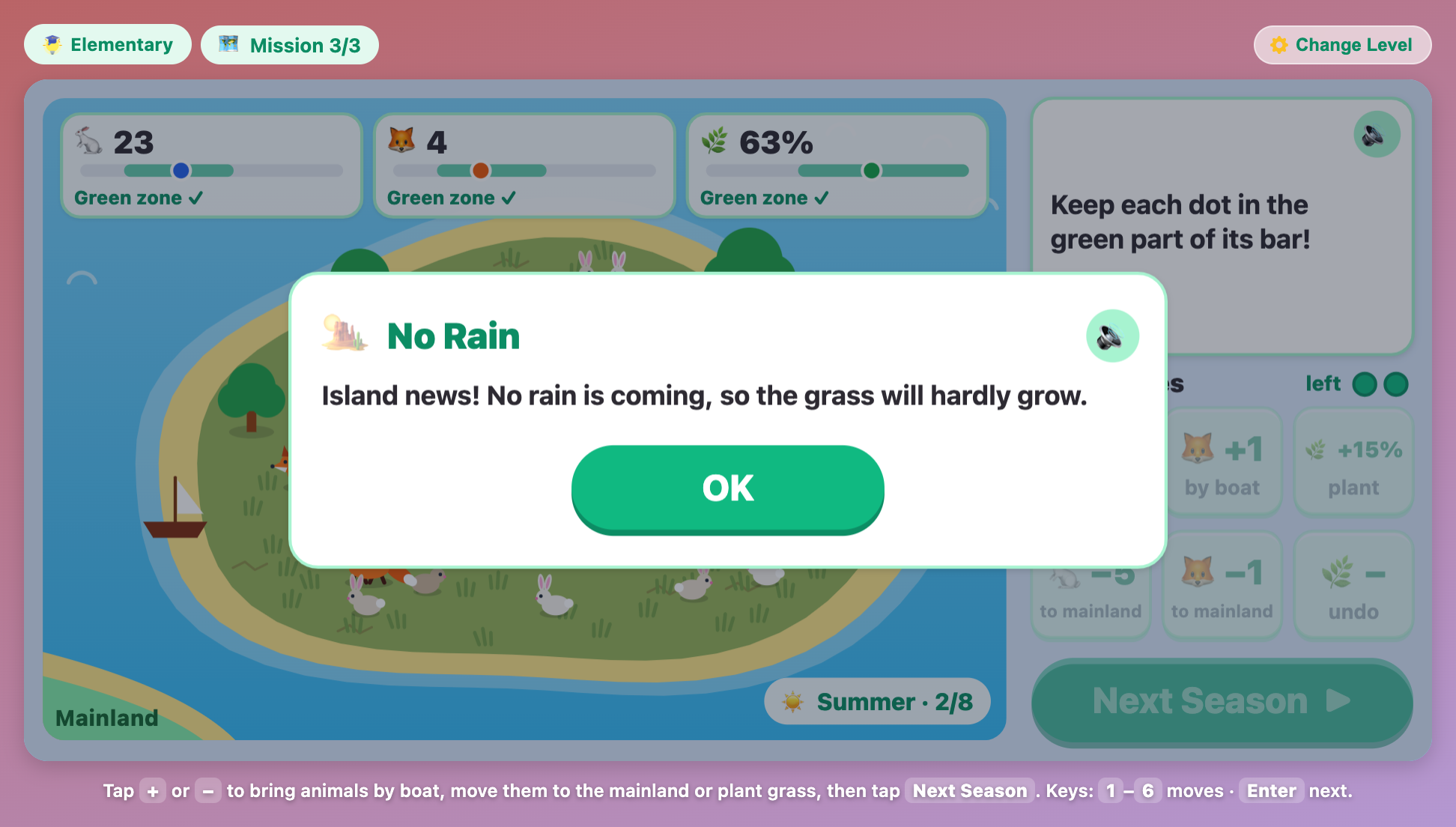
A No Rain island news card in the Dry Year mission, warning that the grass will hardly grow
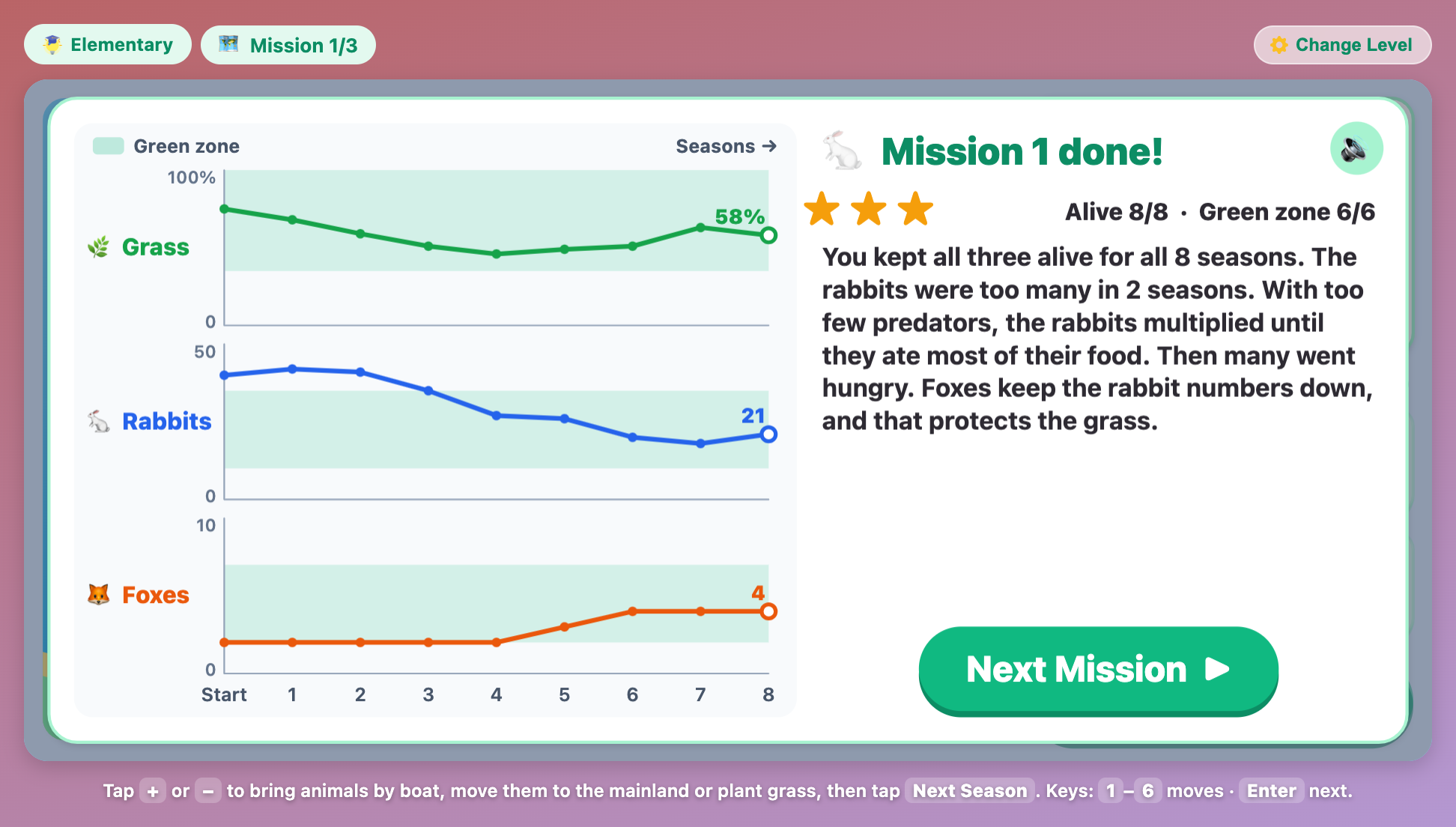
The Mission 1 report in Ecosystem Balance for elementary kids, with three stars and line graphs for grass, rabbits and foxes
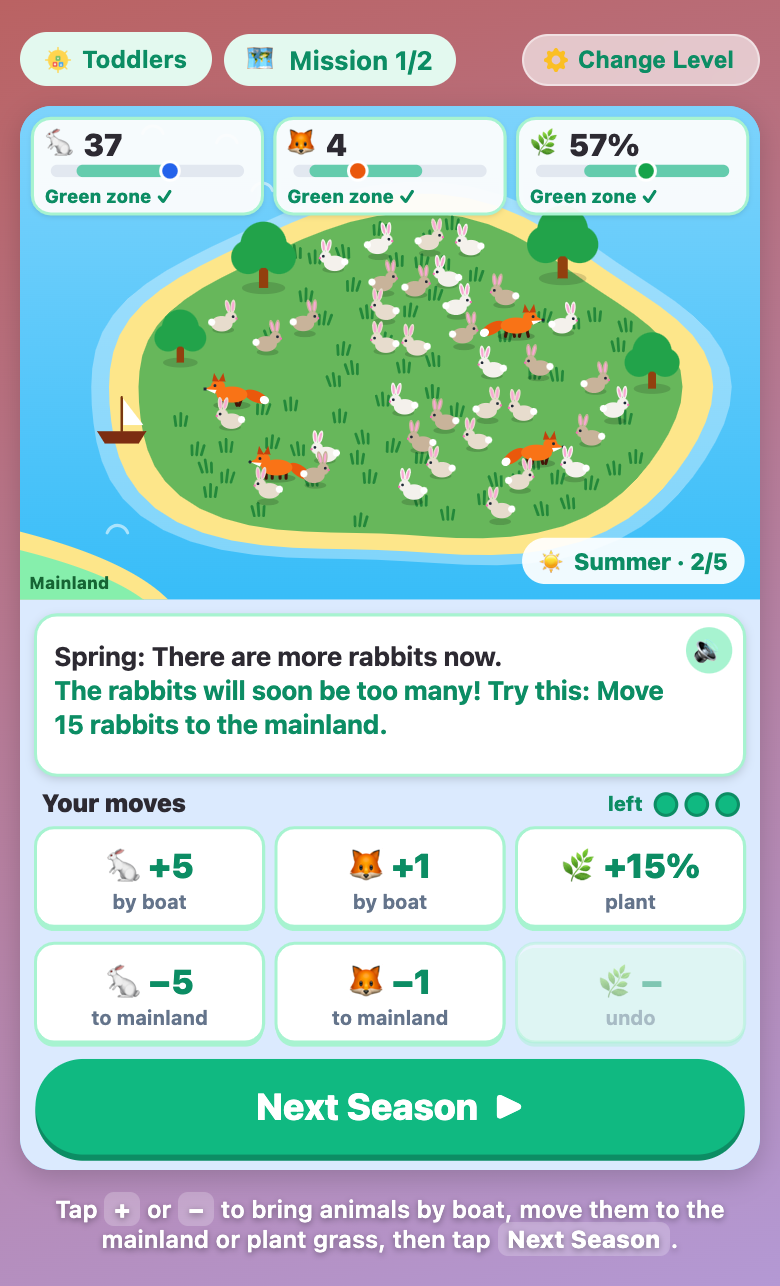
Ecosystem Balance for toddlers on a phone, with a green tip to move 15 rabbits to the mainland
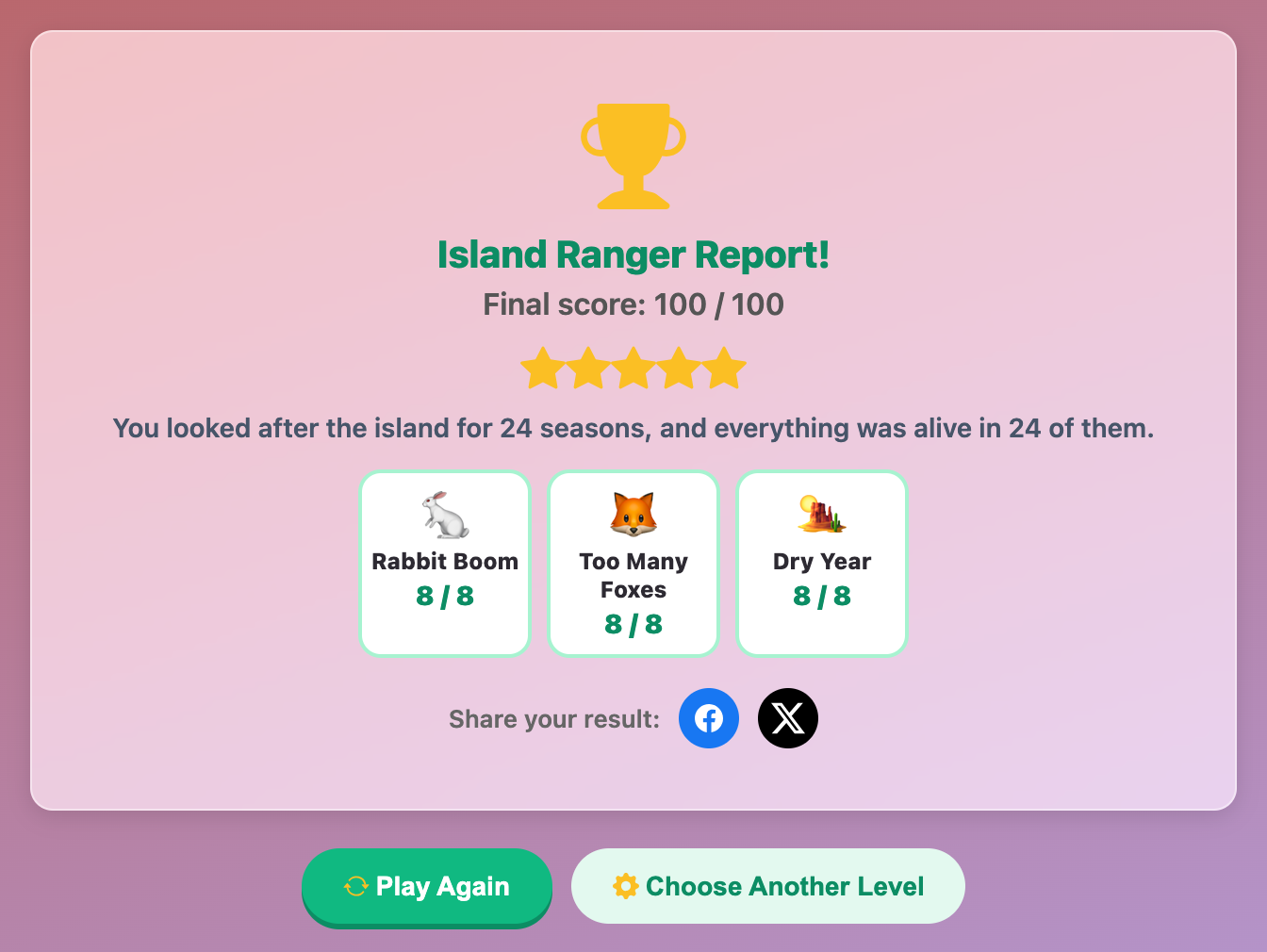
The Island Ranger Report with a gold trophy, a final score of 100 out of 100 and three finished missions
More Science Games
 59.5K plays
4.8
Recycling Sort
Sort everyday items into the Recycle, Compost, or Trash bin before time runs out!
 85.7K plays
4.9
Grow a Plant
Plant seeds in sunny and shady garden beds, then water, feed and protect them day by day. Watch the roots grow underground and harvest sunflowers, tomatoes, carrots and more!
 438.6K plays
4.9
Magnet Experiment
Guess which objects a magnet will pull, then drag the magnet to test every guess. Does gold stick? Does a battery?
 386.9K plays
4.9
Five Senses Match
Decide which of your five senses you would use for each everyday scene before time runs out.
Most Played Games
 1.8M plays
4.9
Color & Draw
A free-drawing canvas with colors and brush sizes to unleash your creativity.
59.5K plays
4.8
Recycling Sort
Sort everyday items into the Recycle, Compost, or Trash bin before time runs out!
 365.8K plays
5.0
Tic-Tac-Toe
Play a game of Tic-Tac-Toe against the computer and see if you can outsmart it.
 274.1K plays
5.0
Sentence Builder
Pick your age level, then tap the shuffled words in the right order to build the sentence.
Comments (20)