
Photosynthesis Factory
173.6K playsRun a leaf as a food factory! Tap the soil to pull water up the roots, catch carbon dioxide bubbles from the air, and let the sun power the machines to make sugar for the plant and oxygen for the animals. Clouds, dry soil, a closed greenhouse and nightfall each slow the factory down. Read the graph to find out what held it back, and big kids predict each day and run a greenhouse experiment.
Help wanted: one boss for a tiny food factory made from a green leaf. Photosynthesis Factory for kids is a free science game that shows how plants make their own food from sunlight, water and carbon dioxide.
You tap the soil to pull water up the roots, and you tap the carbon dioxide bubbles drifting by to pull them into the leaf. The sun gives the light. Put all three together and the leaf makes sugar cubes for the plant and oxygen bubbles for a bunny to breathe. It has four levels for kids from about 2 to 12, and it plays right in your web browser, with no download and no sign-up. It works on computers, phones and tablets.
Every day in the game has its own weather. Clouds hide the sun, the soil dries out, a greenhouse runs short of air, or night falls. Each one slows your factory down in a different way. Your job is to keep the machines turning, then work out what held them back. Scientists have a name for that: the limiting factor. Here you get to feel it with your own fingers.
🍃 Why a Leaf Is a Food Factory
Photosynthesis (say it: foe-toe-SIN-thuh-sis) is a long word for something simple. It means "making things with light." Green plants take in three things and turn them into food:
Light from the sun. The green stuff in leaves, called chlorophyll, catches it.
Water from the soil. The roots drink it, and tiny tubes in the stem carry it up.
Carbon dioxide, a gas in the air. It slips into the leaf through tiny holes called stomata.
Out come two things. One is sugar, the plant's food, which it uses to grow. The other is oxygen, the gas that animals and people breathe. In the game, every sugar cube comes with 6 oxygen bubbles, just like the real recipe: 6 carbon dioxide plus 6 water make 1 sugar plus 6 oxygen.
The game draws all of this as a cute factory. The big leaf has a face and two gear windows. The gears spin faster when the factory runs faster. A little vent on top lets oxygen out, and a hole underneath lets carbon dioxide in. Sugar cubes slide down the stem into a store by the roots.
Here is the part that makes this game special. The factory can only go as fast as its scarcest input. If the light is at full but the water is at half, the factory runs at half speed. More light won't help. Only more water will. That missing input is the limiting factor, and every day in the game is built to teach it.
🔧 Clocking In: How to Play on KidWorld
Pick your level. The game starts on Elementary. Tap Change Level at the top to choose Toddlers, Preschool, Elementary or Tweens instead. The game remembers your choice next time.
Read the day card. Each day starts with its weather, like ☀️ Sunny Day or 🏜️ Dry Day, and a sugar goal: "Make 12 sugar cubes!" Tap Start the Day when you're ready.
Tap the soil for water. Every tap on the brown soil pulls water up the roots, and you'll see a little +💧. You can pull about four times a second, so wild tapping doesn't add more.
Tap the purple CO₂ bubbles. They float in from the right side of the sky. Tap one and it flies into the leaf. If it drifts off the left edge, it's gone.
Watch the four gauges. Above the picture are bars for Light, Water, CO₂ and Speed. The input that is holding the factory back gets an orange outline. You can't change the light; the weather decides it.
Keep an eye on the timer. A green bar and a seconds counter show how much of the day is left. Days last 20 seconds for the two youngest levels and 25 seconds for the older ones. The clock pauses while the game reads something aloud.
Read your day report. You see your sugar cubes, your oxygen bubbles and a ⭐ Goal! badge if you made enough. Older levels get a graph and a question here (more on that below).
Move on. The Next Day button fills up and counts down by itself, or you can tap it right away. After the last day you see the "Factory Closed for the Week!" card with your score out of 100, up to five stars, and the sugar you made each day. Tap Play Again or Choose Another Level.
Use the extra buttons. Every card and message has a 🔊 button that reads it out loud. Around the game you'll also find buttons for fullscreen, reload and music.
Play your way. It works with a mouse or a finger on a phone or tablet. On a keyboard, press 1 or W for water, 2 or C to catch the CO₂ bubble closest to floating away, number keys to answer questions, and Enter to start a day.
⚙️ Photosynthesis Factory for Kids: Secrets of a Full-Speed Leaf
Making lots of sugar is not about tapping as fast as you can. It's about tapping the right thing at the right time. These tips go from easy to clever.
1. The half-full secret
Each input has a tank inside the leaf. Here's the trick: a tank that is at least half full already runs its machine at full speed. That's why the Water and CO₂ bars stay full for a while and then start to shrink. A shrinking bar means the tank just dropped below half, and the factory is starting to slow. That is your signal to tap.
2. Find a tapping rhythm
On Elementary and Tweens, one pull of water lasts a bit less than two seconds when the factory runs at full speed. So a steady beat works well: tap the soil, catch a bubble, tap the soil again. On Toddlers and Preschool the tanks empty more slowly, so little hands have more time between taps.
3. You don't need every bubble on a normal day
On a sunny day a new CO₂ bubble floats in about every second and a bit. Each one fills a quarter of the tank. Catching about two out of every three is enough to keep the CO₂ bar full. So don't panic about one that got away. Just get the next one.
4. Catch the bubble that's leaving first
When two bubbles are in the sky, tap the one closest to the left edge. The one on the right will still be there in a second. The one on the left won't. The keyboard key 2 does this for you: it always grabs the bubble that would float away soonest.
5. Tap right on the bubble
If you tap empty sky, the factory reminds you: "Tap right on a CO₂ bubble, or tap the soil for water!" Little kids get a bigger area around each bubble that still counts, so a near miss works. On Tweens you need to be more exact. Anywhere on the soil counts as a water tap at every level.
6. Let the orange outline guide you
When you're not sure what to do, look for the gauge with the orange outline. That's the one slowing the factory. If it's Water, tap the soil. If it's CO₂, hunt for a bubble. If it's Light, there's nothing to tap, so use that time to fill the other two tanks before the sun comes back.
🌦️ Five Kinds of Weather, Worked Out One by One
Each weather needs its own plan. Here's how a smart factory boss handles every day the game can give you.
Example 1: The Sunny Day ☀️
The sun is bright, the soil is wet, and bubbles come often. Nothing has to slow you down. The soil never runs out of water today, so you can tap it as often as you like. Keep both tanks above half and the Speed bar stays full the whole day. When we tried it on Tweens, steady tapping made 20 sugar cubes against a goal of 12. This is the day to learn your rhythm.
Example 2: The Cloudy Day ☁️
Thick clouds cover the sun for most of the day. Under the clouds the leaf gets only a little over a quarter of its light, so the Light gauge turns orange. But watch closely: the clouds break twice. The first sunny gap comes about a third of the way through the day, and the second about two thirds in. The message says "The sun came out!"
While it's dark, the factory runs slowly, so your tanks drain slowly too. Top them both up anyway.
When the sun breaks through, the factory jumps to full speed and starts using water and CO₂ fast.
Because your tanks were full, you get every bit of that sunny gap. A player with empty tanks wastes it.
Don't worry if your sugar looks small today. The goal on a cloudy day is smaller too, because the game measures it against what a perfect player could make on that very same day.
Example 3: The Dry Day 🏜️
This one is the trickiest. It hasn't rained for weeks. Your water tank starts half full, and the soil holds only about eight pulls of water. Each pull brings up less than the one before, and the soil never refills. Then the message says "The soil is dry! The roots can't find any more water."
So here is the clever move: don't tap the soil while the Water bar is still full. A tank can't hold more than full, so a pull made too early spills over and is wasted. Wait until the blue bar just starts to shrink, then pull once. You use every drop, and the factory keeps going longer.
Example 4: The Closed Greenhouse 🏡
The doors are shut, and the plants have used up most of the carbon dioxide in the air. Your CO₂ tank starts half full, and a new bubble shows up only about every four or five seconds. Water is easy today; the soil is wet. So spend your attention on the sky. Every single bubble matters, because missing one means a long wait for the next. Keep a finger ready near the right side and grab each bubble the moment it appears. (You'll notice the bunny isn't here. It's a closed greenhouse!)
Example 5: The Day That Turns Into Night 🌙
The sun sets a bit more than halfway through the day. The sky fades, and then the factory stops. The leaf even falls asleep. No tapping can help, because there is no light. So the plan is simple: work your hardest early. Keep both tanks topped up while the sun is high, because every second of daylight counts. After dark, just watch the stars and get ready for the report.
📈 Graph Detective: What Held the Factory Back?
On Elementary and Tweens, each day report shows a line graph of your day. There's an orange line for light, a blue one for water and a purple one for carbon dioxide. The factory's speed is the shaded green area under them. Then the game asks: "What held the factory back the most today?" You pick Light, Water, Carbon dioxide or "Nothing: full speed."
The rule for reading it: the factory can only go as fast as its lowest line. Look for the line that stayed lowest, right on top of the green, for the longest time.
All three lines stay at the top all day. The green area is full. The answer is "Nothing: full speed." That's what a well-played sunny day looks like.
The orange line sits low except for two humps. That's a cloudy day, and the answer is Light.
The orange line drops to the bottom near the end. That's sunset, and the night part of the graph is shaded. The answer is Light again.
The blue line dips on a sunny day. Watch out! The answer is Water, even though the weather was great. The game measures your real day, not just the weather. If you forgot to tap the soil, the graph tells on you, and the report explains what to do next time.
Get it right on the first try for 10 points, or on the second try for 5. After a wrong answer you get a hint about the lowest line. And if two inputs held the factory back almost the same amount, the game doesn't ask at all, because that wouldn't be fair. It just tells you both.
🧪 The Tweens Lab: Predict, Then Experiment
Tweens get two extra science jobs, just like a real scientist.
Make a prediction
Before each day, Tweens read the weather card and guess what will hold the factory back. For example, the Closed Greenhouse card says the plants have used up most of the carbon dioxide. A good prediction is Carbon dioxide. A sunny day's best guess is "Nothing: full speed," and a day that turns into night is Light. A right prediction earns 5 points. After the day, the report also shares an extra fact, like how real leaves close their stomata in a drought to save water.
Run the Experiment Day
The sixth and last day is a test. It's a cloudy day, a dry day or a closed greenhouse, and you may add one helper: a 💡 grow lamp, a 🚿 sprinkler or a 🏭 CO₂ machine. Which one helps the most?
Think about the limiting factor. On a dry day the sun is already bright, so a grow lamp adds nothing. Extra carbon dioxide can't help either, because the water is still running out. Only the sprinkler fixes the real problem. Likewise, a cloudy day needs the grow lamp, and a closed greenhouse needs the CO₂ machine. The right helper is worth 10 points, and the report shows a bar chart of the most sugar a perfect factory could make with no helper and with each one. The right one wins by a lot.
Then the quiz
Elementary and Tweens finish with three quiz questions. Here's a Tweens one: "On a cloudy day, a farmer gives her greenhouse plants extra water. Will they make much more sugar?" The answer is no. Light is the limiting factor, so more water doesn't help. If you understood your Cloudy Day, you already know it.
🧮 How Your Score Is Counted
Each day can earn up to 10 points for sugar. Reach the goal and you get them all; make half the goal and you get half. The questions add more: 10 or 5 points each, depending on how many tries you needed, plus the Tweens predictions and helper. At the end, everything is turned into a score out of 100. Score 90 or more for five stars, 70 for four, and 50 for three.
The goals are fair on every day. The game quietly plays the same day perfectly, with the very same bubbles, and sets your goal at about half of that (a bit more on Tweens). So a cloudy day's goal is small and a sunny day's is big.
🌱 A Factory Shift for Every Age
Photosynthesis Factory for toddlers (ages 2–4)
Toddlers run three days: a sunny day, a cloudy day and a day that turns into night. Days are short, the tanks empty slowly, and the bubbles are easy to hit. There are no questions. Instead, each report says what happened in simple words, like "When the sun went down, the factory stopped. No light, no food!" When the site's sound is on, the game reads the cards and messages out loud, so a child who can't read yet can still play. Sit with them and point at the sun, the water drops and the bunny.
Photosynthesis Factory for preschoolers (ages 4–6)
Preschoolers add the Dry Day, so they meet four kinds of weather. After each day comes one picture question, like "What does the leaf make to feed the plant?" with Sugar, Rocks and Toys to pick from. A wrong answer brings a friendly hint, such as "Look at what slid down the stem!" Everything is still read aloud automatically when sound is on.
Photosynthesis Factory for elementary kids (ages 6–10)
Elementary kids play all five kinds of weather, 25 seconds each. The sunny day always comes first and the day-and-night always comes last, with the other three mixed up. A picture equation sits over the leaf: light + water + carbon dioxide → sugar + oxygen. After each day they read the graph and say what held the factory back, then finish with a three-question quiz. Kids who loved this and want to look after a whole garden can try Grow a Plant, where you water and protect your own sunflowers and carrots.
Photosynthesis Factory for tweens (ages 10–12)
Tweens see the real word equation, "carbon dioxide + water → glucose + oxygen," with light energy and chlorophyll on the arrow. They predict every day's limit, get an extra science fact after each one, run the Experiment Day, and get harder quiz questions about things like chloroplasts, stomata and chemical energy. Their sugar goals are a little higher, and they have to tap more exactly. It's a great warm-up for middle-school science.
💡 What Kids Take Home From the Leaf Factory
Plants need three things, and kids remember them. After pulling water from the soil and bubbles from the air again and again, "light, water and carbon dioxide" is not a list to learn by heart. It's something your hands already know.
The weakest link decides. On the Dry Day you can catch every bubble in the sky and still slow down. That's the limiting factor, a big idea kids will meet again in school science.
Reading a real graph. Kids look at three lines and a shaded area, and use them to answer a question about their own day. That's real data skills, without any worksheet.
Thinking like a scientist. Predict, test, check. Tweens guess the limit, play the day, and then see if they were right. The Experiment Day adds the best question in science: "What happens if I change just one thing?"
Where food comes from. The sugar a leaf makes is where almost every meal on Earth starts. To follow that energy from plants to rabbits to foxes, try Food Chain Builder, where you put grass, rabbits and foxes in order.
👪 For parents and teachers
Photosynthesis Factory is gentle and calm. There are no enemies, no lives to lose and nothing scary. The worst that happens is a sleepy leaf at night. It plays in the browser with no download and no account. Every card has a read-aloud button, and the two youngest levels read by themselves when sound is on. The science was checked by hand: roots take in water, leaves take in carbon dioxide through stomata and give out oxygen, chlorophyll catches light, and the equation is balanced. It's a handy way to start a lesson on plants, and the quiz explanations make a good discussion after play.
Ready to run your own little food factory? Tap the soil, catch those bubbles, and see how much sugar your leaf can make before the week is over. Photosynthesis Factory for kids is waiting for its new boss. And when your plant is done making food, find out how it spreads its seeds in Seed Travelers, where dandelion seeds ride the wind and coconuts float across the sea.
🖼️ See the Game in Action
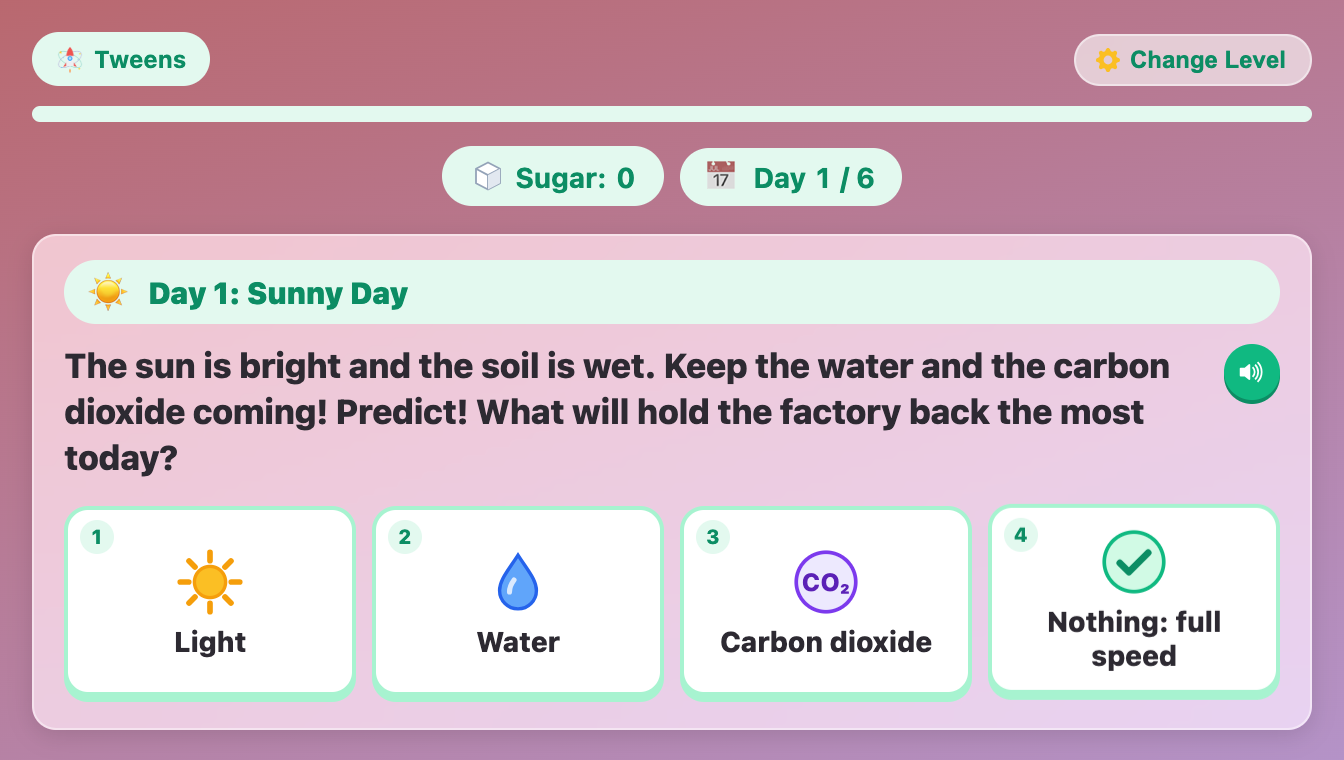
The Tweens prediction card in Photosynthesis Factory, asking what will hold the factory back on a Sunny Day
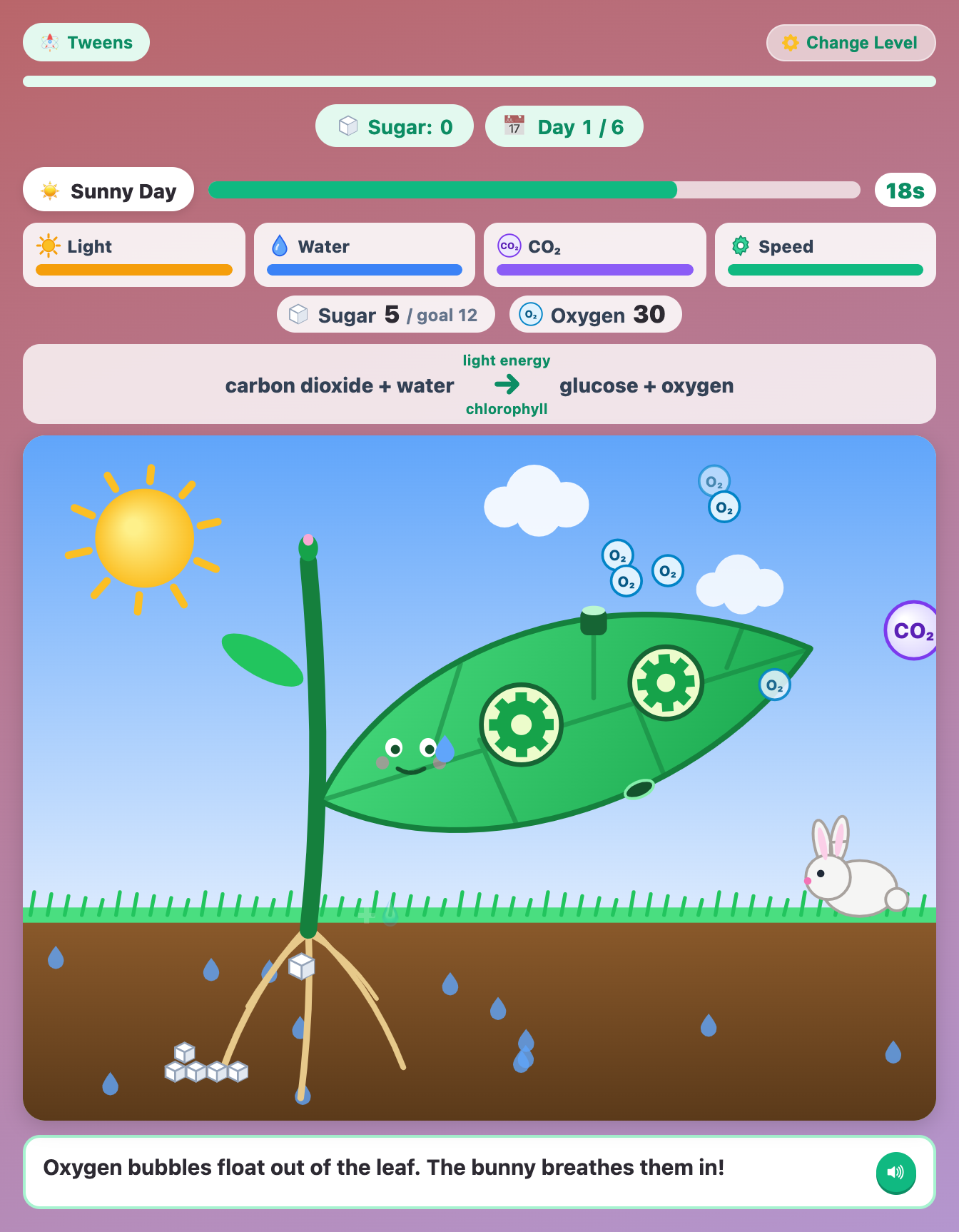
A sunny day in Photosynthesis Factory for kids, with full Light, Water and CO₂ gauges and the word equation over the leaf
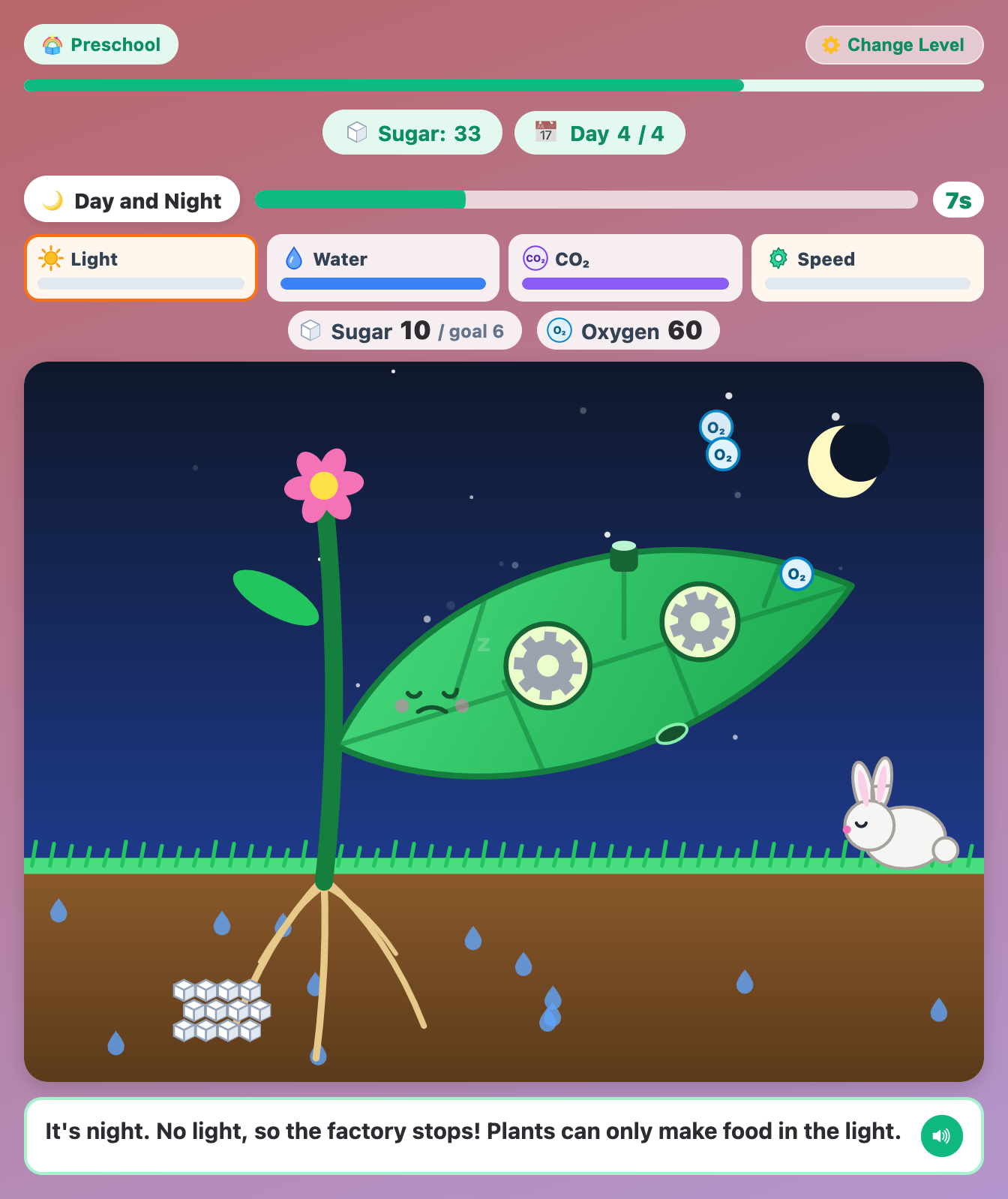
The leaf factory asleep under the moon on the Day and Night day, with its Light gauge empty and outlined in orange
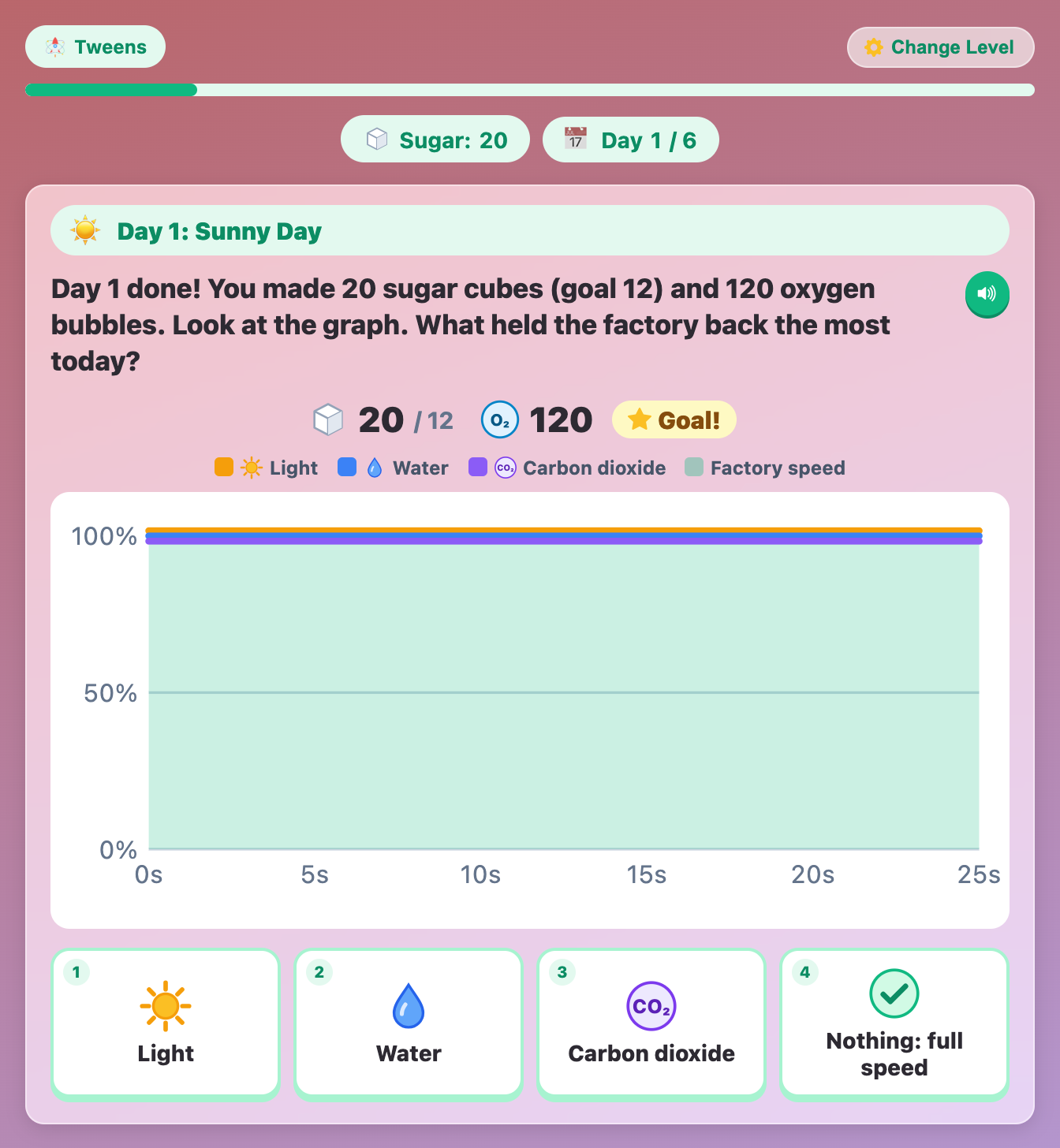
The end-of-day line graph in Photosynthesis Factory for tweens, with light, water and carbon dioxide at the top all day
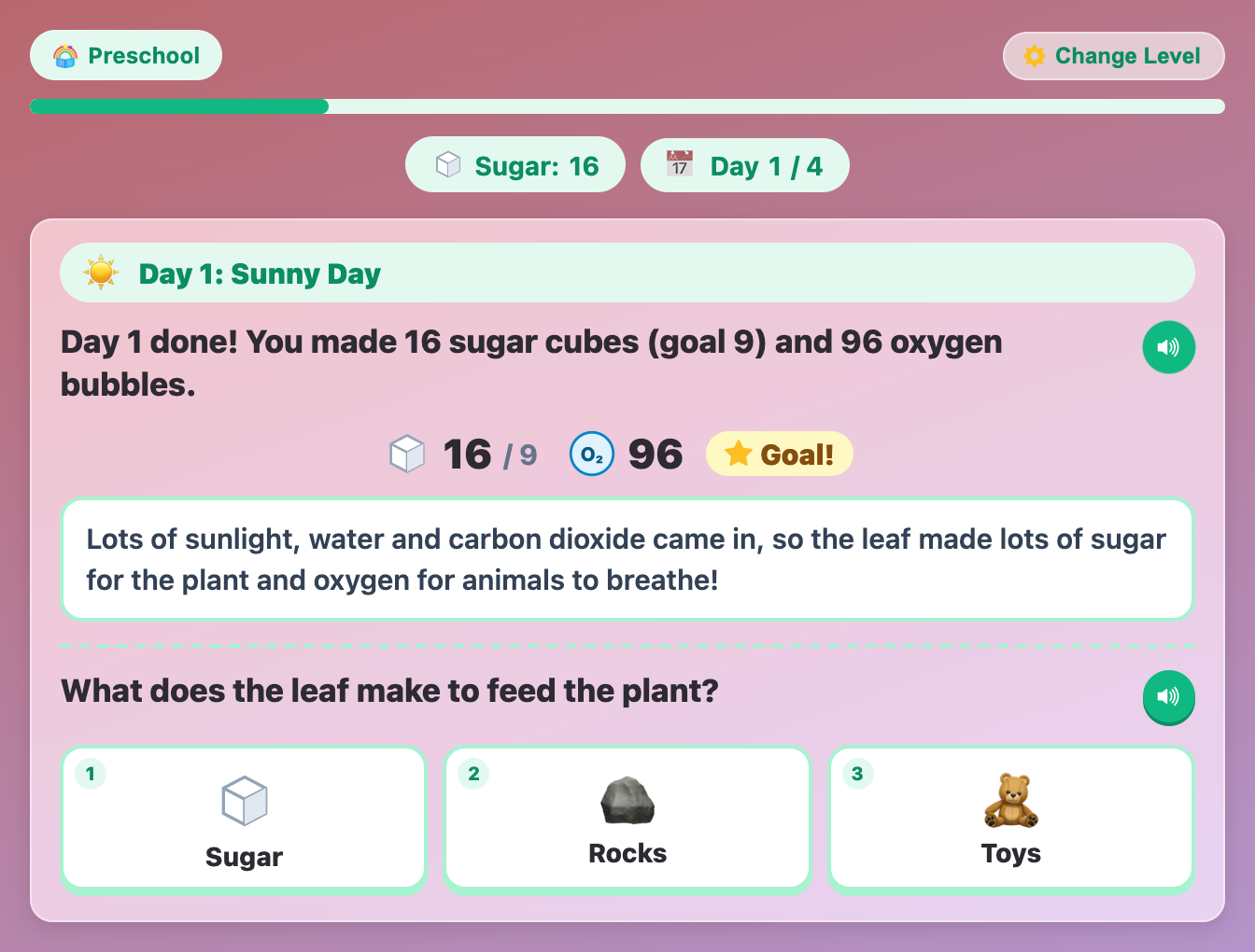
A picture question in Photosynthesis Factory for preschoolers asking what the leaf makes, with Sugar, Rocks and Toys answers
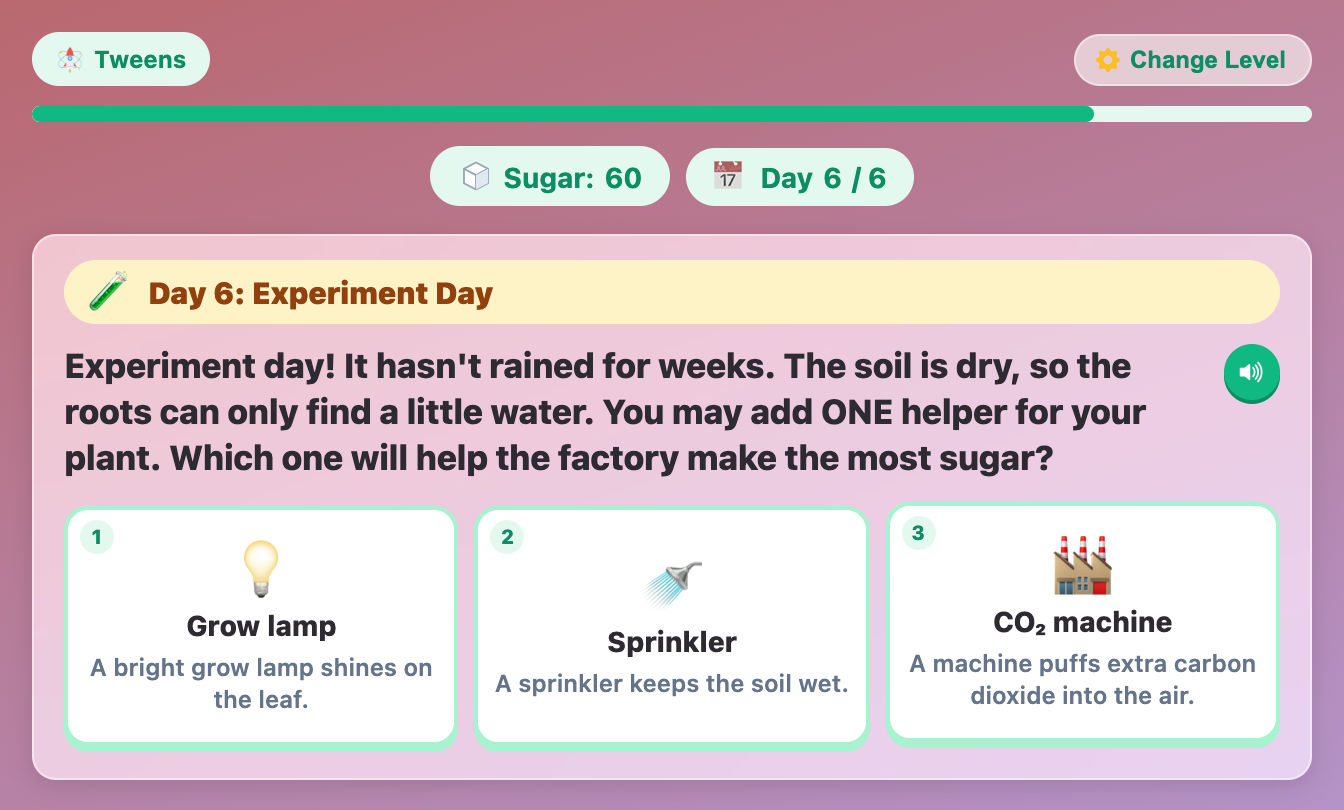
The Experiment Day card on a dry day, offering a grow lamp, a sprinkler or a CO₂ machine as the one helper
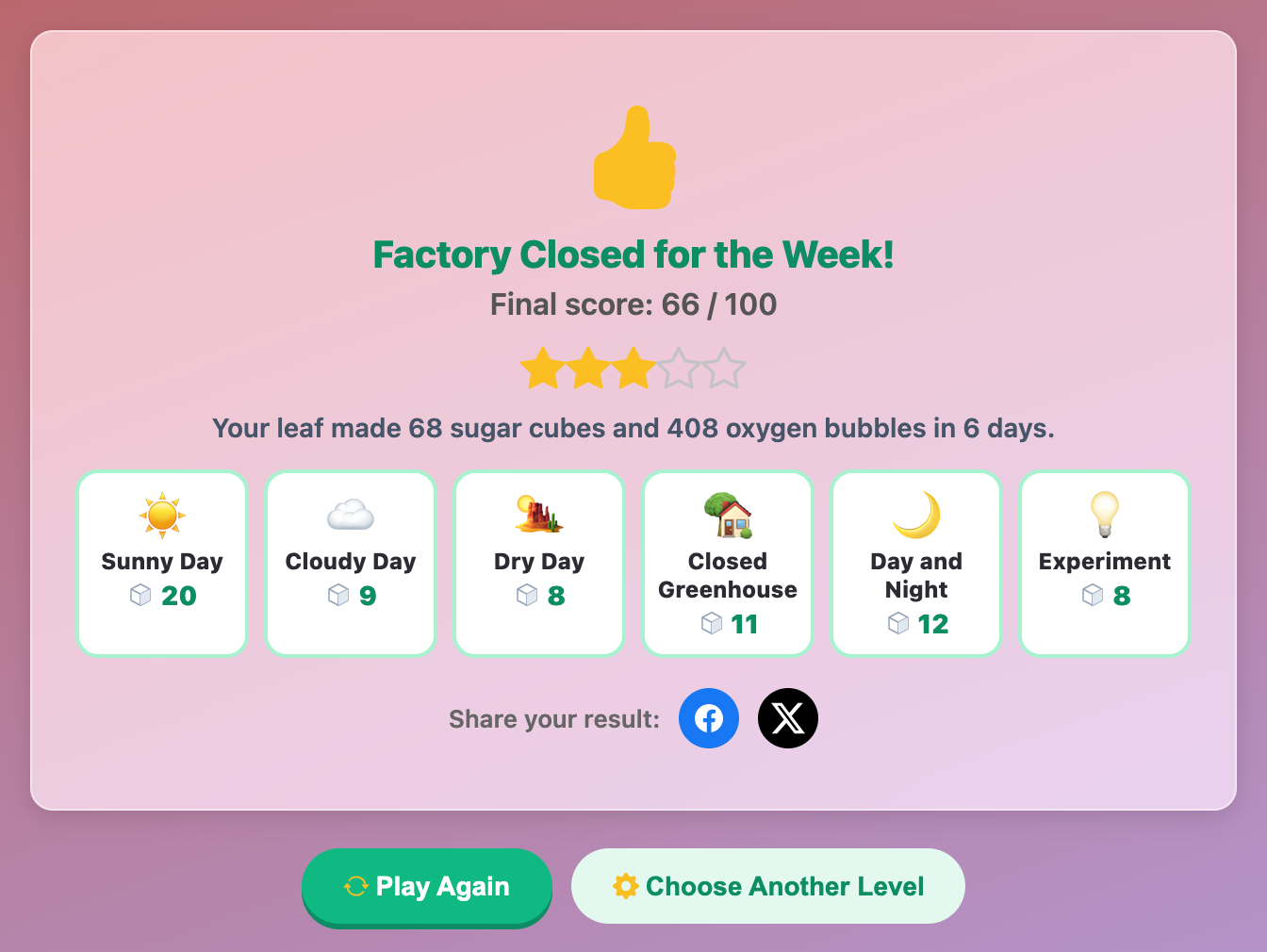
The Factory Closed for the Week finish card, with a final score, stars and the sugar cubes made on each of six days
More Science Games
 59.5K plays
4.8
Recycling Sort
Sort everyday items into the Recycle, Compost, or Trash bin before time runs out!
 85.7K plays
4.9
Grow a Plant
Plant seeds in sunny and shady garden beds, then water, feed and protect them day by day. Watch the roots grow underground and harvest sunflowers, tomatoes, carrots and more!
 438.6K plays
4.9
Magnet Experiment
Guess which objects a magnet will pull, then drag the magnet to test every guess. Does gold stick? Does a battery?
 386.9K plays
4.9
Five Senses Match
Decide which of your five senses you would use for each everyday scene before time runs out.
Most Played Games
 1.8M plays
4.9
Color & Draw
A free-drawing canvas with colors and brush sizes to unleash your creativity.
59.5K plays
4.8
Recycling Sort
Sort everyday items into the Recycle, Compost, or Trash bin before time runs out!
 365.8K plays
5.0
Tic-Tac-Toe
Play a game of Tic-Tac-Toe against the computer and see if you can outsmart it.
 274.1K plays
5.0
Sentence Builder
Pick your age level, then tap the shuffled words in the right order to build the sentence.
Comments (19)