
Seed Travelers
635.4K playsPlants can't walk, so their seeds travel! Blow a dandelion seed on the wind, pop a pea pod, let a burr hitch a ride on a dog and float a coconut across the sea to land each seed on good soil. Seeds that land right under their parent can't grow well, so find out why plants send their seeds far away. Big kids match each seed's shape to the way it travels.
A dandelion has no legs and a coconut has no boat, yet both of them go on long trips. Seed Travelers for kids is a free science game about how seeds travel. You help real plants send a seed to a patch of good soil: you blow the wind, pop a pod, let a dog carry a burr and float a coconut across the sea. It plays in your web browser, for kids from 2 to 12, with no download and no sign-up.
Every plant gets three seeds. Where each one lands decides what happens next. On good soil, a new plant grows. Right under the parent plant, a tiny seedling pops up and then droops, because the big plant takes most of the light, water and space. On stones, in a pond or on the rocks, nothing grows at all, and the game tells you why. Little by little, you find out the big idea scientists call seed dispersal: plants spread their seeds far away so each new plant has room to grow.
🌬️ Seed Travelers for Kids: Four Ways to Leave Home
A plant can't walk. It stays in one spot its whole life. So its seeds have shapes that help something else carry them. Seed Travelers has four of those helpers, and each plant in the game uses one.
💨 Blown by the wind. The dandelion seed has a parachute of fluffy white hairs. The maple seed has one papery wing that spins like a helicopter.
💥 Its pod pops open. The wild pea grows in a pod that dries, twists and splits with a pop. The touch-me-not has a fat pod wound up like a spring.
🐕 Hooks onto animal fur. The burdock burr is a round ball of tiny hooks that grab fur.
🌊 Floats on water. The coconut has a thick husk full of air, so it floats, and a hard shell that keeps sea water out.
Each scene is a side view of the ground, like a slice of a garden. The parent plant stands on the left. A wooden sign that says 🌱 Good soil marks a patch of dark, crumbly earth somewhere to the right. Between them there is stony ground, and often a little pond with cattails. The coconut has its own beach scene: the palm on a small island, the blue sea, and a far island with wet sand, a patch of 🌱 Dry sand and grey rocks.
Your goal is the same in every scene: get the seed onto the good patch. If it misses, the game shows you exactly what went wrong:
Too close to its parent: the seedling has to share light, water and space with the big plant, so it won't grow well.
Stony ground or rocks: there's no soil there for its roots.
The pond: “Plop!” This seed can't grow under water.
The wet sand: the next high tide will wash the coconut back out to sea.
The dog ran off: the burr rode away, far from the garden.
🎮 Your First Trip: Playing Seed Travelers on KidWorld
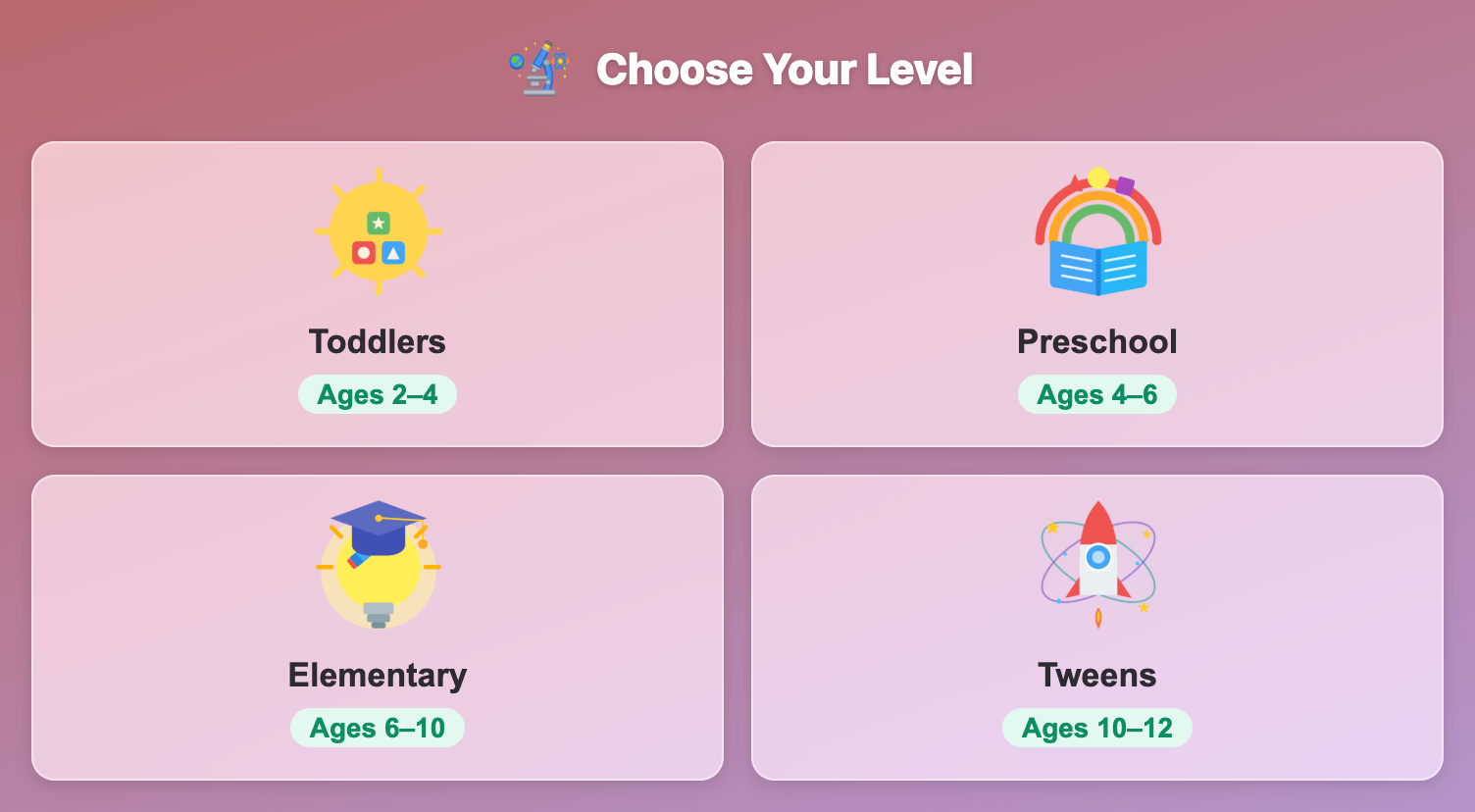
Pick your level. The first time you play, the game starts at Elementary. Tap Change Level to see all four cards: Toddlers (ages 2–4), Preschool (ages 4–6), Elementary (ages 6–10) and Tweens (ages 10–12). The game remembers your choice next time.
Read the Start card. Each plant opens with a card that shows its seed, the way it travels and what to do, such as “Hold down to blow the wind, then let go so the seed floats down.” Tap the 🔊 button to hear it read out loud. Then press Start.
Watch the top of the game. 🌱 Grown counts the seeds you planted well. 🌰 Plant 1 / 4 shows which plant you're on. On the right, Seed 1 of 3 and three dots show how many seeds you have left for this plant.
Send the seed. Every way to travel has its own move. You can play with a mouse, by touch on a phone or tablet, or with the keyboard. The next section explains each move.
Read the message strip. The white strip under the scene talks to you the whole time. After a miss it adds a tip, like “Too short! Blow a little longer.” If you wait without doing anything, it reminds you what to do.
Look where your seeds landed. Each seed you send stays on the ground where it fell. That makes your second and third seeds much easier to aim.
Read the fact card. When a seed grows, or when all three seeds are used, a card tells you about that plant. Older levels add a bonus fact. Then press Next Plant, or wait: the button fills up and counts down from 5, then moves on by itself.
Answer the questions (older levels). Tweens first answer “How does this seed travel?” before each launch. Elementary and Tweens finish with one last question about why plants spread their seeds.
See your score. The Seed Travelers Done! card shows your final score out of 100, up to five ⭐ stars, and a picture of every seed with its travel icon. A 🌱 next to a seed means it grew. Choose Play Again for new scenes, or Choose Another Level.
Use the page buttons. Around the game you'll find buttons for fullscreen (a bigger scene is easier to aim), reload (start over right away) and music on or off.
⌨️ Playing with a keyboard
Hold Space or Enter instead of holding the mouse. For the popping pods, press Space once to show a starting aim, use the up and down arrows to make the shot higher or lower, the left and right arrows for less or more power, and press Space again to pop. In the questions, the number keys 1 to 4 pick an answer.
🎯 How to Land Every Seed: Tricks for Each Way to Travel
Each plant needs a different skill. The wind needs patience, the pods need good aim, and the dog and the coconut need good timing. Here is how to get each one right, with real examples from the game.
💨 Wind seeds: the longer you blow, the farther they go
Press and hold on the scene. The first press lets the seed go, and the wind starts to blow. The 💨 arrow at the top grows to show how hard it's blowing. While the wind blows, the seed sinks very slowly and drifts to the right. When you let go, the wind dies down and the seed floats gently to the ground.
Hold longer for a far patch. More blowing means more time in the air, so the seed goes farther.
Let go a little early. The seed keeps drifting for a moment after you let go, because the wind takes a bit of time to die down. So let go just before the seed is over the patch, not when it's already there.
On Toddlers and Preschool, follow the red ring. A dashed line and a red ring show where the seed would land if you let go right now. Keep holding until the ring sits on the dark soil, then let go.
The maple is heavier. It starts high up in its big tree, but its wing can't hold it up like a parachute, so it falls faster. The big tree also makes a wider “too close” zone. Start blowing at once and keep holding most of the way.
Example 1, the counting trick. On Elementary there's no red ring. Say the Good soil sign stands a little past the middle of the scene. Try holding for a slow count of “one, two” and let go. If the seed lands on the stones before the patch, the strip says “Too short! Blow a little longer.” Your first seed stays on the ground as a marker. Now count to “three” and watch it float down past your first one, onto the soil. Counting turns a guess into a plan.
Example 2, Tweens gusts. On Tweens the wind has gusts, little puffs that come and go by themselves. Before you press, look at the 💨 arrow: it already moves with the gusts. If it points right, a gust will help you, so let go a bit sooner. If it shrinks or points left, the gust is pushing back, so hold a bit longer.
💥 Popping pods: pull back like a slingshot
For the wild pea and the touch-me-not, press anywhere on the scene, pull back down and to the left, and let go. The seed flies the opposite way, up and to the right. A longer pull means more power. A tiny pull won't pop the pod at all; the strip says “Pull back farther to pop the pod!” A row of dots shows the path the seed will take.
Change one thing at a time. Keep the same angle and change only the length of your pull. Then you know exactly what made the difference.
Use the dots. On Toddlers and Preschool, the dots show the whole path and end with a red ✗ where the seed will land. Move until the ✗ sits on the soil. On Elementary you only see the start of the path, and on Tweens just a short piece, so you have to picture the rest.
A middle angle is the easiest. A very flat shot or a very high one needs a much bigger pull to go the same distance. An angle about halfway between flat and straight up gets the most distance out of your pull.
Mind the pond. Ponds can show up in the wind scenes and the pod scenes. A shot that's a little off can end with a “Plop!”
Example 3, reading the ✗. In the wild pea picture at the end of this page, the dotted arc ends with a red ✗ on the stones, just before the Good soil sign. That means: a bit more power. Pull back a little farther, or tap the right arrow two or three times, and watch the ✗ slide onto the dark soil. Then let go. Pop!
🐕 Burrs: let the dog do the walking
For the burdock, you don't throw anything. A friendly dog walks in from the left and brushes past the plant. The burr's hooks grab its fur all by themselves, and the strip says so. Now watch the dog. When its back is over the good soil, tap. The dog stops to scratch, and the burr drops straight down from its back.
Don't tap too early. Before the burr hooks on, a tap does nothing; the strip says “Wait for the dog to brush past the burr first!”
Watch the burr, not the dog's nose. The burr rides on the dog's back, a little behind its head. That's the spot that has to be over the patch.
Don't wait too long. If the dog walks off the edge, the burr goes with it: “Oh no, the dog ran off with the burr!” That seed is lost.
The dog gets faster as the levels go up. On Toddlers it ambles. On Tweens it trots, so the right moment is shorter.
Example 4, a second-chance burr. You tap too soon, while the dog is still walking over the stones. The burr falls short, and the tip says “Too soon! Wait until the dog is over the good soil.” With the next seed, you wait until the dog's back passes the post of the Good soil sign, which stands right at the start of the patch. Then tap. The burr drops onto the soil.
🌊 Coconuts: two good moments in a row
The coconut takes two steps. First, the palm tree sways its leafy top back and forth, over the beach and then out over the sea. Tap when it leans out over the water. The coconut drops, splashes, and floats, because its husk is full of air. The sea current carries it to the far island.
Second, hold down to build a wave. A meter fills up, then empties again if you keep holding. Let go and the wave pushes the coconut up the beach. A small wave leaves it on the wet sand, where the tide will take it back. A big wave throws it onto the rocks. You want the middle: dry sand.
Don't tap while the palm is over the beach. The coconut lands right under its parent, which is too close.
Let go while the meter is still rising. The meter goes up and then back down. If you hold too long, you lose your wave and it shrinks again. Most of the time the right moment comes on the way up.
On Toddlers and Preschool, use the band. The meter shows a band for the dry sand. Let go while the meter is inside it. Toddlers also see the patch glow and a little “Now!” bubble at the right moment, for the palm and the dog too.
Example 5, the wave that was too big. On Elementary you hold the wave until the meter is almost full. “Bonk!” The coconut lands on the rocks, and the tip says “Too big! Make a smaller wave.” Next coconut, you tap when the palm leans over the sea, wait for it to float to the island, then let go when the meter is about a third of the way up. It rolls onto the dry sand, above the high tide, and a new palm sprouts.
🏆 How to Win: Use Your Misses and Earn More Points
Three seeds per plant sounds like a lot, but the first seed is worth the most. A seed that grows on your first try earns 10 points, on the second try 6, and on the third try 3. So the smartest players treat seed one like a careful test, not a wild guess.
Look before you press. Find the Good soil sign first. Is it close to the parent or near the right edge? Is there a pond in the way?
Always read the tip. “Too short” or “Too far” tells you which way to change. Then change only a little.
Use your old seeds as markers. If seed one landed just before the patch, aim a little past it. If it landed past the patch, aim a little before it.
Learn from the drooping seedling. When a seed lands too close, you'll see a little sprout pop up and wilt. That's your clue to send the next one much farther.
🧩 The tweens question: read the shape
On Tweens, each plant starts with a picture of its seed and a clue about its shape, with four answers: Blown by the wind, Floats on water, Hooks onto animal fur, or Its pod pops open. The clue never names the answer, so think about the shape. Fluffy hairs or a papery wing? Wind. A husk full of air? Water. Tiny hooks? Fur. A pod that dries and twists, or one wound up like a spring? It pops.
A right answer first time earns 5 points, and right after one wrong answer earns 2. A wrong answer greys out that button and says “Not quite! Look at its shape again.” After the answer, the game explains how that shape travels, and then you press Launch It!
❓ The last question
On Elementary and Tweens the game ends by asking: “Why do plants send their seeds away from the parent plant?” Think back to every drooping seedling you saw. The right answer is about each new plant getting its own light, water and space. It's worth 10 points first time and 5 on the second try. Tweens also learn the real science name, seed dispersal.
🧮 Adding it up
Your points are turned into a score out of 100. Here's a real Toddlers game with four plants (40 points to win): the dandelion grew first try (10), the wild pea on its second seed (6), the burdock on its second seed (6), and the coconut first try (10). That's 32 out of 40, a score of 80 and four stars. Planting every seed on the first try is the only way to get a perfect 100. A score of 90 or more earns all five stars.
👧 Which Level Fits Your Child?
All four levels use the same scenes and the same simple moves. What changes is how much help you get, how big the patch is, and how much there is to think about.
🐣 Toddlers, ages 2–4: helpers everywhere
Seed Travelers for toddlers has four plants in the same order every time: dandelion, wild pea, burdock and coconut. The good patch is the biggest of any level. The red ring shows where a wind seed will land, the dots show a pod's whole path, the patch glows and a “Now!” bubble pops up when it's time to tap for the dog or the palm. The dog walks slowly and the palm sways slowly. A grown-up can sit beside the child, point at the sign and say “Let go when the ring is on the soil!”
🌈 Preschool, ages 4–6: a little less help
Seed Travelers for preschoolers has the same four plants in a mixed-up order and a smaller patch. The red ring, the full path of dots and the band on the wave meter are still there, but the glow and the “Now!” bubbles are gone. Kids learn to watch the dog and the palm and pick the moment themselves.
📚 Elementary, ages 6–10: aim on your own
Seed Travelers for elementary kids adds the spinning maple, so there are five plants. The patch shrinks again. There's no red ring and no wave band, and the dots show only the start of a pod's path. Now the misses really matter, because the seeds you already sent are your only markers. Each fact card adds a bonus fact, like the one about the burrs that gave an engineer the idea for Velcro. The game ends with the “why spread seeds?” question.
🚀 Tweens, ages 10–12: think like a scientist
Seed Travelers for tweens brings all six plants, including the touch-me-not, in random order. Before each launch, you match the seed's shape to the way it travels. The patch is the smallest, the dots show just a short piece of the path, gusts push the wind seeds around, and the dog, the palm and the wave meter are all quicker. The final explanation uses the real term, seed dispersal.
🔬 What Kids Learn When Seeds Travel
Shape and job go together. When a dandelion seed hangs in the air while a maple seed falls fast, kids see that a parachute and a wing do different jobs. The tweens question turns that into a habit: look at the shape, then guess how it moves.
Plants need space and light. The drooping seedling under its parent is a small moment, but kids remember it. It shows, with no long lecture, that a seed has to get away to grow well. Curious why light matters so much to a leaf? In Photosynthesis Factory you run a leaf as a little food factory powered by the sun.
Cause and effect, and trying again. Hold longer, the seed goes farther. Pull harder, the pea flies farther. Each miss comes with a clear reason and a clear tip, so a miss feels like a clue, not a failure. Kids learn to change one thing at a time, which is how real experiments work.
Timing and guessing distances. Tapping when the dog's back is over the patch, or letting go of the wave at the right moment, trains the eyes and hands to work together.
A seed's story keeps going. Once a seed lands on good soil, the next part of its life is growing roots and leaves. Kids who want to look after a seed after it lands can water and feed one in Grow a Plant, where you can see the roots grow underground.
💚 A note for parents and teachers
Seed Travelers is gentle and calm: a sunny sky, friendly plants and a happy dog. Nothing scary happens, and no one is ever told off; a missed seed just gets a kind tip. It plays in the browser, with no download, no account and nothing to buy inside the game. Every 🔊 button reads the text aloud, which helps children who are still learning to read. The facts were written by hand and checked, such as dandelion clocks holding more than a hundred seeds and coconuts floating for months at sea. The game practices plant science (seed dispersal and what plants need to grow), careful observation, cause and effect, timing, and reading short instructions.
So pick a plant and help its seed find a home. Blow a dandelion across the stones, pop a pea over the pond, let a dog carry a burr, and send a coconut sailing to a new island. Seed Travelers for kids turns a big science idea into a handful of happy little sprouts. And if you'd like to see where many seeds begin, fly from flower to flower carrying pollen in Busy Bee Maze.
🖼️ See the Game in Action
The Choose Your Level screen in Seed Travelers for kids, with Toddlers, Preschool, Elementary and Tweens cards
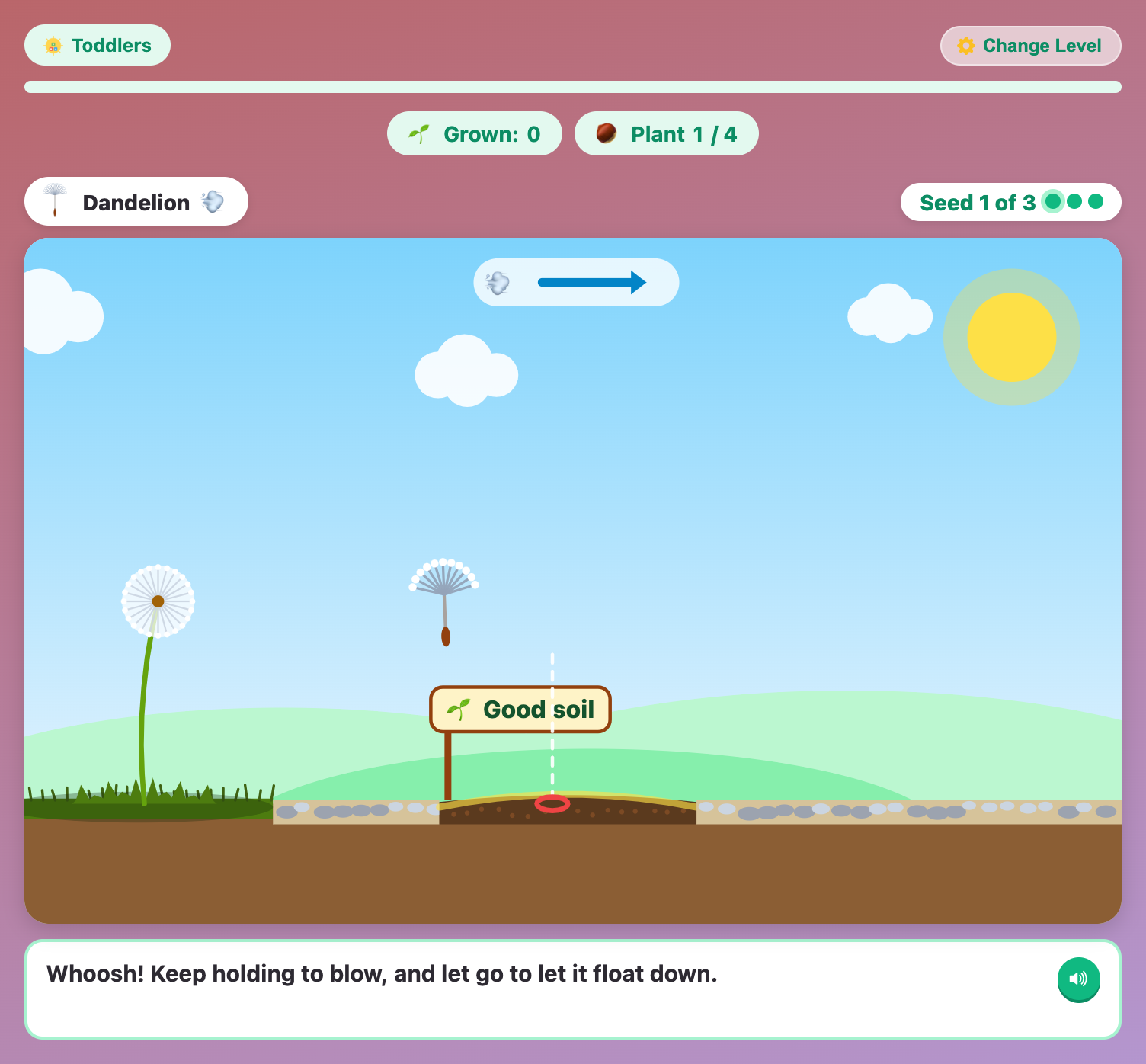
A dandelion seed floating on the wind toward the Good soil sign, with a red ring showing where it will land
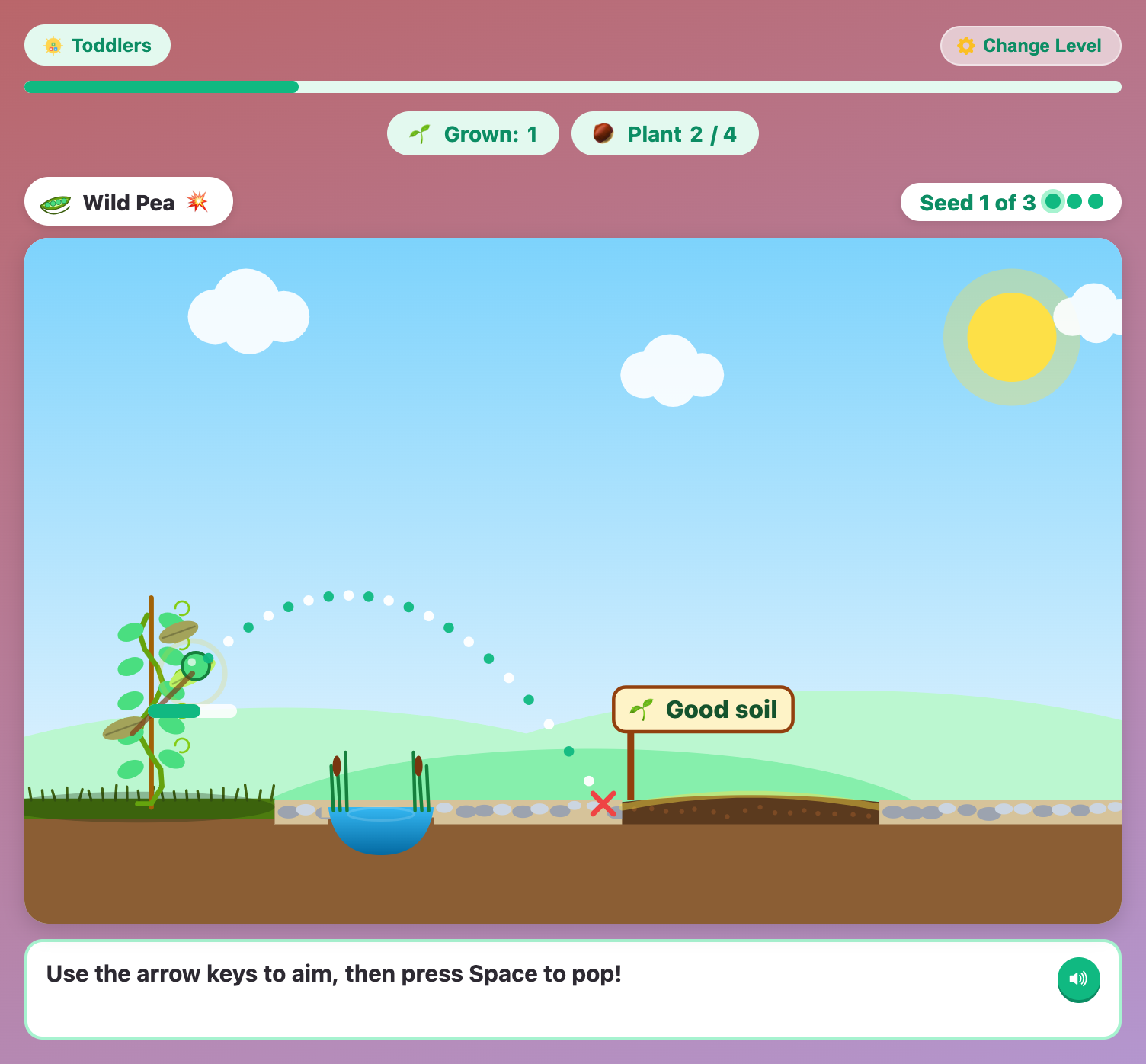
Aiming the wild pea pod in Seed Travelers for toddlers, with a dotted arc that ends just short of the good soil
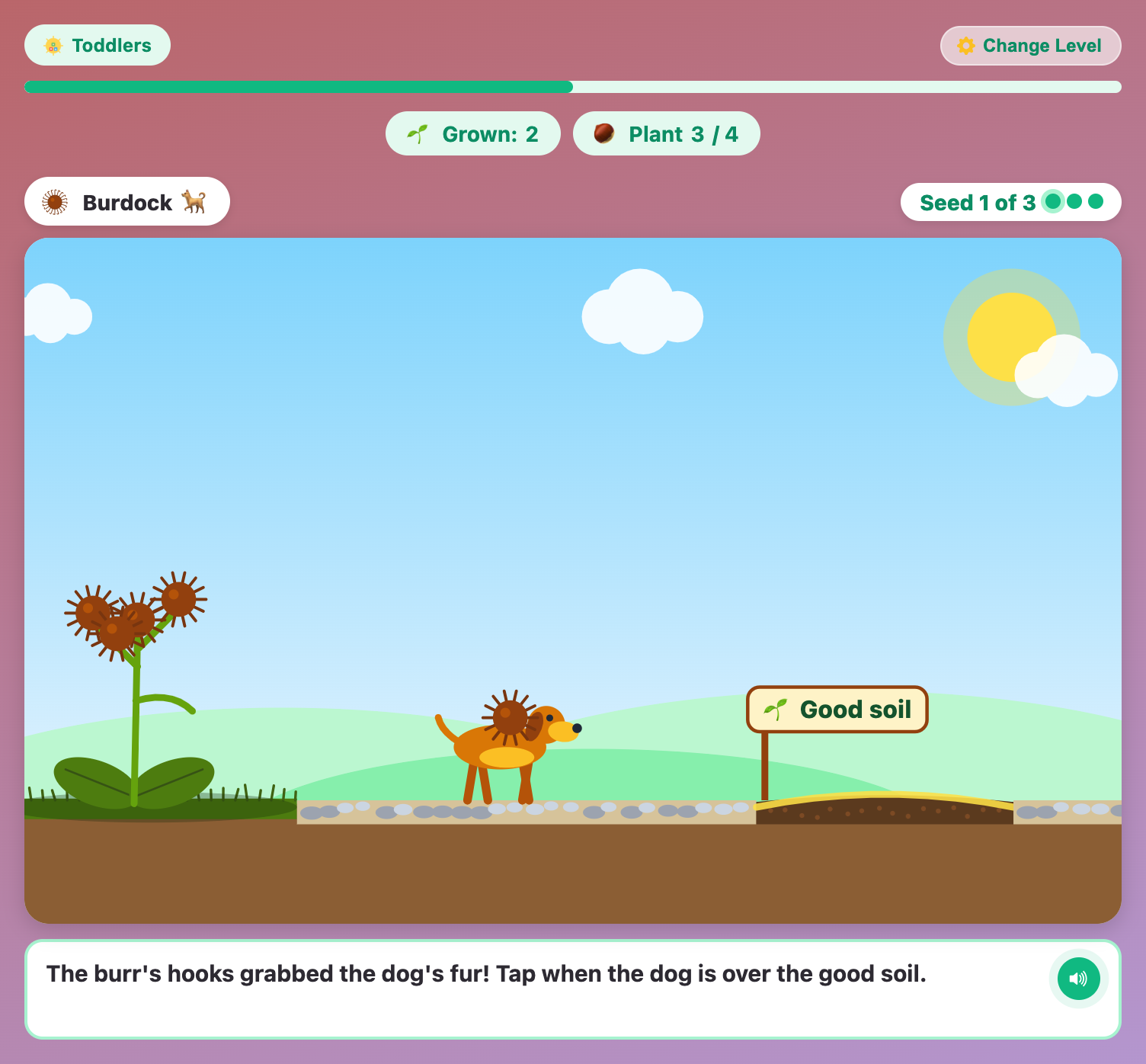
A dog walking past stony ground with a spiky burdock burr hooked onto its back
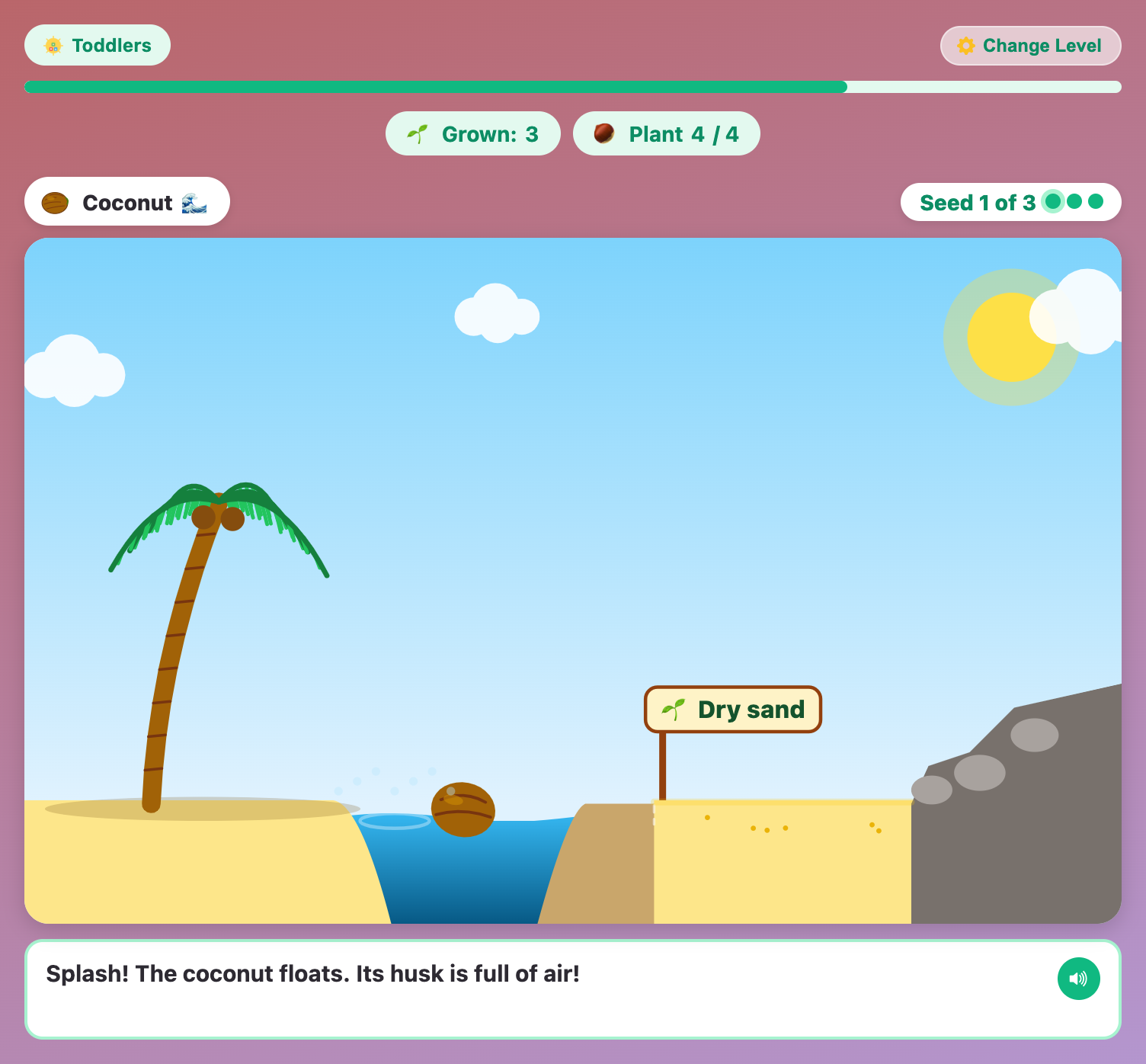
A coconut floating in the sea between the palm tree island and the far beach with its Dry sand sign
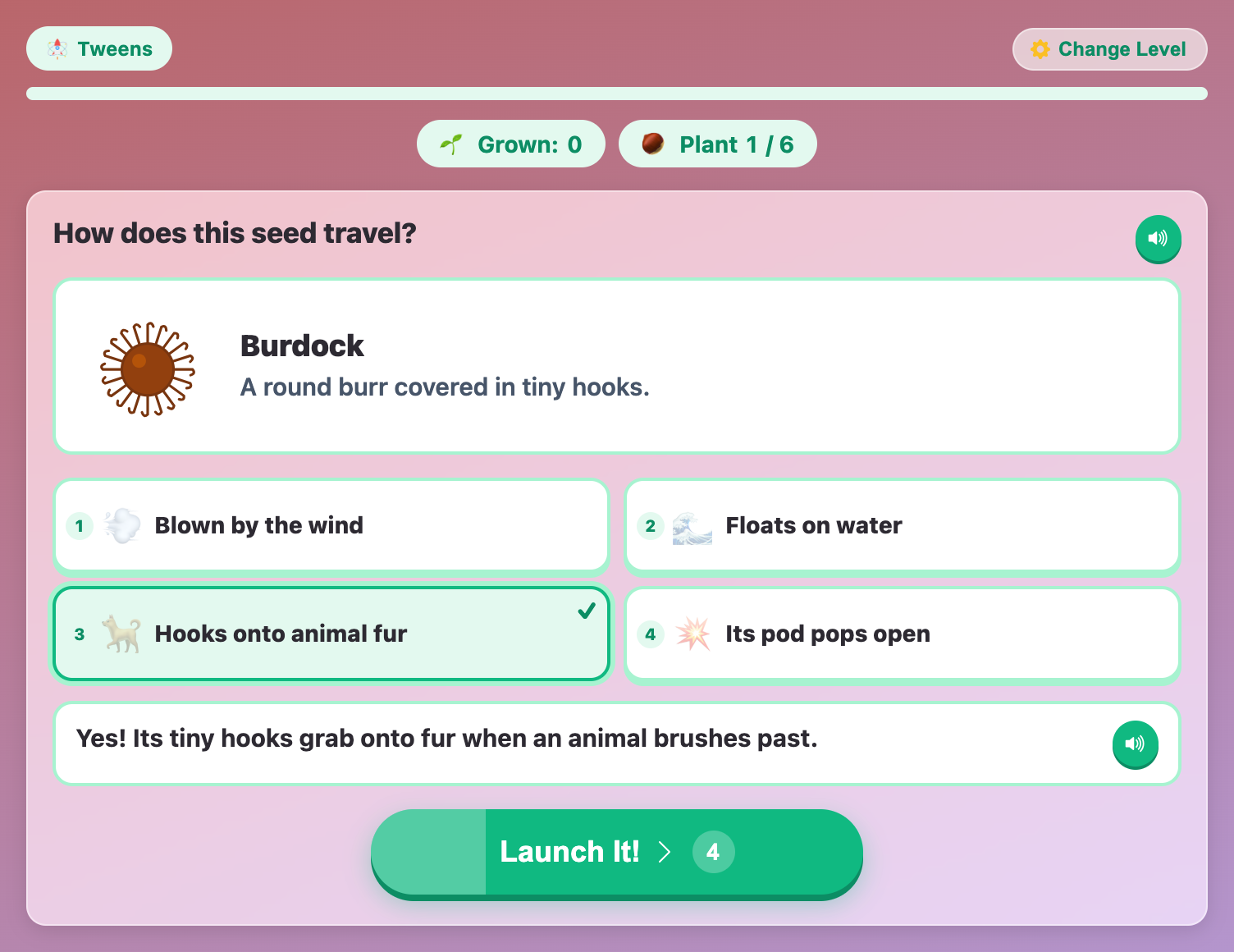
The How does this seed travel question for tweens, with Hooks onto animal fur picked for the burdock burr
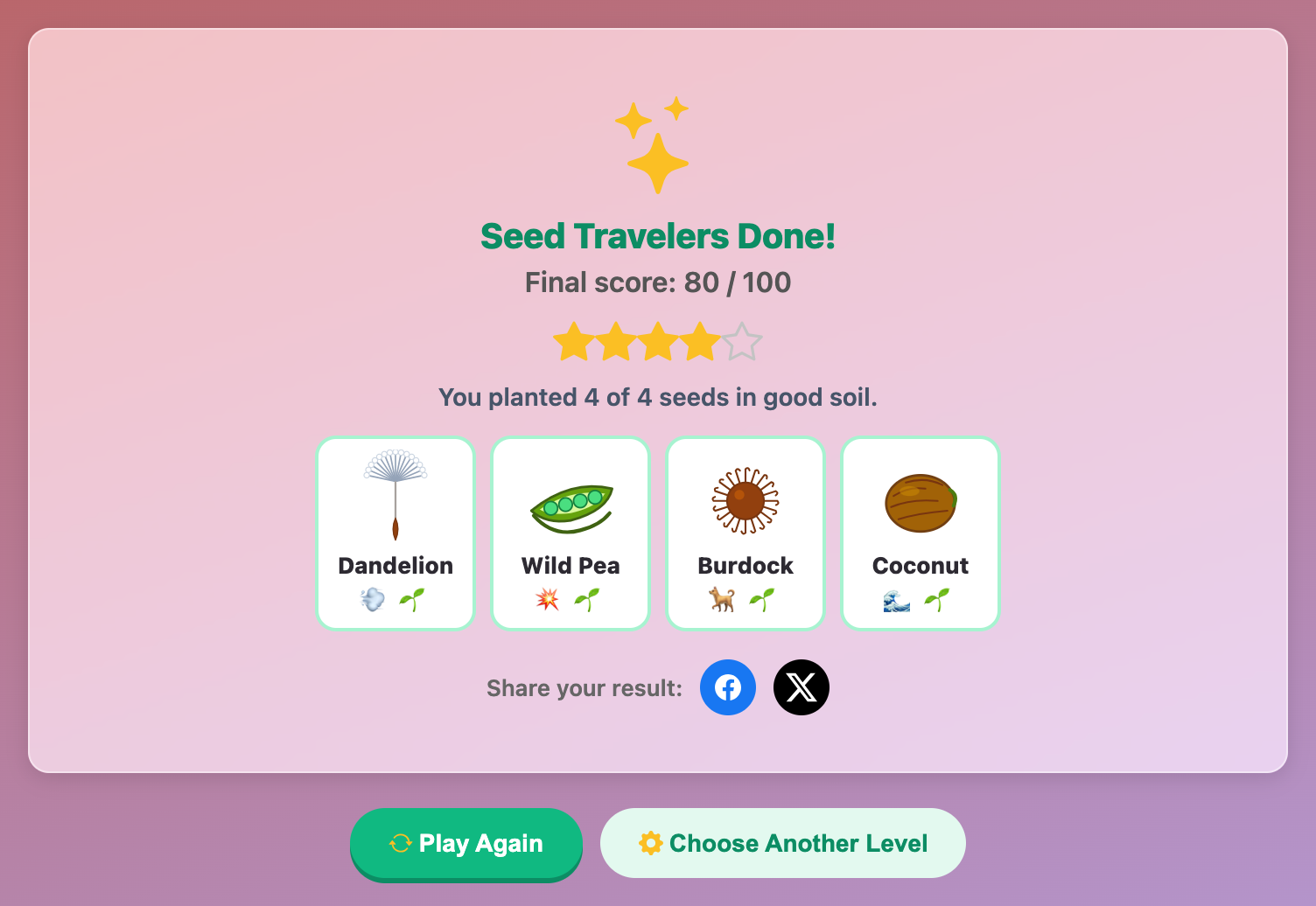
The Seed Travelers Done card with a score of 80 out of 100, four stars and four seeds planted
More Science Games
 59.5K plays
4.8
Recycling Sort
Sort everyday items into the Recycle, Compost, or Trash bin before time runs out!
 85.7K plays
4.9
Grow a Plant
Plant seeds in sunny and shady garden beds, then water, feed and protect them day by day. Watch the roots grow underground and harvest sunflowers, tomatoes, carrots and more!
 438.6K plays
4.9
Magnet Experiment
Guess which objects a magnet will pull, then drag the magnet to test every guess. Does gold stick? Does a battery?
 386.9K plays
4.9
Five Senses Match
Decide which of your five senses you would use for each everyday scene before time runs out.
Most Played Games
 1.8M plays
4.9
Color & Draw
A free-drawing canvas with colors and brush sizes to unleash your creativity.
59.5K plays
4.8
Recycling Sort
Sort everyday items into the Recycle, Compost, or Trash bin before time runs out!
 365.8K plays
5.0
Tic-Tac-Toe
Play a game of Tic-Tac-Toe against the computer and see if you can outsmart it.
 274.1K plays
5.0
Sentence Builder
Pick your age level, then tap the shuffled words in the right order to build the sentence.
Comments (40)